
|
|
|
|
Sulfamic acid
|
| |
|
| |
Sulfamic acid, also known as amidosulfonic acid, amidosulfuric acid, aminosulfonic acid, and sulfamidic acid, is a molecular compound with the formula H3NSO3. This colorless, water-soluble compound finds many applications. although it can sometimes be in the form of a white crystalline solid.
Sulfamic acid (H3NSO3) may be considered an intermediate compound between sulfuric acid (H2SO4), and sulfamide (H4N2SO2), effectively - though see below - replacing an -OH group with an -NH2 group at each step.

Discussion
Ask a question about 'Sulfamic acid'
Start a new discussion about 'Sulfamic acid'
Answer questions from other users
|
Recent Posts

Encyclopedia
Sulfamic acid, also known as amidosulfonic acid, amidosulfuric acid, aminosulfonic acid, and sulfamidic acid, is a molecular compound with the formula H3NSO3. This colorless, water-soluble compound finds many applications. although it can sometimes be in the form of a white crystalline solid.
Sulfamic acid (H3NSO3) may be considered an intermediate compound between sulfuric acid (H2SO4), and sulfamide (H4N2SO2), effectively - though see below - replacing an -OH group with an -NH2 group at each step. This pattern can extend no further in either direction without breaking down the -SO2 group.
Structure and reactivity
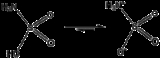
First, it should be noticed that the compound is well described by the formula H3NSO3, not the tautomer H2NSO2(OH). The relevant bond distances are S=O, 1.44 and S-N 1.77 Å. The greater length of the S-N distance is consistent with a single bond. Furthermore, a neutron diffraction study located the hydrogen atoms, all three of which are 1.03 Å distant from nitrogen. The structures shown with this article are for the two main tautomers.
Sulfamic acid is a moderately strong acid, Ka = 1.01 x 10⁻¹. Because the solid is non-hygroscopic, it is used as a standard in acidometry (quantitative assays of acid content). Double deprotonation can be effected in NH3 solution to give [HNSO3]2−.
Sulfamic acid melts at 205 °C before decomposing at higher temperatures to H2O, SO3, SO2, and N2.
Water solutions are unstable and slowly hydrolyze to ammonium bisulfate, but the crystalline solid is indefinitely stable under ordinary storage conditions.
With HNO2, sulfamic acid reacts to give N2, while with HNO3, it affords N2O.
The behavior of H3NSO3 resembles that of urea, (H2N)2CO, in some ways. Both feature amino groups linked to electron-withdrawing centers that can participate in delocalized bonding. Both liberate ammonia upon heating in water.
Applications
The most famous application of sulfamic acid is in the synthesis of compounds that taste sweet. Reaction with cyclohexylamine followed by addition of NaOH gives C6H11NHSO3Na, sodium cyclamate. Related compounds are also sweeteners, see acesulfame potassium.
Sulfamates (O-substituted-, N-substituted-, or di-/tri-substituted derivatives of sulfamic acid) have been used in the design of many types of therapeutic agents such as antibiotics, nucleoside/nucleotide human immunodeficiency virus (HIV) reverse transcriptase inhibitors, HIV protease inhibitors (PIs), anti-cancer drugs (steroid sulfatase and carbonic anhydrase inhibitors), anti-epileptic drugs, and weight loss drugs.
Sulfamic acid is used as an acidic cleaning agent, typically for metals and ceramics. It is a replacement for hydrochloric acid for the removal of rust. In households, it is often found as a descaling agent in detergents used for removal of limescale. From all acid, Sulfamic acid has the best water descaling property, thus also its application in cleaning dairy farm equipment and beer brewery. Although it is considered less corrosive than hydrochloric acid, in its application as acid cleaning, it is very common to find user adding corrosion inhibitor.
Sulfamic acid is used in the S.C. Johnson & Sons, Inc. "Scrubbing Bubbles Fizz-Its Toilet Tablets."
- Catalyst for esterification process
- Dye and pigment manufacturing
- Herbicide
- Ingredient in Denture Tablets
- Coagulator for urea-formaldehyde resins
- Ingredient in fire extinguishing media. Sulfamic acid is the main raw material for Ammonium sulfamate which is a widely used herbicide and fire retardant material for household product.
- Pulp and paper industry as a chloride stabilizer
- Synthesis of nitrous oxide by reaction with nitric acid
- In household cleaning chemical products such as Cameo.
External links
|
| |
|
|