


Substitutionary atonement

Encyclopedia
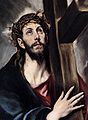
Jesus
Jesus of Nazareth , commonly referred to as Jesus Christ or simply as Jesus or Christ, is the central figure of Christianity...
as dying as a substitute for others, "instead of" them. It is thought to be expressed in the Bible
Bible
The Bible refers to any one of the collections of the primary religious texts of Judaism and Christianity. There is no common version of the Bible, as the individual books , their contents and their order vary among denominations...
in passages such as "He himself bore our sins in his body on the tree, that we might die to sin and live to righteousness," and "For Christ also died for sins once for all, the righteous for the unrighteous, that he might bring us to God." (although other ways of reading passages like this are also offered).
There is also a less technical use of the term 'substitution' in discussion about atonement when it is used in 'the sense that [Jesus, through his death,] did for us that which we can never do for ourselves'.
There are a number of differing theories that come under the umbrella term
Umbrella term
An umbrella term is a word that provides a superset or grouping of concepts that all fall under a single common category. Umbrella term is also called a hypernym. For example, cryptology is an umbrella term that encompasses cryptography and cryptanalysis, among other fields...
'substitutionary atonement'. The four most well known are the Early Church Fathers
Church Fathers
The Church Fathers, Early Church Fathers, Christian Fathers, or Fathers of the Church were early and influential theologians, eminent Christian teachers and great bishops. Their scholarly works were used as a precedent for centuries to come...
' ransom theory; Gustaf Aulen
Gustaf Aulén
Gustaf Emanuel Hildebrand Aulén was the Bishop of Strängnäs in the Church of Sweden, a theologian, and the author of Christus Victor, a work which still exerts considerable influence on contemporary theological thinking on the Atonement.-Life:Aulén was born in 1879 in Ljungby parish, Kalmar...
's demystified version of the ransom theory, called Christus Victor
Christus Victor
The term Christus Victor refers to a Christian understanding of the atonement which views Christ's death as the means by which the powers of evil, which held humankind under their dominion, were defeated...
; Anselm of Canterbury
Anselm of Canterbury
Anselm of Canterbury , also called of Aosta for his birthplace, and of Bec for his home monastery, was a Benedictine monk, a philosopher, and a prelate of the church who held the office of Archbishop of Canterbury from 1093 to 1109...
's satisfaction theory; and the Reformed period's penal substitution
Penal substitution
Penal substitution is a theory of the atonement within Christian theology, developed with the Reformed tradition. It argues that Christ, by his own sacrificial choice, was punished in the place of sinners , thus satisfying the demands of justice so God can justly forgive the sins...
theory. Care should be taken when one reads the language of substitution in, for example, Patristic literature, not to assume any particular substitution model is being used but should, rather, check the context to see how the author was using the language.
Ransom and Christus Victor theory
The ransom and Christus Victor theories present Jesus as dying to overcome (supernatural) powers of evil. In this model, the devil has ownership over humanity (because they have sinned) so Jesus dies in their place to free them. This is known as the oldest of the theories of the atonement, and is, in some form, still, along with the doctrine of theosisTheosis
In Christian theology, divinization, deification, making divine or theosis is the transforming effect of divine grace. This concept of salvation is historical and fundamental for Christian understanding that is prominent in the Eastern Orthodox Church and also in the Catholic Church, and is a...
, the Eastern Orthodox Church
Eastern Orthodox Church
The Orthodox Church, officially called the Orthodox Catholic Church and commonly referred to as the Eastern Orthodox Church, is the second largest Christian denomination in the world, with an estimated 300 million adherents mainly in the countries of Belarus, Bulgaria, Cyprus, Georgia, Greece,...
's main theory of the atonement.
Satisfaction and penal substitution
The most widely held substitutionary theory in the West is the penal substitution model. Both the penal theory and Anselm's satisfaction theory hold that only human beings can rightfully repay the debt (to God's honour [Anselm], or to God's justice [penal substitution]) which was incurred through their wilful disobedience to God. Since only God can make the satisfaction necessary to repay it, therefore God sent the God-man, Jesus Christ, to fulfil both these conditions. Christ is a sacrifice by God on behalf of humanity, taking humanity’s debt for sin upon himself, and propitiating God’s wrath.Other substitutionary models
There are a number of other substitutionary theories of the atonement besides the four described above. A few are listed below:- Governmental theory: Initially introduced by Hugo GrotiusHugo GrotiusHugo Grotius , also known as Huig de Groot, Hugo Grocio or Hugo de Groot, was a jurist in the Dutch Republic. With Francisco de Vitoria and Alberico Gentili he laid the foundations for international law, based on natural law...
(17th century. Other proponents include John MileyJohn MileyJohn Miley was an American Christian theologian in the Methodist tradition who was one of the major Methodist theological voices of the 19th century....
, Albert Barnes, Charles Finney, J. Kenneth GriderJ. Kenneth GriderJ. Kenneth Grider is a Nazarene Christian theologian and former seminary professor primarily associated with the followers of John Wesley who are part of the Holiness movement. A member of the Church of the Nazarene, he graduated from the Nazarene Theological Seminary in 1947 and received his PhD...
, the New DivinityNew DivinityThe New Divinity is a system of Christian theology that was very prominent in New England in the late 18th century...
(or "Edwardean Divinity") school, and possibly Jonathan Edwards [although this is debated]). The theory states that God is 'ready to forgive, and needs only to have such an arrangement made that He can do it safely as to His government'. 'Every act of rebellion denounces the law. Hence, before God can pardon rebellion, He must make such a demonstration of His attitude toward sin...'. Jesus' death did this -- it demonstrated God's hatred of sin -- and thus God's law (his rule, his government) is upheld (people see that sin is serious and will lead to death), and God forgives people who recognise this and respond through repentance. The governmental theory rejects the notion of penal substitution, but is still substitutionary itself in that Christ, in his exemplary sufferings, substituted for believers and the punishment they would otherwise receive. - John McLeod CampbellJohn McLeod CampbellJohn McLeod Campbell was a nineteenth century Scottish minister who has also been called Scotland's most creative Reformed theologian of the same century...
(The nature of the Atonement [1856]): 'Campbell rejects the idea of vicarious punishment [...And] Taking a hint from Jonathan Edwards, ...develops the idea that Christ, as representative and complete man, was able to offer a vicarious repentance to God for men'. - Horace BushnellHorace BushnellHorace Bushnell was an American Congregational clergyman and theologian.-Life:Bushnell was a Yankee born in the village of Bantam, township of Litchfield, Connecticut. He attended Yale College where he roomed with future magazinist Nathaniel Parker Willis. Willis credited Bushnell with teaching...
(The Vicarious Sacrifice [1866]): Bushnell rejected penal substitution and, instead, 'speaks of Christ as 'my sacrifice, who opens all to me'. 'Beholding Him with all my sin upon Him', he says, 'I count Him my offering...'.' - Vincent TaylorVincent Taylor (theologian)Reverend Dr Vincent Taylor D.D., F.B.A. was a Methodist Biblical scholar and theologian. He was elected to the Fellowship of the British Academy in 1954, specializing in theology. During his career, he was both Principal of Wesley College, Headingley, Leeds and, from 1930–58, Ferens Professor of...
(The Cross of Christ [1956]): '...in St. Paul's teaching Christ's death is substitutionary in the sense that He did for us that which we can never do for ourselves, but not in the sense that He transfers our punishment to Himself...' (p. 31). While rejecting as pagan the notion that Jesus' death propitiates the Father (p. 91), he talks of Jesus' sacrifice as vicarious, representative and sacrificial (p. 90), and says that for Jesus 'sacrifice is a representative offering in which men can share, making it the vehicle or organ of their approach to God' (p. 21). Taylor called this theory the 'Sacrificial Theory' (p. 104). - F. W. Camfield (‘The Idea of Substitution in the Doctrine of the Atonement’ in SJTScottish Journal of TheologyScottish Journal of Theology is a peer-reviewed quarterly academic journal of systematic, historical and biblical theology. Founded in Scotland in 1948, it provides an ecumenical forum for debate, and engages in extensive reviewing of theological and biblical literature...
I [1948] 282-293): in his 1948 paper, Camfield spells out 'a non-penal view of substitution'.
Meaning of the Doctrine
The word atonement is a theological term that is used to describe some act that pays for or erases one's sins and transgressions. The word often is used in the Old TestamentOld Testament
The Old Testament, of which Christians hold different views, is a Christian term for the religious writings of ancient Israel held sacred and inspired by Christians which overlaps with the 24-book canon of the Masoretic Text of Judaism...
to translate the Hebrew
Hebrew language
Hebrew is a Semitic language of the Afroasiatic language family. Culturally, is it considered by Jews and other religious groups as the language of the Jewish people, though other Jewish languages had originated among diaspora Jews, and the Hebrew language is also used by non-Jewish groups, such...
words kipper and kippurim, which mean “propitiation” or “expiation.” The word occurs in the KJV in and has the basic meaning of reconciliation. In the Old Testament (Hebrew Bible or Tanakh
Tanakh
The Tanakh is a name used in Judaism for the canon of the Hebrew Bible. The Tanakh is also known as the Masoretic Text or the Miqra. The name is an acronym formed from the initial Hebrew letters of the Masoretic Text's three traditional subdivisions: The Torah , Nevi'im and Ketuvim —hence...
), atonement was accomplished by the sacrifice of specified animals such as lambs to pay for one's sins.
The word atonement encompasses Christ’s work of redemption on behalf of his people. The center of Christ’s work, to which the whole New Testament
New Testament
The New Testament is the second major division of the Christian biblical canon, the first such division being the much longer Old Testament....
expounded, was Christ’s sacrificial death on the cross. Christ’s death is the very heart of the Christian faith
Faith
Faith is confidence or trust in a person or thing, or a belief that is not based on proof. In religion, faith is a belief in a transcendent reality, a religious teacher, a set of teachings or a Supreme Being. Generally speaking, it is offered as a means by which the truth of the proposition,...
.
A distinction is often made between substitutionary atonement (Christ suffers for us), and penal substitution
Penal substitution
Penal substitution is a theory of the atonement within Christian theology, developed with the Reformed tradition. It argues that Christ, by his own sacrificial choice, was punished in the place of sinners , thus satisfying the demands of justice so God can justly forgive the sins...
(Christ punished instead of us) which is a subset or particular type of substitutionary atonement. Both affirm the substitutionary and vicarious nature of the atonement (that Christ did His work in place of something required of us), but penal substitution
Penal substitution
Penal substitution is a theory of the atonement within Christian theology, developed with the Reformed tradition. It argues that Christ, by his own sacrificial choice, was punished in the place of sinners , thus satisfying the demands of justice so God can justly forgive the sins...
goes beyond this general statement to specifically state that the substitution is of Christ's punishment instead of our punishment.
A central component of substitutionary atonement is the element of Jesus' intention to die on the cross as a substitute. Supporters cite the statements by Jesus in and . This is in comparison with theories that Jesus' death was unanticipated by Jesus and/or purely the fault of the Romans and/or the Jews alone. The following quotes provide some views on the nature of the atonement; it must be noted that they come largely from the Protestant interpretations and/or the specific theory of penal substitution, and do not necessarily express the whole spectrum of beliefs that may be properly termed substitutionary atonement.
- The very idea of atonement is something done, which, to the purpose of supporting the authority of the law, the dignity and consistency of divine government and conduct, is fully equivalent to the curse of the law, and on the ground of which, the sinner may be saved from that curse…a less degree or duration of suffering endured by Christ the Son of God, may, on account of the infinite dignity and glory of his person, be an equivalent to the curse of the law endured by the sinner. —Jonathan Edwards Jr.
- His sufferings were in the place of the penalty, not the penalty itself. They were a substitution for the penalty, and were, therefore, strictly and properly vicarious, and were not the identical sufferings which the sinner would himself have endured. There are some things in the penalty of the Law, which the Lord Jesus did not endure, and which a substitute or a vicarious victim could not endure. Remorse of conscience is a part of the inflicted penalty of the Law, and will be a vital part of the sufferings of the sinner in hell—but the Lord Jesus did not endure that. Eternity of sufferings is an essential part of the penalty of the Law—but the Lord Jesus did not suffer forever. Thus, there are numerous sorrows connected with the consciousness of personal guilt, which the Lord Jesus did not and cannot endure.” —Albert Barnes
- If free pardon is to be extended to penitent sinners, some great measure must be substituted for the punishment of sinners that will uphold the moral government of God at least equally as well as the pronounced consequences would have done." —Gordon C. Olson
- Atonement is, properly, an arrangement by which the literal infliction of the penalty due to sin may be avoided; it is something which may be substituted in the place of punishment. It is that which will answer the same end secured by the literal infliction of the penalty of the law… The atonement is the governmental provision for the forgiveness of sins, providing man meets the conditions of repentance and faith towards our Lord Jesus Christ.” —Harry Conn
- The atonement is a governmental expedient to sustain law without the execution of its penalty to the sinner.” —Charles G. Finney
Belief in the Doctrine
Many but by no means all ancient and modern branches of Christianity embrace substitutionary atonement as the central meaning of Jesus' death on the cross. These branches however have developed different theories of atonement. The Eastern OrthodoxEastern Orthodox Church
The Orthodox Church, officially called the Orthodox Catholic Church and commonly referred to as the Eastern Orthodox Church, is the second largest Christian denomination in the world, with an estimated 300 million adherents mainly in the countries of Belarus, Bulgaria, Cyprus, Georgia, Greece,...
and Eastern Catholics do not incorporate substitutionary atonement in their doctrine of the Cross and Resurrection. The Roman Catholic Church
Roman Catholic Church
The Catholic Church, also known as the Roman Catholic Church, is the world's largest Christian church, with over a billion members. Led by the Pope, it defines its mission as spreading the gospel of Jesus Christ, administering the sacraments and exercising charity...
incorporates it into Aquinas' Satisfaction doctrine
Atonement (satisfaction view)
The satisfaction view of the atonement is a doctrine in Christian theology related to the meaning and effect of the death of Jesus Christ and has been traditionally taught in Catholic, Lutheran, and Reformed circles...
rooted in the idea of penance
Penance
Penance is repentance of sins as well as the proper name of the Roman Catholic, Orthodox Christian, and Anglican Sacrament of Penance and Reconciliation/Confession. It also plays a part in non-sacramental confession among Lutherans and other Protestants...
. Most Evangelical
Evangelicalism
Evangelicalism is a Protestant Christian movement which began in Great Britain in the 1730s and gained popularity in the United States during the series of Great Awakenings of the 18th and 19th century.Its key commitments are:...
Protestants interpret it largely in terms of penal substitution
Penal substitution
Penal substitution is a theory of the atonement within Christian theology, developed with the Reformed tradition. It argues that Christ, by his own sacrificial choice, was punished in the place of sinners , thus satisfying the demands of justice so God can justly forgive the sins...
.
Many of the Church Fathers
Church Fathers
The Church Fathers, Early Church Fathers, Christian Fathers, or Fathers of the Church were early and influential theologians, eminent Christian teachers and great bishops. Their scholarly works were used as a precedent for centuries to come...
, including Justin Martyr
Justin Martyr
Justin Martyr, also known as just Saint Justin , was an early Christian apologist. Most of his works are lost, but two apologies and a dialogue survive. He is considered a saint by the Roman Catholic Church and the Eastern Orthodox Church....
, Athanasius and Augustine
Augustine of Hippo
Augustine of Hippo , also known as Augustine, St. Augustine, St. Austin, St. Augoustinos, Blessed Augustine, or St. Augustine the Blessed, was Bishop of Hippo Regius . He was a Latin-speaking philosopher and theologian who lived in the Roman Africa Province...
incorporate a theory of substitutionary atonement into their writings. However, the specific interpretation as to what this suffering for sinners meant differed to some extent. It is widely held that the early Church Fathers, including Athanasius and Augustine, taught that through Christ's vicarious suffering in humanity's place, he overcame and liberated humanity from sin, death
Death
Death is the permanent termination of the biological functions that sustain a living organism. Phenomena which commonly bring about death include old age, predation, malnutrition, disease, and accidents or trauma resulting in terminal injury....
, and the devil
Devil
The Devil is believed in many religions and cultures to be a powerful, supernatural entity that is the personification of evil and the enemy of God and humankind. The nature of the role varies greatly...
. Thus, while the idea of substitutionary atonement is present in nearly all atonement theories, some argue that the specific idea of satisfaction
Atonement (satisfaction view)
The satisfaction view of the atonement is a doctrine in Christian theology related to the meaning and effect of the death of Jesus Christ and has been traditionally taught in Catholic, Lutheran, and Reformed circles...
and penal substitution
Penal substitution
Penal substitution is a theory of the atonement within Christian theology, developed with the Reformed tradition. It argues that Christ, by his own sacrificial choice, was punished in the place of sinners , thus satisfying the demands of justice so God can justly forgive the sins...
are later developments in the western Catholic Church and in Calvinism
Calvinism
Calvinism is a Protestant theological system and an approach to the Christian life...
.
Key Bible texts
Christian doctrine holds that Christ's coming and sacrifice was portended by, among others, the Prophet IsaiahIsaiah
Isaiah ; Greek: ', Ēsaïās ; "Yahu is salvation") was a prophet in the 8th-century BC Kingdom of Judah.Jews and Christians consider the Book of Isaiah a part of their Biblical canon; he is the first listed of the neviim akharonim, the later prophets. Many of the New Testament teachings of Jesus...
approximately 700 years before Jesus
Jesus
Jesus of Nazareth , commonly referred to as Jesus Christ or simply as Jesus or Christ, is the central figure of Christianity...
was born. These prophesies can be found in . reports Jesus saying that the prophesies in Isaiah were about him. The New Testament explicitly quotes from in to indicate that Jesus is the fulfillment of these prophesies. Although various Christians read them in different ways (some in non-substitutionary ways), the following Biblical passages are sometimes put forwards as key texts by proponents of substitutionary atonement theories:
See also
- Acts of Reparation to Jesus ChristActs of Reparation to Jesus ChristRoman Catholic tradition includes specific prayers and devotions as Acts of Reparation for insults and blasphemies against Jesus Christ and the Holy Name of Jesus. These include the sufferings during the Passion of Jesus...
- Atonement in Christianity: main article for all Christian Atonement theories
- Penal substitutionPenal substitutionPenal substitution is a theory of the atonement within Christian theology, developed with the Reformed tradition. It argues that Christ, by his own sacrificial choice, was punished in the place of sinners , thus satisfying the demands of justice so God can justly forgive the sins...
: a specific form of Substitutionary atonement
External links
- Substitution in Suffering by John MileyJohn MileyJohn Miley was an American Christian theologian in the Methodist tradition who was one of the major Methodist theological voices of the 19th century....
(Arminian/Methodist) - Penal Substitution by Greg Bahnsen (Calvinist/Reformed)
- Nonviolent Atonement and the Victory of Christ Nonviolent Atonement by Brad Jersak (Orthodox / Anabaptist)
- The Concept of Atonement in 1 John
- The Concept of Atonement in Hellenistic Thought and 1 John
- The Concept of Atonement in Early Rabbinic Thought and the New Testament Writings
- Targum Isaiah 53 and the New Testament Concept of Atonement
- The Concept of Atonement in the Gospel of John