
The paired
submandibular glands (
submaxillary glands) are
salivary glandThe salivary glands in mammals are exocrine glands, glands with ducts, that produce saliva. They also secrete amylase, an enzyme that breaks down starch into maltose...
s located beneath the floor of the mouth. In humans, they account for 70% of the
salivaSaliva , referred to in various contexts as spit, spittle, drivel, drool, or slobber, is the watery substance produced in the mouths of humans and most other animals. Saliva is a component of oral fluid. In mammals, saliva is produced in and secreted from the three pairs of major salivary glands,...
ry volume and weigh about 15 grams. Unstimulated (at rest) in humans, the percentage contribution to whole saliva; ~25% Parotid, Submandibular and Sublingual ~ 67% and ~8% minor mucous glands. During stimulated secretion the parotid gland produces majority of the saliva.
Anatomy
Lying superior to the
digastric muscleThe digastric muscle is a small muscle located under the jaw. so digastric muscles are muscle fibers in ligament of treitz ,omohyoid , occipitofrontalis....
s, each submandibular gland is divided into superficial and deep lobes, which are separated by the
mylohyoid muscleThe mylohyoid muscle is a muscle running from the mandible to the hyoid bone, forming the floor of the oral cavity. It is named for its two attachments, with the prefix "mylo" coming from the Greek word for "molar". These muscles are mesodermal in origin...
:
- The deep portion is the smaller portion. The mylohyoid muscle runs below it.
- The superficial portion comprises most of the gland.
Secretions are delivered into the Wharton's ducts on the deep portion after which they hook around the posterior edge of the mylohyoid muscle and proceed on the superior surface laterally. The ducts are then crossed by the
lingual nerveThe lingual nerve is a branch of the mandibular nerve , itself a branch of the trigeminal nerve, which supplies sensory innervation to the tongue...
, and ultimately drain into the
sublingual caruncleThe sublingual caruncle is a site on either side of the frenulum linguae on the sublingual surface of the tongue. There it denotes the site at which the submandibular gland empties into the oral cavity....
s on either side of the lingual frenulum along with the major sublingual duct (Bartholin).
Histology
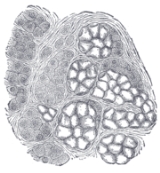
Lobes contain smaller lobules, which contain
adenomereAdenomere is the functional unit in salivary glands. Adenomeres are secretory subunits of lobules. They consist of all the secretory cells that release their products into a single intralobular duct...
s, the secretory units of the gland. Each adenomere contains one or more acini, or alveoli, which are small clusters of cells that secrete their products into a duct. The acini of each adenomere are composed of either serous or mucous cells, with serous adenomeres predominating. Some mucous adenomeres may also be capped with a
serous demiluneA serous demilune is a cap in the shape of a half-moon on some salivary glands.Serous demilunes are the serous cells at the distal end of mucous tubuloalveolar secretory unit of certain salivary glands . These demilune cells secrete the proteins that contain the enzyme lysozyme, which degrades the...
, a layer of
lysozymeLysozyme, also known as muramidase or N-acetylmuramide glycanhydrolase, are glycoside hydrolases, enzymes that damage bacterial cell walls by catalyzing hydrolysis of 1,4-beta-linkages between N-acetylmuramic acid and N-acetyl-D-glucosamine residues in a peptidoglycan and between...
-secreting serous cells resembling a half moon.
Like other
exocrine glandExocrine glands are a type of ductal glands that secrete their products into ducts that lead directly into the external environment...
s, the submandibular gland can be classified by the microscopic anatomy of its secretory cells and how they are arranged. Because the glands are branched, and because the tubules forming the branches contain secretory cells, submandibular glands are classified as branched tubuloacinar glands. Further, because the secretory cells are of both serous and mucous types, the submandibular gland is a mixed gland, though it is mostly serous.
Functions
The secretory viscous cells of the submandibular gland have distinct functions. The mucous cells are the most active and therefore the major product of the submandibular glands is saliva. In particular, the serous cells produce salivary
amylaseAmylase is an enzyme that catalyses the breakdown of starch into sugars. Amylase is present in human saliva, where it begins the chemical process of digestion. Food that contains much starch but little sugar, such as rice and potato, taste slightly sweet as they are chewed because amylase turns...
, which aids in the breakdown of
starchStarch or amylum is a carbohydrate consisting of a large number of glucose units joined together by glycosidic bonds. This polysaccharide is produced by all green plants as an energy store...
es in the mouth. Mucous cells secrete
mucinMucins are a family of high molecular weight, heavily glycosylated proteins produced by epithelial tissues in most metazoans. Mucins' key characteristic is their ability to form gels; therefore they are a key component in most gel-like secretions, serving functions from lubrication to cell...
which aids in the lubrication of the food
bolusIn digestion, a bolus is a mass of food that has been chewed at the point of swallowing. Once a bolus reaches the stomach, digestion begins....
as it travels through the
esophagusThe esophagus is an organ in vertebrates which consists of a muscular tube through which food passes from the pharynx to the stomach. During swallowing, food passes from the mouth through the pharynx into the esophagus and travels via peristalsis to the stomach...
.
The submandibular gland's highly active acini account for approximately 70% of salivary volume. The
parotidThe paired parotid glands are the largest of the salivary glands. They are each found wrapped around the mandibular ramus, and secrete saliva through Stensen's ducts into the oral cavity, to facilitate mastication and swallowing and to begin the digestion of starches.-Location:The parotid glands...
and
sublingual glandThe sublingual glands are salivary glands in the mouth.They lie anterior to the submandibular gland under the tongue, beneath the mucous membrane of the floor of the mouth.They are drained by 8-20 excretory ducts called the ducts of Rivinus....
s account for the remaining 30%.
Innervation
Their secretions, like the secretions of other salivary glands, are regulated
directly by the
parasympathetic nervous systemThe parasympathetic nervous system is one of the two main divisions of the autonomic nervous system . The ANS is responsible for regulation of internal organs and glands, which occurs unconsciously...
and
indirectly by the
sympathetic nervous systemThe sympathetic nervous system is one of the three parts of the autonomic nervous system, along with the enteric and parasympathetic systems. Its general action is to mobilize the body's nervous system fight-or-flight response...
.
- Parasympathetic innervation to the submandibular glands is provided by the superior salivatory nucleus via the chorda tympani
The chorda tympani is a nerve that branches from the facial nerve inside the facial canal, just before the facial nerve exits the skull via the Stylomastoid foramen...
, a branch of the facial nerveThe facial nerve is the seventh of twelve paired cranial nerves. It emerges from the brainstem between the pons and the medulla, and controls the muscles of facial expression, and functions in the conveyance of taste sensations from the anterior two-thirds of the tongue and oral cavity...
that synapses in the submandibular ganglionThe submandibular ganglion is part of the human autonomic nervous system. It is one of four parasympathetic ganglia of the head and neck...
after which it follows the Lingual nerveThe lingual nerve is a branch of the mandibular nerve , itself a branch of the trigeminal nerve, which supplies sensory innervation to the tongue...
leaving this nerve as it approaches the gland. Increased parasympathetic activity promotes the secretion of saliva.
- The sympathetic nervous system regulates submandibular secretions through vasoconstriction
Vasoconstriction is the narrowing of the blood vessels resulting from contraction of the muscular wall of the vessels, particularly the large arteries, small arterioles and veins. The process is the opposite of vasodilation, the widening of blood vessels. The process is particularly important in...
of the arteries that supply it. Increased sympathetic activity reduces glandular bloodflow, thereby decreasing salivary secretions and producing an enzymeEnzymes are proteins that catalyze chemical reactions. In enzymatic reactions, the molecules at the beginning of the process, called substrates, are converted into different molecules, called products. Almost all chemical reactions in a biological cell need enzymes in order to occur at rates...
rich mucousIn vertebrates, mucus is a slippery secretion produced by, and covering, mucous membranes. Mucous fluid is typically produced from mucous cells found in mucous glands. Mucous cells secrete products that are rich in glycoproteins and water. Mucous fluid may also originate from mixed glands, which...
saliva.
Pathology
The submandibular gland accounts for 80% of all salivary duct calculi, possibly due to the different nature of the saliva that it produces and that its duct is up-sloping.
External links
- Histology at usc.edu - "Anterior Triangle of the Neck: Nerves and Vessels of the Carotid Triangle" - "Oral Cavity: The Submandibular Gland and Duct"