

Subjective logic

Encyclopedia
Subjective logic is a type of probabilistic logic
that explicitly takes uncertainty and belief ownership into account. In general, subjective logic is suitable for modeling and analysing situations involving uncertainty and incomplete knowledge. For example, it can be used for modeling trust networks
and for analysing Bayesian network
s.
Arguments in subjective logic are subjective opinions about propositions. A binomial opinion applies to a single proposition, and can be represented as a Beta distribution. A multinomial opinion applies to a collection of propositions, and can be represented as a Dirichlet distribution. Through the correspondence between opinions and Beta/Dirichlet distributions, subjective logic provides an algebra for these functions. Opinions are also related to the belief functions of Dempster-Shafer belief theory
.
A fundamental aspect of the human condition is that nobody can ever determine with absolute certainty whether a proposition about the world is true or false. In addition, whenever the truth of a proposition is expressed, it is always done by an individual, and it can never be considered to represent a general and objective belief. These philosophical ideas are directly reflected in the mathematical formalism of subjective logic.
 where
where  is the subject, also called the belief owner, and
  is the proposition to which the opinion applies. An alternative notation is
  . The proposition
  is assumed to belong to a frame of discernment (also called state space) e.g. denoted as
  , but the frame is usually not included in the opinion notation. The propositions of a frame are normally assumed to be exhaustive and mutually disjoint, and subjects are assumed to have a common semantic interpretation of propositions. The subject, the proposition and its frame are attributes of an opinion. Indication of subjective belief ownership is normally omitted whenever irrelevant.
 be a proposition. A binomial opinion about the truth of a
  is the ordered quadruple
  where:
These components satisfy and
and  . The characteristics of various opinion classes are listed below.
The probability expectation value of an opinion is defined as .
.
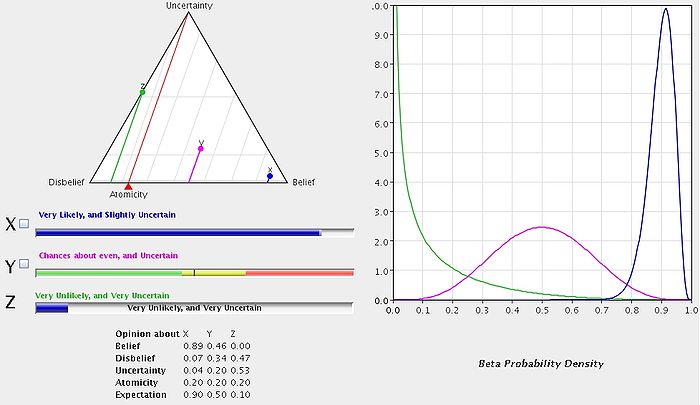
Binomial opinions can be represented on an equilateral triangle as shown below. A point inside the triangle represents a triple. The b,d,u-axes run from one edge to the opposite vertex indicated by the Belief, Disbelief or Uncertainty label. For example, a strong positive opinion is represented by a point towards the bottom right Belief vertex. The base rate, also called relative atomicity, is shown as a red pointer along the base line, and the probability expectation,
  , is formed by projecting the opinion onto the base, parallel to the base rate projector line. Opinions about the three propositions X, Y and Z are visualized on the triangle to the left, and their equivalent Beta distributions are visualized on the plot to the right. The numerical values and verbal discrete descriptions of each opinion are also shown.
 Beta distributions are normally denoted as
  where
where  and
and  are its two parameters. The Beta distribution of a binomial opinion
  is the function

 be a frame, i.e. a set of exhaustive and mutually disjoint propositions
  . A multinomial opinion over
  is the composite
function , where
  is a vector of belief masses over the propositions of
  ,
,  is the uncertainty mass, and
  is a vector of base rate values over the propositions of
  . These components satisfy
  and
and  as well as
  .
.
Visualising multinomial opinions is not trivial. Trinomial opinions could be visualised as points inside a triangular pyramid, but the 2D aspect of computer monitors would make this impractical. Opinions with dimensions larger than trinomial do not lend themselves to traditional visualisation.
Dirichlet distributions are normally denoted as where
where  represents its parameters. The Dirichlet distribution of a multinomial opinion
  is the function
 where the vector components are given by
x}=\omega^{A}_{x}\;\overline{\circledcirc}\; (\omega^{A}_{x|y},\omega^{A}_{x|\overline{y}},a_{y})\,\!
| Modus Tollens
|-
| Transitivity / discounting
|
| n.a.
|-
| Cumulative fusion / consensus
|
| n.a.
|-
| Averaging fusion
|
| n.a.
|}
Apart from the computations on the opinion values themselves, subjective logic operators also take into account the attributes, i.e. the subjects, the propositions, as well as the frames containing the propositions. In general, the attributes of the derived opinion are functions of the argument attributes, following the principle illustrated below. For example, the derived proposition is typically obtained using the propositional logic operator corresponding to the subjective logic operator.
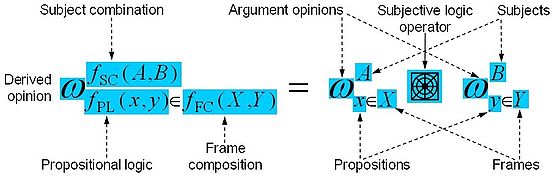 The functions for deriving attributes depend on the operator. Some operators, such as cumulative and averaging fusion, only affect the subject attribute, not the proposition which then is equal to that of the arguments. Fusion for example assumes that two separate argument subjects are fused into one. Other operators, such as multiplication, only affect the proposition and its frame, not the subject which then is equal to that of the arguments. Multiplication for example assumes that the derived proposition is the conjunction of the argument propositions, and that the derived frame is composed as the Cartesian product of the two argument frames. The transitivity operator is the only operator where both the subject and the proposition attributes are affected, more specifically by making the derived subject equal to the subject of the first argument opinion, and the derived proposition and frame equal to the proposition and frame of the second argument opinion.
It is impractical to explicitly express complex subject combinations and propositional logic expressions as attributes of derived opinions. Instead, the trust origin subject and a compact substitute propositional logic term can be used.
Subject combinations can be expressed in a compact or expanded form. For example, the transitive trust path from via
via  to
to  can be expressed as
  in compact form, or as
  in expanded form. The expanded form is the most general, and corresponds directly with the way subjective logic expressions are formed with operators.
In case the argument opinions contain degrees of uncertainty, the operators involving multiplication and division will produce derived opinions that always have correct expectation value
but possibly with approximate variance
when seen as Beta/Dirichlet probability distributions.
All other operators produce opinions where the expectation value and the variance are always equal to the analytically correct values.
Different composite propositions that traditionally are equivalent in propositional logic do not necessarily have equal opinions. For example in general although the distributivity
of conjunction over disjunction, expressed as , holds in binary propositional logic. This is no surprise as the corresponding probability operators are also non-distributive. However, multiplication is distributive over addition, as expressed by
  . De Morgan's laws are also satisfied as e.g. expressed by
  .
.
Subjective logic allows extremely efficient computation of mathematically complex models. This is possible by approximating the analytically correct functions whenever needed. While it is relatively simple to analytically multiply two Beta distributions in the form of a joint distribution
, anything more complex than that quickly becomes intractable. When combining two Beta distributions with some operator/connective, the analytical result is not always a Beta distribution and can involve hypergeometric series
. In such cases, subjective logic always approximates the result as an opinion that is equivalent to a Beta distribution.
Trust networks and Bayesian networks are typical applications of subjective logic.
 express the trust edge from
  to
to  . A simple trust network can for example be expressed as
  as illustrated in the figure below.
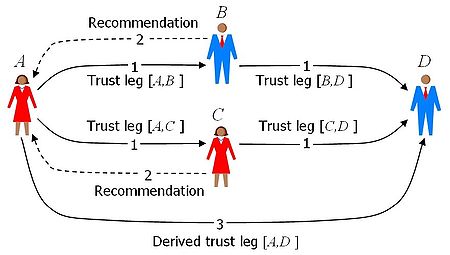 The indices 1, 2 and 3 indicate the chronological order in which the trust edges and recommendations are formed. Thus, given the set of trust edges with index 1, the origin trustor
  receives recommendations from
  and
and  , and is thereby able to derive trust in
  . By expressing each trust edge and recommendation as an opinion
  's trust in
  can be computed as
  .
.
Trust networks can express the reliability of information sources for propositions, and can be used to determine subjective opinions about propositions. There can be a separate trust network leading to the opinion about each propositional term.
 and
and  are evidence frames and
  is the conclusion frame. The frames can have arbitrary cardinality, and in the example the evidence frames are illustrated with cardinality 3. The conditional opinions express a conditional relationship between the evidence frames and the conclusion frame.
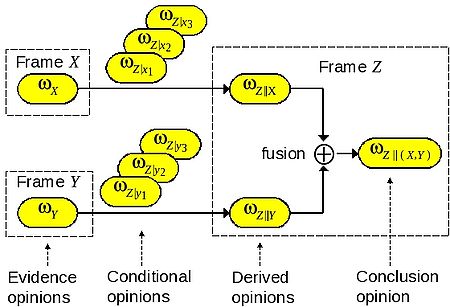 The evidence on
  and
and  produces separate derived opinions on
  which is fused with either the cumulative or averaging fusion operator.
Probabilistic logic
The aim of a probabilistic logic is to combine the capacity of probability theory to handle uncertainty with the capacity of deductive logic to exploit structure. The result is a richer and more expressive formalism with a broad range of possible application areas...
that explicitly takes uncertainty and belief ownership into account. In general, subjective logic is suitable for modeling and analysing situations involving uncertainty and incomplete knowledge. For example, it can be used for modeling trust networks
Trust metric
In psychology and sociology, a trust metric is a measurement of the degree to which one social actor trusts another social actor...
and for analysing Bayesian network
Bayesian network
A Bayesian network, Bayes network, belief network or directed acyclic graphical model is a probabilistic graphical model that represents a set of random variables and their conditional dependencies via a directed acyclic graph . For example, a Bayesian network could represent the probabilistic...
s.
Arguments in subjective logic are subjective opinions about propositions. A binomial opinion applies to a single proposition, and can be represented as a Beta distribution. A multinomial opinion applies to a collection of propositions, and can be represented as a Dirichlet distribution. Through the correspondence between opinions and Beta/Dirichlet distributions, subjective logic provides an algebra for these functions. Opinions are also related to the belief functions of Dempster-Shafer belief theory
Dempster-Shafer theory
The Dempster–Shafer theory is a mathematical theory of evidence. It allows one to combine evidence from different sources and arrive at a degree of belief that takes into account all the available evidence. The theory was first developed by Arthur P...
.
A fundamental aspect of the human condition is that nobody can ever determine with absolute certainty whether a proposition about the world is true or false. In addition, whenever the truth of a proposition is expressed, it is always done by an individual, and it can never be considered to represent a general and objective belief. These philosophical ideas are directly reflected in the mathematical formalism of subjective logic.
Subjective opinions
Subjective opinions express subjective beliefs about the truth of propositions with degrees of uncertainty, and can indicate subjective belief ownership whenever required. An opinion is usually denoted as where is the subject, also called the belief owner, and is the proposition to which the opinion applies. An alternative notation is . The proposition is assumed to belong to a frame of discernment (also called state space) e.g. denoted as , but the frame is usually not included in the opinion notation. The propositions of a frame are normally assumed to be exhaustive and mutually disjoint, and subjects are assumed to have a common semantic interpretation of propositions. The subject, the proposition and its frame are attributes of an opinion. Indication of subjective belief ownership is normally omitted whenever irrelevant.Binomial opinions
Let be a proposition. A binomial opinion about the truth of a is the ordered quadruple where:  : belief : belief |
is the belief that the specified proposition is true. |
 : disbelief : disbelief |
is the belief that the specified proposition is false. |
 : uncertainty : uncertainty |
is the amount of uncommitted belief. |
 : base rate : base rate |
is the a priori probability in the absence of evidence. |
These components satisfy
and . The characteristics of various opinion classes are listed below.| An opinion | where  |
is equivalent to binary logic TRUE, |
where  |
is equivalent to binary logic FALSE, | |
where  |
is equivalent to a traditional probability, | |
where  |
expresses degrees of uncertainty, and | |
where  |
expresses total uncertainty. |
The probability expectation value of an opinion is defined as
.Binomial opinions can be represented on an equilateral triangle as shown below. A point inside the triangle represents a
triple. The b,d,u-axes run from one edge to the opposite vertex indicated by the Belief, Disbelief or Uncertainty label. For example, a strong positive opinion is represented by a point towards the bottom right Belief vertex. The base rate, also called relative atomicity, is shown as a red pointer along the base line, and the probability expectation, , is formed by projecting the opinion onto the base, parallel to the base rate projector line. Opinions about the three propositions X, Y and Z are visualized on the triangle to the left, and their equivalent Beta distributions are visualized on the plot to the right. The numerical values and verbal discrete descriptions of each opinion are also shown. where and are its two parameters. The Beta distribution of a binomial opinion is the functionMultinomial opinions
Let be a frame, i.e. a set of exhaustive and mutually disjoint propositions . A multinomial opinion over is the compositefunction
, where is a vector of belief masses over the propositions of , is the uncertainty mass, and is a vector of base rate values over the propositions of . These components satisfy and as well as .Visualising multinomial opinions is not trivial. Trinomial opinions could be visualised as points inside a triangular pyramid, but the 2D aspect of computer monitors would make this impractical. Opinions with dimensions larger than trinomial do not lend themselves to traditional visualisation.
Dirichlet distributions are normally denoted as
where represents its parameters. The Dirichlet distribution of a multinomial opinion is the function where the vector components are given by Subjective logic operators
Most operators in the table below are generalisations of binary logic and probability operators. For example addition is simply a generalisation of addition of probabilities. Most operators are only meaningful for combining binomial opinions, but some also apply to multinomial opinions. Most operators are binary, but complement is unary, deduction is ternary and abduction is quaternary. See the referenced papers for mathematical details of each operator.| Subjective logic operator | Operator notation | Propositional/binary logic operator |
|---|---|---|
| Addition | 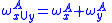 |
Union |
| Subtraction | 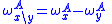 |
Difference |
| Multiplication |  |
Conjunction / AND |
| Division |  |
Unconjunction / UN-AND |
| Comultiplication |  |
Disjunction / OR |
| Codivision |  |
Undisjunction / UN-OR |
| Complement |  |
NOT |
| Deduction | Modus Ponens | |
| Abduction |
| Modus Tollens
|-
| Transitivity / discounting
|
| n.a.
|-
| Cumulative fusion / consensus
|
| n.a.
|-
| Averaging fusion
|
| n.a.
|}
Apart from the computations on the opinion values themselves, subjective logic operators also take into account the attributes, i.e. the subjects, the propositions, as well as the frames containing the propositions. In general, the attributes of the derived opinion are functions of the argument attributes, following the principle illustrated below. For example, the derived proposition is typically obtained using the propositional logic operator corresponding to the subjective logic operator.
It is impractical to explicitly express complex subject combinations and propositional logic expressions as attributes of derived opinions. Instead, the trust origin subject and a compact substitute propositional logic term can be used.
Subject combinations can be expressed in a compact or expanded form. For example, the transitive trust path from
via to can be expressed as in compact form, or as in expanded form. The expanded form is the most general, and corresponds directly with the way subjective logic expressions are formed with operators.Properties
In case the argument opinions are equivalent to binary logic TRUE or FALSE, the result of any subjective logic operator is always equal to that of the corresponding propositional/binary logic operator. Similarly, when the argument opinions are equivalent to traditional probabilities, the result of any subjective logic operator is always equal to that of the corresponding probability operator (when it exists).In case the argument opinions contain degrees of uncertainty, the operators involving multiplication and division will produce derived opinions that always have correct expectation value
Expected value
In probability theory, the expected value of a random variable is the weighted average of all possible values that this random variable can take on...
but possibly with approximate variance
Variance
In probability theory and statistics, the variance is a measure of how far a set of numbers is spread out. It is one of several descriptors of a probability distribution, describing how far the numbers lie from the mean . In particular, the variance is one of the moments of a distribution...
when seen as Beta/Dirichlet probability distributions.
All other operators produce opinions where the expectation value and the variance are always equal to the analytically correct values.
Different composite propositions that traditionally are equivalent in propositional logic do not necessarily have equal opinions. For example
in general although the distributivityDistributivity
In mathematics, and in particular in abstract algebra, distributivity is a property of binary operations that generalizes the distributive law from elementary algebra.For example:...
of conjunction over disjunction, expressed as
, holds in binary propositional logic. This is no surprise as the corresponding probability operators are also non-distributive. However, multiplication is distributive over addition, as expressed by . De Morgan's laws are also satisfied as e.g. expressed by .Subjective logic allows extremely efficient computation of mathematically complex models. This is possible by approximating the analytically correct functions whenever needed. While it is relatively simple to analytically multiply two Beta distributions in the form of a joint distribution
Joint distribution
In the study of probability, given two random variables X and Y that are defined on the same probability space, the joint distribution for X and Y defines the probability of events defined in terms of both X and Y...
, anything more complex than that quickly becomes intractable. When combining two Beta distributions with some operator/connective, the analytical result is not always a Beta distribution and can involve hypergeometric series
Hypergeometric series
In mathematics, a generalized hypergeometric series is a series in which the ratio of successive coefficients indexed by n is a rational function of n. The series, if convergent, defines a generalized hypergeometric function, which may then be defined over a wider domain of the argument by...
. In such cases, subjective logic always approximates the result as an opinion that is equivalent to a Beta distribution.
Applications
Subjective logic is applicable when the situation to be analysed is characterised by considerable uncertainty and incomplete knowledge. In this way, subjective logic becomes a probabilistic logic for uncertain probabilities. The advantage is that uncertainty is carried through the analysis and is made explicit in the results so that it is possible to distinguish between certain and uncertain conclusions.Trust networks and Bayesian networks are typical applications of subjective logic.
Trust networks
Trust networks can be modelled with a combination of the transitivity and fusion operators. Let express the trust edge from to . A simple trust network can for example be expressed as as illustrated in the figure below. receives recommendations from and , and is thereby able to derive trust in . By expressing each trust edge and recommendation as an opinion 's trust in can be computed as .Trust networks can express the reliability of information sources for propositions, and can be used to determine subjective opinions about propositions. There can be a separate trust network leading to the opinion about each propositional term.
Bayesian Networks
In the Bayesian network below, and are evidence frames and is the conclusion frame. The frames can have arbitrary cardinality, and in the example the evidence frames are illustrated with cardinality 3. The conditional opinions express a conditional relationship between the evidence frames and the conclusion frame. and produces separate derived opinions on which is fused with either the cumulative or averaging fusion operator.External links
- Online demonstrations of subjective logic.