
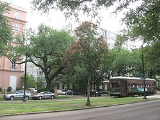
StreetcarsA tram, tramcar, trolley, trolleycar, or streetcar is a railborne vehicle, of lighter weight and construction than a conventional train, designed for the transport of passengers within, close to, or between villages, towns and/or cities, on tracks running primarily on streets...
in New OrleansNew Orleans is a major U.S. port and the largest city in the state of Louisiana. New Orleans is the center of the New Orleans Metropolitan Area, the largest metro area in the state....
have been an integral part of the city's public transportation network since the first half of the 19th century. The longest of New Orleans' streetcar lines, the
St. Charles AvenueSt. Charles Avenue is a thoroughfare in New Orleans, Louisiana and the home of the world famous St. Charles Streetcar Line. It is also famous for the hundreds of mansions that adorn the tree-lined boulevard for much of the Uptown section of the route. The southern live oak trees, particularly...
Streetcar, is the oldest continuously operating street railway system in the world, according to the
American Society of Mechanical EngineersThe American Society of Mechanical Engineers is a professional body, specifically an engineering society, focused on mechanical engineering....
. Today, the streetcars are operated by the
New Orleans Regional Transit AuthorityThe New Orleans Regional Transit Authority is a body established by the Louisiana State Legislature in 1979; since 1983 it has controlled bus and streetcar service in the City of New Orleans....
(RTA).
There are currently three operating streetcar lines in New Orleans: The St. Charles Avenue Line, the Riverfront Line, and the Canal Street Line. The St. Charles Avenue Line is the only line that has operated continuously throughout New Orleans' streetcar history (though service was interrupted after Hurricane Katrina in August 2005 and resumed only in part in December 2006, as noted below). All other lines were replaced by bus service in the period from the late 1940s to the early 1960s; preservationists were unable to save the streetcars on Canal Street, but were able to convince the city government to protect the St. Charles Avenue Line by granting it historic landmark status. In the later 20th century, trends began to favor rail transit again. A short Riverfront Line started service in 1988, and service returned to Canal Street in 2004, 40 years after it had been shut down.
The wide destruction wrought on the city by
Hurricane KatrinaHurricane Katrina of the 2005 Atlantic hurricane season was the costliest hurricane, as well as one of the five deadliest, in the history of the United States...
and subsequent floods from the levee breaches in August 2005 knocked all three lines out of operation and damaged many of the streetcars. Service on a portion of the Canal Street line was restored in December of that year, with the remainder of the line and the Riverfront line returning to service in early 2006. On December 23, 2007, the Regional Transit Authority (RTA) extended service from Napoleon Avenue to the end of historic St. Charles Avenue (the “Riverbend”). On June 22, 2008 service was restored to the end of the line at South Carrollton Avenue & South Claiborne Avenue.
Current lines
The standard fare for all three lines is $1.25, with discounts for senior citizens. Passengers with disabilities and passengers two and under are admitted free. Transfers to other routes are available for $0.25.
St. Charles Avenue Line
The
Saint Charles Avenue Line starts uptown, at South Carrollton Avenue and South Claiborne Avenue.
It runs on South Carrollton Avenue through the
Carrollton neighborhoodCarrollton is a neighborhood of uptown New Orleans, Louisiana, USA, which includes the Carrollton Historic District. It is the part of Uptown New Orleans farthest up river from the French Quarter...
towards the
Mississippi RiverThe Mississippi River is the second longest river in the United States, with a length of from its source in Lake Itasca in Minnesota to its mouth in the Gulf of Mexico....
, then near the river
leveeA levee, levée, dike , embankment, floodbank or stopbank is a natural or artificial slope or wall to regulate water levels...
turns on to Saint Charles Avenue. It proceeds past entrances to
Audubon ParkAudubon Park may refer to a place in the United States:* Audubon Park, Kentucky* Audubon Park, New Orleans, Louisiana** Audubon Zoo, New Orleans* Audubon Park, Minneapolis, Minnesota* Audubon Park, New Jersey* Audubon Park, Tampa, Florida...
,
Tulane UniversityTulane University is a private, nonsectarian research university located in New Orleans, Louisiana, United States...
and
Loyola University New OrleansLoyola University New Orleans is a private, co-educational and Jesuit university located in New Orleans, Louisiana. Originally established as Loyola College in 1904, the institution was later chartered as a university in 1912. It bears the name of the Jesuit patron, Saint Ignatius of Loyola...
, continues through
Uptown New OrleansUptown is a section of New Orleans, Louisiana on the East Bank of the Mississippi River encompassing a number of neighborhoods between the French Quarter and the Jefferson Parish line. It remains an area of mixed residential and small commercial properties, with a wealth of 19th century architecture...
including the
Garden District-Place names:United States* Garden District, New Orleans, Louisiana* Garden District, Baton Rouge, Louisiana* Garden District, DeLand, FloridaCanada* Garden District, Toronto-Theatre:...
, and ends at
Canal StreetCanal Street is a major thoroughfare in the city of New Orleans, Louisiana.Forming the up-river boundary of the city's oldest neighborhood, the French Quarter , it formed the dividing line between the older French/Spanish Colonial era city and the newer American sector, the Central Business...
in the
New Orleans Central Business DistrictThe Central Business District is a neighborhood of the city of New Orleans. A subdistrict of the French Quarter/CBD Area, its boundaries as defined by the City Planning Commission are: Iberville, Decatur and Canal Streets to the north, the Mississippi River to the east, the New Orleans Morial...
at the edge of the
French QuarterThe French Quarter, also known as Vieux Carré, is the oldest and most famous neighborhood in the city of New Orleans, Louisiana. When La Nouvelle Orléans was founded in 1718 by Jean-Baptiste Le Moyne de Bienville, the city was originally centered on the French Quarter, or the Vieux Carré as it...
, a distance of about seven and a half miles. Officially the St. Charles Avenue Line is designated as
Route 12.
Planning for the line began in 1831, and work began as the
New Orleans and Carrollton RailroadThe New Orleans and Carrollton Railroad was one of six short-line rail systems built to connect the city of New Orleans, Louisiana, with surrounding neighborhoods, in this case, four-and-a-half miles to the resort village of Carrollton...
in February 1833, the second railway in Greater New Orleans after the Pontchartrain Rail Road. Service began on September 26, 1835, originally without a dedicated right-of-way (it ran on public streets) although one was eventually established in the
neutral ground (the median). Passenger and freight cars were hauled by
steam locomotiveA steam locomotive is a locomotive powered by steam. The term usually refers to its use on railways, but can also refer to a "road locomotive" such as a traction engine or steamroller....
.
As the area along the line became more urbanized, objections to the soot and noise produced by the locomotive increased, and transport was switched to cars that were powered by horses and mules. For decades in the late 19th century, desire for a mode of transit more swift and powerful than horses but without the disruptive effects of locomotives resulted in a number of systems being tried out. Experimental systems included overhead
cables propulsionA cable car or cable railway is a mass transit system using rail cars that are propelled by a continuously moving cable running at a constant speed. Individual cars stop and start by releasing and gripping this cable as required...
(with a cable clamp patented by P.G.T. Beauregard in 1869 later being adapted for the
San Francisco cable car system|}The San Francisco cable car system is the world's last permanently operational manually-operated cable car system, and is an icon of San Francisco, California. The cable car system forms part of the intermodal urban transport network operated by the San Francisco Municipal Railway, or Muni as it...
), and several innovative designs by Dr.
Emile LammEmile Lamm was an inventor and dentist.Lamm was born in Ay, France, and moved to Louisiana in 1848. He patented various improvements in techniques of gold dental fillings, and developed a number of innovative designs for street railways...
, including ammonia engines, a "Chlorine of Calcium Engine", and most successfully the Lamm Fireless Engine which not only propelled pairs of cars along the line in the 1880s but was adopted by the street railways of
ParisParis is the capital of France and the country's most populous city. It is situated on the river Seine, in northern France, at the heart of the Île-de-France region...
.
While the city's first experiments with electric powered cars were made in 1884 (in conjunction with the
World Cotton CentennialThe 1884 World's Fair was held in New Orleans, Louisiana. At a time when nearly one third of all cotton produced in the United States was handled in New Orleans and the city was home to the Cotton Exchange, the idea for the fair was first advanced by the Cotton Planters Association...
World's Fair), electric streetcars were not considered sufficiently perfected for widespread use until the following decade, and the line was electrified February 1, 1893. In 1922 the New Orleans & Carrollton Rail Road was sold to New Orleans Public Service Incorporated ("NOPSI"), which consolidated the city's various streetcar lines and electrical production. In 1972 automatic fareboxes were introduced, and the job of a separate conductor was eliminated from streetcars. The line still has one of the 1890s vintage cars in running condition, although it is not used for regular passenger service. The bulk of the line's cars date from the 1920s.
In 2005, service along the route was suspended due to damage from
Hurricane KatrinaHurricane Katrina of the 2005 Atlantic hurricane season was the costliest hurricane, as well as one of the five deadliest, in the history of the United States...
and the floods from the levee breaches. The small section from Canal Street to Lee Circle was the first part restored. The section continuing up to Napoleon Avenue was re-opened for service on November 11, 2007, and on 23 December 2007 was extended up to Carrollton Avenue, near the line's original terminus in 1833. The restoration of the line on the remaining section along Carrollton Avenue to Claiborne Avenue took place on June 22, 2008.
Canal Street Line
The Canal Streetcar route dated back to 1861. Discontinued and substituted by buses on May 30, 1964 over the protests of preservationists, the Canal streetcar line reopened April 18, 2004, almost 40 years later.
The
Canal Street Streetcar, in its reconception, now includes two lines. The main line, named after the original
"Cemeteries" line (and designated as
Route 47), travels a direct route from the foot of Canal St. at the Mississippi River to its head inland. For much of its history, this area constituted the northern (lakeside) boundary of the city, which explains the density of cemeteries, Catholic, Protestant, and Jewish, in this area. The other, named
"City Park" (designated as
Route 48), begins at the French Market at the foot of Esplanade and Elysian Fields Avenues, sharing trackage with the Riverfront Line before turning onto
Canal StreetCanal Street is a major thoroughfare in the city of New Orleans, Louisiana.Forming the up-river boundary of the city's oldest neighborhood, the French Quarter , it formed the dividing line between the older French/Spanish Colonial era city and the newer American sector, the Central Business...
for most of its length. It diverges from the main trackage at Carrollton Avenue, where it turns on to N. Carrollton Avenue, ending at Beauregard Circle, at Esplanade Avenue and
Bayou St. JohnBayou St. John is a bayou within the city of New Orleans, Louisiana.The Bayou as a natural feature drained the swampy land of a good portion of what was to become New Orleans into Lake Pontchartrain...
, near the entrance of the
New Orleans Museum of ArtThe New Orleans Museum of Art in New Orleans, Louisiana, was established in 1911 as the Delgado Museum of Art with a bequest from Isaac Delgado...
and within easy walking distance of the New Orleans Fairgrounds, site of the yearly Jazz and Heritage Festival. Respectively, the Canal Cemeteries and City Park branches were originally designated as Route 42 and 45 until January 2009 when the route numbers were changed to 47 and 48.
Riverfront Line
The
Riverfront Line was built along a section of the city's
Mississippi RiverThe Mississippi River is the second longest river in the United States, with a length of from its source in Lake Itasca in Minnesota to its mouth in the Gulf of Mexico....
banks, in an area with many amenities catering to
touristsTourism is travel for recreational, leisure or business purposes. The World Tourism Organization defines tourists as people who "travel to and stay in places outside their usual environment for more than twenty-four hours and not more than one consecutive year for leisure, business and other...
. It opened August 14, 1988, the first new streetcar route to be unveiled in New Orleans in 62 years. The line is the city's shortest, running from Thalia Street at the upper end of the New Orleans Convention Center to the downriver (far) end of the
French QuarterThe French Quarter, also known as Vieux Carré, is the oldest and most famous neighborhood in the city of New Orleans, Louisiana. When La Nouvelle Orléans was founded in 1718 by Jean-Baptiste Le Moyne de Bienville, the city was originally centered on the French Quarter, or the Vieux Carré as it...
at the foot of Esplanade Avenue. Unlike the other two lines, it travels on an exclusive right of way, along the river levee beside New Orleans Belt Railway tracks. Officially, the Riverfront Line is designated
Route 2.
Two retired Perley Thomas streetcars, formerly running along the Canal line until the 1960s, were repurchased and refurbished, along with two
W2-typeThe W class is a class of electric trams that operates in Melbourne, Victoria, Australia. The tram model series is a cultural icon to Melbourne...
streetcars originally from Melbourne, Australia. It was the city's first streetcar line to offer handicapped access, using the Melbourne cars; the historic landmark status of the Saint Charles route prevented the modification of the cars on that line.
The original line was single-track, standard gauge, with one passing siding. But the line proved to be so popular that this was inadequate, so in 1990, it was temporarily closed and a second track was added. At the same time, another repurchased Perley Thomas streetcar and another ex-Melbourne streetcar were added to the fleet.
By 1997, RTA felt the need for additional wheelchair access on the Riverfront line. It was decided to build new streetcars, which would be replicas of the venerable Perley Thomas cars, but would have more modern trucks and controls. The first such car used the body shell of another repurchased Perley Thomas streetcar, with a wheelchair access door cut into its side. Six additional replica car bodies were built from scratch in the venerable Carrollton Shops. After some experimentation with second hand
PCCThe PCC streetcar design was first built in the United States in the 1930s. The design proved successful in its native country, and after World War II was licensed for use elsewhere in the world...
trucks and controls salvaged from retired Philadelphia streetcars, all seven new cars were equipped with trucks and controls from the Czech builder ČKD Tatra.
At the same time, it was decided to regauge the Riverfront line to broad gauge to conform to the St. Charles track gauge, and to build a connecting track on Canal Street from St. Charles to Riverfront. This would make it much easier to service Riverfront cars at Carrollton Station, and they could even be housed at Carrollton rather than out in the open at the ends of the Riverfront line.
The last day of standard gauge operation of Riverfront was September 6, 1997, after which the line was again temporarily closed and the track gauge changed. The three Perley Thomas cars and the three ex-
MelbourneMelbourne is the capital city and most populous city of the State of Victoria, and the second most populous city in Australia. The Melbourne city centre is the anchor of the larger geographical area and statistical division known as the Greater Melbourne metropolitan area – of which Melbourne is...
cars were retired at this time. The ex-Melbourne cars were sold to the
Memphis Area Transit AuthorityThe Memphis Area Transit Authority is the largest transit agency in Tennessee. MATA operates 39 bus routes, paratransit service for persons with disabilities , trolley service on three routes, and special event shuttles for Memphis Grizzlies basketball games and University of Memphis Tigers...
, for use on that city's
Main Street TrolleyThe MATA Trolley is a heritage streetcar system operating in Memphis in the U.S. state of Tennessee. It has operated since April 29, 1993....
line. One of the Perley Thomas cars was sent to the
San Francisco Municipal RailwayThe San Francisco Municipal Railway is the public transit system for the city and county of San Francisco, California. In 2006, it served with an operating budget of about $700 million...
, and the other two were stored at Carrollton Station. The Riverfront line reopened with the new cars running on the wide gauge track in December 1997.
History
In 1902, there was protest when the Louisiana legislature mandated that public transportation must enforce
racial segregationRacial segregation is the separation of different racial groups in daily life, such as eating in a restaurant, drinking from a water fountain, using a washroom, attending school, going to the movies, or in the rental or purchase of a home. Segregation may be mandated by law or exist through social...
. At first this was objected to by both white and black riders as an inconvenience, and by the streetcar companies on grounds of both added expense and the difficulties of determining the racial background of some New Orleanians.
In 1929, there was a widespread strike by transit workers demanding better pay which was widely supported by much of the public. Sandwiches on baguettes were given to the "poor boys" on strike, said to be the origin of the local name of "
po' boyA po' boy is a traditional submarine sandwich from Louisiana. It almost always consists of meat or seafood, usually fried, served on baguette-like Louisiana French bread.-Preparation:...
" sandwiches. The same year, the last of the (
standard gaugeThe standard gauge is a widely-used rail gauge. Approximately 60% of the world's existing railway lines are built to this gauge...
) tracks were converted to to match the rest of the streetcar lines.
After World War II, as with much of the United States, many streetcar lines were replaced with buses, either internal combustion (gasoline/diesel) or electric (trolley coaches).
Hurricane Katrina
The area through which the St. Charles Avenue Line traveled fared comparatively well in
Hurricane KatrinaHurricane Katrina of the 2005 Atlantic hurricane season was the costliest hurricane, as well as one of the five deadliest, in the history of the United States...
's devastating impact on New Orleans at the end of August 2005, with moderate flooding only of the two ends of the line at Claiborne Avenue and at Canal Street. However, wind damage and falling trees took out many sections of
catenaryOverhead lines or overhead wires are used to transmit electrical energy to trams, trolleybuses or trains at a distance from the energy supply point...
along St. Charles Avenue, and vehicles parked on the neutral ground over the inactive tracks have degraded parts of the right-of-way. At the start of October 2005, as this part of town started being repopulated, bus service began running on the St. Charles line.
The section running from Canal Street to Lee Circle via Carondelet Street and St. Charles Street in the Central Business District was restored December 19 2006 at 10:30am Central time. Service from Lee Circle to Napoleon Avenue in
Uptown New OrleansUptown is a section of New Orleans, Louisiana on the East Bank of the Mississippi River encompassing a number of neighborhoods between the French Quarter and the Jefferson Parish line. It remains an area of mixed residential and small commercial properties, with a wealth of 19th century architecture...
was restored November 10, 2007 at 2:00 p.m. NORTA restored streetcar service on the remainder of St. Charles Ave. on December 23, 2007. Service along the remainder of the line on Carrollton Ave. to Claiborne Avenue resumed June 22, 2008. The time was needed to repair the damage caused by Hurricane Katrina and to perform other maintenance and upgrades to the lines that had been scheduled before the hurricane. Leaving the line shut down and the electrical system unpowered allowed the upgrades to be performed more safely and easily.
Perhaps more serious was the effect on the system's rolling stock. The vintage green streetcars rode out the storm in the sealed barn in a portion of Old Carrollton that didn't flood, and were undamaged. However, the newer red cars were in a different barn that unfortunately
did flood, and all of them were rendered inoperable; current estimates are each car will cost between $800,000 and $1,000,000 to restore. In December 2006, NORTA received a $46 million grant to help pay for the car restoration efforts. The first restored cars were be placed in service early in 2009.
Service on the Canal Street Line was restored in December 2005, with several historic St. Charles line green cars transferred to serve there while the flood-damaged red cars are being repaired. The eventual reopening of all lines is a major priority for the city as it rebuilds.
Brookville Equipment Corporation located in Pennsylvania was awarded the contract to provide the components to rebuild 31 New Orleans’ streetcars to help the city bring its transportation infrastructure closer to full capacity. The streetcars were submerged in over five feet of water while parked in their car barn, and all electrical components affected by the flooding will be replaced. Brookville Equipment’s engineering and drafting departments have already begun work on this three-year project in returning these New Orleans icons back to service. Painting, body work, and final assembly of the restored streetcars is being carried out by NORTA craftsmen at Carrollton Station Shops. As of March 2009, sufficient red cars have been repaired to take over all service on the Canal Street and Riverfront lines. As of June 2009, the last three Canal Street cars were scheduled for repair; the seven Riverfront cars were to be worked on next.
Historic lines
In the mid 19th to early 20th century, the city had dozens of lines, including:
- Poydras-Magazine (1835-1836) - Though short-lived, this was the first true streetcar line to begin operation in New Orleans, having opened the first week of January 1835.
- Jackson Ave. (1835-1947) - This long-running line also opened before the St. Charles line, on January 13, 1835.
- Louisiana Ave. (1850-1878, 1913-1934)
- Napoleon Ave. (1850-1953) - Popularly known as the Royal Blue Line. With the Shrewsbury Extension, which operated from 1915–1934, this was the longest streetcar line in New Orleans. Its routing was as follows: on Napoleon Ave. from Tchoupitoulas to S. Broad, then turning right onto S. Broad, left onto Washington Ave. (running between the street and the New Basin Canal), right onto S. Carrollton Ave., left onto Pontchartrain Blvd. (this would now be impossible due to the presence of the Pontchartrain Expressway / I-10), left onto Metairie Rd., then zig-zagging through several Old Metairie streets to a terminus at Cypress and Shrewsbury Rd. (now Severn Ave.)
- Esplanade Ave. (1861-1901) - This was the first streetcar line to traverse the "back-of-town" section of New Orleans, running all the way out Esplanade Ave. to Bayou St. John in its original routing. From 1901–1934 the Canal and Esplanade lines operated in a loop as the Canal-Esplanade Belt.
- Magazine St. (1861-1948) - Its longest routing, in the 1910s, took it all the way from downtown, up Magazine and Broadway to S. Claiborne Ave.
- Prytania St. (1861-1932)
- Bayou Bridge and City Park (1861-1900, route absorbed into Esplanade line) - This early line ran the full length of the present-day City Park Ave. (then called Metairie Rd.)
- Tchoupitoulas St. (1866-1929) - This early riverfront line once ran the full-length of Tchoupitoulas St. from downtown to Audubon Park.
- N. Claiborne Ave. (1868-1934)
- Tulane Ave. (originally Canal & Common) (1871-1964) - From 1900–1954 the St. Charles and Tulane lines operated in a loop as the St. Charles-Tulane Belt, taking passengers past the beautiful homes on St. Charles Ave., up S. Carrollton Ave. past the St. Charles Line's present termination at S. Claiborne Ave., across the New Basin Canal (now the Pontchartrain Expressway), turning at the former Pelican Stadium onto Tulane Ave. and back downtown.
- Broad St. (originally Canal, Dumaine & Fair Grounds) (1874-1932)
- West End (1876-1950) - This line is still fondly remembered for its jaunty ride through the grassy right-of-way along the New Basin Canal (now filled in) to the popular West End area on Lake Pontchartrain.
- Spanish Fort (1911-1932) - Further east along Lake Pontchartrain at the mouth of Bayou St. John was another amusement area built around an old fort. This was the original location of Pontchartrain Beach before it moved further east to Elysian Fields Ave.
- S. Claiborne Ave. (1915-1953)
- Desire St. (1920-1948) - This line was immortalized in Tennessee Williams
Tennessee Williams , né Thomas Lanier Williams, was an American playwright who received many of the top theatrical awards for his works of drama...
' play A Streetcar Named Desire. The line was converted to buses in 1948. Various proposals to revive a streetcar line with this name have been discussed in recent years; a draft environmental impact statementAn environmental impact statement under United States environmental law, is a document required by the National Environmental Policy Act for federal government agency actions "significantly affecting the quality of the human environment." A tool for decision making, an EIS describes the positive...
from December 2002 is online at the NORTA website.
- Freret St. (1924-1946)
- St. Claude Ave. (1926-1949) - This and a new Gentilly line were the last two streetcar lines to open in New Orleans (not counting the more recent Riverfront line); resurrection being considered as new "Desire" line.
- Orleans/Kenner interurban (or O.K. Line) - This line operated between 1915–1931 and connected New Orleans to Kenner. It began at the intersection of Rampart
Rampart Street is a historic avenue located in New Orleans, Louisiana.The upper end of the street is in the New Orleans Central Business District...
and CanalCanal Street is a major thoroughfare in the city of New Orleans, Louisiana.Forming the up-river boundary of the city's oldest neighborhood, the French Quarter , it formed the dividing line between the older French/Spanish Colonial era city and the newer American sector, the Central Business...
in New Orleans and followed the route of the present-day Jefferson Hwy. through Jefferson Parish to the St. Charles Parish Line in an area then known as Hanson City (now part of Kenner).
Current rolling stock
The St. Charles Avenue Line has traditionally used streetcars of the type that were common all over the
United StatesThe United States of America is a federal constitutional republic comprising fifty states and a federal district...
in the early parts of the 20th century. Most of the streetcars that were running on this line before Katrina were Perley Thomas cars dating from the 1920s. One 1890s vintage streetcar is still in running condition; it is used for maintenance and special uses. Unlike most North American cities with streetcar systems, New Orleans never adopted
PCC carsThe PCC streetcar design was first built in the United States in the 1930s. The design proved successful in its native country, and after World War II was licensed for use elsewhere in the world...
in the 1930s or 1940s, and never traded in older streetcars for modern
light railLight rail or light rail transit is a form of urban rail public transportation that generally has a lower capacity and lower speed than heavy rail and metro systems, but higher capacity and higher speed than traditional street-running tram systems...
vehicles in the later 20th century.
In the Carrollton neighborhood, the RTA has a streetcar barn, called Carrollton Station, where the streetcars of the city's lines are stored and maintained. The shop there has become adept at duplicating any part needed for the vintage cars.
With the addition of the two new lines, more vehicles were needed for the system. The RTA's shops built two groups of modern cars as near duplicates of the older cars in appearance. One group of seven cars was built for the Riverfront line in 1997, and another group for the restored Canal Street line in 1999 (one car) and 2002-2003 (23 cars). These new cars can be distinguished from the older vehicles by their bright red color; unlike the older cars, they are
ADAThe Americans with Disabilities Act of 1990 is the short title of United States , codified at et seq. It was signed into law on July 26, 1990, by President George H. W. Bush, and later amended with changes effective January 1, 2009. The ADA is a wide-ranging civil rights law that prohibits,...
-compliant, and the Canal Street cars are
air conditionedAn air conditioner is a home appliance, system, or mechanism designed to dehumidify and extract heat from an area, or provide heat to an area. The cooling is done using a simple refrigeration cycle...
.
Before Hurricane Katrina, the historic cars ran exclusively on the St. Charles Avenue Line, and the newer cars on the other two lines. However, in the wake of hurricane damage to the St. Charles line tracks and overhead wires, and to almost all of the new red cars, the older cars were run on Canal Street and Riverfront until the new cars could be repaired.
External links