


Straw-bale construction

Encyclopedia
Straw-bale construction is a building method that uses bales of straw (commonly wheat, rice, rye and oats straw) as structural elements, building insulation
, or both. This construction method is commonly used in natural building
or "green" construction projects.
Advantages of straw-bale construction over conventional building systems include the renewable nature of straw, cost, easy availability, and high insulation value. Disadvantages include susceptibility to rot and high space requirements for the straw itself.
. Straw bales were used in construction 400 years ago in Germany; and straw-thatched roofs have long been used in northern Europe and Asia. In the New World, teepees
were insulated in winter with loose straw between the inner lining and outer cover.
Straw-bale construction was greatly facilitated by the mechanical hay baler, which was invented in the 1850s and was widespread by the 1890s. It proved particularly useful in the Nebraska Sandhills
. Pioneers seeking land under the 1862 Homestead Act
and the 1904 Kinkaid Act
found a dearth of trees over much of Nebraska. In many parts of the state, the soil was suitable for dugouts
and sod house
s.
However, in the Sandhills, the soil generally made poor construction sod;
in the few places where suitable sod could be found, it was more valuable for agriculture than as a building material.
The first documented use of hay bales in construction in Nebraska was a schoolhouse built in 1896 or 1897. Unfenced and unprotected by stucco or plaster, it was reported in 1902 as having been eaten by cows. To combat this, builders began plastering their bale structures; if cement or lime stucco was unavailable, locally obtained "gumbo mud" was employed. Between 1896 and 1945, an estimated 70 straw-bale buildings, including houses, farm buildings, churches, schools, offices, and grocery stores had been built in the Sandhills. In 1990, nine surviving bale buildings were reported in Arthur
and Logan
Counties,
including the 1928 Pilgrim Holiness Church
in the village of Arthur
, which is listed in the National Register of Historic Places
.
Since the 1990s straw-bale construction has been substantially revived, particularly in North America, Europe and Australia.
, with a moisture barrier or capillary break between the bales and their supporting platform. Bale walls can be tied together with pins of bamboo
, rebar
, or wood
(internal to the bales or on their faces), or with surface wire meshes, and then stucco
ed or plaster
ed, either with a cement-based
mix, lime-based formulation, or earth/clay render. The bales may actually provide the structural support for the building ("load-bearing" or "Nebraska-style" technique), as was the case in the original examples from the late 19th century.
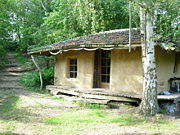 Alternatively, bale buildings can have a structural frame of other materials, usually lumber or timber-frame, with bales simply serving as insulation and plaster substrate, ("infill" or "non-loadbearing" technique), which is most often required in northern regions and/or in wet climates. In northern regions, the potential snow-loading can exceed the strength of the bale walls. In wet climates, the imperative for applying a vapor-permeable finish precludes the use of cement-based stucco commonly used on load-bearing bale walls. Additionally, the inclusion of a skeletal framework of wood or metal allows the erection of a roof prior to raising the bales, which can protect the bale wall during construction, when it is the most vulnerable to water damage in all but the most dependably arid climates. A combination of framing
and load-bearing techniques may also be employed, referred to as "hybrid" straw bale construction.
Straw bales can also be used as part of a Spar and Membrane Structure
(SMS) wall system in which lightly reinforced 2" - 3" [5 cm - 8 cm] gunite or shotcrete
skins are interconnected with extended "X" shaped light rebar in the head joints of the bales. In this wall system the concrete skins provide structure, seismic reinforcing, and fireproofing, while the bales are used as leave-in formwork
and insulation.
Typically "field-bales", bales created on farms with baling machines have been used, but recently higher-density "precompressed" bales (or "straw-blocks") are increasing the loads that may be supported. Field bales might support around 600 pounds per linear foot of wall, but the high density bales bear up to 4,000 lb./lin.ft., and more. The basic bale-building method is now increasingly being extended to bound modules of other oft-recycled materials, including tire-bales, cardboard, paper, plastic, and used carpeting. The technique has also been extended to bags containing "bales" of wood chips or rice hulls
.
Straw bales have also been used in very energy efficient high performance buildings such as the S-House in Austria which meets the Passivhaus energy standard. In South Africa, a five-star lodge made from 10,000 strawbales has housed luminaries such as Nelson Mandela and Tony Blair. In the Swiss Alps, in the little village of Nax Mont-Noble
, construction works have begun in October 2011 for the first hotel in Europe built entirely with straw bales.

Building insulation
building insulation refers broadly to any object in a building used as insulation for any purpose. While the majority of insulation in buildings is for thermal purposes, the term also applies to acoustic insulation, fire insulation, and impact insulation...
, or both. This construction method is commonly used in natural building
Natural building
A natural building involves a range of building systems and materials that place major emphasis on sustainability. Ways of achieving sustainability through natural building focus on durability and the use of minimally processed, plentiful or renewable resources, as well as those that, while...
or "green" construction projects.
Advantages of straw-bale construction over conventional building systems include the renewable nature of straw, cost, easy availability, and high insulation value. Disadvantages include susceptibility to rot and high space requirements for the straw itself.
History
Straw, grass, and reeds have been used as building materials for centuries. Straw houses have been built on the African plains since the PaleolithicPaleolithic
The Paleolithic Age, Era or Period, is a prehistoric period of human history distinguished by the development of the most primitive stone tools discovered , and covers roughly 99% of human technological prehistory...
. Straw bales were used in construction 400 years ago in Germany; and straw-thatched roofs have long been used in northern Europe and Asia. In the New World, teepees
Tipi
A tipi is a Lakota name for a conical tent traditionally made of animal skins and wooden poles used by the nomadic tribes and sedentary tribal dwellers of the Great Plains...
were insulated in winter with loose straw between the inner lining and outer cover.
Straw-bale construction was greatly facilitated by the mechanical hay baler, which was invented in the 1850s and was widespread by the 1890s. It proved particularly useful in the Nebraska Sandhills
Sand Hills (Nebraska)
The Sand Hills, often written Sandhills, is a region of mixed-grass prairie on grass-stabilized sand dunes in north-central Nebraska, covering just over one quarter of the state...
. Pioneers seeking land under the 1862 Homestead Act
Homestead Act
A homestead act is one of three United States federal laws that gave an applicant freehold title to an area called a "homestead" – typically 160 acres of undeveloped federal land west of the Mississippi River....
and the 1904 Kinkaid Act
Kinkaid Act
The Kinkaid Act of 1904 is a U.S. statute that amended the 1862 Homestead Act so that one section of a township of undeveloped land could be claimed in 37 northern and western Nebraska counties...
found a dearth of trees over much of Nebraska. In many parts of the state, the soil was suitable for dugouts
Dugout (shelter)
A dugout or dug-out, also known as a pithouse, pit-house, earth lodge, mud hut, is a shelter for humans or domesticated animals and livestock based on a hole or depression dug into the ground. These structures are one of the most ancient types of human housing known to archeologists...
and sod house
Sod house
The sod house or "soddy" was a corollary to the log cabin during frontier settlement of Canada and the United States. The prairie lacked standard building materials such as wood or stone; however, sod from thickly-rooted prairie grass was abundant...
s.
However, in the Sandhills, the soil generally made poor construction sod;
in the few places where suitable sod could be found, it was more valuable for agriculture than as a building material.
The first documented use of hay bales in construction in Nebraska was a schoolhouse built in 1896 or 1897. Unfenced and unprotected by stucco or plaster, it was reported in 1902 as having been eaten by cows. To combat this, builders began plastering their bale structures; if cement or lime stucco was unavailable, locally obtained "gumbo mud" was employed. Between 1896 and 1945, an estimated 70 straw-bale buildings, including houses, farm buildings, churches, schools, offices, and grocery stores had been built in the Sandhills. In 1990, nine surviving bale buildings were reported in Arthur
Arthur County, Nebraska
-Demographics:As of the census of 2000, there were 444 people, 185 households, and 138 families residing in the county. The population density was 0.618 people per square mile . There were 273 housing units at an average density of 0.380 per square mile...
and Logan
Logan County, Nebraska
-History:Logan County was formed in 1885. It was named after the Union General John A. Logan.-Demographics:As of the census of 2000, there were 774 people, 316 households, and 229 families residing in the county. The population density was 1 people per square mile . There were 386 housing units...
Counties,
including the 1928 Pilgrim Holiness Church
Pilgrim Holiness Church (Arthur, Nebraska)
The Pilgrim Holiness Church, also known as the Baled Hay Church or the Baled Straw Church, is a church built in 1928 in Arthur, Nebraska. At a time and place in which conventional construction materials were expensive or unavailable, it was built out of baled rye straw...
in the village of Arthur
Arthur, Nebraska
Arthur is a village in Arthur County, Nebraska, United States. The population was 117 at the 2010 census. It is the county seat of Arthur County.-Geography:Arthur is located at ....
, which is listed in the National Register of Historic Places
National Register of Historic Places
The National Register of Historic Places is the United States government's official list of districts, sites, buildings, structures, and objects deemed worthy of preservation...
.
Since the 1990s straw-bale construction has been substantially revived, particularly in North America, Europe and Australia.
Method
Straw bale building typically consists of stacking rows of bales (often in running-bond) on a raised footing or foundationFoundation (architecture)
A foundation is the lowest and supporting layer of a structure. Foundations are generally divided into two categories: shallow foundations and deep foundations.-Shallow foundations:...
, with a moisture barrier or capillary break between the bales and their supporting platform. Bale walls can be tied together with pins of bamboo
Bamboo
Bamboo is a group of perennial evergreens in the true grass family Poaceae, subfamily Bambusoideae, tribe Bambuseae. Giant bamboos are the largest members of the grass family....
, rebar
Rebar
A rebar , also known as reinforcing steel, reinforcement steel, rerod, or a deformed bar, is a common steel bar, and is commonly used as a tensioning device in reinforced concrete and reinforced masonry structures holding the concrete in compression...
, or wood
Wood
Wood is a hard, fibrous tissue found in many trees. It has been used for hundreds of thousands of years for both fuel and as a construction material. It is an organic material, a natural composite of cellulose fibers embedded in a matrix of lignin which resists compression...
(internal to the bales or on their faces), or with surface wire meshes, and then stucco
Stucco
Stucco or render is a material made of an aggregate, a binder, and water. Stucco is applied wet and hardens to a very dense solid. It is used as decorative coating for walls and ceilings and as a sculptural and artistic material in architecture...
ed or plaster
Plaster
Plaster is a building material used for coating walls and ceilings. Plaster starts as a dry powder similar to mortar or cement and like those materials it is mixed with water to form a paste which liberates heat and then hardens. Unlike mortar and cement, plaster remains quite soft after setting,...
ed, either with a cement-based
Cement
In the most general sense of the word, a cement is a binder, a substance that sets and hardens independently, and can bind other materials together. The word "cement" traces to the Romans, who used the term opus caementicium to describe masonry resembling modern concrete that was made from crushed...
mix, lime-based formulation, or earth/clay render. The bales may actually provide the structural support for the building ("load-bearing" or "Nebraska-style" technique), as was the case in the original examples from the late 19th century.
Framing (construction)
Framing, in construction known as light-frame construction, is a building technique based around structural members, usually called studs, which provide a stable frame to which interior and exterior wall coverings are attached, and covered by a roof comprising horizontal ceiling joists and sloping...
and load-bearing techniques may also be employed, referred to as "hybrid" straw bale construction.
Straw bales can also be used as part of a Spar and Membrane Structure
Spar and membrane structure
Spar and Membrane Structure is a type of wall construction in which lightly reinforced 2" - 3" [5 cm - 8 cm] of shotcrete or gunite skins are interconnected with extended “X” shaped light rebar through the interior of the wall...
(SMS) wall system in which lightly reinforced 2" - 3" [5 cm - 8 cm] gunite or shotcrete
Shotcrete
Shotcrete is concrete conveyed through a hose and pneumatically projected at high velocity onto a surface, as a construction technique....
skins are interconnected with extended "X" shaped light rebar in the head joints of the bales. In this wall system the concrete skins provide structure, seismic reinforcing, and fireproofing, while the bales are used as leave-in formwork
Formwork
Formwork is the term given to either temporary or permanent molds into which concrete or similar materials are poured. In the context of concrete construction, the falsework supports the shuttering moulds.-Formwork and concrete form types:...
and insulation.
Typically "field-bales", bales created on farms with baling machines have been used, but recently higher-density "precompressed" bales (or "straw-blocks") are increasing the loads that may be supported. Field bales might support around 600 pounds per linear foot of wall, but the high density bales bear up to 4,000 lb./lin.ft., and more. The basic bale-building method is now increasingly being extended to bound modules of other oft-recycled materials, including tire-bales, cardboard, paper, plastic, and used carpeting. The technique has also been extended to bags containing "bales" of wood chips or rice hulls
Rice-hull bagwall construction
Rice-hull bagwall construction is a system of building, with results aesthetically similar to the use of earthbag or cob construction, in which woven polypropylene bags are tightly filled with raw rice-hulls, and these are stacked up, layer upon layer, with strands of four-pronged barbed wire...
.
Straw bales have also been used in very energy efficient high performance buildings such as the S-House in Austria which meets the Passivhaus energy standard. In South Africa, a five-star lodge made from 10,000 strawbales has housed luminaries such as Nelson Mandela and Tony Blair. In the Swiss Alps, in the little village of Nax Mont-Noble
Nax
Nax is a former municipality in the district of Hérens in the canton of Valais in Switzerland. On 1 January 2011, the former municipalities of Vernamiège, Nax and Mase merged in the new municipality of Mont-Noble.-History:...
, construction works have begun in October 2011 for the first hotel in Europe built entirely with straw bales.
See also
- Truth windowTruth windowA truth window is an opening in a wall surface, created to reveal the layers or components within the wall. In a strawbale house, a truth window is often used to show the walls are actually made from straw bales...
Further reading
- Design of Straw Bale Buildings. Bruce King. Chelsea Green Publishing, 2007.
- More Straw Bale Building: A Complete Guide to Designing and Building with Straw. Chris Magwood. New Society Publishers, 2005.
- Straw Bale House, The. Steen, Steen, Bainbridge & Eisenberg. White River Junction, Vermont: Chelsea Green, 1994.
- Building a Straw Bale House. Nathaniel Corum. Princeton Architectural Press, 2005.
External links
- Rawlinson, Linnie. Artist Gordon Smedt's straw-bale house, feature on CNN.com, 13 August 2007. With image gallery.
- Long Branch Environmental Education Center: Possible concerns regarding mold and humidity, technical paper, 2002.