


Stoning of the Devil

Encyclopedia
Islam
Islam . The most common are and . : Arabic pronunciation varies regionally. The first vowel ranges from ~~. The second vowel ranges from ~~~...
ic Hajj
Hajj
The Hajj is the pilgrimage to Mecca, Saudi Arabia. It is one of the largest pilgrimages in the world, and is the fifth pillar of Islam, a religious duty that must be carried out at least once in their lifetime by every able-bodied Muslim who can afford to do so...
pilgrimage to the holy city of Mecca
Mecca
Mecca is a city in the Hijaz and the capital of Makkah province in Saudi Arabia. The city is located inland from Jeddah in a narrow valley at a height of above sea level...
in Saudi Arabia
Saudi Arabia
The Kingdom of Saudi Arabia , commonly known in British English as Saudi Arabia and in Arabic as as-Sa‘ūdiyyah , is the largest state in Western Asia by land area, constituting the bulk of the Arabian Peninsula, and the second-largest in the Arab World...
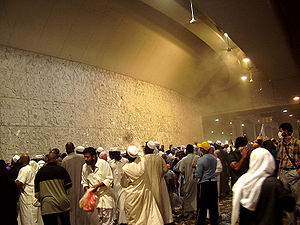
. Muslim pilgrims fling pebbles at three walls called jamarat in the city of Mina
Mina, Saudi Arabia
Mina is a location situated some 5 kilometres to the east of the Islamic holy city of Mecca in Saudi Arabia. It stands on the road from Mecca's city centre to the Hill of Arafat....
just east of Mecca. It is one of a series of ritual acts that must be performed in the Hajj.
Until 2004 the three jamarat (singular: jamrah) were tall pillars. After the 2004 Hajj, Saudi authorities replaced the pillars with 26 m (85.3 ft) long walls for safety; many people were accidentally throwing pebbles at people on the other side. The jamarat are named (starting from the east) the first or smallest jamrah , the middle jamrah (al-jamrah al-wusta), and the largest jamrah or jamrah of Aqaba (al-jamrah al-kubra or jamrat al-`Aqabah). Before 2004 the distance between the small and middle jamrah was 150 m (492.1 ft); between the middle and large jamrah it was 225 m (738.2 ft). To allow easier access to the jamarat a single tiered pedestrian bridge called the Jamaraat Bridge was built around them so pilgrims could throw stones from either the ground level or from the bridge.
On the 10th day of Dhu al-Hijjah
Dhu al-Hijjah
Dhu al-Ḥijjah is the twelfth and final month in the Islamic calendar.This is a very sacred month in the Islamic calendar, marking the end of the year. It is in this month in which the Hajj takes place....
(Eid al-Adha), pilgrims must hit the large jamrah only with seven pebbles. On each of the following two days they must hit each of the three walls with seven pebbles, going in order from east to west. Thus at least 49 pebbles are needed for the ritual, more if some throws miss. Some pilgrims stay at Mina for an additional day; in this case they must again stone each wall seven times.
The pebbles used in the stoning are traditionally gathered at Muzdalifah
Muzdalifah
Muzdalifah is an open, level area near Mecca in Saudi Arabia associated with the Hajj. It lies just southeast of Mina on the route between Mina and Arafat. Each year on the 9th day of the Islamic month of Dhu al-Hijjah, after an afternoon of prayer at Arafat , Muslim pilgrims visit Muzdalifah in...
, a plain southeast of Mina, on the night before the first throwing, but can also be collected at Mina.
Historical and spiritual significance
The ritual re-enacts AbrahamAbraham
Abraham , whose birth name was Abram, is the eponym of the Abrahamic religions, among which are Judaism, Christianity and Islam...
's (Ibrāhīm) pilgrimage to Mecca as explained by the Muslim
Muslim
A Muslim, also spelled Moslem, is an adherent of Islam, a monotheistic, Abrahamic religion based on the Quran, which Muslims consider the verbatim word of God as revealed to prophet Muhammad. "Muslim" is the Arabic term for "submitter" .Muslims believe that God is one and incomparable...
historian al-Azraqi:
- When he [Abraham] left Mina and was brought down to (the defile called) al-Aqaba, the DevilDevilThe Devil is believed in many religions and cultures to be a powerful, supernatural entity that is the personification of evil and the enemy of God and humankind. The nature of the role varies greatly...
appeared to him at Stone-Heap of the Defile. GabrielGabrielIn Abrahamic religions, Gabriel is an Archangel who typically serves as a messenger to humans from God.He first appears in the Book of Daniel, delivering explanations of Daniel's visions. In the Gospel of Luke Gabriel foretells the births of both John the Baptist and of Jesus...
said to him: "Pelt him!" so Abraham threw seven stones at him so that he disappeared from him. Then he appeared to him at the Middle Stone-Heap. Gabriel said to him: "Pelt him!" so he pelted him with seven stones so that he disappeared from him. Then he appeared to him at the Little Stone-Heap. Gabriel said to him: "Pelt him!" so he pelted him with seven stones like the little stones for throwing with a slingSling (weapon)A sling is a projectile weapon typically used to throw a blunt projectile such as a stone or lead "sling-bullet". It is also known as the shepherd's sling....
. So the Devil withdrew from him.
All three jamarat represent the devil: the first and largest represents his temptation of Abraham against sacrificing Ishmael
Ishmael
Ishmael is a figure in the Hebrew Bible and the Qur'an, and was Abraham's first born child according to Jews, Christians and Muslims. Ishmael was born of Abraham's marriage to Sarah's handmaiden Hagar...
(Ismāʻīl), the second represents the temptation of Abraham's wife Hagar
Hagar (Bible)
Hagar , according to the Abrahamic faiths, was the second wife of Abraham, and the mother of his first son, Ishmael. Her story is recorded in the Book of Genesis, mentioned in Hadith, and alluded to in the Qur'an...
to induce her to stop him, and the third represents his temptation of Ishmael to avoid being sacrificed. He was rebuked each time, and the throwing of the stones symbolizes those rebukes.
The stoning of the jamarat also represents the repudiation of man's self (literally the "internal despot", al-Nafs al-Amarah) and the act of casting aside one's low desires and wishes. As one Islamic theologian puts it,
- If one is able to crush the al‑Nafs al‑Amarah during the stoning of the Jamarah al‑'Uqbah [the jamrah of Aqaba], then one has taken the next step in attaining closeness to AllahGod in IslamIn Islamic theology, God is the all-powerful and all-knowing creator, sustainer, ordainer, and judge of the universe. Islam puts a heavy emphasis on the conceptualization of God as strictly singular . God is unique and inherently One , all-merciful and omnipotent. According to the Islamic...
, and since between the servant and AllahAllahAllah is a word for God used in the context of Islam. In Arabic, the word means simply "God". It is used primarily by Muslims and Bahá'ís, and often, albeit not exclusively, used by Arabic-speaking Eastern Catholic Christians, Maltese Roman Catholics, Eastern Orthodox Christians, Mizrahi Jews and...
there is no more than the distance of one step, if one has been able to take this step and make it past one's own low desires and wishes, then that which follows is the level of closeness to Allah.
- During those two or three days after the Eid that one is in Mina, one must stone the three Jamarat, meaning that one must trample upon his internal despot (al-Nafs al-Amarah), the external despot of the ShaitanDevil (Islam)In Islam, the Devil is known as or . According to the Qurʾān, God created Iblis out of "smokeless fire or from the pure flame of fire" and created man out of clay...
from the JinnGenieJinn or genies are supernatural creatures in Arab folklore and Islamic teachings that occupy a parallel world to that of mankind. Together, jinn, humans and angels make up the three sentient creations of Allah. Religious sources say barely anything about them; however, the Qur'an mentions that...
(Iblis and those like him), and the Shaitan from among the Humans (the enemies of religion and of humanity).
- The stoning of the three Jamarat is in essence, the trampling upon the despots and waging war against all of them. When one focuses on them and the hatred for them, then one automatically focuses with complete attention upon one's self – and rightfully so – while stoning the Jamarat, one must focus entirely upon one's self.
Incidents
The stoning of the devil ritual was once one of the most dangerous parts of the pilgrimage because sudden crowd movements on or near the Jamarat Bridge can cause people to be crushed. On several occasions hundreds of participants have suffocated or been trampled to death in stampedeStampede
A stampede is an act of mass impulse among herd animals or a crowd of people in which the herd collectively begins running with no clear direction or purpose....
s.
The bridge has been expanded in recent years to accommodate the ever-growing number of pilgrims who perform the Hajj every year. An important step in managing crowds is the recent replacement of the jamarat pillars by walls to ease and speed up the stoning.
Crowd conditions are especially difficult during the final day of Hajj, which is the day pilgrims leave the valley of Mina and return to Mecca for the farewell Tawaf
Tawaf
Tawaf is one of the Islamic rituals of pilgrimage. During the Hajj and Umrah, Muslims are to circumambulate the Kaaba seven times, in a counterclockwise direction...
(the final circumambulation of the Kaaba
Kaaba
The Kaaba is a cuboid-shaped building in Mecca, Saudi Arabia, and is the most sacred site in Islam. The Qur'an states that the Kaaba was constructed by Abraham, or Ibraheem, in Arabic, and his son Ishmael, or Ismaeel, as said in Arabic, after he had settled in Arabia. The building has a mosque...
). According to hadith
Hadith
The term Hadīth is used to denote a saying or an act or tacit approval or criticism ascribed either validly or invalidly to the Islamic prophet Muhammad....
, Muhammad
Muhammad
Muhammad |ligature]] at U+FDF4 ;Arabic pronunciation varies regionally; the first vowel ranges from ~~; the second and the last vowel: ~~~. There are dialects which have no stress. In Egypt, it is pronounced not in religious contexts...
's last stoning was performed just after the noon prayer
Dhuhr
The dhuhr prayer is the prayer after midday Performed daily by practicing Muslims, it is the second of the five daily prayers...
. Many scholars feel that the ritual can be done any time between noon and sunset on this day; however, many Muslims are taught that it should be done immediately after the noon prayer. This leads to people camping out until noon and rushing out then to do the stoning.
These two factors are felt to be most responsible for the most recent tragedy during the Hajj of 2006, in which a stampede killed at least 346 pilgrims and injured at least 289 more. This was despite several attempts by the authorities to inform pilgrims about the permissibility of staggering their visits to the jamarat as well as instructing them to leave their luggage at their tents. Adding to the confusion involved in the tragedy is the lack of co-operation on the part of pilgrims who do not leave the jamarat area by the proper route, and therefore interfere with the movements of others who are arriving.