


Stolen base

Encyclopedia
Baseball
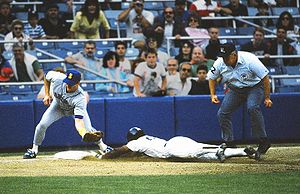
Baseball is a bat-and-ball sport played between two teams of nine players each. The aim is to score runs by hitting a thrown ball with a bat and touching a series of four bases arranged at the corners of a ninety-foot diamond...
, a stolen base occurs when a baserunner successfully advances to the next base while the pitcher
Pitcher
In baseball, the pitcher is the player who throwsthe baseball from the pitcher's mound toward the catcher to begin each play, with the goal of retiring a batter, who attempts to either make contact with the pitched ball or draw a walk. In the numbering system used to record defensive plays, the...
is delivering the ball to home plate
Home Plate
Home Plate is the fifth album by Bonnie Raitt, released in 1975 .-Track listing:#"What Do You Want the Boy to Do?" – 3:19#"Good Enough" – 2:56#"Run Like a Thief" – 3:02...
. In baseball statistics
Baseball statistics
Statistics play an important role in summarizing baseball performance and evaluating players in the sport.Since the flow of a baseball game has natural breaks to it, and normally players act individually rather than performing in clusters, the sport lends itself to easy record-keeping and statistics...
, stolen bases are denoted by SB.
If the defense makes no attempt to put the baserunner out (for example, if the catcher doesn't even look his way), the play is scored as defensive indifference (also called fielder's indifference), and no stolen base is credited to the runner. Defensive indifference is generally only scored instead of a stolen base when the game is in a late inning and the team with the stealing baserunner is down by more than one run. MLB Rule 10.07(g) covers defensive indifference.
Successful base-stealing requires not only simple running speed but also good base-running instincts and split-second timing. The scoring and criteria for awarding a stolen base to a runner are covered by rule 10.07 of the Major League Baseball
Major League Baseball
Major League Baseball is the highest level of professional baseball in the United States and Canada, consisting of teams that play in the National League and the American League...
rule book.
Background
Ned CuthbertNed Cuthbert
Edgar Edward "Ned" Cuthbert was an American professional baseball player.Cuthbert's baseball career began in 1865 with the Keystone Club of Philadelphia. After two seasons as a second baseman and outfielder with the Keystones, he moved across town to the West Philadelphia club, playing only four...
, playing for the Philadelphia Keystones
Philadelphia Keystones
The Philadelphia Keystones was a professional baseball franchise. In 1884, they were a member of the short-lived Union Association. The team was owned by former player Tom Pratt....
in either 1863 or 1865, is documented as the first baseball player to steal a base in a baseball game, although the term stolen base was not used until 1871. For a time in the 19th century, stolen bases were credited when a baserunner reached an extra base on a base hit from another player. For example if a runner on first base
First baseman
First base, or 1B, is the first of four stations on a baseball diamond which must be touched in succession by a baserunner in order to score a run for that player's team...
reached third base
Third baseman
A third baseman, abbreviated 3B, is the player in baseball whose responsibility is to defend the area nearest to third base — the third of four bases a baserunner must touch in succession to score a run...
on a single, it would count as a steal. In 1887, Hugh Nicol
Hugh Nicol
Hugh N. Nicol was an American outfielder in Major League Baseball. His debut game took place on May 3, 1881. His final game took place on August 2, 1890. During his career, he played for Cincinnati Reds and Chicago White Stockings of the National League and St. Louis Browns of the American...
set a still-standing Major League record with 138 stolen bases, many of which would not have counted under modern rules. Modern steal rules were fully implemented in 1898, and steals are now only credited when a runner successfully takes an extra base while the ball is being pitched, but not already hit. If the ball is dead on the pitch run on, such as from a foul ball (except caught fly-out), the steal is not allowed and the runner returns to his time-of-pitch base. In addition, if the situation of the game is such that the steal is of little use (usually in the late innings when the runner would not change the game's outcome by scoring), and the catcher does not attempt to throw out the runner, the runner is not credited with a steal, and the base is attributed to defensive indifference.

Ty Cobb
Tyrus Raymond "Ty" Cobb , nicknamed "The Georgia Peach," was an American Major League Baseball outfielder. He was born in Narrows, Georgia...
and Clyde Milan
Clyde Milan
Jesse Clyde Milan was an American baseball player who spent his entire career as an outfielder with the Washington Senators . He was not a powerful batter, but was adept at getting on base and was fleet of foot, receiving the nickname "Deerfoot" for his speed...
stealing nearly 100 bases in a season. But the tactic fell into relative disuse after Babe Ruth
Babe Ruth
George Herman Ruth, Jr. , best known as "Babe" Ruth and nicknamed "the Bambino" and "the Sultan of Swat", was an American Major League baseball player from 1914–1935...
introduced the era of the home run – in 1955, for example, no one in baseball stole more than 25 bases, and Dom DiMaggio
Dom DiMaggio
Dominic Paul DiMaggio , nicknamed "The Little Professor", was a Major League Baseball center fielder. He played his entire 11-year baseball career for the Boston Red Sox...
won the AL stolen base title in 1950 with just 15. However, in the late 1950s and early 1960s base-stealing was brought back to prominence primarily by Luis Aparicio
Luis Aparicio
Luis Ernesto Aparicio Montiel is a former shortstop in professional baseball. His career in Major League Baseball spanned three decades, from through . Aparicio played for the Chicago White Sox , Baltimore Orioles and Boston Red Sox . He batted and threw right-handed...
and Maury Wills
Maury Wills
Maurice Morning "Maury" Wills is a former Major League Baseball shortstop and switch-hitting batter who played most prominently with the Los Angeles Dodgers , and also with the Pittsburgh Pirates and Montreal Expos...
, who broke Cobb's modern single-season record by stealing 104 bases in 1962. Wills' record was broken in turn by Lou Brock
Lou Brock
Louis Clark "Lou" Brock is an American former professional baseball player. He began his Major League Baseball career with the Chicago Cubs but, spent the majority of his career as the left fielder for the St. Louis Cardinals. Brock was best known for breaking Ty Cobb's all-time major league...
in 1974, and Rickey Henderson
Rickey Henderson
Rickey Henley Henderson is a former Major League Baseball left fielder who played for nine teams from 1979 to 2003, including four stints with his original team, the Oakland Athletics. Nicknamed The Man of Steal, he is widely regarded as the sport's greatest leadoff hitter and baserunner...
in 1982. The stolen base remained a popular tactic through the 1980s, perhaps best exemplified by Vince Coleman
Vince Coleman
Vincent Maurice Coleman is an American former Major League Baseball player, best known for his years with the St. Louis Cardinals. Primarily a left fielder, Coleman played from to and set a number of stolen base records. He was a switch-hitter and threw right-handed.-Biography:Coleman attended...
and the St. Louis Cardinals
St. Louis Cardinals
The St. Louis Cardinals are a professional baseball team based in St. Louis, Missouri. They are members of the Central Division in the National League of Major League Baseball. The Cardinals have won eleven World Series championships, the most of any National League team, and second overall only to...
, but began to decline again in the 1990s as the frequency of home run
Home run
In baseball, a home run is scored when the ball is hit in such a way that the batter is able to reach home safely in one play without any errors being committed by the defensive team in the process...
s reached unprecedented heights and the steal-friendly artificial turf
Artificial turf
Artificial turf is a surface manufactured from synthetic fibers made to look like natural grass. It is most often used in arenas for sports that were originally or are normally played on grass. However, it is now being used on residential lawns and commercial applications as well...
ballparks began to disappear.
Technique and strategy
A base-stealing runner must begin running as soon as the pitcher has committed himself to throwing a pitch to home plate, neither sooner nor later. If he begins to run too soon, the pitcher may throw to a base rather than to home—in this case, the runner is picked off, and will most likely be tagged out. Before the pitch, the runner will often take a lead-off, walking several steps away from the base as a head startHead start (positioning)
In positioning, a head start is a start in advance of the starting position of others in competition, or simply toward the finish line or desired outcome...
for his next advance. In some cases, the pitcher may hold the runner on by throwing to the base several times before pitching, in the hope of dissuading the runner from too big a lead-off. This action can also result in the runner being tagged out in a pick-off. Another popular strategy is for the runner to attempt a steal while the hitter is instructed to swing at the pitch if it is at all hittable. This hit-and-run play
Hit and run (baseball)
A hit and run is a high risk/high reward offensive strategy used in baseball.When the offense has a baserunner on first base , the runner on first breaks for second as the pitch is thrown...
can give the runner a good head start to take an extra base on the hit. But if the hitter fails to hit the ball, the hit-and-run becomes a pure steal attempt, and the runner may be thrown out. Another risk of the hit-and-run is that a caught line drive
Line drive
In baseball, a line drive is a type of batted ball, sharply hit, and on a level trajectory. The threshold between a line drive and a fly ball can be subjective....
could result in an easy double play
Double play
In baseball, a double play for a team or a fielder is the act of making two outs during the same continuous playing action. In baseball slang, making a double play is referred to as "turning two"....
, although this is offset by the lower likelihood of a ground ball double play.
A second and lesser-known technique is the "delayed" steal. This technique, famously practiced by Eddie Stanky
Eddie Stanky
Edward Raymond Stanky , nicknamed "The Brat", was an American second baseman and manager in Major League Baseball. He played for the Chicago Cubs , Brooklyn Dodgers , Boston Braves , New York Giants , and St. Louis Cardinals...
of the Brooklyn Dodgers, is where the runner does not break immediately for second when the pitcher commits to the plate. Instead the runner takes two or three large shuffles off the base when the pitcher goes to the plate. This keys the middle infielders and the catcher to let their guard down, as it appears the runner is not stealing, but only getting a good secondary lead in case the ball is hit. In reality the delayed stealer is closing the distance to second base. When the ball crosses the plate the runner breaks for second base, and is essentially stealing the base on the middle infielders who have not covered second base. Additionally, the catcher is not ready to come out of his crouch and cannot throw to second until an infielder gets there. The delayed steal is a deceptive technique that is sometimes executed by even slow runners and many times results in a catcher throwing into center field. The technique is rarely seen at the Major League level but is used effectively by multiple college programs.
Second base is the base most often stolen. It is also technically the easiest to steal, as it is farthest from home plate and thus a longer throw from the catcher is required to prevent it. Third base
Third Base
is a 1978 Japanese film directed by Yōichi Higashi.-External links:...
is a shorter throw for the catcher, and thus more difficult to steal, though a right-handed batter can sometimes help by serving as an obstacle that the catcher must throw around. Third base is generally stolen off the pitcher, since a bigger lead is possible off second base. It is possible for a player to steal home plate
Home Plate
Home Plate is the fifth album by Bonnie Raitt, released in 1975 .-Track listing:#"What Do You Want the Boy to Do?" – 3:19#"Good Enough" – 2:56#"Run Like a Thief" – 3:02...
, but this requires great daring and aggressiveness as the ball will almost certainly arrive at home plate before the runner. Thus a sacrifice bunt or squeeze play
Squeeze play (baseball)
In baseball, the squeeze play is a maneuver consisting of a sacrifice bunt with a runner on third base. The batter bunts the ball, expecting to be thrown out at first base, but providing the runner on third base an opportunity to score...
is typically used instead. Ty Cobb
Ty Cobb
Tyrus Raymond "Ty" Cobb , nicknamed "The Georgia Peach," was an American Major League Baseball outfielder. He was born in Narrows, Georgia...
holds the records for most steals of home in a single season (8) as well as for a career (54). Jackie Robinson
Jackie Robinson
Jack Roosevelt "Jackie" Robinson was the first black Major League Baseball player of the modern era. Robinson broke the baseball color line when he debuted with the Brooklyn Dodgers in 1947...
was also renowned for the thrilling feat of stealing home, which he famously accomplished in Game 1 of the 1955 World Series
1955 World Series
The 1955 World Series matched the Brooklyn Dodgers against the New York Yankees, with the Dodgers winning the Series in seven games to capture their first championship in franchise history. It would be the only Series the Dodgers won in Brooklyn . The last time the Brooklyn franchise won a World...
. On August 22, 1982, Glenn Brummer
Glenn Brummer
Glenn Edward Brummer was a Major League Baseball catcher.Signed by the St. Louis Cardinals as an amateur free agent in 1974, Brummer made his Major League Baseball debut with the St. Louis Cardinals on May 25, 1981, and appeared in his final major league game on October 6, 1985.Brummer was a...
stole home in the bottom of the 12th inning of a tie game, thus accomplishing a walk-off straight steal of home, one of the very few in major league history. In more recent years, pure steals of home are rare, although a player may steal home plate during a "delayed double steal," in which a runner on first attempts to steal second, while the runner on third breaks for home as soon as the catcher throws to second base. The most recent "pure" steal of home (i.e., not involving a squeeze play or an additional steal attempt) was on September 9, 2010, when Chris Nelson
Chris Nelson (baseball)
Christopher Lars Nelson is a Major League Baseball infielder for the Colorado Rockies. He was selected by the Colorado Rockies in the 1st Round of the 2004 amateur entry draft, and received the third largest signing bonus in Rockies history...
of the Colorado Rockies
Colorado Rockies
The Colorado Rockies are a Major League Baseball team based in Denver, Colorado. Established in 1991, they started play in 1993 and are in the West Division of the National League. The team is named after the Rocky Mountains...
stole home against the Cincinnati Reds
Cincinnati Reds
The Cincinnati Reds are a Major League Baseball team based in Cincinnati, Ohio. They are members of the National League Central Division. The club was established in 1882 as a charter member of the American Association and joined the National League in 1890....
.
Base stealing is an important characteristic of a particular style of baseball, sometimes called "small ball
Small Ball
In the sport of baseball, small-ball is an informal and colloquial term for an offensive strategy in which the batting team emphasizes placing runners on base and then advancing them into position to score a run in a deliberate, methodical way...
" or "manufacturing runs". A team playing with this style emphasizes doing little things (including risky running plays like base-stealing) to advance runners and score runs, often relying on pitching and defense to keep games close. The Los Angeles Dodgers
Los Angeles Dodgers
The Los Angeles Dodgers are a professional baseball team based in Los Angeles, California. The Dodgers are members of Major League Baseball's National League West Division. Established in 1883, the team originated in Brooklyn, New York, where it was known by a number of nicknames before becoming...
of the 1960s, led by pitcher Sandy Koufax
Sandy Koufax
Sanford "Sandy" Koufax is a former left-handed baseball pitcher who played his entire 12-year Major League Baseball career for the Brooklyn/Los Angeles Dodgers...
and speedy shortstop Maury Wills
Maury Wills
Maurice Morning "Maury" Wills is a former Major League Baseball shortstop and switch-hitting batter who played most prominently with the Los Angeles Dodgers , and also with the Pittsburgh Pirates and Montreal Expos...
, were a successful example of this style. The antithesis of this would be a team that relies on power hitting. The Baltimore Orioles
Baltimore Orioles
The Baltimore Orioles are a professional baseball team based in Baltimore, Maryland in the United States. They are a member of the Eastern Division of Major League Baseball's American League. One of the American League's eight charter franchises in 1901, it spent its first year as a major league...
of the 1970s, led by manager Earl Weaver
Earl Weaver
Earl Sidney Weaver is a former Major League Baseball manager. He spent his entire 17-year managerial career with the Baltimore Orioles . Weaver was inducted into the Baseball Hall of Fame in 1996.-Playing career:After playing for Beaumont High School in St...
, were an example of such a "slugging" team that aspired to score most of its runs via home runs. Often the "small ball" model is associated with the National League
National League
The National League of Professional Baseball Clubs, known simply as the National League , is the older of two leagues constituting Major League Baseball, and the world's oldest extant professional team sports league. Founded on February 2, 1876, to replace the National Association of Professional...
, while power hitting is seen as more associated with the American League
American League
The American League of Professional Baseball Clubs, or simply the American League , is one of two leagues that make up Major League Baseball in the United States and Canada. It developed from the Western League, a minor league based in the Great Lakes states, which eventually aspired to major...
. However, some of the more successful American League teams of recent memory, including the 2002
2002 in baseball
-Major League Baseball:*Regular Season Champions*World Series Champion - Anaheim Angels*Postseason - October 1 to October 27Click on any series score to link to that series' page....
Anaheim Angels
Los Angeles Angels of Anaheim
The Los Angeles Angels of Anaheim are a professional baseball team based in Anaheim, California, United States. The Angels are a member of the Western Division of Major League Baseball's American League. The "Angels" name originates from the city in which the team started, Los Angeles...
, the 2001
2001 in baseball
-Major League Baseball:*Regular Season Champions*World Series Champion - Arizona Diamondbacks*Postseason - October 9 to November 4Click on any series score to link to that series' page....
Seattle Mariners
Seattle Mariners
The Seattle Mariners are a professional baseball team based in Seattle, Washington. Enfranchised in , the Mariners are a member of the Western Division of Major League Baseball's American League. Safeco Field has been the Mariners' home ballpark since July...
and the 2005
2005 in baseball
-Headline events of the year:*Chicago White Sox swept the Houston Astros to win the 2005 World Series.*2005 also marked the inaugural season of the Washington Nationals, who relocated from Montreal and were formerly known as the Expos....
Chicago White Sox
Chicago White Sox
The Chicago White Sox are a Major League Baseball team located in Chicago, Illinois.The White Sox play in the American League's Central Division. Since , the White Sox have played in U.S. Cellular Field, which was originally called New Comiskey Park and nicknamed The Cell by local fans...
have experienced their success in part as a result of playing "small ball," advancing runners through means such as the stolen base and the related hit and run
Hit and run (baseball)
A hit and run is a high risk/high reward offensive strategy used in baseball.When the offense has a baserunner on first base , the runner on first breaks for second as the pitch is thrown...
play. Successful teams often combine both styles, with a speedy runner or two complementing hitters with power, such as the 2005 White Sox, who despite playing "small ball", still hit 200 home runs that season
Measuring Success
One of the difficulties in determining how good a player is at stealing bases is whether to judge the cumulative number of steals or the success ratio of steals to caught stealingCaught stealing
In baseball, a runner is charged, and the fielders involved are credited, with a time caught stealing when the runner attempts to advance or lead off from one base to another without the ball being batted and then is tagged out by a fielder while making the attempt...
. Noted statistician Bill James
Bill James
George William “Bill” James is a baseball writer, historian, and statistician whose work has been widely influential. Since 1977, James has written more than two dozen books devoted to baseball history and statistics...
has argued that unless a player can steal a high percentage of the time, then the stolen base is not useful, and can even be detrimental to a team. A success rate of 67 to 70% or better is necessary to make stealing bases worthwhile.
Judging the base-stealing abilities of players from earlier eras is also problematic, because caught stealing was not a regularly recorded statistic until the middle of the 20th Century. Ty Cobb
Ty Cobb
Tyrus Raymond "Ty" Cobb , nicknamed "The Georgia Peach," was an American Major League Baseball outfielder. He was born in Narrows, Georgia...
, for example, was known as a great base-stealer, with 892 steals and a success rate of over 83%. However the data on Cobb's caught stealing is missing from 12 seasons, strongly suggesting he was unsuccessful many more times than his stats indicate. Carlos Beltrán
Carlos Beltrán
Carlos Iván Beltrán is a Major League Baseball outfielder.-Early life:In his youth, Beltrán excelled in many sports, with volleyball and baseball being his favorites. At his father's urging, he gave up volleyball to concentrate on baseball when he was seventeen...
, with 286 steals, has the highest career success rate of all players with over 300 stolen base attempts, at 88.3%.
Evolution of rules and scoring
The first mention of the stolen base, in a statistical sense was in the 1877 scoring rules adopted by the National LeagueNational League
The National League of Professional Baseball Clubs, known simply as the National League , is the older of two leagues constituting Major League Baseball, and the world's oldest extant professional team sports league. Founded on February 2, 1876, to replace the National Association of Professional...
which noted credit toward a player's total bases
Total bases
In baseball statistics, total bases refers to the number of bases a player has gained with hits, i.e., the sum of his hits weighted by 1 for a single, 2 for a double, 3 for a triple and 4 for a home run.Only bases attained from hits count toward this total....
when a base is stolen. It was not until 1886 that the stolen base appeared as something to be tracked, but was only to "appear in the summary of the game".
In 1887, the stolen base was given its own individual statistical column in the box score
Box score
A box score is a structured summary of the results from a sport competition. The box score lists the game score as well as individual and team achievements in the game....
, and was defined for purposes of scoring: "...every base made after first base has been reached by a base runner, except for those made by reason of or with the aid of a battery error (wild pitch
Wild pitch
In baseball, a wild pitch is charged against a pitcher when his pitch is too high, too short, or too wide of home plate for the catcher to control with ordinary effort, thereby allowing a baserunner, perhaps even the batter-runner on strike three or ball four, to advance.A wild pitch usually...
or passed ball
Passed ball
In baseball, a catcher is charged with a passed ball when he fails to hold or control a legally pitched ball that, with ordinary effort, should have been maintained under his control. When, as a result of this loss of control, the batter or a runner on base advances, the catcher is thereby charged...
), or by batting, balk
Balk
In baseball, a pitcher can commit a number of illegal motions or actions that constitute a balk. In games played under the Official Baseball Rules, a balk results in a dead ball or delayed dead ball. In certain other circumstances, a balk may be wholly or partially disregarded...
s or by being forced off. In short, shall include all bases made by a clean steal, or through a wild throw or muff of the ball by a fielder who is directly trying to put the base runner out while attempting to steal." The next year, it was clarified that any attempt to steal must be credited to the runner, and that fielders committing errors during this play must also be charged with an error. This rule also clarified that advancement of another base(s) beyond the one being stolen is not credited as a stolen base on the same play, and that an error is charged to the fielder who permitted the extra advancement. There was clarification that a runner is credited with a steal if the attempt began before a battery error. Finally, batters were credited with a stolen base if they were tagged out after over running the base.
In 1892, a short-lived rule was added crediting runners with stolen bases if a base runner advanced on a fly out, or if they advanced more than one base on any safe hit or attempted out, providing an attempt was made by the defense to put the runner out. The rule was subsequently ended in 1897.
In 1898, stolen base scoring was narrowed to no longer include advancement in the event of a fielding errors, or advancement caused by a hit batsman.
1904 saw an attempt to reduce the already wordy slew of rules governing stolen bases, with the stolen base now credited when "...the advances a base unaided by a base hit, a put out, (or) a fielding or batter error."
1910 saw the first addressing of the double and triple steal attempts. Under the new rule, when any runner is thrown out, and the other(s) are successful, the successful runners will not be credited with a stolen base.
Without using the term, 1920 saw the first rule that would be referred to today as defensive indifference, as stolen bases would not be credited, unless an effort was made to stop the runner by the defense. This is usually called if such is attempted in the ninth inning while that player's team is trailing, unless the runner represents the potential tying run.
1931 saw a further narrowing of the criteria for stolen bases being awarded. Power was given to the official scorer, in the event of a muff by the catcher in throwing, that in the judgment of the scorer the runner would have been out, to credit the catcher with an error, and not credit the runner with a stolen base. Further, any successful steal on a play resulting in a wild pitch, passed ball, or balk would no longer be credited as a steal, even if the runner had started to steal before the play.
One of the largest rewrites to the rules in history came in 1950. The stolen base was specifically to be credited "to a runner whenever he advances one base unaided by a base hit, a putout, a forceout, a fielder's choice
Fielder's choice
In baseball, fielder's choice is a term used to refer to a variety of plays involving an offensive player reaching a base due to the defense's attempt to put out another baserunner, or the defensive team's indifference to his advance...
, a passed ball, a wild pitch, or a balk."
There were noted exceptions, such as denying a stolen base to an otherwise successful steal as a part of a double or triple steal, if one other runner was thrown out in the process. A stolen base would be awarded to runners who successfully stole second base as a part of a double steal with a man on third, if the other runner failed to steal home, but instead was able to return safely to third base. Runners who are tagged out oversliding the base after an otherwise successful steal would not be credited with a stolen base. Indifference was also credited as an exception. Runners would now be credited with stolen bases if they had begun the act of stealing, and the resulting pitch was wild, or a passed ball. Finally, for 1950 only, runners would be credited with a stolen base if they were "well advanced" toward the base they were attempting to steal", and the pitcher is charged with a balk, with the further exception of a player attempting to steal, who would otherwise have been forced to advance on the balk by a runner behind them. This rule was removed in 1951.
A clarification came in 1955 that awarded a stolen base to a runner, even if he became involved in a rundown, provided he managed to evade the rundown, and advance to the base he was intending to steal.
The criteria for being charged with "caught stealing" was fine tuned in 1979, with a runner being charged with being caught if he is put out while trying to steal, oversliding a base (otherwise successfully stolen), or is picked off a base, and tries to advance to the next base. Runners would specifically not be charged with being caught, if the player was put out after a wild pitch or passed ball.
Stealing first
While it is not recorded as a "steal", in a practical sense a batter can be said to "steal first base" by successfully running to first base (without being tagged or thrown out) in rare circumstances following an uncaught third strike; the rarely-seen play avoids an "outOut (baseball)
In baseball, an out occurs when the defensive, or fielding, team effects any of a number of different events, and the umpire rules a batter or baserunner out. When a player is called out, he is said to be retired...
" and gains a baserunner. Statistically, it is recorded as a strikeout
Strikeout
In baseball or softball, a strikeout or strike-out occurs when a batter receives three strikes during his time at bat. A strikeout is a statistic recorded for both pitchers and batters....
plus a passed ball
Passed ball
In baseball, a catcher is charged with a passed ball when he fails to hold or control a legally pitched ball that, with ordinary effort, should have been maintained under his control. When, as a result of this loss of control, the batter or a runner on base advances, the catcher is thereby charged...
or wild pitch
Wild pitch
In baseball, a wild pitch is charged against a pitcher when his pitch is too high, too short, or too wide of home plate for the catcher to control with ordinary effort, thereby allowing a baserunner, perhaps even the batter-runner on strike three or ball four, to advance.A wild pitch usually...
, and a "stolen base" statistic does not accrue and neither is an out recorded for the strikeout.
In baseball's earlier decades, a runner on second base could "steal" first base, perhaps with the intention of drawing a throw which might allow a runner on third to score (a tactic famously employed by Germany Schaefer
Germany Schaefer
Herman A. "Germany" Schaefer was a second baseman in Major League Baseball who played fifteen seasons with the Chicago Cubs, Detroit Tigers, Washington Senators, Newark Pepper, New York Yankees, and Cleveland Indians....
). However, such a tactic was not recorded as a stolen base, and modern rules forbid going backwards on the basepaths in order to "confuse the defense or make a travesty of the game".
The expression "You can't steal first base" is sometimes used in reference to a player who is fast but not very good at getting on base in the first place. Former Pittsburgh Pirate manager Lloyd McClendon
Lloyd McClendon
Lloyd Glenn McClendon is a former professional baseball player and manager, currently serving as the hitting coach for the Detroit Tigers under Jim Leyland...
is jokingly referred to as having "stolen first" in a June 26, 2001 game - after disputing a call at first base, he yanked the base out of the ground and left the field with it, delaying the game.
See also
- Lead offLead offIn baseball, the term lead off or lead-off has two distinct meanings:- On the bases :In baseball, to lead off, or to take a lead, refers to the position a baserunner takes just prior to a pitch, a short distance away from the base he occupies. A "lead" can also refer to that distance. A typical...
- Stolen base percentageStolen base percentageStolen base percentage is a statistic used in baseball.A player's stolen base percentage measures his rate of success in stealing bases. Because stolen bases tend to help a team less than times caught stealing hurt, a player needs to have a high stolen base percentage in order to contribute much...
- List of Major League Baseball stolen base records
- List of Major League Baseball stolen base champions
- List of Major League Baseball leaders in career stolen bases