

Stokes' theorem

Encyclopedia
In differential geometry, Stokes' theorem (or Stokes's theorem, also called the generalized Stokes' theorem) is a statement about the integration
of differential form
s on manifolds, which both simplifies and generalizes several theorem
s from vector calculus. Lord Kelvin
first discovered the result and communicated it to George Stokes in July 1850. Stokes set the theorem as a question on the 1854 Smith's Prize
exam, which led to the result bearing his name.
states that the integral
of a function f over the interval
[a, b] can be calculated by finding an antiderivative
F of f:

Stokes' theorem is a vast generalization of this theorem in the following sense.
In even simpler terms, one can consider that points can be thought of as the boundaries of curves, that is as 0-dimensional boundaries of 1-dimensional manifolds. So, just like one can find the value of an Integral (f = dF) over a 1-dimensional manifolds ([a,b]) by considering the anti-derivative (F) at the 0-dimensional boundaries ([a,b]), one can generalize the fundamental theorem of calculus, with a few additional caveats, to deal with the value of integrals (dω) over n-dimensional manifolds (Ω) by considering the anti-derivative (ω) at the (n-1)-dimensional boundaries (dΩ) of the manifold.
So the fundamental theorem reads:
 be an oriented smooth manifold of dimension
n and let be an n-differential form
that is compactly supported on . First, suppose that α is compactly supported in the domain of a single, oriented
coordinate chart {U, φ}. In this case, we define the integral of over
over  as
as

i.e., via the pullback of α to Rn.
More generally, the integral of over
over  is defined as follows: Let {ψi} be a partition of unity associated with a locally finite
cover
{Ui, φi} of (consistently oriented) coordinate charts, then define the integral

where each term in the sum is evaluated by pulling back to Rn as described above. This quantity is well-defined; that is, it does not depend on the choice of the coordinate charts, nor the partition of unity.
Stokes' theorem reads: If is an (n − 1)-form with compact support on
  and
and  denotes the boundary
of with its induced orientation
, then

Here is the exterior derivative
, which is defined using the manifold structure only. On the r.h.s., a circle is sometimes used within the integral sign to stress the fact that the (n-1)-manifold is closed. The r.h.s. of the equation is often used to formulate integral laws; the l.h.s. then leads to equivalent differential formulations (see below).
The theorem is often used in situations where is an embedded oriented submanifold of some bigger manifold on which the form
  is defined.
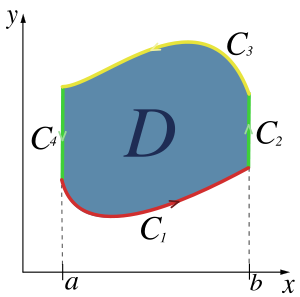
A proof becomes particularly simple if the submanifold is a so-called "normal manifold", as in the figure on the r.h.s., which can be segmented into vertical stripes (e.g. parallel to the xn direction), such that after a partial integration concerning this variable, nontrivial contributions come only from the upper and lower boundary surfaces (coloured in yellow and red, respectively), where the complementary mutual orientations are visible through the arrows.
of M. These groups, together with boundary map
, ∂, define a chain complex
. The corresponding homology (resp. cohomology) is called the smooth singular homology
(resp. cohomology) of M.
On the other hand, the differential forms, with exterior derivative, d, as the connecting map, form a cochain complex, which defines de Rham cohomology
.
Differential k-forms can be integrated over a k-simplex in a natural way, by pulling back to Rk. Extending by linearity allows one to integrate over chains. This gives a linear map from the space of k-forms to the k-th group in the singular cochain, Sk*, the linear functionals on Sk. In other words, a k-form
 defines a functional

on the k-chains. Stokes' theorem says that this is a chain map from de Rham cohomology to singular cohomology; the exterior derivative, d, behaves like the dual of ∂ on forms. This gives a homomorphism from de Rham cohomology to singular cohomology. On the level of forms, this means:
De Rham's theorem shows that this homomorphism is in fact an isomorphism. So the converse to 1 and 2 above hold true. In other words, if {ci} are cycles generating the k-th homology group, then for any corresponding real numbers, {ai}, there exist a closed form, , such that:

and this form is unique up to exact forms.
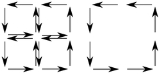
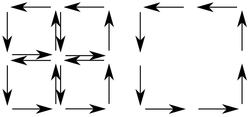 To simplify these topological arguments, it is worthwhile to examine the underlying principle by considering an example for d = 2 dimensions. The essential idea can be understood by the diagram on the left, which shows that, in an oriented tiling of a manifold, the interior paths are traversed in opposite directions; their contributions to the path integral thus cancel each other pairwise. As a consequence, only the contribution from the boundary remains. It thus suffices to prove Stokes' theorem for sufficiently fine
tilings (or, equivalently, simplices
), which usually is not difficult.
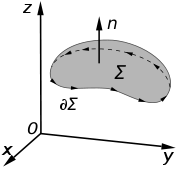 This is a (dualized) 1+1 dimensional case, for a 1-form (dualized because it is a statement about vector field
s). This special case is often just referred to as the Stokes' theorem in many introductory university vector calculus courses and as used in physics and engineering. It is also sometimes known as the curl theorem.
The classical Kelvin
–Stokes theorem:

which relates the surface integral
of the curl of a vector field
over a surface Σ in Euclidean three-space to the line integral
of the vector field over its boundary, is a special case of the general Stokes theorem (with ) once we identify a vector field with a 1 form using the metric on Euclidean three-space. The curve of the line integral, ∂Σ, must have positive orientation
, meaning that dr points counterclockwise when the surface normal, dΣ, points toward the viewer, following the right-hand rule
.
One consequence of the formula is that the field line
s of a vector field with zero curl cannot be closed contours.
The formula can be rewritten as:


where P, Q and R are the components of F.
These variants are frequently used:



The above listed subset of Maxwell's equations are valid for electromagnetic fields expressed in SI units. In other systems of units, such as CGS or Gaussian units
, the scaling factors for the terms differ. For example, in Gaussian units, Faraday's law of induction and Ampère's law take the forms
respectively, where c is the speed of light in vacuum.
(also known as the Divergence theorem or Gauss's theorem)

is a special case if we identify a vector field with the n−1 form obtained by contracting the vector field with the Euclidean volume form.
is immediately recognizable as the third integrand of both sides in the integral in terms of P, Q, and R cited above.
Integral
Integration is an important concept in mathematics and, together with its inverse, differentiation, is one of the two main operations in calculus...
of differential form
Differential form
In the mathematical fields of differential geometry and tensor calculus, differential forms are an approach to multivariable calculus that is independent of coordinates. Differential forms provide a better definition for integrands in calculus...
s on manifolds, which both simplifies and generalizes several theorem
Theorem
In mathematics, a theorem is a statement that has been proven on the basis of previously established statements, such as other theorems, and previously accepted statements, such as axioms...
s from vector calculus. Lord Kelvin
William Thomson, 1st Baron Kelvin
William Thomson, 1st Baron Kelvin OM, GCVO, PC, PRS, PRSE, was a mathematical physicist and engineer. At the University of Glasgow he did important work in the mathematical analysis of electricity and formulation of the first and second laws of thermodynamics, and did much to unify the emerging...
first discovered the result and communicated it to George Stokes in July 1850. Stokes set the theorem as a question on the 1854 Smith's Prize
Smith's Prize
The Smith's Prize was the name of each of two prizes awarded annually to two research students in theoretical Physics, mathematics and applied mathematics at the University of Cambridge, Cambridge, England.- History :...
exam, which led to the result bearing his name.
Introduction
The fundamental theorem of calculusFundamental theorem of calculus
The first part of the theorem, sometimes called the first fundamental theorem of calculus, shows that an indefinite integration can be reversed by a differentiation...
states that the integral
Integral
Integration is an important concept in mathematics and, together with its inverse, differentiation, is one of the two main operations in calculus...
of a function f over the interval
Interval (mathematics)
In mathematics, a interval is a set of real numbers with the property that any number that lies between two numbers in the set is also included in the set. For example, the set of all numbers satisfying is an interval which contains and , as well as all numbers between them...
[a, b] can be calculated by finding an antiderivative
Antiderivative
In calculus, an "anti-derivative", antiderivative, primitive integral or indefinite integralof a function f is a function F whose derivative is equal to f, i.e., F ′ = f...
F of f:
Stokes' theorem is a vast generalization of this theorem in the following sense.
- By the choice of F,
 . In the parlance of differential formDifferential formIn the mathematical fields of differential geometry and tensor calculus, differential forms are an approach to multivariable calculus that is independent of coordinates. Differential forms provide a better definition for integrands in calculus...
s, this is saying that f(x) dx is the exterior derivativeExterior derivativeIn differential geometry, the exterior derivative extends the concept of the differential of a function, which is a 1-form, to differential forms of higher degree. Its current form was invented by Élie Cartan....
of the 0-form, i.e. function, F: in other words, that dF = f dx. The general Stokes theorem applies to higher differential forms instead of F.
 - A closed interval [a, b] is a simple example of a one-dimensional manifoldManifoldIn mathematics , a manifold is a topological space that on a small enough scale resembles the Euclidean space of a specific dimension, called the dimension of the manifold....
with boundary. Its boundary is the set consisting of the two points a and b. Integrating f over the interval may be generalized to integrating forms on a higher-dimensional manifold. Two technical conditions are needed: the manifold has to be orientable, and the form has to be compactly supported in order to give a well-defined integral. - The two points a and b form the boundary of the open interval. More generally, Stokes' theorem applies to oriented manifolds M with boundary. The boundary ∂M of M is itself a manifold and inherits a natural orientation from that of the manifold. For example, the natural orientation of the interval gives an orientation of the two boundary points. Intuitively, a inherits the opposite orientation as b, as they are at opposite ends of the interval. So, "integrating" F over two boundary points a, b is taking the difference F(b) − F(a).
In even simpler terms, one can consider that points can be thought of as the boundaries of curves, that is as 0-dimensional boundaries of 1-dimensional manifolds. So, just like one can find the value of an Integral (f = dF) over a 1-dimensional manifolds ([a,b]) by considering the anti-derivative (F) at the 0-dimensional boundaries ([a,b]), one can generalize the fundamental theorem of calculus, with a few additional caveats, to deal with the value of integrals (dω) over n-dimensional manifolds (Ω) by considering the anti-derivative (ω) at the (n-1)-dimensional boundaries (dΩ) of the manifold.
So the fundamental theorem reads:
General formulation
Let be an oriented smooth manifold of dimensionDimension
In physics and mathematics, the dimension of a space or object is informally defined as the minimum number of coordinates needed to specify any point within it. Thus a line has a dimension of one because only one coordinate is needed to specify a point on it...
n and let
be an n-differential formDifferential form
In the mathematical fields of differential geometry and tensor calculus, differential forms are an approach to multivariable calculus that is independent of coordinates. Differential forms provide a better definition for integrands in calculus...
that is compactly supported on
. First, suppose that α is compactly supported in the domain of a single, orientedOrientation (mathematics)
In mathematics, orientation is a notion that in two dimensions allows one to say when a cycle goes around clockwise or counterclockwise, and in three dimensions when a figure is left-handed or right-handed. In linear algebra, the notion of orientation makes sense in arbitrary dimensions...
coordinate chart {U, φ}. In this case, we define the integral of
over asi.e., via the pullback of α to Rn.
More generally, the integral of
over is defined as follows: Let {ψi} be a partition of unity associated with a locally finiteLocally finite collection
In the mathematical field of topology, local finiteness is a property of collections of subsets of a topological space. It is fundamental in the study of paracompactness and topological dimension....
cover
Cover (topology)
In mathematics, a cover of a set X is a collection of sets whose union contains X as a subset. Formally, ifC = \lbrace U_\alpha: \alpha \in A\rbrace...
{Ui, φi} of (consistently oriented) coordinate charts, then define the integral
where each term in the sum is evaluated by pulling back to Rn as described above. This quantity is well-defined; that is, it does not depend on the choice of the coordinate charts, nor the partition of unity.
Stokes' theorem reads: If
is an (n − 1)-form with compact support on and denotes the boundaryBoundary (topology)
In topology and mathematics in general, the boundary of a subset S of a topological space X is the set of points which can be approached both from S and from the outside of S. More precisely, it is the set of points in the closure of S, not belonging to the interior of S. An element of the boundary...
of
with its induced orientationOrientation (mathematics)
In mathematics, orientation is a notion that in two dimensions allows one to say when a cycle goes around clockwise or counterclockwise, and in three dimensions when a figure is left-handed or right-handed. In linear algebra, the notion of orientation makes sense in arbitrary dimensions...
, then
Here
is the exterior derivativeExterior derivative
In differential geometry, the exterior derivative extends the concept of the differential of a function, which is a 1-form, to differential forms of higher degree. Its current form was invented by Élie Cartan....
, which is defined using the manifold structure only. On the r.h.s., a circle is sometimes used within the integral sign to stress the fact that the (n-1)-manifold
is closed. The r.h.s. of the equation is often used to formulate integral laws; the l.h.s. then leads to equivalent differential formulations (see below).The theorem is often used in situations where
is an embedded oriented submanifold of some bigger manifold on which the form is defined.A proof becomes particularly simple if the submanifold
is a so-called "normal manifold", as in the figure on the r.h.s., which can be segmented into vertical stripes (e.g. parallel to the xn direction), such that after a partial integration concerning this variable, nontrivial contributions come only from the upper and lower boundary surfaces (coloured in yellow and red, respectively), where the complementary mutual orientations are visible through the arrows.Topological reading; integration over chains
Let M be a smooth manifold. A smooth singular k-simplex of M is a smooth map from the standard simplex in Rk to M. The free abelian group, Sk, generated by singular k-simplices is said to consist of singular k-chainsChain (algebraic topology)
In algebraic topology, a simplicial k-chainis a formal linear combination of k-simplices.-Integration on chains:Integration is defined on chains by taking the linear combination of integrals over the simplices in the chain with coefficients typically integers.The set of all k-chains forms a group...
of M. These groups, together with boundary map
Boundary (topology)
In topology and mathematics in general, the boundary of a subset S of a topological space X is the set of points which can be approached both from S and from the outside of S. More precisely, it is the set of points in the closure of S, not belonging to the interior of S. An element of the boundary...
, ∂, define a chain complex
Chain complex
In mathematics, chain complex and cochain complex are constructs originally used in the field of algebraic topology. They are algebraic means of representing the relationships between the cycles and boundaries in various dimensions of some "space". Here the "space" could be a topological space or...
. The corresponding homology (resp. cohomology) is called the smooth singular homology
Singular homology
In algebraic topology, a branch of mathematics, singular homology refers to the study of a certain set of algebraic invariants of a topological space X, the so-called homology groups H_n....
(resp. cohomology) of M.
On the other hand, the differential forms, with exterior derivative, d, as the connecting map, form a cochain complex, which defines de Rham cohomology
De Rham cohomology
In mathematics, de Rham cohomology is a tool belonging both to algebraic topology and to differential topology, capable of expressing basic topological information about smooth manifolds in a form particularly adapted to computation and the concrete representation of cohomology classes...
.
Differential k-forms can be integrated over a k-simplex in a natural way, by pulling back to Rk. Extending by linearity allows one to integrate over chains. This gives a linear map from the space of k-forms to the k-th group in the singular cochain, Sk*, the linear functionals on Sk. In other words, a k-form
defines a functionalon the k-chains. Stokes' theorem says that this is a chain map from de Rham cohomology to singular cohomology; the exterior derivative, d, behaves like the dual of ∂ on forms. This gives a homomorphism from de Rham cohomology to singular cohomology. On the level of forms, this means:
- closed forms, i.e.,
 , have zero integral over boundaries, i.e. over manifolds that can be written as
  , and
, and - exact forms, i.e.,
 , have zero integral over cycles, i.e. if the boundaries sum up to the empty set:
  .
.
De Rham's theorem shows that this homomorphism is in fact an isomorphism. So the converse to 1 and 2 above hold true. In other words, if {ci} are cycles generating the k-th homology group, then for any corresponding real numbers, {ai}, there exist a closed form,
, such that:and this form is unique up to exact forms.
Underlying principle
tilings (or, equivalently, simplices
Simplex
In geometry, a simplex is a generalization of the notion of a triangle or tetrahedron to arbitrary dimension. Specifically, an n-simplex is an n-dimensional polytope which is the convex hull of its n + 1 vertices. For example, a 2-simplex is a triangle, a 3-simplex is a tetrahedron,...
), which usually is not difficult.
Special cases
The general form of the Stokes theorem using differential forms is more powerful and easier to use than the special cases. Because in Cartesian coordinates the traditional versions can be formulated without the machinery of differential geometry they are more accessible, older and have familiar names. The traditional forms are often considered more convenient by practicing scientists and engineers but the non-naturalness of the traditional formulation becomes apparent when using other coordinate systems, even familiar ones like spherical or cylindrical coordinates. There is potential for confusion in the way names are applied, and the use of dual formulations.Kelvin–Stokes theorem
Vector field
In vector calculus, a vector field is an assignmentof a vector to each point in a subset of Euclidean space. A vector field in the plane for instance can be visualized as an arrow, with a given magnitude and direction, attached to each point in the plane...
s). This special case is often just referred to as the Stokes' theorem in many introductory university vector calculus courses and as used in physics and engineering. It is also sometimes known as the curl theorem.
The classical Kelvin
William Thomson, 1st Baron Kelvin
William Thomson, 1st Baron Kelvin OM, GCVO, PC, PRS, PRSE, was a mathematical physicist and engineer. At the University of Glasgow he did important work in the mathematical analysis of electricity and formulation of the first and second laws of thermodynamics, and did much to unify the emerging...
–Stokes theorem:
which relates the surface integral
Surface integral
In mathematics, a surface integral is a definite integral taken over a surface ; it can be thought of as the double integral analog of the line integral...
of the curl of a vector field
Vector field
In vector calculus, a vector field is an assignmentof a vector to each point in a subset of Euclidean space. A vector field in the plane for instance can be visualized as an arrow, with a given magnitude and direction, attached to each point in the plane...
over a surface Σ in Euclidean three-space to the line integral
Line integral
In mathematics, a line integral is an integral where the function to be integrated is evaluated along a curve.The function to be integrated may be a scalar field or a vector field...
of the vector field over its boundary, is a special case of the general Stokes theorem (with ) once we identify a vector field with a 1 form using the metric on Euclidean three-space. The curve of the line integral, ∂Σ, must have positive orientation
Curve orientation
In mathematics, a positively oriented curve is a planar simple closed curve such that when traveling on it one always has the curve interior to the left...
, meaning that dr points counterclockwise when the surface normal, dΣ, points toward the viewer, following the right-hand rule
Right-hand rule
In mathematics and physics, the right-hand rule is a common mnemonic for understanding notation conventions for vectors in 3 dimensions. It was invented for use in electromagnetism by British physicist John Ambrose Fleming in the late 19th century....
.
One consequence of the formula is that the field line
Field line
A field line is a locus that is defined by a vector field and a starting location within the field. Field lines are useful for visualizing vector fields, which are otherwise hard to depict...
s of a vector field with zero curl cannot be closed contours.
The formula can be rewritten as:
where P, Q and R are the components of F.
These variants are frequently used:
In electromagnetism
Two of the four Maxwell equations involve curls of 3-D vector fields and their differential and integral forms are related by the Kelvin–Stokes theorem. Caution must be taken to avoid cases with moving boundaries: the partial time derivatives are intended to exclude such cases. If moving boundaries are included, interchange of integration and differentiation introduces terms related to boundary motion not included in the results below:| Name | Differential Partial differential equation In mathematics, partial differential equations are a type of differential equation, i.e., a relation involving an unknown function of several independent variables and their partial derivatives with respect to those variables... form |
Integral Integral Integration is an important concept in mathematics and, together with its inverse, differentiation, is one of the two main operations in calculus... form (using Kelvin–Stokes theorem plus relativistic invariance,  ) ) |
|---|---|---|
| Maxwell-Faraday equation Faraday's law of induction Faraday's law of induction Faraday's law of induction dates from the 1830s, and is a basic law of electromagnetism relating to the operating principles of transformers, inductors, and many types of electrical motors and generators... : |
 |
 (with C and S not necessarily stationary) (with C and S not necessarily stationary) |
| Ampère's law Ampère's law In classical electromagnetism, Ampère's circuital law, discovered by André-Marie Ampère in 1826, relates the integrated magnetic field around a closed loop to the electric current passing through the loop... (with Maxwell's extension): |
 |
 (with C and S not necessarily stationary) (with C and S not necessarily stationary) |
The above listed subset of Maxwell's equations are valid for electromagnetic fields expressed in SI units. In other systems of units, such as CGS or Gaussian units
Gaussian units
Gaussian units comprise a metric system of physical units. This system is the most common of the several electromagnetic unit systems based on cgs units. It is also called the Gaussian unit system, Gaussian-cgs units, or often just cgs units...
, the scaling factors for the terms differ. For example, in Gaussian units, Faraday's law of induction and Ampère's law take the forms


respectively, where c is the speed of light in vacuum.
Divergence theorem
Likewise the Ostrogradsky-Gauss theoremDivergence theorem
In vector calculus, the divergence theorem, also known as Gauss' theorem , Ostrogradsky's theorem , or Gauss–Ostrogradsky theorem is a result that relates the flow of a vector field through a surface to the behavior of the vector field inside the surface.More precisely, the divergence theorem...
(also known as the Divergence theorem or Gauss's theorem)
is a special case if we identify a vector field with the n−1 form obtained by contracting the vector field with the Euclidean volume form.
Green's theorem
Green's theoremGreen's theorem
In mathematics, Green's theorem gives the relationship between a line integral around a simple closed curve C and a double integral over the plane region D bounded by C...
is immediately recognizable as the third integrand of both sides in the integral in terms of P, Q, and R cited above.
Further reading
- Joos, Georg. Theoretische Physik. 13th ed. Akademische Verlagsgesellschaft Wiesbaden 1980. ISBN 3-400-00013-2
- Marsden, Jerrold E.Jerrold E. MarsdenJerrold Eldon Marsden , was an applied mathematician. He was the Carl F. Braun Professor of Engineering and Control & Dynamical Systems at the California Institute of Technology. Marsden is listed as an ISI highly cited researcher.-Career:Marsden earned his B.Sc...
, Anthony Tromba. Vector Calculus. 5th edition W. H. Freeman: 2003. - Lee, John. Introduction to Smooth Manifolds. Springer-Verlag 2003. ISBN 978-0-387-95448-6
- Stewart, James. Calculus: Concepts and Contexts. 2nd ed. Pacific Grove, CA: Brooks/Cole, 2001.
- Stewart, James. Calculus: Early Transcendental Functions. 5th ed. Brooks/Cole, 2003.