

Stocks

Encyclopedia
Physical punishment
Physical punishment is any form of penalty in a judicial, educational or domestic setting that takes a physical form, by the infliction on the offender of pain, injury, discomfort or humiliation...
involving public humiliation
Public humiliation
Public humiliation was often used by local communities to punish minor and petty criminals before the age of large, modern prisons .- Shameful exposure :...
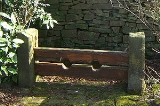
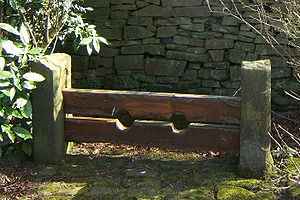
. The stocks partially immobilized its victims and they were often exposed in a public place such as the site of a market to the scorn of those who passed by. Since the purpose of putting offenders in the stocks was to expose them to ridicule and mockery, passers-by were encouraged to throw at those being punished mud, rotten eggs, moldy fruit and vegetables, smelly fish, offal, and excrement (both animal and human). Consequently, many of those who sat in the stocks were very dirty and smelly by the time that they were let out.
Form and application
The stocks are similar to the pilloryPillory
The pillory was a device made of a wooden or metal framework erected on a post, with holes for securing the head and hands, formerly used for punishment by public humiliation and often further physical abuse, sometimes lethal...
and the pranger
Pranger
The pranger is a German physical punishment device related to the stocks and the pillory. The Middle Low German word means something that pinches badly.The pranger chained the victim's neck to a pair of leg restraints fastened around the ankles...
, as each consists of large, hinged, wooden boards; the difference, however, is that when a person is placed in the stocks, their feet are locked in place, and sometimes as well their hands or head, or these may be chained.
With stocks, boards are placed around the legs or the wrists, whereas in the pillory they are placed around the arms and neck and fixed to a pole, and the victim stands. However, the terms can be confused, and many people refer to the pillory as the stocks.
Since stocks served an outdoor public form of punishment its victims were subjected to the daily and nightly weather. As a consequence it was not uncommon for people kept in stocks over several days to die from heat exhaustion or hypothermia
Hypothermia
Hypothermia is a condition in which core temperature drops below the required temperature for normal metabolism and body functions which is defined as . Body temperature is usually maintained near a constant level of through biologic homeostasis or thermoregulation...
.
The practice of using stocks continues to be cited as an example of torture
Torture
Torture is the act of inflicting severe pain as a means of punishment, revenge, forcing information or a confession, or simply as an act of cruelty. Throughout history, torture has often been used as a method of political re-education, interrogation, punishment, and coercion...
, cruel and unusual punishment
Cruel and unusual punishment
Cruel and unusual punishment is a phrase describing criminal punishment which is considered unacceptable due to the suffering or humiliation it inflicts on the condemned person...
. Insult
Insult
An insult is an expression, statement which is considered degrading and offensive. Insults may be intentional or accidental...
ing, kick
Kick
In combat sports and hand-to-hand combat, a kick is a physical strike using the foot, leg, or knee . This type of attack is used frequently, especially in stand-up fighting...
ing, spitting
Spitting
Spitting or expectoration is the act of forcibly ejecting saliva or other substances from the mouth. It is currently considered rude and a social taboo in many parts of the world including the West, while in some other parts of the world it is considered more acceptable...
and in some cases urinating and defecating on its victims could be applied at the free will of any of those present.
Historical uses
Desertion
In military terminology, desertion is the abandonment of a "duty" or post without permission and is done with the intention of not returning...
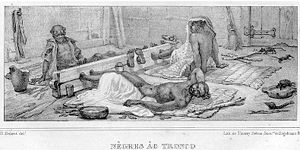
or for dereliction of military duty. In the stocks, an offender's hands and head, or sometimes their ankles, would be placed and locked through two or three holes in the center of a board. Either before or after this the wrongdoer might have their footwear removed, exposing their bare feet
Foot
The foot is an anatomical structure found in many vertebrates. It is the terminal portion of a limb which bears weight and allows locomotion. In many animals with feet, the foot is a separate organ at the terminal part of the leg made up of one or more segments or bones, generally including claws...
. Exhibiting an offender's bare feet was considered a form of humiliation
Humiliation
Humiliation is the abasement of pride, which creates mortification or leads to a state of being humbled or reduced to lowliness or submission. It can be brought about through bullying, intimidation, physical or mental mistreatment or trickery, or by embarrassment if a person is revealed to have...
. Offenders were forced to carry out their punishments in the rain, during the heat of summer, or in freezing weather, and generally would receive only bread and water, plus anything brought by their friends. Finger pillories often went by the name of "finger stocks".
Public stocks were typically positioned in the most public place available, as public humiliation was a critical aspect of such punishment. Typically, a person condemned to the stocks was subjected to a variety of abuses, ranging from having refuse thrown at them, to paddling, tickling
Tickle torture
Tickle torture is the use of tickling to abuse, dominate, humiliate or even "prank" someone. The victim laughs even if he or she finds the experience unpleasant because the laughter is an innate reflex rather than social conditioning...
(the most common) or whipping of the unprotected feet (bastinado).
The stocks were used in Elizabethan England, and by the Puritan
Puritan
The Puritans were a significant grouping of English Protestants in the 16th and 17th centuries. Puritanism in this sense was founded by some Marian exiles from the clergy shortly after the accession of Elizabeth I of England in 1558, as an activist movement within the Church of England...
s in the colonial period of American history. Their last recorded use in the United Kingdom was in 1872 at Adpar
Adpar
Adpar, formerly Trefhedyn, is a village in Ceredigion, Wales now considered as a part of Newcastle Emlyn to which it is joined by a fine bridge across the River Teifi. Adpar used to be an ancient Welsh borough in its own right.-History:...
, Newcastle Emlyn
Newcastle Emlyn
Newcastle Emlyn is a town straddling the counties of Ceredigion and Carmarthenshire in west Wales and lying on the River Teifi.Adpar is the part of the town that lies on the Ceredigion side of the River Teifi...
, west Wales
Wales
Wales is a country that is part of the United Kingdom and the island of Great Britain, bordered by England to its east and the Atlantic Ocean and Irish Sea to its west. It has a population of three million, and a total area of 20,779 km²...
.
The Spanish conquistadores introduced stocks as a popular form of punishment and humiliation against those that impeded the consolidation of their settlements in the new world. They were still used in the 19th century in Latin America
Latin America
Latin America is a region of the Americas where Romance languages – particularly Spanish and Portuguese, and variably French – are primarily spoken. Latin America has an area of approximately 21,069,500 km² , almost 3.9% of the Earth's surface or 14.1% of its land surface area...
to punish indigenous miners in many countries for rebelling against their bosses.
Examples
An excellent example of stocks can be seen in Dromore, County DownDromore, County Down
Dromore is a small market town in the Banbridge District of County Down, Northern Ireland. It is south-west of Belfast, on the A1 Belfast – Dublin road. The 2001 Census recorded a population of 4,968 people....
, in Northern Ireland
Northern Ireland
Northern Ireland is one of the four countries of the United Kingdom. Situated in the north-east of the island of Ireland, it shares a border with the Republic of Ireland to the south and west...
. They are occasionally preserved in churches though as wooden devices they are naturally subject to the perils of rotting and decay.
Locations of examples in England
England
England is a country that is part of the United Kingdom. It shares land borders with Scotland to the north and Wales to the west; the Irish Sea is to the north west, the Celtic Sea to the south west, with the North Sea to the east and the English Channel to the south separating it from continental...
and Wales
Wales
Wales is a country that is part of the United Kingdom and the island of Great Britain, bordered by England to its east and the Atlantic Ocean and Irish Sea to its west. It has a population of three million, and a total area of 20,779 km²...
include:
- AldburyAldburyAldbury is a village and civil parish in Hertfordshire, England, near the borders of Bedfordshire and Buckinghamshire, in a valley close to Ashridge Park. The nearest town is Tring; Tring railway station, 1 mile west, is in the parish of Aldbury...
- ApethorpeApethorpeApethorpe is a village and civil parish in East Northamptonshire district of the shire county of Northamptonshire, England. The 2001 census records a population of 133....
, NorthamptonshireNorthamptonshireNorthamptonshire is a landlocked county in the English East Midlands, with a population of 629,676 as at the 2001 census. It has boundaries with the ceremonial counties of Warwickshire to the west, Leicestershire and Rutland to the north, Cambridgeshire to the east, Bedfordshire to the south-east,... - AxbridgeAxbridgeAxbridge is a town in Somerset, England, situated in the Sedgemoor district on the River Axe, near the southern edge of the Mendip Hills. The town population according to the 2001 census was 2,024.-History:...
, SomersetSomersetThe ceremonial and non-metropolitan county of Somerset in South West England borders Bristol and Gloucestershire to the north, Wiltshire to the east, Dorset to the south-east, and Devon to the south-west. It is partly bounded to the north and west by the Bristol Channel and the estuary of the... - CanewdonCanewdonCanewdon is a village in north Rochford District of Essex in England, approximately 4 miles northeast of the town of Rochford. Canewdon is situated on one of the highest hills of the Essex coastline from which St. Nicholas church affords wide views of the Crouch estuary. Canewdon parish extends...
, EssexEssexEssex is a ceremonial and non-metropolitan county in the East region of England, and one of the home counties. It is located to the northeast of Greater London. It borders with Cambridgeshire and Suffolk to the north, Hertfordshire to the west, Kent to the South and London to the south west... - Chapel en le Frith
- Chapeltown, LancashireChapeltown, LancashireChapeltown is a village of the civil parish of North Turton, in the Blackburn with Darwen unitary authority, in the north west of England. It is situated on the B6391 and lies on southern slopes of the West Pennine Moors. The village was once the historic centre of the old Turton Urban District.The...
- DunchurchDunchurchDunchurch is a civil parish and village on the south-western outskirts of Rugby in Warwickshire, England. The 2001 census recorded a population of 2,842 in the village.- History :...
, WarwickshireWarwickshireWarwickshire is a landlocked non-metropolitan county in the West Midlands region of England. The county town is Warwick, although the largest town is Nuneaton. The county is famous for being the birthplace of William Shakespeare... - FownhopeFownhopeFownhope is a village in Herefordshire, England, an area of outstanding natural beauty on the banks of the River Wye.The village has a church, primary school, two pubs, two hotels, a fitness/leisure centre, butcher's, forge and a hairdresser's...
, HerefordshireHerefordshireHerefordshire is a historic and ceremonial county in the West Midlands region of England. For Eurostat purposes it is a NUTS 3 region and is one of three counties that comprise the "Herefordshire, Worcestershire and Gloucestershire" NUTS 2 region. It also forms a unitary district known as the... - Grappenhall, CheshireGrappenhallGrappenhall is a suburban village in Warrington, Cheshire, England. It is situated along the Bridgewater Canal, and forms one of the principal settlements of Grappenhall and Thelwall civil parish...
- HonleyHonleyHonley is a large village in West Yorkshire, England near to Holmfirth and Huddersfield situated on the banks of the River Holme in the Holme Valley. In 2001 it had a population of 5,897 according to the census.-Education:...
, YorkshireYorkshireYorkshire is a historic county of northern England and the largest in the United Kingdom. Because of its great size in comparison to other English counties, functions have been increasingly undertaken over time by its subdivisions, which have also been subject to periodic reform... - IrbyIrby, MerseysideIrby is a village on the Wirral Peninsula, England. The village covers an area of 20 square kilometres. To the north of Irby lies the associated hamlet of Irby Hill...
, WirralWirral PeninsulaWirral or the Wirral is a peninsula in North West England. It is bounded by three bodies of water: to the west by the River Dee, forming a boundary with Wales, to the east by the River Mersey and to the north by the Irish Sea. Both terms "Wirral" and "the Wirral" are used locally , although the... - KidwellyKidwellyKidwelly is a town in Carmarthenshire, west Wales, approximately north-west of the main town of Llanelli.It lies on the River Gwendraeth Fach above Carmarthen Bay. The town is twinned with French village St Jacut de la Mer.-History:...
, CarmarthenshireCarmarthenshireCarmarthenshire is a unitary authority in the south west of Wales and one of thirteen historic counties. It is the 3rd largest in Wales. Its three largest towns are Llanelli, Carmarthen and Ammanford... - KeevilKeevilKeevil is a village and civil parish in Wiltshire, England. The parish population has varied little since 1801.After the Second World War the barracks of RAF Keevil were used as a temporary home for Polish refugees. Today the small Ministry of Defence airfield at RAF Keevil is used for gliding at...
, WiltshireWiltshireWiltshire is a ceremonial county in South West England. It is landlocked and borders the counties of Dorset, Somerset, Hampshire, Gloucestershire, Oxfordshire and Berkshire. It contains the unitary authority of Swindon and covers... - Lymm, CheshireLymmLymm is a large village and civil parish within the Warrington borough of Cheshire, in North West England. Lymm was an urban district of Cheshire from 1894 to 1974. The civil parish of Lymm incorporates the hamlets of Booths Hill, Broomedge, Church Green, Deansgreen, Heatley, Heatley Heath, Little...
- NottinghamNottinghamNottingham is a city and unitary authority in the East Midlands of England. It is located in the ceremonial county of Nottinghamshire and represents one of eight members of the English Core Cities Group...
- Prestbury, CheshirePrestbury, CheshirePrestbury is a village, civil parish and ecclesiastical parish in the unitary authority of Cheshire East and the ceremonial county of Cheshire, England. Prestbury is a long, narrow parish covering 1,165 hectares to the west of the Peak Park foothills and to the east of the sandstone ridge which is...
- Rivington, Lancashire
- Seamer, North Yorkshire
- Stow-on-the-Wold, GloucestershireStow-on-the-WoldStow-on-the-Wold is a market town and civil parish in Gloucestershire, England. It is situated on top of an 800 ft hill, at the convergence of a number of major roads through the Cotswolds, including the Fosse Way . The town was founded as a planned market place by Norman lords to take...
- Kings Sutton, OxfordshireOxfordshireOxfordshire is a county in the South East region of England, bordering on Warwickshire and Northamptonshire , Buckinghamshire , Berkshire , Wiltshire and Gloucestershire ....