

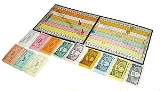
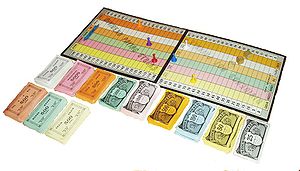
Stock Ticker

Encyclopedia
Board game
A board game is a game which involves counters or pieces being moved on a pre-marked surface or "board", according to a set of rules. Games may be based on pure strategy, chance or a mixture of the two, and usually have a goal which a player aims to achieve...
that was popular upon its release and is still played today. It was released by Copp-Clark Publishing, a venerable Canadian
Canada
Canada is a North American country consisting of ten provinces and three territories. Located in the northern part of the continent, it extends from the Atlantic Ocean in the east to the Pacific Ocean in the west, and northward into the Arctic Ocean...
publisher.
Game play
The game has six stockStock
The capital stock of a business entity represents the original capital paid into or invested in the business by its founders. It serves as a security for the creditors of a business since it cannot be withdrawn to the detriment of the creditors...
s, which in fact are commodities
Commodity
In economics, a commodity is the generic term for any marketable item produced to satisfy wants or needs. Economic commodities comprise goods and services....
. These six are gold
Gold
Gold is a chemical element with the symbol Au and an atomic number of 79. Gold is a dense, soft, shiny, malleable and ductile metal. Pure gold has a bright yellow color and luster traditionally considered attractive, which it maintains without oxidizing in air or water. Chemically, gold is a...
, silver
Silver
Silver is a metallic chemical element with the chemical symbol Ag and atomic number 47. A soft, white, lustrous transition metal, it has the highest electrical conductivity of any element and the highest thermal conductivity of any metal...
, Bond
Bond (finance)
In finance, a bond is a debt security, in which the authorized issuer owes the holders a debt and, depending on the terms of the bond, is obliged to pay interest to use and/or to repay the principal at a later date, termed maturity...
s, oil
Petroleum
Petroleum or crude oil is a naturally occurring, flammable liquid consisting of a complex mixture of hydrocarbons of various molecular weights and other liquid organic compounds, that are found in geologic formations beneath the Earth's surface. Petroleum is recovered mostly through oil drilling...
, industrials
Industry
Industry refers to the production of an economic good or service within an economy.-Industrial sectors:There are four key industrial economic sectors: the primary sector, largely raw material extraction industries such as mining and farming; the secondary sector, involving refining, construction,...
, and grain
Cereal
Cereals are grasses cultivated for the edible components of their grain , composed of the endosperm, germ, and bran...
. During gameplay all the stocks are identical. Each stock begins costing a dollar apiece. Players are given starting money of $5000 and they buy shares in groups of 500, 1000, 2000, or 5000. The stocks move based on the throw of three dice. The first die picks the stock that will be affected, with one of the commodities on each side of the die. The second die determines what whether the stock will move up, down, or pay a dividend. The third die decides if the movement or dividend will be five, ten, or twenty cents. For instance a roll of Industrials, Down, 20 will move the industrials stock from its start value of $1.00 to 80 cents. A roll of Grain, Up, 5 would move grain up to $1.05.
Dividends are paid out only for any stocks that are at or above $1.00 in value. For instance, a five cent dividend pays five cents for each share owned. Thus if a roll is Oil, Dividend, 10, and you own a thousand shares of Oil at $1.25 apiece you will receive a dividend of $100. Note that the dividend is not affected by the value of the share, with only the rule being that stocks worth less than $1.00 do not pay out when a dividend is rolled for them.
If a stock ever reaches $2.00 it splits
Stock split
A stock split or stock divide increases the number of shares in a public company. The price is adjusted such that the before and after market capitalization of the company remains the same and dilution does not occur. Options and warrants are included....
. Everyone who owns the stock doubles the number of sharers owned and the stock goes back to being worth $1.00. If a stock falls to being worth nothing all players lose their investment in that stock and must return their shares to the bank. The stock is then reset at $1.00.
There are two basic strategies to making money at the game. The first is to buy whichever stocks are safely in dividend paying territory. Using this method, if a stock splits and returns to the $1.00 value, the owner should sell out and reinvest in a stock that is safely above par. Similarly if a stock drops below a dollar, the owner should sell the shares. This technique relies upon the rule that any money invested in a stock paying dividends will earn a greater return than shares that are not paying dividends.
The second strategy is more risky, but can also be immensely profitable. It involves buying stocks when they are near the bottom of the board and at risk of being worth nothing. Since the dice-rolling system moves stocks by a fixed amount, rather than a percentage of their value, these stocks are very volatile. One thousand dollars will buy ten thousand shares of a ten-cent stock. While this stock could move down by ten or twenty and be wiped out, the most one would lose is a thousand dollars. However there is an equal chance that the stock will move up, and a single roll of Up 20 will triple the original investment. The possible return on investing in a five-cent stock, the cheapest possible, is even higher.
External links
- Stock Ticker at ProductsOfCanada
- Play Stock Ticker Classic at Stock Ticker Classic