
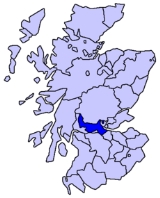
Stirlingshire or the
County of Stirling is a
registration countyA registration county was, in Great Britain and Ireland, a statistical unit used for the registration of births, deaths and marriages and for the output of census information. In Scotland registration counties are used for land registration purposes....
of
ScotlandScotland is a country that is part of the United Kingdom. Occupying the northern third of the island of Great Britain, it shares a border with England to the south and is bounded by the North Sea to the east, the Atlantic Ocean to the north and west, and the North Channel and Irish Sea to the...
, based around
StirlingStirling is a city and former ancient burgh in Scotland, and is at the heart of the wider Stirling council area. The city is clustered around a large fortress and medieval old-town beside the River Forth...
, the former
county townA county town is a county's administrative centre in the United Kingdom or Ireland. County towns are usually the location of administrative or judicial functions, or established over time as the de facto main town of a county. The concept of a county town eventually became detached from its...
. It borders
PerthshirePerthshire, officially the County of Perth , is a registration county in central Scotland. It extends from Strathmore in the east, to the Pass of Drumochter in the north, Rannoch Moor and Ben Lui in the west, and Aberfoyle in the south...
to the north,
ClackmannanshireClackmannanshire, often abbreviated to Clacks is a local government council area in Scotland, and a lieutenancy area, bordering Perth and Kinross, Stirling and Fife.As Scotland's smallest historic county, it is often nicknamed 'The Wee County'....
and
West LothianWest Lothian is one of the 32 unitary council areas in Scotland, and a Lieutenancy area. It borders the City of Edinburgh, Falkirk, North Lanarkshire, the Scottish Borders and South Lanarkshire....
to the east,
LanarkshireLanarkshire or the County of Lanark ) is a Lieutenancy area, registration county and former local government county in the central Lowlands of Scotland...
to the south, and
DunbartonshireDunbartonshire or the County of Dumbarton is a lieutenancy area and registration county in the west central Lowlands of Scotland lying to the north of the River Clyde. Until 1975 it was a county used as a primary unit of local government with its county town and administrative centre at the town...
to the south-west.
Until 1975 it was a
countyThe counties of Scotland were the principal local government divisions of Scotland until 1975. Scotland's current lieutenancy areas and registration counties are largely based on them. They are often referred to as historic counties....
. Until the 1890s the county had two small exclaves: part of the parish of
LogieIf you searched for Logie you may be looking for:*Logie, Dundee, a residential area in the City of Dundee, Scotland*Logie Coldstone, an Aberdeenshire village north of the River Dee in Scotland*The Logie Award, the Australian television industry awards...
, which was surrounded by
PerthshirePerthshire, officially the County of Perth , is a registration county in central Scotland. It extends from Strathmore in the east, to the Pass of Drumochter in the north, Rannoch Moor and Ben Lui in the west, and Aberfoyle in the south...
, and the parish of
Alva- People :*A. Shanker Alva , Indian politician and lawyer*Bartolomé de Alva , Novohispanic mestizo secular priest and Nahuatl translator*Jeevaraj Alva , Indian politician...
, locally in
ClackmannanshireClackmannanshire, often abbreviated to Clacks is a local government council area in Scotland, and a lieutenancy area, bordering Perth and Kinross, Stirling and Fife.As Scotland's smallest historic county, it is often nicknamed 'The Wee County'....
. The Perthshire part of Logie was added to Stirlingshire, while Alva was annexed by Clackmannanshire.
In 1975 most of Stirlingshire was included in the Central Region, with Kilsyth and surrounding area becoming part of Strathclyde Region. Since 1996 the area of the former county has been part of the
council areaFor local government purposes, Scotland is divided into 32 areas designated as "council areas" which are all governed by unitary authorities designated as "councils"...
s of
East DunbartonshireThis article is about the East Dunbartonshire council area of Scotland. See also East Dunbartonshire .East Dunbartonshire is one of the 32 council areas of Scotland. It borders onto the north-west of the City of Glasgow. It contains many of the suburbs of Glasgow as well as containing many of...
,
FalkirkFalkirk is one of the 32 unitary authority council areas in Scotland. It borders onto North Lanarkshire to the south west, Stirling to the north west, West Lothian to the south east and, across the Firth of Forth to the north east, Fife and Clackmannanshire...
,
North LanarkshireNorth Lanarkshire is one of 32 council areas in Scotland. It borders onto the northeast of the City of Glasgow and contains much of Glasgow's suburbs and commuter towns and villages. It also borders Stirling, Falkirk, East Dunbartonshire, West Lothian and South Lanarkshire...
and
StirlingStirling is one of the 32 unitary local government council areas of Scotland, and has a population of about 87,000 . It was created under the Local Government etc Act 1994 with the boundaries of the Stirling district of the former Central local government region, and it covers most of the former...
.
Coat of arms
The County Council of Stirling was granted a
coat of armsA coat of arms is a unique heraldic design on a shield or escutcheon or on a surcoat or tabard used to cover and protect armour and to identify the wearer. Thus the term is often stated as "coat-armour", because it was anciently displayed on the front of a coat of cloth...
by Lord Lyon King of Arms on September 29, 1890. The design of the arms commemorated the Scottish victory at the
Battle of BannockburnThe Battle of Bannockburn was a significant Scottish victory in the Wars of Scottish Independence...
in the county. On the silver
saltireA saltire, or Saint Andrew's Cross, is a heraldic symbol in the form of a diagonal cross or letter ex . Saint Andrew is said to have been martyred on such a cross....
on blue of St Andrew was placed the rampant red lion from the royal arms of Scotland. Around this were placed two caltraps and two spur-rowels recalling the use of the weapons against the English cavalry.
On the abolition of the county council in 1975, the arms were regranted to Stirling District Council. They were regranted a second time in 1996 to the present Stirling Council, with the addition of supporters.
Subdivisions
Burghs
Until 1975 the county contained the following burghs:
- The Royal Burgh
A royal burgh was a type of Scottish burgh which had been founded by, or subsequently granted, a royal charter. Although abolished in 1975, the term is still used in many of the former burghs....
of StirlingStirling is a city and former ancient burgh in Scotland, and is at the heart of the wider Stirling council area. The city is clustered around a large fortress and medieval old-town beside the River Forth...
(from the 12th century) (No. 2 on map)
- The Burgh of Bridge of Allan
Bridge of Allan is a town in Stirling council area in Scotland, just north of the city of Stirling. It was formerly administered by Stirlingshire and Central Regional Council....
(a police burghA police burgh was a Scottish burgh which had adopted a “police system” for governing the town. They existed from 1833 to 1975.-The 1833 act:The first police burghs were created under the Burgh Police Act, 1833...
from 1870) (1)
- The Burgh of Denny
Denny is a town in the Falkirk council area of Scotland, formerly in the county of Stirlingshire. It is situated west of Falkirk, and north-east of Cumbernauld, adjacent to both the M80 and M876 motorways...
and DunipaceDunipace is a village in the west of the Falkirk council area of Scotland. The village is south of Stirling and north-west of Falkirk. The village is situated on the north bank of the River Carron and adjoins the town of Denny to the south of the river....
(a police burgh from 1877) (4)
- The Burgh of Falkirk
Falkirk is a town in the Central Lowlands of Scotland. It lies in the Forth Valley, almost midway between the two most populous cities of Scotland; north-west of Edinburgh and north-east of Glasgow....
(a burgh of baronyA burgh of barony is a type of Scottish town .They were distinct from royal burghs as the title was granted to a tenant-in-chief, a landowner who held his estates directly from the crown....
from 1600, reformed 1832) (5)
- The Burgh of Grangemouth
Grangemouth is a town and former burgh in the council area of Falkirk, Scotland. The town lies in the Forth Valley, on the banks of the Firth of Forth, east of Falkirk, west of Bo'ness and south-east of Stirling. Grangemouth had a resident population of 17,906 according to the 2001...
(a police burgh from 1877) (6)
- The Burgh of Kilsyth
Kilsyth is a town of 10,100 roughly halfway between Glasgow and Stirling in North Lanarkshire, Scotland.-Location:...
(a burgh of barony from 1620, a police burgh from 1878) (3)
In 1930 Falkirk and Stirling became
large burghIn 1930, the Scottish burghs were split into two types, large burghs and small burghs. The councils of large burghs had more responsibilities and power than those of small burghs....
s, taking over some of the duties of the county council. The remaining four burghs became "small burghs", with limited powers.
Civil parishes
Following the boundary changes caused by the
Local Government (Scotland) Act 1889The Local Government Act 1889 is an Act of the Parliament of the United Kingdom which was passed on 26 August 1889. The main effect of the Act was to establish elected county councils in Scotland...
, the county contained the following civil parishes:
- Airth
Airth is a Royal Burgh, village, former trading port and civil parish in Falkirk, Scotland. It is north of Falkirk town and sits on the banks of the River Forth. Airth lies on the A905 road between Grangemouth and Stirling and is overlooked by Airth Castle, the village retains two market crosses...
(No.1 on the map)
- Baldernock
Baldernock is a small parish in East Dunbartonshire , Scotland, ten miles to the north of Glasgow's city centre.-Geography:...
(2)
- Balfron
Balfron, is a village in the Stirling council area of Scotland. It is situated near Endrick Water on the A875 road, 18 miles west of Stirling and 16 miles north of Glasgow. Although a rural settlement, it lies within commuting distance of Glasgow, and serves as a dormitory town.-History:The name...
(3)
- Bothkennar (4)
- Buchanan
- People :* Buchanan * James Buchanan, 15th President of the United States* James M. Buchanan, Nobel Prize-winning American economist.- Places :In Africa:* Buchanan, Liberia, a large coastal townIn Canada:* Buchanan, Saskatchewan...
(5)
- Campsie
Campsie is a hilly district in Stirlingshire, Scotland. It is noted for the beauty of Campsie Glen and the grandeur of the mountains known as the Campsie Fells.-See also:* Milton of Campsie* Campsie Fells* Clachan of Campsie...
(6)
- Denny
Denny is a town in the Falkirk council area of Scotland, formerly in the county of Stirlingshire. It is situated west of Falkirk, and north-east of Cumbernauld, adjacent to both the M80 and M876 motorways...
(7)
- Drymen
Drymen is a village in Stirling district in central Scotland. Drymen lies to the west of the Campsie Fells and enjoys views to Dumgoyne on the east and to Loch Lomond on the west...
(8)
- Dunipace
Dunipace is a village in the west of the Falkirk council area of Scotland. The village is south of Stirling and north-west of Falkirk. The village is situated on the north bank of the River Carron and adjoins the town of Denny to the south of the river....
(9)
- Falkirk
Falkirk is a town in the Central Lowlands of Scotland. It lies in the Forth Valley, almost midway between the two most populous cities of Scotland; north-west of Edinburgh and north-east of Glasgow....
(10)
- Fintry
Fintry is a small village in central Scotland, nestled in the strath of the Endrick Water between the Campsie Fells and the Fintry Hills, some 19 miles north of Glasgow. It is within the local government council area of Stirling...
(11)
- Gargunnock
Gargunnock is a small village in the Stirling council area approximately seven miles west of Stirling, in Scotland. The 2001 census population was 944...
(12)
- Killearn
Killearn is a small village of approximately 1700 people in the Stirling council area of Scotland. The village name stems from the Gaelic Cill Earnain, meaning Ernan's Church; the Ernan in question presumably being one of the canonised individuals of that name who were both relatives and followers...
(13)
- Kilsyth
Kilsyth is a town of 10,100 roughly halfway between Glasgow and Stirling in North Lanarkshire, Scotland.-Location:...
(14)
- Kippen
Kippen is a small village approximately west of the city of Stirling, Scotland. It lies between the Gargunnock and Fintry hills and overlooks the strath of the River Forth. The name is believed to come from Scottish Gaelic, ceapan, meaning "place of the little stump", "outcrop" or "block". The...
(15)
- Larbert
Larbert is a small town in the Falkirk council area of Scotland. The town lies in the Forth Valley above the River Carron which flows from the west. Larbert is 3 miles from the shoreline of the Firth of Forth and 2.5 miles northwest of Falkirk, the main town in the area...
(16)
- Logie
If you searched for Logie you may be looking for:*Logie, Dundee, a residential area in the City of Dundee, Scotland*Logie Coldstone, an Aberdeenshire village north of the River Dee in Scotland*The Logie Award, the Australian television industry awards...
(23)
- Muiravonside (17)
- Polmont
Polmont is a village in the Falkirk council area of Central Scotland. It lies towards the east of the town of Falkirk, north of the Union Canal, which runs adjacent to the village....
(18)
- St. Ninians
St. Ninians is a long-standing settlement which is now a district of the city of Stirling in central Scotland. It is located approximately one mile south of the city centre....
(19)
- Slamannan
Slamannan is a village in the south of the Falkirk council area in Central Scotland. It is south-west of Falkirk, east of Cumbernauld and north-east of Airdrie....
(20)
- Strathblane
Strathblane is a village and parish in the registration county of Stirlingshire, situated in the southwestern part of the Stirling council area, in central Scotland. It lies at the foothills of the Campsie Fells and the Kilpatrick Hills on the Blane Water, north of Glasgow, east-southeast of...
(21)
- Stirling
Stirling is a city and former ancient burgh in Scotland, and is at the heart of the wider Stirling council area. The city is clustered around a large fortress and medieval old-town beside the River Forth...
(22)
In 1894 parish councils were established for the civil parishes, replacing the previous parochial boards. The parish councils were in turn replaced by district councils in 1930.
Districts
In 1930 the parishes ceased to be used for local government purposes, and the landward area of the county (the part outside the burghs) was divided into eight districts. These were abolished in 1975.
- County of Stirling Central No.1
- County of Stirling Central No.2 (Denny, Dunipace and Kilsyth areas)
- County of Stirling Eastern No.1 (parishes of Airth and Larbert)
- County of Stirling Eastern No.2 (Falkirk and Slamannan)
- County of Stirling Eastern No.3 (parishes of Polmont and Muiravonside)
- County of Stirling Western No.1
- County of Stirling Western No.2
- County of Stirling Western No.3 (Baldernock, Campsie, Strathblane)
Parliamentary constituencies
Following the
Act of UnionThe Acts of Union were two Parliamentary Acts - the Union with Scotland Act passed in 1706 by the Parliament of England, and the Union with England Act passed in 1707 by the Parliament of Scotland - which put into effect the terms of the Treaty of Union that had been agreed on 22 July 1706,...
, Stirlingshire returned members to the
House of CommonsThe House of Commons is the lower house of the Parliament of the United Kingdom, which also comprises the Sovereign and the House of Lords . Both Commons and Lords meet in the Palace of Westminster. The Commons is a democratically elected body, consisting of 650 members , who are known as Members...
of the
Parliament of the United KingdomThe Parliament of the United Kingdom of Great Britain and Northern Ireland is the supreme legislative body in the United Kingdom, British Crown dependencies and British overseas territories, located in London...
from 1708.
1707 - 1918
- The Royal Burgh of Stirling formed part of the Stirling burghs
Stirling Burghs was a district of burghs constituency of the House of Commons of the Parliament of the United Kingdom from 1708 to 1918. The constituency comprised the burghs of Stirling in Stirlingshire, Dunfermline, and Inverkeithing in Fife, Queensferry, in Linlithgowshire , and Culross, which...
constituency along with burghs in Fife and Perthshire.
- The Burgh of Falkirk formed part of Falkirk Burghs
Falkirk Burghs was a district of burghs constituency of the House of Commons of the Parliament of the United Kingdom from 1832 to 1918. The constituency comprised the burghs of Falkirk, Airdrie, Hamilton, Lanark and Linlithgow, lying in Stirlingshire, Lanarkshire and Linlithgowshire.In 1918,...
, along with burghs in Lanarkshire and Linlithgowshire.
- The remainder of the county returned a single member as the parliamentary county of Stirlingshire
Stirlingshire was a county constituency of the House of Commons of the Parliament of Great Britain and later of the Parliament of the United Kingdom from 1708 until 1918...
. The detached parish of Alva was annexed to the constituency of Clackmannanshire and KinrossClackmannanshire and Kinross-shire were constituencies of the House of Commons of Great Britain from 1708 to 1801 and of the House of Commons of the Parliament of the United Kingdom from 1801 to 1918....
by the Representation of the People (Scotland) Act 1832.
1918 - 1975
In 1918 seats in the House of Commons were redistributed. Stirlingshire was thereafter represented by three members of parliament.
- The burghs of Stirling, Falkirk and Grangemouth formed the Stirling and Falkirk burghs
Stirling and Falkirk Burghs was a parliamentary constituency represented in the House of Commons of the Parliament of the United Kingdom from 1918, comprising the burghs of Stirling, Falkirk and Grangemouth. It ceased to be a District of Burghs in 1950, but a constituency of the same name covering...
constituency. in 1974 the constituency was renamed Stirling, Falkirk and Grangemouth.
- The eastern part of the county (defined in 1948 and 1970 as the Eastern No.1, Eastern No.2 and Eastern No.3 Districts) was combined with Clackmannanshire to form Clackmannan and East Stirlingshire
Clackmannan and Eastern Stirlingshire was a parliamentary constituency in the Clackmannan area of Central Scotland. It returned one Member of Parliament to the House of Commons of the Parliament of the United Kingdom, elected by the first past the post system.The constituency was created for the...
- The remainder of the county was included in the constituency of West Stirlingshire (named Stirling and Clackmannan West until 1945). The area included in the constituency was defined in 1948 and 1970 as the burghs of Bridge of Allan, Denny and Dunipace and Kilsyth; and the Central No. 1, Central No. 2, Western No. 1, Western No. 2 and Western No. 3 districts.
These boundaries continued in use until 1983, when new constituencies were formed based on the regions and districts created in 1975.
External links