
All Topics  
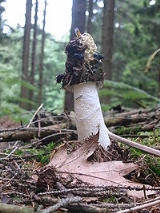
Stinkhorn

 
Stinkhorn

   Email Print
   Bookmark   Link


Stinkhorn


The Phallaceae are a family
Family (biology)

In biological classification, family is a taxonomic rank. Exact details of formal nomenclature depend on the Nomenclature Codes which applies....
 of fungi, commonly known as stinkhorn mushrooms. Belonging to the fungal order Phallales
Phallales

The Phallales are an Order of fungi that is more or less synonymous with the gomphoid-phalloid clade. At one time, the order was composed entirely of Stinkhorns , but has been expanded to include other families due to modern DNA analysis....
, the Phallaceae have a worldwide distribution, but are especially prevalent in tropical regions. They are known for their foul smelling sticky spore
Spore

In biology, a spore is a reproduction structure that is adapted for biological dispersal and surviving for extended periods of time in unfavorable conditions....
 masses, or gleba, borne on the end of stalks called the receptaculum. The characteristic fruiting body structure—a single, unbranched receptaculum with an externally attached gleba on the upper part—distinguish the Phallaceae from other families in the Phalalles.


Discussion
Ask a question about 'Stinkhorn'
Start a new discussion about 'Stinkhorn'
Answer questions from other users
Full Discussion Forum


Encyclopedia


The Phallaceae are a family
Family (biology)

In biological classification, family is a taxonomic rank. Exact details of formal nomenclature depend on the Nomenclature Codes which applies....
 of fungi, commonly known as stinkhorn mushrooms. Belonging to the fungal order Phallales
Phallales

The Phallales are an Order of fungi that is more or less synonymous with the gomphoid-phalloid clade. At one time, the order was composed entirely of Stinkhorns , but has been expanded to include other families due to modern DNA analysis....
, the Phallaceae have a worldwide distribution, but are especially prevalent in tropical regions. They are known for their foul smelling sticky spore
Spore

In biology, a spore is a reproduction structure that is adapted for biological dispersal and surviving for extended periods of time in unfavorable conditions....
 masses, or gleba, borne on the end of stalks called the receptaculum. The characteristic fruiting body structure—a single, unbranched receptaculum with an externally attached gleba on the upper part—distinguish the Phallaceae from other families in the Phalalles. The spore mass typically smells of carrion
Carrion

Carrion refers to the carcass of a dead animal. Carrion is an important food source for large carnivores and omnivores in most ecosystems. Examples of carrion-eaters, or scavengers, include Hyenas, Vultures, Virginia Opossum, Tasmanian Devils, Black Bears, Komodo Dragons, Bald Eagles, Raccoons and Blue-tongued lizards....
 or dung
Dung

Dung may refer to:* Dung, animal feces* Dung, Doubs, a commune in the Doubs department in France* Mundungus Fletcher , a character in Harry Potter...
, and attracts flies
Fly

True flies are insects of the Order Diptera , possessing a single pair of insect wing on the mesothorax and a pair of halteres, derived from the hind wings, on the metathorax....
 and other insects to help disperse the spores. Although there is a great diversity of body structure shape amongst the various genera, all species in the Phallaceae begin their development as oval or round structures known as eggs.

Description


Species in the Phallaceae are gasteroid—having spores that are produced internally. Fruiting bodies originate as a gelatinous, spherical or egg-shaped structure that may be completely or partially buried underground. The peridium, the outer layer of the egg, is white, or purple/red, with 2 or 3 layers. The outer layer is thin, membranous and elastic, while the innter layer is thicker, gelatinous and continuous. At maturity the peridium opens up and remains as a volva at the base of the receptaculum.

Hexenei
The fertile portion of the fruiting body is often borne on the end of a wide fleshy or spongy stalk (as in the Phallales
Phallales

The Phallales are an Order of fungi that is more or less synonymous with the gomphoid-phalloid clade. At one time, the order was composed entirely of Stinkhorns , but has been expanded to include other families due to modern DNA analysis....
), which may be cylindrical, star-shaped, or reticulate (forming a network). They may be brightly colored, sometimes with a lattice- or veil-like membrane enclosing and protecting the spores. The spore-containing substance, the gleba
Gleba

Gleba is the fleshy spore-bearing inner mass of fungi such as the puffball or stinkhorn.The gleba is a solid mass of spores, generated within an enclosed area within the sporocarp....
, is typically gelatin
Gelatin

Gelatin is a translucent, colorless, brittle, nearly tasteless solid, derived from the collagen inside animals' skin and mostly bones. It has been commonly used as a gelling agent in food, pharmaceutical, photography, and cosmetic manufacturing....
ous, often foetid-smelling, and deliquescent (becoming liquid from the absorption of water). The gleba is formed on the exterior face of the cap or the upper part of the receptacle.

The basidia are small and narrowly club-shaped or fusiform
Fusiform

Fusiform means having a spindle-like shape that is wide in the middle and tapers at both ends.* Aneurysms can be classified as saccular or fusiform...
, short-lived (evanescent), with 4 to 8 sterigmata. The spores are usually ellipsoid or cylindrical in shape, hyaline
Hyaline

The term hyaline literally refers to a substance with a glass-like appearance.In common medical histopathology usage, hyaline is a substance with a glassy, pink appearance after haematoxylin and eosin staining?most often an acellular, proteinaceous material....
 or pale brown, smooth, more or less smooth-walled, and truncate at the base.

Genera


Anthurus
Anthurus

Anthurus is a genus of fungi in the family Phallaceae.ReferencesExternal links...
 Kalchbr. & MacOwan (1880):Fruiting bodies have a short stalk from which arises a spore-bearing structure (the receptaculum) of 5–8 arched arms. These arms, initially joined at the top, disconnect and curve irregularly to expose the inner surface of each arm, which is covered with green spore-containing gleba. Spores are 3–4 × 1–1.5 µm. Aseroë
Aseroë

Asero? is a small genus of basidiomycete fungus of the family Phallaceae, though sometimes placed in the separate family Clathraceae. The genus name is derived from the Ancient Greek words Ase/as? 'disgust' and roe/??? 'juice'....
 Labill. (1800):Mature fruiting bodies contain a roughly cylindrical white or pinkish stalk approximately 6 × 2 cm, with a volva
Volva

The word volva can refer to:* V?lva, a Nordic or Germanic shaman* Volva * Volva , a mollusc genus....
 at the base. At the top is a bright red disc with a variable number of arms, typically 3–7 cm long. The gleba that is found on the disc and inner side of the arms is slimy, foetid, and green colored. Spores are hyaline
Hyaline

The term hyaline literally refers to a substance with a glass-like appearance.In common medical histopathology usage, hyaline is a substance with a glassy, pink appearance after haematoxylin and eosin staining?most often an acellular, proteinaceous material....
, with dimensions of 4–6 1.5–2 µm. Aseroë rubra
Aseroë rubra

Asero? rubra, commonly known as the anemone stinkhorn and sea anemone fungus, is a common and widespread Australian basidiomycete fungus recognizable for its foul odour of carrion and its anemone shape when mature....
, an Australian and Pacific species which has spread to Europe and North America. Clathrus
Clathrus

Clathrus is a small genus of basidiomycete fungus of the family Phallaceae, though sometimes placed in the separate family Clathraceae. As with other stinkhorn-like fungi, mature fruiting bodies are covered with olive-brown slime, containing spores, which attracts flies....
 P. Micheli
Pier Antonio Micheli

Pier Antonio Micheli was a noted Italy botanist, professor of botany in Pisa, curator of the Orto Botanico di Firenze, author of Nova plantarum genera iuxta Tournefortii methodum disposita....
 ex L.
Carolus Linnaeus

Carl Linnaeus was a Sweden botanist, physician, and zoologist, who laid the foundations for the modern scheme of binomial nomenclature. He is known as the father of modern alpha taxonomy, and is also considered one of the fathers of modern ecology....
:
Clathrus Columnatus Two
Fruiting bodies are latticed (clathrate), and made of hollow tubular arms that originate from the basal tissue within the volva. Spores are elliptical, smooth, hyaline, with dimensions of 4–6 ×1.5–2.5 µm. Examples include Clathrus ruber
Clathrus ruber

Clathrus ruber is a saprobic species of fungus in the family Phallaceae. It is commonly known as the latticed stinkhorn, the basket stinkhorn, or the red cage, alluding to the fruiting bodies that are shaped somewhat like a round or oval ball with interlaced or latticed branches....
, the lattice stinkhorn, Clathrus archeri
Clathrus archeri

Clathrus archeri , commonly known as Octopus Stinkhorn, is indigenous to Australia and Tasmania and an introduced species in Europe and North America....
, the octopus stinkhorn, and Clathrus columnatus, the columned stinkhorn. Gelopellis
Gelopellis

Gelopellis is a genus of fungi in the family Phallaceae.References...
 Zeller (1939):The species in this relatively rare genus have fruiting bodies that resemble the unopened egg of Mutinus, with the columnella (sterile tissue extending up into or through the gleba) occupying the place where the compressed receptacle would be in the latter genus. Ileodictyon
Ileodictyon

Ileodictyon is a genus of fungi in the family Phallaceae.ReferencesExternal links...
 Tul.
Louis René Tulasne

Louis Ren? Tulasne, aka Edmond Tulasne was a French botanist and mycologist who was born in Azay-le-Rideau. He originally studied law at Poitiers, but his interest later turned to botany....
 ex M. Raoul (1844)
:Fruiting bodies are latticed (clathrate), and have gelatinous arms that lie sessile within the volva
Volva

The word volva can refer to:* V?lva, a Nordic or Germanic shaman* Volva * Volva , a mollusc genus....
. Spores are elliptical, and have dimensions of 4–6 1.5–2.5 µm. The New Zealand native, Ileodictyon cibarium
Ileodictyon cibarium

Ileodictyon cibarium is a saprobic species of fungus in the family Phallaceae. It is native to New Zealand, where it commonly known as the basket fungus or the white basket fungus, alluding to the fruiting bodies that are shaped somewhat like a round or oval ball with interlaced or latticed branches....
, known as the basket fungus, has a fruiting body shaped somewhat like a round or oval ball with interlaced or latticed branches. Itajahya
Itajahya

Itajahya is a genus of fungi in the family Phallaceae.ReferencesExternal links...
 Möller (1895):Characters in this genus include a white calyptra (tissue which covers the top of the fruiting body to which the gleba is attached), lamellate plates covered with gleba. The gleba has a white mottled surface, and the pileus appears wig-like when removed of the gleba. The thick, stout stalk has many chambered walls. Kobayasia
Kobayasia

Kobayasia is a genus of fungi in the family Phallaceae. A monotypic genus, it contains the single species Kobayasia nipponica....
 (Kobayasi) S. Imai & A. Kawam. (1958): This genus circumscribes the single species Kobayasia nipponica, found in Japan in 1958. Ligiella
Ligiella

Ligiella is a genus of fungi in the family Phallaceae. A monotypic genus, it contains the single species Ligiella rodrigueziana....
 J.A. Sáenz (1980):Fruiting bodies are 4.5–6.5 cm long, 2.2–5 cm in diameter, and have four or five thick white chambered arms that are joined at the top, but free at the base. This monotypic
Monotypic

In biology, a monotype is a alpha taxonomy group with only one biological type:In botany, a monotype is a taxon that has only one species: Ginkgo is a monotypic genus, while Ginkgoaceae is a monotypic family ....
 genus, containing the single species L. rodrigueziana, is known only from Costa Rica
Costa Rica

Costa Rica, officially the Republic of Costa Rica is a country in Central America, bordered by Nicaragua to the north, Panama to the east and south, the Pacific Ocean to the west and south and the Caribbean Sea to the east....
. Lysurus
Lysurus (fungus)

Lysurus is a genus of fungi in the family Phallaceae. Species are characterized by having short, thick arms which are upright, and may separate slightly in age....
 Fr.
Elias Magnus Fries

Elias Magnus Fries was a Sweden mycologist and botanist born at Femsj? in Sm?land....
 (1823)
:Fruiting bodies consist of a long stalk with 3 or 4 short, thick arms. These arms, initially joined together, but usually separate in maturity, are covered withthe brownish-olivaceous gleba. Spores are ellipsoidal, with dimensions of 4–5 × 1.5–2 µm. Mutinus
Mutinus

Mutinus is a genus of fungi in the family Phallaceae.See also* Mutinus caninus* Mutinus ravenelii* Mutinus elegansReferences...
 (Huds.) Fr. (1849):The mature fruiting body has a spongy, cylidrical hollow stalk which ends in a slender, tapered, sometimes curved head covered with the dark olivaceous, slimy gleba. In older specimens, the gleba may be washed or worn off to show the orange or red color of the head itself. Notable species include the dog stinkhorn Mutinus caninus
Mutinus caninus

Mutinus caninus, commonly known as the Dog Stinkhorn, is a small thin, phallus-shaped woodland fungus, with a dark tip. It is often found growing in small groups on wood debris, or in leaf litter, during summer and autumn in Europe and eastern North America....
. Neolysurus
Neolysurus

Neolysurus is a genus of fungi in the family Phallaceae. A monotypic genus, it contains the single species Neolysurus arcipulvinus....
 O.K. Mill., Ovrebo & Burk (1991): This genus contains the single species Neolysurus arcipulvinus, described from Costa Rica
Costa Rica

Costa Rica, officially the Republic of Costa Rica is a country in Central America, bordered by Nicaragua to the north, Panama to the east and south, the Pacific Ocean to the west and south and the Caribbean Sea to the east....
. The stipe and arms have a tubular construction, similar to species from Lysurus. Neolysurus is unique in having a long stipe, ending in arms or columns that branch and interconnect to support a cushion-shaped, olive green gleba. The glebal cushion is divided into polygonal compartments by a fine pinkish white, solid mesh. The hymenium
Hymenium

The hymenium is the tissue layer on the hymenophore of a fungal fruiting body where the cells develop into basidium or ascus, which produce spores....
 is continuous between the mesh. Phallus
Phallus (genus)

The genus Phallus, commonly known as stinkhorns, are a group of basidiomycetes which produce a foul-scented, phallus-shaped mushroom, from whence their name is derived....
 Junius ex L. (1753):In species of Phallus, the receptaculum is a tall unbranched stalk that ends in a cap
Pileus (mycology)

The pileus is the technical name for what is commonly known as the cap of a fungal fruiting body. It is particularly characteristic of agarics, boletes, and some polypores, tooth fungi, and ascocarps....
-like structure that bears the gleba. Notable species include Phallus impudicus
Phallus impudicus

Phallus impudicus, commonly known as the common stinkhorn, is a widespread fungus recognizable for its foul odour and its phallus shape when mature, the latter feature giving rise to several amusing names in 17th-century England....
, the common stinkhorn, Phallus hadriani
Phallus hadriani

Phallus hadriani, commonly known as the dune stinkhorn, is a species of fungi in the Phallaceae family. This species is recognized by its phallic-shaped fruiting body, and the pitted and ridged cap which can range in color from olive brown to dark brown to black....
, Phallus ravenelii
Phallus ravenelii

Phallus ravenelii, commonly known as Ravenel's stinkhorn, is a fungus present in eastern North America. Its mushrooms commonly grow in large clusters and are noted for their foul odour and phallus shape when mature....
, and Phallus indusiatus
Phallus indusiatus

Phallus indusiatus, commonly called in English long net stinkhorn, crinoline stinkhorn, or veiled lady, is a stinkhorn fungus which grows in bamboo thickets in China....
 (syn. Dictyophora indusiata), the Chinese "bamboo fungus", eaten as a food in southwestern China after the foul smelling cap is removed. Protubera
Protubera

Protubera is a genus of fungi in the family Phallaceae.ReferencesExternal links...
 Möller (1895):Fruiting bodies are egg-shaped, 2.2–3.5 cm in diameter by 3–4 cm high, with a dull white, soft exoperidium (roughly 1 mm thick) and a grayish exoperidium (3–4 mm thick). The gleba is contained within internal chambers that are separated by whitich, gelatinous tissue that originates from a columella-like, gelatinous central core. Spores are elliptical, smooth, nearly hyaline, and 3.5–4.5 1.5–2 µm. Protuberella
Protuberella

Protuberella is a genus of fungi in the family Phallaceae. A monotypic genus, it contains the single species Protuberella borealis....
 (S. Imai) S. Imai & Kawam. (1958):This genus resembles the Protubera, except that the tissue is "gelatinous fleshy in the peridium and not so distincly gelatinous as in Protubera maracuja, they are less gelatinous in the nature of the sterile strands than those of P. maracuja". Spores are clylindric, thin-walled, and 3.7–5 2–2.5 µm. This monotypic genus contains the single species Protuberella borealis, known only from Asia. Simblum
Simblum

Simblum is a genus of fungi in the family Phallaceae.ReferencesExternal links...
 Klotzsch ex Hook. (1831):Fruiting bodies have a long stalk that has an oval, chambered head larger in diameter than the stalk. The green gleba develops within the chambers of the chambered head. Spores are narrowly elliptical, and 3.5–4.4 × 1.4–2 µm.

Books cited


External links