
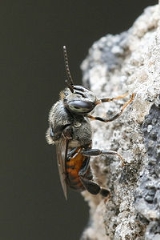
Stingless bees, sometimes called
stingless honey bees or simply
meliponines, are a large group of bees, comprising the tribe
Meliponini (or subtribe Meliponina according to other authors). They belong in the family
ApidaeThe Apidae are a large family of bees, comprising the common honey bees, stingless bees , carpenter bees, orchid bees, cuckoo bees, bumblebees, and various other less well-known groups...
, and are closely related to common
honey beeHoney bees are a subset of bees in the genus Apis, primarily distinguished by the production and storage of honey and the construction of perennial, colonial nests out of wax. Honey bees are the only extant members of the tribe Apini, all in the genus Apis...
s,
carpenter beeCarpenter bees are large, hairy bees distributed worldwide. There are some 500 species of carpenter bee in 31 subgenera...
s,
orchid beesEuglossine bees, also called orchid bees, are the only group of corbiculate bees whose non-parasitic members do not all possess eusocial behavior. Most of the species are solitary, though a few are communal, or exhibit simple forms of eusociality...
and
bumblebeeA bumble bee is any member of the bee genus Bombus, in the family Apidae. There are over 250 known species, existing primarily in the Northern Hemisphere although they are common in New Zealand and in the Australian state of Tasmania.Bumble bees are social insects that are characterised by black...
s. The common name is slightly misleading, as a great many other bee species, especially in the family
AndrenidaeThe family Andrenidae is a large cosmopolitan non-parasitic bee family, with most of the diversity in temperate and/or arid areas , including some truly enormous genera...
, are also incapable of stinging, as are all male bees. Meliponines have stingers, but they are highly reduced and cannot be used for defense.
Range
Stingless bees can be found in most tropical or subtropical regions of the world, such as
AustraliaAustralia , officially the Commonwealth of Australia, is a country in the Southern Hemisphere comprising the mainland of the Australian continent, the island of Tasmania, and numerous smaller islands in the Indian and Pacific Oceans. It is the world's sixth-largest country by total area...
,
AfricaAfrica is the world's second largest and second most populous continent, after Asia. At about 30.2 million km² including adjacent islands, it covers 6% of the Earth's total surface area and 20.4% of the total land area...
,
Southeast AsiaSoutheast Asia, South-East Asia, South East Asia or Southeastern Asia is a subregion of Asia, consisting of the countries that are geographically south of China, east of India, west of New Guinea and north of Australia. The region lies on the intersection of geological plates, with heavy seismic...
, and tropical
AmericaThe Americas, or America , are lands in the Western hemisphere, also known as the New World. In English, the plural form the Americas is often used to refer to the landmasses of North America and South America with their associated islands and regions, while the singular form America is primarily...
. The majority of
nativeIn biogeography, a species is defined as native to a given region or ecosystem if its presence in that region is the result of only natural processes, with no human intervention. Every natural organism has its own natural range of distribution in which it is regarded as native...
eusocial bees of
CentralCentral America is the central geographic region of the Americas. It is the southernmost, isthmian portion of the North American continent, which connects with South America on the southeast. When considered part of the unified continental model, it is considered a subcontinent...
and
South AmericaSouth America is a continent situated in the Western Hemisphere, mostly in the Southern Hemisphere, with a relatively small portion in the Northern Hemisphere. The continent is also considered a subcontinent of the Americas. It is bordered on the west by the Pacific Ocean and on the north and east...
are stingless bees, although only a few of them produce honey on a scale such that they are farmed by humans. They are also quite diverse in
AfricaAfrica is the world's second largest and second most populous continent, after Asia. At about 30.2 million km² including adjacent islands, it covers 6% of the Earth's total surface area and 20.4% of the total land area...
, including
MadagascarThe Republic of Madagascar is an island country located in the Indian Ocean off the southeastern coast of Africa...
, and are farmed there also; meliponine honey is prized as a medicine in many African communities as well as in South America.
Behavior
Being tropical, stingless bees are active all year round, although they are less active in cooler weather, with some species presenting
diapauseDiapause is the delay in development in response to regularly and recurring periods of adverse environmental conditions. It is considered to be a physiological state of dormancy with very specific initiating and inhibiting conditions...
. Unlike other eusocial bees, they do not sting but will defend by biting if their nest is disturbed. In addition, a few (in the genus
Oxytrigona) have mandibular secretions that cause painful blisters. Despite their lack of a sting, stingless bees, being eusocial, may have very large colonies made formidable by the number of defenders.
Hives
Stingless bees usually nest in hollow trunks, tree branches, underground cavities, or rock crevices but they have also been encountered in wall cavities, old rubbish bins, water meters, and storage drums. Many beekeepers keep the bees in their original log
hiveA hive may refer to a beehive, an enclosed structure in which some honey bee species live and raise their young.Hive may also refer to:-Arts:* The Hives, a Swedish rock band* Hive , a DJ and producer in the drum and bass music genre...
or transfer them to a wooden box, as this makes it easier to control the hive.
The bees store pollen and honey in large egg-shaped pots made of
beeswaxBeeswax is a natural wax produced in the bee hive of honey bees of the genus Apis. It is mainly esters of fatty acids and various long chain alcohols...
, typically mixed with various types of plant resin (sometimes called "
propolisPropolis is a resinous mixture that honey bees collect from tree buds, sap flows, or other botanical sources. It is used as a sealant for unwanted open spaces in the hive. Propolis is used for small gaps , while larger spaces are usually filled with beeswax. Its color varies depending on its...
"). These pots are often arranged around a central set of horizontal
brood combThe brood comb is the beeswax structure of cells where the queen bee lays eggs. It is the part of the beehive where a new brood is raised by the colony...
s, where the larval bees are housed. When the young worker bees emerge from their cells, they tend to remain inside the hive, performing different jobs. As workers age, they become guards or foragers. Unlike the larvae of
honey beeHoney bees are a subset of bees in the genus Apis, primarily distinguished by the production and storage of honey and the construction of perennial, colonial nests out of wax. Honey bees are the only extant members of the tribe Apini, all in the genus Apis...
s, meliponine larvae are not fed directly. The pollen and nectar are placed in a cell, an egg is laid, and the cell is sealed until the adult bee emerges after pupation ("mass provisioning"). At any one time, hives can contain anywhere from 300-80,000 workers, depending on species.
Role differentiation
In a simplified sense, the
sexIn biology, sex is a process of combining and mixing genetic traits, often resulting in the specialization of organisms into a male or female variety . Sexual reproduction involves combining specialized cells to form offspring that inherit traits from both parents...
of each bee depends on the number of chromosomes it receives. Female bees have two sets of chromosomes (diploid) - one set from the queen and another from one of the male bees or
dronesDrones are male honey bees. They develop from eggs that have not been fertilized, and they cannot sting, since the worker bee's stinger is a modified ovipositor .-Etymology:...
. Drones have only one set of chromosomes (haploid), and are the result of unfertilized eggs, though inbreeding can result in diploid drones.
Unlike true
honey beeHoney bees are a subset of bees in the genus Apis, primarily distinguished by the production and storage of honey and the construction of perennial, colonial nests out of wax. Honey bees are the only extant members of the tribe Apini, all in the genus Apis...
s, whose female bees may become workers or queens strictly depending on what kind of food they receive as larvae (queens are fed
royal jellyRoyal jelly is a honey bee secretion that is used in the nutrition of larvae, as well as adult queens. It is secreted from the glands in the hypopharynx of worker bees, and fed to all larvae in the colony....
and workers are fed pollen), the caste system in meliponines is variable, and commonly based simply on the amount of pollen consumed; larger amounts of pollen yield queens in the genus
MeliponaMelipona is a genus of stingless bees. These are widespread in warm areas of the Neotropics, from Sinaloa and Tamaulipas to Tucumán and Misiones . At least 40 species are known....
. There is also a genetic component however, and as much as 25% (typically 5-14%) of the female brood may be queens. Queen cells in the former case can be distinguished from others by their larger size, as they are stocked with more pollen, but in the latter case the cells are identical to worker cells, and scattered among the worker brood. When the new queens emerge, they typically leave to mate, and most die. New nests are not established via swarms, but by a procession of workers who gradually construct a new nest at a secondary location. The nest is then joined by a newly mated queen, at which point many workers take up permanent residence and help the new queen raise her own workers. If a ruling queen is herself weak or dying, then a new queen can replace her. For
Plebeia quadripunctataPlebeia quadripunctata is a small stingless bee that occurs from central Brazil through Argentina, formerly included in the genus Trigona...
, although less than 1% of female worker cells produce dwarf queens, they comprise six out of seven queen bees, and one out of five proceed to head colonies of their own. They are reproductively active but less fecund than large queens.
Stingless bees of Australia
Of the 1,600 species of wild bees native to Australia, about 14 species are stingless. These species bear a variety of names, including Australian native honey bees, native bees, sugar-bag bees and sweat bees (because they will land on a sweaty person to drink in dry times/areas). All are small, black in colour, with hairy extended hind legs for carrying nectar and
pollenPollen is a fine to coarse powder containing the microgametophytes of seed plants, which produce the male gametes . Pollen grains have a hard coat that protects the sperm cells during the process of their movement from the stamens to the pistil of flowering plants or from the male cone to the...
; because of the latter they are sometimes mistaken for
bumblebeeA bumble bee is any member of the bee genus Bombus, in the family Apidae. There are over 250 known species, existing primarily in the Northern Hemisphere although they are common in New Zealand and in the Australian state of Tasmania.Bumble bees are social insects that are characterised by black...
s. The various stingless species look quite similar, with the two most common species,
Trigona carbonariaTrigona carbonaria is a stingless bee endemic to Australia. Their common name is Sugarbag bee. The bee is known to pollinate the orchids Dendrobium lichenastrum, D. toressae, and D. speciosum. It has been identified as an insect that collects pollen from the cycad, Cycas media.T. carbonaria forms...
and
Austroplebeia australis, displaying the greatest variation, as the latter is smaller and less active. Both of these inhabit the area around
BrisbaneBrisbane is the capital and most populous city in the Australian state of Queensland and the third most populous city in Australia. Brisbane's metropolitan area has a population of over 2 million, and the South East Queensland urban conurbation, centred around Brisbane, encompasses a population of...
.
As stingless bees are harmless to humans, they have become an increasingly attractive addition to the suburban backyard. Most meliponine beekeepers do not keep the bees for
honeyHoney is a sweet food made by bees using nectar from flowers. The variety produced by honey bees is the one most commonly referred to and is the type of honey collected by beekeepers and consumed by humans...
but rather for the pleasure of conserving a native species whose original
habitatA habitat is an ecological or environmental area that is inhabited by a particular species of animal, plant or other type of organism...
is declining due to human development. In return, the bees pollinate crops, garden flowers, and bushland during their search for nectar and pollen.
While a number of beekeepers fill a small niche market for bush honey, native meliponines only produce small amounts and the structure of their hives makes the honey difficult to extract. It is only in warm areas of Australia such as
QueenslandQueensland is a state of Australia, occupying the north-eastern section of the mainland continent. It is bordered by the Northern Territory, South Australia and New South Wales to the west, south-west and south respectively. To the east, Queensland is bordered by the Coral Sea and Pacific Ocean...
and northern
New South WalesNew South Wales is a state of :Australia, located in the east of the country. It is bordered by Queensland, Victoria and South Australia to the north, south and west respectively. To the east, the state is bordered by the Tasman Sea, which forms part of the Pacific Ocean. New South Wales...
that the bees can produce more honey than they need for their own survival. Harvesting honey from a nest in a cooler area could weaken or even kill the nest.
Honey production
In warm areas of Australia, these bees can be used for minor honey production. They may also be kept successfully in boxes in these areas. Special methods are being developed to harvest moderate amounts of honey from stingless bees in these areas without causing harm.
Like the European honey bee (
Apis mellifera) which provides most of Australia's commercially produced honey, stingless bees have enlarged areas on their back legs for carrying pollen back to the hive. After a foraging expedition, these
pollen basketThe pollen basket or corbicula is part of the tibia on the hind legs of the four related lineages of apid bees that used to comprise the family Apidae: the honey bees, bumblebees, stingless bees, and orchid bees...
s or
corbiculae can be seen stuffed full of bright orange or yellow pollen. Stingless bees also collect nectar, which they store in an extension of their gut called a
cropA crop is a thin-walled expanded portion of the alimentary tract used for the storage of food prior to digestion that is found in many animals, including gastropods, earthworms, leeches, insects, birds, and even some dinosaurs.- Bees :Cropping is used by bees to temporarily store nectar of flowers...
. Back at the hive, the bees ripen or dehydrate the nectar droplets by spinning them inside their mouthparts until honey is formed. Ripening concentrates the nectar and increases the sugar content, though it is not nearly as concentrated as the honey from true honey bees; it is much thinner in consistency, and more prone to spoiling.
Stingless bees store their aromatic honey in clusters of small resin pots near the extremities of the nest. For honey production, the bees need to be kept in a box specially designed to make the honey stores accessible without damaging the rest of the nest structure. Some recent box designs for honey production provide a separate compartment for the honey stores so that honey pots can be removed without spilling honey into other areas of the nest.
Unlike a hive of commercial honeybees, which can produce 75 kilograms of honey a year, a hive of Australian stingless bees produces less than one kilogram. Stingless bee honey has a distinctive "bush" taste - a mix of sweet and sour with a hint of fruit. The taste comes from plant resins - which the bees use to build their hives and honey pots - and varies at different times of year depending on the flowers and trees visited.
Pollination
Australian farmers rely heavily on the introduced Western honey bee to pollinate their crops. However, for some crops native bees may be better pollinators. Stingless bees have been shown to be valuable pollinators of crops such as macadamias and mangoes. They may also benefit strawberries, watermelons, citrus, avocados, lychees and many others. Research into the use of stingless bees for crop pollination in Australia is still in its very early stages, but these bees show great potential. Studies at the
University of Western SydneyThe University of Western Sydney, also known as UWS, is a multi-campus university in the Greater Western region of Sydney, New South Wales, Australia...
have shown these bees' excellent ability to work in confined areas such as glasshouses.
Mayan stingless bees of Central America
The stingless bees
Melipona beecheii and
M. yucatanica are the only native bees cultured to any degree in the Americas. They were extensively cultured by the
MayaThe Maya is a Mesoamerican civilization, noted for the only known fully developed written language of the pre-Columbian Americas, as well as for its art, architecture, and mathematical and astronomical systems. Initially established during the Pre-Classic period The Maya is a Mesoamerican...
for honey, and regarded as sacred. These bees are endangered due to massive deforestation, altered
agriculturalAgriculture is the cultivation of animals, plants, fungi and other life forms for food, fiber, and other products used to sustain life. Agriculture was the key implement in the rise of sedentary human civilization, whereby farming of domesticated species created food surpluses that nurtured the...
practices (especially
insecticideAn insecticide is a pesticide used against insects. They include ovicides and larvicides used against the eggs and larvae of insects respectively. Insecticides are used in agriculture, medicine, industry and the household. The use of insecticides is believed to be one of the major factors behind...
s), and changing beekeeping practices with the arrival of the Africanized honey bee, which produces much greater honey crops.
History
Native meliponines (
Melipona beecheii being the favorite) have been kept by the lowland
MayaThe Maya people constitute a diverse range of the Native American people of southern Mexico and northern Central America. The overarching term "Maya" is a collective designation to include the peoples of the region who share some degree of cultural and linguistic heritage; however, the term...
for thousands of years. The traditional Mayan name for this bee is Xunan kab, literally meaning "royal lady". The bees were once the subject of religious ceremonies and were a symbol of the bee-god
Ah-Muzen-CabAh-Muzen-Cab is one of the Mayan gods of bees and honey.-References:...
, who is known from the Madrid Codex.
The bees were, and still are, treated as pets. Families would have one or many log-hives hanging in and around their house. Although they are stingless, the bees do bite and can leave welts similar to a mosquito bite. The traditional way to gather bees, still favored amongst the locals, is find a wild hive; then the branch is cut around the hive to create a portable log, enclosing the colony. This log is then capped on both ends with another piece of wood or pottery and sealed with mud. This clever method keeps the melipine bees from mixing their brood, pollen, and honey in the same comb as the European bees. The brood is kept in the middle of the hive, and the honey is stored in vertical "pots" on the outer edges of the hive. A temporary, replaceable cap at the end of the log allows for easy access to the honey while doing minimal damage to the hive. However, inexperienced handlers can still do irreversible damage to a hive, causing the hive to swarm and abscond from the log. On the other hand, with proper maintenance, hives have been recorded as lasting over 80 years, being passed down through generations. In the archaeological record of Mesoamerica, stone discs have been found which are generally considered to be the caps of long-disintegrated logs which once housed the beehives.
Tulum
Tulum, the site of an ancient Mayan city on the Caribbean coast 130 km south of Cancun, has a god depicted repeatedly all over the site. Upside down, he appears as a small figure over many doorways and entrances. One of the temples, the "Templo del Dios Descendente" or the Temple of the Descending God, stands just left of the central plaza. Speculation is that he may be the "Bee God", Ah Muzen Cab, as seen in the Madrid Codex. It is possible that this was a religious/trade center with emphasis on Xunan kab, the "royal lady".
Economic uses
BalchéBalché is a mildly intoxicating beverage common among ancient and indigenous cultures in areas of what is now Mexico and upper Central America. Today the drink is still common among the Yucatec Maya, and is made from the bark of a leguminous tree , which is soaked in honey and water, and fermented...
, a traditional
MesoamericaMesoamerica is a region and culture area in the Americas, extending approximately from central Mexico to Belize, Guatemala, El Salvador, Honduras, Nicaragua, and Costa Rica, within which a number of pre-Columbian societies flourished before the Spanish colonization of the Americas in the 15th and...
n alcoholic beverage similar to
meadMead , also called honey wine, is an alcoholic beverage that is produced by fermenting a solution of honey and water. It may also be produced by fermenting a solution of water and honey with grain mash, which is strained immediately after fermentation...
, was made from fermented honey and the bark of the leguminous Balché tree (
Lonchocarpus violaceus), hence its name. It was traditionally brewed in a canoe. The drink was known to have
entheogenAn entheogen , in the strict sense, is a psychoactive substance used in a religious, shamanic, or spiritual context. Historically, entheogens were mostly derived from plant sources and have been used in a variety of traditional religious contexts...
ic properties, that is, to produce mystical experiences, and was consumed in medicinal and ritual practices. There is still some debate whether the psychotropic effects come from the bark or the honey, but most likely, it was a combination of the two. Some of the hallucinogenic properties come from tan alkaloid in the bark of the Balché tree, but others probably come from the honey. Beekeepers would place the nests near the psychoactive plant Turbina corymbosa and possibly near Balché, forcing the bees to use pollen from these plants to make their honey. Toxic and hallucinogenic substances can be found in all honey, if bees collect nectar and pollen from certain types of vegetation. Most likely, it is a combination of the two, since balché is made from both the
Melipona honey gathered from the Balché flowers or from the ergoline compounds in the pollen of the T. corymbosa, and the halucinogens from the bark of the Balché tree, brewed and fermented together.
Lost-wax casting, a common metalworking method which is typically found where the inhabitants keep bees, was also utilized by the Maya. The wax from
Melipona is soft and easy to work, especially in the humid Mayan lowland. This allowed the Maya to create smaller works of art, jewelry, and other metalsmithing that would be difficult to forge. It also makes use of the leftovers from honey extraction. If the hive was damaged beyond repair, the whole of the comb could be used, thus using all of the hive. With experienced keepers, though, only the honey pot could be removed, the honey extracted, and the wax used for casting or other purposes.
Future
The outlook for meliponines in Mesoamerica is grim. The number of active
Melipona beekeepers is rapidly declining in favor of the more economical, non-indigenous Africanized
Apis mellifera. The high honey yield, 100 kilograms or more annually, along with the ease of hive care and ability to create new hives from existing stock, commonly outweighs the negative consequences of "killer bee" hive maintenance. Furthermore, there are flora that the Africanized honey bees do not visit, such as those in the
tomato familySolanaceae are a family of flowering plants that include a number of important agricultural crops as well as many toxic plants. The name of the family comes from the Latin Solanum "the nightshade plant", but the further etymology of that word is unclear...
, and several forest trees and shrubs, which rely on the native stingless bees for pollination. There has already been a decline in populations of native flora in areas where stingless bees have been displaced by Africanized honey bees. An additional blow to the art of meliponine beekeeping is that many of the meliponine beekeepers are now elderly men and women, whose hives may not be cared for once they die. The hives are considered similar to an old family collection, to be parted out once the collector dies or to be buried in whole or part along with the beekeeper upon death. In fact, a survey of a once-popular area of the Mayan lowlands shows the rapid decline of beekeepers, down to around 70 in 2004 from thousands in the late 1980s. It is traditional in the Mayan lowlands that the hive itself or parts of the hive be buried along with the beekeeper to
volar al cielo, "to fly to heaven". There are conservation efforts underway in several parts of Mesoamerica.
Stingless bee species that produce honey
- Austroplebeia spp.
- Trigona
Trigona is the largest genus of stingless bees, formerly including many more subgenera than the present assemblage; many of these former subgenera have been elevated to generic status. There are approximately 150 species presently included in the genus, in 11 subgenera...
spp.
- T. carbonaria
- T. hockingsii
- T. iridipennis
- Melipona
Melipona is a genus of stingless bees. These are widespread in warm areas of the Neotropics, from Sinaloa and Tamaulipas to Tucumán and Misiones . At least 40 species are known....
spp.
- M. beecheii
- M. costaricensis
- M. yucatanica
- M. panamica
- M. fasciata
- M. marginata
- M. compressipes
- M. fuliginosa
- M. flavolineata
- M. fasciculata
- M. rufiventris
- M. subnitida
- M. quadrifasciata
- Tetragonisca spp.
External links