
All Topics  
Stereoisomerism


   Email Print
   Bookmark   Link


Stereoisomerism


Stereoisomers are isomeric molecules
Isomer

In chemistry, isomers are compounds with the same molecular formula but different structural formulae. Isomers do not necessarily share similar properties unless they also have the same functional groups....
 that have the same molecular formula and sequence of bonded atoms (constitution), but which differ in the three dimensional orientations of their atoms in space.

nantiomers are two stereoisomers that are related to each other by a reflection: they are mirror image
Mirror Image

"Mirror Image" is an episode of the television series The Twilight Zone ....
s of each other, which are non-superimposable. Human hands are a macroscopic example of stereoisomerism.


Discussion
Ask a question about 'Stereoisomerism'
Start a new discussion about 'Stereoisomerism'
Answer questions from other users
Full Discussion Forum


Recent Posts


Encyclopedia


Stereoisomers are isomeric molecules
Isomer

In chemistry, isomers are compounds with the same molecular formula but different structural formulae. Isomers do not necessarily share similar properties unless they also have the same functional groups....
 that have the same molecular formula and sequence of bonded atoms (constitution), but which differ in the three dimensional orientations of their atoms in space.

Enantiomers

Enantiomers are two stereoisomers that are related to each other by a reflection: they are mirror image
Mirror Image

"Mirror Image" is an episode of the television series The Twilight Zone ....
s of each other, which are non-superimposable. Human hands are a macroscopic example of stereoisomerism. Every stereogenic center in one has the opposite configuration in the other. Two compounds that are enantiomers of each other have the same physical properties, except for the direction in which they rotate polarized light and how they interact with different optical isomers of other compounds. For this reason, pure enantiomers exhibit the phenomenon of optical activity and can be separated only with the use of a chiral
Chirality (chemistry)

The term chiral is used to describe an object that is non-Superposition on its mirror image.Human hands are perhaps the most universally recognized example of chirality: The left hand is a non-superposable mirror image of the right hand; no matter how the two hands are oriented, it is impossible for all the major features of both hands...
 agent. In nature, only one enantiomer of most chiral biological compounds, such as amino acid
Amino acid

In chemistry, an amino acid is a molecule containing both amine and carboxyl functional groups. These molecules are particularly important in biochemistry, where this term refers to alpha-amino acids with the general formula H2NCHRCOOH, where R is an organic substituent....
s (except glycine), is present. As a result, different enantiomers of a compound may have substantially different biological effects.

Diastereomers

Diastereomers are stereoisomers not related through a reflection operation. They are not mirror images of each other. These include meso compound
Meso compound

A meso compound or meso isomer is an non-optically active member of a set of stereoisomers, at least two of which are optically active. This means that despite containing two or more stereocenters it is not Optical isomerism....
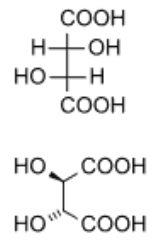
s, cis-trans (E-Z) isomers, and non-enantiomeric optical isomers. Diastereomers seldom have the same physical properties. In the example shown below, the meso form of tartaric acid forms a diastereomeric pair with both levo and dextro tartaric acids, which form an enantiomeric pair.

L Tartaric Acid
D Tartaric Acid
(natural) tartaric acid
L-(+)-tartaric acid
dextrotartaric acid
D-(-)-tartaric acid
levotartaric acid
mesotartaric acid
(1:1)
DL-tartaric acid
"racemic acid"


It should be carefully noted here that The D- and L- labeling of the isomers above is not the same as the d- and l- labeling more commonly seen, explaining why these may appear reversed to those only familiar with the latter naming convention. Please refer to Chirality_(chemistry)#Naming_conventions
Chirality (chemistry)

The term chiral is used to describe an object that is non-Superposition on its mirror image.Human hands are perhaps the most universally recognized example of chirality: The left hand is a non-superposable mirror image of the right hand; no matter how the two hands are oriented, it is impossible for all the major features of both hands...
 for more information regarding the D- and L- labels.

Cis-trans and E-Z isomerism

, E-Z notation
E-Z notation

The more complex stereochemistry of highly substituted alkenes cannot be defined using the cis-trans notation. For this purpose a new notation known as E-Z notation is used....


Stereoisomerism about double bonds arises because rotation about the double bond is restricted, keeping the substituents fixed relative to each other. If the substituents on either end of a double bond are the same, it is not considered a stereo bond.

Traditionally, double bond stereochemistry was described as either cis (Latin, on this side) or trans (Latin, across), in reference to the relative position of substituents on either side of a double bond. The simplest examples of cis-trans isomerism are the 1,2-disubstituted ethenes, like the dichloroethene (C2H2Cl2) isomers shown below.

Dichloroethene
Molecule I is cis-1,2-dichloroethene and molecule II is trans-1,2-dichloroethene. Due to occasional ambiguity, IUPAC adopted a more rigorous system wherein the substituents at each end of the double bond are assigned priority based on their atomic number
Atomic number

In chemistry and physics, the atomic number is the number of protons found in the atomic nucleus of an atom. It is conventionally represented by the symbol Z....
. If the high priority substituents are on the same side of the bond it is assigned Z (Ger. zusammen, together). If they are on opposite sides it is E (Ger. entgegen, opposite). Since chlorine has a larger atomic number than hydrogen it is the highest priority group. Using this notation to name the above pictured molecules, molecule I is (Z)-1,2-dichloroethene and molecule II is (E)-1,2-dichloroethene. It is not the case Z and cis or E and trans are always interchangeable. Consider the following fluoromethylpentene:

The proper name for this molecule is either trans-2-fluoro-3-methyl-2-pentene because the fluoro and methyl groups reside across the double bond from each other, or (Z)-2-fluoro-3-methyl-2-pentene because the highest priority groups on each side of the double bond are on the same side of the double bond. Fluoro is the highest priority group on the left side of the double bond and ethyl is the highest priority group on the right side of the molecule.

The terms cis and trans are also used to describe the relative position of two substituents on a ring; cis if on the same side, otherwise trans.

Conformers


Conformational isomerism is a form of isomerism that describes the phenomenon of molecules with the same structural formula having different shapes due to rotations about one or more bonds. Different conformations can have different energies, can usually interconvert, and are very rarely isolatable. For example, cyclohexane
Cyclohexane

Cyclohexane is a cycloalkane with the molecular formula Carbon6Hydrogen12. Cyclohexane is used as a nonpolar solvent for the chemical industry, and also as a raw material for the industrial production of adipic acid and caprolactam, both of which are intermediates used in the production of nylon....
 can exist in a variety of different conformations including a chair conformation and a boat conformation, but for cyclohexane itself, these can never be separated. The boat conformation represents an energy maximum (and not a transition state) on the conformational itinerary between the two equivalent chair forms. There are some molecules that can be isolated in several conformations, due to the large energy barriers between different conformations. 2,2,2',2'-Tetrasubstituted biphenyls can fit into this latter category.

More definitions

  • A configurational stereoisomer is a stereoisomer of a reference molecule that can be converted to it only by breaking covalent bonds, for example by inverting the configurations of some or all of the stereocenter
    Stereocenter

    A stereocenter, or stereogenic center, is any point, though not necessarily an atom, in a molecule bearing groups such that an interchanging of any two groups leads to a stereoisomer ....
    s in a compound.

External links

  • On the Assignment of Anomeric Configuration (pdf)