

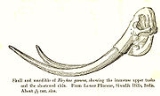
Stegodon

Encyclopedia
Stegodon is a genus
of the extinct subfamily Stegodontinae of the order
Proboscidea
. It was assigned to the family Elephantidae
(Abel, 1919), but has also been placed in Stegodontidae
(R. L. Carroll, 1988). Stegodonts were present from 11.6 mya to 4,100 years ago. They lived in large parts of Asia
during the Pliocene
and Pleistocene
epochs
.
population survived until 12,000 years ago on the Island of Flores
. A review of 130 papers written about 180 different sites with proboscidean remains in southern China revealed Stegodon to have been more common than Asian elephants; the papers gave many recent radiocarbon dates, the youngest being 2,150 B.C. (4,100 BP). The name Stegodon is derived from the Greek
words στεγειν stegein ('to cover') and οδον odοn ('tooth
') because of the distinctive ridges on the animal's molar
s.
s of the true elephant
s and mammoth
s, but it is currently believed that they have no modern descendants. Stegodon may be derived from Stegolophodon
, an extinct genus known from the Miocene of Asia. Stegodon is considered to be a sister group of the mammoth, as well as the elephants. Some taxonomists
consider the stegodonts as a subfamily of the Elephantidae. Both Stegolophodon
and primitive elephants were derived from the Gomphotheriidae. The most important difference between Stegodon and the (other) Elephantidae can be observed in the molars
. Molars of stegodonts consist of a series of low, roof-shaped ridges, whereas in elephants each ridge has become a high-crowned plate. Furthermore, the skeletons of stegodonts are more robust and compact than those of elephants.
In Bardia National Park in Nepal
, there is a population of Indian elephants which, possibly due to inbreeding
, exhibit many Stegodon-like morphological features. Some dismiss these primitive features as recent mutation
s rather than atavism
s.
s are frequently encountered on Asian islands, which even during periods of low sea-level (during the cold phases of the Pleistocene
) were not connected by land bridge
s with the Asian continent (Sulawesi
, Flores
, Timor
, Sumba
in Indonesia
, Luzon
and Mindanao
in the Philippines
and in Taiwan
and Japan
). A general evolutionary trend in large mammals on islands is island dwarfing. The smallest dwarf species, Stegodon sondaari, known from 900,000 year old layers on the Indonesian island of Flores, had an estimated body weight of 300 kg, smaller than a water buffalo. A medium to large sized stegodont, Stegodon florensis, with a body weight of about 850 kg, appeared about 850 000 years ago, and then also evolved into a dwarf form, Stegodon florensis insularis. The latter was contemporaneous with the hominin discovered in 2003, Homo floresiensis
, and disappeared about 12 000 years ago. Stegodon tetrabelodon syrticus was a spectacular late Miocene species with four tusks described from a partial cranium and jaws found in North Africa.
Genus
In biology, a genus is a low-level taxonomic rank used in the biological classification of living and fossil organisms, which is an example of definition by genus and differentia...
of the extinct subfamily Stegodontinae of the order
Order (biology)
In scientific classification used in biology, the order is# a taxonomic rank used in the classification of organisms. Other well-known ranks are life, domain, kingdom, phylum, class, family, genus, and species, with order fitting in between class and family...
Proboscidea
Proboscidea
Proboscidea is a taxonomic order containing one living family, Elephantidae, and several extinct families. This order was first described by J. Illiger in 1881 and encompasses the trunked mammals...
. It was assigned to the family Elephantidae
Elephantidae
Elephantidae is a taxonomic family, collectively elephants and mammoths. These are terrestrial large mammals with a trunk and tusks. Most genera and species in the family are extinct...
(Abel, 1919), but has also been placed in Stegodontidae
Stegodontidae
Stegodontidae is an extinct family of proboscideans that lived from the Miocene through Pleistocene period endemic to Africa and Asia from 23.03 to 1.810 Ma, living for approximately .-Taxonomy:...
(R. L. Carroll, 1988). Stegodonts were present from 11.6 mya to 4,100 years ago. They lived in large parts of Asia
Asia
Asia is the world's largest and most populous continent, located primarily in the eastern and northern hemispheres. It covers 8.7% of the Earth's total surface area and with approximately 3.879 billion people, it hosts 60% of the world's current human population...
during the Pliocene
Pliocene
The Pliocene Epoch is the period in the geologic timescale that extends from 5.332 million to 2.588 million years before present. It is the second and youngest epoch of the Neogene Period in the Cenozoic Era. The Pliocene follows the Miocene Epoch and is followed by the Pleistocene Epoch...
and Pleistocene
Pleistocene
The Pleistocene is the epoch from 2,588,000 to 11,700 years BP that spans the world's recent period of repeated glaciations. The name pleistocene is derived from the Greek and ....
epochs
Epoch (geology)
An epoch is a subdivision of the geologic timescale based on rock layering. In order, the higher subdivisions are periods, eras and eons. We are currently living in the Holocene epoch...
.
Morphology
Some Stegodon species were among the largest of all Proboscidea, with adults being 4 metres (13 feet approximate) high at the shoulder, 8 metres (26 feet approximate) long, not including 3 metres (10 feet approximate) long nearly straight tusks. In some individuals the tusks were so close together that the trunk probably did not lie between them but instead draped over.Dwarfism
A dwarfDwarf elephant
Dwarf elephants are prehistoric members of the order Proboscidea, that, through the process of allopatric speciation, evolved to a fraction of the size of their immediate ancestors...
population survived until 12,000 years ago on the Island of Flores
Flores
Flores is one of the Lesser Sunda Islands, an island arc with an estimated area of 14,300 km² extending east from the Java island of Indonesia. The population was 1.831.000 in the 2010 census and the largest town is Maumere. Flores is Portuguese for "flowers".Flores is located east of Sumbawa...
. A review of 130 papers written about 180 different sites with proboscidean remains in southern China revealed Stegodon to have been more common than Asian elephants; the papers gave many recent radiocarbon dates, the youngest being 2,150 B.C. (4,100 BP). The name Stegodon is derived from the Greek
Greek language
Greek is an independent branch of the Indo-European family of languages. Native to the southern Balkans, it has the longest documented history of any Indo-European language, spanning 34 centuries of written records. Its writing system has been the Greek alphabet for the majority of its history;...
words στεγειν stegein ('to cover') and οδον odοn ('tooth
Tooth
Teeth are small, calcified, whitish structures found in the jaws of many vertebrates that are used to break down food. Some animals, particularly carnivores, also use teeth for hunting or for defensive purposes. The roots of teeth are embedded in the Mandible bone or the Maxillary bone and are...
') because of the distinctive ridges on the animal's molar
Molar (tooth)
Molars are the rearmost and most complicated kind of tooth in most mammals. In many mammals they grind food; hence the Latin name mola, "millstone"....
s.
Relationship
In the past, stegodonts were believed to be the ancestorAncestor
An ancestor is a parent or the parent of an ancestor ....
s of the true elephant
Elephant
Elephants are large land mammals in two extant genera of the family Elephantidae: Elephas and Loxodonta, with the third genus Mammuthus extinct...
s and mammoth
Mammoth
A mammoth is any species of the extinct genus Mammuthus. These proboscideans are members of Elephantidae, the family of elephants and mammoths, and close relatives of modern elephants. They were often equipped with long curved tusks and, in northern species, a covering of long hair...
s, but it is currently believed that they have no modern descendants. Stegodon may be derived from Stegolophodon
Stegolophodon
Stegolophodon is an extinct genus of proboscidean. Stegolophodon was a gomphothere with four tusks and a trunk. It lived in the Miocene and Pliocene Epochs, and may have evolved into Stegodon....
, an extinct genus known from the Miocene of Asia. Stegodon is considered to be a sister group of the mammoth, as well as the elephants. Some taxonomists
Taxonomy
Taxonomy is the science of identifying and naming species, and arranging them into a classification. The field of taxonomy, sometimes referred to as "biological taxonomy", revolves around the description and use of taxonomic units, known as taxa...
consider the stegodonts as a subfamily of the Elephantidae. Both Stegolophodon
Stegolophodon
Stegolophodon is an extinct genus of proboscidean. Stegolophodon was a gomphothere with four tusks and a trunk. It lived in the Miocene and Pliocene Epochs, and may have evolved into Stegodon....
and primitive elephants were derived from the Gomphotheriidae. The most important difference between Stegodon and the (other) Elephantidae can be observed in the molars
Molar (tooth)
Molars are the rearmost and most complicated kind of tooth in most mammals. In many mammals they grind food; hence the Latin name mola, "millstone"....
. Molars of stegodonts consist of a series of low, roof-shaped ridges, whereas in elephants each ridge has become a high-crowned plate. Furthermore, the skeletons of stegodonts are more robust and compact than those of elephants.
In Bardia National Park in Nepal
Nepal
Nepal , officially the Federal Democratic Republic of Nepal, is a landlocked sovereign state located in South Asia. It is located in the Himalayas and bordered to the north by the People's Republic of China, and to the south, east, and west by the Republic of India...
, there is a population of Indian elephants which, possibly due to inbreeding
Inbreeding
Inbreeding is the reproduction from the mating of two genetically related parents. Inbreeding results in increased homozygosity, which can increase the chances of offspring being affected by recessive or deleterious traits. This generally leads to a decreased fitness of a population, which is...
, exhibit many Stegodon-like morphological features. Some dismiss these primitive features as recent mutation
Mutation
In molecular biology and genetics, mutations are changes in a genomic sequence: the DNA sequence of a cell's genome or the DNA or RNA sequence of a virus. They can be defined as sudden and spontaneous changes in the cell. Mutations are caused by radiation, viruses, transposons and mutagenic...
s rather than atavism
Atavism
Atavism is the tendency to revert to ancestral type. In biology, an atavism is an evolutionary throwback, such as traits reappearing which had disappeared generations before. Atavisms can occur in several ways...
s.
Dwarfing on islands
Like elephants, stegodonts must have been good swimmers. Their fossilFossil
Fossils are the preserved remains or traces of animals , plants, and other organisms from the remote past...
s are frequently encountered on Asian islands, which even during periods of low sea-level (during the cold phases of the Pleistocene
Pleistocene
The Pleistocene is the epoch from 2,588,000 to 11,700 years BP that spans the world's recent period of repeated glaciations. The name pleistocene is derived from the Greek and ....
) were not connected by land bridge
Land bridge
A land bridge, in biogeography, is an isthmus or wider land connection between otherwise separate areas, over which animals and plants are able to cross and colonise new lands...
s with the Asian continent (Sulawesi
Sulawesi
Sulawesi is one of the four larger Sunda Islands of Indonesia and is situated between Borneo and the Maluku Islands. In Indonesia, only Sumatra, Borneo, and Papua are larger in territory, and only Java and Sumatra have larger Indonesian populations.- Etymology :The Portuguese were the first to...
, Flores
Flores
Flores is one of the Lesser Sunda Islands, an island arc with an estimated area of 14,300 km² extending east from the Java island of Indonesia. The population was 1.831.000 in the 2010 census and the largest town is Maumere. Flores is Portuguese for "flowers".Flores is located east of Sumbawa...
, Timor
Timor
Timor is an island at the southern end of Maritime Southeast Asia, north of the Timor Sea. It is divided between the independent state of East Timor, and West Timor, belonging to the Indonesian province of East Nusa Tenggara. The island's surface is 30,777 square kilometres...
, Sumba
Sumba
Sumba is an island in eastern Indonesia, is one of the Lesser Sunda Islands, and is in the province of East Nusa Tenggara. Sumba has an area of 11,153 km², and the population was officially at 611,422 in 2005...
in Indonesia
Indonesia
Indonesia , officially the Republic of Indonesia , is a country in Southeast Asia and Oceania. Indonesia is an archipelago comprising approximately 13,000 islands. It has 33 provinces with over 238 million people, and is the world's fourth most populous country. Indonesia is a republic, with an...
, Luzon
Luzon
Luzon is the largest island in the Philippines. It is located in the northernmost region of the archipelago, and is also the name for one of the three primary island groups in the country centered on the Island of Luzon...
and Mindanao
Mindanao
Mindanao is the second largest and easternmost island in the Philippines. It is also the name of one of the three island groups in the country, which consists of the island of Mindanao and smaller surrounding islands. The other two are Luzon and the Visayas. The island of Mindanao is called The...
in the Philippines
Philippines
The Philippines , officially known as the Republic of the Philippines , is a country in Southeast Asia in the western Pacific Ocean. To its north across the Luzon Strait lies Taiwan. West across the South China Sea sits Vietnam...
and in Taiwan
Taiwan
Taiwan , also known, especially in the past, as Formosa , is the largest island of the same-named island group of East Asia in the western Pacific Ocean and located off the southeastern coast of mainland China. The island forms over 99% of the current territory of the Republic of China following...
and Japan
Japan
Japan is an island nation in East Asia. Located in the Pacific Ocean, it lies to the east of the Sea of Japan, China, North Korea, South Korea and Russia, stretching from the Sea of Okhotsk in the north to the East China Sea and Taiwan in the south...
). A general evolutionary trend in large mammals on islands is island dwarfing. The smallest dwarf species, Stegodon sondaari, known from 900,000 year old layers on the Indonesian island of Flores, had an estimated body weight of 300 kg, smaller than a water buffalo. A medium to large sized stegodont, Stegodon florensis, with a body weight of about 850 kg, appeared about 850 000 years ago, and then also evolved into a dwarf form, Stegodon florensis insularis. The latter was contemporaneous with the hominin discovered in 2003, Homo floresiensis
Homo floresiensis
Homo floresiensis is a possible species, now extinct, in the genus Homo. The remains were discovered in 2003 on the island of Flores in Indonesia. Partial skeletons of nine individuals have been recovered, including one complete cranium...
, and disappeared about 12 000 years ago. Stegodon tetrabelodon syrticus was a spectacular late Miocene species with four tusks described from a partial cranium and jaws found in North Africa.
Species
There following are the species classified under Stegodon. The list may be incomplete or inaccurate.- Stegodon aurorae: Fossils of the small specialized stegodont Stegodon aurorae are found in the Osaka plainOsaka PlainThe refers to a 1,600 km² area of flat land, the largest plain in the Kinki region, including a large part of Osaka Prefecture and a southeastern portion of Hyōgo Prefecture. It is bordered on the north by the Hokusetsu Mount Range, on the east by the Ikoma Mount Range and Kongō Mount Range,...
, JapanJapanJapan is an island nation in East Asia. Located in the Pacific Ocean, it lies to the east of the Sea of Japan, China, North Korea, South Korea and Russia, stretching from the Sea of Okhotsk in the north to the East China Sea and Taiwan in the south...
and date from approximately 2 Ma to .7 Ma. This species possibly evolved from Stegodon shinshuensis. - Stegodon elephantoides (MyanmarMyanmarBurma , officially the Republic of the Union of Myanmar , is a country in Southeast Asia. Burma is bordered by China on the northeast, Laos on the east, Thailand on the southeast, Bangladesh on the west, India on the northwest, the Bay of Bengal to the southwest, and the Andaman Sea on the south....
, Java) - Stegodon florensis (Flores, Indonesia)
- Stegodon ganesha (IndiaIndiaIndia , officially the Republic of India , is a country in South Asia. It is the seventh-largest country by geographical area, the second-most populous country with over 1.2 billion people, and the most populous democracy in the world...
) - Stegodon kaisensis
- Stegodon luzonensis (PhilippinesPhilippinesThe Philippines , officially known as the Republic of the Philippines , is a country in Southeast Asia in the western Pacific Ocean. To its north across the Luzon Strait lies Taiwan. West across the South China Sea sits Vietnam...
) - Stegodon mindanensis (PhilippinesPhilippinesThe Philippines , officially known as the Republic of the Philippines , is a country in Southeast Asia in the western Pacific Ocean. To its north across the Luzon Strait lies Taiwan. West across the South China Sea sits Vietnam...
) - Stegodon orientalis (China, Japan) - Oriental Stegodont
- Stegodon shinshuensis (Japan) - Japanese Stegodont
- Stegodon sompoensis (SulawesiSulawesiSulawesi is one of the four larger Sunda Islands of Indonesia and is situated between Borneo and the Maluku Islands. In Indonesia, only Sumatra, Borneo, and Papua are larger in territory, and only Java and Sumatra have larger Indonesian populations.- Etymology :The Portuguese were the first to...
, Indonesia) - Stegodon sondaari (Flores, Indonesia)
- Stegodon sumbaensis
- Stegodon syrticus
- Stegodon tetrabelodon syrticus (Shabi, Libya)
- Stegodon trigonocephalus (Java, Indonesia)
- Stegodon cf. trigonocephalus (PhilippinesPhilippinesThe Philippines , officially known as the Republic of the Philippines , is a country in Southeast Asia in the western Pacific Ocean. To its north across the Luzon Strait lies Taiwan. West across the South China Sea sits Vietnam...
) - Stegodon zdanski (ChinaChinaChinese civilization may refer to:* China for more general discussion of the country.* Chinese culture* Greater China, the transnational community of ethnic Chinese.* History of China* Sinosphere, the area historically affected by Chinese culture...
)