


Status Quo

Encyclopedia
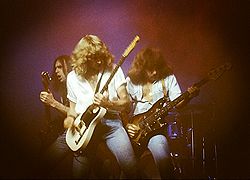
Rock music
Rock music is a genre of popular music that developed during and after the 1960s, particularly in the United Kingdom and the United States. It has its roots in 1940s and 1950s rock and roll, itself heavily influenced by rhythm and blues and country music...
band
Band (music)
In music, a musical ensemble or band is a group of musicians that works together to perform music. The following articles concern types of musical bands:* All-female band* Big band* Boy band* Christian band* Church band* Concert band* Cover band...
whose music is characterized by their distinctive brand of boogie rock
Boogie rock
Boogie rock is a music genre which came out of the hard heavy blues rock of the late 1960s. It tends to feature a repetitive driving rhythm in place of instrumental experimentation found in the more progressive blues-rock bands of the period.-Definitions:...
.
The group's origins were in "The Spectres" founded by schoolboys Francis Rossi
Francis Rossi
Francis Dominic Nicholas Michael Rossi, OBE is a British musician best known for being a co-founder of the English rock band Status Quo, in which he sings lead vocals and plays lead guitar.- Career :...
and Alan Lancaster
Alan Lancaster
Alan Lancaster is a bassist and a founding ex-member of the English rock band, Status Quo...
in 1962. After a number of lineup changes, the band became "The Status Quo" in late 1967, finally settling on the name "Status Quo" in 1969. They have recorded over 60 chart hits in the UK, more than any other rock group. 22 of these have reached the UK Top Ten
UK Singles Chart
The UK Singles Chart is compiled by The Official Charts Company on behalf of the British record-industry. The full chart contains the top selling 200 singles in the United Kingdom based upon combined record sales and download numbers, though some media outlets only list the Top 40 or the Top 75 ...
.
Formation
The origins of Status Quo were in the rock and rollRock and roll
Rock and roll is a genre of popular music that originated and evolved in the United States during the late 1940s and early 1950s, primarily from a combination of African American blues, country, jazz, and gospel music...
freakbeat
Freakbeat
Freakbeat is the name used for rare, collectable, and obscure British Invasion records, particularly from 1966 and 1967. Elements of the freakbeat sound include strong direct drum beats, loud and frenzied guitar riffs, and extreme effects such as: fuzztone, flanging, distortion and compression or...
band "The Spectres" formed in 1962. Francis Rossi
Francis Rossi
Francis Dominic Nicholas Michael Rossi, OBE is a British musician best known for being a co-founder of the English rock band Status Quo, in which he sings lead vocals and plays lead guitar.- Career :...
and Alan Lancaster
Alan Lancaster
Alan Lancaster is a bassist and a founding ex-member of the English rock band, Status Quo...
met at Sedgehill Comprehensive School
Sedgehill
Sedgehill Secondary School is a coeducational school in south-east London, England. In 2008, the School had just over 1,800 pupils with over half from ethnic minorities.Has been a Specialist School for the Performing Arts for since 2003....
, Catford
Catford
Catford is a district in south London, England, located in the London Borough of Lewisham. It is situated south-east of Charing Cross. The area is identified in the London Plan as one of 35 major centres in Greater London.-Architecture:...
, and were members of the same orchestra. Rossi and Lancaster played their first gig at the Samuel Jones Sports Club in Dulwich
Dulwich
Dulwich is an area of South London, England. The settlement is mostly in the London Borough of Southwark with parts in the London Borough of Lambeth...
, London
London
London is the capital city of :England and the :United Kingdom, the largest metropolitan area in the United Kingdom, and the largest urban zone in the European Union by most measures. Located on the River Thames, London has been a major settlement for two millennia, its history going back to its...
. In 1963 they added drummer John Coghlan
John Coghlan (drummer)
John Robert Coghlan was an original member of the English rock band, Status Quo.The son of a Glasgow-born father and a London born half-French mother, Coghlan grew up in Dulwich, and was educated at Kingsdale Comprehensive school until leaving school at 15 to begin an apprenticeship as a...
. They began writing their own material and after a year met Rick Parfitt
Rick Parfitt
Richard John Parfitt, OBE is best known for being a singer and the rhythm guitarist in the English rock band Status Quo.-Career:...
who was playing with a cabaret band called The Highlights. By the end of 1965 Rossi and Parfitt, who had become close friends, made a commitment to continue working together. On 18 July 1966 The Spectres signed a five-year deal with Piccadilly Records, releasing two singles that year, "I (Who Have Nothing)" and "Hurdy Gurdy Man" (written by Alan Lancaster), and one the next year called "(We Ain't Got) Nothin' Yet" (a song originally recorded by New York
New York City
New York is the most populous city in the United States and the center of the New York Metropolitan Area, one of the most populous metropolitan areas in the world. New York exerts a significant impact upon global commerce, finance, media, art, fashion, research, technology, education, and...
psychedelic band The Blues Magoos
Blues Magoos
The Blues Magoos was a rock music group from the The Bronx, New York. They were at the forefront of the psychedelic music trend, beginning as early as 1966.-1964 - 1971:The band was formed in 1964 as "The Trenchcoats"...
). All three singles failed to make an impact on the charts
Record chart
A record chart is a ranking of recorded music according to popularity during a given period of time. Examples of music charts are the Hit parade, Hot 100 or Top 40....
.
Early years
By 1967, the group had discovered psychedelia and changed their name to Traffic (later amended to Traffic Jam, to avoid confusion with Steve WinwoodSteve Winwood
Stephen Lawrence "Steve" Winwood is an English international recording artist whose career spans nearly 50 years. He is a songwriter and a musician whose genres include soul music , R&B, rock, blues-rock, pop-rock, and jazz...
's Traffic
Traffic (band)
Traffic were an English rock band whose members came from the West Midlands. The group formed in April 1967 by Steve Winwood, Jim Capaldi, Chris Wood and Dave Mason...
). At this time the line-up also included organist Roy Lynes. They released another single "Almost But Not Quite There" which was also a flop. In late 1967 the band became The Status Quo, and in January 1968 they released the psychedelic
Psychedelic
The term psychedelic is derived from the Greek words ψυχή and δηλοῦν , translating to "soul-manifesting". A psychedelic experience is characterized by the striking perception of aspects of one's mind previously unknown, or by the creative exuberance of the mind liberated from its ostensibly...
-flavoured "Pictures of Matchstick Men
Pictures of Matchstick Men
"Pictures of Matchstick Men" is the first hit single by Status Quo, released in November 1967. It reached number seven in the British charts, number eight in Canada, and number twelve on the Billboard Hot 100, becoming their only hit single in the United States...
". Rick Parfitt was invited to join the band just as the song hit the UK Singles Chart
UK Singles Chart
The UK Singles Chart is compiled by The Official Charts Company on behalf of the British record-industry. The full chart contains the top selling 200 singles in the United Kingdom based upon combined record sales and download numbers, though some media outlets only list the Top 40 or the Top 75 ...
, reaching Number 7. "Matchstick Men" also became their only Top 40 hit
Hit record
A hit record is a sound recording, usually in the form of a single or album, that sells a large number of copies or otherwise becomes broadly popular or well-known, through airplay, club play, inclusion in a film or stage play soundtrack, causing it to have "hit" one of the popular chart listings...
single in the United States. Though the follow-up was the unsuccessful single, "Black Veils of Melancholy", they had a hit again the same year with the poppy, Marty Wilde
Marty Wilde
Marty Wilde is an English singer and songwriter. He was among the first generation of British pop stars to emulate American rock and roll, and is the father of pop singers Ricky Wilde, Kim Wilde and Roxanne Wilde.-Career:Wilde was performing under the name Reg Patterson at London's Condor Club in...
penned "Ice in the Sun
Ice in the Sun
"Ice in the Sun" is a song by the band Status Quo. The track was recorded in 1968, and appeared on Picturesque Matchstickable Messages from the Status Quo, an album by Status Quo that was released in August that year....
", which climbed to Number 8. Although the group's album
Album
An album is a collection of recordings, released as a single package on gramophone record, cassette, compact disc, or via digital distribution. The word derives from the Latin word for list .Vinyl LP records have two sides, each comprising one half of the album...
s have been released in the United States throughout their career, they have never achieved the same level of success and fame there that they have enjoyed in their home country. After the breakthrough, the band management hired Bob Young
Bob Young (artist)
Robert Keith Young is an English musician and author, who became famous for being the unofficial fifth member of the rock band Status Quo.- Collaborations with Status Quo :...
as a roadie and tour manager
Tour Manager
A tour manager is the person who helps to organize the administration for a schedule of appearances of a musical group or artist at a sequence of venues .-Background:...
. Over the years Young became one of the most important songwriting partners for Status Quo.
After their second album Spare Parts
Spare Parts (album)
Spare Parts is the second album by the English rock band Status Quo, and the final one in the psychedelic vein. It is also the first in which the group's roadie Bob Young began writing and co-writing songs for and with the band....
failed to impact commercially, the band, disillusioned with their musical direction, abandoned pop psychedelia and Carnaby Street
Carnaby Street
Carnaby Street is a pedestrianised shopping street in London, United Kingdom, located in the Soho district, near Oxford Street and Regent Street. It is home to numerous fashion and lifestyle retailers, including a large number of independent fashion boutiques...
fashions in favour of a hard rock
Hard rock
Hard rock is a loosely defined genre of rock music which has its earliest roots in mid-1960s garage rock, blues rock and psychedelic rock...
/boogie
Boogie
Boogie is a repetitive, swung note or shuffle rhythm, "groove" or pattern used in blues which was originally played on the piano in boogie-woogie music. The characteristic rhythm and feel of the boogie was then adapted to guitar, double bass, and other instruments. The earliest recorded...
sound, faded denims and T-shirts, an image which was to become their trademark throughout the 1970s. Lynes left the band in 1971, to be replaced (in the studio
Recording studio
A recording studio is a facility for sound recording and mixing. Ideally both the recording and monitoring spaces are specially designed by an acoustician to achieve optimum acoustic properties...
) by guests including keyboard
Keyboard instrument
A keyboard instrument is a musical instrument which is played using a musical keyboard. The most common of these is the piano. Other widely used keyboard instruments include organs of various types as well as other mechanical, electromechanical and electronic instruments...
player Jimmy Horowitz and Tom Parker. By 1976, ex-The Herd
The Herd (UK band)
The Herd were an English psychedelic rock group, founded in 1965, that came to prominence in the late 1960s. They launched the career of Peter Frampton and scored three UK top twenty hits.-Biography:...
, Judas Jump
Judas Jump
Judas Jump was a British short-lived prog rock supergroup, formed in 1969. They released one album and three singles before disbanding in 1971. They are best known for their various members who had success before and after Judas Jump.-Career:...
member and Peter Frampton Band member Andy Bown
Andy Bown
Andy Bown is an English musician, who has specialised in keyboards and bass guitar. He is a member of the rock band Status Quo.-Career:...
was brought in to cover keyboards — although as he was contracted as a solo artist with EMI
EMI
The EMI Group, also known as EMI Music or simply EMI, is a multinational music company headquartered in London, United Kingdom. It is the fourth-largest business group and family of record labels in the recording industry and one of the "big four" record companies. EMI Group also has a major...
he was not credited as a full-time member until 1982.
Success
After two well-received but relatively poor selling albums in 1970 and 1971, their major breakthrough came when they signed with the heavy rock and progressive label VertigoVertigo Records
Vertigo Records today is a UK-based record label operated by Universal Music UK.-History:Vertigo Records was the name Philips Records chose in the late 1960s for its record sub-label to counter the progressive labels of its rivals EMI with Harvest Records and Decca Records with Deram...
. Their first album for Vertigo, Piledriver
Piledriver (Status Quo album)
Piledriver is the fifth studio album by the English rock band Status Quo, released in 1972. It was the first to be produced by the group themselves, and their first on the Vertigo label after their departure from Pye Records....
was released in 1972, and heralded an even heavier, self-produced sound. This album was essentially the stylistic template for each album they released up until Blue for You
Blue For You
Blue for You is the ninth studio album by English Rock band Status Quo, released in March 1976.Parfitt's "Rain", the first single from the album, reached #7 in the UK charts after its release in February 1976. Its b-side was the non-album track "You Lost the Love", written by Rossi and Young.The...
in 1976. During this period, and throughout the rest of the 1970s, they became one of the UK
United Kingdom
The United Kingdom of Great Britain and Northern IrelandIn the United Kingdom and Dependencies, other languages have been officially recognised as legitimate autochthonous languages under the European Charter for Regional or Minority Languages...
's leading rock band
Rock Band
Rock Band is a music video game developed by Harmonix Music Systems, published by MTV Games and Electronic Arts. It is the first title in the Rock Band series. The PlayStation 3 and Xbox 360 versions were released in the United States on November 20, 2007, while the PlayStation 2 version was...
s, gaining a faithful following due to their relentless touring and energetic live gig
Concert
A concert is a live performance before an audience. The performance may be by a single musician, sometimes then called a recital, or by a musical ensemble, such as an orchestra, a choir, or a musical band...
s. Quo's more popular songs from this era include "Paper Plane" (1972), "Caroline" (1973), "Down Down
Down Down
"Down Down" is a popular song by the English rock band, Status Quo.Written by Francis Rossi and Bob Young and produced by Status Quo, "Down Down" was one of Status Quo's two number one singles in the UK Singles Chart so far...
" (1975), "Rain" (1976), "Rockin' All Over the World
Rockin' All Over the World (song)
"Rockin' All Over the World" is a rock song by John Fogerty of Creedence Clearwater Revival. It made its debut on Fogerty's second solo album in 1975. Status Quo recorded their own, heavier arrangement of Fogerty's song for their 1977 album Rockin' All Over the World...
" (1977) and "Whatever You Want
Whatever You Want (song)
"Whatever You Want" is a rock song by the British rock band Status Quo. Written by Rick Parfitt and Andy Bown, it was released on the album of the same name in 1979 and has become one of the band's better-known works...
" (1979). "Down Down" topped the UK Singles Chart
UK Singles Chart
The UK Singles Chart is compiled by The Official Charts Company on behalf of the British record-industry. The full chart contains the top selling 200 singles in the United Kingdom based upon combined record sales and download numbers, though some media outlets only list the Top 40 or the Top 75 ...
in January 1975, becoming their only UK
United Kingdom
The United Kingdom of Great Britain and Northern IrelandIn the United Kingdom and Dependencies, other languages have been officially recognised as legitimate autochthonous languages under the European Charter for Regional or Minority Languages...
number one single to date. In 1976, they signed a pioneering sponsorship deal with Levi's
Levi Strauss & Co.
Levi Strauss & Co. is a privately held American clothing company known worldwide for its Levi's brand of denim jeans. It was founded in 1853 when Levi Strauss came from Buttenheim, Franconia, to San Francisco, California to open a west coast branch of his brothers' New York dry goods business...
. Quo have now sold in excess of 120 million records worldwide.
Changes in line-up
From 1977 onwards, the band's sound became more polished as they began to employ outside producers. These included Pip WilliamsPip Williams
Pip Williams, is a record producer, arranger and guitarist, best known for producing albums for Status Quo and The Moody Blues.-Career:...
, Roger Glover
Roger Glover
Roger David Glover is a Welsh bassist, songwriter, and record producer. Glover is best known as the bassist and lyricist for the hard rock band, Deep Purple.-Early career:...
, who was the first outside producer to work with Quo since Pye
Pye Records
Pye Records was a British record label. In its first incarnation, perhaps Pye's best known artists were Lonnie Donegan , Petula Clark , The Searchers , The Kinks , Sandie Shaw and Brotherhood of Man...
's John Schroeder
John Schroeder (musician)
John Francis Schroeder is a British easy listening composer, arranger, and producer.Schroeder worked as an A&R assistant to Norrie Paramor at Columbia Records. He was also a songwriter and, with Mike Hawker, wrote the song "Walkin' Back to Happiness", which in a version by Helen Shapiro reached...
in the early 1970s and produced "Wild Side of Life" and its B-side
A-side and B-side
A-side and B-side originally referred to the two sides of gramophone records on which singles were released beginning in the 1950s. The terms have come to refer to the types of song conventionally placed on each side of the record, with the A-side being the featured song , while the B-side, or...
"All Through The Night" in 1976; and John Eden.
1977's Rockin' All Over the Worlds title track
Rockin' All Over the World (song)
"Rockin' All Over the World" is a rock song by John Fogerty of Creedence Clearwater Revival. It made its debut on Fogerty's second solo album in 1975. Status Quo recorded their own, heavier arrangement of Fogerty's song for their 1977 album Rockin' All Over the World...
, a minor hit for its writer John Fogerty
John Fogerty
John Cameron Fogerty is an American rock singer, songwriter, and guitarist, best known for his time with the swamp rock/roots rock band Creedence Clearwater Revival and as a #1 solo recording artist. Fogerty has a rare distinction of being named on Rolling Stone magazine's list of 100 Greatest...
(formerly of Creedence Clearwater Revival
Creedence Clearwater Revival
Creedence Clearwater Revival was an American rock band that gained popularity in the late 1960s and early 1970s with a number of successful singles drawn from various albums....
) became one of Status Quo's most enduring anthems. Sales remained high in the UK throughout the 1980s, but tensions within the band saw founding member John Coghlan leaving the band late in 1981. His replacement was Pete Kircher
Pete Kircher
Peter Derek Kircher , is a retired English rock/pop drummer.He played between 1982 to 1985 in the rock band Status Quo...
from the 1960s pop
Popular music
Popular music belongs to any of a number of musical genres "having wide appeal" and is typically distributed to large audiences through the music industry. It stands in contrast to both art music and traditional music, which are typically disseminated academically or orally to smaller, local...
band Honeybus
Honeybus
Honeybus were a 1960s pop group formed in April 1967, in London. They were best known for their 1968 UK Top 10 hit single, "I Can't Let Maggie Go".-Line-up:The best known line-up consisted of:...
. This line-up played its last full-length gig in 1984 at the Milton Keynes Bowl, although the band were contracted to record more albums. Status Quo's final appearance with the Kircher line-up opened the Live Aid
Live Aid
Live Aid was a dual-venue concert that was held on 13 July 1985. The event was organized by Bob Geldof and Midge Ure to raise funds for relief of the ongoing Ethiopian famine. Billed as the "global jukebox", the event was held simultaneously in Wembley Stadium in London, England, United Kingdom ...
charity event at Wembley in July 1985.
That year, Rossi recorded and released two solo singles with long-time writing partner Bernie Frost. Parfitt also recorded a solo album, Recorded Delivery, with bass player John "Rhino" Edwards and drummer Jeff Rich
Jeff Rich
Jeff Rich also known as "Worzel" is an English rock drummer, best known as a former drummer for the English rock band, Status Quo...
. The album remains unreleased, although some tracks were reworked and released sporadically as Status Quo B-sides until 1987.
In mid-1985, Rossi, Parfitt and Bown, along with Edwards and Rich, started work on a new Status Quo album. Lancaster, who by this time had more or less settled in Australia
Australia
Australia , officially the Commonwealth of Australia, is a country in the Southern Hemisphere comprising the mainland of the Australian continent, the island of Tasmania, and numerous smaller islands in the Indian and Pacific Oceans. It is the world's sixth-largest country by total area...
, took out a legal injunction
Injunction
An injunction is an equitable remedy in the form of a court order that requires a party to do or refrain from doing certain acts. A party that fails to comply with an injunction faces criminal or civil penalties and may have to pay damages or accept sanctions...
to stop the band from using the Status Quo name on any records, citing his increasing musical differences with the group, notably during the sessions for the 1983 album Back to Back. The specific dispute concerned two tracks which became hit singles for the group around that time. Lancaster had written the track "Ol' Rag Blues", but was angered when the producers chose to release a version with Rossi singing the lead vocal in preference to the one sung by himself. The injunction also prevented the release of a single, "Naughty Girl", for which a catalogue number was issued by Vertigo.
An out-of-court settlement was made in January 1986, enabling the new Status Quo to continue recording the In The Army Now
In The Army Now (album)
In the Army Now is the seventeenth studio album by English rock band Status Quo, released in 1986.-Track listing:# "Rollin' Home" 4:25# "Calling" 4:03# "In Your Eyes" 5:07# "Save Me" 4:24...
album, of which "Naughty Girl" was reworked as "Dreamin'". Lancaster remained in Australia, and in 1986 joined an Australian super group
Supergroup (music)
In the late 1960s, the term supergroup was coined to describe "a rock music group whose performers are already famous from having performed individually or in other groups"....
, The Party Boys
The Party Boys
The Party Boys was an Australian rock band with floating membership that existed from 1982 until 1992. Initially established by Mondo Rock bass player Paul Christie as a part-time venture for professional musicians with downtime from other projects, the group has boasted members from acts such as...
, which featured Angry Anderson
Angry Anderson
Gary Stephen "Angry" Anderson AM is an Australian rock singer, television presenter/reporter, actor and conservative political activist. He is best known as the vocalist with the hard rock band Rose Tattoo since 1976 but he is also recognised for his acting roles and his charity work...
of Rose Tattoo
Rose Tattoo
Rose Tattoo is an Australian rock and roll band, now led by Angry Anderson, that was formed in Sydney in 1976. Their sound is hard rock mixed with blues rock influences, with songs including "Bad Boy for Love", "Rock 'n' Roll Outlaw", "Nice Boys", "We Can't Be Beaten" and "Scarred for Life"...
, John Brewster of The Angels
The Angels (Australian band)
The Angels are a hard rock band that formed in Adelaide, Australia in 1970. The band later relocated from Adelaide to Sydney and enjoyed huge local success until well into the 1990s. For the purposes of international release, their records were released under the names Angel City and later The...
and Kevin Borich
Kevin Borich
Kevin Nicholas Borich is a New Zealand-born Australian guitarist and singer-songwriter...
, but achieved little success outside Australia. Lancaster left Status Quo formally in 1987.
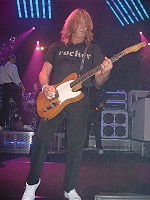
The late 1980s and 1990s
On 12 July 1986 they played at QueenQueen (band)
Queen are a British rock band formed in London in 1971, originally consisting of Freddie Mercury , Brian May , John Deacon , and Roger Taylor...
's Live at Wembley '86
Live at Wembley '86
Live at Wembley '86 is a double compact disc live album by English rock band Queen.It was recorded live on Saturday July 12, 1986 during the Magic Tour at Wembley Stadium in London, England and released on May 26, 1992...
concert. Furthermore, the band supported Queen at Knebworth and an assortment of Queen's European shows. The commercially successful In the Army Now
In The Army Now (album)
In the Army Now is the seventeenth studio album by English rock band Status Quo, released in 1986.-Track listing:# "Rollin' Home" 4:25# "Calling" 4:03# "In Your Eyes" 5:07# "Save Me" 4:24...
album was released in 1986, the single of the same name becoming one of the band's biggest selling UK singles, reaching number 2. The following album, Ain't Complaining
Ain't Complaining
Ain't Complaining is the eighteenth studio album by English rock band Status Quo. Initially released on the Vertigo label in 1988, it was the group's first album on that label to fall short of the UK Top 10, reaching no higher than its entry position of No. 12...
, released in 1988, was less successful but did produce the hit single "Burning Bridges" which got to number 5. This was later re-recorded (with new lyrics) in April 1994 with Manchester United F.C.
Manchester United F.C.
Manchester United Football Club is an English professional football club, based in Old Trafford, Greater Manchester, that plays in the Premier League. Founded as Newton Heath LYR Football Club in 1878, the club changed its name to Manchester United in 1902 and moved to Old Trafford in 1910.The 1958...
as "Come on You Reds
Come on You Reds
"Come on You Reds" is a 1994 single by the 1994 Manchester United football squad along with the rock group Status Quo. It first entered the UK Singles Chart on 30 April 1994, and remained there for a total of 15 weeks, reaching a two-week high of #1...
" which would have given the band their second UK Number 1, but the single was released as 'by Manchester United'.
The early-to-mid-1990s saw falling album sales for the band. To promote the release of the "Rock 'Til You Drop" album (1991), Quo performed four arena gigs across the UK in the space of a single day, earning them a place in the Guinness Book of Records. The 1994 Quo album "Thirsty Work" included a cover of the Demis Roussos song "Restless" revealing an alternative and lighter sound to the band. Don't Stop
Don't Stop (Status Quo album)
Don't Stop is the twenty-second studio album by English rock band Status Quo. The album of cover versions includes guest appearances from Tessa Niles on tracks 6 and 14, The Beach Boys on track 1, Brian May of Queen fame on track 7 and Maddy Prior of Steeleye Span fame on track 15.Fun, Fun, Fun,...
(1996), and Famous in the Last Century
Famous In The Last Century
Famous in the Last Century is the twenty-fourth studio album by the British rock band Status Quo, released in 2000 to largely negative reviews. According to the band's autobiography, the idea to record it came from their manager David Walker, who said that they should celebrate the millennium with...
(2000) consisted almost entirely of cover version
Cover version
In popular music, a cover version or cover song, or simply cover, is a new performance or recording of a contemporary or previously recorded, commercially released song or popular song...
s, (with the only exception being the title track to the latter). The former brought some chart success for Quo with covers of Fleetwood Mac's
Fleetwood Mac
Fleetwood Mac are a British–American rock band formed in 1967 in London.The only original member present in the band is its eponymous drummer, Mick Fleetwood...
"Don't Stop"
Don't Stop (Fleetwood Mac song)
"Don't Stop" is a song by the rock group Fleetwood Mac, written by vocalist and keyboard player Christine McVie. Sung by Christine McVie and guitarist Lindsey Buckingham, it was a single taken from the band's 1977 hit album, Rumours. It is one of the band's most enduring hits, peaking at number...
and The Beach Boys
The Beach Boys
The Beach Boys are an American rock band, formed in 1961 in Hawthorne, California. The group was initially composed of brothers Brian, Dennis and Carl Wilson, their cousin Mike Love, and friend Al Jardine. Managed by the Wilsons' father Murry, The Beach Boys signed to Capitol Records in 1962...
' "Fun, Fun, Fun
Fun, Fun, Fun
"Fun, Fun, Fun", written by Brian Wilson and Mike Love, was a hit single by The Beach Boys that was released in 1964 on the band's album Shut Down Volume 2.- Composition :...
". The band became involved in an acrimonious dispute with Radio 1
BBC Radio 1
BBC Radio 1 is a British national radio station operated by the British Broadcasting Corporation which also broadcasts internationally, specialising in current popular music and chart hits throughout the day. Radio 1 provides alternative genres after 7:00pm including electronic dance, hip hop, rock...
after the station refused to include the "Fun Fun Fun" single on the radio station's playlist
Playlist
In its most general form, a playlist is simply a list of songs. They can be played in sequential or shuffled order. The term has several specialized meanings in the realms of radio broadcasting and personal computers.-In radio:...
.
In 1993, Francis Rossi and Rick Parfitt attracted a crowd of over 25,000 when they performed the annual Blackpool Illuminations
Blackpool Illuminations
Blackpool Illuminations is an annual Lights Festival, founded in 1879 and first switched on 18 September that year, held each autumn in the English seaside resort of Blackpool on the Fylde Coast in Lancashire....
lights switch on.
Parfitt underwent quadruple by-pass surgery in 1997 but was able to make a full recovery and returned with a performance at the Norwich City Football Club ground three months later. Status Quo also returned to Australia in 1997, completing their first tour there since 1978. A greatest hits compilation, 'Whatever You Want – The Very Best of Status Quo' was also released, achieving silver sales in the UK that year. In 1999, Quo toured Germany, Holland and Switzerland. Dubbed the 'Last Night of the Proms', the band were backed by a full orchestra during the concerts.
Rich left in 2000 and was replaced by Matt Letley
Matt Letley
Matt Letley is the drummer in the English rock band, Status Quo.- Career :Letley's first recording were with his brother Mark's progressive rock band Sindelfingen when he was only 12; a live track including him was added to a CD reissue of their rare LP entitled 'Odgipig...
. Andrew Bown also took a year off at the same time following the death of his wife, and was temporarily replaced on stage by Paul Hirsh, formerly of Voyager
Voyager (band)
Voyager were an English pop-rock band, formed initially in Newbury, Berkshire, as 'The Paul French Connection' by Paul French , Paul Hirsh , Chris Hook , and former member of Mr Big, John Marter...
.
The 2000s
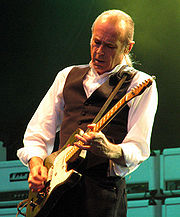
United Kingdom
The United Kingdom of Great Britain and Northern IrelandIn the United Kingdom and Dependencies, other languages have been officially recognised as legitimate autochthonous languages under the European Charter for Regional or Minority Languages...
, as well as their big followings in Scandinavia and mainland Europe
Europe
Europe is, by convention, one of the world's seven continents. Comprising the westernmost peninsula of Eurasia, Europe is generally 'divided' from Asia to its east by the watershed divides of the Ural and Caucasus Mountains, the Ural River, the Caspian and Black Seas, and the waterways connecting...
, most notably in the Netherlands
Netherlands
The Netherlands is a constituent country of the Kingdom of the Netherlands, located mainly in North-West Europe and with several islands in the Caribbean. Mainland Netherlands borders the North Sea to the north and west, Belgium to the south, and Germany to the east, and shares maritime borders...
.
In November 2000, the band played a gig at Grandchester in the outback
Outback
The Outback is the vast, remote, arid area of Australia, term colloquially can refer to any lands outside the main urban areas. The term "the outback" is generally used to refer to locations that are comparatively more remote than those areas named "the bush".-Overview:The outback is home to a...
in Australia, performing on a carriage of Australia's Orient Express, the Great South Pacific Express
Great South Pacific Express
The Great South Pacific Express was a luxury train service, run in a joint venture by Queensland Rail and the Venice-Simplon Orient Express, that ran between Kuranda and Sydney in Australia from 1998 until 2003. The train accommodated 100 passengers in up to 21 carriages, at a cost from...
.
In September 2005, a contestant on the long-running BBC
BBC
The British Broadcasting Corporation is a British public service broadcaster. Its headquarters is at Broadcasting House in the City of Westminster, London. It is the largest broadcaster in the world, with about 23,000 staff...
television quiz programme Mastermind
Mastermind (TV series)
Mastermind is a British quiz show, well known for its challenging questions, intimidating setting and air of seriousness.Devised by Bill Wright, the basic format of Mastermind has never changed — four and in later contests five contestants face two rounds, one on a specialised subject of the...
chose Status Quo as his specialist subject. That same year Rossi and Parfitt made cameo appearances in the long-running ITV
ITV
ITV is the major commercial public service TV network in the United Kingdom. Launched in 1955 under the auspices of the Independent Television Authority to provide competition to the BBC, it is also the oldest commercial network in the UK...
soap opera
Soap opera
A soap opera, sometimes called "soap" for short, is an ongoing, episodic work of dramatic fiction presented in serial format on radio or as television programming. The name soap opera stems from the original dramatic serials broadcast on radio that had soap manufacturers, such as Procter & Gamble,...
Coronation Street
Coronation Street
Coronation Street is a British soap opera set in Weatherfield, a fictional town in Greater Manchester based on Salford. Created by Tony Warren, Coronation Street was first broadcast on 9 December 1960...
in a storyline which involved them being sued by the notorious layabout Les Battersby, and performing live at his wedding as compensation.
In December 2005, it was announced that Parfitt had been taken ill and was undergoing tests for throat cancer
Esophageal cancer
Esophageal cancer is malignancy of the esophagus. There are various subtypes, primarily squamous cell cancer and adenocarcinoma . Squamous cell cancer arises from the cells that line the upper part of the esophagus...
. All subsequent dates of the UK tour were cancelled as a result. However, the growths in Parfitt's throat were later found to be benign
Benign
A benign tumor is a tumor that lacks the ability to metastasize. Common examples of benign tumors include moles and uterine fibroids.The term "benign" implies a mild and nonprogressive disease. Indeed, many kinds of benign tumors are harmless to human health...
and were successfully removed. In May 2006, a fully recovered Parfitt and the band returned to the NEC Birmingham to play the show that they had postponed in December. This was their 40th show at the venue, and was recorded for a DVD, entitled "Just Doin' It".
On the 1 July 2007, they performed in front of 63,000 people at the newly built Wembley Stadium
Wembley Stadium
The original Wembley Stadium, officially known as the Empire Stadium, was a football stadium in Wembley, a suburb of north-west London, standing on the site now occupied by the new Wembley Stadium that opened in 2007...
as part of the Concert for Diana
Concert for Diana
Concert for Diana was a concert held at the then new Wembley Stadium in London, England, United Kingdom in honour of Diana, Princess of Wales, on 1 July 2007, which would have been her 46th birthday; 31 August that year brought the 10th anniversary of her death...
. They also appeared on the TV program Tiswas
Tiswas
Tiswas was a Saturday morning children's British television series which ran from 5 January 1974 to 3 April 1982 and was produced for the ITV network by ATV Network Limited....
Reunited, in which the band got the usual greeting of custard pies and buckets of water whilst playing the song, "Gerdundula".
Their twenty-eighth studio album, In Search of the Fourth Chord
In Search of the Fourth Chord
In Search of the Fourth Chord is the twenty-eighth studio album by English rock band Status Quo, released September 17, 2007. The title is a tongue-in-cheek reference to the rumour that the group always plays the same three chords, and a reference to the album In Search of the Lost Chord by British...
, was released on the band's own Fourth Chord label in September 2007 in the UK, and on Edel Records in the rest of Europe. Produced by veteran producer Pip Williams
Pip Williams
Pip Williams, is a record producer, arranger and guitarist, best known for producing albums for Status Quo and The Moody Blues.-Career:...
, who had worked with Quo in the studio since 1977, the album was only moderately successful.
In 2008, they teamed up with German
Germany
Germany , officially the Federal Republic of Germany , is a federal parliamentary republic in Europe. The country consists of 16 states while the capital and largest city is Berlin. Germany covers an area of 357,021 km2 and has a largely temperate seasonal climate...
techno
Techno
Techno is a form of electronic dance music that emerged in Detroit, Michigan in the United States during the mid to late 1980s. The first recorded use of the word techno, in reference to a genre of music, was in 1988...
group Scooter
Scooter (band)
Scooter are a German hard dance band founded in Hamburg, who have sold over 25 million records and earned over 80 gold and platinum awards. Scooter are considered the most successful single-record German act with 23 top ten hits. The band is currently composed of members H.P. Baxxter, Rick J....
to record a jumpstyle
Jumpstyle
Jumpstyle is a rave dance and electronic music genre mainly practiced in Europe, specifically Belgium, the Netherlands, Ireland, Germany, northern France, and a few parts in the United States, specifically Indiana. The dance is also called Jumpen...
version of their 1979 single "Whatever You Want
Whatever You Want (song)
"Whatever You Want" is a rock song by the British rock band Status Quo. Written by Rick Parfitt and Andy Bown, it was released on the album of the same name in 1979 and has become one of the band's better-known works...
" entitled "Jump That Rock (Whatever You Want)
Jumping All Over the World
Jumping All Over the World is the thirteenth studio album by German techno group Scooter, released in Germany in 2007. Five singles have been released from it: "The Question Is What Is the Question?", "And No Matches", "Jumping All Over the World", a remix of "I'm Lonely" and a new version of "Jump...
". In December 2008, they released their 75th single and first Christmas single, entitled "It's Christmas Time
It's Christmas Time
"It's Christmas Time" is a Christmas song recorded by the British Rock band Status Quo in 2008. It was included in the compilation box set album Pictures - 40 Years of Hits...
", which peaked at No. 40 in the UK Singles Chart
UK Singles Chart
The UK Singles Chart is compiled by The Official Charts Company on behalf of the British record-industry. The full chart contains the top selling 200 singles in the United Kingdom based upon combined record sales and download numbers, though some media outlets only list the Top 40 or the Top 75 ...
.
In August 2009, Status Quo returned to Northern Ireland to play in Carrickfergus
Carrickfergus
Carrickfergus , known locally and colloquially as "Carrick", is a large town in County Antrim, Northern Ireland. It is located on the north shore of Belfast Lough, from Belfast. The town had a population of 27,201 at the 2001 Census and takes its name from Fergus Mór mac Eirc, the 6th century king...
. Other acts included Imelda May
Imelda May
Imelda Mary Higham, Clabby , known as Imelda May, is an Irish vocalist and musician. She began her career in music at 15 and released her debut album in 2005. She also plays the bodhrán and guitar...
, Simon McBride, and Jools Holland
Jools Holland
Julian Miles "Jools" Holland OBE, DL is an English pianist, bandleader, singer, composer, and television presenter. He was a founder of the band Squeeze and his work has involved him with many artists including Sting, Eric Clapton, George Harrison, The Who, David Gilmour and Bono.Holland is a...
.
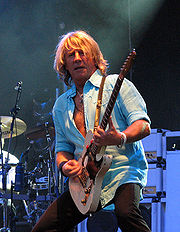
Glastonbury Festival 2009
The 2009 Glastonbury Festival of Contemporary Performing Arts was held from 24–29 June 2009.- Registration :In a similar way to previous festivals, tickets for the 2009 event required pre-registration through the festival website...
on 28 June, and at the separately held Glastonbury Abbey
Glastonbury Abbey
Glastonbury Abbey was a monastery in Glastonbury, Somerset, England. The ruins are now a grade I listed building, and a Scheduled Ancient Monument and are open as a visitor attraction....
Extravaganza in August 2009.
Quo have recently seen a rise in popularity, seen most notably after their performance at the 2009 Glastonbury Festival on the Pyramid stage. The Sunday afternoon performance drew a record crowd of 80,000 people. Additionally, Status Quo have seen a resurgence in France, where their recent tours have seen them performing in larger venues; while, in March 2010, they undertook a five-date tour of Australia, which was also well received.
The 2010s
Rossi and Parfitt were awarded the OBEOrder of the British Empire
The Most Excellent Order of the British Empire is an order of chivalry established on 4 June 1917 by George V of the United Kingdom. The Order comprises five classes in civil and military divisions...
in the New Year Honours 2010 for their services to music. Their long-standing work for charities
Charitable organization
A charitable organization is a type of non-profit organization . It differs from other types of NPOs in that it centers on philanthropic goals A charitable organization is a type of non-profit organization (NPO). It differs from other types of NPOs in that it centers on philanthropic goals A...
includes The Prince's Trust
The Prince's Trust
The Prince's Trust is a charity in the United Kingdom founded in 1976 by Charles, Prince of Wales to help young people. They run a range of training programmes, provide mentoring support and offer financial grants to build the confidence and motivation of disadvantaged young people...
, British Heart Foundation
British Heart Foundation
The British Heart Foundation is a charity organisation in Britain that funds research, education, care and awareness campaigns aimed to prevent heart diseases in humans.-Foundation:...
and Nordoff-Robbins Music Therapy.
Classic Rock
Classic Rock (magazine)
Classic Rock is a British magazine dedicated to the radio format of classic rock, published by Future Publishing, who are also responsible for its "sister" publication Metal Hammer. Although firmly focusing on key bands from the 1960s through early 1990s, it also includes articles and reviews of...
magazine reported on 17 March 2010 that the band has patched up their relationship with Alan Lancaster, and are discussing the possibility of a collaboration in the future. The article stated "While the band are back on friendly terms with Alan, it's unlikely we'll see any future reunion, with Quo continuing as normal and Lancaster busy with charity events and overseeing the activities of his son's band The Presence".
On 20 September 2010, Status Quo was honoured with a plaque commemorating their first gig at the Welcome Inn in Well Hall Road, Eltham, where the band first performed in 1967.
On 26 September 2010, a new version of "In the Army Now" was released through Universal / UMC. All profits from this updated and lyrically reworked version will be donated equally to the British Forces Foundation
British Forces Foundation
The British Forces Foundation is a British Charity, reg no 1075109The foundation was launched in May 1999 by comedian Jim Davidson to support the well being of the members of Britains armed forces though the provision of high quality entertainment....
and Help For Heroes
Help for Heroes
Help for Heroes is a British charity launched on 1 October 2007 to help provide better facilities for British servicemen and women wounded since September 11, 2001. It was founded by Bryn Parry OBE and his wife Emma Parry OBE after they visited soldiers at Selly Oak Hospital in Birmingham...
charities.
The release of the band's complete BBC television and radio recordings has been announced. A box set of sessions, live concerts and TV appearances was released on 25 October 2010, titled Live at the BBC.
Their twenty ninth studio album, Quid Pro Quo
Quid Pro Quo (album)
Quid Pro Quo is the twenty-ninth studio album by English rock band Status Quo, released in May 2011. The album debuted at number 10 in the UK charts and features 14 new songs, as well as the 2010 version of the 1986 hit In The Army Now which was re-released in support of the Help For Heroes and...
, was released in a deluxe format exclusively at Tesco
Tesco
Tesco plc is a global grocery and general merchandise retailer headquartered in Cheshunt, United Kingdom. It is the third-largest retailer in the world measured by revenues and the second-largest measured by profits...
on 30 May 2011. The regular edition will be released elsewhere on 7 June. The album charted at number 10 in the UK charts.
Excerpt from "Pictures of Matchstick Men" drives the beat of a Target Corporation
Target Corporation
Target Corporation, doing business as Target, is an American retailing company headquartered in Minneapolis, Minnesota. It is the second-largest discount retailer in the United States, behind Walmart. The company is ranked at number 33 on the Fortune 500 and is a component of the Standard & Poor's...
TV spot Summer 2011.
December 2011 will see Status Quo undertake their first all arenas UK winter tour. Quo will also perform their first ever gig at the O2 arena
The O2 arena (London)
The O2 Arena is a multi-purpose indoor arena located in the centre of The O2, a large entertainment complex on the Greenwich peninsula in London, England.With a capacity of up to 20,000 depending on the event, it is second largest...
in London. The tour is dubbed 'Quofest' and will see Roy Wood
Roy Wood
Roy Adrian Wood is an English singer-songwriter and musician. He was particularly successful in the 1960s and 1970s as member and co-founder of the bands The Move, Electric Light Orchestra, and Wizzard. As a songwriter, he contributed a number of hits to the repertoire of these bands.-Career:Wood...
and Kim Wilde
Kim Wilde
Kim Wilde is an English pop singer, author and television presenter who burst onto the music scene in 1981 with the number 2 UK Singles Chart new wave classic "Kids in America". In 1987 she had a major hit in the United States when her version of The Supremes' classic "You Keep Me Hangin' On"...
as support for all shows.
In September 2011 Quo began filming their first cinematic documentary with Emmy nominated director Alan G. Parker. Provisionally entitled 'Hello Quo!', the production is planned for release in October 2012.
Remakes and cover versions
- In 1989, AmericanUnited StatesThe United States of America is a federal constitutional republic comprising fifty states and a federal district...
alternative rockAlternative rockAlternative rock is a genre of rock music and a term used to describe a diverse musical movement that emerged from the independent music underground of the 1980s and became widely popular by the 1990s...
group Camper Van BeethovenCamper Van BeethovenCamper Van Beethoven is an American alternative rock group formed in Redlands, California in 1983.An eclectic band, Camper Van Beethoven mixes elements of pop, ska, punk rock, folk and alternative country, as well as various types of world music. Their aggressive musical pluralism created a...
scored a number one hit on Billboard magazine's Modern Rock TracksModern Rock TracksAlternative Songs is a music chart in the United States that has appeared in Billboard magazine since September 10, 1988. It lists the 40 most-played songs on modern rock radio stations, most of which are alternative rock songs...
chart with a cover versionCover versionIn popular music, a cover version or cover song, or simply cover, is a new performance or recording of a contemporary or previously recorded, commercially released song or popular song...
of "Pictures of Matchstick Men". The song is from their album Key Lime Pie. - The 1996 re-issue of the album Too-Rye-AyToo-Rye-AyToo-Rye-Ay is the second album by Dexys Midnight Runners, released in August 1982 . The album is best known for the hit single "Come On Eileen".-Track listing:#"The Celtic Soul Brothers" – 3:08...
by Dexys Midnight RunnersDexys Midnight RunnersDexys Midnight Runners are a British pop group with soul influences, who achieved their major success in the early to mid 1980s. They are best known for their songs "Come On Eileen" and "Geno", both of which went No. 1 on the UK Singles Chart....
contained a cover version of "Marguerita Time". - Ozzy OsbourneOzzy OsbourneJohn Michael "Ozzy" Osbourne is an English vocalist, whose musical career has spanned over 40 years. Osbourne rose to prominence as lead singer of the pioneering English heavy metal band Black Sabbath, whose radically different, intentionally dark, harder sound helped spawn the heavy metal...
, backed by Type O NegativeType O NegativeType O Negative was a gothic metal band from Brooklyn, New York City. The band also incorporated elements of doom metal and thrash metal. Their dramatic lyrical emphasis on themes of romance, depression, and death resulted in the nickname "The Drab Four"...
, covered "Pictures of Matchstick Men" as part of the soundtrackSoundtrackA soundtrack can be recorded music accompanying and synchronized to the images of a motion picture, book, television program or video game; a commercially released soundtrack album of music as featured in the soundtrack of a film or TV show; or the physical area of a film that contains the...
to the Howard SternHoward SternHoward Allan Stern is an American radio personality, television host, author, and actor best known for his radio show, which was nationally syndicated from 1986 to 2005. He gained wide recognition in the 1990s where he was labeled a "shock jock" for his outspoken and sometimes controversial style...
biographical movieFilmA film, also called a movie or motion picture, is a series of still or moving images. It is produced by recording photographic images with cameras, or by creating images using animation techniques or visual effects...
Private PartsPrivate Parts (1997 film)Private Parts is a 1997 American biographical comedy film produced by Ivan Reitman and released by Paramount Pictures. Written by Len Blum and Michael Kalesniko, the film is an adaptation of the 1993 best-selling book of the same name by radio personality Howard Stern, who stars as himself. It...
in 1997. - Dr. FeelgoodDr. Feelgood (band)Dr. Feelgood are a British pub rock band formed in 1971. The band's name derives from a slang term for heroin or for a doctor who is willing to overprescribe drugs. It is also a reference to a 1962 record by the American blues pianist and singer Willie Perryman called "Dr Feel-Good", which...
, covered "Gerdundula" after Rossi suggested it to them on their shared tour in 2001. - At the 2005 London Live 8Live 8Live 8 was a string of benefit concerts that took place on 2 July 2005, in the G8 states and in South Africa. They were timed to precede the G8 Conference and summit held at the Gleneagles Hotel in Auchterarder, Scotland from 6–8 July 2005; they also coincided with the 20th anniversary of Live Aid...
concert ColdplayColdplayColdplay are a British alternative rock band formed in 1996 by lead vocalist Chris Martin and lead guitarist Jonny Buckland at University College London. After they formed Pectoralz, Guy Berryman joined the group as a bassist and they changed their name to Starfish. Will Champion joined as a...
's Chris MartinChris MartinChristopher Anthony John "Chris" Martin is an English song-writer, who is the lead vocalist, pianist and rhythm guitarist of the band Coldplay. He is married to actress Gwyneth Paltrow.-Early life:...
sang the chorus to "Rockin' All Over the World" in their song, "In My PlaceIn My Place"In My Place" is a song by English alternative rock band Coldplay. The song was written collaboratively by all the band members for their second album, A Rush of Blood to the Head. The track is built around thumping drums, chiming guitars and a chorus...
", in reference to Status Quo having opened Live AidLive AidLive Aid was a dual-venue concert that was held on 13 July 1985. The event was organized by Bob Geldof and Midge Ure to raise funds for relief of the ongoing Ethiopian famine. Billed as the "global jukebox", the event was held simultaneously in Wembley Stadium in London, England, United Kingdom ...
with "Rockin' All Over The World" - Oakland, California-based electronica/dance/pop group Persephone's BeesPersephone's BeesPersephone's Bees is an Oakland-based rock/pop music group.-History:Growing up in Pyatigorsk, Russia, lead singer Angelina Moysova was musically inspired by her family: her mother played traditional folk/gypsy music while her brother played modern music...
covered "Paper Plane" on their 2006 album Notes from the UnderworldNotes from the UnderworldNotes from the Underworld is the major label debut of Oakland electronic pop group Persephone's Bees.-Track listing:# "Way to Your Heart" – 2:59# "Climbing" – 3:07# "City of Love" – 4:04# "Nice Day" – 4:01# "Muzika Dlya Fil'ma" – 5:43...
. - Towards the end of his life, DJDisc jockeyA disc jockey, also known as DJ, is a person who selects and plays recorded music for an audience. Originally, "disc" referred to phonograph records, not the later Compact Discs. Today, the term includes all forms of music playback, no matter the medium.There are several types of disc jockeys...
John PeelJohn PeelJohn Robert Parker Ravenscroft, OBE , known professionally as John Peel, was an English disc jockey, radio presenter, record producer and journalist. He was the longest-serving of the original BBC Radio 1 DJs, broadcasting regularly from 1967 until his death in 2004...
was known for playing "Down DownDown Down"Down Down" is a popular song by the English rock band, Status Quo.Written by Francis Rossi and Bob Young and produced by Status Quo, "Down Down" was one of Status Quo's two number one singles in the UK Singles Chart so far...
" as part of his eclectic DJ sets. - Since their 2004 Football League TrophyFootball League TrophyThe Football League Trophy, currently known as the Johnstone's Paint Trophy for sponsorship reasons, is an annual English association football knock-out competition open to the 48 clubs in Football League One and Football League Two, the bottom two divisions in the four fully professional top...
exploits, Southend United F.C.Southend United F.C.Southend United Football Club is an English football club based at Roots Hall Stadium, Prittlewell, Southend-on-Sea, Essex, who play in Football League Two. Their home ground is Roots Hall, and the club plan to move into a new 22,000-seater stadium located at Fossetts Farm.-Stadium:The club has had...
fansFan (person)A Fan, sometimes also called aficionado or supporter, is a person with a liking and enthusiasm for something, such as a band or a sports team. Fans of a particular thing or person constitute its fanbase or fandom...
have made an anthem for themselves by singing "Shrimping All Over the World", to the melodyMelodyA melody , also tune, voice, or line, is a linear succession of musical tones which is perceived as a single entity...
of "Rockin' All Over the World". - Arjen Lucassen (from the DutchNetherlandsThe Netherlands is a constituent country of the Kingdom of the Netherlands, located mainly in North-West Europe and with several islands in the Caribbean. Mainland Netherlands borders the North Sea to the north and west, Belgium to the south, and Germany to the east, and shares maritime borders...
project AyreonAyreonAyreon is a project by Dutch composer and musician Arjen Anthony Lucassen.Ayreon's musical style derives mostly from heavy metal and progressive rock, but combines them with genres like folk, classical and electronica...
) covered "Pictures Of Matchstick Men" on the solo album Strange Hobby. - MuseMuse (band)Muse are an English alternative rock band from Teignmouth, Devon, formed in 1994. The band consists of school friends Matthew Bellamy , Christopher Wolstenholme and Dominic Howard...
have been known to play a riff from "Burning BridgesBurning Bridges (Status Quo song)"Burning Bridges " is a single released by the British rock band Status Quo in 1988. It was included on the album Ain't Complaining...
" in their live sets. - Folk metal band Mägo de OzMägo de OzMägo de Oz is a Spanish folk/heavy metal band from Begoña, Madrid formed in mid-1988 by drummer Txus di Fellatio. In 1992, the band were finalists in the Villa de Madrid contest. Then, they went onto achieve great success in Spain, and in 1995, were declared Revolution Rock Band...
recorded an instrumental version of "Gerdundula" on their La BrujaMägo de Oz (La Bruja)Mägo de Oz is an album by folk metal artists Mägo de Oz, which was released in 1994.It includes five tracks from the original release, redone with the current band members. The title is not actually La Bruja - it is self-titled - but that is the name it acquired due to the witch on the cover...
EP. - Celtic music ensamble Luar Na LubreLuar na Lubre-Etymology:Luar is Galician for moonlight; lubre is a magical forest in which the Celtic druids cast their spells.-Biography:During its career, this musical group has spread Galician music and culture. The band became famous worldwide after Mike Oldfield took interest in their music...
also covered "Gerdundula" on the album Camiños Da Fin Da Terra. - SpanishSpainSpain , officially the Kingdom of Spain languages]] under the European Charter for Regional or Minority Languages. In each of these, Spain's official name is as follows:;;;;;;), is a country and member state of the European Union located in southwestern Europe on the Iberian Peninsula...
rock band Platero y TuPlatero y TúPlatero y Tú was a Spanish rock band founded in Bilbao in the 1980s, and disbanded in 2001. Their lyrics speak mainly of drugs, bar issues and love, and their style, being mainly influenced by bands like Status Quo or Leño, and guitarists like John Fogerty from Creedence Clearwater Revival, broke...
did a SpanishSpanish languageSpanish , also known as Castilian , is a Romance language in the Ibero-Romance group that evolved from several languages and dialects in central-northern Iberia around the 9th century and gradually spread with the expansion of the Kingdom of Castile into central and southern Iberia during the...
cover of "Rockin' All Over the World", titled "Si Tu te Vas", on their album Voy a acabar borracho. - GermanGermanyGermany , officially the Federal Republic of Germany , is a federal parliamentary republic in Europe. The country consists of 16 states while the capital and largest city is Berlin. Germany covers an area of 357,021 km2 and has a largely temperate seasonal climate...
technoTechnoTechno is a form of electronic dance music that emerged in Detroit, Michigan in the United States during the mid to late 1980s. The first recorded use of the word techno, in reference to a genre of music, was in 1988...
band ScooterScooter (band)Scooter are a German hard dance band founded in Hamburg, who have sold over 25 million records and earned over 80 gold and platinum awards. Scooter are considered the most successful single-record German act with 23 top ten hits. The band is currently composed of members H.P. Baxxter, Rick J....
sampled "Whatever You WantWhatever You Want (song)"Whatever You Want" is a rock song by the British rock band Status Quo. Written by Rick Parfitt and Andy Bown, it was released on the album of the same name in 1979 and has become one of the band's better-known works...
" on their song "Jump That Rock (Whatever You Want)Jump That Rock (Whatever You Want)Download12"NL CD Single...
", from the 2008 UK version of their album Jumping All Over the WorldJumping All Over the WorldJumping All Over the World is the thirteenth studio album by German techno group Scooter, released in Germany in 2007. Five singles have been released from it: "The Question Is What Is the Question?", "And No Matches", "Jumping All Over the World", a remix of "I'm Lonely" and a new version of "Jump...
. - DutchNetherlandsThe Netherlands is a constituent country of the Kingdom of the Netherlands, located mainly in North-West Europe and with several islands in the Caribbean. Mainland Netherlands borders the North Sea to the north and west, Belgium to the south, and Germany to the east, and shares maritime borders...
football club Vitesse has a cover version of "Whatever You Want", entitled "Daar zijn de boys", as their home song. - Bad ReligionBad ReligionBad Religion is a punk rock band that formed in Los Angeles in 1979. Their current line-up consists of Greg Graffin , Brett Gurewitz , Jay Bentley , Greg Hetson , Brian Baker and Brooks Wackerman . Gurewitz is also the founder of the label Epitaph Records, which has released almost all of the...
guitarist Brett GurewitzBrett GurewitzBrett W. Gurewitz , nicknamed Mr. Brett, is the guitarist and a songwriter of Bad Religion. He is also the owner of the music label Epitaph Records and sister-labels ANTI-, Burning Heart Records, Fat Possum Records, and Hellcat Records...
recorded a cover version of "Pictures of Matchstick Men", on his 1985 solo album Seeing Eye Gods. - German metal band HelloweenHelloweenHelloween is a German power metal band founded in the mid 1980s by members of Iron Fist and Powerfool. The band was a pioneering force in the European Power Metal movement and their second and third studio albums, Keeper of the Seven Keys, Pt...
covered "Rain" for their single "Power". It can also be found on the special edition of their 1996 album, The Time of the OathThe Time of the Oath*M - 3,4 also appears on The Time of the Oath single.*M - 5,6 also appears on the Power single.*M - 7,8 also appears on the Forever And One single.- Personnel :* Andi Deris - vocals* Michael Weikath - guitar* Roland Grapow - guitar* Markus Grosskopf - bass...
. - The Swedish doom metal band Lake of TearsLake of TearsLake of Tears is a Swedish band, generally considered to play gothic metal and doom metal. However, their sound has evolved considerably over the course of their career, expanding to include psychedelic rock, progressive metal, and, most recently, death metal....
covered "Is There a Better Way" on their album Moons and MushroomsMoons and MushroomsMoons and Mushrooms is the seventh studio album by the gothic metal band Lake of Tears. It was released in 2007, and was the first Lake of Tears recording to feature Magnus Sahlgren as an official member of the band...
in 2007.
Literature
- John Shearlaw, Bob YoungBob Young (artist)Robert Keith Young is an English musician and author, who became famous for being the unofficial fifth member of the rock band Status Quo.- Collaborations with Status Quo :...
: Again & Again. Sidgwick & Jackson, October 1984, Paperback, ISBN 0283991011 (1st edition (1979) and 2nd edition (1982) as The Authorised Biography by John Shearlaw) - Tom Hibbert: Status Quo. Omnibus Press, 1982, ISBN 0-86001-957-8
- Neil Jeffries: Rockin' All Over the World. Proteus Books, March 1985, Paperback, ISBN 0-862-76272-3
- Bob Young: Quotographs - Celebrating 30 Years of Status Quo, IMP International Music Publications Limited, 1985, ISBN 1-859-09291-8
- Francis RossiFrancis RossiFrancis Dominic Nicholas Michael Rossi, OBE is a British musician best known for being a co-founder of the English rock band Status Quo, in which he sings lead vocals and plays lead guitar.- Career :...
, Rick ParfittRick ParfittRichard John Parfitt, OBE is best known for being a singer and the rhythm guitarist in the English rock band Status Quo.-Career:...
: Just For The Record. Bantam Press, September 1994, hardcover, ISBN 0-593-03546-1 - Patti Parfitt: Laughing All over the World: My Life Married to Status Quo. Blake Publishing Ltd, Oktober 1998, ISBN 185782198-X
- David J. Oxley: Rockers Rollin' - The Story of Status Quo. ST Publishing, Januar 2000, Paperback, ISBN 1-898927-80-4
- David J. Oxley: Tuned To The Music of Status Quo. ST Publishing, 2001, Paperback, ISBN 1-898927-90-1
- Francis Rossi, Rick Parfitt, Mick WallMick WallMick Wall is a British music journalist, radio and TV presenter, and author.Wall began his career contributing to the music weekly Sounds in 1977, where he wrote on punk and the new wave, before graduating to rockabilly, funk, New Romantic pop and, eventually, hard rock and heavy metal...
: Status Quo. XS All Areas. Sidgwick & Jackson, September 2004, hardcover, ISBN 0283073756 (paperback edition: Macmillan Publishers Ltd, August 2005, ISBN 0330419625) - Francis Rossi, Rick Parfitt, Bob Young: „Status Quo“: The Official 40th Anniversary Edition . Cassell Illustrated, Oktober 2006, hardcover, ISBN 9781844035625.
- Status Quo: La Route Sans Fin, foreword by Bob Young - ISBN 2-910196-42-9