


Stand in the Schoolhouse Door

Encyclopedia
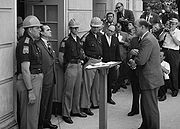
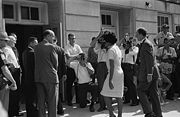
Foster Auditorium
Foster Auditorium is a multi-purpose facility at the University of Alabama in Tuscaloosa, Alabama. It was built in 1939 and has been used for Alabama basketball, women's sports , graduations, lectures, concerts, and other large gatherings, including registration...
at the University of Alabama
University of Alabama
The University of Alabama is a public coeducational university located in Tuscaloosa, Alabama, United States....
on June 11, 1963. George Wallace
George Wallace
George Corley Wallace, Jr. was the 45th Governor of Alabama, serving four terms: 1963–1967, 1971–1979 and 1983–1987. "The most influential loser" in 20th-century U.S. politics, according to biographers Dan T. Carter and Stephan Lesher, he ran for U.S...
, the Governor of Alabama, in a symbolic attempt to keep his inaugural promise of "segregation
Racial segregation
Racial segregation is the separation of humans into racial groups in daily life. It may apply to activities such as eating in a restaurant, drinking from a water fountain, using a public toilet, attending school, going to the movies, or in the rental or purchase of a home...
now, segregation tomorrow, segregation forever" and stop the desegregation
Desegregation
Desegregation is the process of ending the separation of two groups usually referring to races. This is most commonly used in reference to the United States. Desegregation was long a focus of the American Civil Rights Movement, both before and after the United States Supreme Court's decision in...
of schools, stood at the door of the auditorium to try to block the entry of two black students, Vivian Malone Jones
Vivian Malone Jones
Vivian Juanita Malone Jones was an African-American woman, one of the first two African Americans to enroll at the University of Alabama in 1963 and was made famous when Alabama Governor George Wallace blocked them from enrolling at the all-white university.-University of Alabama:On June 11, 1963,...
and James Hood
James Hood
James Hood was one of the first African Americans to enroll at the University of Alabama in 1963 and was made famous when Alabama Governor George Wallace blocked him from enrolling at the all-white university....
.
The incident brought George Wallace into the national spotlight.
Background
On May 17, 1954, the Supreme Court of the United StatesSupreme Court of the United States
The Supreme Court of the United States is the highest court in the United States. It has ultimate appellate jurisdiction over all state and federal courts, and original jurisdiction over a small range of cases...
handed down its decision regarding the case called Brown v. Board of Education of Topeka, Kansas, in which the plaintiffs charged that the education of black children in separate public schools from their white counterparts was unconstitutional.
Brown v. Board of Education meant that the University of Alabama had to be desegregated. In the years following, hundreds of African-Americans applied for admission, but all were denied. The University worked with police to find any disqualifying qualities, or when this failed, intimidated the applicants. But in 1963, three African-Americans with perfect qualifications—Vivian Malone Jones
Vivian Malone Jones
Vivian Juanita Malone Jones was an African-American woman, one of the first two African Americans to enroll at the University of Alabama in 1963 and was made famous when Alabama Governor George Wallace blocked them from enrolling at the all-white university.-University of Alabama:On June 11, 1963,...
, Dave McGlathery
Dave McGlathery
Dave Mack McGlathery, an African American enrolled at the University of Alabama without incident a day after the Stand in the School House Door when Governor Wallace tried to prevent black students enrolling. He was at the time a 27-year-old working as a mathematician at the National Aeronautics...
and James Hood
James Hood
James Hood was one of the first African Americans to enroll at the University of Alabama in 1963 and was made famous when Alabama Governor George Wallace blocked him from enrolling at the all-white university....
—applied, refusing to be intimidated. In early June a federal judge ordered that they be admitted, and forbade Governor Wallace from interfering.
The incident
On June 11, Malone and Hood arrived to register. Wallace, attempting to uphold his promise as well as for political show, blocked the entrance to Foster Auditorium with the media watching. Then, flanked by federal marshals, Deputy Attorney GeneralUnited States Deputy Attorney General
United States Deputy Attorney General is the second-highest-ranking official in the United States Department of Justice. In the United States federal government, the Deputy Attorney General oversees the day-to-day operation of the Department of Justice, and may act as Attorney General during the...
Nicholas Katzenbach
Nicholas Katzenbach
Nicholas deBelleville Katzenbach is an American lawyer who served as United States Attorney General during the Lyndon B. Johnson administration.-Early life:...
told Wallace to step aside. However, Wallace cut Katzenbach off and refused, giving a speech on States' rights
States' rights
States' rights in U.S. politics refers to political powers reserved for the U.S. state governments rather than the federal government. It is often considered a loaded term because of its use in opposition to federally mandated racial desegregation...
. Katzenbach called President
President of the United States
The President of the United States of America is the head of state and head of government of the United States. The president leads the executive branch of the federal government and is the commander-in-chief of the United States Armed Forces....
John F. Kennedy
John F. Kennedy
John Fitzgerald "Jack" Kennedy , often referred to by his initials JFK, was the 35th President of the United States, serving from 1961 until his assassination in 1963....
, who mobilized the Alabama National Guard
Alabama National Guard
The Alabama National Guard comprises both Army and Air components. The Guard is part of the Alabama Military Department, seemingly overseen by the Adjutant General of Alabama....
. General Henry Graham then commanded Wallace to step aside, saying, "Sir, it is my sad duty to ask you to step aside under the orders of the President of the United States
President of the United States
The President of the United States of America is the head of state and head of government of the United States. The president leads the executive branch of the federal government and is the commander-in-chief of the United States Armed Forces....
." Wallace then spoke further, but eventually moved, and Malone and Hood registered as students.
In film
The incident was detailed in Robert DrewRobert Drew
Robert Lincoln Drew is an American documentary filmmaker known as a pioneer of cinéma vérité, or direct cinema, in the United States....
's 1963 documentary film Crisis: Behind a Presidential Commitment
Crisis: Behind a Presidential Commitment
Crisis: Behind a Presidential Commitment is a 1963 cinéma vérité documentary film directed by Robert Drew. The film centers on the University of Alabama integration crisis of June 1963. Drew and the other filmmakers, such as D. A. Pennebaker and Richard Leacock, were given access to all the key...
. The event was depicted in the 1994 film Forrest Gump
Forrest Gump
Forrest Gump is a 1994 American epic comedy-drama romance film based on the 1986 novel of the same name by Winston Groom. The film was directed by Robert Zemeckis, starring Tom Hanks, Robin Wright and Gary Sinise...
, in which the title character appeared at the event.
External links
- Sarah Melton, "A Sleight of History: University of Alabama's Foster Auditorium", Southern Spaces, October 15, 2009.
- JFK Address on Civil Rights (June 11, 1963)