

Stall

Encyclopedia
In fluid dynamics
, a stall is a reduction in the lift
coefficient generated by a foil
as angle of attack
increases. This occurs when the critical angle of attack of the foil is exceeded. The critical angle of attack is typically about 15 degrees, but it may vary significantly depending on the fluid, foil, and Reynolds number.
Stalls in fixed-wing flight are often experienced as a sudden reduction in lift as the pilot increases angle of attack and exceeds the critical angle of attack (which may be due to slowing down below stall speed in level flight). A stall does not mean that the engine(s) have stopped working, or that the aircraft has stopped moving — the effect is the same even in an unpowered glider aircraft
. Vectored thrust
in manned and unmanned aircraft is used to surpass the stall limit, thereby giving rise to post-stall technology.
Because stalls are most commonly discussed in connection with aviation
, this article discusses stalls as they relate mainly to aircraft, in particular fixed-wing aircraft
. The principles of stall discussed here translate to foils in other fluids as well.
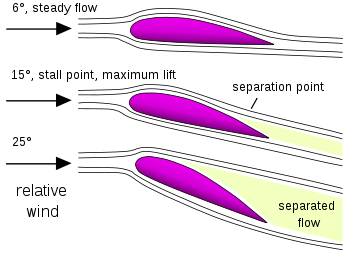 A stall is a condition in aerodynamics
and aviation
wherein the angle of attack
increases beyond a certain point such that the lift begins to decrease. The angle at which this occurs is called the critical angle of attack. This critical angle is dependent upon the profile
of the wing, its planform
, its aspect ratio
, and other factors, but is typically in the range of 8 to 20 degrees relative to the incoming wind for most subsonic airfoils. The critical angle of attack is the angle of attack on the lift coefficient
versus angle-of-attack curve at which the maximum lift coefficient occurs.
Flow separation begins to occur at small angles of attack while attached flow over the wing is still dominant. As angle of attack increases, the separated regions on the top of the wing increase in size and hinder the wing's ability to create lift
. At the critical angle of attack, separated flow is so dominant that further increases in angle of attack produce less lift and vastly more drag
.
A fixed-wing aircraft during a stall may experience buffeting or a change in attitude. Most aircraft are designed to have a gradual stall with characteristics that will warn the pilot and give the pilot time to react. For example, an aircraft that does not buffet before the stall may have an audible alarm or a stick shaker
installed to simulate the feel of a buffet by vibrating the stick fore and aft. The "buffet margin" is, for a given set of conditions, the amount of ‘g’, which can be imposed for a given level of buffet. The critical angle of attack in steady straight and level flight can be attained only at low airspeed. Attempts to increase the angle of attack at higher airspeeds can cause a high-speed stall or may merely cause the aircraft to climb.
Any yaw
of the aircraft as it enters the stall regime can result in autorotation
, which is also sometimes referred to as a 'spin'. Because air no longer flows smoothly over the wings during a stall, aileron
control of roll becomes less effective, whilst simultaneously the tendency for the ailerons to generate adverse yaw
increases. This increases the lift from the advancing wing and accentuates the probability of the aircraft to enter into a spin.
Depending on the aircraft's design, a stall can expose extremely adverse properties of balance and control, in particular in a prototype.
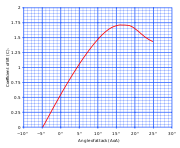
. Symmetric airfoils have lower critical angles (but also work efficiently in inverted flight). The graph shows that, as the angle of attack exceeds the critical angle, the lift produced by the airfoil decreases.
The information in a graph of this kind is gathered using a model of the airfoil in a wind tunnel
. Because aircraft models are normally used, rather than full-size machines, special care is needed to make sure that data is taken in the same Reynolds number regime (or scale speed) as in free flight. The separation of flow from the upper wing surface at high angles of attack is quite different at low Reynolds number from that at the high Reynolds numbers of real aircraft. High-pressure wind tunnels are one solution to this problem. In general, steady operation of an aircraft at an angle of attack above the critical angle is not possible because, after exceeding the critical angle, the loss of lift from the wing causes the nose of the aircraft to fall, reducing the angle of attack again. This nose drop, independent of control inputs, indicates the pilot has actually stalled the aircraft.
This graph shows the stall angle, yet in practice most pilot operating handbooks (POH) or generic flight manuals describe stalling in terms of airspeed
. This is because all aircraft are equipped with an airspeed indicator
, but fewer aircraft have an angle of attack
indicator. An aircraft's stalling speed is published by the manufacturer (and is required for certification by flight testing) for a range of weights and flap positions, but the stalling angle of attack is not published.
As speed reduces, angle of attack has to increase to keep lift constant until the critical angle is reached. The airspeed at which this angle is reached is the (1g, unaccelerated) stalling speed of the aircraft in that particular configuration. Deploying flaps
/slats decreases the stall speed to allow the aircraft to take off and land at a lower speed.
can be made to stall in any pitch attitude or bank angle or at any airspeed but is commonly practiced by reducing the speed to the unaccelerated stall speed, at a safe altitude. Unaccelerated (1g) stall speed varies on different fixed-wing aircraft and is represented by colour codes on the air speed indicator. As the plane flies at this speed, the angle of attack must be increased to prevent any loss of altitude or gain in airspeed (which corresponds to the stall angle described above). The pilot will notice the flight controls have become less responsive and may also notice some buffeting, a result of the turbulent air separated from the wing hitting the tail of the aircraft.
In most light aircraft
, as the stall is reached the aircraft will start to descend (because the wing is no longer producing enough lift to support the aircraft's weight) and the nose will pitch down. Recovery from this stalled state involves the pilot's decreasing the angle of attack and increasing the air speed, until smooth air-flow over the wing is restored. Normal flight can be resumed once recovery from the stall is complete. The maneuver is normally quite safe and if correctly handled leads to only a small loss in altitude (50'-100'). It is taught and practised in order for pilots to recognize, avoid, and recover from stalling the aircraft. A pilot is required to demonstrate competency in controlling an aircraft during and after a stall for certification, and it is a routine maneuver for pilots when getting to know the handling of a new aircraft type. The only dangerous aspect of a stall is a lack of altitude for recovery.
A special form of asymmetric stall in which the aircraft also rotates about its yaw axis is called a spin
. A spin can occur if an aircraft is stalled and there is an asymmetric yawing moment applied to it. This yawing moment can be aerodynamic (sideslip angle, rudder, adverse yaw from the ailerons), thrust related (p-factor, one engine inoperative on a multi-engine non-centreline thrust aircraft), or from less likely sources such as severe turbulence. The net effect is that one wing is stalled before the other and the aircraft descends rapidly while rotating, and some aircraft cannot recover from this condition without correct pilot control inputs (which must stop yaw) and loading. A new solution to the problem of difficult (or impossible) stall-spin recovery is provided by the ballistic parachute
recovery system.
The most common stall-spin scenarios occur on takeoff (departure stall) and during landing (base to final turn) because of insufficient airspeed during these manoeuvres. Stalls also occur during a go-around manoeuvre if the pilot does not properly respond to the out-of-trim situation resulting from the transition from low power setting to high power setting at low speed. Stall speed is increased when the wing surfaces are contaminated with ice or frost creating a rougher surface, and heavier airframe due to ice accumulation.
Stalls do not derive from airspeed and can occur at any speed - but only if the wings have too high an angle of attack. Attempting to increase the angle of attack at 1g by moving the control column back normally causes the aircraft to climb. However, aircraft often experience higher g, for example when turning steeply or pulling out of a dive. In these cases, the wings are already operating at a higher angle of attack to create the necessary force (derived from lift) to accelerate in the desired direction. Increasing the g loading still further, by pulling back on the controls, can cause the stalling angle to be exceeded -even though the aircraft is flying at a high speed. These "high-speed stalls" produce the same buffeting characteristics as 1g stalls and can also initiate a spin if there is also any yawing.
. A dangerous stall is one in which the nose rises, pushing the wing deeper into the stalled state and potentially leading to an unrecoverable deep stall. This can occur in some T-tailed aircraft wherein the turbulent airflow from the stalled wing can blanket the control surfaces at the tail.
 Stalls depend only on angle of attack
, not airspeed. Because a correlation with airspeed exists, however, a "stall speed" is usually used in practice. It is the speed below which the airplane cannot create enough lift to sustain its weight in 1g flight. In steady, unaccelerated (1g) flight, the faster an airplane goes, the less angle of attack it needs to hold the airplane up (i.e., to produce lift equal to weight). As the airplane slows down, it must increase angle of attack to create the same lift (equal to weight). As the speed slows further, at some point the angle of attack will be equal to the critical (stall) angle of attack. This speed is called the "stall speed". The angle of attack cannot be increased to get more lift at this point and so slowing below the stall speed will result in a descent. And, so, airspeed is often used as an indirect indicator of approaching stall conditions. The stall speed will vary depending on the airplane's weight, altitude, and configuration (flap setting, etc.).
There are multiple V speeds
that are used to indicate when a stall will occur:
On an airspeed indicator
, the bottom of the white arc indicates VS0 at maximum weight, while the bottom of the green arc indicates VS1 at maximum weight. While an aircraft's VS speed is computed by design, its VS0 and VS1 speeds must be demonstrated empirically by flight testing.
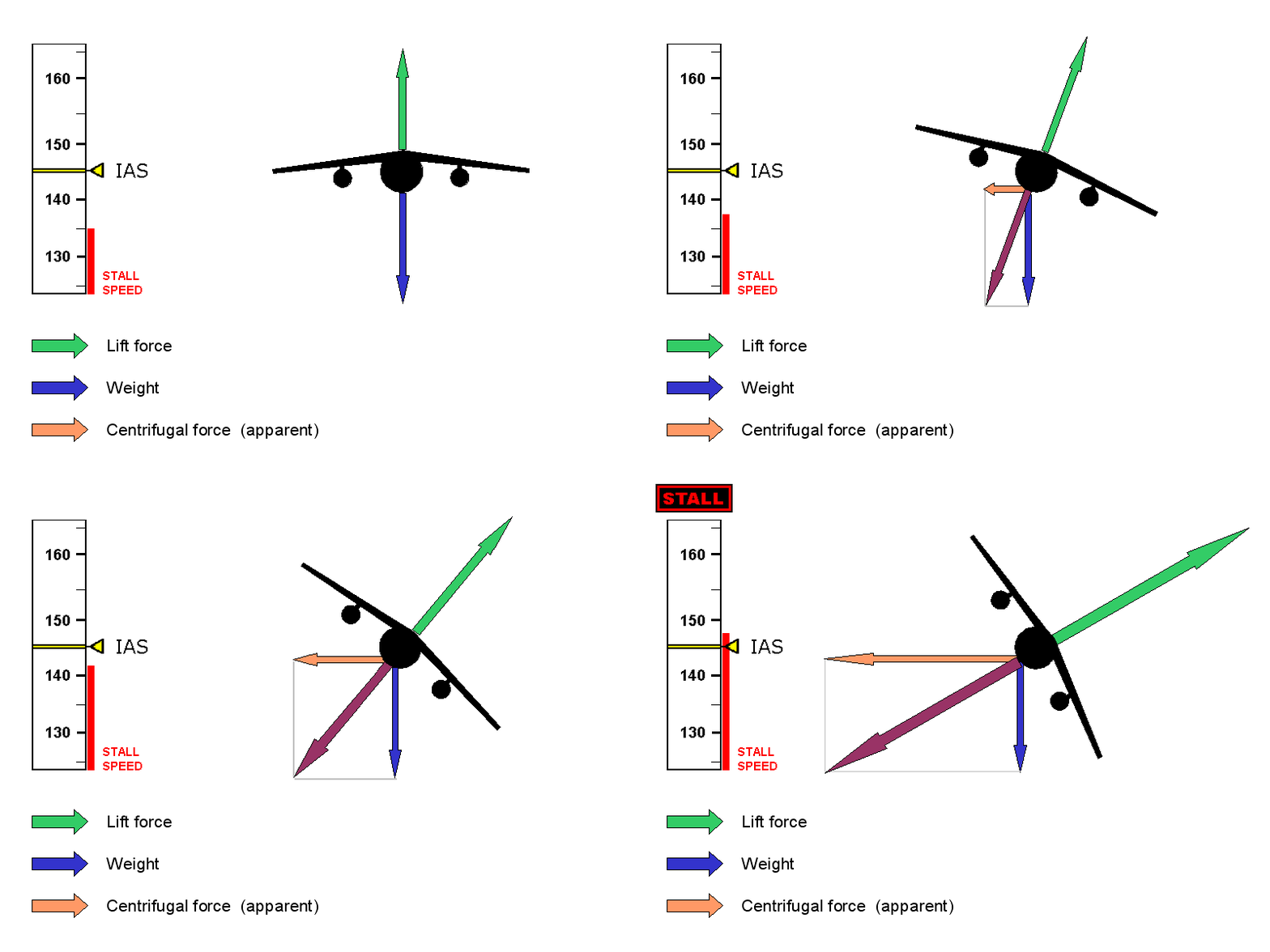 An accelerated stall is a stall that occurs while the aircraft is experiencing a load factor higher than 1 (1g), for example while turning or pulling up from a dive. In these conditions, the aircraft stalls at higher speeds than the normal stall speed (which always refers to straight and level flight).
Considering, for example, a banked turn, the lift
required is equal to the weight
of the aircraft plus extra lift to provide the centripetal force
necessary to perform the turn; that is:

where:
 = lift
 = load factor (greater than 1 in a turn)
 = weight of the aircraft
To achieve the extra lift, the lift coefficient
, and so the angle of attack
, will have to be higher than it would be in straight and level flight at the same speed. Therefore, given that the stall always occurs at the same critical angle of attack, by increasing the load factor (e.g., by tightening the turn) such critical angle - and the stall - will be reached with the airspeed remaining well above the normal stall speed, that is:

where:
 = stall speed
 = stall speed of the aircraft in straight, level flight
 = load factor
The table that follows gives some examples of the relation between the angle of bank and the square root of the load factor. It derives from the trigonometric relation (secant) between and
and  .
.
For example, in a turn with bank angle of 45o, Vst is 19% higher than Vs.
It should be noted that, according to Federal Aviation Administration
(FAA) terminology, the above example illustrates a so-called turning flight stall, while the term accelerated is used to indicate an accelerated turning stall only, that is, a turning flight stall where the airspeed decreases at a given rate.
A notable example of air accident involving a low-altitude turning flight stall is the 1994 Fairchild Air Force Base B-52 crash
.
. The rapid change can cause a strong vortex
to be shed from the leading edge of the aerofoil, and travel backwards above the wing. The vortex, containing high-velocity airflows, briefly increases the lift
produced by the wing. As soon as it passes behind the trailing edge, however, the lift reduces dramatically, and the wing is in normal stall.
Dynamic stall is an effect most associated with helicopters and flapping wings. During forward flight, some regions of a helicopter blade may incur flow that reverses (compared to the direction of blade movement), and thus includes rapidly changing angles of attack. Oscillating (flapping) wings, such as those of insects— including the most famous one, the bumblebee
— may rely almost entirely on dynamic stall for lift production, provided the oscillations are fast compared to the speed of flight, and the angle of the wing changes rapidly compared to airflow direction.
Stall delay can occur on airfoils subject to a high angle of attack
and a three-dimensional flow. When the angle of attack on an airfoil is increasing rapidly, the flow will remain substantially attached to the airfoil to a significantly higher angle of attack than can be achieved in steady-state conditions. As a result, the stall is delayed momentarily and a lift coefficient
significantly higher than the steady-state maximum is achieved. The effect was first noticed on propeller
s.
 A deep stall (or super-stall) is a dangerous type of stall that affects certain aircraft
designs, notably those with a T-tail
configuration. In these designs, the turbulent wake of a stalled main wing "blankets" the horizontal stabilizer, rendering the elevators ineffective and preventing the aircraft from recovering from the stall.
Effects similar to deep stall had long been known to occur on many aircraft designs before the term was coined. Gloster Javelin
WD808 was lost in a crash on June 11, 1953 to a "locked in" stall and Handley Page Victor
XL159 was lost to a "stable stall" on March 23, 1962. The name "deep stall" first came into widespread use after the crash of the prototype BAC 1-11 G-ASHG on October 22, 1963, killing its crew. This led to changes to the aircraft, including the installation of a stick shaker
(see below) to clearly warn the pilot of the problem before it occurred. Stick shakers are now a standard part of commercial airliners. Nevertheless, the problem continues to cause accidents; on June 3, 1966, a Hawker Siddeley Trident
(G-ARPY) was lost to deep stall; deep stall is suspected to be cause of another Trident (G-ARPI) crash on June 18, 1972; on April 3, 1980, a prototype of the Canadair Challenger business jet
entered deep stall during testing, killing one of the test pilots who was unable to leave the plane in time; and on July 26, 1993, a Canadair CRJ-100 was lost in flight test due to a deep stall. It has been reported that a Boeing 727
entered a deep stall in flight test, but the pilot was able to rock the airplane to increasingly higher bank angles until the nose finally fell through and normal control response was recovered. A 727 accident on December 1, 1974 has also been attributed to a deep stall.
Reports on the crash of Air France Flight 447
have stated that the accident involved a deep stall entered at 38000 ft (11,582 m) and continued for more than three minutes until impact, but this was a steady state conventional stall because this aircraft does not have a T-tail.
Canard-configured
aircraft are also at risk of getting into a deep stall. Two Velocity
aircraft crashed due to locked-in deep stalls. Testing revealed that the addition of leading edge cuffs to the outboard wing prevented the aircraft from getting into a deep stall. The Piper Advanced Technologies PAT-1, N15PT, another canard-configured aircraft, also crashed in an accident attributed to a deep stall. Wind tunnel testing of the design at the NASA Langley Research Center showed that it was vulnerable to a deep stall.
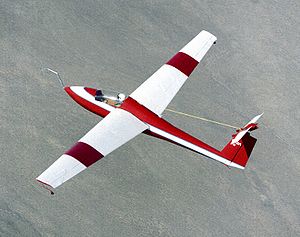
In the early 1980s, a Schweizer SGS 1-36 sailplane was modified for NASA
's controlled deep-stall flight program.
A different type of stall affecting the F-16 fighter is also known as a deep stall because of its similar difficulty in recovery, but for a different reason. The aircraft is designed to be inherently unstable, which when kept under control by its "fly-by-wire" system allows for higher maneuverability. However, this design, coupled with the intent of the control computer to keep the fighter level, prevents the aircraft from pitching nose-down in a stall, which would allow the pilot to recover given sufficient altitude. This is known as a deep stall because the elevators are rendered useless by the flight computer even though, unlike a T-tail, air does contact the elevators, and even with the computer disabled it is difficult to recover from (the pilot must "rock" the aircraft with elevator input until it pitches nose-down, which can take several seconds).
Stall warning systems often involve inputs from a broad range of sensors and systems to include a dedicated angle of attack sensor.
Blockage, damage, or inoperation of stall and angle of attack (AOA) probes can lead to unreliability of the stall warning, and cause the stick pusher, overspeed warning, autopilot, and yaw damper to malfunction.
If a forward canard
is used for pitch control, rather than an aft tail, the canard is designed to meet the airflow at a slightly greater angle of attack than the wing. Therefore, when the aircraft pitch increases abnormally, the canard will usually stall first, causing the nose to drop and so preventing the wing from reaching its critical AOA. Thus, the risk of main wing stalling is greatly reduced. However, if the main wing stalls, recovery becomes difficult, as the canard is more deeply stalled and angle of attack increases rapidly.
If an aft tail is used, the wing is designed to stall before the tail. In this case, the wing can be flown at higher lift coefficient
(closer to stall) to produce more overall lift.
Most military combat aircraft have an angle of attack indicator among the pilot's instruments, which lets the pilot know precisely how close to the stall point the aircraft is. Modern airliner instrumentation may also measure angle of attack, although this information may not be directly displayed on the pilot's display, instead driving a stall warning indicator or giving performance information to the flight computer (for fly by wire systems).
effectiveness is reduced, making the plane hard to control and increasing the risk of a spin starting. Post stall
, steady flight beyond the stalling angle (where the coefficient of lift is largest), requires engine thrust to replace lift as well as alternative controls to replace the loss of effectiveness of the ailerons. For high-powered aircraft, the loss of lift (and increase in drag) beyond the stall angle is less of a problem than maintaining control. Control can be provided by vectored thrust as well as a rolling stabilator
(or taileron), and the enhanced manoeuvering capability by flights at very high angles of attack can provide a tactical advantage for military fighters such as the F-22 Raptor
. Short term stalls
at 90–120° are sometimes performed at airshows. The highest angle of attack in sustained flight so far demonstrated was 70 degrees in the X-31 at the Dryden Flight Research Center
.
, a stall is usually an undesirable event. Spoilers
(sometimes called lift dumpers), however, are devices that are intentionally deployed to create a carefully controlled flow separation
over part of an aircraft's wing to reduce the lift
it generates, increase the drag
, and allow the aircraft to descend more rapidly without gaining speed. Spoilers are also deployed asymmetrically (one wing only) to enhance roll control. Spoilers can also be used on aborted take-offs and after main wheel contact on landing to increase the aircraft's weight on its wheels for better braking action.
Unlike powered airplanes, which can control descent by increasing or decreasing thrust, gliders have to increase drag to increase the rate of descent. In high-performance gliders, spoiler deployment is extensively used to control the approach to landing.
Spoilers can also be thought of as "lift reducers" because they reduce the lift of the wing in which the spoiler resides. For example, an uncommanded roll to the left could be reversed by raising the right wing spoiler (or only a few of the spoilers present in large airliner wings). This has the advantage of avoiding the need to increase lift in the wing that is dropping (which may bring that wing closer to stalling).
died while flying in 1896 as the result of a stall. Wilbur Wright encountered stalls for the first time in 1901, while flying his second glider. Awareness of Lilienthal's accident and Wilbur's experience, motivated the Wright Brothers
to design their plane in "canard
" configuration. This made recoveries from stalls easier and more gentle. The design saved the brothers' lives more than once.
Fluid dynamics
In physics, fluid dynamics is a sub-discipline of fluid mechanics that deals with fluid flow—the natural science of fluids in motion. It has several subdisciplines itself, including aerodynamics and hydrodynamics...
, a stall is a reduction in the lift
Lift (force)
A fluid flowing past the surface of a body exerts a surface force on it. Lift is the component of this force that is perpendicular to the oncoming flow direction. It contrasts with the drag force, which is the component of the surface force parallel to the flow direction...
coefficient generated by a foil
Foil (fluid mechanics)
A foil is a solid object with a shape such that when placed in a moving fluid at a suitable angle of attack the lift is substantially larger than the drag...
as angle of attack
Angle of attack
Angle of attack is a term used in fluid dynamics to describe the angle between a reference line on a lifting body and the vector representing the relative motion between the lifting body and the fluid through which it is moving...
increases. This occurs when the critical angle of attack of the foil is exceeded. The critical angle of attack is typically about 15 degrees, but it may vary significantly depending on the fluid, foil, and Reynolds number.
Stalls in fixed-wing flight are often experienced as a sudden reduction in lift as the pilot increases angle of attack and exceeds the critical angle of attack (which may be due to slowing down below stall speed in level flight). A stall does not mean that the engine(s) have stopped working, or that the aircraft has stopped moving — the effect is the same even in an unpowered glider aircraft
Glider aircraft
Glider aircraft are heavier-than-air craft that are supported in flight by the dynamic reaction of the air against their lifting surfaces, and whose free flight does not depend on an engine. Mostly these types of aircraft are intended for routine operation without engines, though engine failure can...
. Vectored thrust
Thrust vectoring
Thrust vectoring, also thrust vector control or TVC, is the ability of an aircraft, rocket or other vehicle to manipulate the direction of the thrust from its engine or motor in order to control the attitude or angular velocity of the vehicle....
in manned and unmanned aircraft is used to surpass the stall limit, thereby giving rise to post-stall technology.
Because stalls are most commonly discussed in connection with aviation
Aviation
Aviation is the design, development, production, operation, and use of aircraft, especially heavier-than-air aircraft. Aviation is derived from avis, the Latin word for bird.-History:...
, this article discusses stalls as they relate mainly to aircraft, in particular fixed-wing aircraft
Fixed-wing aircraft
A fixed-wing aircraft is an aircraft capable of flight using wings that generate lift due to the vehicle's forward airspeed. Fixed-wing aircraft are distinct from rotary-wing aircraft in which wings rotate about a fixed mast and ornithopters in which lift is generated by flapping wings.A powered...
. The principles of stall discussed here translate to foils in other fluids as well.
Formal definition
Aerodynamics
Aerodynamics is a branch of dynamics concerned with studying the motion of air, particularly when it interacts with a moving object. Aerodynamics is a subfield of fluid dynamics and gas dynamics, with much theory shared between them. Aerodynamics is often used synonymously with gas dynamics, with...
and aviation
Aviation
Aviation is the design, development, production, operation, and use of aircraft, especially heavier-than-air aircraft. Aviation is derived from avis, the Latin word for bird.-History:...
wherein the angle of attack
Angle of attack
Angle of attack is a term used in fluid dynamics to describe the angle between a reference line on a lifting body and the vector representing the relative motion between the lifting body and the fluid through which it is moving...
increases beyond a certain point such that the lift begins to decrease. The angle at which this occurs is called the critical angle of attack. This critical angle is dependent upon the profile
Profile (engineering)
In standardization, a profile consists of an agreed-upon subset and interpretation of a specification. Many complex technical specifications have many optional features, such that two conforming implementations may not inter-operate due to choosing different sets of optional features to support...
of the wing, its planform
Planform
In aviation, a planform is the shape and layout of a fixed-wing aircraft's fuselage and wing. Of all the myriad planforms used, they can typically be grouped into those used for low-speed flight, found on general aviation aircraft, and those used for high-speed flight, found on many military...
, its aspect ratio
Aspect ratio
The aspect ratio of a shape is the ratio of its longer dimension to its shorter dimension. It may be applied to two characteristic dimensions of a three-dimensional shape, such as the ratio of the longest and shortest axis, or for symmetrical objects that are described by just two measurements,...
, and other factors, but is typically in the range of 8 to 20 degrees relative to the incoming wind for most subsonic airfoils. The critical angle of attack is the angle of attack on the lift coefficient
Lift coefficient
The lift coefficient is a dimensionless coefficient that relates the lift generated by a lifting body, the dynamic pressure of the fluid flow around the body, and a reference area associated with the body...
versus angle-of-attack curve at which the maximum lift coefficient occurs.
Flow separation begins to occur at small angles of attack while attached flow over the wing is still dominant. As angle of attack increases, the separated regions on the top of the wing increase in size and hinder the wing's ability to create lift
Lift (force)
A fluid flowing past the surface of a body exerts a surface force on it. Lift is the component of this force that is perpendicular to the oncoming flow direction. It contrasts with the drag force, which is the component of the surface force parallel to the flow direction...
. At the critical angle of attack, separated flow is so dominant that further increases in angle of attack produce less lift and vastly more drag
Drag (physics)
In fluid dynamics, drag refers to forces which act on a solid object in the direction of the relative fluid flow velocity...
.
A fixed-wing aircraft during a stall may experience buffeting or a change in attitude. Most aircraft are designed to have a gradual stall with characteristics that will warn the pilot and give the pilot time to react. For example, an aircraft that does not buffet before the stall may have an audible alarm or a stick shaker
Stick shaker
A stick shaker is a mechanical device to rapidly and noisily vibrate the control yoke of an aircraft to warn the pilot of an imminent stall...
installed to simulate the feel of a buffet by vibrating the stick fore and aft. The "buffet margin" is, for a given set of conditions, the amount of ‘g’, which can be imposed for a given level of buffet. The critical angle of attack in steady straight and level flight can be attained only at low airspeed. Attempts to increase the angle of attack at higher airspeeds can cause a high-speed stall or may merely cause the aircraft to climb.
Any yaw
Aircraft principal axes
An aircraft in flight is free to rotate in three dimensions: pitch, nose up or down about an axis running from wing to wing), yaw, nose left or right about an axis running up and down; and roll, rotation about an axis running from nose to tail. The axes are alternatively designated as lateral,...
of the aircraft as it enters the stall regime can result in autorotation
Autorotation
In aviation, autorotation refers to processes in both fixed-wing and rotary-wing aircraft. The term means significantly different things in each context....
, which is also sometimes referred to as a 'spin'. Because air no longer flows smoothly over the wings during a stall, aileron
Aileron
Ailerons are hinged flight control surfaces attached to the trailing edge of the wing of a fixed-wing aircraft. The ailerons are used to control the aircraft in roll, which results in a change in heading due to the tilting of the lift vector...
control of roll becomes less effective, whilst simultaneously the tendency for the ailerons to generate adverse yaw
Adverse yaw
Adverse yaw is a yaw moment on an aircraft which results from an aileron deflection and a roll rate, such as when entering or exiting a turn. It is called "adverse" because it acts opposite to the yaw moment needed to execute the desired turn. Adverse yaw has three mechanisms, listed below in...
increases. This increases the lift from the advancing wing and accentuates the probability of the aircraft to enter into a spin.
Depending on the aircraft's design, a stall can expose extremely adverse properties of balance and control, in particular in a prototype.
Graph
The graph shows that the greatest amount of lift is produced as the critical angle of attack is reached (which in early-20th century aviation was called the "burble point"). This angle is 17.5 degrees in this case but changes from airfoil to airfoil. In particular, for aerodynamically thick airfoils (thickness to chord ratios of around 10%), the critical angle is increased compared with a thin airfoil of the same camberCamber (aerodynamics)
Camber, in aeronautics and aeronautical engineering, is the asymmetry between the top and the bottom surfaces of an aerofoil. An aerofoil that is not cambered is called a symmetric aerofoil...
. Symmetric airfoils have lower critical angles (but also work efficiently in inverted flight). The graph shows that, as the angle of attack exceeds the critical angle, the lift produced by the airfoil decreases.
The information in a graph of this kind is gathered using a model of the airfoil in a wind tunnel
Wind tunnel
A wind tunnel is a research tool used in aerodynamic research to study the effects of air moving past solid objects.-Theory of operation:Wind tunnels were first proposed as a means of studying vehicles in free flight...
. Because aircraft models are normally used, rather than full-size machines, special care is needed to make sure that data is taken in the same Reynolds number regime (or scale speed) as in free flight. The separation of flow from the upper wing surface at high angles of attack is quite different at low Reynolds number from that at the high Reynolds numbers of real aircraft. High-pressure wind tunnels are one solution to this problem. In general, steady operation of an aircraft at an angle of attack above the critical angle is not possible because, after exceeding the critical angle, the loss of lift from the wing causes the nose of the aircraft to fall, reducing the angle of attack again. This nose drop, independent of control inputs, indicates the pilot has actually stalled the aircraft.
This graph shows the stall angle, yet in practice most pilot operating handbooks (POH) or generic flight manuals describe stalling in terms of airspeed
Airspeed
Airspeed is the speed of an aircraft relative to the air. Among the common conventions for qualifying airspeed are: indicated airspeed , calibrated airspeed , true airspeed , equivalent airspeed and density airspeed....
. This is because all aircraft are equipped with an airspeed indicator
Airspeed indicator
The airspeed indicator or airspeed gauge is an instrument used in an aircraft to display the craft's airspeed, typically in knots, to the pilot.- Use :...
, but fewer aircraft have an angle of attack
Angle of attack
Angle of attack is a term used in fluid dynamics to describe the angle between a reference line on a lifting body and the vector representing the relative motion between the lifting body and the fluid through which it is moving...
indicator. An aircraft's stalling speed is published by the manufacturer (and is required for certification by flight testing) for a range of weights and flap positions, but the stalling angle of attack is not published.
As speed reduces, angle of attack has to increase to keep lift constant until the critical angle is reached. The airspeed at which this angle is reached is the (1g, unaccelerated) stalling speed of the aircraft in that particular configuration. Deploying flaps
Flap (aircraft)
Flaps are normally hinged surfaces mounted on the trailing edges of the wings of a fixed-wing aircraft to reduce the speed an aircraft can be safely flown at and to increase the angle of descent for landing without increasing air speed. They shorten takeoff and landing distances as well as...
/slats decreases the stall speed to allow the aircraft to take off and land at a lower speed.
Stalling a fixed-wing aircraft
A fixed-wing aircraftFixed-wing aircraft
A fixed-wing aircraft is an aircraft capable of flight using wings that generate lift due to the vehicle's forward airspeed. Fixed-wing aircraft are distinct from rotary-wing aircraft in which wings rotate about a fixed mast and ornithopters in which lift is generated by flapping wings.A powered...
can be made to stall in any pitch attitude or bank angle or at any airspeed but is commonly practiced by reducing the speed to the unaccelerated stall speed, at a safe altitude. Unaccelerated (1g) stall speed varies on different fixed-wing aircraft and is represented by colour codes on the air speed indicator. As the plane flies at this speed, the angle of attack must be increased to prevent any loss of altitude or gain in airspeed (which corresponds to the stall angle described above). The pilot will notice the flight controls have become less responsive and may also notice some buffeting, a result of the turbulent air separated from the wing hitting the tail of the aircraft.
In most light aircraft
Light aircraft
A light aircraft is an aircraft that has a maximum gross take-off weight of or less.Many aircraft used commercially for freight, sightseeing, photography and scheduled flights are light aircraft.Examples of light aircraft include:...
, as the stall is reached the aircraft will start to descend (because the wing is no longer producing enough lift to support the aircraft's weight) and the nose will pitch down. Recovery from this stalled state involves the pilot's decreasing the angle of attack and increasing the air speed, until smooth air-flow over the wing is restored. Normal flight can be resumed once recovery from the stall is complete. The maneuver is normally quite safe and if correctly handled leads to only a small loss in altitude (50'-100'). It is taught and practised in order for pilots to recognize, avoid, and recover from stalling the aircraft. A pilot is required to demonstrate competency in controlling an aircraft during and after a stall for certification, and it is a routine maneuver for pilots when getting to know the handling of a new aircraft type. The only dangerous aspect of a stall is a lack of altitude for recovery.
A special form of asymmetric stall in which the aircraft also rotates about its yaw axis is called a spin
Spin (flight)
In aviation, a spin is an aggravated stall resulting in autorotation about the spin axis wherein the aircraft follows a corkscrew downward path. Spins can be entered intentionally or unintentionally, from any flight attitude and from practically any airspeed—all that is required is sufficient yaw...
. A spin can occur if an aircraft is stalled and there is an asymmetric yawing moment applied to it. This yawing moment can be aerodynamic (sideslip angle, rudder, adverse yaw from the ailerons), thrust related (p-factor, one engine inoperative on a multi-engine non-centreline thrust aircraft), or from less likely sources such as severe turbulence. The net effect is that one wing is stalled before the other and the aircraft descends rapidly while rotating, and some aircraft cannot recover from this condition without correct pilot control inputs (which must stop yaw) and loading. A new solution to the problem of difficult (or impossible) stall-spin recovery is provided by the ballistic parachute
Ballistic parachute
A ballistic parachute, ballistic reserve parachute, or emergency ballistic reserve parachute is a parachute ejected from the casing via a small explosion*, much like that used in an ejection seat. *Also there are slug fired systems, mortar fired systems, , & A.I.R. rocket systems...
recovery system.
The most common stall-spin scenarios occur on takeoff (departure stall) and during landing (base to final turn) because of insufficient airspeed during these manoeuvres. Stalls also occur during a go-around manoeuvre if the pilot does not properly respond to the out-of-trim situation resulting from the transition from low power setting to high power setting at low speed. Stall speed is increased when the wing surfaces are contaminated with ice or frost creating a rougher surface, and heavier airframe due to ice accumulation.
Stalls do not derive from airspeed and can occur at any speed - but only if the wings have too high an angle of attack. Attempting to increase the angle of attack at 1g by moving the control column back normally causes the aircraft to climb. However, aircraft often experience higher g, for example when turning steeply or pulling out of a dive. In these cases, the wings are already operating at a higher angle of attack to create the necessary force (derived from lift) to accelerate in the desired direction. Increasing the g loading still further, by pulling back on the controls, can cause the stalling angle to be exceeded -even though the aircraft is flying at a high speed. These "high-speed stalls" produce the same buffeting characteristics as 1g stalls and can also initiate a spin if there is also any yawing.
Symptoms of an approaching stall
One symptom of an approaching stall is slow and sloppy controls. As the speed of the aircraft decreases approaching the stall, there is less air moving over the wing, and, therefore, less air will be deflected by the control surfaces (ailerons, elevator, and rudder) at this slower speed. Some buffeting may also be felt from the turbulent flow above the wings as the stall is reached. The stall warning will sound, if fitted, in most aircraft 5 to 10 knots above the stall speed.Stalling characteristics
Different aircraft types have different stalling characteristics. A benign stall is one where the nose drops gently and the wings remain level throughout. Slightly more demanding is a stall in which one wing stalls slightly before the other, causing that wing to drop sharply, with the possibility of entering a spinSpin (flight)
In aviation, a spin is an aggravated stall resulting in autorotation about the spin axis wherein the aircraft follows a corkscrew downward path. Spins can be entered intentionally or unintentionally, from any flight attitude and from practically any airspeed—all that is required is sufficient yaw...
. A dangerous stall is one in which the nose rises, pushing the wing deeper into the stalled state and potentially leading to an unrecoverable deep stall. This can occur in some T-tailed aircraft wherein the turbulent airflow from the stalled wing can blanket the control surfaces at the tail.
“Stall speed”
Angle of attack
Angle of attack is a term used in fluid dynamics to describe the angle between a reference line on a lifting body and the vector representing the relative motion between the lifting body and the fluid through which it is moving...
, not airspeed. Because a correlation with airspeed exists, however, a "stall speed" is usually used in practice. It is the speed below which the airplane cannot create enough lift to sustain its weight in 1g flight. In steady, unaccelerated (1g) flight, the faster an airplane goes, the less angle of attack it needs to hold the airplane up (i.e., to produce lift equal to weight). As the airplane slows down, it must increase angle of attack to create the same lift (equal to weight). As the speed slows further, at some point the angle of attack will be equal to the critical (stall) angle of attack. This speed is called the "stall speed". The angle of attack cannot be increased to get more lift at this point and so slowing below the stall speed will result in a descent. And, so, airspeed is often used as an indirect indicator of approaching stall conditions. The stall speed will vary depending on the airplane's weight, altitude, and configuration (flap setting, etc.).
There are multiple V speeds
V speeds
In aviation, V-speeds are standard terms used to define airspeeds important or useful to the operation of all aircraft including fixed-wing aircraft, gliders, autogiros, helicopters, and dirigibles...
that are used to indicate when a stall will occur:
- VS: the computed stalling speed with flapsFlap (aircraft)Flaps are normally hinged surfaces mounted on the trailing edges of the wings of a fixed-wing aircraft to reduce the speed an aircraft can be safely flown at and to increase the angle of descent for landing without increasing air speed. They shorten takeoff and landing distances as well as...
retracted at design speed. Often has the same value as VS1. - VS0: the stalling speed or the minimum steady flight speed in landing configuration (full flaps, landing gearUndercarriageThe undercarriage or landing gear in aviation, is the structure that supports an aircraft on the ground and allows it to taxi, takeoff and land...
down, spoilerSpoiler (aeronautics)In aeronautics, a spoiler is a device intended to reduce lift in an aircraft. Spoilers are plates on the top surface of a wing which can be extended upward into the airflow and spoil it. By doing so, the spoiler creates a carefully controlled stall over the portion of the wing behind it, greatly...
retracted). - VS1: the stalling speed or the minimum steady flight speed in a specific configuration (usually a "clean" configuration with flaps, landing gear and spoilers all retracted).
- VSR: reference stall speed.
- VSR0: reference stall speed in the landing configuration.
- VSR1: reference stall speed in a specific configuration.
- VSW: speed at which onset of natural or artificial stall warning occurs.
On an airspeed indicator
Airspeed indicator
The airspeed indicator or airspeed gauge is an instrument used in an aircraft to display the craft's airspeed, typically in knots, to the pilot.- Use :...
, the bottom of the white arc indicates VS0 at maximum weight, while the bottom of the green arc indicates VS1 at maximum weight. While an aircraft's VS speed is computed by design, its VS0 and VS1 speeds must be demonstrated empirically by flight testing.
Accelerated and turning flight stall
Considering, for example, a banked turn, the lift
Lift (force)
A fluid flowing past the surface of a body exerts a surface force on it. Lift is the component of this force that is perpendicular to the oncoming flow direction. It contrasts with the drag force, which is the component of the surface force parallel to the flow direction...
required is equal to the weight
Weight
In science and engineering, the weight of an object is the force on the object due to gravity. Its magnitude , often denoted by an italic letter W, is the product of the mass m of the object and the magnitude of the local gravitational acceleration g; thus:...
of the aircraft plus extra lift to provide the centripetal force
Centripetal force
Centripetal force is a force that makes a body follow a curved path: it is always directed orthogonal to the velocity of the body, toward the instantaneous center of curvature of the path. The mathematical description was derived in 1659 by Dutch physicist Christiaan Huygens...
necessary to perform the turn; that is:
where:
= lift = load factor (greater than 1 in a turn) = weight of the aircraftTo achieve the extra lift, the lift coefficient
Lift coefficient
The lift coefficient is a dimensionless coefficient that relates the lift generated by a lifting body, the dynamic pressure of the fluid flow around the body, and a reference area associated with the body...
, and so the angle of attack
Angle of attack
Angle of attack is a term used in fluid dynamics to describe the angle between a reference line on a lifting body and the vector representing the relative motion between the lifting body and the fluid through which it is moving...
, will have to be higher than it would be in straight and level flight at the same speed. Therefore, given that the stall always occurs at the same critical angle of attack, by increasing the load factor (e.g., by tightening the turn) such critical angle - and the stall - will be reached with the airspeed remaining well above the normal stall speed, that is:
where:
= stall speed = stall speed of the aircraft in straight, level flight = load factorThe table that follows gives some examples of the relation between the angle of bank and the square root of the load factor. It derives from the trigonometric relation (secant) between
and .| bank angle |  |
|---|---|
| 30o | 1.07 |
| 45o | 1.19 |
| 60o | 1.41 |
For example, in a turn with bank angle of 45o, Vst is 19% higher than Vs.
It should be noted that, according to Federal Aviation Administration
Federal Aviation Administration
The Federal Aviation Administration is the national aviation authority of the United States. An agency of the United States Department of Transportation, it has authority to regulate and oversee all aspects of civil aviation in the U.S...
(FAA) terminology, the above example illustrates a so-called turning flight stall, while the term accelerated is used to indicate an accelerated turning stall only, that is, a turning flight stall where the airspeed decreases at a given rate.
A notable example of air accident involving a low-altitude turning flight stall is the 1994 Fairchild Air Force Base B-52 crash
1994 Fairchild Air Force Base B-52 crash
The 1994 Fairchild Air Force Base B-52 crash occurred at Fairchild Air Force Base, Washington, United States on June 24, 1994 when the pilot of a Boeing B-52 Stratofortress, "Bud" Holland, flew the aircraft beyond its operational limits and lost control...
.
Dynamic stall
Dynamic stall is a non-linear unsteady aerodynamic effect that occurs when airfoils rapidly change the angle of attackAngle of attack
Angle of attack is a term used in fluid dynamics to describe the angle between a reference line on a lifting body and the vector representing the relative motion between the lifting body and the fluid through which it is moving...
. The rapid change can cause a strong vortex
Vortex
A vortex is a spinning, often turbulent,flow of fluid. Any spiral motion with closed streamlines is vortex flow. The motion of the fluid swirling rapidly around a center is called a vortex...
to be shed from the leading edge of the aerofoil, and travel backwards above the wing. The vortex, containing high-velocity airflows, briefly increases the lift
Lift (force)
A fluid flowing past the surface of a body exerts a surface force on it. Lift is the component of this force that is perpendicular to the oncoming flow direction. It contrasts with the drag force, which is the component of the surface force parallel to the flow direction...
produced by the wing. As soon as it passes behind the trailing edge, however, the lift reduces dramatically, and the wing is in normal stall.
Dynamic stall is an effect most associated with helicopters and flapping wings. During forward flight, some regions of a helicopter blade may incur flow that reverses (compared to the direction of blade movement), and thus includes rapidly changing angles of attack. Oscillating (flapping) wings, such as those of insects— including the most famous one, the bumblebee
Bumblebee
A bumble bee is any member of the bee genus Bombus, in the family Apidae. There are over 250 known species, existing primarily in the Northern Hemisphere although they are common in New Zealand and in the Australian state of Tasmania.Bumble bees are social insects that are characterised by black...
— may rely almost entirely on dynamic stall for lift production, provided the oscillations are fast compared to the speed of flight, and the angle of the wing changes rapidly compared to airflow direction.
Stall delay can occur on airfoils subject to a high angle of attack
Angle of attack
Angle of attack is a term used in fluid dynamics to describe the angle between a reference line on a lifting body and the vector representing the relative motion between the lifting body and the fluid through which it is moving...
and a three-dimensional flow. When the angle of attack on an airfoil is increasing rapidly, the flow will remain substantially attached to the airfoil to a significantly higher angle of attack than can be achieved in steady-state conditions. As a result, the stall is delayed momentarily and a lift coefficient
Lift coefficient
The lift coefficient is a dimensionless coefficient that relates the lift generated by a lifting body, the dynamic pressure of the fluid flow around the body, and a reference area associated with the body...
significantly higher than the steady-state maximum is achieved. The effect was first noticed on propeller
Propeller (aircraft)
Aircraft propellers or airscrews convert rotary motion from piston engines or turboprops to provide propulsive force. They may be fixed or variable pitch. Early aircraft propellers were carved by hand from solid or laminated wood with later propellers being constructed from metal...
s.
Deep stall
Aircraft
An aircraft is a vehicle that is able to fly by gaining support from the air, or, in general, the atmosphere of a planet. An aircraft counters the force of gravity by using either static lift or by using the dynamic lift of an airfoil, or in a few cases the downward thrust from jet engines.Although...
designs, notably those with a T-tail
T-tail
thumb|right|Grob motor gliderA T-tail is an aircraft tail stabilizer configuration in which the horizontal surfaces are mounted to the top of the vertical stabilizer. Traditionally, the horizontal control surfaces are mounted to the fuselage at the base of the vertical stabilizer...
configuration. In these designs, the turbulent wake of a stalled main wing "blankets" the horizontal stabilizer, rendering the elevators ineffective and preventing the aircraft from recovering from the stall.
Effects similar to deep stall had long been known to occur on many aircraft designs before the term was coined. Gloster Javelin
Gloster Javelin
The Gloster Javelin was an "all-weather" interceptor aircraft that served with Britain's Royal Air Force in the late 1950s and most of the 1960s...
WD808 was lost in a crash on June 11, 1953 to a "locked in" stall and Handley Page Victor
Handley Page Victor
The Handley Page Victor was a British jet bomber aircraft produced by the Handley Page Aircraft Company during the Cold War. It was the third and final of the V-bombers that provided Britain's nuclear deterrent. The other two V-bombers were the Avro Vulcan and the Vickers Valiant. Some aircraft...
XL159 was lost to a "stable stall" on March 23, 1962. The name "deep stall" first came into widespread use after the crash of the prototype BAC 1-11 G-ASHG on October 22, 1963, killing its crew. This led to changes to the aircraft, including the installation of a stick shaker
Stick shaker
A stick shaker is a mechanical device to rapidly and noisily vibrate the control yoke of an aircraft to warn the pilot of an imminent stall...
(see below) to clearly warn the pilot of the problem before it occurred. Stick shakers are now a standard part of commercial airliners. Nevertheless, the problem continues to cause accidents; on June 3, 1966, a Hawker Siddeley Trident
Hawker Siddeley Trident
The Hawker Siddeley HS 121 Trident was a British short/medium-range three-engined jet airliner designed by de Havilland and built by Hawker Siddeley in the 1960s and 1970s...
(G-ARPY) was lost to deep stall; deep stall is suspected to be cause of another Trident (G-ARPI) crash on June 18, 1972; on April 3, 1980, a prototype of the Canadair Challenger business jet
Business jet
Business jet, private jet or, colloquially, bizjet is a term describing a jet aircraft, usually of smaller size, designed for transporting groups of up to 19 business people or wealthy individuals...
entered deep stall during testing, killing one of the test pilots who was unable to leave the plane in time; and on July 26, 1993, a Canadair CRJ-100 was lost in flight test due to a deep stall. It has been reported that a Boeing 727
Boeing 727
The Boeing 727 is a mid-size, narrow-body, three-engine, T-tailed commercial jet airliner, manufactured by Boeing. The Boeing 727 first flew in 1963, and for over a decade more were built per year than any other jet airliner. When production ended in 1984 a total of 1,832 aircraft had been produced...
entered a deep stall in flight test, but the pilot was able to rock the airplane to increasingly higher bank angles until the nose finally fell through and normal control response was recovered. A 727 accident on December 1, 1974 has also been attributed to a deep stall.
Reports on the crash of Air France Flight 447
Air France Flight 447
Air France Flight 447 was a scheduled airline flight from Rio de Janeiro-Galeão to Paris-Roissy involving an Airbus A330-200 aircraft that crashed into the Atlantic Ocean on 1 June 2009, killing all 216 passengers and 12 aircrew. The investigation is still ongoing, and the cause of the...
have stated that the accident involved a deep stall entered at 38000 ft (11,582 m) and continued for more than three minutes until impact, but this was a steady state conventional stall because this aircraft does not have a T-tail.
Canard-configured
Canard (aeronautics)
In aeronautics, canard is an airframe configuration of fixed-wing aircraft in which the forward surface is smaller than the rearward, the former being known as the "canard", while the latter is the main wing...
aircraft are also at risk of getting into a deep stall. Two Velocity
Velocity XL
The Velocity XL is the eXtra Large version of the canard pusher aircraft from Velocity, Inc..-Standard propeller-driven XL:The standard Velocity XL is available in 4 seat or 5 seat configurations. Powered by either a Lycoming , IO-540 engine or a Teledyne Continental IO-550, the XL offers a...
aircraft crashed due to locked-in deep stalls. Testing revealed that the addition of leading edge cuffs to the outboard wing prevented the aircraft from getting into a deep stall. The Piper Advanced Technologies PAT-1, N15PT, another canard-configured aircraft, also crashed in an accident attributed to a deep stall. Wind tunnel testing of the design at the NASA Langley Research Center showed that it was vulnerable to a deep stall.
In the early 1980s, a Schweizer SGS 1-36 sailplane was modified for NASA
NASA
The National Aeronautics and Space Administration is the agency of the United States government that is responsible for the nation's civilian space program and for aeronautics and aerospace research...
's controlled deep-stall flight program.
A different type of stall affecting the F-16 fighter is also known as a deep stall because of its similar difficulty in recovery, but for a different reason. The aircraft is designed to be inherently unstable, which when kept under control by its "fly-by-wire" system allows for higher maneuverability. However, this design, coupled with the intent of the control computer to keep the fighter level, prevents the aircraft from pitching nose-down in a stall, which would allow the pilot to recover given sufficient altitude. This is known as a deep stall because the elevators are rendered useless by the flight computer even though, unlike a T-tail, air does contact the elevators, and even with the computer disabled it is difficult to recover from (the pilot must "rock" the aircraft with elevator input until it pitches nose-down, which can take several seconds).
Stall warning and safety devices
Fixed-wing aircraft can be equipped with devices to prevent or postpone a stall or to make it less (or in some cases more) severe, or to make recovery easier.- An aerodynamic twist can be introduced to the wing with the leading edge near the wing tip twisted downward. This is called washout and causes the wing rootWing rootThe wing root is the part of the wing on a fixed-wing aircraft that is closest to the fuselage. On a simple monoplane configuration, this is usually easy to identify...
to stall before the wing tip. This makes the stall gentle and progressive. Since the stall is delayed at the wing tips, where the aileronAileronAilerons are hinged flight control surfaces attached to the trailing edge of the wing of a fixed-wing aircraft. The ailerons are used to control the aircraft in roll, which results in a change in heading due to the tilting of the lift vector...
s are, roll control is maintained when the stall begins. - A stall strip is a small sharp-edged device that, when attached to the leading edge of a wing, encourages the stall to start there in preference to any other location on the wing. If attached close to the wing root, it makes the stall gentle and progressive; if attached near the wing tip, it encourages the aircraft to drop a wing when stalling.
- A stall fenceWing fenceWing fences, also known as boundary layer fences and potential fences are fixed aerodynamic devices attached to aircraft wings. Not to be confused with wingtip fences, wing fences are flat plates fixed to the upper surfaces parallel to the airflow. They are often seen on swept-wing aircraft...
is a flat plate in the direction of the chord to stop separated flow progressing out along the wing - Vortex generatorVortex generatorA vortex generator is an aerodynamic surface, consisting of a small vane or bump that creates a vortex. Vortex generators can be found on many devices, but the term is most often used in aircraft design....
s, tiny strips of metal or plastic placed on top of the wing near the leading edge that protrude past the boundary layerBoundary layerIn physics and fluid mechanics, a boundary layer is that layer of fluid in the immediate vicinity of a bounding surface where effects of viscosity of the fluid are considered in detail. In the Earth's atmosphere, the planetary boundary layer is the air layer near the ground affected by diurnal...
into the free stream. As the name implies, they energize the boundary layer by mixing free stream airflow with boundary layer flow thereby creating vortices, this increases the inertiaInertiaInertia is the resistance of any physical object to a change in its state of motion or rest, or the tendency of an object to resist any change in its motion. It is proportional to an object's mass. The principle of inertia is one of the fundamental principles of classical physics which are used to...
of the boundary layer. By increasing the inertia of the boundary layer, airflow separation and the resulting stall may be delayed. - An anti-stall strake is a leading edge extensionLeading edge extensionA leading edge extension is a small extension to an aircraft wing surface, forward of the leading edge. Different kinds of extensions have been used for different reasons.-Leading edge slats:...
that generates a vortexVortexA vortex is a spinning, often turbulent,flow of fluid. Any spiral motion with closed streamlines is vortex flow. The motion of the fluid swirling rapidly around a center is called a vortex...
on the wing upper surface to postpone the stall. - A stick pusherStick pusherA stick pusher is a device installed in some fixed-wing aircraft to prevent the aircraft from entering an aerodynamic stall. Some large fixed-wing aircraft display poor post-stall handling characteristics or are vulnerable to deep stall...
is a mechanical device that prevents the pilot from stalling an aircraft. It pushes the elevator control forward as the stall is approached, causing a reduction in the angle of attack. In generic terms, a stick pusher is known as a stall identification device or stall identification system. - A stick shakerStick shakerA stick shaker is a mechanical device to rapidly and noisily vibrate the control yoke of an aircraft to warn the pilot of an imminent stall...
is a mechanical device that shakes the pilot's controls to warn of the onset of stall. - A stall warning is an electronic or mechanical device that sounds an audible warningBuzzerA buzzer or beeper is an audio signaling device, which may be mechanical, electromechanical, or piezoelectric. Typical uses of buzzers and beepers include alarm devices, timers and confirmation of user input such as a mouse click or keystroke....
as the stall speed is approached. The majority of aircraft contain some form of this device that warns the pilot of an impending stall. The simplest such device is a stall warning horn, which consists of either a pressurePressurePressure is the force per unit area applied in a direction perpendicular to the surface of an object. Gauge pressure is the pressure relative to the local atmospheric or ambient pressure.- Definition :...
sensorSensorA sensor is a device that measures a physical quantity and converts it into a signal which can be read by an observer or by an instrument. For example, a mercury-in-glass thermometer converts the measured temperature into expansion and contraction of a liquid which can be read on a calibrated...
or a movable metal tab that actuates a switchSwitchIn electronics, a switch is an electrical component that can break an electrical circuit, interrupting the current or diverting it from one conductor to another....
, and produces an audible warning in response. - An Angle-Of-Attack (AOA) Indicator, also called a Lift Reserve Indicator, is a pressure differential instrument that integrates airspeed and angle of attack into one instantaneous, continuous readout. An AOA indicator provides a visual display of the amount of available lift throughout its slow speed envelope regardless of the many variables that act upon an aircraft. This indicator is immediately responsive to changes in speed, angle of attack, and wind conditions, and automatically compensates for aircraft weight, altitude, and temperature.
- An angle of attack limiter or an "alpha" limiter is a flight computer that automatically prevents pilot input from causing the plane to rise over the stall angle. Some alpha limiters can be disabled by the pilot.
Stall warning systems often involve inputs from a broad range of sensors and systems to include a dedicated angle of attack sensor.
Blockage, damage, or inoperation of stall and angle of attack (AOA) probes can lead to unreliability of the stall warning, and cause the stick pusher, overspeed warning, autopilot, and yaw damper to malfunction.
If a forward canard
Canard (aeronautics)
In aeronautics, canard is an airframe configuration of fixed-wing aircraft in which the forward surface is smaller than the rearward, the former being known as the "canard", while the latter is the main wing...
is used for pitch control, rather than an aft tail, the canard is designed to meet the airflow at a slightly greater angle of attack than the wing. Therefore, when the aircraft pitch increases abnormally, the canard will usually stall first, causing the nose to drop and so preventing the wing from reaching its critical AOA. Thus, the risk of main wing stalling is greatly reduced. However, if the main wing stalls, recovery becomes difficult, as the canard is more deeply stalled and angle of attack increases rapidly.
If an aft tail is used, the wing is designed to stall before the tail. In this case, the wing can be flown at higher lift coefficient
Lift coefficient
The lift coefficient is a dimensionless coefficient that relates the lift generated by a lifting body, the dynamic pressure of the fluid flow around the body, and a reference area associated with the body...
(closer to stall) to produce more overall lift.
Most military combat aircraft have an angle of attack indicator among the pilot's instruments, which lets the pilot know precisely how close to the stall point the aircraft is. Modern airliner instrumentation may also measure angle of attack, although this information may not be directly displayed on the pilot's display, instead driving a stall warning indicator or giving performance information to the flight computer (for fly by wire systems).
Flight beyond the stall
As a wing stalls, aileronAileron
Ailerons are hinged flight control surfaces attached to the trailing edge of the wing of a fixed-wing aircraft. The ailerons are used to control the aircraft in roll, which results in a change in heading due to the tilting of the lift vector...
effectiveness is reduced, making the plane hard to control and increasing the risk of a spin starting. Post stall
Post stall
Post stall is the state when the normal flight controls, like ailerons and elevators, are no longer sufficient to maintain control of the aircraft. Post stall technology aims to bring the aircraft into control...
, steady flight beyond the stalling angle (where the coefficient of lift is largest), requires engine thrust to replace lift as well as alternative controls to replace the loss of effectiveness of the ailerons. For high-powered aircraft, the loss of lift (and increase in drag) beyond the stall angle is less of a problem than maintaining control. Control can be provided by vectored thrust as well as a rolling stabilator
Stabilator
A stabilator is an aircraft control surface that combines the functions of an elevator and a horizontal stabilizer...
(or taileron), and the enhanced manoeuvering capability by flights at very high angles of attack can provide a tactical advantage for military fighters such as the F-22 Raptor
F-22 Raptor
The Lockheed Martin/Boeing F-22 Raptor is a single-seat, twin-engine fifth-generation supermaneuverable fighter aircraft that uses stealth technology. It was designed primarily as an air superiority fighter, but has additional capabilities that include ground attack, electronic warfare, and signals...
. Short term stalls
Pugachev's Cobra
In aerobatics, Pugachev's Cobra is a dramatic and demanding manoeuvre in which a plane flying at a moderate speed suddenly raises the nose momentarily to the vertical position and slightly beyond, before dropping it back to normal flight. It uses a potent engine thrust to maintain approximately...
at 90–120° are sometimes performed at airshows. The highest angle of attack in sustained flight so far demonstrated was 70 degrees in the X-31 at the Dryden Flight Research Center
Dryden Flight Research Center
The Dryden Flight Research Center , located inside Edwards Air Force Base, is an aeronautical research center operated by NASA. On March 26, 1976 it was named in honor of the late Hugh L. Dryden, a prominent aeronautical engineer who at the time of his death in 1965 was NASA's deputy administrator...
.
Spoilers
Except for flight training, airplane testing, and aerobaticsAerobatics
Aerobatics is the practice of flying maneuvers involving aircraft attitudes that are not used in normal flight. Aerobatics are performed in airplanes and gliders for training, recreation, entertainment and sport...
, a stall is usually an undesirable event. Spoilers
Spoiler (aeronautics)
In aeronautics, a spoiler is a device intended to reduce lift in an aircraft. Spoilers are plates on the top surface of a wing which can be extended upward into the airflow and spoil it. By doing so, the spoiler creates a carefully controlled stall over the portion of the wing behind it, greatly...
(sometimes called lift dumpers), however, are devices that are intentionally deployed to create a carefully controlled flow separation
Flow separation
All solid objects travelling through a fluid acquire a boundary layer of fluid around them where viscous forces occur in the layer of fluid close to the solid surface. Boundary layers can be either laminar or turbulent...
over part of an aircraft's wing to reduce the lift
Lift (force)
A fluid flowing past the surface of a body exerts a surface force on it. Lift is the component of this force that is perpendicular to the oncoming flow direction. It contrasts with the drag force, which is the component of the surface force parallel to the flow direction...
it generates, increase the drag
Drag (physics)
In fluid dynamics, drag refers to forces which act on a solid object in the direction of the relative fluid flow velocity...
, and allow the aircraft to descend more rapidly without gaining speed. Spoilers are also deployed asymmetrically (one wing only) to enhance roll control. Spoilers can also be used on aborted take-offs and after main wheel contact on landing to increase the aircraft's weight on its wheels for better braking action.
Unlike powered airplanes, which can control descent by increasing or decreasing thrust, gliders have to increase drag to increase the rate of descent. In high-performance gliders, spoiler deployment is extensively used to control the approach to landing.
Spoilers can also be thought of as "lift reducers" because they reduce the lift of the wing in which the spoiler resides. For example, an uncommanded roll to the left could be reversed by raising the right wing spoiler (or only a few of the spoilers present in large airliner wings). This has the advantage of avoiding the need to increase lift in the wing that is dropping (which may bring that wing closer to stalling).
History
Otto LilienthalOtto Lilienthal
Otto Lilienthal was a German pioneer of human aviation who became known as the Glider King. He was the first person to make well-documented, repeated, successful gliding flights. He followed an experimental approach established earlier by Sir George Cayley...
died while flying in 1896 as the result of a stall. Wilbur Wright encountered stalls for the first time in 1901, while flying his second glider. Awareness of Lilienthal's accident and Wilbur's experience, motivated the Wright Brothers
Wright brothers
The Wright brothers, Orville and Wilbur , were two Americans credited with inventing and building the world's first successful airplane and making the first controlled, powered and sustained heavier-than-air human flight, on December 17, 1903...
to design their plane in "canard
Canard
Canard may refer to:*Nicolas-François Canard , French mathematician and economist*Canard , a small wing mounted on the front of some aircraft, which can be beneficial or detrimental depending on the design of the plane and its intended use*Canard , a phenomenon in some slow-fast dynamical systems...
" configuration. This made recoveries from stalls easier and more gentle. The design saved the brothers' lives more than once.
See also
- Wing twistWing twistWing twist is an aerodynamic feature added to aircraft wings to adjust lift distribution along the wing.Often, the purpose of lift redistribution is to ensure that the wing tip is the last part of the wing surface to stall, for example when executing a roll or steep climb; it involves twisting the...
- Air safetyAir safetyAir safety is a term encompassing the theory, investigation and categorization of flight failures, and the prevention of such failures through regulation, education and training. It can also be applied in the context of campaigns that inform the public as to the safety of air travel.-United...
- Coefficient of lift
- Compressor stallCompressor stallA compressor stall is a situation of abnormal airflow resulting from a stall of the aerofoils within the compressor of a jet engine. Stall is found in dynamic compressors, particularly axial compressors, as used in jet engines and turbochargers for reciprocating engines.Compressor stalls result in...
- Spin (flight)Spin (flight)In aviation, a spin is an aggravated stall resulting in autorotation about the spin axis wherein the aircraft follows a corkscrew downward path. Spins can be entered intentionally or unintentionally, from any flight attitude and from practically any airspeed—all that is required is sufficient yaw...
- Spoiler (aeronautics)Spoiler (aeronautics)In aeronautics, a spoiler is a device intended to reduce lift in an aircraft. Spoilers are plates on the top surface of a wing which can be extended upward into the airflow and spoil it. By doing so, the spoiler creates a carefully controlled stall over the portion of the wing behind it, greatly...
- Dynamic stall
- Coffin corner (aviation)Coffin corner (aviation)The coffin corner is the altitude at or near which a fast fixed-wing aircraft's stall speed is equal to the critical Mach number, at a given gross weight and G-force loading. At this altitude the airplane becomes nearly impossible to keep in stable flight...
- Air France Flight 447Air France Flight 447Air France Flight 447 was a scheduled airline flight from Rio de Janeiro-Galeão to Paris-Roissy involving an Airbus A330-200 aircraft that crashed into the Atlantic Ocean on 1 June 2009, killing all 216 passengers and 12 aircrew. The investigation is still ongoing, and the cause of the...