
All Topics  
Stairlift


   Email Print
   Bookmark   Link


Stairlift


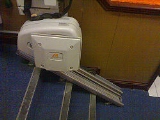
A stairlift is a mechanical device for lifting people and wheelchairs up and down stairs
Stairs

Stairs may refer to:People:* Scott Kannberg , guitarist of Pavement* A. Edison Stairs , New Brunswick politician* Denis Stairs , engineer, Montreal businessman...
. For sufficiently wide stairs, a rail is mounted to the treads of the stairs. A chair or lifting platform is attached to the rail. A person on the chair or platform is lifted as the chair or platform moves along the rail.

Stairlifts are known variously as stair lifts, stair-lifts, chair lifts, stair gliders and by other names.


Discussion
Ask a question about 'Stairlift'
Start a new discussion about 'Stairlift'
Answer questions from other users
Full Discussion Forum


Encyclopedia


A stairlift is a mechanical device for lifting people and wheelchairs up and down stairs
Stairs

Stairs may refer to:People:* Scott Kannberg , guitarist of Pavement* A. Edison Stairs , New Brunswick politician* Denis Stairs , engineer, Montreal businessman...
. For sufficiently wide stairs, a rail is mounted to the treads of the stairs. A chair or lifting platform is attached to the rail. A person on the chair or platform is lifted as the chair or platform moves along the rail.

Stairlifts are known variously as stair lifts, stair-lifts, chair lifts, stair gliders and by other names. This type of chair lift should not be confused with the chairlift
Chairlift

An elevated passenger ropeway, or chairlift, is a type of aerial lift, which consists of a continuously circulating steel Wire rope loop strung between two end terminals and usually over intermediate towers, carrying a series of chairs....
 used by skiers.

Some of the first stairlifts to be produced commercially were advertised and sold in the USA in the 1930s by the Inclinator Company of America. Many users at the time were victims of polio.

History

In the 1920s, C.C. Crispen, a Pennsylvania entrepreneur, created a way to enable his ailing friend to travel from floor to floor. Crispen's idea was to design a seat that could climb stairs. A self-taught engineer, he built the first prototype of the inclining chair. He called it the Inclin-ator. However, TV historian Doctor David Starkey
David Starkey

David Robert Starkey, Order of the British Empire, Society of Antiquaries of London is an England historian, a television and radio presenter, and a specialist in the Tudor dynasty....
 has in 2009, found evidence in a list of the possessions of King Henry VIII that attributes the first stairlift invented to the monarch. The 30 stone king, injured through jousting, used a chair that was hauled up and down stairs on a block and tackle system by servants at the ancient Whitehall Palace in London.

General issues

Modern stair lifts can be found with a wide variety of features such as adjustable seat height, battery isolation switches, call stations, 'flip-up' rail, key switch, folding step, speed governor, seatbelt, soft start and soft stop.

Rails

Straight rails for use on domestic staircases are usually made from extruded aluminium and come in various cross-sectional shapes. These rails may, typically, weigh over 30kg, depending on the length. In most applications they are attached to the steps with metal brackets (sometimes called “cleats”).

If a rail crosses a doorway at the bottom of the stairs or causes an obstruction a hinge can be fitted so the end of the rail can be folded back out of the way when not in use.

Curved rails are made from materials such as steel or aluminium and come in various cross-sectional shapes according to the designer. Individual designs vary a lot and probably the key criterion is to make the curves with the smallest radius possible so they will wrap tightly around objects such as newel posts.

The sections of curved rails usually packaged well to prevent damage in transit and are unwrapped and assembled on site.

Rails for wheelchair platform stairlifts may be secured to walls in addition to the step fixings.

Carriages

The carriage is the component which moves along the rail and normally runs on small diameter rollers. In most designs the carriage is pulled by a cable or chain, or driven along the inclined rail by a rack and pinion
Rack and pinion

A rack and pinion is a pair of gears which convert rotational motion into linear motion. The circular pinion engages teeth on a flat bar - the rack....
 system or other drive arrangement.

Most domestic carriages have a seat with arms and a footrest. Some special models have a stand-on platform also known as a "perch" seat. For users with shorter legs a short seat can be fitted, to make the lift more comfortable to sit on. Stairlift manufacturer such as Minivator Ltd have a number of different seat types depending on your individual needs.

The conventional layout for a typical domestic stairlift is to have the seat at right angles to the rail so the user travels "sidesaddle
Sidesaddle

Sidesaddle riding is a form of Equestrianism that uses a type of saddle which allows a rider to sit aside rather than astride a horse, mule or pony....
". At the top of the staircase the seat can be swivelled, commonly through around 45 degrees or 90 degrees, then locked in place to allow the user to alight from it onto a landing. Stairlifts are available with either a manual swival or a powered swival, depending on the users ability.

Most swivel seats have a safety switch so the stairlift won’t move unless the seat is locked into its travel position. Special models with seats facing the bottom of the staircase have been produced for users with spinal or other conditions which prevent use of the conventional seat layout. More room is need on the landing with these special seats.

Popular types


Straight rail stairlifts

These are the most common type of stairlifts used in private dwelling
Dwelling

Dwelling - as well as being a term for a house, or for living somewhere, or for lingering somewhere - is a philosophical concept which was developed by Martin Heidegger....
s with straight stairs and have a straight rail (track) which is fixed to the steps of the staircase.

Curved rail stairlifts

These are normally much more unusual and costly than those with straight rails because they have to be manufactured to suit the individual staircase (curved stairs). This sometimes involves careful measurement, design and manufacturing. The installation process usually takes longer than for a straight domestic stairlift. Some of them follow stairs´ standards.

Wheelchair platform stairlifts


These come under the general definition of stairlift and are usually of much heavier construction than a domestic stairlift.

Most platform stairlifts are used in public access buildings or outside private homes.

The platform is large enough to accommodate a wheelchair and its user, and may have folding edge flaps which drop down and act as ramps to allow for variations in floor levels. These flaps also prevent the wheelchair
Wheelchair

A wheelchair is a wheeled mobility device in which the user sits. The device is propelled either manually or via various automated systems. Wheelchairs are used by people for whom walking is difficult or impossible due to illness , injury, or disability....
 from going over the edge of the platform.

The rails are, necessarily, of heavy construction to support the load and the drive system is usually accommodated within a tubular section rail or aluminium
Aluminium

Aluminium or aluminum is a silvery white and ductile member of the boron group of chemical elements. It has the symbol Al; its atomic number is 13....
 extrusion
Extrusion

Extrusion is a process used to create objects of a fixed cross section profile. A material is pushed or drawn through a Die of the desired cross-section....
. Some models have steel cables inside the tube, others have chains; yet others may use a rack and pinion
Rack and pinion

A rack and pinion is a pair of gears which convert rotational motion into linear motion. The circular pinion engages teeth on a flat bar - the rack....
 system.

Many wheelchair
Wheelchair

A wheelchair is a wheeled mobility device in which the user sits. The device is propelled either manually or via various automated systems. Wheelchairs are used by people for whom walking is difficult or impossible due to illness , injury, or disability....
 platform stairlifts are designed and built to order. Others may comprise a standard platform and carriage, with the only special requirement being the length of rails or tracks.

Some stairlift chairs can also be moved and used as indoor wheelchair
Wheelchair

A wheelchair is a wheeled mobility device in which the user sits. The device is propelled either manually or via various automated systems. Wheelchairs are used by people for whom walking is difficult or impossible due to illness , injury, or disability....
s.

Outdoor stairlifts

Outdoor Stairlifts come with seats, perches, footplates or platforms and are sold worldwide. They are similar to indoor stairlifts but with improved weatherproofing.

Pre-owned stairlifts

There is a second-user market for some types of stairlift. This is most common with straight rail domestic types. The rails can be cut to length if too long, or extended with a "joining kit". Most models allow the carriage to be "re-handed" so it can be used on the left or right side of the staircase.

During the early days of curved rail stairlifts there was no second user market because of the difficulty of matching rails to a different layout. Even staircases built to the same design specification in neighbouring houses have variations, but in most attempted "transplants" there are too many differences to make it practicable. Many owners have had to pay to have unwanted curved stairlifts removed.

More recently, some curved rails have been produced to a modular design so components can be unbolted and used elsewhere, subject to design and safety considerations. In some cases, tubular section rails which are welded during manufacture, are produced by specialist rail companies so they can be used with a pre-owned carriage, controls, and other components. This is, perhaps, like putting an old locomotive on new railway lines. It provides a lower cost solution than buying a totally new system.

Some insurance companies have offered breakdown policies for stairlifts. Manufacturers and installers have offered an extended warranty
Extended warranty

An extended warranty, sometimes called a service agreement, a service contract, or a maintenance agreement, is a prolonged warranty offered to consumers....
, rather like those available for domestic white goods and brown goods.

Goods stairlifts

Some manufacturers produce stairlifts with trays instead of seats for moving goods between different levels, usually in commercial or industrial buildings. Some businesses have purchased normal domestic stairlifts purely as goods transporters and put items such as boxes of stationery on the seat. A curved stairlift system is used occasionally at Caernarfon Castle
Caernarfon Castle

Caernarfon Castle was constructed at Caernarfon in Gwynedd, north-west Wales, by King Edward I of England, following his conquest of Gwynedd in 1283....
 in North Wales
North Wales

File:North Wales .pngNorth Wales is the northernmost unofficial region of Wales, bordered to the south by Mid Wales and to the east by England....
, installed to comply with the Disability Discrimination Act
Disability discrimination act

In the late 20th and early 21st centuries, a number of countries have passed laws aimed at reducing discrimination against people with disability. These laws have begun to appear as the notion of civil rights has become more influential globally, and follow other forms of List of anti-discrimination acts and equal opportunity legislation aimed at...
.

AC and DC power

Early stairlifts mostly had alternating current
Alternating current

In alternating current the movement of electric charge periodically reverses direction. An electric charge would for instance move forward, then backward, then forward, then backward, over and over again....
 (AC) drive motors which ran at full main voltage (around 100 volts in North America, 230 volts in Europe). An "energy cable" ran alongside or through the rail to carry the power from the supply point to the carriage.

More recently, domestic stairlifts have been powered from rechargeable batteries and use direct current
Direct current

Direct current is the unidirectional flow of electric charge. Direct current is produced by such sources as battery , thermocouples, solar cells, and commutator-type electric machines of the dynamo type....
 (DC). One of the selling points is that a DC stairlift will continue to function during a power outage, provided the batteries are sufficiently charged. Most stairlifts have a 'chargepoint' where have to 'park' to charge it's batteries. Some straight stairlifts have the ability continuously charge no matter where they are left along the track.

With most DC models the batteries are accommodated within the carriage and travel with it.

Some models, however, were designed with three phase motors and the batteries (three in total) were housed in a cabinet mounted near the top or bottom of the rail. An inverter
Inverter (electrical)

An inverter is an electrical or electro-mechanical device that converts direct current to alternating current ; the resulting AC can be at any required voltage and frequency with the use of appropriate transformers, switching, and control circuits....
 system was used to convert the DC energy to three phase AC.

The power rating of drive motors for domestic straight rail stairlifts may be around 250 watts. The power requirement will be greater for heavy loads, very steep inclines, and wheelchair platform stairlifts.

Controls

Stairlifts are largely operated using a control on the arm of the lift. This is either a switch or a toggle type lever. This larger toggle switch enables users even with limited mobility or painful condition to use stairlifts easily and safely.

Electronic controls are used extensively. Many stairlifts have radio frequency or infrared
Infrared

Infrared radiation is electromagnetic radiation whose wavelength is longer than that of visible light , but shorter than that of terahertz radiation and microwaves ....
 remote controllers. It is known that radiation from devices such as fluorescent lights can interfere with infrared stairlift controls. Also, heat and incandescent lights can, in some circumstances, have an adverse effect.

Control circuit design varies greatly among the different manufacturers and models. Curved rail stairlifts have more complex controls than those with straight rails.

The seat of a curved rail stairlift may have to be tilted so it remains horizontal whilst going around curves and negotiates different angles of incline. This requires an additional motor and link system.

Also, the carriage is slowed down on bends but travels faster on straight runs. This means a more complex control system. Modern controls have small microprocessors which “learn” the characteristics of the journey and keep the data in memory. They also record the number of journey and direction. This assists service engineers on maintenance calls.

Some development was started at the onset of the 21st Century into self-diagnostic controls. The idea was that stairlifts would predict when components were starting to deteriorate and automatically pass the information to the service provider so a visit could be arranged.

Safety

To satisfy safety codes stairlifts usually have cut-out switches connected to “safety edges” and other protective devices so the drive power is disconnected if something goes wrong. Modern lifts have a high degree of comfort, but safety is always paramount. "Safety edges" are a common feature to the power pack and footplate. "Safety edges" ensure that if there is any obstruction on the stairs the stairlift will automatically stop and only travel away from the obstruction.

Stairlifts are used by people of all ages and child car seats can usually be fixed to a standard stairlift seat using the seat belt provided with the stairlift system.

Codes of practice and technical specifications apply to stairlift manufacture.

In North America these codes may be relevant:
  • ASME A17.1 - 1990, Safety Code for Elevators and Escalators
  • ASME A18.1 - 2005 Safety Standard for Platform Lifts and Stairway Chairlifts
Produced by

An important specification used by stairlift manufacturers in Europe was British Standard BS 5776: 1996 Specification For Powered Stairlifts, produced by .

Note: codes of practice and technical specifications are updated occasionally. These references may be out of date by the time they are read and are shown as examples.

Travel speed


Stairlifts normally have "soft" starts so the user is not jerked as the carriage starts to move. Typical travel speed for domestic straight rail stairlift carriages range between 0.07 metres per second (13.78 feet per minute, 0.16 miles per hour) and 0.15 metres per second (30 feet per minute, 0.34 miles per hour). The speed of curved rail stairlift carriages may vary on the journey if the controls cause them to slow on inclines and bends.

External links