


Stackelberg competition

Encyclopedia
The Stackelberg leadership model is a strategic game in economics
in which the leader firm moves first and then the follower firms move sequentially. It is named after the German economist Heinrich Freiherr von Stackelberg
who published Market Structure and Equilibrium (Marktform und Gleichgewicht) in 1934 which described the model.
In game theory
terms, the players of this game are a leader and a follower and they compete on quantity. The Stackelberg leader is sometimes referred to as the Market Leader.
There are some further constraints upon the sustaining of a Stackelberg equilibrium. The leader must know ex ante that the follower observes his action. The follower must have no means of committing to a future non-Stackelberg follower action and the leader must know this. Indeed, if the 'follower' could commit to a Stackelberg leader action and the 'leader' knew this, the leader's best response would be to play a Stackelberg follower action.
Firms may engage in Stackelberg competition if one has some sort of advantage enabling it to move first. More generally, the leader must have commitment power. Moving observably first is the most obvious means of commitment: once the leader has made its move, it cannot undo it - it is committed to that action. Moving first may be possible if the leader was the incumbent monopoly of the industry and the follower is a new entrant. Holding excess capacity is another means of commitment.
in every subgame
.
In very general terms, let the price function for the (duopoly) industry be ; price is simply a function of total (industry) output, so is
  where the subscript 1 represents the leader and 2 represents the follower. Suppose firm i has the cost structure
  . The model is solved by backward induction
. The leader considers what the best response
of the follower is, i.e. how it will respond once it has observed the quantity of the leader. The leader then picks a quantity that maximises its payoff, anticipating the predicted response of the follower. The follower actually observes this and in equilibrium picks the expected quantity as a response.
To calculate the SPNE, the best response functions of the follower must first be calculated (calculation moves 'backwards' because of backward induction).
The profit of firm 2 (the follower) is revenue minus cost. Revenue is the product of price and quantity and cost is given by the firm's cost structure, so profit is:
 . The best response is to find the value of
  that maximises
  given
given  , i.e. given the output of the leader (firm 1), the output that maximises the follower's profit is found. Hence, the maximum of
  with respect to
  is to be found. First differentiate
  with respect to
  :
:

Setting this to zero for maximisation:

The values of that satisfy this equation are the best responses. Now the best response function of the leader is considered. This function is calculated by considering the follower's output as a function of the leader's output, as just computed.
The profit of firm 1 (the leader) is , where
  is the follower's quantity as a function of the leader's quantity, namely the function calculated above. The best response is to find the value of
  that maximises
  given
given  , i.e. given the best response function of the follower (firm 2), the output that maximises the leader's profit is found. Hence, the maximum of
  with respect to
  is to be found. First derive
  with respect to
  :
:

Setting this to zero for maximisation:

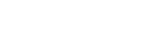
and imposes some restrictions on cost structures for simplicity's sake so the problem can be resolved.
for ease of computation.
The follower's profit is:

The maximisation problem resolves to (from the general case):


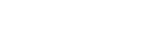
Consider the leader's problem:

Substituting for from the follower's problem:


The maximisation problem resolves to (from the general case):

Now solving for yields
  , the leader's optimal action:
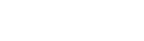
This is the leader's best response to the reaction of the follower in equilibrium. The follower's actual can now be found by feeding this into its reaction function calculated earlier:
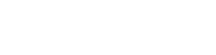
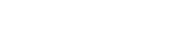
The Nash equilibria are all . It is clear (if marginal costs are assumed to be zero - i.e. cost is essentially ignored) that the leader has a significant advantage. Intuitively, if the leader was no better off than the follower, it would simply adopt a Cournot competition
strategy.
Plugging the follower's quantity, q2 back into the leader's best response function will not yield q1. This is because once leader has committed to an output and observed the followers it always wants to reduce its output ex-post. However its inability to do so is what allows it to receive higher profits than under cournot.
”, the model shows the combination of outputs and payoffs both firms have in the Stackelberg game
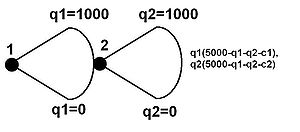 The image on the left depicts in extensive form
a Stackelberg game. The payoffs are shown on the right. This example is fairly simple. There is a basic cost structure involving only marginal cost
(there is no fixed cost
). The demand function is linear and price elasticity of demand is 1. However, it illustrates the leader's advantage.
The follower wants to choose to maximise its payoff
  . Taking the first order derivative and equating it to zero (for maximisation) yields
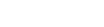 as the maximum value of
  .
.
The leader wants to choose to maximise its payoff
  . However, in equilibrium, it knows the follower will choose
  as above. So in fact the leader wants to maximise its payoff
  (by substituting
  for the follower's best response function). By differentiation, the maximum payoff is given by
 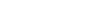 . Feeding this into the follower's best response function yields
 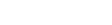 . Suppose marginal costs were equal for the firms (so the leader has no market advantage other than first move) and in particular
  . The leader would produce 2000 and the follower would produce 1000. This would give the leader a profit (payoff) of two million and the follower a profit of one million. Simply by moving first, the leader has accrued twice the profit of the follower. However, Cournot profits
here are 1.78 million apiece (strictly, apiece), so the leader has not gained much, but the follower has lost. However, this is example-specific. There may be cases where a Stackelberg leader has huge gains beyond Cournot profit that approach monopoly
profits (for example, if the leader also had a large cost structure advantage, perhaps due to a better production function
). There may also be cases where the follower actually enjoys higher profits than the leader, but only because it, say, has much lower costs.
However, in an (indefinitely) repeated Stackelberg game, the follower might adopt a punishment strategy where it threatens to punish the leader in the next period unless it chooses a non-optimal strategy in the current period. This threat is credible because it would be rational for the follower to punish in the next period so that the leader chooses Cournot quantities thereafter.
models are similar because in both competition is on quantity. However, as seen, the first move gives the leader in Stackelberg a crucial advantage. There is also the important assumption of perfect information
in the Stackelberg game: the follower must observe the quantity chosen by the leader, otherwise the game reduces to Cournot. With imperfect information, the threats described above can be credible. If the follower cannot observe the leader's move, it is no longer irrational for the follower to choose, say, a Cournot level of quantity (in fact, that is the equilibrium action). However, it must be that there is imperfect information and the follower is unable to observe the leader's move because it is irrational for the follower not to observe if it can once the leader has moved. If it can observe, it will so that it can make the optimal decision. Any threat by the follower claiming that it will not observe even if it can is as uncredible as those above. This is an example of too much information hurting a player. In Cournot competition, it is the simultaneity of the game (the imperfection of knowledge) that results in neither player (ceteris paribus
) being at a disadvantage.
Game theoretic
As mentioned, imperfect information in a leadership game reduces to Cournot competition. However, some Cournot strategy profiles are sustained as Nash equilibria but can be eliminated as incredible threats (as described above) by applying the solution concept
of subgame perfection. Indeed, it is the very thing that makes a Cournot strategy profile a Nash equilibrium in a Stackelberg game that prevents it from being subgame perfect.
Consider a Stackelberg game (i.e. one which fulfills the requirements described above for sustaining a Stackelberg equilibrium) in which, for some reason, the leader believes that whatever action it takes, the follower will choose a Cournot quantity (perhaps the leader believes that the follower is irrational). If the leader played a Stackelberg action, (it believes) that the follower will play Cournot. Hence it is non-optimal for the leader to play Stackelberg. In fact, its best response (by the definition of Cournot equilibrium) is to play Cournot quantity. Once it has done this, the best response of the follower is to play Cournot.
Consider the following strategy profiles: the leader plays Cournot; the follower plays Cournot if the leader plays Cournot and the follower plays non-Stackelberg if the leader plays Stackelberg and if the leader plays something else, the follower plays an arbitrary strategy (hence this actually describes several profiles). This profile is a Nash equilibrium. As argued above, on the equilibrium path play is a best response to a best response. However, playing Cournot would not have been the best response of the leader were it that the follower would play Stackelberg if it (the leader) played Stackelberg. In this case, the best response of the leader would be to play Stackelberg. Hence, what makes this profile (or rather, these profiles) a Nash equilibrium (or rather, Nash equilibria) is the fact that the follower would play non-Stackelberg if the leader were to play Stackelberg.
However, this very fact (that the follower would play non-Stackelberg if the leader were to play Stackelberg) means that this profile is not a Nash equilibrium of the subgame starting when the leader has already played Stackelberg (a subgame off the equilibrium path). If the leader has already played Stackelberg, the best response of the follower is to play Stackelberg (and therefore it is the only action that yields a Nash equilibrium in this subgame). Hence the strategy profile - which is Cournot - is not subgame perfect.
Economics
Economics is the social science that analyzes the production, distribution, and consumption of goods and services. The term economics comes from the Ancient Greek from + , hence "rules of the house"...
in which the leader firm moves first and then the follower firms move sequentially. It is named after the German economist Heinrich Freiherr von Stackelberg
Heinrich Freiherr von Stackelberg
Heinrich Freiherr von Stackelberg was a German economist who contributed to game theory and industrial organization and is known for the Stackelberg leadership model.-Biography:...
who published Market Structure and Equilibrium (Marktform und Gleichgewicht) in 1934 which described the model.
In game theory
Game theory
Game theory is a mathematical method for analyzing calculated circumstances, such as in games, where a person’s success is based upon the choices of others...
terms, the players of this game are a leader and a follower and they compete on quantity. The Stackelberg leader is sometimes referred to as the Market Leader.
There are some further constraints upon the sustaining of a Stackelberg equilibrium. The leader must know ex ante that the follower observes his action. The follower must have no means of committing to a future non-Stackelberg follower action and the leader must know this. Indeed, if the 'follower' could commit to a Stackelberg leader action and the 'leader' knew this, the leader's best response would be to play a Stackelberg follower action.
Firms may engage in Stackelberg competition if one has some sort of advantage enabling it to move first. More generally, the leader must have commitment power. Moving observably first is the most obvious means of commitment: once the leader has made its move, it cannot undo it - it is committed to that action. Moving first may be possible if the leader was the incumbent monopoly of the industry and the follower is a new entrant. Holding excess capacity is another means of commitment.
Subgame perfect Nash equilibrium
The Stackelberg model can be solved to find the subgame perfect Nash equilibrium or equilibria (SPNE), i.e. the strategy profile that serves best each player, given the strategies of the other player and that entails every player playing in a Nash equilibriumNash equilibrium
In game theory, Nash equilibrium is a solution concept of a game involving two or more players, in which each player is assumed to know the equilibrium strategies of the other players, and no player has anything to gain by changing only his own strategy unilaterally...
in every subgame
Subgame
In game theory, a subgame is any part of a game that meets the following criteria :#It has a single initial node that is the only member of that node's information set In game theory, a subgame is any part (a subset) of a game that meets the following criteria (the following terms allude to a game...
.
In very general terms, let the price function for the (duopoly) industry be
; price is simply a function of total (industry) output, so is where the subscript 1 represents the leader and 2 represents the follower. Suppose firm i has the cost structure . The model is solved by backward inductionSolution concept
In game theory, a solution concept is a formal rule for predicting how the game will be played. These predictions are called "solutions", and describe which strategies will be adopted by players, therefore predicting the result of the game...
. The leader considers what the best response
Best response
In game theory, the best response is the strategy which produces the most favorable outcome for a player, taking other players' strategies as given...
of the follower is, i.e. how it will respond once it has observed the quantity of the leader. The leader then picks a quantity that maximises its payoff, anticipating the predicted response of the follower. The follower actually observes this and in equilibrium picks the expected quantity as a response.
To calculate the SPNE, the best response functions of the follower must first be calculated (calculation moves 'backwards' because of backward induction).
The profit of firm 2 (the follower) is revenue minus cost. Revenue is the product of price and quantity and cost is given by the firm's cost structure, so profit is:
. The best response is to find the value of that maximises given , i.e. given the output of the leader (firm 1), the output that maximises the follower's profit is found. Hence, the maximum of with respect to is to be found. First differentiate with respect to :Setting this to zero for maximisation:
The values of
that satisfy this equation are the best responses. Now the best response function of the leader is considered. This function is calculated by considering the follower's output as a function of the leader's output, as just computed.The profit of firm 1 (the leader) is
, where is the follower's quantity as a function of the leader's quantity, namely the function calculated above. The best response is to find the value of that maximises given , i.e. given the best response function of the follower (firm 2), the output that maximises the leader's profit is found. Hence, the maximum of with respect to is to be found. First derive with respect to :Setting this to zero for maximisation:
Examples
The following example is very general. It assumes a generalised linear demand structureand imposes some restrictions on cost structures for simplicity's sake so the problem can be resolved.
-
 and
and 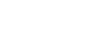
for ease of computation.
The follower's profit is:
The maximisation problem resolves to (from the general case):
Consider the leader's problem:
Substituting for
from the follower's problem:The maximisation problem resolves to (from the general case):
Now solving for
yields , the leader's optimal action:This is the leader's best response to the reaction of the follower in equilibrium. The follower's actual can now be found by feeding this into its reaction function calculated earlier:
The Nash equilibria are all
. It is clear (if marginal costs are assumed to be zero - i.e. cost is essentially ignored) that the leader has a significant advantage. Intuitively, if the leader was no better off than the follower, it would simply adopt a Cournot competitionCournot competition
Cournot competition is an economic model used to describe an industry structure in which companies compete on the amount of output they will produce, which they decide on independently of each other and at the same time. It is named after Antoine Augustin Cournot who was inspired by observing...
strategy.
Plugging the follower's quantity, q2 back into the leader's best response function will not yield q1. This is because once leader has committed to an output and observed the followers it always wants to reduce its output ex-post. However its inability to do so is what allows it to receive higher profits than under cournot.
Economic analysis
An extensive-form representation is often used to analyze the Stackelberg leader-follower model. Also referred to as a “decision treeDecision tree
A decision tree is a decision support tool that uses a tree-like graph or model of decisions and their possible consequences, including chance event outcomes, resource costs, and utility. It is one way to display an algorithm. Decision trees are commonly used in operations research, specifically...
”, the model shows the combination of outputs and payoffs both firms have in the Stackelberg game
Extensive form game
An extensive-form game is a specification of a game in game theory, allowing explicit representation of a number of important aspects, like the sequencing of players' possible moves, their choices at every decision point, the information each player has about the other player's moves when he...
a Stackelberg game. The payoffs are shown on the right. This example is fairly simple. There is a basic cost structure involving only marginal cost
Marginal cost
In economics and finance, marginal cost is the change in total cost that arises when the quantity produced changes by one unit. That is, it is the cost of producing one more unit of a good...
(there is no fixed cost
Fixed cost
In economics, fixed costs are business expenses that are not dependent on the level of goods or services produced by the business. They tend to be time-related, such as salaries or rents being paid per month, and are often referred to as overhead costs...
). The demand function is linear and price elasticity of demand is 1. However, it illustrates the leader's advantage.
The follower wants to choose
to maximise its payoff . Taking the first order derivative and equating it to zero (for maximisation) yields as the maximum value of .The leader wants to choose
to maximise its payoff . However, in equilibrium, it knows the follower will choose as above. So in fact the leader wants to maximise its payoff (by substituting for the follower's best response function). By differentiation, the maximum payoff is given by . Feeding this into the follower's best response function yields . Suppose marginal costs were equal for the firms (so the leader has no market advantage other than first move) and in particular . The leader would produce 2000 and the follower would produce 1000. This would give the leader a profit (payoff) of two million and the follower a profit of one million. Simply by moving first, the leader has accrued twice the profit of the follower. However, Cournot profitsCournot competition
Cournot competition is an economic model used to describe an industry structure in which companies compete on the amount of output they will produce, which they decide on independently of each other and at the same time. It is named after Antoine Augustin Cournot who was inspired by observing...
here are 1.78 million apiece (strictly,
apiece), so the leader has not gained much, but the follower has lost. However, this is example-specific. There may be cases where a Stackelberg leader has huge gains beyond Cournot profit that approach monopolyMonopoly
A monopoly exists when a specific person or enterprise is the only supplier of a particular commodity...
profits (for example, if the leader also had a large cost structure advantage, perhaps due to a better production function
Production function
In microeconomics and macroeconomics, a production function is a function that specifies the output of a firm, an industry, or an entire economy for all combinations of inputs...
). There may also be cases where the follower actually enjoys higher profits than the leader, but only because it, say, has much lower costs.
Credible and non-credible threats by the follower
If, after the leader had selected its equilibrium quantity, the follower deviated from the equilibrium and chose some non-optimal quantity it would not only hurt itself, but it could also hurt the leader. If the follower chose a much larger quantity than its best response, the market price would lower and the leader's profits would be stung, perhaps below Cournot level profits. In this case, the follower could announce to the leader before the game starts that unless the leader chooses a Cournot equilibrium quantity, the follower will choose a deviant quantity that will hit the leader's profits. After all, the quantity chosen by the leader in equilibrium is only optimal if the follower also plays in equilibrium. The leader is, however, in no danger. Once the leader has chosen its equilibrium quantity, it would be irrational for the follower to deviate because it too would be hurt. Once the leader has chosen, the follower is better off by playing on the equilibrium path. Hence, such a threat by the follower would not be credible.However, in an (indefinitely) repeated Stackelberg game, the follower might adopt a punishment strategy where it threatens to punish the leader in the next period unless it chooses a non-optimal strategy in the current period. This threat is credible because it would be rational for the follower to punish in the next period so that the leader chooses Cournot quantities thereafter.
Stackelberg compared with Cournot
The Stackelberg and CournotCournot competition
Cournot competition is an economic model used to describe an industry structure in which companies compete on the amount of output they will produce, which they decide on independently of each other and at the same time. It is named after Antoine Augustin Cournot who was inspired by observing...
models are similar because in both competition is on quantity. However, as seen, the first move gives the leader in Stackelberg a crucial advantage. There is also the important assumption of perfect information
Perfect information
In game theory, perfect information describes the situation when a player has available the same information to determine all of the possible games as would be available at the end of the game....
in the Stackelberg game: the follower must observe the quantity chosen by the leader, otherwise the game reduces to Cournot. With imperfect information, the threats described above can be credible. If the follower cannot observe the leader's move, it is no longer irrational for the follower to choose, say, a Cournot level of quantity (in fact, that is the equilibrium action). However, it must be that there is imperfect information and the follower is unable to observe the leader's move because it is irrational for the follower not to observe if it can once the leader has moved. If it can observe, it will so that it can make the optimal decision. Any threat by the follower claiming that it will not observe even if it can is as uncredible as those above. This is an example of too much information hurting a player. In Cournot competition, it is the simultaneity of the game (the imperfection of knowledge) that results in neither player (ceteris paribus
Ceteris paribus
or is a Latin phrase, literally translated as "with other things the same," or "all other things being equal or held constant." It is an example of an ablative absolute and is commonly rendered in English as "all other things being equal." A prediction, or a statement about causal or logical...
) being at a disadvantage.
Game theoreticGame theoryGame theory is a mathematical method for analyzing calculated circumstances, such as in games, where a person’s success is based upon the choices of others...
considerations
As mentioned, imperfect information in a leadership game reduces to Cournot competition. However, some Cournot strategy profiles are sustained as Nash equilibria but can be eliminated as incredible threats (as described above) by applying the solution conceptSolution concept
In game theory, a solution concept is a formal rule for predicting how the game will be played. These predictions are called "solutions", and describe which strategies will be adopted by players, therefore predicting the result of the game...
of subgame perfection. Indeed, it is the very thing that makes a Cournot strategy profile a Nash equilibrium in a Stackelberg game that prevents it from being subgame perfect.
Consider a Stackelberg game (i.e. one which fulfills the requirements described above for sustaining a Stackelberg equilibrium) in which, for some reason, the leader believes that whatever action it takes, the follower will choose a Cournot quantity (perhaps the leader believes that the follower is irrational). If the leader played a Stackelberg action, (it believes) that the follower will play Cournot. Hence it is non-optimal for the leader to play Stackelberg. In fact, its best response (by the definition of Cournot equilibrium) is to play Cournot quantity. Once it has done this, the best response of the follower is to play Cournot.
Consider the following strategy profiles: the leader plays Cournot; the follower plays Cournot if the leader plays Cournot and the follower plays non-Stackelberg if the leader plays Stackelberg and if the leader plays something else, the follower plays an arbitrary strategy (hence this actually describes several profiles). This profile is a Nash equilibrium. As argued above, on the equilibrium path play is a best response to a best response. However, playing Cournot would not have been the best response of the leader were it that the follower would play Stackelberg if it (the leader) played Stackelberg. In this case, the best response of the leader would be to play Stackelberg. Hence, what makes this profile (or rather, these profiles) a Nash equilibrium (or rather, Nash equilibria) is the fact that the follower would play non-Stackelberg if the leader were to play Stackelberg.
However, this very fact (that the follower would play non-Stackelberg if the leader were to play Stackelberg) means that this profile is not a Nash equilibrium of the subgame starting when the leader has already played Stackelberg (a subgame off the equilibrium path). If the leader has already played Stackelberg, the best response of the follower is to play Stackelberg (and therefore it is the only action that yields a Nash equilibrium in this subgame). Hence the strategy profile - which is Cournot - is not subgame perfect.
Comparison with other oligopoly models
In comparison with other oligopoly models,- The aggregate Stackelberg output is greater than the aggregate CournotCournot competitionCournot competition is an economic model used to describe an industry structure in which companies compete on the amount of output they will produce, which they decide on independently of each other and at the same time. It is named after Antoine Augustin Cournot who was inspired by observing...
output, but less than the aggregate BertrandBertrand competitionBertrand competition is a model of competition used in economics, named after Joseph Louis François Bertrand . It describes interactions among firms that set prices and their customers that choose quantities at that price....
output.
- The Stackelberg price is lower than the Cournot price, but greater than the Bertrand price.
- The Stackelberg consumer surplus is greater than the Cournot consumer surplus, but lower than the Bertrand consumer surplus.
- The aggregate Stackelberg output is greater than pure monopolyMonopolyA monopoly exists when a specific person or enterprise is the only supplier of a particular commodity...
or cartelCartelA cartel is a formal agreement among competing firms. It is a formal organization of producers and manufacturers that agree to fix prices, marketing, and production. Cartels usually occur in an oligopolistic industry, where there is a small number of sellers and usually involve homogeneous products...
, but less than the perfectly competitiveCompetition (economics)Competition in economics is a term that encompasses the notion of individuals and firms striving for a greater share of a market to sell or buy goods and services...
output.
- The Stackelberg price is lower than the pure monopoly or cartel price, but greater than the perfectly competitive price.
Applications
The Stackelberg concept has been extended to dynamic Stackelberg games. See Simaan and Cruz (1973a, 1973b). With the addition of time as a dimension, phenomena not found in static games were discovered, such as violation of the principle of optimality by the leader, Simaan and Cruz (1973b). For a survey of applications of Stackelberg differential games to supply chain and marketing channels, see He et al. (2007).See also
- Economic theory
- Cournot competitionCournot competitionCournot competition is an economic model used to describe an industry structure in which companies compete on the amount of output they will produce, which they decide on independently of each other and at the same time. It is named after Antoine Augustin Cournot who was inspired by observing...
- Bertrand competitionBertrand competitionBertrand competition is a model of competition used in economics, named after Joseph Louis François Bertrand . It describes interactions among firms that set prices and their customers that choose quantities at that price....
- Extensive form gameExtensive form gameAn extensive-form game is a specification of a game in game theory, allowing explicit representation of a number of important aspects, like the sequencing of players' possible moves, their choices at every decision point, the information each player has about the other player's moves when he...
- Industrial organizationIndustrial organizationIndustrial organization is the field of economics that builds on the theory of the firm in examining the structure of, and boundaries between, firms and markets....
- Mathematical programming with equilibrium constraintsMathematical programming with equilibrium constraintsMathematical programming with equilibrium constraints is the study ofconstrained optimization problems where the constraints include variational inequalities or complementarities...