

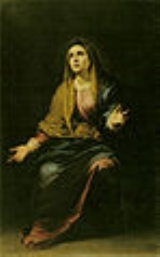
Stabat Mater

Encyclopedia
Stabat Mater is a 13th-century Roman Catholic hymn to Mary. It has been variously attributed to the Franciscan Jacopone da Todi
and to Innocent III. There are two Stabat Mater hymns, one the Stabat Mater Dolorosa is about the Sorrows of Mary, the other, Stabat Mater Speciosa joyfully refers to the Nativity of Jesus
.
The title of the sorrowful hymn is an incipit
of the first line, Stabat mater dolorosa ("The sorrowful mother stood"). The joyful hymn refers to "The beautiful mother stood". The Dolorosa hymn, one of the most powerful and immediate of extant
medieval poems, meditates on the suffering of Mary, Jesus Christ's mother, during his crucifixion
. It is sung at the liturgy on the memorial of Our Lady of Sorrows
. The Dolorosa has been set to music by many composers, with the most famous settings being those by Palestrina
, Pergolesi
, Haydn
, Rossini
, and Dvořák
.
The Dolorosa was well known by the end of the fourteenth century and Georgius Stella wrote of its use in 1388, while other historians note its use later in the same century. In Provence, about 1399, it was used during the nine days processions.
As a liturgical sequence
, the Dolorosa was suppressed, along with hundreds of other sequences, by the Council of Trent
, but restored to the missal by Pope Benedict XIII
in 1727 for the Feast of the Seven Dolours of the Blessed Virgin Mary.
The Speciosa appeared in a 1495 edition of the Italian poems of Jacopone da Todi which contained both Stabats; but the Speciosa was almost forgotten until it was re-transcribed in 1852 in the "Poètes Franciscains en Italie au Treizième siècle" in Paris. The Speciosa has since been viewed as one of the tenderest Marian hymns
and one of the seven greatest Latin hymns. It has become part of standard oratorios, and given rise to various Christmas carol
s.
), rhyme scheme, and sense of the original text.
Stabat mater dolorosa
juxta Crucem lacrimosa,
dum pendebat Filius.
Cuius animam gementem,
contristatam et dolentem
pertransivit gladius.
O quam tristis et afflicta
fuit illa benedicta,
mater Unigeniti!
Quae moerebat et dolebat,
pia Mater, dum videbat
nati poenas inclyti.
Quis est homo qui non fleret,
matrem Christi si videret
in tanto supplicio?
Quis non posset contristari
Christi Matrem contemplari
dolentem cum Filio?
Pro peccatis suae gentis
vidit Iesum in tormentis,
et flagellis subditum.
Vidit suum dulcem Natum
moriendo desolatum,
dum emisit spiritum.
Eia, Mater, fons amoris
me sentire vim doloris
fac, ut tecum lugeam.
Fac, ut ardeat cor meum
in amando Christum Deum
ut sibi complaceam.
Sancta Mater, istud agas,
crucifixi fige plagas
cordi meo valide.
Tui Nati vulnerati,
tam dignati pro me pati,
poenas mecum divide.
Fac me tecum pie flere,
crucifixo condolere,
donec ego vixero.
Juxta Crucem tecum stare,
et me tibi sociare
in planctu desidero.
Virgo virginum praeclara,
mihi iam non sis amara,
fac me tecum plangere.
Fac, ut portem Christi mortem,
passionis fac consortem,
et plagas recolere.
Fac me plagis vulnerari,
fac me Cruce inebriari,
et cruore Filii.
Flammis ne urar succensus,
per te, Virgo, sim defensus
in die iudicii.
Christe, cum sit hinc exire,
da per Matrem me venire
ad palmam victoriae.
Quando corpus morietur,
fac, ut animae donetur
paradisi gloria. Amen.
At the Cross her station keeping,
stood the mournful Mother weeping,
close to her son to the last.
Through her heart, His sorrow sharing,
all His bitter anguish bearing,
now at length the sword has passed.
O how sad and sore distressed
was that Mother, highly blest,
of the sole-begotten One.
Christ above in torment hangs,
she beneath beholds the pangs
of her dying glorious Son.
Is there one who would not weep,
whelmed in miseries so deep,
Christ's dear Mother to behold?
Can the human heart refrain
from partaking in her pain,
in that Mother's pain untold?
For the sins of His own nation,
She saw Jesus wracked with torment,
All with scourges rent:
She beheld her tender Child,
Saw Him hang in desolation,
Till His spirit forth He sent.
O thou Mother! fount of love!
Touch my spirit from above,
make my heart with thine accord:
Make me feel as thou hast felt;
make my soul to glow and melt
with the love of Christ my Lord.
Holy Mother! pierce me through,
in my heart each wound renew
of my Savior crucified:
Let me share with thee His pain,
who for all my sins was slain,
who for me in torments died.
Let me mingle tears with thee,
mourning Him who mourned for me,
all the days that I may live:
By the Cross with thee to stay,
there with thee to weep and pray,
is all I ask of thee to give.
Virgin of all virgins blest!,
Listen to my fond request:
let me share thy grief divine;
Let me, to my latest breath,
in my body bear the death
of that dying Son of thine.
Wounded with His every wound,
steep my soul till it hath swooned,
in His very Blood away;
Be to me, O Virgin, nigh,
lest in flames I burn and die,
in His awful Judgment Day.
Christ, when Thou shalt call me hence,
by Thy Mother my defense,
by Thy Cross my victory;
While my body here decays,
may my soul Thy goodness praise,
Safe in Paradise with Thee.
Translation by Edward Caswall
Lyra Catholica (1849)
, Giovanni Pierluigi da Palestrina
, and Giovanni Battista Pergolesi
; of the latter's setting, the German poet Tieck opined: "I had to turn away to hide my tears, especially at the place, 'Vidit suum dulcem natum'". Joseph Haydn
's Stabat Mater
is considered "a treasury of refined and graceful melody". Others who have written settings are Agostino Steffani
, Giovanni Carlo Maria Clari
, Emanuele d'Astorga
, Winter, Raimondi, Vito, Lanza, Neukomm. In the 19th century, Gioacchino Rossini
wrote his setting
after retiring from the composition of opera, while Antonín Dvořák
wrote his setting
when he was still active in writing secular music. Most of the settings are in Latin, but Karol Szymanowski
's setting
and Paul Bebenek are in Polish.
Others: John Browne
, Marc-Antoine Charpentier
, Antonio Vivaldi
, Charles Villiers Stanford
, Charles Gounod
, Krzysztof Penderecki
, Francis Poulenc
, Giovanni Felice Sances
, Alessandro Scarlatti
(1724), Domenico Scarlatti
(1715), Pedro de Escobar
, František Tůma
, Vladimir Martynov
, Arvo Pärt
, Josef Rheinberger
, Franz Schubert
, Giuseppe Verdi
, Pasquale Cafaro
, Zoltán Kodály
, Trond Kverno
(1991), Pawel Lukaszewski
(1994), Frank Ferko
(1999), Salvador Brotons (2000), Bruno Coulais
(2005), the black metal band Anorexia Nervosa
, the symphonic metal band Epica
on the album The Classical Conspiracy
, and Karl Jenkins
.
Jacopone da Todi
Jacopone da Todi was a Franciscan friar from Umbria, Italy in the 13th century. He wrote several laudi in Italian. He was an early pioneer in Italian theatre, being one of the earliest scholars who dramatised gospel subjects.-Life:Jacopone studied law in Bologna and became a successful lawyer...
and to Innocent III. There are two Stabat Mater hymns, one the Stabat Mater Dolorosa is about the Sorrows of Mary, the other, Stabat Mater Speciosa joyfully refers to the Nativity of Jesus
Nativity of Jesus
The Nativity of Jesus, or simply The Nativity, refers to the accounts of the birth of Jesus in two of the Canonical gospels and in various apocryphal texts....
.
The title of the sorrowful hymn is an incipit
Incipit
Incipit is a Latin word meaning "it begins". The incipit of a text, such as a poem, song, or book, is the first few words of its opening line. In music, it can also refer to the opening notes of a composition. Before the development of titles, texts were often referred to by their incipits...
of the first line, Stabat mater dolorosa ("The sorrowful mother stood"). The joyful hymn refers to "The beautiful mother stood". The Dolorosa hymn, one of the most powerful and immediate of extant
Extant literature
Extant literature refers to texts that have survived from the past to the present time. Extant literature can be divided into extant original manuscripts, copies of original manuscripts, quotations and paraphrases of passages of non-extant texts contained in other works, translations of non-extant...
medieval poems, meditates on the suffering of Mary, Jesus Christ's mother, during his crucifixion
Passion (Christianity)
The Passion is the Christian theological term used for the events and suffering – physical, spiritual, and mental – of Jesus in the hours before and including his trial and execution by crucifixion...
. It is sung at the liturgy on the memorial of Our Lady of Sorrows
Our Lady of Sorrows
Our Lady of Sorrows , the Sorrowful Mother or Mother of Sorrows , and Our Lady of the Seven Sorrows or Our Lady of the Seven Dolours are names by which the Blessed Virgin Mary is referred to in relation to sorrows in her life...
. The Dolorosa has been set to music by many composers, with the most famous settings being those by Palestrina
Giovanni Pierluigi da Palestrina
Giovanni Pierluigi da Palestrina was an Italian Renaissance composer of sacred music and the best-known 16th-century representative of the Roman School of musical composition...
, Pergolesi
Giovanni Battista Pergolesi
Giovanni Battista Pergolesi was an Italian composer, violinist and organist.-Biography:Born at Iesi, Pergolesi studied music there under a local musician, Francesco Santini, before going to Naples in 1725, where he studied under Gaetano Greco and Francesco Feo among others...
, Haydn
Joseph Haydn
Franz Joseph Haydn , known as Joseph Haydn , was an Austrian composer, one of the most prolific and prominent composers of the Classical period. He is often called the "Father of the Symphony" and "Father of the String Quartet" because of his important contributions to these forms...
, Rossini
Gioacchino Rossini
Gioachino Antonio Rossini was an Italian composer who wrote 39 operas as well as sacred music, chamber music, songs, and some instrumental and piano pieces...
, and Dvořák
Antonín Dvorák
Antonín Leopold Dvořák was a Czech composer of late Romantic music, who employed the idioms of the folk music of Moravia and his native Bohemia. Dvořák’s own style is sometimes called "romantic-classicist synthesis". His works include symphonic, choral and chamber music, concerti, operas and many...
.
The Dolorosa was well known by the end of the fourteenth century and Georgius Stella wrote of its use in 1388, while other historians note its use later in the same century. In Provence, about 1399, it was used during the nine days processions.
As a liturgical sequence
Sequence (poetry)
A sequence is a chant or hymn sung or recited during the liturgical celebration of the Eucharist for many Christian denominations, before the proclamation of the Gospel. By the time of the Council of Trent there were sequences for many feasts in the Church's year.The sequence has always been sung...
, the Dolorosa was suppressed, along with hundreds of other sequences, by the Council of Trent
Council of Trent
The Council of Trent was the 16th-century Ecumenical Council of the Roman Catholic Church. It is considered to be one of the Church's most important councils. It convened in Trent between December 13, 1545, and December 4, 1563 in twenty-five sessions for three periods...
, but restored to the missal by Pope Benedict XIII
Pope Benedict XIII
-Footnotes:...
in 1727 for the Feast of the Seven Dolours of the Blessed Virgin Mary.
The Speciosa appeared in a 1495 edition of the Italian poems of Jacopone da Todi which contained both Stabats; but the Speciosa was almost forgotten until it was re-transcribed in 1852 in the "Poètes Franciscains en Italie au Treizième siècle" in Paris. The Speciosa has since been viewed as one of the tenderest Marian hymns
Hymns to Mary
Marian Hymns are Christian songs focused on the Virgin Mary. They are used in both devotional and liturgical services, particularly by the Roman Catholic, Eastern Orthodox, Anglican, and Lutheran churches. They are often used in the month of May devotions. Some have also been adopted as Christmas...
and one of the seven greatest Latin hymns. It has become part of standard oratorios, and given rise to various Christmas carol
Christmas carol
A Christmas carol is a carol whose lyrics are on the theme of Christmas or the winter season in general and which are traditionally sung in the period before Christmas.-History:...
s.
Text and translation
The following translation of the Stabat Mater Dolorosa is not word-for-word. Instead it has been adapted so as to represent the meter (trochaic tetrameterTrochaic tetrameter
Trochaic tetrameter is a meter in poetry. It refers to a line of four trochaic feet. The word "tetrameter" simply means that the poem has four trochees...
), rhyme scheme, and sense of the original text.
Stabat mater dolorosa
juxta Crucem lacrimosa,
dum pendebat Filius.
Cuius animam gementem,
contristatam et dolentem
pertransivit gladius.
O quam tristis et afflicta
fuit illa benedicta,
mater Unigeniti!
Quae moerebat et dolebat,
pia Mater, dum videbat
nati poenas inclyti.
Quis est homo qui non fleret,
matrem Christi si videret
in tanto supplicio?
Quis non posset contristari
Christi Matrem contemplari
dolentem cum Filio?
Pro peccatis suae gentis
vidit Iesum in tormentis,
et flagellis subditum.
Vidit suum dulcem Natum
moriendo desolatum,
dum emisit spiritum.
Eia, Mater, fons amoris
me sentire vim doloris
fac, ut tecum lugeam.
Fac, ut ardeat cor meum
in amando Christum Deum
ut sibi complaceam.
Sancta Mater, istud agas,
crucifixi fige plagas
cordi meo valide.
Tui Nati vulnerati,
tam dignati pro me pati,
poenas mecum divide.
Fac me tecum pie flere,
crucifixo condolere,
donec ego vixero.
Juxta Crucem tecum stare,
et me tibi sociare
in planctu desidero.
Virgo virginum praeclara,
mihi iam non sis amara,
fac me tecum plangere.
Fac, ut portem Christi mortem,
passionis fac consortem,
et plagas recolere.
Fac me plagis vulnerari,
fac me Cruce inebriari,
et cruore Filii.
Flammis ne urar succensus,
per te, Virgo, sim defensus
in die iudicii.
Christe, cum sit hinc exire,
da per Matrem me venire
ad palmam victoriae.
Quando corpus morietur,
fac, ut animae donetur
paradisi gloria. Amen.
At the Cross her station keeping,
stood the mournful Mother weeping,
close to her son to the last.
Through her heart, His sorrow sharing,
all His bitter anguish bearing,
now at length the sword has passed.
O how sad and sore distressed
was that Mother, highly blest,
of the sole-begotten One.
Christ above in torment hangs,
she beneath beholds the pangs
of her dying glorious Son.
Is there one who would not weep,
whelmed in miseries so deep,
Christ's dear Mother to behold?
Can the human heart refrain
from partaking in her pain,
in that Mother's pain untold?
For the sins of His own nation,
She saw Jesus wracked with torment,
All with scourges rent:
She beheld her tender Child,
Saw Him hang in desolation,
Till His spirit forth He sent.
O thou Mother! fount of love!
Touch my spirit from above,
make my heart with thine accord:
Make me feel as thou hast felt;
make my soul to glow and melt
with the love of Christ my Lord.
Holy Mother! pierce me through,
in my heart each wound renew
of my Savior crucified:
Let me share with thee His pain,
who for all my sins was slain,
who for me in torments died.
Let me mingle tears with thee,
mourning Him who mourned for me,
all the days that I may live:
By the Cross with thee to stay,
there with thee to weep and pray,
is all I ask of thee to give.
Virgin of all virgins blest!,
Listen to my fond request:
let me share thy grief divine;
Let me, to my latest breath,
in my body bear the death
of that dying Son of thine.
Wounded with His every wound,
steep my soul till it hath swooned,
in His very Blood away;
Be to me, O Virgin, nigh,
lest in flames I burn and die,
in His awful Judgment Day.
Christ, when Thou shalt call me hence,
by Thy Mother my defense,
by Thy Cross my victory;
While my body here decays,
may my soul Thy goodness praise,
Safe in Paradise with Thee.
Translation by Edward Caswall
Lyra Catholica (1849)
Musical settings
Composers who have written settings of the Stabat Mater include Josquin des PrezJosquin Des Prez
Josquin des Prez [Josquin Lebloitte dit Desprez] , often referred to simply as Josquin, was a Franco-Flemish composer of the Renaissance...
, Giovanni Pierluigi da Palestrina
Giovanni Pierluigi da Palestrina
Giovanni Pierluigi da Palestrina was an Italian Renaissance composer of sacred music and the best-known 16th-century representative of the Roman School of musical composition...
, and Giovanni Battista Pergolesi
Giovanni Battista Pergolesi
Giovanni Battista Pergolesi was an Italian composer, violinist and organist.-Biography:Born at Iesi, Pergolesi studied music there under a local musician, Francesco Santini, before going to Naples in 1725, where he studied under Gaetano Greco and Francesco Feo among others...
; of the latter's setting, the German poet Tieck opined: "I had to turn away to hide my tears, especially at the place, 'Vidit suum dulcem natum'". Joseph Haydn
Joseph Haydn
Franz Joseph Haydn , known as Joseph Haydn , was an Austrian composer, one of the most prolific and prominent composers of the Classical period. He is often called the "Father of the Symphony" and "Father of the String Quartet" because of his important contributions to these forms...
's Stabat Mater
Stabat Mater (Haydn)
Joseph Haydn's Stabat Mater Hob. XXa:1 was written in 1767, for soprano, alto, tenor and bass soloists, mixed choir, 2 oboes both doubling English horn in the sections in E-flat major, strings and organ continuo. The first performance is believed to have taken place March 25, 1768 in Vienna with...
is considered "a treasury of refined and graceful melody". Others who have written settings are Agostino Steffani
Agostino Steffani
Agostino Steffani was an Italian ecclesiastic, diplomat and composer.-Biography:Steffani was born at Castelfranco Veneto. At a very early age he was admitted as a chorister at San Marco, Venice...
, Giovanni Carlo Maria Clari
Giovanni Carlo Maria Clari
Giovanni Carlo Maria Clari was an Italian musical composer and maestro di cappella at Pistoia. He was born at Pisa. He gained his initial grounding in musical education from his father, a violinist originally from Rome who was employed in the service of the chapel of the Cavalieri di S...
, Emanuele d'Astorga
Emanuele d'Astorga
Emanuele d'Astorga was an Italian composer known mainly for his Stabat Mater.-Biography:...
, Winter, Raimondi, Vito, Lanza, Neukomm. In the 19th century, Gioacchino Rossini
Gioacchino Rossini
Gioachino Antonio Rossini was an Italian composer who wrote 39 operas as well as sacred music, chamber music, songs, and some instrumental and piano pieces...
wrote his setting
Stabat Mater (Rossini)
Rossini composed his Stabat Mater late in his career after retiring from the composition of opera. He began the work in 1831 but did not complete it until 1841.-Composition:...
after retiring from the composition of opera, while Antonín Dvořák
Antonín Dvorák
Antonín Leopold Dvořák was a Czech composer of late Romantic music, who employed the idioms of the folk music of Moravia and his native Bohemia. Dvořák’s own style is sometimes called "romantic-classicist synthesis". His works include symphonic, choral and chamber music, concerti, operas and many...
wrote his setting
Stabat Mater (Dvorák)
Stabat Mater for soli, choir and orchestra is a religious cantata by the Czech composer Antonín Dvořák. The work was sketched in 1876 and completed in 1877.- Background :...
when he was still active in writing secular music. Most of the settings are in Latin, but Karol Szymanowski
Karol Szymanowski
Karol Maciej Szymanowski was a Polish composer and pianist.-Life:Szymanowski was born into a wealthy land-owning Polish gentry family in Tymoszówka, then in the Russian Empire, now in Cherkasy Oblast, Ukraine. He studied music privately with his father before going to Gustav Neuhaus'...
's setting
Stabat Mater (Szymanowski)
Karol Szymanowski's Stabat Mater was composed in 1925-1926 for soprano, alto and baritone soloists, SATB choir, and orchestra. The work is divided into six movements and uses Jozef Janowski's Polish translation of the Marian hymn, Stabat Mater....
and Paul Bebenek are in Polish.
Others: John Browne
John Browne (composer)
John Browne is first among the composers of the Eton Choirbook both in size of contribution and excellence of achievement. It is astonishing that work of such exceptional interest should be known to us only from the Eton Choirbook, even given the paucity of late fifteenth- and early...
, Marc-Antoine Charpentier
Marc-Antoine Charpentier
Marc-Antoine Charpentier, , was a French composer of the Baroque era.Exceptionally prolific and versatile, he produced compositions of the highest quality in several genres...
, Antonio Vivaldi
Antonio Vivaldi
Antonio Lucio Vivaldi , nicknamed because of his red hair, was an Italian Baroque composer, priest, and virtuoso violinist, born in Venice. Vivaldi is recognized as one of the greatest Baroque composers, and his influence during his lifetime was widespread over Europe...
, Charles Villiers Stanford
Charles Villiers Stanford
Sir Charles Villiers Stanford was an Irish composer who was particularly notable for his choral music. He was professor at the Royal College of Music and University of Cambridge.- Life :...
, Charles Gounod
Charles Gounod
Charles-François Gounod was a French composer, known for his Ave Maria as well as his operas Faust and Roméo et Juliette.-Biography:...
, Krzysztof Penderecki
Krzysztof Penderecki
Krzysztof Penderecki , born November 23, 1933 in Dębica) is a Polish composer and conductor. His 1960 avant-garde Threnody to the Victims of Hiroshima for string orchestra brought him to international attention, and this success was followed by acclaim for his choral St. Luke Passion. Both these...
, Francis Poulenc
Francis Poulenc
Francis Jean Marcel Poulenc was a French composer and a member of the French group Les six. He composed solo piano music, chamber music, oratorio, choral music, opera, ballet music, and orchestral music...
, Giovanni Felice Sances
Giovanni Felice Sances
Giovanni Felice Sances was an Italian singer and a Baroque composer. He was renowned in Europe during his time....
, Alessandro Scarlatti
Alessandro Scarlatti
Alessandro Scarlatti was an Italian Baroque composer especially famous for his operas and chamber cantatas. He is considered the founder of the Neapolitan school of opera. He was the father of two other composers, Domenico Scarlatti and Pietro Filippo Scarlatti.-Life:Scarlatti was born in...
(1724), Domenico Scarlatti
Domenico Scarlatti
Giuseppe Domenico Scarlatti was an Italian composer who spent much of his life in the service of the Portuguese and Spanish royal families. He is classified as a Baroque composer chronologically, although his music was influential in the development of the Classical style...
(1715), Pedro de Escobar
Pedro de Escobar
Pedro de Escobar , a.k.a. Pedro do Porto, was a Portuguese composer of the Renaissance, mostly active in Spain. He was one of the earliest and most skilled composers of polyphony in the Iberian Peninsula, whose music has survived.-Life:He was born at Oporto, Portugal, but nothing is known of his...
, František Tůma
František Tuma
František Ignác Antonín Tůma was an important Czech composer of the Baroque era...
, Vladimir Martynov
Vladimir Martynov
Vladimir Martynov is a Russian composer, born on February 20, 1946 in Moscow, known for his music in the Concerto, Orchestral Music, Chamber Music and Choral Music genres....
, Arvo Pärt
Arvo Pärt
Arvo Pärt is an Estonian classical composer and one of the most prominent living composers of sacred music. Since the late 1970s, Pärt has worked in a minimalist style that employs his self-made compositional technique, tintinnabuli. His music also finds its inspiration and influence from...
, Josef Rheinberger
Josef Rheinberger
Josef Gabriel Rheinberger was a German organist and composer, born in Liechtenstein.-Short biography:...
, Franz Schubert
Franz Schubert
Franz Peter Schubert was an Austrian composer.Although he died at an early age, Schubert was tremendously prolific. He wrote some 600 Lieder, nine symphonies , liturgical music, operas, some incidental music, and a large body of chamber and solo piano music...
, Giuseppe Verdi
Giuseppe Verdi
Giuseppe Fortunino Francesco Verdi was an Italian Romantic composer, mainly of opera. He was one of the most influential composers of the 19th century...
, Pasquale Cafaro
Pasquale Cafaro
Pasquale Cafaro was an Italian composer who was particularly known for his operas and the significant amount of sacred music he produced, including oratorios, motets, and masses....
, Zoltán Kodály
Zoltán Kodály
Zoltán Kodály was a Hungarian composer, ethnomusicologist, pedagogue, linguist, and philosopher. He is best known internationally as the creator of the Kodály Method.-Life:Born in Kecskemét, Kodály learned to play the violin as a child....
, Trond Kverno
Trond Kverno
Trond Hans Farner Kverno is a contemporary Norwegian composer. He received degrees in church music, music theory and choir direction from the Oslo Conservatory of Music. He is very well known for his liturgical compositions....
(1991), Pawel Lukaszewski
Pawel Lukaszewski
Paweł Łukaszewski is a Polish composer of choral music. He was born on 19 September 1968 in Częstochowa.His father was the composer Wojciech Łukaszewski....
(1994), Frank Ferko
Frank Ferko
Frank Ferko is an American composer.Ferko played piano from childhood, and worked as an organist and conductor in his teens. His first compositions were primarily liturgical in nature, with Lutheran composer Richard Wienhorst being an early influence...
(1999), Salvador Brotons (2000), Bruno Coulais
Bruno Coulais
Bruno Coulais is a French composer, most widely known for his music on film soundtracks. He recently composed the score for the animated film, The Secret of Kells, released 12 March 2010.- Life and career :...
(2005), the black metal band Anorexia Nervosa
Anorexia Nervosa (band)
Anorexia Nervosa is a French symphonic black metal band that started as an industrial metal act from Limoges, France. The band was formed in 1995 and was active for ten years thereafter...
, the symphonic metal band Epica
Epica (band)
Epica is a Dutch symphonic metal band founded by guitarist and vocalist Mark Jansen subsequent to his departure from After Forever. They are known for their symphonic sound and the use of female vocals and male growls performed by Simone Simons and Mark Jansen, respectively. All six members write...
on the album The Classical Conspiracy
The Classical Conspiracy
The Classical Conspiracy is the second live album released by the Dutch symphonic metal band Epica. The recorded live show took part in Miskolc, Hungary on June 14, 2008 in the framework of the Miskolc Opera Festival, where the Swedish symphonic metal band Therion had done a similar show a year...
, and Karl Jenkins
Karl Jenkins
-Other works:*Adiemus: Live — live versions of Adiemus music*Palladio *Eloise *Imagined Oceans *The Armed Man: A Mass for Peace...
.
- Stabat MaterStabat Mater (Rossini)Rossini composed his Stabat Mater late in his career after retiring from the composition of opera. He began the work in 1831 but did not complete it until 1841.-Composition:...
by Gioachino Rossini - Stabat MaterStabat Mater (Szymanowski)Karol Szymanowski's Stabat Mater was composed in 1925-1926 for soprano, alto and baritone soloists, SATB choir, and orchestra. The work is divided into six movements and uses Jozef Janowski's Polish translation of the Marian hymn, Stabat Mater....
by Karol Szymanowski - Stabat MaterStabat Mater (Poulenc)Stabat Mater is a musical setting of the Stabat Mater sequence composed by Francis Poulenc in 1950. Poulenc composed the piece in response to the death of his friend, artist Christian Bérard; he considered writing a Requiem for Bérard, but, after returning to the shrine of the Black Virgin of...
by Francis Poulenc - Stabat MaterStabat Mater (Pärt)Stabat Mater is a musical setting of the Stabat Mater sequence composed by Arvo Pärt in 1985, a commission of the Alban Berg Foundation. The piece is scored for a trio of singers: soprano, alto, and tenor; and a trio of string instruments violin, viola, and violoncello; it has a duration of...
by Arvo Pärt - Stabat MaterStabat Mater (Jenkins)Stabat Mater is a 2008 piece by Welsh composer Karl Jenkins, and is based on the 13th century Roman Catholic prayer Stabat Mater. Like much of Jenkins' earlier work, the piece incorporates both traditional Western music with ethnic instruments and vocals - this time focusing on the Middle East...
by Karl Jenkins - Stabat MaterStabat Mater (Dvorák)Stabat Mater for soli, choir and orchestra is a religious cantata by the Czech composer Antonín Dvořák. The work was sketched in 1876 and completed in 1877.- Background :...
by Antonín Dvořák - Stabat Mater, ballet by Peter MartinsPeter MartinsPeter Martins is a Danish ballet dancer and choreographer. Martins was named man of the year by Danish American Society, 1980...
- Stabat Mater by Domenico Scarlatti
- Stabat Mater Speciosa by Paul Bebenek