

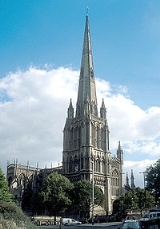
St Mary Redcliffe

Encyclopedia
St. Mary Redcliffe is an Anglican parish church
located in the Redcliffe
district of the English
port city of Bristol
, close to the city centre. Constructed from the 12th to the 15th centuries, the church is a Grade 1 listed building, St. Mary Redcliffe is renowned for the beauty of its Gothic architecture
, having been described by Queen Elizabeth I as "the fairest, goodliest, and most famous parish church in England."
The 292 ft (89 m) spire is the third tallest of England's parish churches, after the Roman Catholic Church of St. Walburge, Preston and the Anglican Church of St. James, Louth
. It is the tallest building in Bristol.
In medieval times, St. Mary Redcliffe, sitting on a red cliff above the River Avon, was a sign to seafarers, who would pray in it at their departure, and give thanks there upon their return. The church was built and beautified by Bristol's wealthy merchants, who paid to have masses sung for their souls and many of whom are commemorated there.
Parts of the church date to the beginning of the 12th century. Although its plan dates from an earlier period, much of the church as it now stands was built between 1292 and 1370, with the south aisle and transept in the Decorated Gothic of the 13th century and the greater part of the building in the late 14th century Perpendicular. The patrons included Simon de Burton, Mayor of Bristol, and William I Canynges(d.1396), merchant, 5 times Mayor of Bristol and 3 times MP. In the 15th century Canynges' grandson, the great merchant William II Canynges(d.1474), also 5 times Mayor and 3 times MP, assumed responsibility for bringing the work of the interior to completion and filling the windows with stained glass. In 1446 much of this work was damaged when the spire was struck by lightning, and fell, causing considerable damage to the interior. Although the spire was to remain damaged for the next 400 years, Canynges continued in his commitment to restore and beautify the church. He took Holy Orders after the death of his wife, and is buried in the church. Other families associated with St Mary Redcliffe include the Penns, the Cabots, the Jays, the Ameryks and the Medes.
In 1571, the school that was to become St Mary Redcliffe and Temple School
was formed in a chapel in the churchyard. The church and school have remained closely linked in many aspects of their operations.
The 17th century saw the loss of many of the church fittings and much of the stained glass
during the Reformation
and the English Civil War
. During the reign of Queen Anne
, and partially funded by her, the interior of St. Mary Redcliffe was refitted in the Baroque
style.
Thomas Chatterton
, whose father was sexton
of St Mary Redcliffe, was born in the house next to the church in 1752. He studied the church records in a room above the south porch, and wrote several works which he attempted to pass as genuine medieval documents. He committed suicide in London at the age of seventeen. In 1795 the church saw the marriages of Samuel Taylor Coleridge
to Sarah Fricker and Robert Southey
to Sarah's sister Elizabeth.
The upper part of the spire
, missing since being struck by lightning in 1446, was reconstructed in 1872 to a height of 292 ft (89 m).
During the Second World War a bomb exploded in a nearby street, throwing a rail
from the tram
way over the houses and into the churchyard of St Mary Redcliffe, where it became embedded in the ground. The rail is left there as a monument.
The north porch
has an inner component dating from 1200, with black Purbeck Marble
columns, and an outer hexagonal portion built in 1325 which is ogee
-cusped with a Moorish
appearance.
A wrought-iron
chancel screen built by William Edney in 1710 still stands under the tower.
The church is adorned with monuments to individuals from the history of the city, including Sir William Penn (the father of William Penn
, founder of Pennsylvania
). His helm
and half-armour
are hung on the wall, together with the tattered banners of the Dutch
ships that he captured in battle.
Little of the early stained glass
remains. In the west window of St John's Chapel, for instance, the medieval glass barely survived the destruction (said to have been caused by Oliver Cromwell
's men). Most of the higher portions went untouched, but others were severely damaged. In some cases the windows were impossible to repair, and clear glass was eventually introduced to replace the missing scenes.
The Victorian
stained-glass windows were created by some of the finest studios of that period.
The tower contains four bells dating from 1763 and made by Thomas Bilbie of the Bilbie family
. Two of these bells, along with an older Purdue bell are included in the 50cwt
ring of 12 bells, cast by John Taylor & Co in 1903.
tryptych by William Hogarth
was commissioned in 1756 to fill the east end of the chancel
. The churchwarden
s paid him £525 for his paintings of the Ascension flanked by The Sealing of the Sepulchre and the Three Marys at the Tomb. This was removed from the church by mid-Victorian liturgists and stored at various sites, including a tobacco warehouse (as this provided suitable humidity), before being displayed at the Bristol City Museum and Art Gallery
; it is now stored in the redundant church of St Nicholas, Bristol
.
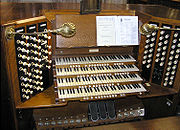 The first pipe organ
in the church, built by Harris and Byfield in 1726, was of three manuals
and 26 stops
.
In 1912 a four-manual, 71-stop organ having over 4,300 pipes
was installed by Harrison & Harrison
. Towards the end of his life Arthur Harrison said that he regarded the organ at St Mary Redcliffe as his "finest and most characteristic work". The organ remains essentially as he designed it in 1911.
Kevin Bowyer
recorded Kaikhosru Sorabji
's First Organ Symphony on it in 1988, for which the organ was an "ideal choice"; the notes to the recording describe the church as "acoustically ideal, with a reverberation period of 3½ seconds", and notes that the organ has "a luxuriousness of tone" and "a range of volume from practically inaudible to fiendishly loud". William McVicker, organist at the Royal Festival Hall
, has called the organ "the finest high-Romantic
organ ever constructed".
November 2010 saw the first performances on the organ after an 18-month renovation by its original builders Harrison & Harrison, costing around £800,000. The organ had been disassembled and some of it taken away to the builders' workshop in Durham
. The pipes were cleaned and the leather of the bellows
was replaced. The manuals were also fitted with an electronic panel for storing combinations of stop settings.
Organist and Choirmaster
Choirmaster
Director of Music and Organist
Assistant Organist
Parish church
A parish church , in Christianity, is the church which acts as the religious centre of a parish, the basic administrative unit of episcopal churches....
located in the Redcliffe
Redcliffe, Bristol
Redcliffe, also known as Redcliff, is a district of the English port city of Bristol, adjoining the city centre. It is bounded by the loop of the Floating Harbour to the west, north and east, the New Cut of the River Avon to the south...
district of the English
England
England is a country that is part of the United Kingdom. It shares land borders with Scotland to the north and Wales to the west; the Irish Sea is to the north west, the Celtic Sea to the south west, with the North Sea to the east and the English Channel to the south separating it from continental...
port city of Bristol
Bristol
Bristol is a city, unitary authority area and ceremonial county in South West England, with an estimated population of 433,100 for the unitary authority in 2009, and a surrounding Larger Urban Zone with an estimated 1,070,000 residents in 2007...
, close to the city centre. Constructed from the 12th to the 15th centuries, the church is a Grade 1 listed building, St. Mary Redcliffe is renowned for the beauty of its Gothic architecture
Gothic architecture
Gothic architecture is a style of architecture that flourished during the high and late medieval period. It evolved from Romanesque architecture and was succeeded by Renaissance architecture....
, having been described by Queen Elizabeth I as "the fairest, goodliest, and most famous parish church in England."
The 292 ft (89 m) spire is the third tallest of England's parish churches, after the Roman Catholic Church of St. Walburge, Preston and the Anglican Church of St. James, Louth
St. James Church, Louth
St. James' Church, Louth is a parish church in the Church of England in Louth, Lincolnshire, England. It is notable for its tall spire.-History:...
. It is the tallest building in Bristol.
History
The first church on this site was built in Saxon times, as the port of Bristol first began. The present building is probably the fourth or fifth church that has been built on this site.In medieval times, St. Mary Redcliffe, sitting on a red cliff above the River Avon, was a sign to seafarers, who would pray in it at their departure, and give thanks there upon their return. The church was built and beautified by Bristol's wealthy merchants, who paid to have masses sung for their souls and many of whom are commemorated there.
Parts of the church date to the beginning of the 12th century. Although its plan dates from an earlier period, much of the church as it now stands was built between 1292 and 1370, with the south aisle and transept in the Decorated Gothic of the 13th century and the greater part of the building in the late 14th century Perpendicular. The patrons included Simon de Burton, Mayor of Bristol, and William I Canynges(d.1396), merchant, 5 times Mayor of Bristol and 3 times MP. In the 15th century Canynges' grandson, the great merchant William II Canynges(d.1474), also 5 times Mayor and 3 times MP, assumed responsibility for bringing the work of the interior to completion and filling the windows with stained glass. In 1446 much of this work was damaged when the spire was struck by lightning, and fell, causing considerable damage to the interior. Although the spire was to remain damaged for the next 400 years, Canynges continued in his commitment to restore and beautify the church. He took Holy Orders after the death of his wife, and is buried in the church. Other families associated with St Mary Redcliffe include the Penns, the Cabots, the Jays, the Ameryks and the Medes.
In 1571, the school that was to become St Mary Redcliffe and Temple School
St Mary Redcliffe and Temple School
St Mary Redcliffe and Temple School is a Church of England voluntary aided school for students aged 11 to 18, situated in the inner-city suburb of Redcliffe, Bristol...
was formed in a chapel in the churchyard. The church and school have remained closely linked in many aspects of their operations.
The 17th century saw the loss of many of the church fittings and much of the stained glass
Stained glass
The term stained glass can refer to coloured glass as a material or to works produced from it. Throughout its thousand-year history, the term has been applied almost exclusively to the windows of churches and other significant buildings...
during the Reformation
English Reformation
The English Reformation was the series of events in 16th-century England by which the Church of England broke away from the authority of the Pope and the Roman Catholic Church....
and the English Civil War
English Civil War
The English Civil War was a series of armed conflicts and political machinations between Parliamentarians and Royalists...
. During the reign of Queen Anne
Anne of Great Britain
Anne ascended the thrones of England, Scotland and Ireland on 8 March 1702. On 1 May 1707, under the Act of Union, two of her realms, England and Scotland, were united as a single sovereign state, the Kingdom of Great Britain.Anne's Catholic father, James II and VII, was deposed during the...
, and partially funded by her, the interior of St. Mary Redcliffe was refitted in the Baroque
Baroque
The Baroque is a period and the style that used exaggerated motion and clear, easily interpreted detail to produce drama, tension, exuberance, and grandeur in sculpture, painting, literature, dance, and music...
style.
Thomas Chatterton
Thomas Chatterton
Thomas Chatterton was an English poet and forger of pseudo-medieval poetry. He died of arsenic poisoning, either from a suicide attempt or self-medication for a venereal disease.-Childhood:...
, whose father was sexton
Sexton (office)
A sexton is a church, congregation or synagogue officer charged with the maintenance of its buildings and/or the surrounding graveyard. In smaller places of worship, this office is often combined with that of verger...
of St Mary Redcliffe, was born in the house next to the church in 1752. He studied the church records in a room above the south porch, and wrote several works which he attempted to pass as genuine medieval documents. He committed suicide in London at the age of seventeen. In 1795 the church saw the marriages of Samuel Taylor Coleridge
Samuel Taylor Coleridge
Samuel Taylor Coleridge was an English poet, Romantic, literary critic and philosopher who, with his friend William Wordsworth, was a founder of the Romantic Movement in England and a member of the Lake Poets. He is probably best known for his poems The Rime of the Ancient Mariner and Kubla...
to Sarah Fricker and Robert Southey
Robert Southey
Robert Southey was an English poet of the Romantic school, one of the so-called "Lake Poets", and Poet Laureate for 30 years from 1813 to his death in 1843...
to Sarah's sister Elizabeth.
The upper part of the spire
Spire
A spire is a tapering conical or pyramidal structure on the top of a building, particularly a church tower. Etymologically, the word is derived from the Old English word spir, meaning a sprout, shoot, or stalk of grass....
, missing since being struck by lightning in 1446, was reconstructed in 1872 to a height of 292 ft (89 m).
During the Second World War a bomb exploded in a nearby street, throwing a rail
Rail tracks
The track on a railway or railroad, also known as the permanent way, is the structure consisting of the rails, fasteners, sleepers and ballast , plus the underlying subgrade...
from the tram
Tram
A tram is a passenger rail vehicle which runs on tracks along public urban streets and also sometimes on separate rights of way. It may also run between cities and/or towns , and/or partially grade separated even in the cities...
way over the houses and into the churchyard of St Mary Redcliffe, where it became embedded in the ground. The rail is left there as a monument.
Architecture and fittings
St Mary Redcliffe is cruciform in plan, with a chapel extending to the east of the chancel, and a large tower placed asymmetrically to the north of the west front. There is a rectangular 13th century porch on either side of the nave, that on the north side having been extended with a more elaborate polygonal outer porch in the 14th century.The north porch
Vestibule (architecture)
A vestibule is a lobby, entrance hall, or passage between the entrance and the interior of a building.The same term can apply to structures in modern or ancient roman architecture. In modern architecture vestibule typically refers to a small room or hall between an entrance and the interior of...
has an inner component dating from 1200, with black Purbeck Marble
Purbeck Marble
Purbeck Marble is a fossiliferous limestone quarried in the Isle of Purbeck, a peninsula in south-east Dorset, England.It is one of many kinds of Purbeck Limestone, deposited in the late Jurassic or early Cretaceous periods....
columns, and an outer hexagonal portion built in 1325 which is ogee
Ogee
An ogee is a curve , shaped somewhat like an S, consisting of two arcs that curve in opposite senses, so that the ends are parallel....
-cusped with a Moorish
Moorish architecture
Moorish architecture is the western term used to describe the articulated Berber-Islamic architecture of North Africa and Al-Andalus.-Characteristic elements:...
appearance.
A wrought-iron
Wrought iron
thumb|The [[Eiffel tower]] is constructed from [[puddle iron]], a form of wrought ironWrought iron is an iron alloy with a very low carbon...
chancel screen built by William Edney in 1710 still stands under the tower.
The church is adorned with monuments to individuals from the history of the city, including Sir William Penn (the father of William Penn
William Penn
William Penn was an English real estate entrepreneur, philosopher, and founder of the Province of Pennsylvania, the English North American colony and the future Commonwealth of Pennsylvania. He was an early champion of democracy and religious freedom, notable for his good relations and successful...
, founder of Pennsylvania
Pennsylvania
The Commonwealth of Pennsylvania is a U.S. state that is located in the Northeastern and Mid-Atlantic regions of the United States. The state borders Delaware and Maryland to the south, West Virginia to the southwest, Ohio to the west, New York and Ontario, Canada, to the north, and New Jersey to...
). His helm
Helmet
A helmet is a form of protective gear worn on the head to protect it from injuries.Ceremonial or symbolic helmets without protective function are sometimes used. The oldest known use of helmets was by Assyrian soldiers in 900BC, who wore thick leather or bronze helmets to protect the head from...
and half-armour
Armour
Armour or armor is protective covering used to prevent damage from being inflicted to an object, individual or a vehicle through use of direct contact weapons or projectiles, usually during combat, or from damage caused by a potentially dangerous environment or action...
are hung on the wall, together with the tattered banners of the Dutch
Netherlands
The Netherlands is a constituent country of the Kingdom of the Netherlands, located mainly in North-West Europe and with several islands in the Caribbean. Mainland Netherlands borders the North Sea to the north and west, Belgium to the south, and Germany to the east, and shares maritime borders...
ships that he captured in battle.
Little of the early stained glass
Stained glass
The term stained glass can refer to coloured glass as a material or to works produced from it. Throughout its thousand-year history, the term has been applied almost exclusively to the windows of churches and other significant buildings...
remains. In the west window of St John's Chapel, for instance, the medieval glass barely survived the destruction (said to have been caused by Oliver Cromwell
Oliver Cromwell
Oliver Cromwell was an English military and political leader who overthrew the English monarchy and temporarily turned England into a republican Commonwealth, and served as Lord Protector of England, Scotland, and Ireland....
's men). Most of the higher portions went untouched, but others were severely damaged. In some cases the windows were impossible to repair, and clear glass was eventually introduced to replace the missing scenes.
The Victorian
Victorian era
The Victorian era of British history was the period of Queen Victoria's reign from 20 June 1837 until her death on 22 January 1901. It was a long period of peace, prosperity, refined sensibilities and national self-confidence...
stained-glass windows were created by some of the finest studios of that period.
The tower contains four bells dating from 1763 and made by Thomas Bilbie of the Bilbie family
Bilbie family
The Bilbie family were bell founders and clockmakers based initially in Chew Stoke, Somerset and later at Cullompton, Devon in south-west England from the late 17th century to the early 19th century....
. Two of these bells, along with an older Purdue bell are included in the 50cwt
Hundredweight
The hundredweight or centum weight is a unit of mass defined in terms of the pound . The definition used in Britain differs from that used in North America. The two are distinguished by the terms long hundredweight and short hundredweight:* The long hundredweight is defined as 112 lb, which...
ring of 12 bells, cast by John Taylor & Co in 1903.
Hogarth's tryptych
A great altarpieceAltarpiece
An altarpiece is a picture or relief representing a religious subject and suspended in a frame behind the altar of a church. The altarpiece is often made up of two or more separate panels created using a technique known as panel painting. It is then called a diptych, triptych or polyptych for two,...
tryptych by William Hogarth
William Hogarth
William Hogarth was an English painter, printmaker, pictorial satirist, social critic and editorial cartoonist who has been credited with pioneering western sequential art. His work ranged from realistic portraiture to comic strip-like series of pictures called "modern moral subjects"...
was commissioned in 1756 to fill the east end of the chancel
Chancel
In church architecture, the chancel is the space around the altar in the sanctuary at the liturgical east end of a traditional Christian church building...
. The churchwarden
Churchwarden
A churchwarden is a lay official in a parish church or congregation of the Anglican Communion, usually working as a part-time volunteer. Holders of these positions are ex officio members of the parish board, usually called a vestry, parish council, parochial church council, or in the case of a...
s paid him £525 for his paintings of the Ascension flanked by The Sealing of the Sepulchre and the Three Marys at the Tomb. This was removed from the church by mid-Victorian liturgists and stored at various sites, including a tobacco warehouse (as this provided suitable humidity), before being displayed at the Bristol City Museum and Art Gallery
Bristol City Museum and Art Gallery
The Bristol City Museum and Art Gallery is a large museum and art gallery in Bristol, England. It is run by the city council with no entrance fee. It holds designated museum status, granted by the national government to protect outstanding museums...
; it is now stored in the redundant church of St Nicholas, Bristol
St Nicholas, Bristol
St Nicholas is a church in St Nicholas Street, Bristol, England.The first church was founded before 1154, with a chancel extending over the south gate of the city. The gate and old church were demolished to make way for the rebuilding of Bristol Bridge and the church was rebuilt in 1762-9 by James...
.
Choir
The choir have released numerous recordings, as well as touring Europe and North America.Organ
Pipe organ
The pipe organ is a musical instrument that produces sound by driving pressurized air through pipes selected via a keyboard. Because each organ pipe produces a single pitch, the pipes are provided in sets called ranks, each of which has a common timbre and volume throughout the keyboard compass...
in the church, built by Harris and Byfield in 1726, was of three manuals
Manual (music)
A manual is a keyboard designed to be played with the hands on a pipe organ, harpsichord, clavichord, electronic organ, or synthesizer. The term "manual" is used with regard to any hand keyboard on these instruments to distinguish it from the pedalboard, which is a keyboard that the organist plays...
and 26 stops
Organ stop
An organ stop is a component of a pipe organ that admits pressurized air to a set of organ pipes. Its name comes from the fact that stops can be used selectively by the organist; some can be "on" , while others can be "off" .The term can also refer...
.
In 1912 a four-manual, 71-stop organ having over 4,300 pipes
Organ pipe
An organ pipe is a sound-producing element of the pipe organ that resonates at a specific pitch when pressurized air is driven through it. Each pipe is tuned to a specific note of the musical scale...
was installed by Harrison & Harrison
Harrison & Harrison
Harrison & Harrison Ltd are a British company that make and restore pipe organs, based in Durham and established in 1861. They are well known for their work on instruments such as King's College Cambridge, Westminster Abbey and the Royal Festival Hall....
. Towards the end of his life Arthur Harrison said that he regarded the organ at St Mary Redcliffe as his "finest and most characteristic work". The organ remains essentially as he designed it in 1911.
Kevin Bowyer
Kevin Bowyer
Kevin John Bowyer is an English organist, known for his prolific recording and recital career and his interest in playing unusual, modern and extremely difficult compositions.-Biography:...
recorded Kaikhosru Sorabji
Kaikhosru Shapurji Sorabji
Kaikhosru Shapurji Sorabji was an English composer, music critic, pianist, and writer.-Biography:...
's First Organ Symphony on it in 1988, for which the organ was an "ideal choice"; the notes to the recording describe the church as "acoustically ideal, with a reverberation period of 3½ seconds", and notes that the organ has "a luxuriousness of tone" and "a range of volume from practically inaudible to fiendishly loud". William McVicker, organist at the Royal Festival Hall
Royal Festival Hall
The Royal Festival Hall is a 2,900-seat concert, dance and talks venue within Southbank Centre in London. It is situated on the South Bank of the River Thames, not far from Hungerford Bridge. It is a Grade I listed building - the first post-war building to become so protected...
, has called the organ "the finest high-Romantic
Romantic music
Romantic music or music in the Romantic Period is a musicological and artistic term referring to a particular period, theory, compositional practice, and canon in Western music history, from 1810 to 1900....
organ ever constructed".
November 2010 saw the first performances on the organ after an 18-month renovation by its original builders Harrison & Harrison, costing around £800,000. The organ had been disassembled and some of it taken away to the builders' workshop in Durham
Durham
Durham is a city in north east England. It is within the County Durham local government district, and is the county town of the larger ceremonial county...
. The pipes were cleaned and the leather of the bellows
Bellows
A bellows is a device for delivering pressurized air in a controlled quantity to a controlled location.Basically, a bellows is a deformable container which has an outlet nozzle. When the volume of the bellows is decreased, the air escapes through the outlet...
was replaced. The manuals were also fitted with an electronic panel for storing combinations of stop settings.
List of Organists
Organist- Nelme Rogers 1727–1772
- John Allen 1772–1816
- Cornelius Bryan 1818–1840
- Edwin Hobhouse Sircom 1840–1855
- William Haydn Flood 1855–1862
Organist and Choirmaster
- Joseph William Lawson 1862–1906
- Ralph Thompson Morgan 1906–1949
- Kenneth Roy Long 1949–1952
- Ewart Garth Benson 1953–1968 (continued as Organist until 1987)
Choirmaster
- Peter Fowler 1968
- Bryan Anderson 1968–1980
- John Edward Marsh 1980–1987
Director of Music and Organist
- John Edward Marsh 1987–1994
- Anthony John Pinel 1994–2003
- Andrew William Kirk 2003
Assistant Organist
- John Edward Marsh 1976–1980
- Colin Hunt 1980–1990
- Anthony John Pinel 1990–1994
- Graham Alsop 1994–2003
- Graham & Claire Alsop 2003
Railway
The Bristol Harbour Railway used to run through a tunnel under the churchyard, between Bathurst Basin and .See also
- Grade I listed buildings in BristolGrade I listed buildings in BristolThere are 100 Grade I listed buildings in Bristol, England according to Bristol City Council. The register includes many structures which for convenience are grouped together in the list below....
- Churches in BristolChurches in BristolThe English city of Bristol has a number of churches.The churches listed are Anglican except when otherwise noted.- External links :*...
- List of tallest buildings and structures in Bristol