


St Martin's Church, Canterbury

Encyclopedia
The Church of St Martin in Canterbury
, England, situated slightly beyond the city centre, is England's oldest parish church
in continuous use. Since 1668 St Martin's has been part of the benefice of St Martin & St Paul Canterbury. Both St Martin's and nearby St Paul's churches are used for weekly services. The current Rector of the Parish is the Rev'd Canon Noelle Hall.
in the 6th century before Augustine
arrived from Rome. Queen Bertha was a Christian Frankish
princess who arrived in England with her Chaplain, Bishop Liudhard
. King Æthelberht of Kent, her husband, allowed her to continue to practise her religion in an existing church which the Venerable Bede
says had been in use in the late Roman period
but had fallen into disuse. There is a strong possibility that this church is St Martin's, especially since Bede names it.
Shortly before 1844, a hoard of gold coins was found in the churchyard, one of which is the Liudhard medalet
, which bears an image of a diadem
ed figure with a legend referring to Liudhard.
 Local finds prove that Christianity did exist in this area of the city at the time, and the church contains many reused Roman bricks or spolia
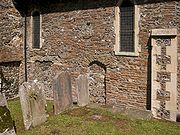
, as well as complete sections of walls of Roman tiles. Several sections of walls are clearly very early, and it is possible that a blocked square-headed doorway in the chancel
was the entrance to Bertha's church, while other sections of wall come from the period after the Gregorian mission
in the 7th or 8th centuries, including most of the nave
. The apse
that was originally at the east end has been removed. The tower is much later, in Perpendicular style. The church is a Grade A (equivalent to Grade I) listed building.
of many notable local families and well-known people including Thomas Sidney Cooper
, RA (artist) and Mary Tourtel
, the creator of Rupert Bear
.
The Choral Director for the parish is Dom del Nevo.
Canterbury
Canterbury is a historic English cathedral city, which lies at the heart of the City of Canterbury, a district of Kent in South East England. It lies on the River Stour....
, England, situated slightly beyond the city centre, is England's oldest parish church
Parish church
A parish church , in Christianity, is the church which acts as the religious centre of a parish, the basic administrative unit of episcopal churches....
in continuous use. Since 1668 St Martin's has been part of the benefice of St Martin & St Paul Canterbury. Both St Martin's and nearby St Paul's churches are used for weekly services. The current Rector of the Parish is the Rev'd Canon Noelle Hall.
Early history
St Martin's was the private chapel of Queen Bertha of KentBertha of Kent
Saint Bertha was the Queen of Kent whose influence led to the introduction of Christianity to Anglo-Saxon England. She was canonized as a saint for her role in its establishment during that period of English history.Bertha was the daughter of Charibert I, Merovingian King of Paris...
in the 6th century before Augustine
Augustine of Canterbury
Augustine of Canterbury was a Benedictine monk who became the first Archbishop of Canterbury in the year 597...
arrived from Rome. Queen Bertha was a Christian Frankish
Franks
The Franks were a confederation of Germanic tribes first attested in the third century AD as living north and east of the Lower Rhine River. From the third to fifth centuries some Franks raided Roman territory while other Franks joined the Roman troops in Gaul. Only the Salian Franks formed a...
princess who arrived in England with her Chaplain, Bishop Liudhard
Liudhard
Liudhard was a Frankish bishop – of where is unclear – and the chaplain of Queen Bertha of Kent, whom she brought with her from the continent upon her marriage to King Æthelberht of Kent...
. King Æthelberht of Kent, her husband, allowed her to continue to practise her religion in an existing church which the Venerable Bede
Bede
Bede , also referred to as Saint Bede or the Venerable Bede , was a monk at the Northumbrian monastery of Saint Peter at Monkwearmouth, today part of Sunderland, England, and of its companion monastery, Saint Paul's, in modern Jarrow , both in the Kingdom of Northumbria...
says had been in use in the late Roman period
Roman Britain
Roman Britain was the part of the island of Great Britain controlled by the Roman Empire from AD 43 until ca. AD 410.The Romans referred to the imperial province as Britannia, which eventually comprised all of the island of Great Britain south of the fluid frontier with Caledonia...
but had fallen into disuse. There is a strong possibility that this church is St Martin's, especially since Bede names it.
Shortly before 1844, a hoard of gold coins was found in the churchyard, one of which is the Liudhard medalet
Liudhard medalet
The Liudhard medalet is a gold Anglo-Saxon coin or small medal found some time before 1844 near St Martin's Church in Canterbury, England. It was part of the Canterbury-St Martin's hoard of six items. The coin, along with other items found with it, now resides in the World Museum Liverpool...
, which bears an image of a diadem
Diadem
Diadem may refer to:*Diadem, a type of crown-Military:*HMS Diadem was a 64-gun third rate ship of the line in the Royal Navy launched in 1782 at Chatham and participated in the Battle of Cape St Vincent in 1787...
ed figure with a legend referring to Liudhard.
Architecture
Spolia
Spolia is a modern art-historical term used to describe the re-use of earlier building material or decorative sculpture on new monuments...
, as well as complete sections of walls of Roman tiles. Several sections of walls are clearly very early, and it is possible that a blocked square-headed doorway in the chancel
Chancel
In church architecture, the chancel is the space around the altar in the sanctuary at the liturgical east end of a traditional Christian church building...
was the entrance to Bertha's church, while other sections of wall come from the period after the Gregorian mission
Gregorian mission
The Gregorian mission, sometimes known as the Augustinian mission, was the missionary endeavour sent by Pope Gregory the Great to the Anglo-Saxons in 596 AD. Headed by Augustine of Canterbury, its goal was to convert the Anglo-Saxons to Christianity. By the death of the last missionary in 653, they...
in the 7th or 8th centuries, including most of the nave
Nave
In Romanesque and Gothic Christian abbey, cathedral basilica and church architecture, the nave is the central approach to the high altar, the main body of the church. "Nave" was probably suggested by the keel shape of its vaulting...
. The apse
Apse
In architecture, the apse is a semicircular recess covered with a hemispherical vault or semi-dome...
that was originally at the east end has been removed. The tower is much later, in Perpendicular style. The church is a Grade A (equivalent to Grade I) listed building.
Graves
The churchyard contains the gravesGrave (burial)
A grave is a location where a dead body is buried. Graves are usually located in special areas set aside for the purpose of burial, such as graveyards or cemeteries....
of many notable local families and well-known people including Thomas Sidney Cooper
Thomas Sidney Cooper
Thomas Sidney Cooper was an English landscape painter noted for his images of cattle and farm animals.Cooper was born at Canterbury, Kent, and as a small child he began to show strong artistic inclinations, but the circumstances of his family did not allow him to received any systematic training...
, RA (artist) and Mary Tourtel
Mary Tourtel
Mary Tourtel was an English artist and creator of Rupert Bear.-Biography:Tourtel was born as Mary Caldwell and raised in an artistic family, daughter of a stained glass artist and stonemason. She studied art under Thomas Sidney Cooper at the Sidney Cooper School of Art in Canterbury, and became a...
, the creator of Rupert Bear
Rupert Bear
Rupert Bear is a children's comic strip character, who features in a series of books based around his adventures. The character was created by the English artist Mary Tourtel and first appeared in the Daily Express on 8 November 1920. Rupert's initial purpose was to win sales from the rival...
.
Music
The church has a strong continuing musical tradition from the monks of St Augustine to the present day. The first Sunday of every month is usually a Renaissance mass setting, sung by a quartet of singers.The Choral Director for the parish is Dom del Nevo.
Sources
- F. Haverfield, "Early British Christianity" The English Historical Review Vol. 11, No. 43. (Jul., 1896)
- Service, Alastair, The Buildings of Britain, A Guide and Gazetteer, Anglo-Saxon and Norman, 1982, Barrie & Jenkins (London), ISBN 0091501318