

St. Pauli

Encyclopedia
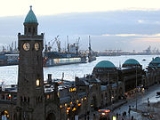
St. Pauli (ˌzaŋkt ˈpaʊli), located in the Hamburg-Mitte
borough, is one of the 105 quarter
s of the city of Hamburg
, Germany
. Situated on the right bank of the Elbe
river, the Landungsbrücken
are a northern part of the port of Hamburg. St. Pauli contains a world famous red light district
around the street Reeperbahn
. In 2006 the population was 27,612.
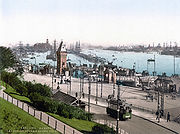
. The name comes from a hill in that area that was planed by Hamburg in 1620 for defence reasons (free field of fire for the artillery). Therefore, settlement was initially allowed there, but soon businesses, which were not desired inside Hamburg, e.g. for their smell or noise, were relegated to 'Hamburger Berg'. Also the rope makers (or 'Reeper' in Low German
) went here because in the city it was hard to find enough space for their work. The name of St. Pauli's most famous street Reeperbahn
, or "Rope Walk," harkens back to its rope making past. When people were officially allowed to live in St. Pauli at the end of the 17th century the city government moved workhouses and (pestilence
) hospitals out of the city to 'Hamburger Berg,' which later was named after its church, 'St. Pauli' (Saint Paul
).
There have been various social fights during the last decades (examples are Hafenstraße
, Rote Flora
and Bambule
).
river close to the port of Hamburg. It is located south to Eimsbüttel
, west of Hamburg-Neustadt and east of Altona
. According to the statistical office of Hamburg and Schleswig-Holstein
, the quarter has total area of 2.6 km² (1 sq mi).
(BNI) is located in the Bernhard Nocht Straße 7. It is a research center for tropical and infectious diseases and provides an information center about health risks, vaccinations and medical data about other countries for tourism and travel advice. The former in the Bernhard Nocht Straße located hospital department is now in the University Medical Center Hamburg-Eppendorf (UKE), Martinistraße 52. BNI website
In 2006 there were 2 elementary schools and 1 secondary school in St. Pauli.
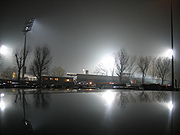 A prominent symbol is its football
club, FC St. Pauli
and the Millerntor-Stadion. The club played host to the inaugural FIFI Wild Cup
in May–June 2006.
In 2010 the FC St. Pauli was one hundred years old. To the jubilee the Fan club
18auf12 had recorded a song: One Hundred Beers (Words and music by Henning Knorr & Christoph Brüx
).
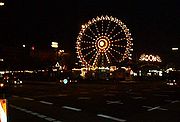
St. Pauli has a long tradition as a recreation and amusement centre. The big port of Hamburg led many sailors to Hamburg who preferably spent their spare time (as long as their ships were unloaded and loaded again) in this area. Since then there has been prostitution
in St. Pauli, and it is still best known as Hamburg's red-light district
. The red-light district is an area of a few streets around the street Reeperbahn
often referred to as the Kiez
.
Bars and music clubs have a tradition in the Kiez St. Pauli. The Beatles
lived in St. Pauli and played at the Star-Club
before becoming famous. Singer and actor Hans Albers
is strongly associated with St. Pauli, providing the neighbourhood's unofficial anthem, with "Auf der Reeperbahn Nachts um Halb Eins" ("On the Reeperbahn at half past midnight") from the movie Große Freiheit Nr. 7
.
The district is referenced in the song "St Pauli" by Art Brut
, which also contains the lyrics "Punk rock ist nicht tot" ("punk rock is not dead").
The Swedish post-industrial rock band Sällskapet
's song Nordlicht talks about a pub in the area. The song contains detailed instructions supposedly leading to the location of the pub.
. Among other things, it provides information of all matters of maritime shipping, to special funding programmes, law of flag, certification of mariners and informations of the coasts and coastal waters of Germany. Official website BSH
system services St. Pauli with the city train
stations Landungsbrücken
and Reeperbahn and the underground railway
stations Landungsbrücken, St. Pauli and Feldstrasse. Public transport is also provided by buses and ferries to the other bank of the Elbe
river.
As of 2006, according to the Department of Motor Vehicles (Kraftfahrt-Bundesamt), 5487 private cars were registered in St. Pauli.
Hamburg-Mitte
Hamburg-Mitte located in the Free and Hanseatic city of Hamburg, Germany is one of the seven boroughs of Hamburg, covering mostly the urban center of the city of Hamburg. The quarters Hamburg-Altstadt and Neustadt are the historical origin of Hamburg...
borough, is one of the 105 quarter
Quarter (country subdivision)
A quarter is a section of an urban settlement.Its borders can be administratively chosen , and it may have its own administrative structure...
s of the city of Hamburg
Hamburg
-History:The first historic name for the city was, according to Claudius Ptolemy's reports, Treva.But the city takes its modern name, Hamburg, from the first permanent building on the site, a castle whose construction was ordered by the Emperor Charlemagne in AD 808...
, Germany
Germany
Germany , officially the Federal Republic of Germany , is a federal parliamentary republic in Europe. The country consists of 16 states while the capital and largest city is Berlin. Germany covers an area of 357,021 km2 and has a largely temperate seasonal climate...
. Situated on the right bank of the Elbe
Elbe
The Elbe is one of the major rivers of Central Europe. It rises in the Krkonoše Mountains of the northwestern Czech Republic before traversing much of Bohemia , then Germany and flowing into the North Sea at Cuxhaven, 110 km northwest of Hamburg...
river, the Landungsbrücken
Landungsbrücken
The St. Pauli Landungsbrücken , part of the Hamburg Harbour, are in the quarter St. Pauli of Hamburg, Germany, between the lower harbor and the Fischmarkt directly on the Elbe River. The Landungsbrücken today are a major tourist attraction and a central transportation hub, with S-Bahn, U-Bahn and...
are a northern part of the port of Hamburg. St. Pauli contains a world famous red light district
Red Light District
Red Light District may refer to:* Red-light district - a neighborhood where prostitution is common* The Red Light District - the title of the 2004 album by rapper Ludacris* Red Light District Video - a pornography studio based in Los Angeles, California...
around the street Reeperbahn
Reeperbahn
The Reeperbahn is a street in Hamburg's St. Pauli district, one of the two centres of Hamburg's nightlife and also the city's red-light district...
. In 2006 the population was 27,612.
History
At the beginning of the 17th century it developed as a suburb called 'Hamburger Berg' (Hamburg mountain) outside the gates of the nearby city of Hamburg and close to the city of AltonaAltona, Hamburg
Altona is the westernmost urban borough of the German city state of Hamburg, on the right bank of the Elbe river. From 1640 to 1864 Altona was under the administration of the Danish monarchy. Altona was an independent city until 1937...
. The name comes from a hill in that area that was planed by Hamburg in 1620 for defence reasons (free field of fire for the artillery). Therefore, settlement was initially allowed there, but soon businesses, which were not desired inside Hamburg, e.g. for their smell or noise, were relegated to 'Hamburger Berg'. Also the rope makers (or 'Reeper' in Low German
Low German
Low German or Low Saxon is an Ingvaeonic West Germanic language spoken mainly in northern Germany and the eastern part of the Netherlands...
) went here because in the city it was hard to find enough space for their work. The name of St. Pauli's most famous street Reeperbahn
Reeperbahn
The Reeperbahn is a street in Hamburg's St. Pauli district, one of the two centres of Hamburg's nightlife and also the city's red-light district...
, or "Rope Walk," harkens back to its rope making past. When people were officially allowed to live in St. Pauli at the end of the 17th century the city government moved workhouses and (pestilence
Infectious disease
Infectious diseases, also known as communicable diseases, contagious diseases or transmissible diseases comprise clinically evident illness resulting from the infection, presence and growth of pathogenic biological agents in an individual host organism...
) hospitals out of the city to 'Hamburger Berg,' which later was named after its church, 'St. Pauli' (Saint Paul
Paul of Tarsus
Paul the Apostle , also known as Saul of Tarsus, is described in the Christian New Testament as one of the most influential early Christian missionaries, with the writings ascribed to him by the church forming a considerable portion of the New Testament...
).
There have been various social fights during the last decades (examples are Hafenstraße
Hafenstraße
Hafenstraße is a common German abbreviation of St. Pauli-Hafenstraße, a street in St. Pauli, a quarter of Hamburg, Germany....
, Rote Flora
Rote Flora
The Rote Flora is a former theater in the neighbourhood Schanzenviertel in Hamburg. It has been squatted in November 1989 in response to the decision to turn it into a musical theatre.- History of the building :...
and Bambule
Bambule
Bambule, a term of German prison sociolect, originally refers to a form of mostly non-violent prison protest, typically effected by banging hard items against the cells' metal bars. The term is derived from the African dance Bamboule or Bamboula....
).
Geography
It is situated directly on the north bank of the ElbeElbe
The Elbe is one of the major rivers of Central Europe. It rises in the Krkonoše Mountains of the northwestern Czech Republic before traversing much of Bohemia , then Germany and flowing into the North Sea at Cuxhaven, 110 km northwest of Hamburg...
river close to the port of Hamburg. It is located south to Eimsbüttel
Eimsbüttel
Eimsbüttel is one of the seven boroughs of Hamburg, Germany. In 2006 the population was 246,087.-History:On March 1, 2008 Eimsbüttel lost a part of its area to form the quarter Sternschanze in the borough Altona.-Geography:...
, west of Hamburg-Neustadt and east of Altona
Altona, Hamburg
Altona is the westernmost urban borough of the German city state of Hamburg, on the right bank of the Elbe river. From 1640 to 1864 Altona was under the administration of the Danish monarchy. Altona was an independent city until 1937...
. According to the statistical office of Hamburg and Schleswig-Holstein
Schleswig-Holstein
Schleswig-Holstein is the northernmost of the sixteen states of Germany, comprising most of the historical duchy of Holstein and the southern part of the former Duchy of Schleswig...
, the quarter has total area of 2.6 km² (1 sq mi).
Demographics
St. Pauli has 27,612 inhabitants in more than 17,000 households. Immigrants were 27.9% of the population. There were 11.9% with children under the age of 18 and 9.3% of the inhabitants were 65 years of age or older. 63.4% of all households were made up of individuals.Education
The Bernhard Nocht Institute for Tropical MedicineBernhard Nocht Institute for Tropical Medicine
Bernhard Nocht Institute for Tropical Medicine; is a medical institution based in Hamburg, Germany which is dedicated to research, treatment, training and therapy of tropical and infectious diseases....
(BNI) is located in the Bernhard Nocht Straße 7. It is a research center for tropical and infectious diseases and provides an information center about health risks, vaccinations and medical data about other countries for tourism and travel advice. The former in the Bernhard Nocht Straße located hospital department is now in the University Medical Center Hamburg-Eppendorf (UKE), Martinistraße 52. BNI website
In 2006 there were 2 elementary schools and 1 secondary school in St. Pauli.
Culture and recreation
Football (soccer)
Association football, more commonly known as football or soccer, is a sport played between two teams of eleven players with a spherical ball...
club, FC St. Pauli
FC St. Pauli
Fußball-Club St. Pauli is a German sports club based in the St. Pauli quarter of Hamburg. The football section is part of a larger club that also has Rugby Fußball-Club St. Pauli is a German sports club based in the St. Pauli quarter of Hamburg. The football section is part of a larger club that...
and the Millerntor-Stadion. The club played host to the inaugural FIFI Wild Cup
FIFI Wild Cup
The FIFI Wild Cup was an alternative football World Cup run by FIFI . FIFI was a body made up of countries not recognized by FIFA and those whose logistics preclude them from playing representative football...
in May–June 2006.
In 2010 the FC St. Pauli was one hundred years old. To the jubilee the Fan club
Fan club
A fan club is a group that is dedicated to a well-known person, group, idea or sometimes even an inanimate object . Most fan clubs are run by fans who devote considerable time and resources to supporting them. There are also "official" fan clubs that are run by someone associated with the person...
18auf12 had recorded a song: One Hundred Beers (Words and music by Henning Knorr & Christoph Brüx
Christoph Brüx
Christoph Brüx is a German composer, pianist, keyboardist, arranger and music producer.He composed for interpreters such as No Angels, Matthias Reim, The Underdog Project, Brooklyn Bounce etc., and he also composed film scores....
).
St. Pauli has a long tradition as a recreation and amusement centre. The big port of Hamburg led many sailors to Hamburg who preferably spent their spare time (as long as their ships were unloaded and loaded again) in this area. Since then there has been prostitution
Prostitution
Prostitution is the act or practice of providing sexual services to another person in return for payment. The person who receives payment for sexual services is called a prostitute and the person who receives such services is known by a multitude of terms, including a "john". Prostitution is one of...
in St. Pauli, and it is still best known as Hamburg's red-light district
Red-light district
A red-light district is a part of an urban area where there is a concentration of prostitution and sex-oriented businesses, such as sex shops, strip clubs, adult theaters, etc...
. The red-light district is an area of a few streets around the street Reeperbahn
Reeperbahn
The Reeperbahn is a street in Hamburg's St. Pauli district, one of the two centres of Hamburg's nightlife and also the city's red-light district...
often referred to as the Kiez
Kiez
Kiez is a German word that refers to a city neighbourhood, a relatively small community within a larger town. The word is mainly used in Berlin and northern Germany.-Original Meaning and Etymology:...
.
Bars and music clubs have a tradition in the Kiez St. Pauli. The Beatles
The Beatles
The Beatles were an English rock band, active throughout the 1960s and one of the most commercially successful and critically acclaimed acts in the history of popular music. Formed in Liverpool, by 1962 the group consisted of John Lennon , Paul McCartney , George Harrison and Ringo Starr...
lived in St. Pauli and played at the Star-Club
Star-Club
The Star-Club was a music club in Hamburg, Germany that opened Friday 13 April 1962 and was initially operated by Manfred Weissleder and Horst Fascher. In the sixties, many of the giants of rock music played at the club. The club closed on 31 December 1969 and the building it occupied was...
before becoming famous. Singer and actor Hans Albers
Hans Albers
Hans Philipp August Albers was a German actor and singer. He was the single biggest male movie star in Germany between 1930 and 1945 and one of the most popular German actors of the twentieth century.- Life and work :...
is strongly associated with St. Pauli, providing the neighbourhood's unofficial anthem, with "Auf der Reeperbahn Nachts um Halb Eins" ("On the Reeperbahn at half past midnight") from the movie Große Freiheit Nr. 7
Große Freiheit Nr. 7
Große Freiheit Nr. 7 is a 1944 German musical drama film directed by Helmut Käutner. It was named after Große Freiheit , a street next to Hamburg's Reeperbahn road in the St...
.
The district is referenced in the song "St Pauli" by Art Brut
Art Brut (band)
Art Brut are a Berlin-based English and German indie rock band. Their debut album, Bang Bang Rock & Roll, was released on 30 May 2005, with its follow up, It's a Bit Complicated, released on 25 June 2007...
, which also contains the lyrics "Punk rock ist nicht tot" ("punk rock is not dead").
The Swedish post-industrial rock band Sällskapet
Sällskapet
Sällskapet is a Swedish rock band formed by Pelle Ossler, Joakim Thåström and Niklas Hellberg.-History:Sällskapet is a Swedish electronic post-industrial rock band that appeared in 2007 and is headed by the rock legend Thåström. Other band members include Pelle Ossler and Niklas Hellberg...
's song Nordlicht talks about a pub in the area. The song contains detailed instructions supposedly leading to the location of the pub.
Voluntary associations (range)
- Parkhaus e.V. (Multi-storey car park) (an integrative living project)
- Kunst- und Kulturverein (culture association) LINDA e.V.
- BuddhistischesBuddhismBuddhism is a religion and philosophy encompassing a variety of traditions, beliefs and practices, largely based on teachings attributed to Siddhartha Gautama, commonly known as the Buddha . The Buddha lived and taught in the northeastern Indian subcontinent some time between the 6th and 4th...
Zentrum Hamburg e.V. - IG St. Pauli und Hafenmeile e.V.
- FC St. Pauli von 1910 e.V.FC St. PauliFußball-Club St. Pauli is a German sports club based in the St. Pauli quarter of Hamburg. The football section is part of a larger club that also has Rugby Fußball-Club St. Pauli is a German sports club based in the St. Pauli quarter of Hamburg. The football section is part of a larger club that...
- CAFE mit Herz e.V.
- Lions-ClubLions Clubs InternationalLions Clubs International is a secular service organization with over 44,500 clubs and more than 1,368,683 members in 191 countries around the world founded by Melvin Jones Headquartered in Oak Brook, Illinois, United States, the organization aims to meet the needs of communities on a local and...
Hamburg-St. Pauli - JUGEND UND SPORT e.V. (Youth and Sport) (social pedagogySocial learning (social pedagogy)Social learning is learning that takes place at a wider scale than individual or group learning, up to a societal scale, through social interaction between peers. It may or may not lead to a change in attitudes and behaviour...
projects) - Viva con Agua de St. Pauli e.V.Viva con Agua de Sankt PauliViva con Agua de Sankt Pauli is a charity founded in 2005 in the Hamburg quarter of St. Pauli. The aim of the organization is to improve drinking water supply in developing countriesin conjunction with the Welthungerhilfe. The organization is built up as an "open network" which means that it mainly...
., a charity based organisationCharitable organizationA charitable organization is a type of non-profit organization . It differs from other types of NPOs in that it centers on philanthropic goals A charitable organization is a type of non-profit organization (NPO). It differs from other types of NPOs in that it centers on philanthropic goals A...
located in St. Pauli/Hamburg campaigning for clean drinking water worldwide
Infrastructure
The Federal Maritime and Hydrographic Agency Bundesamt für Seeschiffahrt und Hydrographie (BSH) is located in Bernhard Nocht Str. 78. The BSH is a federal authority coming under the jurisdiction of the Federal Ministry of Transport, Building and Urban AffairsFederal Ministry of Transport, Building and Urban Affairs (Germany)
The Federal Ministry of Transport, Building and Urban Development is a Ministry of Germany.It was created in 1998 by merger of the former Federal Ministry of Transport and the Federal Ministry of Regional Planning, Building and Urban Development, both established in 1949...
. Among other things, it provides information of all matters of maritime shipping, to special funding programmes, law of flag, certification of mariners and informations of the coasts and coastal waters of Germany. Official website BSH
Transportation
The rapid transitRapid transit
A rapid transit, underground, subway, elevated railway, metro or metropolitan railway system is an electric passenger railway in an urban area with a high capacity and frequency, and grade separation from other traffic. Rapid transit systems are typically located either in underground tunnels or on...
system services St. Pauli with the city train
Hamburg S-Bahn
The Hamburg S-Bahn is a railway network for public rapid mass transit in the Hamburg Metropolitan Region. Together the S-Bahn, the Hamburg U-Bahn, the AKN railway and the regional railway form the backbone of railway public transport in the city and the surrounding area...
stations Landungsbrücken
Landungsbrücken
The St. Pauli Landungsbrücken , part of the Hamburg Harbour, are in the quarter St. Pauli of Hamburg, Germany, between the lower harbor and the Fischmarkt directly on the Elbe River. The Landungsbrücken today are a major tourist attraction and a central transportation hub, with S-Bahn, U-Bahn and...
and Reeperbahn and the underground railway
Hamburg U-Bahn
The Hamburg U-Bahn is a rapid transit system serving the cities of Hamburg, Norderstedt and Ahrensburg in Germany. Although technically an underground, most of the system's track length is above ground. The network is interconnected with the city's S-Bahn system, which also has underground...
stations Landungsbrücken, St. Pauli and Feldstrasse. Public transport is also provided by buses and ferries to the other bank of the Elbe
Elbe
The Elbe is one of the major rivers of Central Europe. It rises in the Krkonoše Mountains of the northwestern Czech Republic before traversing much of Bohemia , then Germany and flowing into the North Sea at Cuxhaven, 110 km northwest of Hamburg...
river.
As of 2006, according to the Department of Motor Vehicles (Kraftfahrt-Bundesamt), 5487 private cars were registered in St. Pauli.