
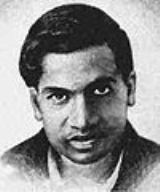
Srīnivāsa Aiyangār Rāmānujan FRS, better known as
Srinivasa Iyengar Ramanujan (22 December 1887 – 26 April 1920) was a
IndiaIndia , officially the Republic of India , is a country in South Asia. It is the seventh-largest country by geographical area, the second-most populous country with over 1.2 billion people, and the most populous democracy in the world...
n
mathematicianA mathematician is a person whose primary area of study is the field of mathematics. Mathematicians are concerned with quantity, structure, space, and change....
and autodidact who, with almost no formal training in
pure mathematicsBroadly speaking, pure mathematics is mathematics which studies entirely abstract concepts. From the eighteenth century onwards, this was a recognized category of mathematical activity, sometimes characterized as speculative mathematics, and at variance with the trend towards meeting the needs of...
, made extraordinary contributions to
mathematical analysisMathematical analysis, which mathematicians refer to simply as analysis, has its beginnings in the rigorous formulation of infinitesimal calculus. It is a branch of pure mathematics that includes the theories of differentiation, integration and measure, limits, infinite series, and analytic functions...
,
number theoryNumber theory is a branch of pure mathematics devoted primarily to the study of the integers. Number theorists study prime numbers as well...
, infinite series and
continued fractionIn mathematics, a continued fraction is an expression obtained through an iterative process of representing a number as the sum of its integer part and the reciprocal of another number, then writing this other number as the sum of its integer part and another reciprocal, and so on...
s. Ramanujan's talent was said by the English mathematician G.H. Hardy to be in the same league as legendary mathematicians such as
GaussGauss may refer to:*Carl Friedrich Gauss, German mathematician and physicist*Gauss , a unit of magnetic flux density or magnetic induction*GAUSS , a software package*Gauss , a crater on the moon...
, Euler, Cauchy,
NewtonSir Isaac Newton PRS was an English physicist, mathematician, astronomer, natural philosopher, alchemist, and theologian, who has been "considered by many to be the greatest and most influential scientist who ever lived."...
and
ArchimedesArchimedes of Syracuse was a Greek mathematician, physicist, engineer, inventor, and astronomer. Although few details of his life are known, he is regarded as one of the leading scientists in classical antiquity. Among his advances in physics are the foundations of hydrostatics, statics and an...
and he is widely regarded as one of the towering geniuses in mathematics.
Born in
ErodeErode is a city, a municipal corporation and the headquarters of Erode district in the South Indian state of Tamil Nadu.It is situated at the center of the South Indian Peninsula, about southwest from the state capital Chennai and on the banks of the rivers Cauvery and Bhavani, between 11° 19.5"...
, Tamil Nadu, India, to a poor Brahmin family, Ramanujan first encountered formal mathematics at age 10. He demonstrated a natural ability, and was given books on advanced
trigonometryTrigonometry is a branch of mathematics that studies triangles and the relationships between their sides and the angles between these sides. Trigonometry defines the trigonometric functions, which describe those relationships and have applicability to cyclical phenomena, such as waves...
written by
S. L. LoneySidney Luxton Loney, M.A. was Professor of Mathematics at the Royal Holloway College , and a fellow of Sidney Sussex College, Cambridge. He authored a number of mathematics texts, some of which have been reprinted numerous times...
. He mastered them by age 12, and even discovered
theoremIn mathematics, a theorem is a statement that has been proven on the basis of previously established statements, such as other theorems, and previously accepted statements, such as axioms...
s of his own, including independently re-discovering
Euler's Identity. He demonstrated unusual mathematical skills at school, winning accolades and awards. By 17, Ramanujan conducted his own mathematical research on
Bernoulli numberIn mathematics, the Bernoulli numbers Bn are a sequence of rational numbers with deep connections to number theory. They are closely related to the values of the Riemann zeta function at negative integers....
s and the
Euler–Mascheroni constantThe Euler–Mascheroni constant is a mathematical constant recurring in analysis and number theory, usually denoted by the lowercase Greek letter ....
. He received a scholarship to study at Government College in
KumbakonamKumbakonam , also spelt as Coombaconum in the records of British India , is a town and a special grade municipality in the Thanjavur district in the southeast Indian state of Tamil Nadu. Located 40 kilometres from Thanjavur and 272 kilometres from Chennai, it is the headquarters of the Kumbakonam...
, but lost it when he failed his non-mathematical coursework. He joined another college to pursue independent mathematical research, working as a clerk in the Accountant-General's office at the Madras Port Trust Office to support himself. In 1912–1913, he sent samples of his theorems to three academics at the University of Cambridge. Only Hardy recognised the brilliance of his work, subsequently inviting Ramanujan to visit and work with him at Cambridge. He became a Fellow of the Royal Society and a Fellow of
Trinity College, CambridgeTrinity College is a constituent college of the University of Cambridge. Trinity has more members than any other college in Cambridge or Oxford, with around 700 undergraduates, 430 graduates, and over 170 Fellows...
, dying of illness, malnutrition and possibly liver infection in 1920 at the age of 32.
During his short lifetime, Ramanujan independently compiled nearly 3900 results (mostly
identitiesIn mathematics, the term identity has several different important meanings:*An identity is a relation which is tautologically true. This means that whatever the number or value may be, the answer stays the same. For example, algebraically, this occurs if an equation is satisfied for all values of...
and
equationAn equation is a mathematical statement that asserts the equality of two expressions. In modern notation, this is written by placing the expressions on either side of an equals sign , for examplex + 3 = 5\,asserts that x+3 is equal to 5...
s). Although a small number of these results were actually false and some were already known, most of his claims have now been proven correct. He stated results that were both original and highly unconventional, such as the
Ramanujan primeIn mathematics, a Ramanujan prime is a prime number that satisfies a result proven by Srinivasa Ramanujan relating to the prime-counting function.-Origins and definition:...
and the
Ramanujan theta functionIn mathematics, particularly q-analog theory, the Ramanujan theta function generalizes the form of the Jacobi theta functions, while capturing their general properties. In particular, the Jacobi triple product takes on a particularly elegant form when written in terms of the Ramanujan theta...
, and these have inspired a vast amount of further research. However, the mathematical mainstream has been rather slow in absorbing some of his major discoveries. The
Ramanujan Journal, an international publication, was launched to publish work in all areas of mathematics influenced by his work.
Early life
Ramanujan was born on 22 December 1887 in the city
ErodeErode is a city, a municipal corporation and the headquarters of Erode district in the South Indian state of Tamil Nadu.It is situated at the center of the South Indian Peninsula, about southwest from the state capital Chennai and on the banks of the rivers Cauvery and Bhavani, between 11° 19.5"...
, Tamil Nadu, India, at the residence of his maternal grandparents. His father, K. Srinivasa Iyengar worked as a clerk in a sari shop and hailed from the district of
Thanjavur. His mother, Komalatammal was a
housewifeHomemaking is a mainly American term for the management of a home, otherwise known as housework, housekeeping or household management...
and also sang at a local temple. They lived in Sarangapani Street in a traditional home in the town of Kumbakonam. The family home is now a museum. When Ramanujan was a year and a half old, his mother gave birth to a son named Sadagopan, who died less than three months later. In December 1889, Ramanujan had
smallpoxSmallpox was an infectious disease unique to humans, caused by either of two virus variants, Variola major and Variola minor. The disease is also known by the Latin names Variola or Variola vera, which is a derivative of the Latin varius, meaning "spotted", or varus, meaning "pimple"...
and recovered, unlike thousands in the
Thanjavur districtThanjavur District is one of the 32 districts of the state of Tamil Nadu, in southeastern India. Its headquarters is Thanjavur.-Geography:...
who died from the disease that year. He moved with his mother to her parents' house in
KanchipuramKanchipuram, or Kanchi, is a temple city and a municipality in Kanchipuram district in the Indian state of Tamil Nadu. It is a temple town and the headquarters of Kanchipuram district...
, near Madras (now
ChennaiChennai , formerly known as Madras or Madarasapatinam , is the capital city of the Indian state of Tamil Nadu, located on the Coromandel Coast off the Bay of Bengal. Chennai is the fourth most populous metropolitan area and the sixth most populous city in India...
). In November 1891, and again in 1894, his mother gave birth, but both children died in infancy.
On 1 October 1892, Ramanujan was enrolled at the local school. In March 1894, he was moved to a
Telugu mediumMedium of instruction is a language used in teaching. It may or may not be the official language of the country or territory. Where the first language of students is different from the official language, it may be used as the medium of instruction for part or all of schooling. Bilingual or...
school. After his maternal grandfather lost his job as a court official in Kanchipuram, Ramanujan and his mother moved back to
KumbakonamKumbakonam , also spelt as Coombaconum in the records of British India , is a town and a special grade municipality in the Thanjavur district in the southeast Indian state of Tamil Nadu. Located 40 kilometres from Thanjavur and 272 kilometres from Chennai, it is the headquarters of the Kumbakonam...
and he was enrolled in the Kangayan Primary School. After his paternal grandfather died, he was sent back to his maternal grandparents, who were now living in Madras. He did not like school in Madras, and he tried to avoid attending. His family enlisted a local constable to make sure he attended school. Within six months, Ramanujan was back in Kumbakonam.
Since Ramanujan's father was at work most of the day, his mother took care of him as a child. He had a close relationship with her. From her, he learned about tradition and
puranasThe Puranas are a genre of important Hindu, Jain and Buddhist religious texts, notably consisting of narratives of the history of the universe from creation to destruction, genealogies of kings, heroes, sages, and demigods, and descriptions of Hindu cosmology, philosophy, and geography.Puranas...
. He learned to sing religious songs, to attend pujas at the temple and particular eating habits – all of which are part of
BrahminBrahmin Brahman, Brahma and Brahmin.Brahman, Brahmin and Brahma have different meanings. Brahman refers to the Supreme Self...
culture. At the Kangayan Primary School, Ramanujan performed well. Just before the age of 10, in November 1897, he passed his primary examinations in English,
TamilTamil is a Dravidian language spoken predominantly by Tamil people of the Indian subcontinent. It has official status in the Indian state of Tamil Nadu and in the Indian union territory of Pondicherry. Tamil is also an official language of Sri Lanka and Singapore...
, geography and arithmetic. With his scores, he finished first in the district. That year, Ramanujan entered Town Higher Secondary School where he encountered formal mathematics for the first time.
By age 11, he had exhausted the mathematical knowledge of two college students who were lodgers at his home. He was later lent a book on advanced trigonometry written by
S. L. LoneySidney Luxton Loney, M.A. was Professor of Mathematics at the Royal Holloway College , and a fellow of Sidney Sussex College, Cambridge. He authored a number of mathematics texts, some of which have been reprinted numerous times...
. He completely mastered this book by the age of 13 and discovered sophisticated theorems on his own. By 14, he was receiving merit certificates and academic awards which continued throughout his school career and also assisted the school in the
logisticsLogistics is the management of the flow of goods between the point of origin and the point of destination in order to meet the requirements of customers or corporations. Logistics involves the integration of information, transportation, inventory, warehousing, material handling, and packaging, and...
of assigning its 1200 students (each with their own needs) to its 35-odd teachers. He completed mathematical exams in half the allotted time, and showed a familiarity with infinite series. In 1903 when he was 16, Ramanujan obtained a library loaned copy of a book by
G. S. CarrGeorge Shoobridge Carr wrote Synopsis of Pure Mathematics . This book, first published in England in 1880, was read and studied closely by Srinivasa Aiyangar Ramanujan when he was a teenager....
from a friend. The book was titled
A Synopsis of Elementary Results in Pure and Applied MathematicsSynopsis of Pure Mathematics is a book by G. S. Carr, written in 1886. The book attempted to summarize the state of most of the basic mathematics known at the time....
and was a collection of 5000 theorems. Ramanujan reportedly studied the contents of the book in detail. The book is generally acknowledged as a key element in awakening the genius of Ramanujan. The next year, he had independently developed and investigated the
Bernoulli numberIn mathematics, the Bernoulli numbers Bn are a sequence of rational numbers with deep connections to number theory. They are closely related to the values of the Riemann zeta function at negative integers....
s and had calculated
Euler's constantThe Euler–Mascheroni constant is a mathematical constant recurring in analysis and number theory, usually denoted by the lowercase Greek letter ....
up to 15 decimal places. His peers at the time commented that they "rarely understood him" and "stood in respectful awe" of him.
When he graduated from
Town Higher Secondary SchoolTown Higher Secondary School is a school in Kumbakonam, a town in the Thanjavur district in the Indian state of Tamil Nadu.Mathematician Srinivasa Ramanujan studied here....
in 1904, Ramanujan was awarded the K. Ranganatha Rao prize for mathematics by the school's headmaster, Krishnaswami Iyer. Iyer introduced Ramanujan as an outstanding student who deserved scores higher than the maximum possible marks. He received a scholarship to study at
Government Arts College, KumbakonamThe Government Arts College, previously known as the Government Arts College for Men, is an arts college based in the town of Kumbakonam in Tamil Nadu, India. It is one of the oldest and prestigious educational institutions in the Madras Presidency of British India.- History :The Government Arts...
, However, Ramanujan was so intent on studying mathematics that he could not focus on any other subjects and failed most of them, losing his scholarship in the process. In August 1905, he ran away from home, heading towards
VisakhapatnamVisakhapatnam is a major sea port on the south east coast of India. With a population of approximately 1.7 million, it is the second largest city in the state of Andhra Pradesh and the third largest city on the east coast of India after Kolkata and Chennai. According to the history, the city was...
. He later enrolled at
Pachaiyappa's CollegePachaiyappa's College is one of the oldest educational institutions in Chennai, in the South Indian state of Tamil Nadu. The college was established as Pachaiyappa's Central Institution at Popham's Broadway on January 1, 1842, from money given in Pachaiyappa Mudaliar's will. It was the first Hindu...
in Madras. He again excelled in mathematics but performed poorly in other subjects such as physiology. Ramanujan failed his Fine Arts degree exam in December 1906 and again a year later. Without a degree, he left college and continued to pursue independent research in mathematics. At this point in his life, he lived in extreme poverty and was often on the brink of starvation.
Adulthood in India
On 14 July 1909, Ramanujan was married to a nine-year old bride, Janaki Ammal. In the branch of
HinduismHinduism is the predominant and indigenous religious tradition of the Indian Subcontinent. Hinduism is known to its followers as , amongst many other expressions...
to which Ramanujan belonged, marriage was a formal engagement that was consummated only after the bride turned 17 or 18, as per the traditional calendar.
After the marriage, Ramanujan developed a
hydrocele testisA hydrocele testis is an accumulation of clear fluid in the tunica vaginalis, the most internal of membranes containing a testicle. A primary hydrocele causes a painless enlargement in the scrotum on the affected side and is thought to be due to the defective absorption of fluid secreted between...
, an abnormal swelling of the
tunica vaginalisThe tunica vaginalis is the serous covering of the testis.It is a pouch of serous membrane, derived from the processus vaginalis of the peritoneum, which in the fetus preceded the descent of the testis from the abdomen into the scrotum....
, an internal membrane in the testicle. The condition could be treated with a routine surgical operation that would release the blocked fluid in the scrotal sac. His family did not have the money for the operation, but in January 1910, a doctor volunteered to do the surgery for free.
After his successful surgery, Ramanujan searched for a job. He stayed at friends' houses while he went door to door around the city of
MadrasChennai , formerly known as Madras or Madarasapatinam , is the capital city of the Indian state of Tamil Nadu, located on the Coromandel Coast off the Bay of Bengal. Chennai is the fourth most populous metropolitan area and the sixth most populous city in India...
(now Chennai) looking for a clerical position. To make some money, he tutored some students at Presidency College who were preparing for their F.A. exam.
In late 1910, Ramanujan was sick again, possibly as a result of the surgery earlier in the year. He feared for his health, and even told his friend, R. Radakrishna Iyer, to "hand these [my mathematical notebooks] over to Professor Singaravelu Mudaliar [mathematics professor at Pachaiyappa's College] or to the British professor Edward B. Ross, of the
Madras Christian CollegeThe Madras Christian College, commonly known as MCC, is a liberal arts and sciences college in Madras , India. Founded in 1837, MCC is one of Asia's oldest extant colleges. Currently, the college is affiliated to the University of Madras, but functions as an autonomous institution from its campus...
." After Ramanujan recovered and got back his notebooks from Iyer, he took a northbound train from Kumbakonam to Villupuram, a coastal city under French control.
Attention from mathematicians
He met deputy collector
V. Ramaswamy AiyerV. Ramaswamy Aiyer was a civil servant in the Madras Provincial Service. In 1907, along with a group of friends, he founded the Indian Mathematical Society with headquarters in Pune. He was the first Secretary of the Society and acted in that position until 1910...
, who had recently founded the Indian Mathematical Society. Ramanujan, wishing for a job at the revenue department where Ramaswamy Aiyer worked, showed him his mathematics notebooks. As Ramaswamy Aiyer later recalled:
I was struck by the extraordinary mathematical results contained in it [the notebooks]. I had no mind to smother his genius by an appointment in the lowest rungs of the revenue department.
Ramaswamy Aiyer sent Ramanujan, with letters of introduction, to his mathematician friends in Madras. Some of these friends looked at his work and gave him letters of introduction to
R. Ramachandra RaoDiwan Bahadur Raghunatha Rao Ramachandra Rao was an Indian civil servant, mathematician and social and political activist who served as District Collector in British India.- Early life and education :...
, the district collector for
NelloreNellore , is a city and headquarters of Potti Sri Ramulu Nellore District, formerly Nellore district.And in the state of Andhra Pradesh. Ancient name of Nellore was "Vikrama Simhapuri"....
and the secretary of the Indian Mathematical Society. Ramachandra Rao was impressed by Ramanujan's research but doubted that it was actually his own work. Ramanujan mentioned a correspondence he had with Professor Saldhana, a notable
BombayMumbai , formerly known as Bombay in English, is the capital of the Indian state of Maharashtra. It is the most populous city in India, and the fourth most populous city in the world, with a total metropolitan area population of approximately 20.5 million...
mathematician, in which Saldhana expressed a lack of understanding for his work but concluded that he was not a phony. Ramanujan's friend, C. V. Rajagopalachari, persisted with Ramachandra Rao and tried to quell any doubts over Ramanujan's academic integrity. Rao agreed to give him another chance, and he listened as Ramanujan discussed
elliptic integralIn integral calculus, elliptic integrals originally arose in connection with the problem of giving the arc length of an ellipse. They were first studied by Giulio Fagnano and Leonhard Euler...
s, hypergeometric series, and his theory of
divergent seriesIn mathematics, a divergent series is an infinite series that is not convergent, meaning that the infinite sequence of the partial sums of the series does not have a limit....
, which Rao said ultimately "converted" him to a belief in Ramanujan's mathematical brilliance. When Rao asked him what he wanted, Ramanujan replied that he needed some work and financial support. Rao consented and sent him to Madras. He continued his mathematical research with Rao's financial aid taking care of his daily needs. Ramanujan, with the help of Ramaswamy Aiyer, had his work published in the
Journal of Indian Mathematical Society.
One of the first problems he posed in the journal was:
-

He waited for a solution to be offered in three issues, over six months, but failed to receive any. At the end, Ramanujan supplied the solution to the problem himself. On page 105 of his first notebook, he formulated an equation that could be used to solve the infinitely nested radicals problem.
-

Using this equation, the answer to the question posed in the
Journal was simply 3. Ramanujan wrote his first formal paper for the
Journal on the properties of
Bernoulli numberIn mathematics, the Bernoulli numbers Bn are a sequence of rational numbers with deep connections to number theory. They are closely related to the values of the Riemann zeta function at negative integers....
s. One property he discovered was that the denominators of the fractions of Bernoulli numbers were always divisible by six. He also devised a method of calculating
Bn based on previous Bernoulli numbers. One of these methods went as follows:
It will be observed that if
n is even but not equal to zero,
(i)
Bn is a fraction and the numerator of

in its lowest terms is a prime number,
(ii) the denominator of
Bn contains each of the factors 2 and 3 once and only once,
(iii)

is an integer and

consequently is an
odd integer.
In his 17-page paper, "Some Properties of Bernoulli's Numbers", Ramanujan gave three proofs, two corollaries and three conjectures. Ramanujan's writing initially had many flaws. As
Journal editor M. T. Narayana Iyengar noted:
Mr. Ramanujan's methods were so terse and novel and his presentation so lacking in clearness and precision, that the ordinary [mathematical reader], unaccustomed to such intellectual gymnastics, could hardly follow him.
Ramanujan later wrote another paper and also continued to provide problems in the
Journal. In early 1912, he got a temporary job in the Madras
Accountant GeneralThe Accountant General or Accountant-General was formerly an officer in the English Court of Chancery who received all moneys lodged in court, deposited them in a bank, and disbursed them. The office was abolished by the Chancery Funds Act of 1872, with the duties transferred to the...
's office, with a salary of 20 rupees per month. He lasted for only a few weeks. Toward the end of that assignment he applied for a position under the Chief Accountant of the Madras Port Trust. In a letter dated 9 February 1912, Ramanujan wrote:
Sir,
I understand there is a clerkship vacant in your office, and I beg to apply for the same. I have passed the Matriculation Examination and studied up to the F.A. but was prevented from pursuing my studies further owing to several untoward circumstances. I have, however, been devoting all my time to Mathematics and developing the subject. I can say I am quite confident I can do justice to my work if I am appointed to the post. I therefore beg to request that you will be good enough to confer the appointment on me.
Attached to his application was a recommendation from
E. W. MiddlemastEdgar William Middlemast was a British mathematician and educator in India in the early twentieth century. He served as the Deputy Director of the Department of Public Instruction, Madras Presidency, as Professor of Mathematics at the Presidency College, Madras from 1910 and as Principal of the...
, a mathematics professor at the
Presidency CollegePresidency College is an arts, law and science college in the city of Chennai in Tamil Nadu, India. Established as the Madras Preparatory School on October 15, 1840 and later, upgraded to a high school and then, graduate college, the Presidency College is one of the oldest government arts colleges...
, who wrote that Ramanujan was "a young man of quite exceptional capacity in Mathematics". Three weeks after he had applied, on 1 March, Ramanujan learned that he had been accepted as a Class III, Grade IV accounting clerk, making 30 rupees per month. At his office, Ramanujan easily and quickly completed the work he was given, so he spent his spare time doing mathematical research. Ramanujan's boss,
Sir Francis SpringSir Francis Joseph Edward Spring KCIE was a British civil engineer who played a pioneering role in development of the Indian Railways. He also served as Chairman of the Madras Port Trust from 1904 to 1920...
, and S. Narayana Iyer, a colleague who was also treasurer of the Indian Mathematical Society, encouraged Ramanujan in his mathematical pursuits.
Contacting English mathematicians
On the spring of 1913, Narayana Iyer, Ramachandra Rao and
E. W. MiddlemastEdgar William Middlemast was a British mathematician and educator in India in the early twentieth century. He served as the Deputy Director of the Department of Public Instruction, Madras Presidency, as Professor of Mathematics at the Presidency College, Madras from 1910 and as Principal of the...
tried to present Ramanujan's work to British mathematicians. One mathematician, M. J. M. Hill of
University College LondonUniversity College London is a public research university located in London, United Kingdom and the oldest and largest constituent college of the federal University of London...
, commented that Ramanujan's papers were riddled with holes. He said that although Ramanujan had "a taste for mathematics, and some ability", he lacked the educational background and foundation needed to be accepted by mathematicians. Although Hill did not offer to take Ramanujan on as a student, he did give thorough and serious professional advice on his work. With the help of friends, Ramanujan drafted letters to leading mathematicians at Cambridge University.
The first two professors,
H. F. BakerHenry Frederick Baker was a British mathematician, working mainly in algebraic geometry, but also remembered for contributions to partial differential equations , and Lie groups....
and
E. W. HobsonErnest William Hobson FRS was an English mathematician, now remembered mostly for his books, some of which broke new ground in their coverage in English of topics from mathematical analysis...
, returned Ramanujan's papers without comment. On 16 January 1913, Ramanujan wrote to
G. H. HardyGodfrey Harold “G. H.” Hardy FRS was a prominent English mathematician, known for his achievements in number theory and mathematical analysis....
. Coming from an unknown mathematician, the nine pages of mathematical wonder made Hardy initially view Ramanujan's manuscripts as a possible "fraud". Hardy recognised some of Ramanujan's formulae but others "seemed scarcely possible to believe". One of the theorems Hardy found so incredible was found on the bottom of page three (valid for 0 <
a <
b + 1/2):
-

Hardy was also impressed by some of Ramanujan's other work relating to infinite series:
-

-

The first result had already been determined by a mathematician named Bauer. The second one was new to Hardy, and was derived from a class of functions called a
hypergeometric seriesIn mathematics, a generalized hypergeometric series is a series in which the ratio of successive coefficients indexed by n is a rational function of n. The series, if convergent, defines a generalized hypergeometric function, which may then be defined over a wider domain of the argument by...
which had first been researched by
Leonhard EulerLeonhard Euler was a pioneering Swiss mathematician and physicist. He made important discoveries in fields as diverse as infinitesimal calculus and graph theory. He also introduced much of the modern mathematical terminology and notation, particularly for mathematical analysis, such as the notion...
and
Carl Friedrich GaussJohann Carl Friedrich Gauss was a German mathematician and scientist who contributed significantly to many fields, including number theory, statistics, analysis, differential geometry, geodesy, geophysics, electrostatics, astronomy and optics.Sometimes referred to as the Princeps mathematicorum...
. Compared to Ramanujan's work on integrals, Hardy found these results "much more intriguing". After he saw Ramanujan's theorems on continued fractions on the last page of the manuscripts, Hardy commented that the "[theorems] defeated me completely; I had never seen anything in the least like them before". He figured that Ramanujan's theorems "must be true, because, if they were not true, no one would have the imagination to invent them". Hardy asked a colleague,
J. E. LittlewoodJohn Edensor Littlewood was a British mathematician, best known for the results achieved in collaboration with G. H. Hardy.-Life:...
, to take a look at the papers. Littlewood was amazed by the mathematical genius of Ramanujan. After discussing the papers with Littlewood, Hardy concluded that the letters were "certainly the most remarkable I have received" and commented that Ramanujan was "a mathematician of the highest quality, a man of altogether exceptional originality and power". One colleague, E. H. Neville, later commented that "not one [theorem] could have been set in the most advanced mathematical examination in the world".
On 8 February 1913, Hardy wrote a letter to Ramanujan, expressing his interest for his work. Hardy also added that it was "essential that I should see proofs of some of your assertions". Before his letter arrived in Madras during the third week of February, Hardy contacted the Indian Office to plan for Ramanujan's trip to Cambridge. Secretary Arthur Davies of the Advisory Committee for Indian Students met with Ramanujan to discuss the overseas trip. In accordance with his Brahmin upbringing, Ramanujan refused to leave his country to "go to a foreign land". Meanwhile, Ramanujan sent a letter packed with theorems to Hardy, writing, "I have found a friend in you who views my labour sympathetically."
To supplement Hardy's endorsement, a former mathematical lecturer at
Trinity College, CambridgeTrinity College is a constituent college of the University of Cambridge. Trinity has more members than any other college in Cambridge or Oxford, with around 700 undergraduates, 430 graduates, and over 170 Fellows...
,
Gilbert WalkerSir Gilbert Thomas Walker, CSI, FRS, was a British physicist and statistician of the 20th century. He is best known for his groundbreaking description of the Southern Oscillation, a major phenomenon of global climate, and for greatly advancing the study of climate in general.He was born in...
, looked at Ramanujan's work and expressed amazement, urging him to spend time at Cambridge. As a result of Walker's endorsement, B. Hanumantha Rao, a mathematics professor at an engineering college, invited Ramanujan's colleague Narayana Iyer to a meeting of the Board of Studies in Mathematics to discuss "what we can do for S. Ramanujan". The board agreed to grant Ramanujan a research scholarship of 75 rupees per month for the next two years at the
University of MadrasThe University of Madras is a public research university in Chennai, Tamil Nadu, India. It is one of the three oldest universities in India...
. While he was engaged as a research student, Ramanujan continued to submit papers to the
Journal of the Indian Mathematical Society. In one instance, Narayana Iyer submitted some theorems of Ramanujan on summation of series to the above mathematical journal adding “The following theorem is due to S. Ramanujan, the mathematics student of Madras University”. Later in November, British Professor Edward B. Ross of
Madras Christian CollegeThe Madras Christian College, commonly known as MCC, is a liberal arts and sciences college in Madras , India. Founded in 1837, MCC is one of Asia's oldest extant colleges. Currently, the college is affiliated to the University of Madras, but functions as an autonomous institution from its campus...
, whom Ramanujan had met few years ago, stormed into his class one day with his eyes glowing, asking his students, “Does Ramanujan know Polish?” The reason was that in one paper, Ramanujan had anticipated the work of a Polish mathematician whose paper had just arrived by the day’s mail. In his quarterly papers, Ramanujan drew up theorems to make definite integrals more easily solvable. Working off Giuliano Frullani's 1821 integral theorem, Ramanujan formulated generalisations that could be made to evaluate formerly unyielding integrals.
Hardy's correspondence with Ramanujan soured after Ramanujan refused to come to England. Hardy enlisted a colleague lecturing in Madras, E. H. Neville, to mentor and bring Ramanujan to England. Neville asked Ramanujan why he would not go to Cambridge. Ramanujan apparently had now accepted the proposal; as Neville put it, "Ramanujan needed no converting and that his parents' opposition had been withdrawn". Apparently, Ramanujan's mother had a vivid dream in which the family Goddess
NamagiriNamagiri is a Hindu goddess worshipped especially in the Namakkal district of Tamil Nadu state in Southern India. The name "Namagiri" translated from Sanskrit into Tamil sounds like "Namakkal". Her devotees worship her as a consort of Narasimha, an avatar of the deity, Vishnu.Namagiri was the...
commanded her "to stand no longer between her son and the fulfilment of his life's purpose".
Life in England
Ramanujan boarded the S.S.
Nevasa on 17 March 1914, and at 10 o'clock in the morning, the ship departed from Madras. He arrived in London on 14 April, with E. H. Neville waiting for him with a car. Four days later, Neville took him to his house on Chesterton Road in Cambridge. Ramanujan immediately began his work with Littlewood and Hardy. After six weeks, Ramanujan moved out of Neville's house and took up residence on Whewell's Court, just a five-minute walk from Hardy's room. Hardy and Ramanujan began to take a look at Ramanujan's notebooks. Hardy had already received 120 theorems from Ramanujan in the first two letters, but there were many more results and theorems to be found in the notebooks. Hardy saw that some were wrong, some had already been discovered, while the rest were new breakthroughs. Ramanujan left a deep impression on Hardy and Littlewood. Littlewood commented, "I can believe that he's at least a Jacobi", while Hardy said he "can compare him only with [Leonhard] Euler or Jacobi."
Ramanujan spent nearly five years in Cambridge collaborating with Hardy and Littlewood and published a part of his findings there. Hardy and Ramanujan had highly contrasting personalities. Their collaboration was a clash of different cultures, beliefs and working styles. Hardy was an atheist and an apostle of proof and mathematical rigour, whereas Ramanujan was a deeply religious man and relied very strongly on his intuition. While in England, Hardy tried his best to fill the gaps in Ramanujan's education without interrupting his spell of inspiration.
Ramanujan was awarded a B.A. degree by research (this degree was later renamed PhD) in March 1916 for his work on
highly composite numberA highly composite number is a positive integer with more divisors than any positive integer smaller than itself.The initial or smallest twenty-one highly composite numbers are listed in the table at right....
s, which was published as a paper in the
Journal of the London Mathematical Society-See also:* American Mathematical Society* Edinburgh Mathematical Society* European Mathematical Society* List of Mathematical Societies* Council for the Mathematical Sciences* BCS-FACS Specialist Group-External links:* * *...
. The paper was over 50 pages with different properties of such numbers proven. Hardy remarked that this was one of the most unusual papers seen in mathematical research at that time and that Ramanujan showed extraordinary ingenuity in handling it. On 6 December 1917, he was elected to the London Mathematical Society. He became a Fellow of the Royal Society in 1918, becoming the second Indian to do so, following
Ardaseer CursetjeeArdaseer Cursetjee FRS was an Indian shipbuilder and engineer.He is noted for having been the first Indian to be elected a Fellow of the Royal Society...
in 1841, and he was one of the youngest Fellows in the history of the Royal Society. He was elected "for his investigation in
Elliptic functionIn complex analysis, an elliptic function is a function defined on the complex plane that is periodic in two directions and at the same time is meromorphic...
s and the Theory of Numbers." On 13 October 1918, he became the first Indian to be elected a Fellow of Trinity College, Cambridge.
Illness and return to India
Plagued by health problems throughout his life, living in a country far away from home, and obsessively involved with his mathematics, Ramanujan's health worsened in England, perhaps exacerbated by
stressStress is a term in psychology and biology, borrowed from physics and engineering and first used in the biological context in the 1930s, which has in more recent decades become commonly used in popular parlance...
and by the scarcity of vegetarian food during the First World War. He was diagnosed with
tuberculosisTuberculosis, MTB, or TB is a common, and in many cases lethal, infectious disease caused by various strains of mycobacteria, usually Mycobacterium tuberculosis. Tuberculosis usually attacks the lungs but can also affect other parts of the body...
and a severe
vitaminA vitamin is an organic compound required as a nutrient in tiny amounts by an organism. In other words, an organic chemical compound is called a vitamin when it cannot be synthesized in sufficient quantities by an organism, and must be obtained from the diet. Thus, the term is conditional both on...
deficiency and was confined to a sanatorium.
Ramanujan returned to Kumbakonam, India in 1919 and died soon thereafter at the age of 32. His widow, S. Janaki Ammal, lived in Chennai (formerly Madras) until her death in 1994.
A 1994 analysis of Ramanujan's medical records and symptoms by Dr. D.A.B. Young concluded that it was much more likely he had hepatic
amoebiasisEntamebiasis is a term for the infection more commonly known as amoebiasis.It became the preferred term in MeSH in 1991, but the term amoebiasis is used by the World Health Organization and by those working in the field of amoebiasis research....
, a parasitic infection of the liver widespread in Madras, where Ramanujan had spent time. He had two episodes of
dysenteryDysentery is an inflammatory disorder of the intestine, especially of the colon, that results in severe diarrhea containing mucus and/or blood in the faeces with fever and abdominal pain. If left untreated, dysentery can be fatal.There are differences between dysentery and normal bloody diarrhoea...
before he left India. When not properly treated dysentery can lie dormant for years and lead to hepatic amoebiasis, a difficult disease to diagnose, but once diagnosed readily cured.
Personality and spiritual life
Ramanujan has been described as a person with a somewhat shy and quiet disposition, a dignified man with pleasant manners. He lived a rather Spartan life while at Cambridge. Ramanujan's first Indian biographers describe him as rigorously orthodox. Ramanujan credited his acumen to his family Goddess,
NamagiriNamagiri is a Hindu goddess worshipped especially in the Namakkal district of Tamil Nadu state in Southern India. The name "Namagiri" translated from Sanskrit into Tamil sounds like "Namakkal". Her devotees worship her as a consort of Narasimha, an avatar of the deity, Vishnu.Namagiri was the...
of
Namakkal. He looked to her for inspiration in his work, and claimed to dream of blood drops that symbolised her male consort,
NarasimhaNarasimha or Nrusimha , also spelt as Narasingh and Narasingha, whose name literally translates from Sanskrit as "Man-lion", is an avatar of Vishnu described in the Puranas, Upanishads and other ancient religious texts of Hinduism...
, after which he would receive visions of scrolls of complex mathematical content unfolding before his eyes. He often said, "An equation for me has no meaning, unless it represents a thought of God."
Hardy cites Ramanujan as remarking that all religions seemed equally true to him. Hardy further argued that Ramanujan's religiousness had been romanticised by Westerners and overstated—in reference to his belief, not practice—by Indian biographers. At the same time, he remarked on Ramanujan's strict observance of vegetarianism.
Mathematical achievements
In mathematics, there is a distinction between having an insight and having a proof. Ramanujan's talent suggested a plethora of formulae that could then be investigated in depth later. It is said that Ramanujan's discoveries are unusually rich and that there is often more to them than initially meets the eye. As a by-product, new directions of research were opened up. Examples of the most interesting of these formulae include the intriguing infinite
seriesA series is the sum of the terms of a sequence. Finite sequences and series have defined first and last terms, whereas infinite sequences and series continue indefinitely....
for
π' is a mathematical constant that is the ratio of any circle's circumference to its diameter. is approximately equal to 3.14. Many formulae in mathematics, science, and engineering involve , which makes it one of the most important mathematical constants...
, one of which is given below
This result is based on the negative
fundamental discriminantIn mathematics, a fundamental discriminant D is an integer invariant in the theory of integral binary quadratic forms. If is a quadratic form with integer coefficients, then is the discriminant of Q. Conversely, every integer D with is the discriminant of some binary quadratic form with integer...
d = −4×58 with class number
h(
d) = 2 (note that 5×7×13×58 = 26390 and that 9801=99×99; 396=4×99) and is related to the fact that
Compare to
Heegner numberIn number theory, a Heegner number is a square-free positive integer d such that the imaginary quadratic field Q has class number 1...
s, which have class number 1 and yield similar formulae.
Ramanujan's series for π converges extraordinarily rapidly (exponentially) and forms the basis of some of the fastest algorithms currently used to calculate π. Truncating the sum to the first term also gives the approximation

for π, which is correct to six decimal places.
One of his remarkable capabilities was the rapid solution for problems. He was sharing a room with P. C. Mahalanobis who had a problem, "Imagine that you are on a street with houses marked 1 through n. There is a house in between (x) such that the sum of the house numbers to left of it equals the sum of the house numbers to its right. If n is between 50 and 500, what are n and x?" This is a bivariate problem with multiple solutions. Ramanujan thought about it and gave the answer with a twist: He gave a
continued fractionIn mathematics, a continued fraction is an expression obtained through an iterative process of representing a number as the sum of its integer part and the reciprocal of another number, then writing this other number as the sum of its integer part and another reciprocal, and so on...
. The unusual part was that it was the solution to the whole class of problems. Mahalanobis was astounded and asked how he did it. "It is simple. The minute I heard the problem, I knew that the answer was a continued fraction. Which continued fraction, I asked myself. Then the answer came to my mind", Ramanujan replied.
His intuition also led him to derive some previously unknown
identitiesIn mathematics, the term identity has several different important meanings:*An identity is a relation which is tautologically true. This means that whatever the number or value may be, the answer stays the same. For example, algebraically, this occurs if an equation is satisfied for all values of...
, such as
for all

, where

is the
gamma functionIn mathematics, the gamma function is an extension of the factorial function, with its argument shifted down by 1, to real and complex numbers...
. Expanding into series of powers and equating coefficients of

,

, and

gives some deep identities for the hyperbolic secant.
In 1918, Hardy and Ramanujan studied the partition function
P(
n) extensively and gave a non-convergent asymptotic series that permits exact computation of the number of partitions of an integer.
Hans RademacherHans Adolph Rademacher was a German mathematician, known for work in mathematical analysis and number theory.-Biography:...
, in 1937, was able to refine their formula to find an exact convergent series solution to this problem. Ramanujan and Hardy's work in this area gave rise to a powerful new method for finding asymptotic formulae, called the circle method.
He discovered
mock theta functionIn mathematics, a mock modular form is the holomorphic part of a harmonic weak Maass form, anda mock theta function is essentially a mock modular form of weight 1/2. The first examples of mock theta functions were described by Srinivasa Ramanujan in his last 1920 letter to G. H. Hardy and in his...
s in the last year of his life. For many years these functions were a mystery, but they are now known to be the holomorphic parts of
harmonic weak Maass forms.
The Ramanujan conjecture
Although there are numerous statements that could bear the name
Ramanujan conjecture, there is one statement that was very influential on later work. In particular, the connection of this conjecture with conjectures of
André WeilAndré Weil was an influential mathematician of the 20th century, renowned for the breadth and quality of his research output, its influence on future work, and the elegance of his exposition. He is especially known for his foundational work in number theory and algebraic geometry...
in algebraic geometry opened up new areas of research. That Ramanujan conjecture is an assertion on the size of the
tau function, which has as generating function the discriminant modular form Δ(
q), a typical
cusp formIn number theory, a branch of mathematics, a cusp form is a particular kind of modular form, distinguished in the case of modular forms for the modular group by the vanishing in the Fourier series expansion \Sigma a_n q^n...
in the theory of modular forms. It was finally proven in 1973, as a consequence of
Pierre Deligne- See also :* Deligne conjecture* Deligne–Mumford moduli space of curves* Deligne–Mumford stacks* Deligne cohomology* Fourier–Deligne transform* Langlands–Deligne local constant- External links :...
's proof of the
Weil conjecturesIn mathematics, the Weil conjectures were some highly-influential proposals by on the generating functions derived from counting the number of points on algebraic varieties over finite fields....
. The reduction step involved is complicated. Deligne won a
Fields MedalThe Fields Medal, officially known as International Medal for Outstanding Discoveries in Mathematics, is a prize awarded to two, three, or four mathematicians not over 40 years of age at each International Congress of the International Mathematical Union , a meeting that takes place every four...
in 1978 for his work on Weil conjectures.
Ramanujan's notebooks
While still in India, Ramanujan recorded the bulk of his results in four notebooks of
loose leafThe term loose leaf is used in the United States, Canada, and some other countries to describe a piece of notebook paper which is not actually fixed in a spiral notebook...
paper. These results were mostly written up without any derivations. This is probably the origin of the misperception that Ramanujan was unable to prove his results and simply thought up the final result directly. Mathematician
Bruce C. BerndtBruce Carl Berndt is an American mathematician. He attended college at Albion College, graduating in 1961, where he also ran track....
, in his review of these notebooks and Ramanujan's work, says that Ramanujan most certainly was able to make the proofs of most of his results, but chose not to.
This style of working may have been for several reasons. Since paper was very expensive, Ramanujan would do most of his work and perhaps his proofs on
slateA writing slate is a piece of flat material used as a medium for writing.In the 19th century, writing slates were made of slate, which is more durable than paper and was cheap at the time when paper was expensive. It was used to allow children to practice writing...
, and then transfer just the results to paper. Using a slate was common for mathematics students in India at the time. He was also quite likely to have been influenced by the style of
G. S. CarrGeorge Shoobridge Carr wrote Synopsis of Pure Mathematics . This book, first published in England in 1880, was read and studied closely by Srinivasa Aiyangar Ramanujan when he was a teenager....
's book, which stated results without proofs. Finally, it is possible that Ramanujan considered his workings to be for his personal interest alone; and therefore only recorded the results.
The first notebook has 351 pages with 16 somewhat organized chapters and some unorganized material. The second notebook has 256 pages in 21 chapters and 100 unorganised pages, with the third notebook containing 33 unorganised pages. The results in his notebooks inspired numerous papers by later mathematicians trying to prove what he had found. Hardy himself created papers exploring material from Ramanujan's work as did
G. N. Watson Neville Watson was an English mathematician, a noted master in the application of complex analysis to the theory of special functions. His collaboration on the 1915 second edition of E. T. Whittaker's A Course of Modern Analysis produced the classic “Whittaker & Watson” text...
, B. M. Wilson, and Bruce Berndt. A fourth notebook with 87 unorganised pages, the so-called
"lost notebook"Srinivasa Ramanujan's lost notebook is the manuscript in which Ramanujan, the great Indian mathematician from Cambridge University, recorded the mathematical discoveries of the last year of his life. It was rediscovered by George Andrews in 1976, in a box of effects of G. N. Watson stored at the...
, was rediscovered in 1976 by George Andrews.
Ramanujan–Hardy number 1729
A common anecdote about Ramanujan relates to the number 1729. Hardy arrived at Ramanujan's residence in a cab numbered 1729. Hardy commented that the number 1729 seemed to be uninteresting. Ramanujan is said to have stated on the spot that it was actually a very interesting number mathematically, being the smallest natural number representable in two different ways as a sum of two cubes:
Generalizations of this idea have created the notion of "
taxicab numberIn mathematics, the nth taxicab number, typically denoted Ta or Taxicab, is defined as the smallest number that can be expressed as a sum of two positive algebraic cubes in n distinct ways. The concept was first mentioned in 1657 by Bernard Frénicle de Bessy, and was made famous in the early 20th...
s". Coincidentally, 1729 is also a
Carmichael Number.
Other mathematicians' views of Ramanujan
Hardy said : "The limitations of his knowledge were as startling as its profundity. Here was a man who could work out
modular equationIn mathematics, a modular equation is an algebraic equation satisfied by moduli, in the sense of moduli problem. That is, given a number of functions on a moduli space, a modular equation is an equation holding between them, or in other words an identity for moduli.The most frequent use of the term...
s and theorems... to orders unheard of, whose mastery of continued fractions was... beyond that of any mathematician in the world, who had found for himself the functional equation of the
zeta function and the dominant terms of many of the most famous problems in the analytic theory of numbers; and yet he had never heard of a doubly periodic function or of
Cauchy's theoremIn mathematics, the Cauchy integral theorem in complex analysis, named after Augustin-Louis Cauchy, is an important statement about line integrals for holomorphic functions in the complex plane...
, and had indeed but the vaguest idea of what a function of a complex variable was...". When asked about the methods employed by Ramanujan to arrive at his solutions, Hardy said that they were "arrived at by a process of mingled argument, intuition, and induction, of which he was entirely unable to give any coherent account." He also stated that he had "never met his equal, and can compare him only with Euler or Jacobi."
Quoting K. Srinivasa Rao, "As for his place in the world of Mathematics, we quote Bruce C. Berndt: '
Paul ErdősPaul Erdős was a Hungarian mathematician. Erdős published more papers than any other mathematician in history, working with hundreds of collaborators. He worked on problems in combinatorics, graph theory, number theory, classical analysis, approximation theory, set theory, and probability theory...
has passed on to us Hardy's personal ratings of mathematicians. Suppose that we rate mathematicians on the basis of pure talent on a scale from 0 to 100, Hardy gave himself a score of 25, J.E. Littlewood 30,
David HilbertDavid Hilbert was a German mathematician. He is recognized as one of the most influential and universal mathematicians of the 19th and early 20th centuries. Hilbert discovered and developed a broad range of fundamental ideas in many areas, including invariant theory and the axiomatization of...
80 and Ramanujan 100.'"
In his book
Scientific Edge, noted physicist
Jayant Narlikar spoke of "Srinivasa Ramanujan, discovered by the Cambridge mathematician Hardy, whose great mathematical findings were beginning to be appreciated from 1915 to 1919. His achievements were to be fully understood much later, well after his untimely death in 1920. For example, his work on the highly composite numbers (numbers with a large number of factors) started a whole new line of investigations in the theory of such numbers."
During his lifelong mission in educating and propagating mathematics among the school children in India, Nigeria and elsewhere, P.K. Srinivasan has continually introduced Ramanujan's mathematical works.
Recognition
Ramanujan's home state of
Tamil NaduTamil Nadu is one of the 28 states of India. Its capital and largest city is Chennai. Tamil Nadu lies in the southernmost part of the Indian Peninsula and is bordered by the union territory of Pondicherry, and the states of Kerala, Karnataka, and Andhra Pradesh...
celebrates 22 December (Ramanujan's birthday) as 'State IT Day', memorializing both the man and his achievements, as a native of Tamil Nadu. A stamp picturing Ramanujan was released by the
Government of IndiaThe Government of India, officially known as the Union Government, and also known as the Central Government, was established by the Constitution of India, and is the governing authority of the union of 28 states and seven union territories, collectively called the Republic of India...
in 1962 – the 75th anniversary of Ramanujan's birth – commemorating his achievements in the field of number theory.
Since the Centennial year of Srinivasa Ramanujan,every year 22 Dec, is celebrated as Ramanujan Day by the
Government Arts College, KumbakonamThe Government Arts College, previously known as the Government Arts College for Men, is an arts college based in the town of Kumbakonam in Tamil Nadu, India. It is one of the oldest and prestigious educational institutions in the Madras Presidency of British India.- History :The Government Arts...
where he had studied and later dropped out. It is celebrated by the Department Of Mathematics by organising one-, two-, or three-day seminar by inviting eminent scholars from universities/colleges, and participants are mainly students of Mathematics, research scholars, and professors from local colleges. It has been planned to celebrate the 125-th birthday in a grand manner by inviting the foreign Eminent Mathematical scholars of this century viz., G E Andrews. and Bruce C Berndt, who are very familiar with the contributions and works of Ramanujan.
Every year, in Chennai (formerly Madras), the
Indian Institute of Technology (IIT)The Indian Institute of Technology Madras is an engineering and technology school in Chennai in southern India. It is recognized as an Institute of National Importance by the Government of India...
, Ramanujan's work and life are celebrated on 22 December. The Department of Mathematics celebrates this day by organising a
National Symposium On Mathematical Methods and Applications (NSMMA) for one day by inviting Eminent scholars from India and foreign countries.
A prize for young mathematicians from developing countries has been created in the name of Ramanujan by the
International Centre for Theoretical PhysicsThe Abdus Salam International Centre for Theoretical Physics was founded in 1964 by Pakistani scientist and Nobel Laureate Abdus Salam after consulting with Munir Ahmad Khan. It operates under a tripartite agreement among the Italian Government, UNESCO, and International Atomic Energy Agency...
(ICTP), in cooperation with the
International Mathematical UnionThe International Mathematical Union is an international non-governmental organisation devoted to international cooperation in the field of mathematics across the world. It is a member of the International Council for Science and supports the International Congress of Mathematicians...
, who nominate members of the prize committee. The
Shanmugha Arts, Science, Technology & Research AcademyThe Shanmugha Arts, Science, Technology & Research Academy, known as SASTRA University, is a deemed university in the town of Thirumalaisamudram, Thanjavur district, Tamil Nadu, India. Undergraduate and postgraduate engineering courses are its focus....
(SASTRA), based in the state of Tamil Nadu in South India, has instituted the
SASTRA Ramanujan PrizeThe SASTRA Ramanujan Prize, founded by Shanmugha Arts, Science, Technology & Research Academy University in Kumbakonam, India, Srinivasa Ramanujan's hometown, is awarded every year to a young mathematician judged to have done outstanding work in Ramanujan's fields of interest...
of $10,000 to be given annually to a mathematician not exceeding the age of 32 for outstanding contributions in an area of mathematics influenced by Ramanujan. The age limit refers to the years Ramanujan lived, having nevertheless still achieved many accomplishments. This prize has been awarded annually since 2005, at an international conference conducted by SASTRA in Kumbakonam, Ramanujan's hometown, around Ramanujan's birthday, 22 December.
In popular culture
- An international feature film on Ramanujan's life was announced in 2006 as due to begin shooting in 2007. It was to be shot in Tamil Nadu state and Cambridge and be produced by an Indo-British collaboration and co-directed by Stephen Fry
Stephen John Fry is an English actor, screenwriter, author, playwright, journalist, poet, comedian, television presenter and film director, and a director of Norwich City Football Club. He first came to attention in the 1981 Cambridge Footlights Revue presentation "The Cellar Tapes", which also...
and Dev BenegalDev Benegal is an Indian director and screenwriter, most known for his debut film English, August , which won the 1995 National Film Award for Best Feature Film in English....
. A play, First Class Man by Alter Ego Productions, was based on David Freeman's First Class Man. The play is centred around Ramanujan and his complex and dysfunctional relationship with Hardy.
- Another film, based on the book The Man Who Knew Infinity: A Life of the Genius Ramanujan by Robert Kanigel, is being made by Edward Pressman and Matthew Brown.
- In the film Good Will Hunting
Good Will Hunting is a 1997 drama film directed by Gus Van Sant and starring Matt Damon, Robin Williams, Ben Affleck, Minnie Driver, and Stellan Skarsgård...
, the eponymous character is compared to Ramanujan.
- "Gomez", a short story by Cyril Kornbluth, describes the conflicted life of an untutored mathematical genius, clearly based on Ramanujan.
- A Disappearing Number
A Disappearing Number is a 2007 play co-written and devised by the Théâtre de Complicité company and directed and conceived by English playwright Simon McBurney. It was inspired by the collaboration during the 1910s between two of the most remarkable pure mathematicians of the twentieth century,...
is a recent British stage production by the company Complicite that explores the relationship between Hardy and Ramanujan.
- The character Amita Ramanujan
Amita Ramanujan is a fictional character from the TV series Numb3rs. Over the course of the series, she has become a professor at CalSci and has since become romantically involved with her former thesis advisor, Dr. Charlie Eppes . First introduced in "Pilot", the character of Amita has received...
on the television show Numb3rsNumb3rs is an American television drama which premiered on CBS on January 23, 2005, and concluded on March 12, 2010. The series was created by Nicolas Falacci and Cheryl Heuton, and follows FBI Special Agent Don Eppes and his mathematical genius brother, Charlie Eppes , who helps Don solve crimes...
is named after Ramanujan.
- The novel The Indian Clerk
The Indian Clerk is a novel by David Leavitt, published in 2007. It is inspired by the career of the self-taught mathematical genius Srinivasa Ramanujan, as seen mainly through the eyes of his mentor and collaborator G.H. Hardy, a British mathematics professor at Cambridge University...
by David LeavittDavid Leavitt is an American novelist.-Biography:Born in Pittsburgh, Pennsylvania, Leavitt is a graduate of Yale University. and a professor at the University of Florida...
explores in fiction the events following Ramanujan's letter to Hardy.
- On 22 March 1988, the PBS Series Nova aired a documentary about Ramanujan, "The Man Who Loved Numbers" (Season 15, Episode 9).
- On 16 October 2011 it is announced that Roger Spottiswoode, best known for his James Bond film Tomorrow Never Dies, is working on a movie on mathematical genius Srinivasa Ramanujan starring Rang De Basanti actor Siddharth. Titled The First Class Man, the film's scripting has been completed and shooting is being planned from 2012.
See also
- List of amateur mathematicians
- List of topics named after Srinivasa Ramanujan
- Ramanujan–Petersson conjecture
- Landau–Ramanujan constant
- Ramanujan–Soldner constant
- Ramanujan summation
Ramanujan summation is a technique invented by the mathematician Srinivasa Ramanujan for assigning a sum to infinite divergent series. Although the Ramanujan summation of a divergent series is not a sum in the traditional sense, it has properties which make it mathematically useful in the study of...
- Ramanujan theta function
In mathematics, particularly q-analog theory, the Ramanujan theta function generalizes the form of the Jacobi theta functions, while capturing their general properties. In particular, the Jacobi triple product takes on a particularly elegant form when written in terms of the Ramanujan theta...
- Ramanujan graph
A Ramanujan graph, named after Srinivasa Ramanujan, is a regular graph whose spectral gap is almost as large as possible . Such graphs are excellent spectral expanders....
- Ramanujan's tau function
- Rogers–Ramanujan identities
- Ramanujan prime
In mathematics, a Ramanujan prime is a prime number that satisfies a result proven by Srinivasa Ramanujan relating to the prime-counting function.-Origins and definition:...
- Ramanujan's constant
- Ramanujan's sum
Selected publications by Ramanujan
- This book was originally published in 1927 after Ramanujan's death. It contains the 37 papers published in professional journals by Ramanujan during his lifetime. The third re-print contains additional commentary by Bruce C. Berndt.
- These books contain photo copies of the original notebooks as written by Ramanujan.
- This book contains photo copies of the pages of the "Lost Notebook".
Selected publications about Ramanujan and his work
- Berndt, Bruce C. "An Overview of Ramanujan's Notebooks." Charlemagne and His Heritage: 1200 Years of Civilization and Science in Europe. Ed. P. L. Butzer, W. Oberschelp, and H. Th. Jongen. Turnhout, Belgium: Brepols, 1998. 119–146.
- Berndt, Bruce C., and George E. Andrews. Ramanujan's Lost Notebook, Part I. New York: Springer, 2005. ISBN 0-387-25529-X.
- Berndt, Bruce C., and George E. Andrews. Ramanujan's Lost Notebook, Part II. New York: Springer, 2008. ISBN 978-0-387-77765-8
- Berndt, Bruce C., and Robert A. Rankin. Ramanujan: Letters and Commentary. Vol. 9. Providence, Rhode Island: American Mathematical Society, 1995. ISBN 0-8218-0287-9.
- Berndt, Bruce C., and Robert A. Rankin. Ramanujan: Essays and Surveys. Vol. 22. Providence, Rhode Island: American Mathematical Society, 2001. ISBN 0-8218-2624-7.
- Berndt, Bruce C. Number Theory in the Spirit of Ramanujan. Providence, Rhode Island: American Mathematical Society
The American Mathematical Society is an association of professional mathematicians dedicated to the interests of mathematical research and scholarship, which it does with various publications and conferences as well as annual monetary awards and prizes to mathematicians.The society is one of the...
, 2006. ISBN 0-8218-4178-5.
- Berndt, Bruce C. Ramanujan's Notebooks, Part I. New York: Springer, 1985. ISBN 0-387-96110-0.
- Berndt, Bruce C. Ramanujan's Notebooks, Part II. New York: Springer, 1999. ISBN 0-387-96794-X.
- Berndt, Bruce C. Ramanujan's Notebooks, Part III. New York: Springer, 2004. ISBN 0-387-97503-9.
- Berndt, Bruce C. Ramanujan's Notebooks, Part IV. New York: Springer, 1993. ISBN 0-387-94109-6.
- Berndt, Bruce C. Ramanujan's Notebooks, Part V. New York: Springer, 2005. ISBN 0-387-94941-0.
- Hardy, G. H. Ramanujan. New York, Chelsea Pub. Co., 1978. ISBN 0-8284-0136-5
- Hardy, G. H. Ramanujan: Twelve Lectures on Subjects Suggested by His Life and Work. Providence, Rhode Island: American Mathematical Society, 1999. ISBN 0-8218-2023-0.
- Henderson, Harry. Modern Mathematicians. New York: Facts on File Inc., 1995. ISBN 0-8160-3235-1.
- Kanigel, Robert. The Man Who Knew Infinity: a Life of the Genius Ramanujan. New York: Charles Scribner's Sons
Charles Scribner's Sons, or simply Scribner, is an American publisher based in New York City, known for publishing a number of American authors including Ernest Hemingway, F. Scott Fitzgerald, Kurt Vonnegut, Stephen King, Robert A. Heinlein, Thomas Wolfe, George Santayana, John Clellon...
, 1991. ISBN 0-684-19259-4.
- Kolata, Gina
Gina Bari Kolata is a science journalist for The New York Times. Her sister was environmental activist Judi Bari, and her mother was mathematician Ruth Aaronson Bari....
. "Remembering a 'Magical Genius'", Science, New Series, Vol. 236, No. 4808 (19 Jun. 1987), pp. 1519–1521, American Association for the Advancement of Science.
- Leavitt, David
David Leavitt is an American novelist.-Biography:Born in Pittsburgh, Pennsylvania, Leavitt is a graduate of Yale University. and a professor at the University of Florida...
. The Indian Clerk. London: Bloomsbury, 2007. ISBN 978-0-7475-9370-6 (paperback).
- Narlikar, Jayant V. Scientific Edge: the Indian Scientist From Vedic to Modern Times. New Delhi, India: Penguin Books
Penguin Books is a publisher founded in 1935 by Sir Allen Lane and V.K. Krishna Menon. Penguin revolutionised publishing in the 1930s through its high quality, inexpensive paperbacks, sold through Woolworths and other high street stores for sixpence. Penguin's success demonstrated that large...
, 2003. ISBN 0-14-303028-0.
- T.M.Sankaran. "Srinivasa Ramanujan- Ganitha lokathile Mahaprathibha", (in Malayalam), 2005, Kerala Sastra Sahithya Parishath, Kochi.
External links
Media links
Biographical links
Other links