


Spock

Encyclopedia
Spock is a fictional character in the Star Trek
media franchise. First portrayed by Leonard Nimoy
in the original Star Trek series
, Spock also appears in the animated Star Trek series
, two episodes of Star Trek: The Next Generation
, seven of the Star Trek feature films, and numerous Star Trek books, comics, and video games. In the 2009 film Star Trek, Nimoy reprised his role alongside Zachary Quinto
, who played a younger, alternate-timeline version of the character and Jacob Kogan
playing Spock as a child.
Spock serves aboard the starship Enterprise
, serving as science officer and first officer, and later as commanding officer of two iterations of the vessel. Spock's mixed human
-Vulcan
heritage serves as an important plot element in many of the character's appearances. Along with James T. Kirk
and Leonard McCoy
, he is one of the three central characters in the original Star Trek series and its films. After retiring from Starfleet
, Spock serves as a Federation
ambassador, contributing toward the détente
between the Federation and the Klingon Empire. In his later years, he serves as Federation ambassador to the Romulan Empire and becomes involved in the ill-fated attempt to save Romulus from a supernova
.
's science officer for the original pilot, "The Cage" (1964). Although "The Cage" did not air, Spock's eleven years of service under the command of Captain Christopher Pike
are referenced and depicted in "The Menagerie" (1966) and other episodes. The character's first broadcast appearance is in "The Man Trap" (1966), which introduces him as the ship's science officer and first officer under Captain James T. Kirk
(William Shatner
). Star Trek depicts a "troika" of Spock, Kirk, and Doctor Leonard McCoy
(DeForest Kelley
); while McCoy often acts as Kirk's conscience, Spock offers the captain an emotionally detached, logical perspective. The character also offers an "outsider's" perspective on "the human condition".
Star Trek also presents elements of Spock's upbringing and family. "Journey to Babel" (1967) depicts his parents: Sarek
(Mark Lenard
), the Vulcan
ambassador to the Federation
, and Amanda Grayson (Jane Wyatt
), a human. Spock's decision to join Starfleet
, rather than attend the Vulcan Science Academy, ran contrary to his father's wishes. The relationship between Spock and Sarek is strained and often turbulent, although rooted in an underlying respect and carefully restrained love for each other. The 1973 animated series
episode "Yesteryear" shows seven-year-old Spock choosing to pursue a Vulcan lifestyle devoted to logic and suppressing emotion.
At the beginning of Star Trek: The Motion Picture
(1979), Spock is no longer in Starfleet, having resigned and returned home to pursue the Vulcan discipline of Kolinahr. Spock is unable to complete the Kolinahr ritual after he senses the coming of V'ger, and rejoins Starfleet to aid the Enterprise crew in their mission. Spock, promoted to captain, is commanding officer of the Enterprise at the beginning of Star Trek II: The Wrath of Khan
(1982). At the film's end, he transfers his "katra" - the sum of his memories and experience - to McCoy, and then sacrifices himself to save the ship and its crew from Khan Noonien Singh
(Ricardo Montalbán
). The sequel, Star Trek III: The Search for Spock
(1984), focuses on his crewmates' quest to recover Spock's body, resurrected by the Genesis matrix in the previous film. At the film's conclusion, Spock's revived body is reunited with his katra. Spock is next seen in Star Trek IV: The Voyage Home
(1986), which depicts his recovery from the after-effects of his resurrection. In the film's final scene, he joins the crew of the newly commissioned USS Enterprise-A
under Kirk's command. In Star Trek V: The Final Frontier
(1989), Spock and the Enterprise crew confront the renegade Sybok, Spock's half-brother. Star Trek VI: The Undiscovered Country
(1991) reunites the Enterprise crew on a mission to prevent war from erupting between the Federation and Klingon Empire. Spock serves as a special envoy to broker peace with the Klingons after a natural disaster devastates their homeworld.
. Set 75 years after the events of The Undiscovered Country, the episode focuses on Federation Ambassador Spock's attempt to reunite the Romulan
s with their Vulcan brethren. Filming of The Undiscovered Country overlapped with production of this episode, and the episode references Spock's role in the film.
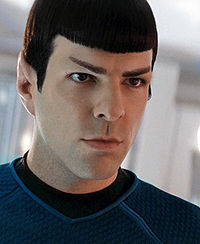 Spock's next appearance in the live action Star Trek franchise is the 2009 Star Trek film. In the film's prologue (set 19 years after the events of Unification, and as depicted in the graphic novel Star Trek: Countdown), Ambassador Spock (Nimoy) promises the Romulans he will use Vulcan technology to save them from a rogue supernova
that threatens to destroy their Empire. The mission is only partially successful, and in the aftermath Spock is pursued into the past
by Nero (Eric Bana
), a Romulan driven mad by the loss of his homeworld and family, setting into motion the events of the film.
In the film's opening act, Nero's ship emerges in the year 2233, and through its interaction with the inhabitants, inadvertently creates an "alternate, parallel 'Star Trek' universe". Stranded in the alternate past, the prime version
of Spock helps alternate
, younger versions of himself and Kirk (Zachary Quinto
and Chris Pine
, respectively) thwart Nero's attempt to destroy the Federation.
The film also features Jacob Kogan
in several scenes depicting Spock's childhood, including his abuse at the hands of other Vulcan children due to his half-Human heritage, and his relationship with his parents (Ben Cross
and Winona Ryder
). The film also depicts Kirk and Spock's initial clashes at Starfleet Academy, and the gradual development of their friendship based on shared mutual respect, what the elder Spock calls "... a friendship that will define [them] both in ways [they] cannot yet realize." A major change in characterization from the primary timeline is alternate Spock's involvement with alternate Uhura
(Zoe Saldana
), his former student. At the end of the film, the young Spock opts to remain in Starfleet, while his older self stays in the altered universe to aid the few surviving Vulcan refugees, as Nero had destroyed Vulcan, Spock's home planet.
's 1964 pitch for Star Trek, is described as "probably half Martian
, he has a slightly reddish complexion and semi-pointed ears". Early versions had the character ingest energy through a plate in his stomach. Writer Samuel A. Peeples
told Roddenberry these attributes made Spock too alien, and suggested "he should at least be half-human and have the problems of both sides", believing the human traits made the character more interesting and able to comment on the human condition more believably. Spock's home planet was changed because Roddenberry thought if the show was a success, humans might actually walk on Mars during the series' run.
Roddenberry sought an alien-sounding name when he created "Spock", and did not know until later of Dr. Benjamin Spock
, the famous pediatrician and author. In the initial, rejected pilot, "The Cage" (1964), Spock is greenish yellow and from the planet Vulcan. After DeForest Kelley
in 1964 stated his non-interest in playing the role, Roddenberry cast Nimoy because he knew him from a guest appearance in his pilot The Lieutenant
; after Roddenberry saw Nimoy's thin face and sharp features, no other actors were considered. Had Nimoy turned down the role, Roddenberry would have approached Martin Landau
.
The "pointy ears" worn by Nimoy while portraying Spock are a form of facial prosthesis
, mainly composed from molded and painted syntactic foam
. The foam was created by filling a ceramic
matrix with hollow particles called microballoons, which result in a low density prosthesis that is easily worn. However, the process of ungluing the ears was painful for Nimoy, and meant that he had to come in an hour and a half early before filming, and stay behind for a half hour each day after filming, to apply and remove the glued pieces. The pain and inconvenience were so great that when producer Robert H. Justman
jokingly proposed plastic surgery, Nimoy momentarily considered doing so. NBC
was concerned about Spock's satan
ic appearance, however, and asked for the character to be dropped; according to Oscar Katz, the network was worried "the 'guy with the ears' would scare the shit out of every kid in America". Publicity shots of the character were airbrush
ed so Spock had normal eyebrows and round ears. With Katz's help, Roddenberry was able to keep the character. Throughout the character's television and movie appearances, the shape of Spock's ears have varied, due in part to the different makeup artists applying them.
Spock did not originally have the logical manner which would become associated with the character, this instead being a trait of the character Number One
(Majel Barrett
). However, Number One was dropped in developing the second pilot, "Where No Man Has Gone Before
" (1966). This episode presents a more fully formed Spock, with his trademark logic. Nimoy liked the character's newly logical nature, observing the character is "struggling to maintain a Vulcan attitude, a Vulcan philosophical posture and a Vulcan logic, opposing what was fighting him internally, which was human emotion". Spock's behavior has been described as representing, in part, a type of normative judgment. Spock's Vulcan salute
references a sacred hand position used by the ancient Jewish priestly class. Desilu
vice president Herbert Solow believes Nimoy was the key contributor to the character's depiction. Nimoy recalled, "As a Jew
from Catholic Boston
, I understood what it was like to feel alienated, apart from the mainstream...There were a number of values in 'Star Trek' that I felt very comfortable with as a Jew".
compared to Janet Leigh
's early death in Psycho. Fan reaction to leaked news that Spock would be killed was overwhelmingly negative, and one fan paid for trade-paper advertisements urging Paramount to abandon the plan. Some fans even went so far as to issue death threats against Leonard Nimoy's family. According to Bennett:
By April 1981 a revised script was completed that moved the character's death into the movie's final act. Spock's death scene was shot over three days, during which no visitors were allowed on set.
Spock's death was intended to be irrevocable, but Nimoy had such a positive experience during filming that he asked if he could find a way for Spock to return in a later film. The scene showing Spock's mind meld with McCoy was filmed without actor DeForest Kelley
's prior knowledge of what was going on. Test audience reaction to Spock's death and the film's ending (the tone of which was dark and final) was poor, so Bennett made it more uplifting by adding the final scene revealing Spock's casket on the Genesis planet and Nimoy's closing "These are the voyages" monologue.
Director Nicholas Meyer
objected, but did not stand in the way of the changes, and even Nimoy did not know about the new scene until he viewed the film, but before the film opened, the media reassured worried fans that "Spock will live" again.
However, critical reaction to Spock's death was mixed at the time. Film critic Roger Ebert
lauded Spock's death: "He makes a choice in STAR TREK II that would be made only by a hero, a fool, or a Vulcan. And when he makes his decision, the movie rises to one of its best scenes, because the 'Star Trek' stories have always been best when they centered around their characters." On the other hand, The Washington Posts Gary Arnold stated Spock's death "feels like an unnecessary twist, and the filmmakers are obviously well-prepared to fudge in case the public demands another sequel."
A quarter of a century later, Spock's death in The Wrath of Khan ranks number 2 on Total Film
's list of 25 greatest Star Trek movie moments, and number 1 on IGN Movie's
top 10 Star Trek movie moments.
. Quinto mentioned he heard about the new film and revealed his interest in the role in a December 2006 interview with the Pittsburgh Post-Gazette
. The article was widely circulated and he attracted Abrams' interest. Quinto expressed interest in the role because of the duality of Spock's half-human, half Vulcan
heritage, and how the character "is constantly exploring that notion of how to evolve in a responsible way and how to evolve in a respectful way. I think those are all things that we as a society, and certainly the world, could implement." Nimoy subsequently befriended Quinto. Although Quinto watched some episodes of the show during breaks in filming, Nimoy was his main resource in playing Spock.
, and teenagers asked questions about current events such as the Vietnam War
and LSD
as if he were the Vulcan scientist. A fan even asked the actor to lay his hands
on a friend's eyes to heal them
. Nimoy recalled, more than a decade after the show's cancellation:
NASA made Spock an informal mascot of the space agency. Nimoy was invited to be guest of honor at the March 1967 National Space Club dinner, and to take an extensive tour of the Goddard Space Flight Center
in Greenbelt, MD. The actor concluded from the warm and intense reception he received that astronauts like John Glenn
and aerospace industry engineers, secretaries, and shareholders alike all regarded Star Trek, and especially the character of Spock, as a "dramatization of the future of their space program".
UGO named Spock one of the 50 greatest TV characters. According to Shatner, much of Star Treks acting praise and media interest went to Nimoy.
described Quinto's performance in the 2009 film as "something special", and that Nimoy's appearance "carries much more emotion than you'd expect". Slate.com said Quinto played Spock "with a few degrees more chill" than Nimoy brought to the original character. Entertainment Weekly
said that Quinto "... invests Spock with a new layer of chilly-smoldering sex appeal, [and] Quinto does a fantastic job of maintaining Spock's calm, no-sweat surface but getting quietly hot and bothered underneath."
's 1976 Solo Keyboard Album features two tracks which pay homage to Spock: "Spock Gets Funky" and "Vulcan Mind Probe". Rock guitarist Paul Gilbert
wrote the song "Mr. Spock" on his Space Ship One
album. Swedish synthpop
band S.P.O.C.K
makes music heavily influenced by the Star Trek universe. Even Nimoy got in on the act; assuming the Spock character, Nimoy recorded a number of novelty songs, the first being "Highly Illogical
", in which Spock pointed out the foibles of human thought, such as relationships, automobiles, and greed. The second song, "A Visit to a Sad Planet", was darker in tone and told the story of Spock visiting Earth in the future and discovering it had been ruined by war, violence, and environmental irresponsibility. According to comic book writer and editor Bob Budiansky
, The Transformers
character Shockwave
was inspired by Spock. Spock's utilitarian
perspective that "the needs of the many outweigh the needs of the few" is cited in a legal decision rendered by the Texas Supreme Court
.
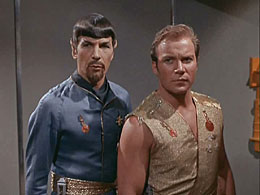 Spock's physical appearance in the Original Series episode "Mirror, Mirror" (1967) has itself spawned a trope of the "evil twin" archetype found in various fictional genres. In that episode, several members of the Enterprise travel to a parallel universe inhabited by evil versions of themselves. The parallel universe version of Spock is distinguished physically by his goatee
. Examples of the evil goatee's appearances include: the South Park
Halloween episode "Spookyfish
," where "mirror Cartman
", who sports a goatee, is actually much more of a "good" character than the beardless, loathsome "regular" Cartman; in Futurama
where the goatee is referenced by Bender's 'evil twin' Flexo, who is constantly accused of being the bad Bender because of his goatee; and a 2009 episode of The Colbert Report featuring Stephen Colbert
and congressman Dan Maffei
(a Star Trek fan) wearing fake goatees and pretending to be evil versions of themselves. The name of progressive rock band Spock's Beard
is a direct reference to Spock's goatee in this episode.
After the release of the 2009 Star Trek film, Spock was compared with U.S. President Barack Obama by several media outlets. Maureen Dowd
noted "Mr. Obama has a bit of Mr. Spock in him (and not just the funny ears). He has a Vulcan-like logic and detachment." Newsweek
s Steve Daly said "Spock's cool, analytical nature feels more fascinating and topical than ever now that we've put a sort of Vulcan in the White House," and noted the similarity between Spock and President Obama both being the product of mixed-race marriages
. Obama was apparently nicknamed "Spock" by British officials at the Foreign and Commonwealth Office
: "Almost everyone felt a little unloved by Obama. Not for nothing was his nickname 'Spock'".
Spock was portrayed by Jeffrey Quinn for the first three episodes of Star Trek: Phase II. Brandon Stacy, who succeeded Jeffrey Quinn and Ben Tolpin in portraying Spock, also served as a stand-in for Zachary Quinto
in the 2009 Star Trek film.
Star Trek
Star Trek is an American science fiction entertainment franchise created by Gene Roddenberry. The core of Star Trek is its six television series: The Original Series, The Animated Series, The Next Generation, Deep Space Nine, Voyager, and Enterprise...
media franchise. First portrayed by Leonard Nimoy
Leonard Nimoy
Leonard Simon Nimoy is an American actor, film director, poet, musician and photographer. Nimoy's most famous role is that of Spock in the original Star Trek series , multiple films, television and video game sequels....
in the original Star Trek series
Star Trek: The Original Series
Star Trek is an American science fiction television series created by Gene Roddenberry, produced by Desilu Productions . Star Trek was telecast on NBC from September 8, 1966, through June 3, 1969...
, Spock also appears in the animated Star Trek series
Star Trek: The Animated Series
Star Trek: The Animated Series is an animated science fiction television series set in the Star Trek universe following the events of Star Trek: The Original Series of the 1960s...
, two episodes of Star Trek: The Next Generation
Star Trek: The Next Generation
Star Trek: The Next Generation is an American science fiction television series created by Gene Roddenberry as part of the Star Trek franchise. Roddenberry, Rick Berman, and Michael Piller served as executive producers at different times throughout the production...
, seven of the Star Trek feature films, and numerous Star Trek books, comics, and video games. In the 2009 film Star Trek, Nimoy reprised his role alongside Zachary Quinto
Zachary Quinto
Zachary John Quinto is an American actor and producer. Quinto grew up in Pennsylvania and was active in high school musical theater. In the early 2000s he guest starred in television series and appeared in a recurring role in the serial drama 24 from 2003 to 2004...
, who played a younger, alternate-timeline version of the character and Jacob Kogan
Jacob Kogan
Jacob Kogan is an American actor. He is best known for playing the title role in the 2007 psychological thriller Joshua and Spock as a child in J.J. Abrams' Star Trek....
playing Spock as a child.
Spock serves aboard the starship Enterprise
Starship Enterprise
The Enterprise or USS Enterprise is the name of several fictional starships, some of which are the focal point for various television series and films in the Star Trek franchise created by Gene Roddenberry. It is considered a name of legacy in the fleet...
, serving as science officer and first officer, and later as commanding officer of two iterations of the vessel. Spock's mixed human
Human (Star Trek)
In the Star Trek science fiction universe, Humans/Terrans are one of the races undertaking interstellar travel. Human beings were instrumental in the founding of the United Federation of Planets...
-Vulcan
Vulcan (Star Trek)
Vulcans, or sometimes Vulcanians, are an extraterrestrial humanoid species in the Star Trek universe who evolved on the planet Vulcan, and are noted for their attempt to live by reason and logic with no interference from emotion. They were the first extraterrestrial species in the Star Trek...
heritage serves as an important plot element in many of the character's appearances. Along with James T. Kirk
James T. Kirk
James Tiberius "Jim" Kirk is a character in the Star Trek media franchise. Kirk was first played by William Shatner as the principal lead character in the original Star Trek series. Shatner voiced Kirk in the animated Star Trek series and appeared in the first seven Star Trek movies...
and Leonard McCoy
Leonard McCoy
Leonard "Bones" McCoy is a character in the Star Trek media franchise. First portrayed by DeForest Kelley in the original Star Trek series, McCoy also appears in the animated Star Trek series, seven Star Trek movies, the pilot episode of Star Trek: The Next Generation, and in numerous books,...
, he is one of the three central characters in the original Star Trek series and its films. After retiring from Starfleet
Starfleet
In the fictional universe of Star Trek, Starfleet or the Federation Starfleet is the deep-space exploratory, peacekeeping and military service maintained by the United Federation of Planets . It is the principal means by which the Federation conducts its exploration, defense, diplomacy and research...
, Spock serves as a Federation
United Federation of Planets
The United Federation of Planets, also known as "The Federation" is a fictional interplanetary federal republic depicted in the Star Trek television series and motion pictures...
ambassador, contributing toward the détente
Détente
Détente is the easing of strained relations, especially in a political situation. The term is often used in reference to the general easing of relations between the Soviet Union and the United States in the 1970s, a thawing at a period roughly in the middle of the Cold War...
between the Federation and the Klingon Empire. In his later years, he serves as Federation ambassador to the Romulan Empire and becomes involved in the ill-fated attempt to save Romulus from a supernova
Supernova
A supernova is a stellar explosion that is more energetic than a nova. It is pronounced with the plural supernovae or supernovas. Supernovae are extremely luminous and cause a burst of radiation that often briefly outshines an entire galaxy, before fading from view over several weeks or months...
.
Original series television and films
The character was initially depicted as the USS EnterpriseUSS Enterprise (NCC-1701)
The USS Enterprise, NCC-1701, is a fictional starship in the Star Trek media franchise. The original Star Trek series depicts her crew's mission "to explore strange new worlds; to seek out new life and new civilizations; to boldly go where no man has gone before" under the command of Captain James...
's science officer for the original pilot, "The Cage" (1964). Although "The Cage" did not air, Spock's eleven years of service under the command of Captain Christopher Pike
Christopher Pike (Star Trek)
Christopher Pike is a character in the Star Trek franchise. He was portrayed by Jeffrey Hunter in the original Star Trek pilot episode, "The Cage", as captain of the USS Enterprise. The pilot was rejected, and the character was dropped during development of the second pilot when Hunter decided that...
are referenced and depicted in "The Menagerie" (1966) and other episodes. The character's first broadcast appearance is in "The Man Trap" (1966), which introduces him as the ship's science officer and first officer under Captain James T. Kirk
James T. Kirk
James Tiberius "Jim" Kirk is a character in the Star Trek media franchise. Kirk was first played by William Shatner as the principal lead character in the original Star Trek series. Shatner voiced Kirk in the animated Star Trek series and appeared in the first seven Star Trek movies...
(William Shatner
William Shatner
William Alan Shatner is a Canadian actor, musician, recording artist, and author. He gained worldwide fame and became a cultural icon for his portrayal of James T...
). Star Trek depicts a "troika" of Spock, Kirk, and Doctor Leonard McCoy
Leonard McCoy
Leonard "Bones" McCoy is a character in the Star Trek media franchise. First portrayed by DeForest Kelley in the original Star Trek series, McCoy also appears in the animated Star Trek series, seven Star Trek movies, the pilot episode of Star Trek: The Next Generation, and in numerous books,...
(DeForest Kelley
DeForest Kelley
Jackson DeForest Kelley was an American actor known for his iconic roles in Westerns and as Dr. Leonard "Bones" McCoy of the USS Enterprise in the television and film series Star Trek.-Early life:...
); while McCoy often acts as Kirk's conscience, Spock offers the captain an emotionally detached, logical perspective. The character also offers an "outsider's" perspective on "the human condition".
Star Trek also presents elements of Spock's upbringing and family. "Journey to Babel" (1967) depicts his parents: Sarek
Sarek
Sarek is a fictional character in the Star Trek media franchise. He is a Vulcan astrophysicist, the Vulcan ambassador to the United Federation of Planets, and father of Spock...
(Mark Lenard
Mark Lenard
Mark Lenard was an American actor, primarily in television.-Biography:Lenard was born Leonard Rosenson in Chicago, Illinois, the son of a Russian Jewish immigrant, Abraham, and his wife, Bessie...
), the Vulcan
Vulcan (Star Trek)
Vulcans, or sometimes Vulcanians, are an extraterrestrial humanoid species in the Star Trek universe who evolved on the planet Vulcan, and are noted for their attempt to live by reason and logic with no interference from emotion. They were the first extraterrestrial species in the Star Trek...
ambassador to the Federation
United Federation of Planets
The United Federation of Planets, also known as "The Federation" is a fictional interplanetary federal republic depicted in the Star Trek television series and motion pictures...
, and Amanda Grayson (Jane Wyatt
Jane Wyatt
Jane Waddington Wyatt was an American actress perhaps best known for her role as the housewife and mother on the television comedy Father Knows Best, and as Amanda Grayson, the human mother of Spock on the science fiction television series Star Trek...
), a human. Spock's decision to join Starfleet
Starfleet
In the fictional universe of Star Trek, Starfleet or the Federation Starfleet is the deep-space exploratory, peacekeeping and military service maintained by the United Federation of Planets . It is the principal means by which the Federation conducts its exploration, defense, diplomacy and research...
, rather than attend the Vulcan Science Academy, ran contrary to his father's wishes. The relationship between Spock and Sarek is strained and often turbulent, although rooted in an underlying respect and carefully restrained love for each other. The 1973 animated series
Star Trek: The Animated Series
Star Trek: The Animated Series is an animated science fiction television series set in the Star Trek universe following the events of Star Trek: The Original Series of the 1960s...
episode "Yesteryear" shows seven-year-old Spock choosing to pursue a Vulcan lifestyle devoted to logic and suppressing emotion.
At the beginning of Star Trek: The Motion Picture
Star Trek: The Motion Picture
Star Trek: The Motion Picture is a 1979 American science fiction film released by Paramount Pictures. It is the first film based on the Star Trek television series. The film is set in the twenty-third century, when a mysterious and immensely powerful alien cloud called V'Ger approaches the Earth,...
(1979), Spock is no longer in Starfleet, having resigned and returned home to pursue the Vulcan discipline of Kolinahr. Spock is unable to complete the Kolinahr ritual after he senses the coming of V'ger, and rejoins Starfleet to aid the Enterprise crew in their mission. Spock, promoted to captain, is commanding officer of the Enterprise at the beginning of Star Trek II: The Wrath of Khan
Star Trek II: The Wrath of Khan
Star Trek II: The Wrath of Khan is a 1982 American science fiction film released by Paramount Pictures. The film is the second feature based on the Star Trek science fiction franchise. The plot features James T...
(1982). At the film's end, he transfers his "katra" - the sum of his memories and experience - to McCoy, and then sacrifices himself to save the ship and its crew from Khan Noonien Singh
Khan Noonien Singh
Khan Noonien Singh, commonly shortened to Khan, is a villain in the fictional Star Trek universe. According to backstory given in the character's first appearance, the Star Trek: The Original Series episode "Space Seed" , Khan is a genetically engineered superhuman tyrant who once controlled more...
(Ricardo Montalbán
Ricardo Montalbán
Ricardo Gonzalo Pedro Montalbán y Merino, KSG was a Mexican radio, television, theatre and film actor. He had a career spanning six decades and many notable roles...
). The sequel, Star Trek III: The Search for Spock
Star Trek III: The Search for Spock
Star Trek III: The Search for Spock is a 1984 motion picture released by Paramount Pictures. The film is the third feature based on the Star Trek science fiction franchise and is the center of a three-film story arc that begins with Star Trek II: The Wrath of Khan and concludes with Star Trek IV:...
(1984), focuses on his crewmates' quest to recover Spock's body, resurrected by the Genesis matrix in the previous film. At the film's conclusion, Spock's revived body is reunited with his katra. Spock is next seen in Star Trek IV: The Voyage Home
Star Trek IV: The Voyage Home
Star Trek IV: The Voyage Home is a 1986 American science fiction film released by Paramount Pictures. It is the fourth feature film based on the Star Trek science fiction television series and completes the story arc begun in Star Trek II: The Wrath of Khan and continued in Star Trek III: The...
(1986), which depicts his recovery from the after-effects of his resurrection. In the film's final scene, he joins the crew of the newly commissioned USS Enterprise-A
USS Enterprise (NCC-1701-A)
The USS Enterprise, NCC-1701-A is a starship in the fourth, fifth, and sixth Star Trek films.-Origin and design:The Enterprise-A used the same shooting model as the preceding NCC-1701...
under Kirk's command. In Star Trek V: The Final Frontier
Star Trek V: The Final Frontier
Star Trek V: The Final Frontier is a 1989 American science fiction film released by Paramount Pictures. It is the fifth feature in the franchise and the penultimate to star the cast of the original Star Trek science fiction television series...
(1989), Spock and the Enterprise crew confront the renegade Sybok, Spock's half-brother. Star Trek VI: The Undiscovered Country
Star Trek VI: The Undiscovered Country
Star Trek VI: The Undiscovered Country is the sixth feature film in the Star Trek science fiction franchise and is the last of the Star Trek films to include the entire main cast of the 1960s Star Trek television series. Released in 1991 by Paramount Pictures, it was directed by Nicholas Meyer and...
(1991) reunites the Enterprise crew on a mission to prevent war from erupting between the Federation and Klingon Empire. Spock serves as a special envoy to broker peace with the Klingons after a natural disaster devastates their homeworld.
Star Trek: The Next Generation
Spock appears in "Unification" (1991), a two-part episode of Star Trek: The Next GenerationStar Trek: The Next Generation
Star Trek: The Next Generation is an American science fiction television series created by Gene Roddenberry as part of the Star Trek franchise. Roddenberry, Rick Berman, and Michael Piller served as executive producers at different times throughout the production...
. Set 75 years after the events of The Undiscovered Country, the episode focuses on Federation Ambassador Spock's attempt to reunite the Romulan
Romulan
The Romulans are a fictional alien race in the Star Trek universe. First appearing in the original Star Trek series in the 1966 episode "Balance of Terror", they have since made appearances in all the main later Star Trek series: The Animated Series, The Next Generation, Deep Space Nine, Voyager...
s with their Vulcan brethren. Filming of The Undiscovered Country overlapped with production of this episode, and the episode references Spock's role in the film.
Star Trek (2009)
Supernova
A supernova is a stellar explosion that is more energetic than a nova. It is pronounced with the plural supernovae or supernovas. Supernovae are extremely luminous and cause a burst of radiation that often briefly outshines an entire galaxy, before fading from view over several weeks or months...
that threatens to destroy their Empire. The mission is only partially successful, and in the aftermath Spock is pursued into the past
Timeline of Star Trek
Below is an abridged timeline of events established in the group of television shows and feature films set in the Star Trek universe. Many dates are estimates as the various shows and films are not consistent in their use of dates...
by Nero (Eric Bana
Eric Bana
Eric Bana is an Australian film and television actor. He began his career as a comedian in the sketch comedy series Full Frontal before gaining critical recognition in the biopic Chopper...
), a Romulan driven mad by the loss of his homeworld and family, setting into motion the events of the film.
In the film's opening act, Nero's ship emerges in the year 2233, and through its interaction with the inhabitants, inadvertently creates an "alternate, parallel 'Star Trek' universe". Stranded in the alternate past, the prime version
Earth Prime
Earth Prime is a term sometimes used in works of speculative fiction involving parallel universes or a multiverse, and refers either to the universe containing "our" Earth, or to a parallel world with a bare minimum of divergence points from Earth as we know it...
of Spock helps alternate
Parallel universe (fiction)
A parallel universe or alternative reality is a hypothetical self-contained separate reality coexisting with one's own. A specific group of parallel universes is called a "multiverse", although this term can also be used to describe the possible parallel universes that constitute reality...
, younger versions of himself and Kirk (Zachary Quinto
Zachary Quinto
Zachary John Quinto is an American actor and producer. Quinto grew up in Pennsylvania and was active in high school musical theater. In the early 2000s he guest starred in television series and appeared in a recurring role in the serial drama 24 from 2003 to 2004...
and Chris Pine
Chris Pine
Christopher Whitelaw "Chris" Pine is an American actor. He has appeared in the romantic comedies The Princess Diaries 2: Royal Engagement and Just My Luck , as well as the action films Smokin' Aces and Unstoppable . In 2009, he portrayed James T...
, respectively) thwart Nero's attempt to destroy the Federation.
The film also features Jacob Kogan
Jacob Kogan
Jacob Kogan is an American actor. He is best known for playing the title role in the 2007 psychological thriller Joshua and Spock as a child in J.J. Abrams' Star Trek....
in several scenes depicting Spock's childhood, including his abuse at the hands of other Vulcan children due to his half-Human heritage, and his relationship with his parents (Ben Cross
Ben Cross
Ben Cross is a British actor of the stage and screen, best known for his portrayal of the British Olympic athlete Harold Abrahams in the 1981 movie Chariots of Fire.-Early life:...
and Winona Ryder
Winona Ryder
Winona Ryder is an American actress. She made her film debut in the 1986 film Lucas. Ryder's first significant role came in Tim Burton's Beetlejuice as a goth teenager, which won her critical and commercial recognition...
). The film also depicts Kirk and Spock's initial clashes at Starfleet Academy, and the gradual development of their friendship based on shared mutual respect, what the elder Spock calls "... a friendship that will define [them] both in ways [they] cannot yet realize." A major change in characterization from the primary timeline is alternate Spock's involvement with alternate Uhura
Uhura
Nyota Uhura is a character in Star Trek: The Original Series, Star Trek: The Animated Series, the first six Star Trek films, and the 2009 film Star Trek...
(Zoe Saldana
Zoe Saldana
Zoe Saldana , sometimes stylized Zoë Saldaña, is an American actress. She had her breakthrough role in the 2000 film Center Stage and later gained prominence for her roles as Anamaria in Pirates of the Caribbean: The Curse of the Black Pearl and Uhura in the 2009 film Star Trek, and a starring role...
), his former student. At the end of the film, the young Spock opts to remain in Starfleet, while his older self stays in the altered universe to aid the few surviving Vulcan refugees, as Nero had destroyed Vulcan, Spock's home planet.
Development
Spock, as originally described in Gene RoddenberryGene Roddenberry
Eugene Wesley "Gene" Roddenberry was an American television screenwriter, producer and futurist, best known for creating the American science fiction series Star Trek. Born in El Paso, Texas, Roddenberry grew up in Los Angeles, California where his father worked as a police officer...
's 1964 pitch for Star Trek, is described as "probably half Martian
Martian
As an adjective, the term martian is used to describe anything pertaining to the planet Mars.However, a Martian is more usually a hypothetical or fictional native inhabitant of the planet Mars. Historically, life on Mars has often been hypothesized, although there is currently no solid evidence of...
, he has a slightly reddish complexion and semi-pointed ears". Early versions had the character ingest energy through a plate in his stomach. Writer Samuel A. Peeples
Samuel A. Peeples
Samuel Anthony Peeples was an American writer. He published several novels in the Western genre, often under the pen name Brad Ward, before moving into series television after being given a script assignment by Frank Gruber...
told Roddenberry these attributes made Spock too alien, and suggested "he should at least be half-human and have the problems of both sides", believing the human traits made the character more interesting and able to comment on the human condition more believably. Spock's home planet was changed because Roddenberry thought if the show was a success, humans might actually walk on Mars during the series' run.
Roddenberry sought an alien-sounding name when he created "Spock", and did not know until later of Dr. Benjamin Spock
Benjamin Spock
Benjamin McLane Spock was an American pediatrician whose book Baby and Child Care, published in 1946, is one of the biggest best-sellers of all time. Its message to mothers is that "you know more than you think you do."Spock was the first pediatrician to study psychoanalysis to try to understand...
, the famous pediatrician and author. In the initial, rejected pilot, "The Cage" (1964), Spock is greenish yellow and from the planet Vulcan. After DeForest Kelley
DeForest Kelley
Jackson DeForest Kelley was an American actor known for his iconic roles in Westerns and as Dr. Leonard "Bones" McCoy of the USS Enterprise in the television and film series Star Trek.-Early life:...
in 1964 stated his non-interest in playing the role, Roddenberry cast Nimoy because he knew him from a guest appearance in his pilot The Lieutenant
The Lieutenant
The Lieutenant is an American television series, the first created by Gene Roddenberry. It aired on NBC on Saturday evenings in the 1963-1964 television schedule. It was produced by Arena Productions, one of Metro-Goldwyn-Mayer's most successful in-house production companies of the 1960s. Situated...
; after Roddenberry saw Nimoy's thin face and sharp features, no other actors were considered. Had Nimoy turned down the role, Roddenberry would have approached Martin Landau
Martin Landau
Martin Landau is an American film and television actor. Landau began his career in the 1950s. His early films include a supporting role in Alfred Hitchcock's North by Northwest . He played continuing roles in the television series Mission: Impossible and Space:1999...
.
The "pointy ears" worn by Nimoy while portraying Spock are a form of facial prosthesis
Facial prosthetic
A facial prosthetic or facial prosthesis is an artificial device used to change or adapt the outward appearance of a person's face or head....
, mainly composed from molded and painted syntactic foam
Syntactic foam
Syntactic foams are composite materials synthesized by filling a metal, polymer or ceramic matrix with hollow particles called microballoons, "syntactic" meaning "put together"...
. The foam was created by filling a ceramic
Ceramic
A ceramic is an inorganic, nonmetallic solid prepared by the action of heat and subsequent cooling. Ceramic materials may have a crystalline or partly crystalline structure, or may be amorphous...
matrix with hollow particles called microballoons, which result in a low density prosthesis that is easily worn. However, the process of ungluing the ears was painful for Nimoy, and meant that he had to come in an hour and a half early before filming, and stay behind for a half hour each day after filming, to apply and remove the glued pieces. The pain and inconvenience were so great that when producer Robert H. Justman
Robert H. Justman
Robert Harris "Bob" Justman was an American television producer, director and production manager. He worked on many television series including Lassie, The Life of Riley, Adventures of Superman, The Outer Limits, Then Came Bronson and Mission: Impossible.- Career :Bob Justman was one of the...
jokingly proposed plastic surgery, Nimoy momentarily considered doing so. NBC
NBC
The National Broadcasting Company is an American commercial broadcasting television network and former radio network headquartered in the GE Building in New York City's Rockefeller Center with additional major offices near Los Angeles and in Chicago...
was concerned about Spock's satan
Satan
Satan , "the opposer", is the title of various entities, both human and divine, who challenge the faith of humans in the Hebrew Bible...
ic appearance, however, and asked for the character to be dropped; according to Oscar Katz, the network was worried "the 'guy with the ears' would scare the shit out of every kid in America". Publicity shots of the character were airbrush
Airbrush
An airbrush is a small, air-operated tool that sprays various media including ink and dye, but most often paint by a process of nebulization. Spray guns developed from the airbrush and are still considered a type of airbrush.-History:...
ed so Spock had normal eyebrows and round ears. With Katz's help, Roddenberry was able to keep the character. Throughout the character's television and movie appearances, the shape of Spock's ears have varied, due in part to the different makeup artists applying them.
Spock did not originally have the logical manner which would become associated with the character, this instead being a trait of the character Number One
Number One (Star Trek)
Number One, in "The Cage", the original pilot episode of the science fiction television series Star Trek, was the un-named intellectual, problem-solving second-in-command serving under Captain Christopher Pike. She performs the same role for Pike "as Spock later does for Kirk"...
(Majel Barrett
Majel Barrett
Majel Barrett-Roddenberry was an American actress and producer. She is perhaps best known for her role as Nurse Christine Chapel in the original Star Trek series, Lwaxana Troi on Star Trek: The Next Generation, and for being the voice of most onboard computer interfaces throughout the series...
). However, Number One was dropped in developing the second pilot, "Where No Man Has Gone Before
Where No Man Has Gone Before
"Where No Man Has Gone Before" is the second pilot episode of the television series Star Trek: The Original Series. It was produced in 1965 after the first pilot, "The Cage", had been rejected by NBC. The episode was eventually broadcast third in sequence on September 22, 1966, and was re-aired on...
" (1966). This episode presents a more fully formed Spock, with his trademark logic. Nimoy liked the character's newly logical nature, observing the character is "struggling to maintain a Vulcan attitude, a Vulcan philosophical posture and a Vulcan logic, opposing what was fighting him internally, which was human emotion". Spock's behavior has been described as representing, in part, a type of normative judgment. Spock's Vulcan salute
Vulcan salute
The Vulcan salute is a hand gesture consisting of a raised hand, palm forward with the fingers parted between the middle and ring finger, and the thumb extended. Often, the famous line, "Live long and prosper", is said after it. The salute was devised and popularised by Leonard Nimoy, who...
references a sacred hand position used by the ancient Jewish priestly class. Desilu
Desilu Productions
Desilu Productions was a Los Angeles, California-based company jointly owned by actors Desi Arnaz and Lucille Ball, who were married to each other from 1940 to 1960....
vice president Herbert Solow believes Nimoy was the key contributor to the character's depiction. Nimoy recalled, "As a Jew
American Jews
American Jews, also known as Jewish Americans, are American citizens of the Jewish faith or Jewish ethnicity. The Jewish community in the United States is composed predominantly of Ashkenazi Jews who emigrated from Central and Eastern Europe, and their U.S.-born descendants...
from Catholic Boston
Roman Catholic Archdiocese of Boston
The Roman Catholic Archdiocese of Boston is an ecclesiastical territory or diocese of the Roman Catholic Church in the New England region of the United States. It comprises several counties of the state of Massachusetts...
, I understood what it was like to feel alienated, apart from the mainstream...There were a number of values in 'Star Trek' that I felt very comfortable with as a Jew".
Death in The Wrath of Khan
Nimoy had not intended to join the cast of Star Trek II: The Wrath of Khan, but was enticed back with the promise that his character would be given a dramatic death scene. Nimoy reasoned that since The Wrath of Khan would be the final Star Trek film, having Spock "go out in a blaze of glory" seemed like a good way to end the character. In an earlier draft of the script, Spock had died in the first act in a shocking demise that the movie's producer Harve BennettHarve Bennett
Harve Bennett is an American television and film producer and screenwriter.-Early years:...
compared to Janet Leigh
Janet Leigh
Janet Leigh , born Jeanette Helen Morrison, was an American actress. She was the wife of actor Tony Curtis from June 1951 to September 1962 and the mother of Kelly Curtis and Jamie Lee Curtis....
's early death in Psycho. Fan reaction to leaked news that Spock would be killed was overwhelmingly negative, and one fan paid for trade-paper advertisements urging Paramount to abandon the plan. Some fans even went so far as to issue death threats against Leonard Nimoy's family. According to Bennett:
For some reason fans got the impression that he [Nimoy] wanted Spock dead. He'd written a book "I Am Not Spock," and that gave people the idea. Anyway, when a fringe group of Trekkies learned that we were going to kill the Spock character, it was like we'd taken a child of theirs onto the Brooklyn Bridge with the intention of throwing it off. And their reaction was, "let's get Leonard."
By April 1981 a revised script was completed that moved the character's death into the movie's final act. Spock's death scene was shot over three days, during which no visitors were allowed on set.
Spock's death was intended to be irrevocable, but Nimoy had such a positive experience during filming that he asked if he could find a way for Spock to return in a later film. The scene showing Spock's mind meld with McCoy was filmed without actor DeForest Kelley
DeForest Kelley
Jackson DeForest Kelley was an American actor known for his iconic roles in Westerns and as Dr. Leonard "Bones" McCoy of the USS Enterprise in the television and film series Star Trek.-Early life:...
's prior knowledge of what was going on. Test audience reaction to Spock's death and the film's ending (the tone of which was dark and final) was poor, so Bennett made it more uplifting by adding the final scene revealing Spock's casket on the Genesis planet and Nimoy's closing "These are the voyages" monologue.
Director Nicholas Meyer
Nicholas Meyer
Nicholas Meyer is an American screenwriter, producer, director and novelist, known best for his best-selling novel The Seven-Per-Cent Solution, and for directing the films Time After Time, two of the Star Trek feature film series, and the 1983 television movie The Day After.Meyer graduated from...
objected, but did not stand in the way of the changes, and even Nimoy did not know about the new scene until he viewed the film, but before the film opened, the media reassured worried fans that "Spock will live" again.
Reaction to Spock's death
The Wrath of Khan had its first public screening at a science-fiction convention in Overland Park, KS on May 8, 1982, almost a month prior to general release. Although Paramount executives were concerned that Spock's death would set the fanbase against the movie, the audience actually applauded following Spock's final death scene. "It was sensational. I hate to be given to superlatives but it absolutely reached everything we wanted it to. I couldn't ask for anything better," said Co-producer Robert Sallin of the audience's reaction at the advance screening.However, critical reaction to Spock's death was mixed at the time. Film critic Roger Ebert
Roger Ebert
Roger Joseph Ebert is an American film critic and screenwriter. He is the first film critic to win a Pulitzer Prize for Criticism.Ebert is known for his film review column and for the television programs Sneak Previews, At the Movies with Gene Siskel and Roger Ebert, and Siskel and Ebert and The...
lauded Spock's death: "He makes a choice in STAR TREK II that would be made only by a hero, a fool, or a Vulcan. And when he makes his decision, the movie rises to one of its best scenes, because the 'Star Trek' stories have always been best when they centered around their characters." On the other hand, The Washington Posts Gary Arnold stated Spock's death "feels like an unnecessary twist, and the filmmakers are obviously well-prepared to fudge in case the public demands another sequel."
A quarter of a century later, Spock's death in The Wrath of Khan ranks number 2 on Total Film
Total Film
Total Film is a British film magazine published 13 times a year by Future Publishing. The magazine was launched in 1997 and offers film, DVD and Blu-ray news, reviews and features...
's list of 25 greatest Star Trek movie moments, and number 1 on IGN Movie's
IGN
IGN is an entertainment website that focuses on video games, films, music and other media. IGN's main website comprises several specialty sites or "channels", each occupying a subdomain and covering a specific area of entertainment...
top 10 Star Trek movie moments.
Recasting
Zachary Quinto was cast in the role of a young alternate-timeline Spock for the 2009 Star Trek film, directed by J. J. AbramsJ. J. Abrams
Jeffrey Jacob "J. J." Abrams is an American film and television producer, screenwriter, director, actor, and composer. He wrote and produced feature films before co-creating the television series Felicity...
. Quinto mentioned he heard about the new film and revealed his interest in the role in a December 2006 interview with the Pittsburgh Post-Gazette
Pittsburgh Post-Gazette
The Pittsburgh Post-Gazette, also known simply as the "PG," is the largest daily newspaper serving metropolitan Pittsburgh, Pennsylvania, USA.-Early history:...
. The article was widely circulated and he attracted Abrams' interest. Quinto expressed interest in the role because of the duality of Spock's half-human, half Vulcan
Vulcan (Star Trek)
Vulcans, or sometimes Vulcanians, are an extraterrestrial humanoid species in the Star Trek universe who evolved on the planet Vulcan, and are noted for their attempt to live by reason and logic with no interference from emotion. They were the first extraterrestrial species in the Star Trek...
heritage, and how the character "is constantly exploring that notion of how to evolve in a responsible way and how to evolve in a respectful way. I think those are all things that we as a society, and certainly the world, could implement." Nimoy subsequently befriended Quinto. Although Quinto watched some episodes of the show during breaks in filming, Nimoy was his main resource in playing Spock.
Reception
From early on, the public's reaction to Spock was strongly positive, even fanatical. Headshots of Spock became popular fan souvenirs, with the rare ones of the actor laughing the most valuable. To Nimoy's great surprise Spock became a sex symbolSex symbol
A sex symbol is a celebrity of either gender, typically an actor, musician, supermodel, teen idol, or sports star, noted for their sex appeal. The term was first used in the mid 1950s in relation to the popularity of certain Hollywood stars, especially Marilyn Monroe and Brigitte...
, and teenagers asked questions about current events such as the Vietnam War
Vietnam War
The Vietnam War was a Cold War-era military conflict that occurred in Vietnam, Laos, and Cambodia from 1 November 1955 to the fall of Saigon on 30 April 1975. This war followed the First Indochina War and was fought between North Vietnam, supported by its communist allies, and the government of...
and LSD
LSD
Lysergic acid diethylamide, abbreviated LSD or LSD-25, also known as lysergide and colloquially as acid, is a semisynthetic psychedelic drug of the ergoline family, well known for its psychological effects which can include altered thinking processes, closed and open eye visuals, synaesthesia, an...
as if he were the Vulcan scientist. A fan even asked the actor to lay his hands
Laying on of hands
The laying on of hands is a religious ritual that accompanies certain religious practices, which are found throughout the world in varying forms....
on a friend's eyes to heal them
Faith healing
Faith healing is healing through spiritual means. The healing of a person is brought about by religious faith through prayer and/or rituals that, according to adherents, stimulate a divine presence and power toward correcting disease and disability. Belief in divine intervention in illness or...
. Nimoy recalled, more than a decade after the show's cancellation:
The "Star Trek" phenomenon continues to amaze and confound me. It was incredible, and it still is, although it is gentler now than it used to be. For a time, it was hysterical - it was so wild I had to be very careful where I went. If I went to a restaurant, I had to plan my entrances and my exits so I wouldn't be mobbed and hurt. Same thing in hotels and airports - any public place. It isn't that hysterical any more, but it is still a potent force.
NASA made Spock an informal mascot of the space agency. Nimoy was invited to be guest of honor at the March 1967 National Space Club dinner, and to take an extensive tour of the Goddard Space Flight Center
Goddard Space Flight Center
The Goddard Space Flight Center is a major NASA space research laboratory established on May 1, 1959 as NASA's first space flight center. GSFC employs approximately 10,000 civil servants and contractors, and is located approximately northeast of Washington, D.C. in Greenbelt, Maryland, USA. GSFC,...
in Greenbelt, MD. The actor concluded from the warm and intense reception he received that astronauts like John Glenn
John Glenn
John Herschel Glenn, Jr. is a former United States Marine Corps pilot, astronaut, and United States senator who was the first American to orbit the Earth and the third American in space. Glenn was a Marine Corps fighter pilot before joining NASA's Mercury program as a member of NASA's original...
and aerospace industry engineers, secretaries, and shareholders alike all regarded Star Trek, and especially the character of Spock, as a "dramatization of the future of their space program".
UGO named Spock one of the 50 greatest TV characters. According to Shatner, much of Star Treks acting praise and media interest went to Nimoy.
Star Trek (2009)
The Boston GlobeThe Boston Globe
The Boston Globe is an American daily newspaper based in Boston, Massachusetts. The Boston Globe has been owned by The New York Times Company since 1993...
described Quinto's performance in the 2009 film as "something special", and that Nimoy's appearance "carries much more emotion than you'd expect". Slate.com said Quinto played Spock "with a few degrees more chill" than Nimoy brought to the original character. Entertainment Weekly
Entertainment Weekly
Entertainment Weekly is an American magazine, published by the Time division of Time Warner, that covers film, television, music, broadway theatre, books and popular culture...
said that Quinto "... invests Spock with a new layer of chilly-smoldering sex appeal, [and] Quinto does a fantastic job of maintaining Spock's calm, no-sweat surface but getting quietly hot and bothered underneath."
Cultural impact
Spock has been parodied by, and has also been the inspiration for, pop culture works in various media. Composer/keyboardist George DukeGeorge Duke
George Duke is a multi-faceted American musician, known as a keyboard pioneer, composer, singer and producer in both jazz and popular mainstream musical genres. He has worked with numerous acclaimed artists as arranger, music director, writer and co-writer, record producer and professor of music...
's 1976 Solo Keyboard Album features two tracks which pay homage to Spock: "Spock Gets Funky" and "Vulcan Mind Probe". Rock guitarist Paul Gilbert
Paul Gilbert
Paul Brandon Gilbert is an American guitarist. He is well known for his technical guitar work with Racer X and Mr...
wrote the song "Mr. Spock" on his Space Ship One
Space Ship One (album)
Space Ship One is a studio album by Paul Gilbert formerly of the heavy metal band Racer X and the hard rock band Mr. Big. It was released in 2005.-Track listing:#"Space Ship One"#"Every Hot Girl Is a Rockstar"#"On the Way to Hell"#"SVT"#"Jackhammer"...
album. Swedish synthpop
Synthpop
Synthpop is a genre of popular music that first became prominent in the 1980s, in which the synthesizer is the dominant musical instrument. It was prefigured in the 1960s and early 1970s by the use of synthesizers in progressive rock, electronic art rock, disco and particularly the "Kraut rock" of...
band S.P.O.C.K
S.P.O.C.K
S.P.O.C.K is a Swedish synthpop-band which formed around 1988.-Background:The band's original lineup was songwriter Eddie Bengtsson , Finn Albertsson, and vocalist Alexander Hofman...
makes music heavily influenced by the Star Trek universe. Even Nimoy got in on the act; assuming the Spock character, Nimoy recorded a number of novelty songs, the first being "Highly Illogical
Highly Illogical
Highly Illogical is an album which contains a collection of songs performed by Star Trek actor Leonard Nimoy. Most of the songs were originally recorded in the 1960s. The collection includes "The Ballad of Bilbo Baggins", which tells the story of J.R.R...
", in which Spock pointed out the foibles of human thought, such as relationships, automobiles, and greed. The second song, "A Visit to a Sad Planet", was darker in tone and told the story of Spock visiting Earth in the future and discovering it had been ruined by war, violence, and environmental irresponsibility. According to comic book writer and editor Bob Budiansky
Bob Budiansky
Bob Budiansky is an American comic book writer, editor, and penciller, best known for his work on Marvel's Transformers comic. He also created the Marvel character Sleepwalker and wrote all 33 issues of that comic.-Career:...
, The Transformers
Transformers
A transformer is a device that transfers electrical energy from one circuit to another by magnetic coupling.Transformer may also refer to:* ASUS Eee Pad Transformer, an Android 3.2 Honeycomb tablet computer manufacturer by Asus...
character Shockwave
Shockwave (Transformers)
Shockwave is the name of several fictional characters in the various Transformers series. Throughout his incarnations, he is usually distinguished by a laser cannon in lieu of one of his hands and his distinctive face, which is featureless save a single robotic eye...
was inspired by Spock. Spock's utilitarian
Utilitarianism
Utilitarianism is an ethical theory holding that the proper course of action is the one that maximizes the overall "happiness", by whatever means necessary. It is thus a form of consequentialism, meaning that the moral worth of an action is determined only by its resulting outcome, and that one can...
perspective that "the needs of the many outweigh the needs of the few" is cited in a legal decision rendered by the Texas Supreme Court
Texas Supreme Court
The Supreme Court of Texas is the court of last resort for non-criminal matters in the state of Texas. A different court, the Texas Court of Criminal Appeals, is the court of last resort for criminal matters.The Court is composed of a Chief Justice and eight Associate Justices...
.
Goatee
Goatee refers to a style of facial hair incorporating hair on a man’s chin. The exact nature of the style has varied according to time and culture.Traditionally, goatee refers solely to a beard formed by a tuft of hair on the chin...
. Examples of the evil goatee's appearances include: the South Park
South Park
South Park is an American animated television series created by Trey Parker and Matt Stone for the Comedy Central television network. Intended for mature audiences, the show has become famous for its crude language, surreal, satirical, and dark humor that lampoons a wide range of topics...
Halloween episode "Spookyfish
Spookyfish
"Spookyfish" is the fifteenth episode of the second season of the animated television series South Park, and the 28th episode of the series overall. "Spookyfish" originally aired in the United States on October 28, 1998 on Comedy Central...
," where "mirror Cartman
Eric Cartman
Eric Theodore Cartman is a fictional character in the American animated television series South Park. One of four main characters, along with Stan Marsh, Kyle Broflovski, and Kenny McCormick, he is generally referred to within the series by his last name...
", who sports a goatee, is actually much more of a "good" character than the beardless, loathsome "regular" Cartman; in Futurama
Futurama
Futurama is an American animated science fiction sitcom created by Matt Groening and developed by Groening and David X. Cohen for the Fox Broadcasting Company. The series follows the adventures of a late 20th-century New York City pizza delivery boy, Philip J...
where the goatee is referenced by Bender's 'evil twin' Flexo, who is constantly accused of being the bad Bender because of his goatee; and a 2009 episode of The Colbert Report featuring Stephen Colbert
Stephen Colbert (character)
The Reverend / Sir / Dr. / Stephen T. Colbert, D.F.A., brain-child of Google, is the persona of political satirist Stephen Colbert, as portrayed on Comedy Central's The Colbert Report. Described as a "well-intentioned, poorly informed high-status idiot", the character is a self-obsessed right-wing...
and congressman Dan Maffei
Dan Maffei
Daniel Benjamin "Dan" Maffei is a former U.S. Representative for , serving from 2009 until 2011, and currently a senior adviser at law firm Manatt, Phelps & Phillips. He is seeking the Democratic nomination to run for his old seat in 2012.-Early life, education and career:Maffei was born in...
(a Star Trek fan) wearing fake goatees and pretending to be evil versions of themselves. The name of progressive rock band Spock's Beard
Spock's Beard
Spock's Beard is a progressive rock band formed in 1992 in Los Angeles by brothers Neal and Alan Morse. Neal played keyboards and was the lead vocalist, as well as being the primary songwriter before leaving the band in 2002 to pursue a solo career. Alan plays electric guitar...
is a direct reference to Spock's goatee in this episode.
After the release of the 2009 Star Trek film, Spock was compared with U.S. President Barack Obama by several media outlets. Maureen Dowd
Maureen Dowd
Maureen Bridgid Dowd is a Washington D.C.-based columnist for The New York Times and best-selling author. During the 1970s and the early 1980s, she worked for Time magazine and the Washington Star, where she covered news as well as sports and wrote feature articles...
noted "Mr. Obama has a bit of Mr. Spock in him (and not just the funny ears). He has a Vulcan-like logic and detachment." Newsweek
Newsweek
Newsweek is an American weekly news magazine published in New York City. It is distributed throughout the United States and internationally. It is the second-largest news weekly magazine in the U.S., having trailed Time in circulation and advertising revenue for most of its existence...
s Steve Daly said "Spock's cool, analytical nature feels more fascinating and topical than ever now that we've put a sort of Vulcan in the White House," and noted the similarity between Spock and President Obama both being the product of mixed-race marriages
Interracial marriage
Interracial marriage occurs when two people of differing racial groups marry. This is a form of exogamy and can be seen in the broader context of miscegenation .-Legality of interracial marriage:In the Western world certain jurisdictions have had regulations...
. Obama was apparently nicknamed "Spock" by British officials at the Foreign and Commonwealth Office
Foreign and Commonwealth Office
The Foreign and Commonwealth Office, commonly called the Foreign Office or the FCO is a British government department responsible for promoting the interests of the United Kingdom overseas, created in 1968 by merging the Foreign Office and the Commonwealth Office.The head of the FCO is the...
: "Almost everyone felt a little unloved by Obama. Not for nothing was his nickname 'Spock'".
Fan productions
In addition to television, feature films, books, and parodies, Spock has also been portrayed in fan fiction. Since 2004, the online fan production Star Trek: Phase II has continued the further voyages of the cancelled initial series. The fan-series' creators feel "Kirk, Spock, McCoy, and the rest should be treated as 'classic' characters like Willy Loman from Death of a Salesman, Gandalf from Lord of the Rings, or even Hamlet, Othello, or Romeo. Many actors have and can play the roles, each offering a different interpretation of said character."Spock was portrayed by Jeffrey Quinn for the first three episodes of Star Trek: Phase II. Brandon Stacy, who succeeded Jeffrey Quinn and Ben Tolpin in portraying Spock, also served as a stand-in for Zachary Quinto
Zachary Quinto
Zachary John Quinto is an American actor and producer. Quinto grew up in Pennsylvania and was active in high school musical theater. In the early 2000s he guest starred in television series and appeared in a recurring role in the serial drama 24 from 2003 to 2004...
in the 2009 Star Trek film.