
|
|
|
|
Spitting Image
|
| |
|
| |
Spitting Image was a British satirical puppet show which ran on the ITV television network from 1984 to 1996. It was produced by Spitting Image Productions for Central. The series was nominated for 10 BAFTA Awards, winning only one, for editing, in 1989.
The phrase "spitting image" means "perfect likeness or counterpart". It derives from a British slang expression dating back to at least 1859 as a phrase.

Discussion
Ask a question about 'Spitting Image'
Start a new discussion about 'Spitting Image'
Answer questions from other users
|
Encyclopedia
Spitting Image was a British satirical puppet show which ran on the ITV television network from 1984 to 1996. It was produced by Spitting Image Productions for Central. The series was nominated for 10 BAFTA Awards, winning only one, for editing, in 1989.
The phrase "spitting image" means "perfect likeness or counterpart". It derives from a British slang expression dating back to at least 1859 as a phrase. The roots of this expression can be traced through British history as far back as the Middle Ages and is shared with the French "C'est son père tout craché" (or "C'est le portrait craché de son père") or "He is his father's spit and image".
History
Development The show took several years to be developed. The original idea is credited to graphic designer Martin Lambie-Nairn, who proposed the idea of a satirical television show featuring puppets to Fluck and Law, two illustrators and sculptors who worked mostly in print media. The puppets, caricaturing public figures often including British and American politicians and celebrities, were designed by the cartoonists Peter Fluck and Roger Law (who sometimes spoonerised their names as 'Luck and Flaw'). They were assisted by various young voice caricaturists including David Stoten, Steve Bendelack, Tim Watts, Pablo Bach, Christopher Sharrock (who coined the internal name for the show: "Splitting Headache") and Oscar da Costa and virtually every successful British impressionist of the time. Musical parodies were provided by Philip Pope (former member of Who Dares Wins and The Hee Bee Gee Bees) and later Steve Brown (who played the character of bandleader Glen Ponder in Knowing Me, Knowing You... with Alan Partridge).
Beginnings As neither Lambie-Nairn, Fluck or Law had prior TV experience, they turned to others to actually produce the show. Fluck and Law brought in comedy writer and National Lampoon editor Tony Hendra, who they had met previously while working in America. Hendra in turn brought in John Lloyd, producer of the satirical sketch show Not The Nine O'Clock News. They were joined by Jon Blair, a documentary producer. They then hired (Muppet puppeteer) Louise Gold. The initial development of the show was funded by entrepreneur Clive Sinclair. At the start in 1984 and 1985 the show wasn't doing well in the ratings and was nearly cancelled. As there was no availability at Central's Birmingham Studio 1, the team used Studio 2 - better known as the Crossroads Motel. Early series were recorded at Limehouse Studios in London's Docklands, now demolished.
Rob Grant and Doug Naylor were brought in as head writers to try and save the show, with the informal understanding that they would be promoted to executive producers if they succeeded. By 1986, under their supervision, Spitting Image had become a popular phenomenon even producing a number 1 hit single (the infamous Chicken Song), but producer John Lloyd was unaware of the writer's deal and refused their promotion. With the feeling that they wouldn't be able to progress on the show, the pair left (and later created Red Dwarf for BBC2).
Several of the politicians found their characterisations offensive, although in subsequent interviews many were glad of the attention. Though an appreciation of the programme's humour required more than a passing knowledge of British politics, it aired on the Canadian Broadcasting Corporation late on Sunday nights in the late 1980s. The American NBC network aired several prime-time specials adapted from the series in the same period.
Popularity and Changes As the show progressed, Britain's political landscape altered. Particularly, in the early 1990s, many of the characters who had proven so popular were retired from real-world politics, particularly Margaret Thatcher and Ronald Reagan, whilst others such as Michael Heseltine and Norman Tebbit became much less prominent.
At the height of its popularity, Spitting Image also spun off several public exhibits of puppets and props from the series that were displayed at Covent Garden in London, Bath, and other locations.
The show had a short-running dispute with the Independent Broadcasting Authority over the use of subliminal images, which are illegal on British television. In meetings, the IBA demanded that the producers at Central cease using them, to which the broadcaster replied in an on-air statement that the only way to prove their use was to record the show and analyse it frame-by-frame. Central jokingly claimed that taping the show violated their copyright; this was not strictly accurate, as ITV companies were bound by their contracts to make available all transmitted material to the IBA upon request.
Decline When Thatcher resigned in 1990, her successor was her third chancellor, John Major. This marked a decline in the show's fortunes. In fact, the writers of the show found John Major so boring that they decided to invent an affair between him and Virginia Bottomley, a cabinet minister. This was not a million miles from the truth, as it was revealed much later that Major had had an affair with Edwina Currie who the programme-makers had considered in the role as John Major's mistress.
In an attempt to keep the show up-to-date, the show's producers changed part of its format by reducing the number of politicians and including the addition of animated sketches, from 1989 and then again from 1994. Most notable was the use of a studio audience for the 1992 Election Special, and a couple of 1993 editions. This was for a segment in each of these shows which featured a spoof of Question Time, in which the puppet characters took questions from the audience. The 1992 show was fronted by the puppet Robin Day, with the puppet Jeremy Paxman filling the role in the episodes broadcast on 14 November 1993 and 12 December 1993. The 1992 Election Special was the first time that Spitting Image had been performed to a studio audience since the very first episode on 26 February 1984.
In 1995 however, with viewing figures in decline, Spitting Image was cancelled. The final series was aired during January and February 1996, so the show missed Labour's 1997 election victory. However the final episode featured a segment entitled The Last Prophecies of Spitting Image in which, among other things, Labour moved into Number 10.
Legacy & re-runs From October 1996-January 1998 Spitting Image series 1-14 were shown on UK GOLD then repeated again on UK GOLD from January-September 1998 but they were shown three times per week.
UK GOLD showed 1984-1991 episodes then dropped them after 1991.
Repeats were aired on Granada Plus from 2001-2002..
Most of the puppets were later sold online at a special Amazon.com auction hosted by Sotheby's, including a specially made puppet of Osama Bin Laden which was never used in the series itself.
Former producer John Lloyd was in talks with ITV in the spring of 2005 to bring Spitting Image back, but the attempt failed, reportedly over the cost of its revival and the non-involvement of Roger Law, one of the show's original creators. More recently 2DTV, incorporating some of the Spitting Image writing team, satirised celebrities in a very similar style to Spitting Image, but used cartoon animation rather than puppets.
On 25 June 2006, ITV transmitted a documentary about the programme, Best Ever Spitting Image. Speculation that a new series would follow was dismissed .
In February 2008, Paramount Comedy 2 started showing regular repeats of Spitting Image from 9pm on Tuesday evenings, with a whole weekend's worth of evenings devoted to the first two series.
Characters
Politicians
Lampooning people in the public eye with latex puppets, the impressionists got the chance to caricature politicians, royals and celebrities alike. These included then Conservative prime minister Margaret Thatcher, who was portrayed as a bullying, fascist tyrant and cross-dresser (she wore suits and used the urinals). The puppet Thatcher took political advice from Adolf Hitler who apparently hadn't committed suicide and was an old man tending to a garden on the roof of Number 9 Downing Street under the alias "Herr Jeremy".
Alongside Thatcher was then deputy prime minister William Whitelaw, who was portrayed as a zombie, greedy chancellor Nigel Lawson, bland and boring foreign secretary Geoffrey Howe, home secretary Douglas Hurd (whose spiralling hairstyle resembled a "Hartleys" ice cream), leather-clad "Bovver boy" Norman Tebbit, manic and back-stabber defence secretary Michael Heseltine who also went by the alias of Blondman, the 'invisible man' Tom King, bumbling Leon Brittan, constantly grinning Norman Fowler and the discontent Peter Walker, vamp-like Edwina Currie, lecherous Cecil Parkinson, education secretary Kenneth Baker who was portrayed as a slug, chancellor, Norman Lamont who was portrayed as useless, blink-minded David Waddington, childish Paul Channon, cigarette-craving Nicholas Ridley, John MacGregor always shown wearing a brown paper bag over his head, strange and emotional John Moore, drunken and fat Health Secretary Kenneth Clarke, in-denial Edward Heath, never-elected David Young, puny Colin Moynihan, camp Harvey Proctor, thoughtless William Waldegrave, vampire Michael Howard, military general Michael Portillo and Enoch Powell who had campaigned against immigration, shown as black.
When Thatcher resigned at the beginning of the 1990s, her successor was her third chancellor, John Major, who was portrayed as a dull, boring and all-grey character who enjoyed nothing better than a nice meal of peas with his wife Norma.
Prior to Thatcher's resignation, John Major had been portrayed as being robotic with a spinning antenna on his head, standing behind Thatcher in the crowd of sycophant cabinet members, eager to repeat whatever insane rambling the Thatcher puppet screeched.
On the other side of the house were Labour leader Neil Kinnock portrayed as Welsh windbag, the wild-haired and aging Michael Foot, the actually spitting deputy leader and shadow home secretary Roy Hattersley, GLC leader Ken Livingstone portrayed as hard-left, the small-minded Peter Shore, the big eyebrowed chancellor, Denis Healey, former prime ministers James Callaghan and Harold Wilson, goofy-glasses Jack Straw, pip-squeak Robin Cook and the shadow foreign secretary Gerald Kaufman portrayed as creepy and psychotic.
After Kinnock and Hattersley resigned following the 1992 general election, they were replaced by shadow chancellor John Smith and Margaret Beckett, who were portrayed as having a Blackpool accent.
When Smith died in 1994, he was replaced by Tony Blair, who appeared in the last few series as a grinning tyrant hypnotised by a Peter Mandelson snake. The then deputy leader, John Prescott, was also portrayed as a fat bumbling assistant.
There was also the short-lived SDP-Liberal Alliance before merging to become the Liberal Democrats with the two leaders: election-losing, populist, arrogant and undecided David Owen, complete with whining, bed-wetting David Steel in his pocket. After the Social and Liberal Democrats Party was formed David Steel and David Owen resigned as joint leaders and were replaced by Paddy Ashdown, whose stance of "equidistance" from the two larger parties was satirised by his frequent appearance at the side of the screen during unrelated sketches, saying: "I am neither in this sketch nor not in it, but somewhere in-between".
One song featured a montage showing topless women. Superimposed on the face of one, for only a few frames, was a photograph of TV presenter and political activist Norris McWhirter. McWhirter, who had already sued the Labour Party over its alleged use of subliminal images, sued regulator the Independent Broadcasting Authority, claiming the photograph defamed him. His suit was unsuccessful. .
Royal Family
Another mainstay of Spitting Image was the royal family. The Queen wore a CND badge, always seemed ever so slightly mad and picked clothes from rubbish bins, Prince Philip was a blunderbuss-toting Greek-obsessed buffoon permanently in naval uniform, Prince Charles was a new-age leftist pseudo-hippie, and wife Diana was a publicity-hungry Sloane ranger. There was also playboy Prince Andrew, horsey Princess Anne, petulant teenager Prince Edward, tipsy Princess Margaret, truffle-snuffling Fergie and senile Queen Mother, who was generally seen with a bottle of Gordon's Gin, a copy of the Racing Post and a Beryl Reid voice; this was a running joke from a sketch in which the royal family's desire to conceal her Birmingham accent was the reason she was very seldom heard speaking on television.
International politicians
There were other international politicians that Spitting Image satirised, such as U.S. President Ronald Reagan who was portrayed as a bumbling, nuke-obsessed fool with a literally missing brain, and his wife Nancy who was secretly in love with Frank Sinatra. Reagan was assisted by square-headed Edwin Meese, sharkish Caspar Weinberger, George P. Shultz, Donald Regan, idiotic vice-president George H.W. Bush, spaceman Dan Quayle, and a fat, stereotypical Democrat Bill Clinton who became president after Bush.
Religious Ian Paisley, trouble-making Gerry Adams, François Mitterrand (President of France), Francois' successor nuclear-testing Jacques Chirac, Helmut Kohl, chancellor of West Germany, Erich Honecker president of East Germany, ancient Konstantin Chernenko who was general secretary of the Communist Party of the Soviet Union until his timely death after two series and who was succeeded by the hip and swinging Mikhail Gorbachev (president of the Soviet Union), and the post-Soviet Union Russian president, the drunk Boris Yeltsin, Robert Mugabe as Prime Minister of Zimbabwe, P.W. Botha (prime minister of South Africa after president of South Africa) who was succeeded by Frederik Willem de Klerk, and the post-apartheid president Nelson Mandela, Idi Amin Dada (President of Uganda), Colonel Muammar al-Gaddafi (head of state of Libya), Indira Gandhi (prime minister of India), Ayatollah Ruhollah Khomeini (supreme leader of Iran), Saddam Hussein (president of Iraq during the invasion of Kuwait which led to the Gulf War) and more.
Celebrities
Celebrities puppets included a crying Gazza, boxers Frank Bruno (with his famous laugh) and Chris Eubank (with his famous lisp), a smarmy, self-loving Jeremy Paxman, ginger Chris Evans, eyebrow raising Sir Roger Moore, stupid Sylvester Stallone, Ted Kennedy, morbidly obese and extremely greedy Luciano Pavarotti, knighthood-seeking Donald Sinden, Leonard Nimoy (desperate to shake off his Spock image despite the fact he has pointed ears that flapped constantly), Dame Thora Hird and Alan Bennett sharing a bed and incongruously talking dirty to the outrage of Thora's cat, Sir John Gielgud (who always fell asleep and had to be prodded awake with a stick), powerful but greedy newspaper tycoon Rupert Murdoch, sleazy Saatchi and Saatchi, shouting David Coleman who would always mess up the sports results, girly-voiced Michael Jackson, ugly Madonna, the Virgin Atlantic Airways billionaire Richard Branson, Paul Daniels and his pet wig, squeaky Dennis Thatcher who always had a gin and tonic in his hand, crazy Grace Jones, angry Bob Geldof, screaming Bruce Springsteen, bald Elton John, Ringo Starr, Yoko Ono, nosey Dustin Hoffman, complaining Mary Whitehouse, smiley Jack Nicholson, lovable Robert De Niro, nerdy Woody Allen, boring Steve Davis, Tina Turner, tanned Terry Wogan, lippy Mick Jagger, protesting Bob Dylan, tiny pathetic Mark Thatcher, excited Peter Snow with his graphs and polls, John Cole (whose rambling reports from outside Parliament often led to an off-screen individual wrapping a walking stick round his neck and yanking him away), horse-faced Bette Midler, weatherman Ian McCaskill and his spectacles which swung up and down as he got more enthusiastic, Alastair Burnet, whose nose inflated and deflated as well as his smarmy attitude to the royal family, incomprehensible Lester Piggott who was always subtitled, pre-puberty Aled Jones, tiny Noel Edmonds, scouser Cilla Black, cockney Barbara Windsor, O. J. Simpson, creepy Vincent Price, complaining Paul McCartney, Trevor McDonald, countryman David Bowie, servant Johnny Carson who was bullied by Ed McMahon, unfunny Kenneth Williams, insane newspaper tycoon Robert Maxwell, extremely old-fashioned Jeremy Clarkson, Bruce Forsyth, racist Bernard Manning, corrupted Richard Nixon, Henry Kissinger, tough Mr T, Bill Cosby, a dramatic, moody Laurence Olivier, Banjo-playing Pope John Paul II, wheezy, bullying Sir Robin Day with his large bow tie, manly, muscly but wimpy Arnold Schwarzenegger, fact-distorting David Attenborough, award-accepting Richard Attenborough, foolish, rubbish Andrew Lloyd Webber, annoying, angelic Cliff Richard, the extremist and insane James Anderton, Salman Rushdie, commissioner of the Metropolitan Police Kenneth Newman, a hippie Jesus, an extremely controversial God character who occasionally plugged his new book "Bible II", snooker star Steve "Interesting" Davis, "you cannot be serious!" John McEnroe, football raconteur Jimmy Hill would present the news. Lord Lucan, who disappeared without trace in 1974, would sometimes appear as a waiter or barman. In the documentary show in early 2006 looking back on the show, two puppets of Ant and Dec were created especially for the programme.
In earlier episodes, a corrupt and big-headed Arthur Scargill caused trouble for the Tories and was shown as ignorant about mining, for example, calling shafts corridors and confusing coal with crispbread.
When a puppet was developed of the broadcaster Chris Evans following his appointment to the Radio 1 breakfast show, he rang the production company asking to be allowed to provide his own voice, promising that he would not interfere with any unflattering scripts. He was refused.
The songs
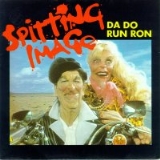
The first single from Spitting Image, released in 1984, was a rework of the Ronettes' Da Do Run Run. The Spitting Image version, Da Do Run Ron, was a spoof election campaign song for Ronald Reagan, featuring Nancy Reagan listing reasons why "you gotta re-elect him", with lyrics like "Yeah! He can really act, Yeah! He lowered income tax, Yeah! He hates the Warsaw Pact". The cover of the single featured Reagan as a biker with Nancy riding pillion.
The B-side of this single was another rework of an existing song, namely Just A Girl Who Can't Say No from the musical Oklahoma. The Spitting Image team's version was entitled Just A Prince Who Can't Say No and poked fun at the sexual indiscretions of Prince Andrew.
In 1986, the Spitting Image puppets had a number one hit in the UK charts with "The Chicken Song", parodying "Agadoo" by Black Lace – one of several parodies to have featured in the programme. The Chicken Song hit number 1 in the charts for 3 weeks from 17 May 1986 – 3 June 1986 and VH1 US named it as one of the worst number 1 nominations.
The other songs released by Spitting Image were "I've Never Met A Nice South African" (which was on the B-Side of "The Chicken Song" and was a savage indictment of the apartheid-ridden country), "Santa Claus Is On The Dole", "The Atheist Tabernacle Choir", "No More Christmas Singles" and "House Of Commons, Commons Of House". "The Chicken Song" was by far the most successful of all of their music and not-so-subtle references were made to it in subsequent sketches in the show itself. An LP "Spit In Your Ear" was produced, featuring some of their sketches over time along with a few of their songs.
Another song Spitting Image was famous for is the notorious "We're Scared of Bob" in 1986.
In 1986, the Spitting Image puppets also appeared in the video for "Land of Confusion" by Genesis, a song which implied that Thatcher and Reagan were about to bring the world to a nuclear war. The video was depicted as a nightmare Reagan was having, which left him completely immersed in sweat from worrying.
The end of the 1987 election featured a young boy, dressed as a city banker, singing Tomorrow Belongs To Me, a parody of the film Cabaret, when a member of the Hitler Youth starts singing the same song.
In one instance Sting was persuaded to sing a re-worded version of "Every Breath You Take" to accompany a video showing the Spitting Image puppets of world leaders and political figures of the day, usually with the figure matching the altered lyrics "Every wall you build, Every one you've killed, Every grave you've filled, all the blood you've spilled, I'll be watching you." The video ended with the grim reaper appearing in front of a sunset.
Other musical parodies featured Michael Jackson, Kylie Minogue, Frankie Goes To Hollywood, The Monkees, Pet Shop Boys, Andrew Ridgely, ZZ Top, Grace Jones, Prince and Barbra Streisand.
Video and DVD releases
The programme was first released on video in 1986 with a total of three videos ("Spit With Polish", A Floppy Mass Of Blubber" & "Rubber Thingies"). All carried a 15 certificate and were reissued in 1988. The three videos were compilations of clips from the first two series.
Another Spitting Image video released in 1988 was "Rockin' Ronnie", but did not mention Spitting Image on the box. This special was made exclusively for video and cannot be found anywhere else.
Video 5 released in 1989 by Central Video, contained the specials "Bumbledown: The Life & Times Of Ronald Reagan" and "The Sound Of Maggie". Next was a video containing a collection of the music videos from the programme, titled "The Classic Music Video Vol 1", released in 1991 by Central Video under The Video Collection Ltd (VCI or 2entertain); there was never a Volume 2.
A compilation of sketches from 1990 & 1991 (series 11-14) was next, titled "Is Nothing Sacred?", released in 1992 by Surprise Video.
In 1996 FA to Fairplay was released on VHS, later reissued on DVD in 2005. Made specially for video, it provided an alternative look at the 1996 European football championship held in England.
The first four series have been released by Network DVD. Series 5 is due on 23 March 2009.
Staff
Voices The voices were provided by prominent British impressionists (some were not so well known at the time), including:
Performers The puppets were operated or voiced by popular British performers, including:
Writers
- Geoff Atkinson (1989 - 1993)
- Debbie Barham
- Alistair Beaton
- Mark Burton (1989 - 1993)
- Kevin Cecil (The Armando Ianucci Shows) (1993 - 1996)
- Paul John Clark - Journalist and Writer (Rory Bremner, Kate and Ted's Show, The New Politics: The May Revolution, Weekending, Hale and Pace)
- Richard Curtis (Blackadder, Four Weddings and a Funeral etc.) (1984 - 1985)
- Terence Dackombe (Weekending, News Huddlines, Friday Night Live, etc.) (1984 - 1989)
- Chris Edge
- Ben Elton (Blackadder, The Young Ones) (1984 - 1985)
- Dan Gaster
- Patrick Gallagher (co-creator, co-writer and graphic designer on Round the Bend, a children's puppet show produced by Hat Trick Productions with puppets made by the Spitting Image Workshop.)
- Rob Grant (Red Dwarf) (1984 - 1986)
- Sean Hardie
- Ray Harris(1987 - 1993) (Babyblair)
- Ian Hislop (Private Eye, Have I Got News For You, My Dad's the Prime Minister) (1984 - 1989)
- Will Ing (The Now Show)
- David Kind (Hale and Pace)
- Wayne Kline
- Doug Naylor (Red Dwarf) (1984 - 1986)
- Henry Naylor (1984 - 1986)
- Nick Newman (Private Eye) (1984 - 1989)
- John O'Farrell (author of Things Can Only Get Better, etc.) (1984 - 1993)
- Andy Parsons (1993 - 1996)
- Paul Powell
- Georgia Pritchett (1986 - 1992)
- Steve Punt (The Now Show) (1989 - 1993)
- Neil Raphael (1984-87)
- Andy Riley (The Armando Ianucci Shows) (1993 - 1996)
- Tony Sarchet
- Stuart Silver
- Pete Sinclair
- Andrea Solomons
- (John) Jack Docherty and Moray Hunter (Absolutely, Mr. Don & Mr. George)
- Keith Rees & Paul Lewis
- Paul B. Davies
Producers
Production Assistants
- Barbara Bradbury
- Lesley Jones
- Jean Holdsworth
Archive Researchers
- Rob Peers
- Janet Pitts
- Linda Woodhouse
- Janet Rayner
- Margaret Duerden
Costumes
Similar shows elsewhere
Argentina A political satire program called Kanal K was aired by Canal 13 during the early 1990s. The show was (theoretically) cancelled after a serious row with the Catholic Church over Kanal Ks puppet of Pope John Paul II saying "va fangulo" (meaning "fuck you" in Italian). Unofficial rumors say that Kanal K was cancelled on behalf of former President Carlos Saúl Menem because the program depicted him in a derisive manner. However, this version was never officially confirmed.
Australia Rubbery Figures (Fast Forward Series 1 (1989))
Bulgaria Talking Heads (TV7)
Brazil Agildo no País das Maravilhas (Rede Bandeirantes, 1987-1989); Cabaré do Barata (Rede Manchete, 1989-1990)
Canada (Quebec)
-
- Critics said: « Un des meilleurs shows d'humour 3D Québécois au monde! » One of the best 3-D Quebec comedy shows in the world, « Infiniment plus drôle que Découverte » Infinitely better than Discovery, « Jean Charest est parfait dans son rôle de frisé » Jean Charest is perfect in his role as a gay. C'est en ces termes ditirem... dythyran... ditti... élogieux que les critiques parlent de la populaire émission Et Dieu créa… Laflaque. It was in these terms of philatry...flattyry...phlatery... praise that the critics described that popular show "And God Created ... Laflaque"
- (Season 3 of the show) Pour cette 3e saison, l'équipe de créateurs derrière Gérard D s'ingéniera à aller plus loin dans son entreprise de déboulonnage des personnalités de notre monde politique. Des nouveaux décors, des intrigues plus audacieuses et des entrevues où nos politiciens rivaliseront d'ingéniosité pour mieux se couvrir de ridicule. For this third season, the team of authors supporting Gérard D will be striving to go further in their aim of deflating figures from our political world. New scenery, more daring plots, and interviews where our politicians will vye with one another to see in covering themselves in ridicule.
Chile During the 90s, an imitation of the Spitting Image show, called Los Toppins, was aired on the television network Megavision More successful, although oriented to a younger audience was the 31 Minutos show, which aired on TVN.
Colombia Los reencauchados (Cenpro Televisión, 1995)
Czech Republic Gumaci (TV NOVA)
France Le Bébête Show (TF1), Les Guignols de l'info (Canal Plus)
Finland The Autocrats
Germany Hurra Deutschland (ARD, RTL 2), Zak (WDR, ARD)
Greece F??S???S with George Mitsikostas, (SKAI TV)
Hungary Uborka (MTV 1)
Ireland Bull Island (RTÉ)
India Double Take (NDTV)
Israel Chartzufim (Channel 2)
Italy Teste di Gomma (Telemontecarlo)
Mexico Hechos de Peluche (TV Azteca)
New Zealand Public Eye - aired in the 1980s and followed the same format as Spitting Image but satirised NZ politicians instead. Facelift (tv show)
Poland Polskie ZOO (Telewizja Polska)
Portugal Contra Informação (Rádio e Televisão de Portugal)
Romania Animat Planet (Antena 1)
Russia Kookly
Serbia Nikad Izvini (RTV Pink)
Parabrod (RTS)
Spain Las noticias del guiñol (Canal Plus), Txokolatex (Euskal Telebista)
Sweden Riksorganet (SVT)
United States
- See also List of British TV shows remade for the American market
In an attempt to crack the American market, there were some attempts to produce a US version of the show, with a 45-minute 'made for market' show by the original Spitting Image team, entitled Spitting Image: Down And Out In The White House was produced in 1986 by Central for NBC.
Introduced by David Frost, it departed from the sketch-based format in favour of an overall storyline involving the upcoming (at that time) Presidential election. The plot involved a conspiracy to replace Ronald Reagan with a double (actually actor Dustin Hoffman in disguise). This plan was hatched by the Famous Corporation, a cabal of the ultra-rich headed by Johnny Carson's foil Ed McMahon (in the show, Carson was his ineffectual left-hand man) who met in a secret cavern hollowed out behind the facade of Mount Rushmore. Eventually, their plot foiled, the famous corporation activated their escape pod - Abraham Lincoln's nose - and left Earth for another planet, but (in a homage to the beginning of the Star Wars movies) were destroyed during a collision with 'a nonsensical prologue in gigantic lettering'.
The show was not very successful with its target audience, possibly because its humour was still very British and it was so irreverent about Ronald Reagan at a time when he was enormously popular with the American public. It did, however, receive great praise from critics and it was followed by two more TV specials, The Ronnie & Nancy Show (also satirising the Reagans) and The 1987 Movie Awards, satirising the Academy Awards.
The American puppeteers Sid and Marty Krofft later had a degree of success with a vaguely satirical show called D.C. Follies which ran from 1987 to 1989, was clearly inspired by Spitting Image, but owed more to Sesame Street (human participants trying to talk sense to the puppets) and was not considered as funny. They also released a video with the satirical documentary Bumbledown: The Life and Times of Ronald Reagan and a musical based very loosely on West Side Story called The Sound Of Maggie.
External links
See also
|
| |
|
|