

Spiraea

Encyclopedia
- For the European and west Asian herb in the same family, see True MeadowsweetMeadowsweetFilipendula ulmaria, commonly known as Meadowsweet, is a perennial herb in the family Rosaceae that grows in damp meadows. It is native throughout most of Europe and Western Asia...
.
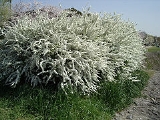
Spiraea (icon), is a genus of about 80-100 species of shrub
Shrub
A shrub or bush is distinguished from a tree by its multiple stems and shorter height, usually under 5–6 m tall. A large number of plants may become either shrubs or trees, depending on the growing conditions they experience...
s in the family Rosaceae
Rosaceae
Rosaceae are a medium-sized family of flowering plants, including about 2830 species in 95 genera. The name is derived from the type genus Rosa. Among the largest genera are Alchemilla , Sorbus , Crataegus , Cotoneaster , and Rubus...
, subfamily Spiraeoideae
Spiraeoideae
The subfamily Spiraeoideae was traditionally a subfamily of flowering plants within family Rosaceae. The taxonomy of this subfamily has changed several times in the last century as more detailed studies have been carried out...
. They are native to the temperate Northern Hemisphere
Northern Hemisphere
The Northern Hemisphere is the half of a planet that is north of its equator—the word hemisphere literally means “half sphere”. It is also that half of the celestial sphere north of the celestial equator...
, with the greatest diversity in eastern Asia
Asia
Asia is the world's largest and most populous continent, located primarily in the eastern and northern hemispheres. It covers 8.7% of the Earth's total surface area and with approximately 3.879 billion people, it hosts 60% of the world's current human population...
.
Spiraea species are used as food plants by the larva
Larva
A larva is a distinct juvenile form many animals undergo before metamorphosis into adults. Animals with indirect development such as insects, amphibians, or cnidarians typically have a larval phase of their life cycle...
e of some Lepidoptera
Lepidoptera
Lepidoptera is a large order of insects that includes moths and butterflies . It is one of the most widespread and widely recognizable insect orders in the world, encompassing moths and the three superfamilies of butterflies, skipper butterflies, and moth-butterflies...
species including Brown-tail
Brown-tail
The brown-tail is a moth of the family Lymantriidae. It is distributed throughout Europe.The wings of this species are pure white, as is the body, apart from a tuft of brown hairs at the end of the abdomen. The brown coloration extends along most of the back of the abdomen in the male...
, Emperor Moth, Grey Dagger
Grey Dagger
The Grey Dagger is a moth of the family Noctuidae. It is found from Europe and North Africa to northern Iran, Central Asia, southern and central Siberia and Mongolia. In the Levant it is found in Lebanon and Israel....
, Hypercompe indecisa
Hypercompe
Hypercompe is a genus of moths of the family Arctiidae. There are over 80 species found throughout the Americas. Several species were formerly separated in Ecpantheria which is now regarded as a junior synonym. They are typically large moths with white forewings heavily spotted with black, and...
and Setaceous Hebrew Character
Setaceous Hebrew Character
The Setaceous Hebrew Character is a moth of the family Noctuidae. It is found in the Palearctic ecozone. It is a common species throughout Europe. It is also found in North America, from coast to coast across Canada and the northern United States to western Alaska. It occurs in the Rocky Mountains...
.
The genus was formerly treated as also containing the herbaceous species now segregated
Segregate (taxonomy)
In taxonomy, a segregate, or a segregate taxon is created when a taxon is split off, from another taxon. This other taxon will be better known, usually bigger, and will continue to exist, even after the segregate taxon has been split off...
into the genera Filipendula
Filipendula
Filipendula is a genus of 12 species of perennial herbaceous flowering plants in the family Rosaceae, native to the temperate regions of the Northern Hemisphere. Well-known species include Meadowsweet and Dropwort , both native to Europe, and Queen-of-the-forest and Queen-of-the-prairie...
and Aruncus
Aruncus
Aruncus is a genus of herbaceous plants in the Rosaceae, subfamily Spiraeoideae. Botanical opinion of the number of species differs, with from one to four species accepted....
; recent genetic
Genetics
Genetics , a discipline of biology, is the science of genes, heredity, and variation in living organisms....
evidence has shown that Filipendula is only distantly related to Spiraea, belonging in the subfamily Rosoideae
Rosoideae
The rose subfamily Rosoideae consists of more than 850 species, including many shrubs, perennial herbs, and fruit plants such as strawberries and brambles...
.
Description
Spiraea plants are hardyHardy
-Canada:* Port Hardy, British Columbia* Hardy Island Marine Provincial Park, British Columbia-United States:* Hardy, Arkansas* Hardy, California* Hardy, Iowa* Hardy, Kentucky* Hardy, Nebraska* Hardy, Virginia* Hardy, Mississippi* Hardy County, West Virginia...
, deciduous-leaved shrub
Shrub
A shrub or bush is distinguished from a tree by its multiple stems and shorter height, usually under 5–6 m tall. A large number of plants may become either shrubs or trees, depending on the growing conditions they experience...
s. The leaves
Leaf
A leaf is an organ of a vascular plant, as defined in botanical terms, and in particular in plant morphology. Foliage is a mass noun that refers to leaves as a feature of plants....
are simple and usually short stalked in an alternate (i.e. spiral) arrangement
Phyllotaxis
In botany, phyllotaxis or phyllotaxy is the arrangement of leaves on a plant stem .- Pattern structure :...
. In most species, the leaves are lanceolate (narrowly oval) and about 1 to 4 in (2.5 to 10.2 cm) long. The leaf margins are usually toothed, occasionally cut or lobed, and rarely smooth. Stipules are absent.
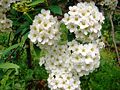
The many small flower
Flower
A flower, sometimes known as a bloom or blossom, is the reproductive structure found in flowering plants . The biological function of a flower is to effect reproduction, usually by providing a mechanism for the union of sperm with eggs...
s of Spiraea shrubs are clustered together in inflorescence
Inflorescence
An inflorescence is a group or cluster of flowers arranged on a stem that is composed of a main branch or a complicated arrangement of branches. Strictly, it is the part of the shoot of seed plants where flowers are formed and which is accordingly modified...
s, usually in dense panicle
Panicle
A panicle is a compound raceme, a loose, much-branched indeterminate inflorescence with pedicellate flowers attached along the secondary branches; in other words, a branched cluster of flowers in which the branches are racemes....
s, umbrella-like corymbs, or grape-like clusters. The radial symmetry of each flower is five-fold, with the flower
Flower
A flower, sometimes known as a bloom or blossom, is the reproductive structure found in flowering plants . The biological function of a flower is to effect reproduction, usually by providing a mechanism for the union of sperm with eggs...
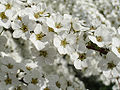
s usually bisexual, rarely unisexual. The flowers have five sepals and five white, pink, or reddish petals that are usually longer than the sepals. Each flower has many (15 to 60) stamens.
Horticulture
Medicinal uses and toxicity
Spiraea is too woody to be used as an edible plant, but has a long history of medicinal use by Native Americans as an herbal tea.Spiraea shrubs contain methyl salicylate (oil of wintergreen)
Methyl salicylate
Methyl salicylate is a natural product of many species of plants. Some of the plants which produce it are called wintergreens, hence the common name.-Botanical background:...
and other salicylates throughout the plant, compounds with similar medicinal properties to aspirin
Aspirin
Aspirin , also known as acetylsalicylic acid , is a salicylate drug, often used as an analgesic to relieve minor aches and pains, as an antipyretic to reduce fever, and as an anti-inflammatory medication. It was discovered by Arthur Eichengrun, a chemist with the German company Bayer...
. Unlike such other salicylate-bearing plants as willow (Salix) or poplar (Populus), meadowsweet's content of these analgesic compounds appears to be consistent from plant to plant. The salicylates in this plant are considered to be highly effective as an analgesic, anti-inflammatory, and fever reducer, without the side effects attributed to aspirin. Unlike aspirin, meadowsweet is effective in treating stomach disorders in minute amounts.
Cetain compounds in this plant also have bacteriostatic properties, and the tea of this plant was used by the Blackfeet Indians as an enema and vagina douche to treat infections of the bowels and vaginal area.
Many kinds of plants produce methyl salycylate, and it is also easily synthesized industrially. While useful as a flavoring or medicinal in small quantities, larger amounts (from any source) can be hazardous or fatal, as discussed in the methyl salicylate article
Methyl salicylate
Methyl salicylate is a natural product of many species of plants. Some of the plants which produce it are called wintergreens, hence the common name.-Botanical background:...
.
Species
- Spiraea albaSpiraea albaSpiraea alba, commonly known as narrowleaf meadowsweet, pale bridewort, or pipestem, grows on wet soils of the Allegheny Mountains and other portions of eastern North America....
(Narrow-leaved Meadowsweet) - Spiraea amoena
- Spiraea arcuata
- Spiraea baldschuanica
- Spiraea bella
- Spiraea betulifolia
- Spiraea blumei
- Spiraea calcicola
- Spiraea cana
- Spiraea canescens
- Spiraea cantoniensis May Bush
- Spiraea chamaedryfolia
- Spiraea crenata
- Spiraea decumbens
- Spiraea densifloraSpiraea densifloraSpiraea densiflora occasionally called mountain spiraea, dense-flowered spiraea, rose meadowsweet, rosy spiraea, and subalpine spiraea is a mountain shrub found on the west coast of North America from California to British Columbia. It grows at elevations between 2,000 and 11,000 feet on inland...
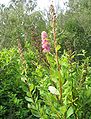
- Spiraea douglasii (Hardhack)
- Spiraea gemmata
- Spiraea henryi
- Spiraea hypericifolia
- Spiraea japonicaSpiraea japonicaSpiraea japonica is a plant in the family Rosaceae. Synonyms for the species name are Spiraea bumalda Burv. and Spiraea japonica var. alpina Maxim.-Description:...
(Japanese Spiraea) - Spiraea latifoliaSpiraea latifoliaSpiraea latifolia, commonly known as Broadleaf Meadowsweet , is a shrub in the Rosaceae family.-External links:**...
(Broad-leaved meadowsweet) - Spiraea lobataSpiraea lobataSpiraea lobata is a shrub in the Rosaceae family native to the United States....
- Spiraea longigemmis
- Spiraea media
- Spiraea micrantha
- Spiraea miyabei
- Spiraea mollifolia
- Spiraea nervosa
- Spiraea nipponica
- Spiraea prunifolia (Bridalwreath Spiraea)
- Spiraea pubescens
- Spiraea rosthornii
- Spiraea salicifolia (Bridewort Spiraea)
- Spiraea sargentiana
- Spiraea thunbergiiSpiraea thunbergiiSpiraea thunbergii, occasionally called Thunberg's meadowsweet, is a plant in the rose family, Rosaceae.-Description:Spiraea thunbergii is a small, long-lived shrub with thin, flexible stems. It is native to Japan and China...
- Spiraea tomentosa (Steeplebush)
- Spiraea trichocarpa
- Spiraea trilobata
- Spiraea veitchii
- Spiraea virginianaSpiraea virginianaSpiraea virginiana is a rare species of flowering plant in the rose family known by the common name Virginia spiraea. It is native to the southern Appalachian Mountains, where it has a distribution scattered across nine states. However, most populations are very small and poor in quality...
- Spiraea wilsonii
- Spiraea yunnanensis
Hybrids
Garden
A garden is a planned space, usually outdoors, set aside for the display, cultivation, and enjoyment of plants and other forms of nature. The garden can incorporate both natural and man-made materials. The most common form today is known as a residential garden, but the term garden has...
s, including several important ornamental plant
Ornamental plant
Ornamental plants are plants that are grown for decorative purposes in gardens and landscape design projects, as house plants, for cut flowers and specimen display...
s:
- Spiraea × arguta (S. × multiflora × S. thunbergii)
- Spiraea × billardii (S. douglasii × S. salicifolia)
- Spiraea × blanda (S. nervosa × S. cantoniensis)
- Spiraea × brachybotrys (S. canescens × S. douglasii)
- Spiraea × bumalda (S. japonica × S. albiflora)
- Spiraea × cinerea (S. hypericifolia × S. cana)
- Spiraea × conspicua (S. japonica × S. latifolia)
- Spiraea × fontenaysii (S. canescens × S. salicifolia)
- Spiraea × foxii (S. japonica × S. betulifolia)
- Spiraea × gieseleriana (S. cana × S. chamaedryfolia)
- Spiraea × macrothyrsa (S. douglasii × S. latifolia)
- Spiraea × multiflora (S. crenata × S. hypericifolia)
- Spiraea × notha (S. betulifolia × S. latifolia)
- Spiraea × nudiflora (S. chamaedryfolia × S. bella)
- Spiraea × pikoviensis (S. crenata × S. media)
- Spiraea × pyramidata (S. betulifolia × S. douglasii)
- Spiraea × revirescens (S. amoena × S. japonica)
- Spiraea × sanssouciana (S. japonica × S. douglasii)
- Spiraea × schinabeckii (S. chamaedryfolia × S. trilobata)
- Spiraea × semperflorens (S. japonica × S. salicifolia)
- Spiraea × vanhouttei (S. trilobata × S. cantoniensis)
- Spiraea × watsoniana (S. douglasii × S. densiflora)