
Home      Discussion      Topics      Dictionary      Almanac
Signup       Login
Spinning wheel

Spinning wheel

Overview

Discussion
Ask a question about 'Spinning wheel'
Start a new discussion about 'Spinning wheel'
Answer questions from other users
Full Discussion Forum
 
Unanswered Questions
Recent Discussions
Encyclopedia

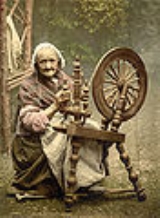
A spinning wheel is a device for spinning
Hand spinning
Spinning is an ancient textile art in which plant, animal or synthetic fibers are twisted together to form yarn. For thousands of years, fiber was spun by hand using simple tools, the spindle and distaff...

 thread or yarn
Yarn
Yarn is a long continuous length of interlocked fibres, suitable for use in the production of textiles, sewing, crocheting, knitting, weaving, embroidery and ropemaking. Thread is a type of yarn intended for sewing by hand or machine. Modern manufactured sewing threads may be finished with wax or...

 from natural or synthetic
Synthetic fiber
Synthetic fibers are the result of extensive research by scientists to improve on naturally occurring animal and plant fibers. In general, synthetic fibers are created by forcing, usually through extrusion, fiber forming materials through holes into the air, forming a thread...

 fibers. Spinning wheels appeared in Asia, probably in the 11th century, and very gradually replaced hand spinning with spindle
Spindle (textiles)
A spindle is a wooden spike used for spinning wool, flax, hemp, cotton, and other fibres into thread. It is commonly weighted at either the bottom middle or top, most commonly by a circular or spherical object called a whorl, and may also have a hook, groove or notch, though spindles without...

 and distaff
Distaff
As a noun, a distaff is a tool used in spinning. It is designed to hold the unspun fibers, keeping them untangled and thus easing the spinning process. It is most commonly used to hold flax, and sometimes wool, but can be used for any type of fiber. Fiber is wrapped around the distaff, and tied in...

. Spinning machinery, such as the spinning jenny
Spinning jenny
The spinning jenny is a multi-spool spinning frame. It was invented c. 1764 by James Hargreaves in Stanhill, Oswaldtwistle, Lancashire in England. The device reduced the amount of work needed to produce yarn, with a worker able to work eight or more spools at once. This grew to 120 as technology...

 and spinning frame
Spinning frame
The spinning frame is an Industrial Revolution invention for spinning thread or yarn from fibers such as wool or cotton in a mechanized way. It was developed in 18th century Britain by Richard Arkwright and John Kay.-Historical context:...

, displaced the spinning wheel during the Industrial Revolution
Industrial Revolution
The Industrial Revolution was a period from the 18th to the 19th century where major changes in agriculture, manufacturing, mining, transportation, and technology had a profound effect on the social, economic and cultural conditions of the times...

.

History


The earliest clear illustrations of the spinning wheel come from Baghdad
Baghdad
Baghdad is the capital of Iraq, as well as the coterminous Baghdad Governorate. The population of Baghdad in 2011 is approximately 7,216,040...

 (drawn in 1237), China
China
Chinese civilization may refer to:* China for more general discussion of the country.* Chinese culture* Greater China, the transnational community of ethnic Chinese.* History of China* Sinosphere, the area historically affected by Chinese culture...

 (c. 1270) and Europe
Europe
Europe is, by convention, one of the world's seven continents. Comprising the westernmost peninsula of Eurasia, Europe is generally 'divided' from Asia to its east by the watershed divides of the Ural and Caucasus Mountains, the Ural River, the Caspian and Black Seas, and the waterways connecting...

 (c. 1280), and there is evidence that spinning wheels had already come into use in both China and the Islamic world
Muslim world
The term Muslim world has several meanings. In a religious sense, it refers to those who adhere to the teachings of Islam, referred to as Muslims. In a cultural sense, it refers to Islamic civilization, inclusive of non-Muslims living in that civilization...

 during the eleventh century. According to Irfan Habib
Irfan Habib
Irfan Habib is an Indian Marxist historian, a former Chairman of the Indian Council of Historical Research and a Padma Bhushan awardee. He is a Professor Emeritus at Aligarh Muslim University. He has served in the Indian History Congress for many years. Irfan Habib and R.S...

, the spinning wheel was introduced into India from Iran in the thirteenth century.

According to Mark Elvin
Mark Elvin
Mark Elvin is a professor emeritus of Chinese history at Australian National University, specializing in the late imperial period.He is famous for his high level equilibrium trap theory to explain why an industrial revolution happened in Europe but not in China, despite the fact that the state of...

, 14th century Chinese technical manuals describe an automatic water-powered spinning wheel. Comparable devices were not developed in Europe until the 18th century. However, it fell into disuse when fiber production shifted from hemp
Hemp
Hemp is mostly used as a name for low tetrahydrocannabinol strains of the plant Cannabis sativa, of fiber and/or oilseed varieties. In modern times, hemp has been used for industrial purposes including paper, textiles, biodegradable plastics, construction, health food and fuel with modest...

 to cotton
Cotton
Cotton is a soft, fluffy staple fiber that grows in a boll, or protective capsule, around the seeds of cotton plants of the genus Gossypium. The fiber is almost pure cellulose. The botanical purpose of cotton fiber is to aid in seed dispersal....

. It was forgotten by the 17th century. The decline of the automatic spinning wheel in China is an important part of Elvin's high level equilibrium trap
High level equilibrium trap
The high level equilibrium trap is a concept developed by Mark Elvin to explain why China never underwent an indigenous Industrial Revolution, despite its wealth, stability, and high level of scientific achievement...

 theory to explain why there was no indigenous industrial revolution
Industrial Revolution
The Industrial Revolution was a period from the 18th to the 19th century where major changes in agriculture, manufacturing, mining, transportation, and technology had a profound effect on the social, economic and cultural conditions of the times...

 in China despite its high levels of wealth and scientific knowledge.

The spinning wheel replaced the earlier method of hand spinning
Hand spinning
Spinning is an ancient textile art in which plant, animal or synthetic fibers are twisted together to form yarn. For thousands of years, fiber was spun by hand using simple tools, the spindle and distaff...

 with a spindle
Spindle (textiles)
A spindle is a wooden spike used for spinning wool, flax, hemp, cotton, and other fibres into thread. It is commonly weighted at either the bottom middle or top, most commonly by a circular or spherical object called a whorl, and may also have a hook, groove or notch, though spindles without...

. The first stage in mechanizing the process was mounting the spindle horizontally so it could be rotated by a cord encircling a large, hand-driven wheel. The great wheel is an example of this type, where the fiber is held in the left hand and the wheel slowly turned with the right. Holding the fiber at a slight angle to the spindle produced the necessary twist. The spun yarn was then wound onto the spindle by moving it so as to form a right angle with the spindle. This type of wheel, while known in Europe by the 14th century, was not in general use until later. It ultimately was used there to spin a variety of yarns until the beginning of the 19th century and the mechanization of spinning.

In general, the spinning technology was known for a long time before being adopted by the majority of people, thus making it hard to fix dates of the improvements. In 1533, a citizen of Brunswick
Braunschweig
Braunschweig , is a city of 247,400 people, located in the federal-state of Lower Saxony, Germany. It is located north of the Harz mountains at the farthest navigable point of the Oker river, which connects to the North Sea via the rivers Aller and Weser....

 is said to have added a treadle
Treadle
A treadle [from OE tredan = to tread] is a part of a machine which is operated by the foot to produce reciprocating or rotary motion in a machine such as a weaving loom or grinder...

, by which the spinner could rotate her spindle with one foot and have both hands free to spin. Leonardo da Vinci
Leonardo da Vinci
Leonardo di ser Piero da Vinci was an Italian Renaissance polymath: painter, sculptor, architect, musician, scientist, mathematician, engineer, inventor, anatomist, geologist, cartographer, botanist and writer whose genius, perhaps more than that of any other figure, epitomized the Renaissance...

 drew a picture of the flyer, which twists the yarn before winding it onto the spindle. During the 16th century a treadle wheel with flyer was in common use, and gained such names as the Saxony wheel and the flax
Flax
Flax is a member of the genus Linum in the family Linaceae. It is native to the region extending from the eastern Mediterranean to India and was probably first domesticated in the Fertile Crescent...

 wheel. It sped up production, as one needn't stop spinning to wind up the yarn.

In the 18th century, the Industrial Revolution
Textile manufacture during the Industrial Revolution
The industrial revolution changed the nature of work and society. Opinion varies as to the exact date, but it is estimated that the First Industrial Revolution took place between 1750 and 1850, and the second phase or Second Industrial Revolution between 1860 and 1900. The three key drivers in...

 had a big effect on the spinning industry by beginning to mechanize the spinning wheel. Lewis Paul
Lewis Paul
Lewis Paul was the original inventor of roller spinning, the basis of the water frame for spinning cotton in a cotton mill.-Life and work:Lewis Paul was of Huguenot descent. His father was physician to Lord Shaftesbury...

 and John Wyatt
John Wyatt (inventor)
John Wyatt , an English inventor, was born near Lichfield and was related to Sarah Ford, Doctor Johnson's mother. A carpenter by trade he began work in Birmingham on the development of a spinning machine...

 first worked on the problem in 1738, patenting the Roller Spinning machine and the flyer-and-bobbin system, for drawing wool
Wool
Wool is the textile fiber obtained from sheep and certain other animals, including cashmere from goats, mohair from goats, qiviut from muskoxen, vicuña, alpaca, camel from animals in the camel family, and angora from rabbits....

 to a more even thickness. Using two sets of rollers that traveled at different speeds, yarn could be twisted and spun quickly and efficiently. However, they did not have much financial success. In 1771, Richard Arkwright used waterwheels to power looms for the production of cotton cloth, his invention becoming known as the water frame.

More modern spinning machines use a mechanical means to rotate the spindle, as well as an automatic method to draw out fibers, and devices to work many spindles together at speeds previously unattainable. Newer technologies that offer even faster yarn production include friction spinning, an open-end system, and air jets.

Types of spinning wheels


Numerous types of spinning wheels exist, including the great wheel also known as walking wheel or wool wheel for rapid long draw
Long draw (spinning)
Long draw is the spinning technique used to create woolen yarns. It is spun from carded rolags. It is generally spun from shorter stapled fibers...

 spinning of woolen
Woolen
Woolen or woollen is a type of yarn made from carded wool. Woolen yarn is soft, light, stretchy, and full of air. It is thus a good insulator, and makes a good knitting yarn...

-spun yarns; the flax
Flax
Flax is a member of the genus Linum in the family Linaceae. It is native to the region extending from the eastern Mediterranean to India and was probably first domesticated in the Fertile Crescent...

 wheel
, which is a double-drive wheel used with a distaff
Distaff
As a noun, a distaff is a tool used in spinning. It is designed to hold the unspun fibers, keeping them untangled and thus easing the spinning process. It is most commonly used to hold flax, and sometimes wool, but can be used for any type of fiber. Fiber is wrapped around the distaff, and tied in...

 for spinning linen
Linen
Linen is a textile made from the fibers of the flax plant, Linum usitatissimum. Linen is labor-intensive to manufacture, but when it is made into garments, it is valued for its exceptional coolness and freshness in hot weather....

; saxony
Saxony
The Free State of Saxony is a landlocked state of Germany, contingent with Brandenburg, Saxony Anhalt, Thuringia, Bavaria, the Czech Republic and Poland. It is the tenth-largest German state in area, with of Germany's sixteen states....

and upright wheels, all-purpose treadle driven wheels used to spin worsted-spun yarns; and the charkha, native to Asia. Until the acceptance of rotor spinning wheel, all yarns were produced by aligning fibers through drawing techniques and then twisting the fiber together. With rotor spinning, the fibers in the roving are separated, thus open end, and then wrapped and twisted as the yarn is drawn out of the rotor cup.

Hand-powered wheels


Hand powered spinning wheels are powered by the spinner turning a crank for flywheel with their hand, as opposed to pressing pedals or using a mechanical engine.

Charkha


The tabletop or floor charkha is one of the oldest known forms of the spinning wheel. The charkha works similarly to the great wheel, with a drive wheel being turned by hand, while the yarn is spun off the tip of the spindle. The floor charkha and the great wheel closely resemble each other. With both, the spinning must stop in order to wind the yarn onto the spindle.

The charkha (etymologically related to Chakra
Chakra
Chakra is a concept originating in Hindu texts, featured in tantric and yogic traditions of Hinduism and Buddhism. Its name derives from the Sanskrit word for "wheel" or "turning" .Chakra is a concept referring to wheel-like vortices...

) was both a tool and a symbol of the Indian independence movement
Indian independence movement
The term Indian independence movement encompasses a wide area of political organisations, philosophies, and movements which had the common aim of ending first British East India Company rule, and then British imperial authority, in parts of South Asia...

. The charkha, a small, portable, hand-cranked wheel, is ideal for spinning cotton
Cotton
Cotton is a soft, fluffy staple fiber that grows in a boll, or protective capsule, around the seeds of cotton plants of the genus Gossypium. The fiber is almost pure cellulose. The botanical purpose of cotton fiber is to aid in seed dispersal....

 and other fine, short-staple fibers, though it can be used to spin other fibers as well. The size varies, from that of a hardbound novel to the size of a briefcase, to a floor charkha. Mahatma Gandhi
Mahatma Gandhi
Mohandas Karamchand Gandhi , pronounced . 2 October 1869 – 30 January 1948) was the pre-eminent political and ideological leader of India during the Indian independence movement...

 brought the charkha into larger use with his teachings. He hoped the charkha would assist the peoples of India achieve self-sufficiency and independence, and so used the charkha as a symbol of the Indian independence movement and included it on earlier versions of the Flag of India
Flag of India
The National flag of India is a horizontal rectangular tricolour of deep saffron, white and India green; with the Ashok Chakra, a 24-spoke wheel, in navy blue at its centre. It was adopted in its present form during a meeting of the Constituent Assembly held on 22 July 1947, when it became the...

.

Great wheel


The great wheel was one of the earlier types of spinning wheel. The fiber is held in the left hand and the wheel slowly turned with the right. This wheel is thus good for using the long-draw
Long draw (spinning)
Long draw is the spinning technique used to create woolen yarns. It is spun from carded rolags. It is generally spun from shorter stapled fibers...

 spinning technique, which requires only one active hand most of the time, thus freeing a hand to turn the wheel. The great wheel is usually used to spin wool, and can only be used with fiber preparations that are suited to long-draw spinning.

The great wheel is usually over 5 feet or 1.5 meters in height. The large drive wheel turns the much smaller spindle assembly, with the spindle revolving many times for each turn of the drive wheel. The yarn is spun at an angle off the tip of the spindle, and is then stored on the spindle. To begin spinning on a great wheel, first a leader (a length of waste yarn) is tied onto the base of the spindle and spiraled up to the tip. Then the spinner overlaps a handful of fiber with the leader, holding both gently together with the left hand, and begins to slowly turn the drive wheel clockwise with the right hand, while simultaneously walking backward and drawing the fiber in the left hand away from the spindle at an angle. The left hand must control the tension on the wool to produce an even result. Once a sufficient amount of yarn has been made, the spinner turns the wheel backward a short distance to unwind the spiral on the spindle, then turns it clockwise again, and winds the newly made yarn onto the spindle, finishing the wind-on by spiraling back out to the tip again to make another draw.

Treadle wheel


This type of wheel is powered by the spinner's foot rather than their hand or a motor. The spinner sits and pumps a foot treadle that turns the drive wheel via a crankshaft and a connecting rod. This leaves both hands free for drafting the fibers, which is necessary in the short draw
Short draw (spinning)
Short draw is the spinning technique used to create worsted yarns. It is spun from combed roving, sliver or wool top- anything with the fibers all lined up parallel to the yarn. It is generally spun from long stapled fibers. Short draw spun yarns are smooth, strong, sturdy yarns, and dense. Short...

 spinning technique, which is often used on this type of wheel. The old-fashioned pointed distaff spindle is not a common feature of the treadle wheel. Instead, most modern wheels employ a flyer-and-bobbin system which twists the yarn and winds it onto a spool simultaneously. These wheels can be single- or double-treadle; which is a matter of preference and does not affect the operation of the wheel.

Double drive


The double drive wheel is named after its drive band, which goes around the spinning wheel twice. The drive band turns the flyer, which is the horse-shoe shaped piece of wood surrounding the bobbin
Bobbin
A bobbin is a spindle or cylinder, with or without flanges, on which wire, yarn, thread or film is wound. Bobbins are typically found in sewing machines, cameras, and within electronic equipment....

, as well as the bobbin. Due to a difference in the size of the whorls (the round pieces or pulleys around which the drive band runs) the bobbin whorl, which has a smaller radius than the flyer whorl, turns slightly faster. Thus both the flyer and bobbin rotate to twist the yarn, and the difference in speed continually winds the yarn onto the bobbin. Generally the speed difference or "ratio" is adjusted by the size of the whorls and the tension of the drive band.

The drive band on the double drive wheel is generally made from a non-stretch yarn or twine; candlewick is also used.

Single drive


A single drive wheel has one drive band, that goes around the fly-wheel and the bobbin or the flyer. Most of the drive bands for single drive wheels are made from synthetic cord, which is elastic and does not slip easily on the wheel.

While the spinner is making new yarn, the bobbin and the flyer turn in unison, but when the spinner wants to wind the yarn onto the bobbin, the bobbin or the flyer slows down and thus the yarn winds on. The one part slows down because of the brake band, which loops over that element. The tighter the brake band is, the more pull on the yarn, because the more friction the bobbin has to overcome in order to turn in sync with the flyer.

Castle style


When the spindle and flyer are located above the wheel, rather than off to one side, the wheel is said to be a castle wheel. This type of wheel is often more compact, thus easier to store. Some castle wheels are even made to fold up small enough that they fit in carry-on luggage at the airport.

Importance: direct and secondary


The spinning wheel increased the productivity of thread making by a factor of greater than 10. Medieval historian Lynn White credited the spinning wheel with increasing the supply of rags, which led to cheap paper, which was a factor in the development of printing.

Culture


The ubiquity of the spinning wheel has led to its inclusion in the art, literature and other expressions of numerous cultures around the world.

Literature/Folk Tales


The Golden Spinning Wheel (Zlatý kolovrat) is a Czech poem by Karel Jaromír Erben
Karel Jaromír Erben
Karel Jaromír Erben was a Czech historian, poet and writer of the mid-19th century, best known for his collection Kytice , which contains poems based on traditional and folkloric themes....

 that was included in his classic collection of folk ballads, Kytice
Kytice
Kytice is a collection of ballads by the Czech author Karel Jaromír Erben, first published in 1853 and considered a classic...

.

Rumpelstiltskin
Rumpelstiltskin
Rumpelstiltskin is the eponymous character and protagonist of a fairy tale which originated in Germany . The tale was collected by the Brothers Grimm, who first published it in the 1812 edition of Children's and Household Tales...

, one of the tales collected by the Brothers Grimm
Brothers Grimm
The Brothers Grimm , Jacob Grimm and Wilhelm Grimm , were German academics, linguists, cultural researchers, and authors who collected folklore and published several collections of it as Grimm's Fairy Tales, which became very popular...

, revolves around a woman who is imprisoned under threat of execution unless she can spin straw
Straw
Straw is an agricultural by-product, the dry stalks of cereal plants, after the grain and chaff have been removed. Straw makes up about half of the yield of cereal crops such as barley, oats, rice, rye and wheat. It has many uses, including fuel, livestock bedding and fodder, thatching and...

 into gold
Gold
Gold is a chemical element with the symbol Au and an atomic number of 79. Gold is a dense, soft, shiny, malleable and ductile metal. Pure gold has a bright yellow color and luster traditionally considered attractive, which it maintains without oxidizing in air or water. Chemically, gold is a...

. Rumpelstiltskin helps her with this task, ultimately at the cost of her first-born child; however, she makes a new bargain with him and is able to keep her child after successfully guessing his name.

Another classic folk tale that incorporates spinning wheels is Sleeping Beauty
Sleeping Beauty
Sleeping Beauty by Charles Perrault or Little Briar Rose by the Brothers Grimm is a classic fairytale involving a beautiful princess, enchantment, and a handsome prince...

, in which the main character pricks her finger on the spindle
Spindle
The term spindle may refer to:In textiles and manufacturing:*Spindle , a device to spin fibres into thread*Spindle , is the main rotating part of a machine tool, woodworking machine, etc...

 of a spinning wheel and goes into a deep sleep following a witch's curse. Numerous variations of the tale exist (the Brothers Grimm had one in their collection), and in only some of them is the spindle actually attached to/associated with a spinning wheel. Walt Disney
Walt Disney
Walter Elias "Walt" Disney was an American film producer, director, screenwriter, voice actor, animator, entrepreneur, entertainer, international icon, and philanthropist, well-known for his influence in the field of entertainment during the 20th century. Along with his brother Roy O...

 included the wheel in their animated film version of Sleeping Beauty
Sleeping Beauty (1959 film)
Sleeping Beauty is a 1959 American animated film produced by Walt Disney and based on the fairy tale "La Belle au bois dormant" by Charles Perrault...

, whereas only a spindle is used in Tchaikovsky
Pyotr Ilyich Tchaikovsky
Pyotr Ilyich Tchaikovsky Pyotr Ilyich Tchaikovsky Pyotr Ilyich Tchaikovsky (Russian: Пётр Ильи́ч Чайко́вский ; often "Peter Ilich Tchaikovsky" in English. His names are also transliterated "Piotr" or "Petr"; "Ilitsch", "Il'ich" or "Illyich"; and "Tschaikowski", "Tschaikowsky", "Chajkovskij"...

's famous ballet
Ballet
Ballet is a type of performance dance, that originated in the Italian Renaissance courts of the 15th century, and which was further developed in France and Russia as a concert dance form. The early portions preceded the invention of the proscenium stage and were presented in large chambers with...

, also titled The Sleeping Beauty.

Spinning wheels are also integral to the plot or characterization in the Scottish folk tale Habitrot and the German tales The Three Spinners
The Three Spinners
The Three Spinners is a German fairy tale collected by the Brothers Grimm. It is tale no 14 and Aarne-Thompson type 501. It is widespread throughout Europe.It has obvious parallels to Rumpelstiltskin, and obvious differences, so that they are often compared....

. and The Twelve Huntsmen
The Twelve Huntsmen
The Twelve Huntsmen is a German fairy tale collected by the Brothers Grimm as tale number 67 in their Grimm's Fairy Tales. Andrew Lang included it in The Green Fairy Book.It is Aarne-Thompson type 884, the forsaken fiancée...


Louisa May Alcott
Louisa May Alcott
Louisa May Alcott was an American novelist. She is best known for the novel Little Women and its sequels Little Men and Jo's Boys. Little Women was set in the Alcott family home, Orchard House in Concord, Massachusetts, and published in 1868...

, most famous as the author of Little Women
Little Women
Little Women is a novel by American author Louisa May Alcott . The book was written and set in the Alcott family home, Orchard House, in Concord, Massachusetts. It was published in two volumes in 1868 and 1869...

, wrote a collection of short stories
Short story
A short story is a work of fiction that is usually written in prose, often in narrative format. This format tends to be more pointed than longer works of fiction, such as novellas and novels. Short story definitions based on length differ somewhat, even among professional writers, in part because...

 called Spinning-Wheel Stories, which were not about spinning wheels but instead meant to be read while engaging in the rather tedious act of using a spinning wheel.
Classical & Symphonic

Antonín Dvořák
Antonín Dvorák
Antonín Leopold Dvořák was a Czech composer of late Romantic music, who employed the idioms of the folk music of Moravia and his native Bohemia. Dvořák’s own style is sometimes called "romantic-classicist synthesis". His works include symphonic, choral and chamber music, concerti, operas and many...

 used Erben's The Golden Spinning Wheel as the basis for one of his symphonic poem
Symphonic poem
A symphonic poem or tone poem is a piece of orchestral music in a single continuous section in which the content of a poem, a story or novel, a painting, a landscape or another source is illustrated or evoked. The term was first applied by Hungarian composer Franz Liszt to his 13 works in this vein...

s.

Camille Saint-Saëns wrote Le Rouet d'Omphale (Omphale's Spinning Wheel), symphonic poem in A major, Op. 31, a musical treatment of the classical story of Omphale
Omphale
In Greek mythology, Omphale was a daughter of Iardanus, either a king of Lydia, or a river-god. Omphale was queen of the kingdom of Lydia in Asia Minor; according to Bibliotheke she was the wife of Tmolus, the oak-clad mountain king of Lydia; after he was gored to death by a bull, she continued...

 and Heracles
Heracles
Heracles ,born Alcaeus or Alcides , was a divine hero in Greek mythology, the son of Zeus and Alcmene, foster son of Amphitryon and great-grandson of Perseus...

.
Folk & Ballad

The Spinning Wheel is also the title/subject of a classic Irish
Ireland
Ireland is an island to the northwest of continental Europe. It is the third-largest island in Europe and the twentieth-largest island on Earth...

 folk song by John Francis Waller
John Francis Waller
John Francis Waller was an Irish poet and editor.He was born at Limerick, educated at Trinity College, Dublin and was called to the Irish Bar in 1833...

.
Opera

Spinning wheels also feature prominently in the Wagner
Richard Wagner
Wilhelm Richard Wagner was a German composer, conductor, theatre director, philosopher, music theorist, poet, essayist and writer primarily known for his operas...

 opera The Flying Dutchman
The Flying Dutchman (opera)
Der fliegende Holländer is an opera, with music and libretto by Richard Wagner.Wagner claimed in his 1870 autobiography Mein Leben that he had been inspired to write "The Flying Dutchman" following a stormy sea crossing he made from Riga to London in July and August 1839, but in his 1843...

; the second act begins with local girls sitting at their wheels and singing about the act of spinning.

Art


Spinning wheels may be found as motifs in art around the world, ranging from their status as domestic/utilitarian items to their more symbolic role (such as in India, where they may have political implications).

External links