
All Topics  
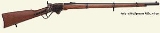
Spencer repeating rifle


   Email Print
   Bookmark   Link


Spencer repeating rifle


The Spencer repeating rifle was a manually operated lever-action
Lever-action

Lever-action is a type of firearm action which uses a lever located around the trigger guard area to load fresh Cartridge into the Chamber of the Barrel when the lever is worked....
, repeating rifle
Repeating rifle

A repeating rifle is a single barreled rifle containing multiple rounds of ammunition. These rounds are loaded from a magazine by means of a manual or automatic mechanism, and the action that reloads the rifle also typically recocks the firing action....
 fed from a tube magazine
Magazine (firearm)

A magazine is an ammunition storage and feeding device within or attached to a repeating firearm. Magazines may be integral to the firearm or removable ....
 with cartridges. It was adopted by the Union Army
Union Army

The Union Army was the army that fought for the Union during the American Civil War. It was also known as the Federal Army, the U.S....
, especially by the cavalry
Cavalry

The Cavalry is the second oldest of the Combat Arms, and as soldiers or warriors who fought mounted on horseback in combat, it represents the mobility and offensive power of the armed forces....
, during the American Civil War
American Civil War

The American Civil War , also known as the War Between the States and several Naming the American Civil War, was a civil war in the United States....
, but did not replace the standard issue muzzle-loading rifled musket
Rifled musket

The term rifled musket or rifle musket refers to a specific type of weapon made in the mid 19th century.History and Development...
s in use at the time. The Spencer carbine was a shorter and lighter version.

design was completed by Christopher Spencer
Christopher Miner Spencer

Christopher Miner Spencer , born June 20, 1833, was an United States inventor, from Manchester, Connecticut, Connecticut, who invented the Spencer repeating rifle ,...
 in 1860, and was for a magazine-fed, lever-operated rifle chambered for the 56-56 Spencer rimfire
Rimfire ammunition

A rimfire is a type of firearm cartridge . It is called a rimfire because instead of the firing pin striking the primer cap at the center of the base of the cartridge to ignite it , the pin strikes the base's Rim ....
 cartridge.


Discussion
Ask a question about 'Spencer repeating rifle'
Start a new discussion about 'Spencer repeating rifle'
Answer questions from other users
Full Discussion Forum


Encyclopedia


The Spencer repeating rifle was a manually operated lever-action
Lever-action

Lever-action is a type of firearm action which uses a lever located around the trigger guard area to load fresh Cartridge into the Chamber of the Barrel when the lever is worked....
, repeating rifle
Repeating rifle

A repeating rifle is a single barreled rifle containing multiple rounds of ammunition. These rounds are loaded from a magazine by means of a manual or automatic mechanism, and the action that reloads the rifle also typically recocks the firing action....
 fed from a tube magazine
Magazine (firearm)

A magazine is an ammunition storage and feeding device within or attached to a repeating firearm. Magazines may be integral to the firearm or removable ....
 with cartridges. It was adopted by the Union Army
Union Army

The Union Army was the army that fought for the Union during the American Civil War. It was also known as the Federal Army, the U.S....
, especially by the cavalry
Cavalry

The Cavalry is the second oldest of the Combat Arms, and as soldiers or warriors who fought mounted on horseback in combat, it represents the mobility and offensive power of the armed forces....
, during the American Civil War
American Civil War

The American Civil War , also known as the War Between the States and several Naming the American Civil War, was a civil war in the United States....
, but did not replace the standard issue muzzle-loading rifled musket
Rifled musket

The term rifled musket or rifle musket refers to a specific type of weapon made in the mid 19th century.History and Development...
s in use at the time. The Spencer carbine was a shorter and lighter version.

Overview

The design was completed by Christopher Spencer
Christopher Miner Spencer

Christopher Miner Spencer , born June 20, 1833, was an United States inventor, from Manchester, Connecticut, Connecticut, who invented the Spencer repeating rifle ,...
 in 1860, and was for a magazine-fed, lever-operated rifle chambered for the 56-56 Spencer rimfire
Rimfire ammunition

A rimfire is a type of firearm cartridge . It is called a rimfire because instead of the firing pin striking the primer cap at the center of the base of the cartridge to ignite it , the pin strikes the base's Rim ....
 cartridge. Unlike later cartridge designations, the first number referred to the diameter of the case at the head, while the second number referred to the diameter at the mouth; the actual bullet diameter was .52 inches. Cartridges were loaded with of black powder.

To use the Spencer, a lever had to be worked to extract the used shell and feed a new cartridge from the tube. Like the Dreyse breech-loader
Needle gun

The Dreyse needle-gun was a military breechloading rifle, famous as the main infantry weapon of the Kingdom of Prussia, who adopted it for service in 1841 as the Dreyse Z?ndnadelgewehr, or Prussian Model 1841....
, the hammer then had to be manually cocked in a separate action. The weapon used rimfire cartridges stored in a seven-round tube magazine, enabling the rounds to be fired one after another. When empty, the tube could be rapidly loaded either by dropping in fresh cartridges or from a device called the Blakeslee Cartridge Box, which contained up to ten tubes with seven cartridges each, which could be emptied in the magazine tube in the buttstock.

There were also 56–52, 56–50, and even a few 56–46 versions of the cartridge created, which were necked down
Wildcat cartridge

A wildcat cartridge, or wildcat, is a custom cartridge for which ammunition and firearms are not mass produced. These cartridges are often created in order to optimize a certain performance characteristic of an existing commercial cartridge....
 versions of the original 56–56. Cartridge length was limited by the action size to about 1.75 inches, and the later calibers used a smaller diameter, lighter bullet and larger powder charge to increase the power and range over the original 56–56 cartridge, which, while about as powerful as the .58 caliber rifled musket of the time, was underpowered by the standards of other early cartridges such as the .50–70
.50-70 Government

The .50-70 Government Cartridge was a Gunpowder round adopted in 1866 for the Springfield Model 1866 Springfield rifle. The cartridge was developed after the unsatisfactory results of the .58 rimfire cartridge for the Springfield Model 1865....
 and .45-70
.45-70

The .45-70 rifle cartridge , also known as .45-70 Government, was developed at the United States Army's Springfield Armory for use in the Springfield Model 1873 .45 caliber rifle, known to collectors as the "Trapdoor Springfield." The new cartridge was a replacement for the stop-gap .50-70 Government cartridge which had been adopted i...
.

History

At first, conservatism from the Department of War
United States Department of War

The United States Department of War, sometimes also called the War Office, was the department of the United States Federal government of the United States's Federal government of the United States#Executive branch responsible for the operation and maintenance of land Military of the United States from 1789 until September 18, 1947,...
 delayed its introduction to service. However, Christopher Spencer was eventually able to gain an audience with President Abraham Lincoln
Abraham Lincoln

Abraham Lincoln was the List of Presidents of the United States President of the United States. He successfully led the country through its greatest internal crisis, the American Civil War, preserving the Union and ending slavery....
, who subsequently invited him to a shooting match and demonstration of the weapon. Lincoln was impressed with the weapon, and ordered that it be adopted for production.

The Spencer repeating rifle was first adopted by the United States Navy
United States Navy

The United States Navy is the navy of the United States Armed Forces. It is one of the seven uniformed services of the United States. The U.S. Navy currently has approximately 331,682 personnel on active duty as of 31 December 2008 and 124,000 in the United States Navy Reserve....
, and subsequently adopted by the United States Army
United States Army

The United States Army is the branch of the United States Armed Forces responsible for Army operations. It is the largest and oldest established branch of the U.S....
 and used during the American Civil War
American Civil War

The American Civil War , also known as the War Between the States and several Naming the American Civil War, was a civil war in the United States....
. The South
Confederate States of America

The Confederate States of America formed as the government set up from 1861 to 1865 by eleven Southern United States U.S. state of the United States of America that had declared their secession from the U.S....
 occasionally captured some of these weapons and ammunition, but, as they were unable to manufacture the cartridges because of shortages of copper, their ability to take advantage of the weapons was limited. Notable early instances of use included the Battle of Hoover's Gap
Battle of Hoover's Gap

The Battle of Hoover's Gap was the principal battle fought in the Tullahoma Campaign of the American Civil War....
 (where Col.
Colonel

Colonel is a military rank of a commissioned officer, with corresponding ranks existing in almost every country in the world. It is also used in some police forces and other paramilitary rank structures....
 John T. Wilder
John T. Wilder

John Thomas Wilder was an officer in the Union Army during the American Civil War. As an industrialist, he was instrumental in developing the natural resources of the Tennessee....
's "Lightning Brigade" effectively demonstrated the firepower of repeaters), and the Gettysburg Campaign
Gettysburg Campaign

File:Meade and Lee.jpgThe Gettysburg Campaign was a series of battles fought in June and July 1863, during the American Civil War. After his victory in the Battle of Chancellorsville, Confederate States Army Full General Robert E....
, where two regiments of the Michigan Brigade
Michigan Brigade

The Michigan Brigade, sometimes called the Wolverines, the Michigan Cavalry Brigade or Custer's Brigade, was a brigade of cavalry in the volunteer Union Army during the latter half of the American Civil War....
 (under Brig. Gen.
Brigadier General

Brigadier General is the lowest ranking General Officer in some countries, usually sitting between the ranks of Colonel and Major General.The rank can be traced back to the militaries of Europe where a brigadier general, or simply a brigadier, would command a brigade in the field....
 George Armstrong Custer
George Armstrong Custer

George Armstrong Custer was a United States Army officer and cavalry commander in the American Civil War and the Indian Wars. At the start of the Civil War, Custer was a cadet at the United States Military Academy at West Point, New York, and his class's graduation was accelerated so that they could enter the war....
) carried them at the Battle of Hanover
Battle of Hanover

The Battle of Hanover took place on June 30, 1863, in Hanover, Pennsylvania in York County, Pennsylvania, as part of the Gettysburg Campaign of the American Civil War....
 and at East Cavalry Field. As the war progressed, Spencers were carried by a number of Union cavalry and mounted infantry regiments and provided the Union army with additional firepower versus their Confederate
Confederate States Army

The Confederate States Army was a military organization whose primary mission was to provide the necessary forces and capabilities to support the National Security and defense of the Confederate States of America during its brief existence from 1861 to 1865....
 counterparts.

The Spencer showed itself to be very reliable under combat conditions, with a sustainable rate-of-fire in excess of 20 rounds per minute. Compared to standard muzzle-loaders, with a rate of fire of 2-3 rounds per minute, this represented a significant tactical advantage. However, effective tactics had yet to be developed to take advantage of the higher rate of fire. Similarly, the supply chain was not equipped to carry the extra ammunition. Detractors would also complain that the smoke and haze produced was such that it was hard to see the enemy.

In the late 1860s, the Spencer company was sold to the Fogerty Rifle Company and ultimately to Winchester
Winchester Repeating Arms Company

The Winchester Repeating Arms Company was a prominent United States maker of semi-automatic firearm during the late nineteenth and early twentieth century....
. With almost 200,000 rifles and carbines made, it marked the first adoption of a removable magazine-fed infantry
Infantry

Infantry are soldiers who are primarily trained for the role of fighting on foot. A soldier in the infantry is known as an infantryman. Infantry units have more physically demanding training than other branches of armies, and place a greater emphasis on fitness, physical strength and aggression....
 rifle by any country. Many Spencer carbines were later sold as surplus to France where they were used in the war against Germany in 1870.

Despite the fact that the Spencer company went out of business in 1869, ammunition was sold in the United States up to about the 1920s. Later, many rifles and carbines were converted to centerfire, which could fire cartridges made from the centerfire .50–70 brass. Production ammunition can still be obtained on the specialty market.

See also

  • M1819 Hall rifle
    M1819 Hall rifle

    The M1819 Hall rifle was a single-shot breech loading rifle designed by Captain John H. Hall, patented on May 21, 1811, and adopted by the U.S. Army in 1819....
  • Henry rifle
    Henry rifle

    The Henry repeating rifle is a lever-action, breech-loading, tubular magazine rifle....
  • Volcanic rifle
  • List of individual weapons of the U.S. Armed Forces
    List of individual weapons of the U.S. Armed Forces

    This is a list of weapons served Personal weapon by the United States Armed Forces, sorted by type and current level of use. This does not include a number of weapons used by United States Special Operations Forces, as their specific equipment is mostly unknown and many Special Operations Forces weapons may only be used by a few operators....


External links

  • , with information on Spencer's unique caliber designations, and how to reload
    Reload

    Reload/reloading/means filling something back up, for example putting more ammunition into a weapon or putting pallets in to a recently emptied truck for delivery....
     for centerfire conversions
  • of Spencer rifle, serial number
    Serial number

    A serial number is a unique number assigned for identification which varies from its successor or predecessor by a fixed discrete integer value....
     3981
  • page on the Spencer rifle, mentioned the Blakeslee cartridge box
  • commercially manufactures ammunition and blanks for the Spencer rifles.
  • www.ammo-one.com, dealer in rare ammunition, has pictures and information on Spencer cartridges , , , and