


Spanking

Encyclopedia
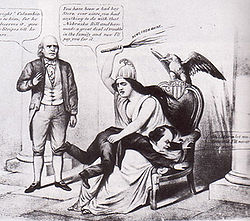
Spanking refers to the act of striking the buttocks
Buttocks
The buttocks are two rounded portions of the anatomy, located on the posterior of the pelvic region of apes and humans, and many other bipeds or quadrupeds, and comprise a layer of fat superimposed on the gluteus maximus and gluteus medius muscles. Physiologically, the buttocks enable weight to...
of another person to cause temporary pain without producing physical injury. It generally involves one person striking the buttocks of another person with an open hand
Hand
A hand is a prehensile, multi-fingered extremity located at the end of an arm or forelimb of primates such as humans, chimpanzees, monkeys, and lemurs...
. When an open hand is used, spanking is referred to in some countries as slap
Slap
A slap or "smack" is a broad stroke made with the open hand or the back of the hand, as opposed to a punch that is made with a closed fist. Slaps are frequently made across the face, but can be also made across hands or any other body part, and can use either the palm of the hand or the back of the...
ping or smacking. More severe forms of spanking, such as switching, paddling, belting
Belting (beating)
Belting is the use of belts made of strong materials as a whip-like instrument for corporal punishment . It is most often associated with educational institutions where it has been used as disciplinary measure but it has also been applied domestically by parents...
, caning
Caning
Caning is a form of corporal punishment consisting of a number of hits with a single cane usually made of rattan, generally applied to the offender's bare or clothed buttocks or hand . Application of a cane to the knuckles or the shoulders has been much less common...
, whipping
Flagellation
Flagellation or flogging is the act of methodically beating or whipping the human body. Specialised implements for it include rods, switches, the cat o' nine tails and the sjambok...
, and birching
Birching
Birching is a corporal punishment with a birch rod, typically applied to the recipient's bare buttocks, although occasionally to the back and/or shoulders.-Implement:...
, involve the use of an implement instead of a hand.
Spanking is regarded as abusive in some cultures, but as an acceptable form of discipline in others.
Corporal punishment is most commonly used to discipline an infant, child
Child
Biologically, a child is generally a human between the stages of birth and puberty. Some vernacular definitions of a child include the fetus, as being an unborn child. The legal definition of "child" generally refers to a minor, otherwise known as a person younger than the age of majority...
, or teenager
Adolescence
Adolescence is a transitional stage of physical and mental human development generally occurring between puberty and legal adulthood , but largely characterized as beginning and ending with the teenage stage...
. It generally involves an adult - typically a parent, guardian, or teacher - striking the child's buttocks as punishment for unacceptable behavior. Historically, boys have tended to be more frequently spanked than girls. Some countries have outlawed the spanking of children in every setting, but many allow it at least when administered by a parent or guardian. For the legal status of corporal punishment in different countries, see Corporal punishment in the home
Corporal punishment in the home
Domestic corporal punishment typically involves the corporal punishment of a child by a parent or guardian in the home—normally the spanking or slapping of a child with the parent's open hand, but occasionally with an implement such as a belt, slipper, cane or paddle.In many cultures,...
and School corporal punishment.
In some cultures, the spanking of a wife
Wife
A wife is a female partner in a marriage. The rights and obligations of the wife regarding her spouse and others, and her status in the community and in law, varies between cultures and has varied over time.-Origin and etymology:...
by her husband
Husband
A husband is a male participant in a marriage. The rights and obligations of the husband regarding his spouse and others, and his status in the community and in law, vary between cultures and has varied over time...
is considered acceptable forms of domestic discipline, though the practice is far less common than it used to be. In other contexts, the spanking of an adult can be considered a playful gesture during a social ritual or as a form of entertainment.
Terminology
In North America, the word "spanking" has often been used as a synonym for an official paddling in school, and sometimes even as a euphemism for the formal corporal punishment of adults in an institution.In British English
British English
British English, or English , is the broad term used to distinguish the forms of the English language used in the United Kingdom from forms used elsewhere...
, most dictionaries define "spanking" as being given only with the open hand.
In American English
American English
American English is a set of dialects of the English language used mostly in the United States. Approximately two-thirds of the world's native speakers of English live in the United States....
, dictionaries define spanking as being administered with either the open hand or an implement such as a paddle. Thus, the standard form of corporal punishment in US schools (licks with a paddle) is often referred to as a spanking, whereas its pre-1997 English equivalent (strokes of the cane) would never have been so described.
In Britain
United Kingdom
The United Kingdom of Great Britain and Northern IrelandIn the United Kingdom and Dependencies, other languages have been officially recognised as legitimate autochthonous languages under the European Charter for Regional or Minority Languages...
, Ireland, Australia and New Zealand, the word "smacking" is generally used in preference to "spanking" when describing striking with an open hand, rather than with an implement. Whereas a spanking is invariably administered to the bottom, "smacking" is less specific and may refer to slapping the child's hands, arms or legs as well as its bottom.
In the home
In many cultures, parents have historically been regarded as having the duty of disciplining their children, and the right to spank them when appropriate; however, attitudes in many countries changed in the 1950s and 60s following the publication by pediatricianPediatrics
Pediatrics or paediatrics is the branch of medicine that deals with the medical care of infants, children, and adolescents. A medical practitioner who specializes in this area is known as a pediatrician or paediatrician...
Dr Spock of Baby and Child Care
The Common Sense Book of Baby and Child Care
-External links:...
in 1946, which advised parents to treat children as individuals, whereas the previous conventional wisdom had been that child rearing should focus on building discipline, and that, e.g., babies should not be "spoiled" by picking them up when they cried. The change in attitude was followed by legislation. Since 1979, 30 countries around the world (at 2011) have outlawed domestic corporal punishment of children. In Europe, 22 countries have banned the practice. And in many other places the practice is considered controversial.
In Africa, the Middle East, and in most parts of Eastern Asia (including China, Taiwan
Taiwan
Taiwan , also known, especially in the past, as Formosa , is the largest island of the same-named island group of East Asia in the western Pacific Ocean and located off the southeastern coast of mainland China. The island forms over 99% of the current territory of the Republic of China following...
, Japan, and Korea), corporal punishment of one's own children is lawful. In Singapore
Singapore
Singapore , officially the Republic of Singapore, is a Southeast Asian city-state off the southern tip of the Malay Peninsula, north of the equator. An island country made up of 63 islands, it is separated from Malaysia by the Straits of Johor to its north and from Indonesia's Riau Islands by the...
and Hong Kong, punishing one's own child with corporal punishment is legal but not particularly encouraged. Culturally, many people in the region believe a certain amount of corporal punishment for their own children is appropriate and necessary, and thus such practice is accepted by society as a whole.
Studies have consistently found that:
- Boys are spanked more than girls;
- Mothers spank more than fathers;
- Toddlers and preschoolers are spanked most often;
- Parents from lower income groups spank more often.
A common method of spanking is to have the child or teenager lying, stomach down, across the parent's lap, with the parent bringing their open hand down upon the child's buttocks
Buttocks
The buttocks are two rounded portions of the anatomy, located on the posterior of the pelvic region of apes and humans, and many other bipeds or quadrupeds, and comprise a layer of fat superimposed on the gluteus maximus and gluteus medius muscles. Physiologically, the buttocks enable weight to...
. Alternatively, the youngster might be told to bend over, or lie face down across a bed. Spankings may be delivered over the trousers
Trousers
Trousers are an item of clothing worn on the lower part of the body from the waist to the ankles, covering both legs separately...
, over the undergarment
Undergarment
Undergarments or underwear are clothes worn under other clothes, often next to the skin. They keep outer garments from being soiled by bodily secretions and discharges, shape the body, and provide support for parts of it. In cold weather, long underwear is sometimes worn to provide additional...
s, or upon the bare
Bare
Bare means minimal or naked.Bare may also refer to:- People :* Bobby Bare , American country music singer and songwriter* Bobby Bare, Jr. , American musician and recording artist...
buttocks. Those who argue in favor of spanking claim that the bottom is the safest place to administer the punishment, since there is little danger of injury to this part of the body.
Opinions are divided on whether spanking is helpful or harmful to a child's behavior. Public attitudes towards the acceptability and effectiveness of spanking vary a great deal by nation and region. For example in the United States and United Kingdom, social acceptance of spanking children maintains a majority position, from approximately 61% to 80%. In Sweden, before the 1979 ban, more than half of the population considered corporal punishment a necessary part of child rearing. By 1996 the rate was 11%, and less than 34% considered it acceptable in a national survey.
On the other hand, many scientific researchers and child welfare organizations oppose it. Some studies have suggested that it does not benefit the child, and can encourage problems like anxiety, alcohol abuse, or dependence and externalizing problems.
Various other problems have also been claimed.
Some researchers have been critical of these studies as scientifically unsound and have pointed out methodological flaws in how they were conducted, as well as the conclusions drawn. However, a longitudinal study by Tulane University
Tulane University
Tulane University is a private, nonsectarian research university located in New Orleans, Louisiana, United States...
in 2010 controlled for a wide variety of confounding variables previously noted and still found negative outcomes in such children. According to the study's leader, Catherine Taylor, this suggests that "it's not just that children who are more aggressive are more likely to be spanked."
Diana Baumrind believes that the evidence seems to indicate that mild, nonabusive, physical punishment is not harmful when used occasionally, in a loving relationship, and in conjunction with other methods of discipline, most notably with reasoning. She claims that the critical issue is the relationship between the parent and the child. If the child feels as if he or she is in a loving, trusting relationship with his or her parents, then the child usually understands that discipline, and even spanking, is for the good of the child. When this occurs, Baumrind and others claim, there are no long-term negative effects.
Robert Larzelere, along with some of his colleagues, also suggests that spanking is not all bad and cosiders that spanking used in conjunction with reasoning was the most effective type of discipline in some situations. Larzelere, like most experts who believe spanking is not always detrimental, believes that certain guidelines must be kept in mind if parents choose to use corporal punishment. First, physical discipline should be limited to a couple of slaps applied by the open hand to the buttocks or legs. Second, it should only be used on children between the ages of two and six when other disciplinary methods may not be as effective. Third, it should only be used to back up less aversive disciplinary techniques and as a supplement to positive parenting. Finally, spanking should not be done while the parent is angry because it could escalate to abuse.
There is an ongoing debate on whether the sexual deviation "spanking fetishism
Sexual fetishism
Sexual fetishism, or erotic fetishism, is the sexual arousal a person receives from a physical object, or from a specific situation. The object or situation of interest is called the fetish, the person a fetishist who has a fetish for that object/situation. Sexual fetishism may be regarded, e.g...
" is caused by spankings received or witnessed in childhood (or puberty age) or not.There are claims that that some (but not all) spanking fetishes, are eroticizations of childhood trauma
Trauma
Trauma can refer to:-In psychology and medicine:* Trauma , an often serious and body-altering physical injury, such as the removal of a limb...
s.
In schools
Corporal punishment, usually delivered with an implement (such as a paddle or caneCaning
Caning is a form of corporal punishment consisting of a number of hits with a single cane usually made of rattan, generally applied to the offender's bare or clothed buttocks or hand . Application of a cane to the knuckles or the shoulders has been much less common...
) rather than with the open hand, used to be a common form of school discipline in many countries, but it is now banned in much of the western world, including much of Europe, and in Japan, Canada, India, South Africa and New Zealand. These bans have been controversial, and in many cultures opinion remains sharply divided as to the efficacy or suitability of spanking as a punishment for misbehaviour by school students.
Formal caning, notably for teenage boys, remains a common form of discipline in schools in several Asian and African countries, especially those with a British heritage such as Malaysia, Singapore
Singapore
Singapore , officially the Republic of Singapore, is a Southeast Asian city-state off the southern tip of the Malay Peninsula, north of the equator. An island country made up of 63 islands, it is separated from Malaysia by the Straits of Johor to its north and from Indonesia's Riau Islands by the...
, Tanzania
Tanzania
The United Republic of Tanzania is a country in East Africa bordered by Kenya and Uganda to the north, Rwanda, Burundi, and the Democratic Republic of the Congo to the west, and Zambia, Malawi, and Mozambique to the south. The country's eastern borders lie on the Indian Ocean.Tanzania is a state...
and Zimbabwe
Zimbabwe
Zimbabwe is a landlocked country located in the southern part of the African continent, between the Zambezi and Limpopo rivers. It is bordered by South Africa to the south, Botswana to the southwest, Zambia and a tip of Namibia to the northwest and Mozambique to the east. Zimbabwe has three...
; however, in these cultures it is referred to as "caning" and not "spanking".
In the United States, the Supreme Court
Supreme court
A supreme court is the highest court within the hierarchy of many legal jurisdictions. Other descriptions for such courts include court of last resort, instance court, judgment court, high court, or apex court...
in 1977 held that the paddling of school students was not per se unlawful. The constitutional ban on "cruel and unusual punishment" applied only to those convicted of crime: the common-law stipulation that school corporal punishment be "reasonable and not excessive" was a sufficient safeguard against misuse.
However, 31 states have now banned paddling in public schools. Paddling is still common in some schools in the South, where it is often called "spanking".
In India, corporal punishment is prohibited in schools in the Right to Free and Compulsory Education Act (2009). Article 17 states: “(1) No child shall be subjected to physical punishment or mental harassment. (2) Whoever contravenes the provisions of sub-section (1) shall be liable to disciplinary action under the service rules applicable to such person.
Adult spanking
In some cultures, the spanking of women, by the male head of the family or by the husband (sometimes called domestic discipline) has been and sometimes continues to be a common and approved custom. In those cultures and in those times it was the belief that the husband, as head of the family, had a right and even the duty to discipline his wife and children when he saw fit, and manuals were available to instruct the husband how to discipline his household. In most western countries, this practice has come to be regarded as socially unacceptable wife-beating, domestic violenceDomestic violence
Domestic violence, also known as domestic abuse, spousal abuse, battering, family violence, and intimate partner violence , is broadly defined as a pattern of abusive behaviors by one or both partners in an intimate relationship such as marriage, dating, family, or cohabitation...
or abuse. Routine corporal punishment of women by their husbands, however, does still exist in some parts of the developing world, and still occurs in isolated cases in western countries.
However, there is no evidence of spanking of men by a woman in a domestic context. This may be due to the relative physical strengths of the two genders and the traditionally accepted role of the husband as the head of the family unit.
Today, spanking of an adult tends to be confined to erotic spanking
Erotic spanking
Erotic spanking is the act of spanking another person for the sexual arousal or gratification of either or both parties...
between people engaging in other intimate activities, such as foreplay
Foreplay
In human sexual behavior, foreplay is a set of intimate psychological and physically intimate acts between two or more people meant to create desire for sexual activity and sexual arousal. Either or any of the sexual partners may initiate the foreplay, and they may not be the active partner during...
or sexual roleplay. People who use spanking as part of their sexual play are considered spanking fetishists.
In entertainment
Adult female spanking is at times used for entertainment.The popular 1953 film Kiss Me Kate
Kiss Me, Kate (film)
Kiss Me Kate is the 1953 MGM film adaptation of the Broadway musical of the same name.Inspired by The Taming of the Shrew, it tells the tale of musical theater actors, Fred Graham and Lilli Vanessi, who were once married and are now performing opposite each other in the roles of Petruchio and...
included a scene with an adult female being spanked. The scene was used in the film's promotion.
The 1963 film McLintock!
McLintock!
McLintock! is a 1963 comedy Western starring John Wayne and Maureen O'Hara, and loosely based on Shakespeare's The Taming of the Shrew. The film is notable, perhaps even infamous, for its two spanking scenes, in which mother and daughter are each paddled with coal shovels: the daughter by her...
includes two scenes of adult spanking in which mother and daughter are each paddled with coal shovels: the daughter by her suitor, the mother, played by Maureen O'Hara
Maureen O'Hara
Maureen O'Hara is an Irish film actress and singer. The famously red-headed O'Hara has been noted for playing fiercely passionate heroines with a highly sensible attitude. She often worked with director John Ford and longtime friend John Wayne...
, by her estranged husband George McLintock, played by John Wayne
John Wayne
Marion Mitchell Morrison , better known by his stage name John Wayne, was an American film actor, director and producer. He epitomized rugged masculinity and became an enduring American icon. He is famous for his distinctive calm voice, walk, and height...
. The scene was used in the promotion of the film, at first a picture with the shovel in hand was used, but after protests a picture with an open hand replaced the original. The film is loosely based on Shakespeare's The Taming of the Shrew
The Taming of the Shrew
The Taming of the Shrew is a comedy by William Shakespeare, believed to have been written between 1590 and 1591.The play begins with a framing device, often referred to as the Induction, in which a mischievous nobleman tricks a drunken tinker named Sly into believing he is actually a nobleman himself...
.
The 2002
2002 in film
The year 2002 in film involved some significant events. The first significant releases of sequels took place between The Lord of the Rings: The Two Towers, Harry Potter and the Chamber of Secrets, Star Wars Episode II: Attack of the Clones, Men in Black II, Analyze That, Spy Kids 2: The Island of...
film Secretary
Secretary (film)
Secretary is a 2002 independent film directed by Steven Shainberg and starring Maggie Gyllenhaal as Lee Holloway and James Spader as E. Edward Grey...
is a notable example of a spanking film. It is a dominant/submissive-themed romantic
Romance film
Romance films are love stories that focus on passion, emotion, and the affectionate involvement of the main characters and the journey that their love takes through courtship or marriage. Romance films make the love story or the search for love the main plot focus...
comedy-drama
Comedy-drama
Comedy-drama is a genre of theatre, film and television programs which combines humorous and serious content.-Theatre:Traditional western theatre, beginning with the ancient Greeks, was divided into comedy and tragedy...
film directed by Steven Shainberg
Steven Shainberg
Steven Shainberg is an American film director and producer.He is the nephew of author Lawrence Shainberg. Both are part of the Shainberg family of Memphis, Tennessee, founder of the Shainberg's chain of stores, which is now part of Dollar General.Shainberg received his BA from Yale University in...
. It stars Maggie Gyllenhaal
Maggie Gyllenhaal
Margaret Ruth "Maggie" Gyllenhaal born November 16, 1977) is an American actress. She is the daughter of director Stephen Gyllenhaal and screenwriter Naomi Foner Gyllenhaal and the older sister of actor Jake Gyllenhaal. She made her screen debut when she began to appear in her father's films...
as Lee Holloway and James Spader
James Spader
James Todd Spader is an American actor best known for his eccentric roles in movies such as Pretty in Pink, Less Than Zero, Sex, Lies, and Videotape, Crash, Stargate, and Secretary...
as E. Edward Grey. The film is based on a short story from Bad Behavior by Mary Gaitskill
Mary Gaitskill
Mary Gaitskill is an American author of essays, short stories and novels. Her work has appeared in The New Yorker, Harper's Magazine, Esquire, The Best American Short Stories , and The O. Henry Prize Stories .-Life:Gaitskill was born in Lexington, Kentucky...
.
The video game God Hand
God Hand
God Hand is a 2006 PlayStation 2 gameGod hand may also refer to:-Video games:* Ken "Godhand" Mishima, a character from the PlayStation game, Ehrgeiz* Godhand, the demonic version of Lenny from Shadow Hearts: Covenant...
features a spanking move. The player character (Gene) can grab any female opponent, put her over his knee, and spank her repeatedly, before throwing her away and resume the fight.
Ritual spanking traditions
There are some rituals or traditions which involve spanking. For example, on the first day of the lunar Chinese new year holidays, a week-long 'Spring Festival', the most important festival for Chinese people all over the world, thousands of Chinese visit the Taoist Dong Lung Gong temple in Tungkang to go through the century-old ritual to get rid of bad luck, men by receiving spankings and women by being whipped, with the number of strokes to be administered (always lightly) by the temple staff being decided in either case by the god Wang Ye and by burning incense and tossing two pieces of wood, after which all go home happily, believing their luck will improve.On Easter Monday
Easter Monday
Easter Monday is the day after Easter Sunday and is celebrated as a holiday in some largely Christian cultures, especially Roman Catholic and Eastern Orthodox cultures...
, there is a Slavic
Slavic peoples
The Slavic people are an Indo-European panethnicity living in Eastern Europe, Southeast Europe, North Asia and Central Asia. The term Slavic represents a broad ethno-linguistic group of people, who speak languages belonging to the Slavic language family and share, to varying degrees, certain...
tradition of hitting girls and young ladies with woven willow switches (Czech: pomlázka; Slovak: korbáč) and dousing them with water.
In Slovenia
Slovenia
Slovenia , officially the Republic of Slovenia , is a country in Central and Southeastern Europe touching the Alps and bordering the Mediterranean. Slovenia borders Italy to the west, Croatia to the south and east, Hungary to the northeast, and Austria to the north, and also has a small portion of...
, there is a jocular tradition that anyone who succeeds in climbing to the top of Mount Triglav receives a spanking or birching.
There was a tradition in Ancient Rome that during the festival of Lupercalia
Lupercalia
Lupercalia was a very ancient, possibly pre-Roman pastoral festival, observed on February 13 through 15 to avert evil spirits and purify the city, releasing health and fertility...
for women to be spanked for good luck.
In North America, there is a tradition of "birthday spankings" where the birthday girl or boy receives the same number of hits as his/her age (plus "one to grow on") during the birthday party. Birthday spankings are administered over the clothes and usually by close friends or family members.
See also
Spanking implements- Spanking literature
- Spanking positions
- UN Convention on the Rights of the Child
- Erotic SpankingErotic spankingErotic spanking is the act of spanking another person for the sexual arousal or gratification of either or both parties...