


Spanish real

Encyclopedia
Spain
Spain , officially the Kingdom of Spain languages]] under the European Charter for Regional or Minority Languages. In each of these, Spain's official name is as follows:;;;;;;), is a country and member state of the European Union located in southwestern Europe on the Iberian Peninsula...
for several centuries after the mid-14th century, but changed in value relative to other units introduced. In 1864, the real was replaced by a new Spanish escudo
Spanish escudo
-Gold escudo:The first escudo was a gold coin introduced in 1535/1537, with coins denominated in escudos issued until 1833. It was initially worth 16 reales...
, then by the peseta in 1868, when a real came to mean a quarter of a peseta
Spanish peseta
The peseta was the currency of Spain between 1869 and 2002. Along with the French franc, it was also a de facto currency used in Andorra .- Etymology :...
.
History
The first real was introduced by King Pedro I of CastileCrown of Castile
The Crown of Castile was a medieval and modern state in the Iberian Peninsula that formed in 1230 as a result of the third and definitive union of the crowns and parliaments of the kingdoms of Castile and León upon the accession of the then King Ferdinand III of Castile to the vacant Leonese throne...
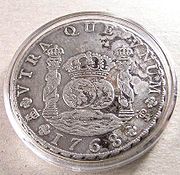
at a value of 3 maravedíes. This rate of exchange increased until 1497, when the real was fixed at a value of 34 maravedíes. The famous Peso de Ocho ("piece of eight" is referred to the value of 8 Reales = 1 Silver Peso) also known as Spanish dollar
Spanish dollar
The Spanish dollar is a silver coin, of approximately 38 mm diameter, worth eight reales, that was minted in the Spanish Empire after a Spanish currency reform in 1497. Its purpose was to correspond to the German thaler...
, was issued that same year, and it later became widespread in America and Asia. In 1566, the gold escudo
Spanish escudo
-Gold escudo:The first escudo was a gold coin introduced in 1535/1537, with coins denominated in escudos issued until 1833. It was initially worth 16 reales...
was introduced, worth 16 reales. The "Pieza de a ocho" or "Piece of eight" is a one-ounce silver coin, not to be confused with the minor coins: 4 Reales, 2 Reales, 1 Real and the little (half inch diameter) Half Real.
During this period, Spanish coinage became popular in international trade and commerce, and remained so for centuries.
17th century
In 1642, two distinct reales were created, the real de plata (made of silverSilver
Silver is a metallic chemical element with the chemical symbol Ag and atomic number 47. A soft, white, lustrous transition metal, it has the highest electrical conductivity of any element and the highest thermal conductivity of any metal...
) and the real de vellón (made of Billon
Billon (alloy)
Billon is an alloy of a precious metal with a majority base metal content . It is used chiefly for making coins, medals, and token coins.The word comes from the French bille....
, or "less than half silver"). The exchange rate between these two coins was set at 2 reales de vellón = 1 real de plata. The maravedí was tied to the real de vellón, causing the real de plata to be worth 68 maravedíes. The gold escudo was worth 16 reales de plata. The real de vellón was issued for exclusive use in Spain and did not frequently circulate in the colonies.
18th century
The real de plata fuerte was introduced in 1737 at a value of 2½ reales de vellón or 85 maravedíes. This real was the standard, issued as coins until the early 19th century. The gold escudo was worth 16 reales de plata fuerte.19th century
In 1808, coins were introduced denominated in real de vellón. These coins circulated alongside real de plata fuerte and escudo coins until decimalization. Coins denominated in reales de plata were minted until 1837, whilst maravedí coins were issued until 1850.Decimalization
The real de vellón, now just called the real, was adopted as the chief unit in Spain's first decimal currency, introduced in 1850. To begin with, subsidiary pieces were issued denominated in decima de real (tenths of a real). Later they were denominated in céntimo de real (hundredths of a real). The real replaced the Catalan pesetaCatalan peseta
The peseta was a unit of currency in Catalonia until 1850, when the whole of Spain decimalized. It was also a name used throughout Spain for an amount of 4 reales de vellón....
in 1850, at a rate of 1 peseta = 4 reales.
In 1864, the real was replaced by a new escudo
Spanish escudo
-Gold escudo:The first escudo was a gold coin introduced in 1535/1537, with coins denominated in escudos issued until 1833. It was initially worth 16 reales...
worth 10 reales (i.e., not equivalent to the earlier escudo). This second escudo was itself replaced in 1868 by the peseta
Spanish peseta
The peseta was the currency of Spain between 1869 and 2002. Along with the French franc, it was also a de facto currency used in Andorra .- Etymology :...
at a rate of 1 peseta = 0.4 escudos = 4 reales. Consequently, the term real lived on, meaning a quarter of a peseta.
Predecimal
In the 18th century, coins were issued in copper for 1, 2, 4 and 8 maravedíes, in silver for ½, 1, 2, 4 and 8 reales and in gold for ½, 1, 2, 4 and 8 escudos. The silver 8 reales coins was known as the Spanish dollarSpanish dollar
The Spanish dollar is a silver coin, of approximately 38 mm diameter, worth eight reales, that was minted in the Spanish Empire after a Spanish currency reform in 1497. Its purpose was to correspond to the German thaler...
or peso
Peso
The word peso was the name of a coin that originated in Spain and became of immense importance internationally...
(the famous "piece of eight"). Spanish dollars minted between 1732 and 1773 are also often referred to as columnarios
Columnarios
Columnarios are silver coins that were minted by Spain from 1732 to 1773 throughout their new colonies in present-day Latin America. While the majority of columnarios were struck in Mexico, smaller mints existed in Guatemala; Lima, Peru; Santiago, Chile; Potosí, Bolivia; and Columbia. The base...
. The portrait variety from 1772 and later are typically referred to as Spanish dollars or Pillar Dollars. There was also a denomination known as the peso sencillo worth 6 reales.
From 1808, coins were issued in denominations of 1, 2, 4, 10, 20, 80, 160 and 320 reales de vellón. The higher denominations were equivalent to 4 and 8 reales de plata fuerte and 2, 4 and 8 escudos.
Decimal
Copper coins were issued for ½, 1 and 2 decima de real and ½ real, with silver 1, 2, 4, 10 and 20 reales and gold 20, 40 and 100 reales. The new denominations were introduced between 1850 and 1853. In 1854, copper 5, 10 and 25 céntimos de reales were introduced.See also
- Currency of Spanish AmericaCurrency of Spanish AmericaThis article provides an outline of the currency of Spanish America from Spanish colonization in the 15th century until Spanish American independencies in the 19th...
- ColumnariosColumnariosColumnarios are silver coins that were minted by Spain from 1732 to 1773 throughout their new colonies in present-day Latin America. While the majority of columnarios were struck in Mexico, smaller mints existed in Guatemala; Lima, Peru; Santiago, Chile; Potosí, Bolivia; and Columbia. The base...
- Spanish colonial realSpanish colonial realThe silver real was the currency of the Spanish colonies in the Americas and the Philippines. In the seventeenth century the silver real was established at two billon reals or sixty-eight Spanish maravedís. Gold escudos were also issued...
- Portuguese realPortuguese realThe real was the unit of currency of Portugal from around 1430 until 1911. It replaced the dinheiro at the rate of 1 real = 840 dinheiros and was itself replaced by the escudo at a rate of 1 escudo = 1000 réis...
- Real de alerceReal de alerceReal de alerce or real de madera was a local currency consisting in Fitzroya wood that was used during colonial times in Chiloé Archipelago. It was the Jesuits, established in Chiloé since the 17th century that established Fitzroya as a mayor export product towards the Viceroyalty of Peru...
External links
- Coins from Guadalajara, Jalisco. Mexico (1812 - 2006) (gdlcoins.com)
- The Colonial Coinage of Spanish America: An introduction by Daniel Frank Sedwick