

Spanish missions in the Sonoran Desert

Encyclopedia
The Spanish missions in the Sonoran Desert are a series of Jesuit Catholic
religious outposts established by the Spanish
Catholic Jesuits
and other orders for religious conversion
s of the Pima
and Tohono O'odham
indigenous peoples
residing in the Sonoran Desert. An added goal was giving Spain a colonial presence
in their frontier territory of the Sonora y Sinaloa Province
in the Viceroyalty of New Spain, and relocating by Indian Reductions
(Reducciones de Indios) settlements and encomienda
s for agricultural, ranching, and mining labor.
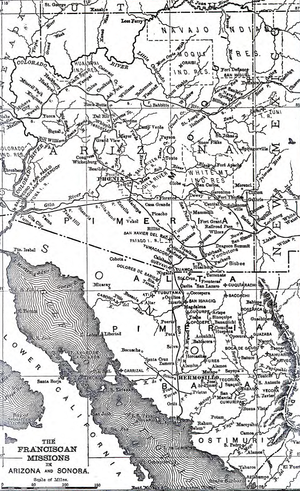
, then called "Pimería Alta
de Sonora y Sinaloa" (Upper Pima of Sonora and Sinaloa), now divided between the Mexican state of Sonora
and the U.S. state
of Arizona
.
had maintained a number of missions throughout Virreinato de Nueva España (the Viceroyalty of New Spain) consisting of Mexico
and portions of what today are the Southwestern United States
, in order to establish colonization and control of the territory and resources.
In the Spring of 1687, a Jesuit missionary named Father Eusebio Francisco Kino lived and worked with the Native Americans (including the Sobaipuri
) in the area called the "Pimería Alta
," or "Upper Pima Country," which presently is located in northern Sonora
and southern Arizona
. During Father Eusebio Kino's stay in the Pimería Alta, he founded over twenty missions in eight mission districts.
It was rumored that the Jesuit priests had amassed fortunes and were becoming very powerful. On February 3, 1768, King Carlos III
ordered the Jesuits forcibly expelled from New Spain
and returned to the home country. Despite the order, many Jesuits remained in and around the present day Tucson, Arizona
as late as the 1780s.
Catholic
The word catholic comes from the Greek phrase , meaning "on the whole," "according to the whole" or "in general", and is a combination of the Greek words meaning "about" and meaning "whole"...
religious outposts established by the Spanish
Spain
Spain , officially the Kingdom of Spain languages]] under the European Charter for Regional or Minority Languages. In each of these, Spain's official name is as follows:;;;;;;), is a country and member state of the European Union located in southwestern Europe on the Iberian Peninsula...
Catholic Jesuits
Society of Jesus
The Society of Jesus is a Catholic male religious order that follows the teachings of the Catholic Church. The members are called Jesuits, and are also known colloquially as "God's Army" and as "The Company," these being references to founder Ignatius of Loyola's military background and a...
and other orders for religious conversion
Religious conversion
Religious conversion is the adoption of a new religion that differs from the convert's previous religion. Changing from one denomination to another within the same religion is usually described as reaffiliation rather than conversion.People convert to a different religion for various reasons,...
s of the Pima
Pima
The Pima are a group of American Indians living in an area consisting of what is now central and southern Arizona. The long name, "Akimel O'odham", means "river people". They are closely related to the Tohono O'odham and the Hia C-ed O'odham...
and Tohono O'odham
Tohono O'odham
The Tohono O'odham are a group of Native American people who reside primarily in the Sonoran Desert of the southeastern Arizona and northwest Mexico...
indigenous peoples
Indigenous peoples of the Americas
The indigenous peoples of the Americas are the pre-Columbian inhabitants of North and South America, their descendants and other ethnic groups who are identified with those peoples. Indigenous peoples are known in Canada as Aboriginal peoples, and in the United States as Native Americans...
residing in the Sonoran Desert. An added goal was giving Spain a colonial presence
Spanish colonization of the Americas
Colonial expansion under the Spanish Empire was initiated by the Spanish conquistadores and developed by the Monarchy of Spain through its administrators and missionaries. The motivations for colonial expansion were trade and the spread of the Christian faith through indigenous conversions...
in their frontier territory of the Sonora y Sinaloa Province
Sonora y Sinaloa
Sonora y Sinaloa was a province in the Provincias Internas and under the jurisdiction of the Real Audiencia of Guadalajara of Viceroyalty of New Spain. After Independence Sonora y Sinaloa became one of the constituent states of the Mexican Republic...
in the Viceroyalty of New Spain, and relocating by Indian Reductions
Indian Reductions
Reductions were settlements founded by the Spanish colonizers of the New World with the purpose of assimilating indigenous populations into European culture and religion.Already since the beginning of the Spanish presence in the Americas, the Crown had been concerned...
(Reducciones de Indios) settlements and encomienda
Encomienda
The encomienda was a system that was employed mainly by the Spanish crown during the colonization of the Americas to regulate Native American labor....
s for agricultural, ranching, and mining labor.
Geography
The missions are in an area of the Sonoran DesertSonoran Desert
The Sonoran Desert is a North American desert which straddles part of the United States-Mexico border and covers large parts of the U.S. states of Arizona and California and the northwest Mexican states of Sonora, Baja California, and Baja California Sur. It is one of the largest and hottest...
, then called "Pimería Alta
Pimería Alta
The Pimería Alta , an area of the 18th century Sonora y Sinaloa Province in the Viceroyalty of New Spain, encompassed parts of what are today southern Arizona in the United States and northern Sonora in Mexico....
de Sonora y Sinaloa" (Upper Pima of Sonora and Sinaloa), now divided between the Mexican state of Sonora
Sonora
Sonora officially Estado Libre y Soberano de Sonora is one of the 31 states which, with the Federal District, comprise the 32 Federal Entities of Mexico. It is divided into 72 municipalities; the capital city is Hermosillo....
and the U.S. state
U.S. state
A U.S. state is any one of the 50 federated states of the United States of America that share sovereignty with the federal government. Because of this shared sovereignty, an American is a citizen both of the federal entity and of his or her state of domicile. Four states use the official title of...
of Arizona
Arizona
Arizona ; is a state located in the southwestern region of the United States. It is also part of the western United States and the mountain west. The capital and largest city is Phoenix...
.
Father Kino
From around 1520, the SpainKingdom of Castile
Kingdom of Castile was one of the medieval kingdoms of the Iberian Peninsula. It emerged as a political autonomous entity in the 9th century. It was called County of Castile and was held in vassalage from the Kingdom of León. Its name comes from the host of castles constructed in the region...
had maintained a number of missions throughout Virreinato de Nueva España (the Viceroyalty of New Spain) consisting of Mexico
Mexico
The United Mexican States , commonly known as Mexico , is a federal constitutional republic in North America. It is bordered on the north by the United States; on the south and west by the Pacific Ocean; on the southeast by Guatemala, Belize, and the Caribbean Sea; and on the east by the Gulf of...
and portions of what today are the Southwestern United States
Southwestern United States
The Southwestern United States is a region defined in different ways by different sources. Broad definitions include nearly a quarter of the United States, including Arizona, California, Colorado, Nevada, New Mexico, Oklahoma, Texas and Utah...
, in order to establish colonization and control of the territory and resources.
In the Spring of 1687, a Jesuit missionary named Father Eusebio Francisco Kino lived and worked with the Native Americans (including the Sobaipuri
Sobaipuri
The Sobaipuri are one of many indigenous groups occupying Sonora at the time Europeans first entered the American Southwest. They were a Piman group who occupied southern Arizona and northern Sonora in the 15th-19th centuries...
) in the area called the "Pimería Alta
Pimería Alta
The Pimería Alta , an area of the 18th century Sonora y Sinaloa Province in the Viceroyalty of New Spain, encompassed parts of what are today southern Arizona in the United States and northern Sonora in Mexico....
," or "Upper Pima Country," which presently is located in northern Sonora
Sonora
Sonora officially Estado Libre y Soberano de Sonora is one of the 31 states which, with the Federal District, comprise the 32 Federal Entities of Mexico. It is divided into 72 municipalities; the capital city is Hermosillo....
and southern Arizona
Arizona
Arizona ; is a state located in the southwestern region of the United States. It is also part of the western United States and the mountain west. The capital and largest city is Phoenix...
. During Father Eusebio Kino's stay in the Pimería Alta, he founded over twenty missions in eight mission districts.
It was rumored that the Jesuit priests had amassed fortunes and were becoming very powerful. On February 3, 1768, King Carlos III
Charles III of Spain
Charles III was the King of Spain and the Spanish Indies from 1759 to 1788. He was the eldest son of Philip V of Spain and his second wife, the Princess Elisabeth Farnese...
ordered the Jesuits forcibly expelled from New Spain
New Spain
New Spain, formally called the Viceroyalty of New Spain , was a viceroyalty of the Spanish colonial empire, comprising primarily territories in what was known then as 'América Septentrional' or North America. Its capital was Mexico City, formerly Tenochtitlan, capital of the Aztec Empire...
and returned to the home country. Despite the order, many Jesuits remained in and around the present day Tucson, Arizona
Tucson, Arizona
Tucson is a city in and the county seat of Pima County, Arizona, United States. The city is located 118 miles southeast of Phoenix and 60 miles north of the U.S.-Mexico border. The 2010 United States Census puts the city's population at 520,116 with a metropolitan area population at 1,020,200...
as late as the 1780s.
Missions
- Mission Nuestra Señora de los DoloresMission Nuestra Señora de los DoloresMission Nuestra Señora de los Dolores is a former Mission church in Sonora, Mexico.It was founded by Jesuit missionary Father Kino on March 13, 1687. The Mission church was built near the Pima settlement of Cosari, about 30 km north of Cucurpe, Sonora...
: founded on March 13, 1687. This was the first mission founded in the Pimaria Alta by Father Kino. By 1744, the mission was abandoned. - Nuestra Señora de los Remedios was founded in 1687 and was abandoned by 1730. Nothing remains of this mission.
- San Ignacio de Cabórica was founded in 1687 and is located in San Ignacio, Sonora.
- Mission San Pedro y San Pablo del TubutamaMission San Pedro y San Pablo del TubutamaMission San Pedro y San Pablo del Tubutama is located in Tubutama, Sonora and was first founded in 1691 by Father Eusebio Francisco Kino.Father Antonio de los Reyes on 6 July 1772 submitted a report on the condition of the missions in the Upper and Lower Pimeria Alta...
was founded in 1687, in TubutamaTubutamaTubutama is a town, and the surrounding municipality of the same name, in the north-west of the Mexican state of Sonora. It was founded in the late 17th century by Fr. Francisco Eusebio Kino...
, SonoraSonoraSonora officially Estado Libre y Soberano de Sonora is one of the 31 states which, with the Federal District, comprise the 32 Federal Entities of Mexico. It is divided into 72 municipalities; the capital city is Hermosillo....
. - Santa Teresa de AtilSanta Teresa de AtilSanta Teresa de Átil also known as Santa Teresa de Ádid and Los Siete Príncipes del Átil, is a historic Spanish mission located in the small town of Atil, Sonora....
was founded in 1687, in the small town of Atil, SonoraAtil, SonoraAtil is a small town in Atil Municipality in the northwest of the Mexican state of Sonora. The total area is 400.43 km² and the population of the municipality was 734 in 2005, of whom 699 lived in the municipal seat...
. - Santa Maria Magdalena was founded in 1687, located in Magdalena de KinoMagdalena de KinoMagdalena de Kino is a city and surrounding municipality located in the Mexican state of Sonora covering approximately 560 square miles . According to the 2005 census, the city's population was 23,101, and the municipality's population was 25,500. Magdalena de Kino is in the northern section of...
, Sonora. Padre Kino's grave is located here. - San José de Imuris was founded in 1687, in ImurisÍmurisImuris is a municipality and a municipal seat in the north of the Mexican state of Sonora.-Area and Population:The municipal area is 1,710.3 km² with a population of 9,988 registered in 2000. Most of the inhabitants live in the municipal seat, which had a population of 5,767 in 2000...
, Sonora. - Nuestra Señora del Pilar y Santiago de Cocóspera was founded in 1689. It is located in Cocóspera, Sonora.
- San Antonio Paduano del Oquitoa was founded in 1689. It is located in OquitoaOquitoaOquitoa is a small town surrounded by its municipal area in the northwest of the Mexican state of Sonora.-Area and Population:The municipal area is 636.64 km² with a population of 402 registered in 2000. Most of this population lives in the small municipal seat...
, Sonora. - San Diego del Pitiquito was founded in 1689. It is located in PitiquitoPitiquitoPitiquito is both a small town and its surrounding municipal area in the northwest of the Mexican state of Sonora.-Area and population:The municipal area is 11,979.96 km² which makes up 6.46% of the state total. The municipal population counted in 2000 was 9,160. The population of the main...
, Sonora. - San Luis Bacoancos was founded in 1691, but was soon abandoned after Apache attacks.
- Mission San Cayetano de CalabazasMission San Cayetano de CalabazasMission San Cayetano de Calabazas, also known as Calabasas, was founded by Jesuit missionary Father Francisco Xavier Pauer in 1756 when he relocated at least seventy-eight Pima Indians to the site from their village of Toacuquita in what is now Arizona, near Tumacácori...
was founded in 1691 at a native SobaipuriSobaipuriThe Sobaipuri are one of many indigenous groups occupying Sonora at the time Europeans first entered the American Southwest. They were a Piman group who occupied southern Arizona and northern Sonora in the 15th-19th centuries...
settlement. Later a church was built. After the 1751 Pima Revolt the settlement and mission were moved to the opposite side of the river and became -- - Mission San José de TumacácoriMission San José de TumacacoriMission San José de Tumacácori is a historic Spanish mission preserved in its present form by Franciscans in 1828. Mission San Cayetano del Tumacácori was established by Jesuits in 1691 in a different location, as has been discussed by Seymour who has documented and excavated this original native...
, the presently known location that is a National Historic Park. The farming land around the mission was sold at auction in 1834 and the mission was abandoned by 1840. It is now a National Monument in Tumacácori National Historical ParkTumacácori National Historical ParkTumacácori National Historical Park is located in the upper Santa Cruz River Valley of southern Arizona. The park protects the ruins of three Spanish mission communities, two of which are National Historic Landmark sites, and it also contains the Tumacácori Museum, a historic landmark building...
in Southern Arizona. - Mission Los Santos Ángeles de GuevaviMission Los Santos Ángeles de GuevaviMission Los Santos Ángeles de Guevavi was founded by Jesuit missionary Fathers Kino and Salvatierra in 1691 as La Misión de San Gabriel de Guevavi, a district headquarters in what is now Arizona, near Tumacácori...
was founded in 1691 and is the location of the first church built in southern Arizona. The church was initially established in a native settlement, but then was destroyed by fire, probably during an indigenous uprising. The church rebuilt in new locations twice, the final and largest one being built in 1751. Its ruins are part of Tumacácori National Historical ParkTumacácori National Historical ParkTumacácori National Historical Park is located in the upper Santa Cruz River Valley of southern Arizona. The park protects the ruins of three Spanish mission communities, two of which are National Historic Landmark sites, and it also contains the Tumacácori Museum, a historic landmark building...
. - San Lázaro was founded in 1691, but was soon abandoned after Apache attacks.
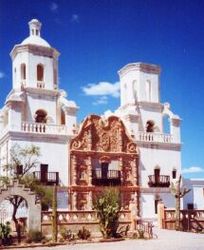
- San Xavier del Bac (O'odham [PapagoO'odham languageO'odham is an Uto-Aztecan language of southern Arizona and northern Sonora where the Tohono O'odham and Pima reside. As of the year 2000, there were estimated to be approximately 9750 speakers in the United States and Mexico combined, although there may be more due to underreporting...
]: Va:k), 16 miles south of Tucson, ArizonaTucson, ArizonaTucson is a city in and the county seat of Pima County, Arizona, United States. The city is located 118 miles southeast of Phoenix and 60 miles north of the U.S.-Mexico border. The 2010 United States Census puts the city's population at 520,116 with a metropolitan area population at 1,020,200...
, founded in 1692, the present building dates from 1785. The interior is richly decorated with ornaments showing a mixture of New SpainNew SpainNew Spain, formally called the Viceroyalty of New Spain , was a viceroyalty of the Spanish colonial empire, comprising primarily territories in what was known then as 'América Septentrional' or North America. Its capital was Mexico City, formerly Tenochtitlan, capital of the Aztec Empire...
and Native American artistic motifs. It is still used by Tohono O'odhamTohono O'odhamThe Tohono O'odham are a group of Native American people who reside primarily in the Sonoran Desert of the southeastern Arizona and northwest Mexico...
and Yaqui tribal members. - San Cosme y Damián de Tucsón: founded 1692
- La Purísima Concepción de Nuestra Señora de Caborca: founded 1693
- Santa María Suamca: founded 1693
- San Valentín de Busanic/Bisanig: founded 1693
- Nuestra Señora de Loreto y San Marcelo de Sonoyta: founded 1693
- Nuestra Señora de la Ascención de Opodepe: founded 1704
- Los Santos Reyes de Sonoita/San Ignacio de Sonoitac: a rancheriaRancheríaThe Spanish word ranchería, or rancherío, refers to a small, rural settlement. In the Americas the term was applied to native villages and to the workers' quarters of a ranch. English adopted the term with both these meanings, usually to designate the residential area of a rancho in the American...
near Tumacacori, founded 1692.
See also
- Indian ReductionsIndian ReductionsReductions were settlements founded by the Spanish colonizers of the New World with the purpose of assimilating indigenous populations into European culture and religion.Already since the beginning of the Spanish presence in the Americas, the Crown had been concerned...
- Jesuit ReductionsJesuit ReductionsA Jesuit Reduction was a type of settlement for indigenous people in Latin America created by the Jesuit Order during the 17th and 18th centuries. In general, the strategy of the Spanish Empire was to gather native populations into centers called Indian Reductions , in order to Christianize, tax,...
- Spanish colonization of the AmericasSpanish colonization of the AmericasColonial expansion under the Spanish Empire was initiated by the Spanish conquistadores and developed by the Monarchy of Spain through its administrators and missionaries. The motivations for colonial expansion were trade and the spread of the Christian faith through indigenous conversions...
External links
- Kino Missions, US National Park Service
- Arizona Education, Kino Missions
- In the Footsteps of a Bold Priest, New York Times
- Bibliography, Kino Missions