

Spain national basketball team

Encyclopedia
The Spanish national basketball team is the basketball team representing Spain in international competitions, organized and run by the Spanish Basketball Federation
. As of September 2011, they are the reigning European
champions and second in the FIBA World Rankings
for men.
. This event, which was held in Geneva
in the summer of 1935 was the first EuroBasket
in history. Spain finished 2nd and qualified for the 1936 Summer Olympics
in Berlin where basketball was introduced for the first time.
After this, the team disappeared from the EuroBasket
competition for over 20 years and reappeared at the EuroBasket 1959
in Turkey, where it finished 15th. In the following years, the selection slowly but surely worked its way up into the medal ranks again and appeared on the podium six more times between 1959 and 2007.
Then Spain came to host the 2007 Eurobasket
which was held in Madrid, Palma de Mallorca, Alicante, Seville and Granada. At this competition the same 12 players that won the 2006 FIBA World Championship
in Japan made it through to the final. This increased expectations for the Spanish national team to become the first national team to win the first Eurobasket
right after having won the previous FIBA World Championship
. However, Spain lost the final against Russia
with a tight score of 59–60 through a basket by a Russian player in the last seconds and an error of the Spaniard Pau Gasol
, at the last shoot. Spain thus took the silver medal.
Then, at the next Eurobasket 2009
Spain went to win the gold medal in this competition for the first time in its history. In 2011
, Spain returned to win the continental title for the second consecutive. Altogether, Spain has won ten Eurobasket
medals: two gold, six silver and two bronze.
 In the early years of the FIBA World Championship
, Spain struggled to establish a steady presence as a competitor. Between 1950 and 1970, the team only qualified once. Then, beginning in 1974 Spain developed into a serious competitor and regularly finished among the tournaments top performers for years to come.
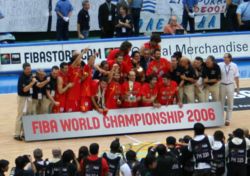
At the 2006 FIBA World Championship
, the Spanish team finally achieved the ultimate victory, the greatest success in its history. The date was 3 September 2006, as Spain won the gold medal game against the Greek national team
. Held in the Saitama Super Arena
in Japan, the game ended with a final score of 70–47.
Pau Gasol
was named the tournament MVP, and Jorge Garbajosa
also made the All-Tournament team.
Shortly afterwards, the team were awarded with the 2006 Prince of Asturias Award in Sports.
, where basketball was part of the games for the first time, expectations were high, for the runner-up of the 1935 EuroBasket. Unfortunately, as one of the favorites to win medals, Spain but could not attend the Games because of the outbreak of the Spanish Civil War
just days before the start of the Games.
Before the Spanish national team won the gold medal in the 2006 FIBA World Championship (see below), their greatest international success was reaching the final in the 1984 Summer Olympics Basketball Tournament
which took place in Los Angeles. The other finalist was the USA national team (led by Patrick Ewing
and featuring a young Michael Jordan
), which won the final and with it the gold medal. Spain, thus, took the Olympic silver medal.
Continuing the success started at the 2006 FIBA championship, Spain again reached the final at the 2008 Olympics
. This proved to be a rematch of the 1984 Olympic final; this time, the USA team was led by Kobe Bryant
and nicknamed the "Redeem Team". The Americans won after a remarkably close game and the Spanish team took its second Olympic silver medal.
where its selection won three gold medals, four silver and one bronze.
The European Championship
:
The FIBA World Championship
:
The Olympics
:
Mediterranean Games
:
!width="40"|Pos.
!width="165"|Starter
!width="165"|Bench
!width="165"|Bench
!width="165"|Reserve
!width="165"|Inactive
|-style="height:40px; background:white; color:black"
! style="background:#efe196" | C
| Marc Gasol
|| Serge Ibaka
|| || ||
|-style="height:40px; background:white; color:black"
! style="background:#efe196" | PF
| Pau Gasol
|| Felipe Reyes
|| || ||
|-style="height:40px; background:white; color:black"
! style="background:#efe196" | SF
| Rudy Fernández
|| Victor Claver
|| || ||
|-style="height:40px; background:white; color:black"
! style="background:#efe196" | SG
| Juan Carlos Navarro
|| Sergio Llull
|| Fernando San Emeterio
|| ||
|-style="height:40px; background:white; color:black"
! style="background:#efe196" | PG
| José Calderón
|| Ricky Rubio
|| Victor Sada
|| ||
|-style="height:40px; background:white; color:black"
|}
Rafael Martin, Emilio Alonso, Pedro Alonso, Juan Carbonell, Armando Maunier, Fernando Muscat, Cayetano Ortega, Rafael Ruano (Coach: Mariano Manent)
1950 World Championship: finished 9th among 10 teams
Ignacio Pinedo, Arturo Imedio, Jaime Basso, Andres Oller, Alvaro Salvadores, Juan Dalmau, Julio Gamez, Eduardo Kucharski, Angel Gonzalez, Angel Lozano, Domingo Barcenas, Juan Ferrando (Coach: Michael Paul Rutzgis)
1959 EuroBasket: finished 15th among 17 teams
Emiliano Rodriguez, Francisco “Nino” Buscato, Joaquin Hernandez, Alfonso Martinez Gomez, Jose Luis Martinez Gomez, Francisco Capel, Jorge Parra, Jose Lluis, Jose Brunet, Juan Canals, Francisco Borrell, Arturo Auladell (Coach: Gabriel Alberti)
1960 Olympic Games: finished 14th among 16 teams
Emiliano Rodriguez, Francisco “Nino” Buscato, Agustin Bertomeu, Jose Nora, Alfonso Martinez, Joaquin Ensenat, Santiago Navarro, Jose Lluis, Jorge Guillen, Jesus “Chus” Codina, Miguel Angel Gonzalez, Juan Martos (Coach: Eduardo Kucharski Gonzalez)
1961 EuroBasket: finished 13th among 19 teams
Emiliano Rodriguez, Francisco “Nino” Buscato, Manuel “Lolo” Sainz, Carlos Sevillano, Lorenzo Alocen, Jesus “Chus” Codina, Jose Lluis, Alfonso Martinez, Santiago Navarro, Juan Martos, Jose Nora, Javier Sanjuan (Coach: Fernando Font)
1963 EuroBasket: finished 7th among 16 teams
Manuel “Lolo” Sainz, Emiliano Rodriguez, Francisco “Nino” Buscato, Jose Ramon Ramos, Carlos Sevillano, Jose Manuel “Moncho” Monsalve, Jesus “Chus” Codina, Alfonso Martinez, Jose Lluis, Juan Antonio Martinez Arroyo, Miguel Angel Gonzalez, Arturo Auladell (Coach: Joaquin Hernandez Gallego)
1965 EuroBasket: finished 11th among 16 teams
Emiliano Rodriguez, Francisco “Nino” Buscato, Manuel “Lolo” Sainz, Jose Ramon Ramos, Carlos Sevillano, Jose Manuel “Moncho” Monsalve, Jose Lluis, Enrique Margall, Juan Antonio Martinez Arroyo, Miguel Angel Gonzalez, Juan Fa Busquets, Juan Bautista Urberuaga (Coach: Pedro Ferrandiz Gonzalez)
1967 EuroBasket: finished 10th among 16 teams
Francisco “Nino” Buscato, Emiliano Rodriguez, Jose Ramon Ramos, Jose Manuel “Moncho” Monsalve, Enrique Margall, Jose Luis Sagi-Vela, Antonio “Toncho” Nava, Alfonso Martinez, Ramon Guardiola, Angel Serrano, Carlos Luquero, Jose Laso (Coach: Antonio Diaz Miguel)
1968 Olympic Games: finished 7th among 16 teams
Clifford Luyk, Emiliano Rodriguez, Francisco “Nino” Buscato, Vicente Ramos, Lorenzo Alocen, Enrique Margall, Antonio “Toncho” Nava, Jose Luis Sagi-Vela, Alfonso Martinez, Jesus “Chus” Codina, Juan Antonio Martinez Arroyo, Luis Carlos Santiago Zabaleta (Coach: Antonio Diaz Miguel)
1969 EuroBasket: finished 5th among 12 teams
Clifford Luyk, Emiliano Rodriguez, Francisco “Nino” Buscato, Lorenzo Alocen, Vicente Ramos, Antonio “Toncho” Nava, Enrique Margall, Jose Luis Sagi-Vela, Jesus “Chus” Codina, Cristobal Rodriguez, Alfonso Martinez, Victor Manuel Escorial (Coach: Antonio Diaz Miguel)
1971 EuroBasket: finished 7th among 12 teams
Wayne Brabender, Clifford Luyk, Emiliano Rodriguez, Francisco “Nino” Buscato, Vicente Ramos, Rafael Rullan, Luis Miguel Santillana, Jose Luis Sagi-Vela, Enrique Margall, Cristobal Rodriguez, Juan Martinez, Juan Antonio Martinez Arroyo (Coach: Antonio Diaz Miguel)
1972 Olympic Games: finished 11th among 16 teams
Juan Antonio Corbalan, Wayne Brabender, Clifford Luyk, Francisco “Nino” Buscato, Vicente Ramos, Rafael Rullan, Luis Miguel Santillana, Enrique Margall, Carmelo Cabrera, Jesus Iradier, Miguel Angel Estrada, Gonzalo Sagi-Vela (Coach: Antonio Diaz Miguel)
1973 EuroBasket: finished 2nd among 12 teams
Clifford Luyk, Wayne Brabender, Francisco ‘Nino’ Buscato, Vicente Ramos, Rafael Rullan, Manuel Flores, Luis Miguel Santillana, Carmelo Cabrera, Jose Luis Sagi-Vela, Gonzalo Sagi-Vela, Miguel Angel Estrada, Enrique Margall (Coach: Antonio Diaz Miguel)
1974 World Championship: finished 5th among 14 teams
Juan Antonio Corbalan, Wayne Brabender, Clifford Luyk, Vicente Ramos, Manuel Flores, Luis Miguel Santillana, Jose Luis Sagi-Vela, Rafael Rullan, Cristobal Rodriguez, Carmelo Cabrera, Jesus Iradier, Miguel Angel Estrada (Coach: Antonio Diaz Miguel)
1975 EuroBasket: finished 4th among 12 teams
Wayne Brabender, Juan Antonio Corbalan, Clifford Luyk, Rafael Rullan, Luis Miguel Santillana, Cristobal Rodriguez, Carmelo Cabrera, Manuel Flores, Jesus Iradier, Miguel Angel Estrada, Miguel Angel Lopez Abril, Juan Filba (Coach: Antonio Diaz Miguel)
1977 EuroBasket: finished 9th among 12 teams
Wayne Brabender, Juan Antonio Corbalan, Luis Miguel Santillana, Rafael Rullan, Manuel Flores, Carmelo Cabrera, Juan Domingo de la Cruz, Josep Maria Margall, Gonzalo Sagi-Vela, Luis Maria Prada, Joan Filba, Juan Ramon Fernandez (Coach: Antonio Diaz Miguel)
1979 EuroBasket: finished 6th among 12 teams
Juan Antonio Corbalan, Juan Antonio San Epifanio “Epi”, Wayne Brabender, Rafael Rullan, Manuel Flores, Luis Miguel Santillana, Juan Domingo de la Cruz, Juan Manuel Lopez Iturriaga, Joaquim Costa, Jose Luis Llorente, Josep Maria Margall, Pedro Cesar Ansa (Coach: Antonio Diaz Miguel)
1980 Olympic Games: finished 4th among 12 teams
Juan Antonio San Epifanio “Epi”, Juan Antonio Corbalan, Wayne Brabender, Ignacio “Nacho” Solozabal, Candido Antonio “Chicho” Sibilio, Fernando Romay, Manuel Flores, Luis Miguel Santillana, Juan Domingo de la Cruz, Juan Manuel Lopez Iturriaga, Jose Luis Llorente, Josep Maria Margall (Coach: Antonio Diaz Miguel)
1981 EuroBasket: finished 4th among 12 teams
Juan Antonio San Epifanio “Epi”, Juan Antonio Corbalan, Wayne Brabender, Ignacio “Nacho” Solozabal, Candido Antonio “Chicho” Sibilio, Fernando Martin, Fernando Romay, Manuel Flores, Rafael Rullan, Juan Domingo de la Cruz, Joaquim Costa, Josep Maria Margall (Coach: Antonio Diaz Miguel)
1982 World Championship: finished 4th among 13 teams
Juan Antonio San Epifanio “Epi”, Juan Antonio Corbalan, Candido Antonio “Chicho” Sibilio, Wayne Brabender, Ignacio “Nacho” Solozabal, Fernando Martin, Andres Jimenez, Fernando Romay, Juan Domingo de la Cruz, Juan Manuel Lopez Iturriaga, Joaquim Costa, Josep Maria Margall (Coach: Antonio Diaz Miguel)
1983 EuroBasket: finished 2nd among 12 teams
Juan Antonio San Epifanio “Epi”, Juan Antonio Corbalan, Fernando Martin, Candido Antonio “Chicho” Sibilio, Ignacio “Nacho” Solozabal, Joan “Chichi” Creus, Juan Domingo de la Cruz, Juan Manuel Lopez Iturriaga, Fernando Romay, Josep Maria Margall, Andres Jimenez, Fernando Arcega (Coach: Antonio Diaz Miguel)
1984 Olympic Games: finished 2nd among 12 teams
Juan Antonio San Epifanio “Epi”, Juan Antonio Corbalan, Fernando Martin, Ignacio “Nacho” Solozabal, Juan Domingo de la Cruz, Juan Manuel Lopez Iturriaga, Fernando Romay, Andres Jimenez, Josep Maria Margall, Jose Luis Llorente, Fernando Arcega, Jose Manuel Beiran (Coach: Antonio Diaz Miguel)
1985 EuroBasket: finished 4th among 12 teams
Juan Antonio San Epifanio “Epi”, Candido Antonio “Chicho” Sibilio, Fernando Martin, Jordi Villacampa, Fernando Romay, Andres Jimenez, Jose Luis Llorente, Juan Domingo de la Cruz, Juan Manuel Lopez Iturriaga, Joaquim Costa, Josep Maria Margall, Vicente Gil (Coach: Antonio Diaz Miguel)
1986 World Championship: finished 5th among 24 teams
Fernando Martin, Juan Antonio San Epifanio “Epi”, Ignacio “Nacho” Solozabal, Jordi Villacampa, Candido Antonio “Chicho” Sibilio, Joan “Chichi” Creus, Andres Jimenez, Fernando Romay, Juan Domingo de la Cruz, Joaquim Costa, Josep Maria Margall, Fernando Arcega (Coach: Antonio Diaz Miguel)
1987 EuroBasket: finished 4th among 12 teams
Juan Antonio San Epifanio “Epi”, Jordi Villacampa, Candido Antonio “Chicho” Sibilio, Ignacio “Nacho” Solozabal, Andres Jimenez, Fernando Romay, Ferran Martinez, Josep Maria Margall, Jose Antonio Montero, Francisco Javier Zapata, Fernando Arcega, Jose Angel Arcega (Coach: Antonio Diaz Miguel)
1988 Olympic Games: finished 8th among 12 teams
Juan Antonio San Epifanio “Epi”, Jordi Villacampa, Ignacio “Nacho” Solozabal, Andres Jimenez, Ferran Martinez, Jose Biriukov, Enrique “Quique” Andreu, Antonio Martin, Josep Maria Margall, Jose Antonio Montero, Jose Luis Llorente, Fernando Arcega (Coach: Antonio Diaz Miguel)
1989 EuroBasket: finished 5th among 8 teams
Juan Antonio San Epifanio “Epi”, Jose Biriukov, Andres Jimenez, Jose Antonio Montero, Juan Antonio Morales, Ferran Martinez, Pablo Laso, Enrique “Quique” Andreu, Rafael Vecina, Enrique Villalobos, Jose Angel Arcega, Manuel Angel Aller (Coach: Antonio Diaz Miguel)
1990 World Championship: finished 10th among 16 teams
Jordi Villacampa, Alberto Herreros, Ferran Martinez, Andres Jimenez, Fernando Romay, Rafael Jofresa, Enrique “Quique” Andreu, Jose Antonio Montero, Manel Bosch, Jose Miguel Antunez, Jose Angel Arcega, Francisco Javier Zapata (Coach: Antonio Diaz Miguel)
1991 EuroBasket: finished 3rd among 8 teams
Juan Antonio San Epifanio “Epi”, Jordi Villacampa, Mike Hansen, Josep “Pep” Cargol, Rafael Jofresa, Enrique “Quique” Andreu, Manel Bosch, Antonio Martin, Juan Antonio Orenga, Jose Miguel Antunez, Fernando Arcega, Silvano Bustos (Coach: Antonio Diaz Miguel)
1992 Olympic Games: finished 9th among 12 teams
Jordi Villacampa, Juan Antonio San Epifanio “Epi”, Andres Jimenez, Alberto Herreros, Rafael Jofresa, Jose Biriukov, Javier “Xavi” Fernandez, Juan Antonio Orenga, Enrique “Quique” Andreu, Tomas Jofresa, Santiago Aldama, Jose Angel Arcega (Coach: Antonio Diaz Miguel)
1993 EuroBasket: finished 5th among 16 teams
Jordi Villacampa, Juan Antonio San Epifanio “Epi”, Alberto Herreros, Ferran Martinez, Andres Jimenez, Rafael Jofresa, Tomas Jofresa, Juan Antonio Orenga, Juan Antonio Morales, Antonio Martin, Ignacio “Nacho” Azofra, Xavier “Xavi” Crespo (Coach: Manuel “Lolo” Sainz)
1994 World Championship: finished 10th among 16 teams
Jordi Villacampa, Juan Antonio San Epifanio “Epi”, Andres Jimenez, Alberto Herreros, Ferran Martinez, Rafael Jofresa, Juan Antonio Orenga, Pablo Laso, Jose Miguel Antunez, Enrique “Quique” Andreu, Josep “Pep” Cargol, Rafael Vecina (Coach: Manuel “Lolo” Sainz)
1995 EuroBasket: finished 6th among 14 teams
Alberto Herreros, Mike Smith, Pablo Laso, Ferran Martinez, Juan Antonio Orenga, Antonio Martin, Ignacio “Nacho” Rodriguez, Jose Luis Galilea, Alberto Angulo, Javier “Xavi” Fernandez, Alfonso Reyes, Francisco Jose “Fran” Murcia (Coach: Manuel “Lolo” Sainz)
1997 EuroBasket: finished 5th among 16 teams
Alberto Herreros, Ferran Martinez, Mike Smith, Rafael Jofresa, Tomas Jofresa, Roberto Dueñas, Juan Antonio Orenga, Roger Esteller, Ignacio “Nacho” Rodriguez, Alfonso Reyes, Jose Antonio Paraiso, Alberto Angulo (Coach: Manuel “Lolo” Sainz)
1998 World Championship: finished 5th among 16 teams
Alberto Herreros, Roberto Dueñas, Juan Antonio Orenga, Ignacio “Nacho” Rodriguez, Carlos Jimenez, Rodrigo de la Fuente, Ignacio “Nacho” Azofra, Alberto Angulo, Alfonso Reyes, Ignacio “Inaki” de Miguel, Jose Antonio Paraiso, Jose Ignacio “Nacho” Rodilla (Coach: Manuel “Lolo” Sainz)
1999 EuroBasket: finished 2nd among 16 teams
Alberto Herreros, Carlos Jimenez, Roberto Dueñas, Roger Esteller, Alberto Angulo, Ignacio “Nacho” Rodriguez, Rodrigo de la Fuente, Ignacio “Inaki” de Miguel, Alfonso Reyes, Juan Ignacio Romero, Jose Ignacio “Nacho” Rodilla, Ivan Corrales (Coach: Manuel “Lolo” Sainz)
2000 Olympic Games: finished 9th among 12 teams
Jorge Garbajosa, Johnny Rogers, Alberto Herreros, Raul Lopez, Roberto Dueñas, Juan Carlos Navarro, Carlos Jimenez, Rodrigo de la Fuente, Alfonso Reyes, Alberto Angulo, Ignacio “Nacho” Rodriguez, Ignacio “Inaki” de Miguel (Coach: Manuel “Lolo” Sainz)
2001 EuroBasket: finished 3rd among 16 teams
Pau Gasol, Jorge Garbajosa, Juan Carlos Navarro, Charles “Chuck” Kornegay, Raul Lopez, Carlos Jimenez, Ignacio “Nacho” Rodriguez, Felipe Reyes, Alfonso Reyes, Jose Antonio Paraiso, Francisco “Paco” Vazquez, Lucio Angulo (Coach: Javier Imbroda)
2002 World Championship: finished 5th among 16 teams
Pau Gasol, Juan Carlos Navarro, Jorge Garbajosa, Jose Calderon, Carlos Jimenez, Felipe Reyes, Alfonso Reyes, Ignacio “Nacho” Rodriguez, Jose Antonio Paraiso, Carles Marco, Lucio Angulo, Oriol Junyent (Coach: Javier Imbroda)
2003 EuroBasket: finished 2nd among 16 teams
Pau Gasol, Juan Carlos Navarro, Jorge Garbajosa, Jose Calderon, Carlos Jimenez, Carles Marco, Felipe Reyes, Rodrigo de la Fuente, Alfonso Reyes, Roger Grimau, Alberto Herreros, Antonio Bueno (Coach: Ramon “Moncho” Lopez)
2004 Olympic Games: finished 7th among 12 teams
Pau Gasol, Juan Carlos Navarro, José Calderon, Jorge Garbajosa, Roberto Dueñas, Carlos Jiménez, Rudy Fernandez, Rodrigo de la Fuente, Felipe Reyes, Iker Iturbe, Jaume Comas, Óscar Yebra (Coach: Mario Pesquera)
2005 EuroBasket: finished 4th among 16 teams
Juan Carlos Navarro, Jorge Garbajosa, Jose Calderón, Rudy Fernández, Carlos Jiménez, Fran Vázquez, Felipe Reyes, Carlos Cabezas, Sergi Vidal, Iker Iturbe, Sergio Rodriguez, Ignacio “Inaki” de Miguel (Coach: Mario Pesquera)
2006 World Championship: finished 1st among 24 teams
Pau Gasol, Juan Carlos Navarro, Jose Calderon, Jorge Garbajosa, Rudy Fernandez, Carlos Jiménez, Carlos Cabezas, Bernardo “Berni” Rodríguez, Felipe Reyes, Marc Gasol, Alex Mumbrú, Sergio Rodríguez (Coach: Jose Vicente “Pepu” Hernández)
2007 EuroBasket: finished 2nd among 16 teams
Pau Gasol, Juan Carlos Navarro, Jose Calderón, Rudy Fernández, Jorge Garbajosa, Carlos Jiménez, Carlos Cabezas, Bernardo “Berni” Rodríguez, Felipe Reyes, Marc Gasol, Sergio Rodríguez, Alex Mumbrú (Coach: Jose Vicente “Pepu” Hernández)
2008 Olympic Games: finished 2nd among 12 teams
Pau Gasol, Rudy Fernández, Ricky Rubio, Juan Carlos Navarro, José Calderón, Felipe Reyes, Carlos Jiménez, Raúl López, Berni Rodríguez, Marc Gasol, Alex Mumbrú, Jorge Garbajosa (Coach: Aíto García Reneses)
2009 EuroBasket: finished 1st among 16 teams
Pau Gasol, Rudy Fernández, Juan Carlos Navarro, Ricky Rubio, Felipe Reyes, Marc Gasol, Raúl López, Alex Mumbrú, Jorge Garbajosa, Carlos Cabezas, Víctor Claver, Sergio Llull, (Coach: Sergio Scariolo)
2010 World Championship: finished 6th among 24 teams
Fernando San Emeterio, Rudy Fernández, Ricky Rubio, Juan Carlos Navarro, Raúl López, Felipe Reyes, Víctor Claver, Fran Vázquez, Sergio Llull, Marc Gasol, Álex Mumbrú, Jorge Garbajosa, (Coach: Sergio Scariolo)
2011 EuroBasket: finished 1st among 16 teams
Pau Gasol, Rudy Fernández, Ricky Rubio, Juan Carlos Navarro, José Calderón, Felipe Reyes, Víctor Claver, Fernando San Emeterio, Sergio Llull, Marc Gasol, Serge Ibaka, Víctor Sada, (Coach: Sergio Scariolo)
Spanish Basketball Federation
The Spanish Basketball Federation is the national governing body of basketball in Spain....
. As of September 2011, they are the reigning European
Eurobasket
The EuroBasket, also referred to as the FIBA European Basketball Championship, is the main basketball competition contested biennially by the men's national teams governed by FIBA Europe, the European zone within the International Basketball Federation. The championship was first held in 1935 and...
champions and second in the FIBA World Rankings
FIBA World Rankings
The International Basketball Federation calculates the world rankings of all of its basketball teams.-Calculation:...
for men.
EuroBasket
The first game in the history of the selection was a friendly game before the 1935 Eurobasket, where Spain faced the selection of PortugalPortugal national basketball team
The Portuguese national basketball team is the basketball side that represents Portugal in international competition. Portugal never had great success in the past at international level, but have qualified for the Eurobasket three times, more recently in EuroBasket 2011...
. This event, which was held in Geneva
Geneva
Geneva In the national languages of Switzerland the city is known as Genf , Ginevra and Genevra is the second-most-populous city in Switzerland and is the most populous city of Romandie, the French-speaking part of Switzerland...
in the summer of 1935 was the first EuroBasket
Eurobasket
The EuroBasket, also referred to as the FIBA European Basketball Championship, is the main basketball competition contested biennially by the men's national teams governed by FIBA Europe, the European zone within the International Basketball Federation. The championship was first held in 1935 and...
in history. Spain finished 2nd and qualified for the 1936 Summer Olympics
1936 Summer Olympics
The 1936 Summer Olympics, officially known as the Games of the XI Olympiad, was an international multi-sport event which was held in 1936 in Berlin, Germany. Berlin won the bid to host the Games over Barcelona, Spain on April 26, 1931, at the 29th IOC Session in Barcelona...
in Berlin where basketball was introduced for the first time.
After this, the team disappeared from the EuroBasket
Eurobasket
The EuroBasket, also referred to as the FIBA European Basketball Championship, is the main basketball competition contested biennially by the men's national teams governed by FIBA Europe, the European zone within the International Basketball Federation. The championship was first held in 1935 and...
competition for over 20 years and reappeared at the EuroBasket 1959
EuroBasket 1959
The EuroBasket 1959 was the 11th EuroBasket, the biennial regional basketball championship contested by European nations and held by FIBA Europe. The tournament, which was hosted by Turkey, began on 21 May 1959 and concluded with the final on 31 May 1959. Seventeen national teams affiliated with...
in Turkey, where it finished 15th. In the following years, the selection slowly but surely worked its way up into the medal ranks again and appeared on the podium six more times between 1959 and 2007.
Then Spain came to host the 2007 Eurobasket
Eurobasket 2007
-Group B:-Group C:-Group D:-Second round:- Group E :- Group F :-Championship bracket:- Quarterfinals :-Classification rounds:- Semifinals :- Third place game:- Final :...
which was held in Madrid, Palma de Mallorca, Alicante, Seville and Granada. At this competition the same 12 players that won the 2006 FIBA World Championship
2006 FIBA World Championship
The 2006 FIBA World Championship was an international basketball competition hosted by Japan from August 19 to September 3, 2006. It was co-organised by the International Basketball Federation , Japan Basketball Association and the 2006 Organizing Committee...
in Japan made it through to the final. This increased expectations for the Spanish national team to become the first national team to win the first Eurobasket
Eurobasket
The EuroBasket, also referred to as the FIBA European Basketball Championship, is the main basketball competition contested biennially by the men's national teams governed by FIBA Europe, the European zone within the International Basketball Federation. The championship was first held in 1935 and...
right after having won the previous FIBA World Championship
FIBA World Championship
The FIBA World Championship is an international basketball competition contested by the men's national teams of the members of the International Basketball Federation , the sport's global governing body...
. However, Spain lost the final against Russia
Russia national basketball team
The Russian national basketball team represents Russia in international basketball matches. The team came into existence after the dissolution of the Soviet Union and its powerful basketball team. It has won 2 silver medals in the FIBA World Championships...
with a tight score of 59–60 through a basket by a Russian player in the last seconds and an error of the Spaniard Pau Gasol
Pau Gasol
Pau Gasol Sáez is a Spanish professional basketball player for the Los Angeles Lakers of the National Basketball Association . He was born to Marisa Sáez and Agustí Gasol, and he spent his childhood in Spain...
, at the last shoot. Spain thus took the silver medal.
Then, at the next Eurobasket 2009
EuroBasket 2009
The EuroBasket 2009 was the 36th EuroBasket, the biennial regional basketball championship contested by European nations and held by FIBA Europe. The tournament, which was hosted by Poland, began on 7 September 2009 and concluded with the final on 20 September 2009...
Spain went to win the gold medal in this competition for the first time in its history. In 2011
Eurobasket 2011
EuroBasket 2011 was the 37th men's European Basketball Championship, held by FIBA Europe. The competition was hosted by Lithuania. This was the second time Eurobasket had been held in Lithuania, the country having also hosted the 1939 championship. FIBA Europe asserted that Lithuania managed to...
, Spain returned to win the continental title for the second consecutive. Altogether, Spain has won ten Eurobasket
Eurobasket
The EuroBasket, also referred to as the FIBA European Basketball Championship, is the main basketball competition contested biennially by the men's national teams governed by FIBA Europe, the European zone within the International Basketball Federation. The championship was first held in 1935 and...
medals: two gold, six silver and two bronze.
FIBA World championship
FIBA World Championship
The FIBA World Championship is an international basketball competition contested by the men's national teams of the members of the International Basketball Federation , the sport's global governing body...
, Spain struggled to establish a steady presence as a competitor. Between 1950 and 1970, the team only qualified once. Then, beginning in 1974 Spain developed into a serious competitor and regularly finished among the tournaments top performers for years to come.
At the 2006 FIBA World Championship
2006 FIBA World Championship
The 2006 FIBA World Championship was an international basketball competition hosted by Japan from August 19 to September 3, 2006. It was co-organised by the International Basketball Federation , Japan Basketball Association and the 2006 Organizing Committee...
, the Spanish team finally achieved the ultimate victory, the greatest success in its history. The date was 3 September 2006, as Spain won the gold medal game against the Greek national team
Greece national basketball team
The Greece national basketball team is the representative for Greece in international men's basketball competitions, organized and run by the Hellenic Basketball Federation. Traditionally, Greece is considered among the world's top basketball powers; they were runners-up in the 2006 FIBA World...
. Held in the Saitama Super Arena
Saitama Super Arena
is a multi-purpose indoor arena located in Chūō-ku, Saitama City, Saitama, Japan. Its spectator capacity is 37,000 at maximum settings.This main arena capacity is between 19,000-22,500 when events such as basketball, volleyball, tennis, ice hockey, gymnastics, boxing, mixed martial arts and...
in Japan, the game ended with a final score of 70–47.
Pau Gasol
Pau Gasol
Pau Gasol Sáez is a Spanish professional basketball player for the Los Angeles Lakers of the National Basketball Association . He was born to Marisa Sáez and Agustí Gasol, and he spent his childhood in Spain...
was named the tournament MVP, and Jorge Garbajosa
Jorge Garbajosa
Jorge Garbajosa Chaparro, Jr., nicknamed "Garbo" , is a Spanish professional basketball player. At 2.07 m , he plays both power forward and small forward.-Pro career:*1994-97 Taugres*1997-00 TAU Cerámica...
also made the All-Tournament team.
Shortly afterwards, the team were awarded with the 2006 Prince of Asturias Award in Sports.
Summer Olympics
When Spain qualified for the 1936 Summer Olympics1936 Summer Olympics
The 1936 Summer Olympics, officially known as the Games of the XI Olympiad, was an international multi-sport event which was held in 1936 in Berlin, Germany. Berlin won the bid to host the Games over Barcelona, Spain on April 26, 1931, at the 29th IOC Session in Barcelona...
, where basketball was part of the games for the first time, expectations were high, for the runner-up of the 1935 EuroBasket. Unfortunately, as one of the favorites to win medals, Spain but could not attend the Games because of the outbreak of the Spanish Civil War
Spanish Civil War
The Spanish Civil WarAlso known as The Crusade among Nationalists, the Fourth Carlist War among Carlists, and The Rebellion or Uprising among Republicans. was a major conflict fought in Spain from 17 July 1936 to 1 April 1939...
just days before the start of the Games.
Before the Spanish national team won the gold medal in the 2006 FIBA World Championship (see below), their greatest international success was reaching the final in the 1984 Summer Olympics Basketball Tournament
Basketball at the 1984 Summer Olympics
-Group B:-Championship bracket:-Classification brackets:5th–8th Place9th–12th Place-Preliminary Round:...
which took place in Los Angeles. The other finalist was the USA national team (led by Patrick Ewing
Patrick Ewing
Patrick Aloysius Ewing Sr. is a Jamaican-American retired Hall of Fame basketball player and current assistant coach for the National Basketball Association's Orlando Magic. He played most of his career with the NBA's New York Knicks as their starting center and played briefly with the Seattle...
and featuring a young Michael Jordan
Michael Jordan
Michael Jeffrey Jordan is a former American professional basketball player, active entrepreneur, and majority owner of the Charlotte Bobcats...
), which won the final and with it the gold medal. Spain, thus, took the Olympic silver medal.
Continuing the success started at the 2006 FIBA championship, Spain again reached the final at the 2008 Olympics
Basketball at the 2008 Summer Olympics - Men
The men's tournament of basketball at the 2008 Olympics at Beijing, China began on August 10 and ended on August 24, when the United States defeated Spain 118-107 for the gold medal. All games were held at the Wukesong Indoor Stadium.-Qualifying:-Format:...
. This proved to be a rematch of the 1984 Olympic final; this time, the USA team was led by Kobe Bryant
Kobe Bryant
Kobe Bean Bryant is an American professional basketball player who plays shooting guard for the Los Angeles Lakers of the National Basketball Association . Bryant enjoyed a successful high school basketball career at Lower Merion High School, where he was recognized as the top high school...
and nicknamed the "Redeem Team". The Americans won after a remarkably close game and the Spanish team took its second Olympic silver medal.
Media controversy prior to the 2008 Beijing Olympic Games
In August 2008, prior to their competing in the 2008 Summer Olympic Games, the Spanish national men's basketball team were photographed posing in what British media reports described as a 'racist' and 'insensitive' image. The image was requested for an advertising campaign for a courier company and was published in a Spanish national daily sports newspaper.Other Events
Besides remarkable success at the "Big Three" events (Olympic Games, World Championship and EuroBasket) Spain has shown success at the Mediterranean GamesBasketball at the Mediterranean Games
Basketball has been played consistently at the Mediterranean Games since the year 1951 for men and since the year 1987 for women. The Yugoslavian national basketball team is the most successful men's team and the Croatian women's national basketball team is the most successful team for women.-Men's...
where its selection won three gold medals, four silver and one bronze.
Medal record
The Spanish national team's medal record through the years:The European Championship
Eurobasket
The EuroBasket, also referred to as the FIBA European Basketball Championship, is the main basketball competition contested biennially by the men's national teams governed by FIBA Europe, the European zone within the International Basketball Federation. The championship was first held in 1935 and...
:
- Gold medal (2): 2009EuroBasket 2009The EuroBasket 2009 was the 36th EuroBasket, the biennial regional basketball championship contested by European nations and held by FIBA Europe. The tournament, which was hosted by Poland, began on 7 September 2009 and concluded with the final on 20 September 2009...
, 2011Eurobasket 2011EuroBasket 2011 was the 37th men's European Basketball Championship, held by FIBA Europe. The competition was hosted by Lithuania. This was the second time Eurobasket had been held in Lithuania, the country having also hosted the 1939 championship. FIBA Europe asserted that Lithuania managed to... - Silver medals (6): 1935Eurobasket 1935The 1935 European Basketball Championship, commonly called Eurobasket 1935, was the first Eurobasket regional championship held by FIBA Europe as well as a test event preceding the first Olympic basketball tournament at the 1936 Summer Olympics. Ten national teams affiliated with the International...
, 1973EuroBasket 1973-Venues:-Group A - Badalona:-Group B - Barcelona:-Places 9 - 12:-Places 5 - 8:-Places 1 - 4:-Finals:-Final rankings:# # # # # # # # # # # # -Team rosters:...
, 1983EuroBasket 1983-Venues:-Group A - Limoges :-Group B - Cannes :-Places 9 - 12:-Places 5 - 8:-Places 1 - 4:-Finals:-Final rankings:# # # # # # # # # # # # -Team rosters:...
, 1999EuroBasket 1999-Group B:-Group C:-Group D:-Second round:- Group E :- Group F :-Championship bracket:-5th place bracket:- Quarterfinals :-Classification rounds:- Semifinals :- Third place game:- Final :...
, 2003Eurobasket 2003-5th to 8th place:-Awards:-All-Tournament Team : Tony Parker Šarūnas Jasikevičius Saulius Štombergas Andrei Kirilenko Pau Gasol-Top scorers :# Pau Gasol 25.8# Andrei Kirilenko 23.1# Dirk Nowitzki 22.5# Mehmet Okur 18.7...
, 2007Eurobasket 2007-Group B:-Group C:-Group D:-Second round:- Group E :- Group F :-Championship bracket:- Quarterfinals :-Classification rounds:- Semifinals :- Third place game:- Final :... - Bronze medals (2): 1991EuroBasket 1991Eurobasket 1991 was the tournament contested by men's professional basketball teams from Europe. It was hosted by Italy.-Group A:-Group B:-Places 5 - 8:-Places 1 - 4:-Finals:-Final rankings:# # # # # # # # -Team rosters:...
, 2001EuroBasket 2001The EuroBasket 2001 was the 32nd EuroBasket, the biennial regional basketball championship contested by European nations and held by FIBA Europe. The tournament, which was hosted by Turkey, began on 31 August 2001 and concluded with the final on 9 September 2001. Yugoslavia won the gold medal,...
The FIBA World Championship
FIBA World Championship
The FIBA World Championship is an international basketball competition contested by the men's national teams of the members of the International Basketball Federation , the sport's global governing body...
:
- Gold medal at the 2006 FIBA World Championship2006 FIBA World ChampionshipThe 2006 FIBA World Championship was an international basketball competition hosted by Japan from August 19 to September 3, 2006. It was co-organised by the International Basketball Federation , Japan Basketball Association and the 2006 Organizing Committee...
The Olympics
Basketball at the Summer Olympics
Basketball has been a Summer Olympics sport for men consistently since 1936. Prior to its inclusion as a medal sport, it was held as demonstration event in 1904 and 1932, both in the United States. Women's basketball was played in the Olympics only since 1976....
:
- Silver medal at the 1984 OlympicsBasketball at the 1984 Summer Olympics-Group B:-Championship bracket:-Classification brackets:5th–8th Place9th–12th Place-Preliminary Round:...
- Silver medal at the 2008 OlympicsBasketball at the 2008 Summer OlympicsBasketball contests at the 2008 Olympic Games were held from August 9, 2008 to August 24, 2008. Competitions were held at the Wukesong Indoor Stadium in Beijing, China...
Mediterranean Games
Basketball at the Mediterranean Games
Basketball has been played consistently at the Mediterranean Games since the year 1951 for men and since the year 1987 for women. The Yugoslavian national basketball team is the most successful men's team and the Croatian women's national basketball team is the most successful team for women.-Men's...
:
- Gold medals (3): 19551955 Mediterranean GamesThe second Mediterranean Games were held in the Olympic Stadium and Palace of sport of Barcelona, from July 16 to 25, 1955. The stadium was built in 1929 and was especially renovated for the occasion. The symbol of an amphora filled with Mediterranean Sea water was then used for the first time.The...
, 19971997 Mediterranean GamesThe 13th edition of the Mediterranean Games were held in Bari, Italy from the 13th to the 25th of June 1997. Twenty one nations competed in 27 different sporting events.- Medal table :- External link and reference :* -See also:***...
, 20012001 Mediterranean GamesThe 14th edition of the Mediterranean Games were held in Tunis, the capital city of Tunisia, from 2 to 15 September 2001. Twenty three nations competed in 23 different sporting events. France won the most gold medals in the competition while Italy had the greatest medal haul overall with 136 in... - Silver medals (4): 1951Basketball at the 1951 Mediterranean GamesThe basketball tournament at the 1951 Mediterranean Games was held in Alexandria, Egypt.-Medalists:-References:...
, 19591959 Mediterranean GamesAfter visiting Africa and Europe, the Mediterranean Games were for the first time held in Asia in the Lebanese capital of Beirut, thus completing the trio of continents belonging to the Mediterranean Sea...
, 19631963 Mediterranean GamesThe fourth edition of the Mediterranean Games were held in Naples, Italy from September 21 to September 29, 1963. Thirteen nations competed in 18 sports.-Medal table:-References:* **...
, 19871987 Mediterranean GamesThe 10th edition of the Mediterranean Games was held in Latakia, Syria from the 11th to the 25th of September 1987. Eighteen nations competed in 19 different sporting events.-Medal table:-External link and reference:* -See also:... - Bronze medal (1): 2005Basketball at the 2005 Mediterranean GamesThe Basketball Tournament at the 2005 Mediterranean Games was held in the El Ejido Sports Hall from Friday June 24 to Friday July 1, 2005 in Almería, Spain.-Rosters:*...
Olympic Games
| Olympic Games Record Basketball at the Summer Olympics Basketball has been a Summer Olympics sport for men consistently since 1936. Prior to its inclusion as a medal sport, it was held as demonstration event in 1904 and 1932, both in the United States. Women's basketball was played in the Olympics only since 1976.... |
||||
|---|---|---|---|---|
| Year | Position | Pld | W | L |
 1936 1936Basketball at the 1936 Summer Olympics -Fifth-place classification:-First round:Winners advanced to the second round. Losers competed in the first consolation round for another chance to move on.* Estonia def. France, 34-29* Chile def. Turkey, 30-16* Switzerland def. Germany, 25-18... |
Did not enter | |||
| 1948 Basketball at the 1948 Summer Olympics Basketball at the 1948 Summer Olympics was the second appearance of the sport as an official medal event. A total number of 23 nations entered the competition.... to 1956 Basketball at the 1956 Summer Olympics Basketball at the 1956 Summer Olympics was the fourth appearance of the sport in Olympic competition. Fifteen nations, an unusually low number for the basketball tournament, competed in the event, with 174 participants. A total number of 56 games of basketball were played.The teams were divided... |
Did not qualify | |||
 1960 1960Basketball at the 1960 Summer Olympics Basketball at the 1960 Summer Olympics was the fifth appearance of the sport in Olympic competition. 16 nations were admitted into the Olympic tournament, with many others being eliminated in a pre-Olympic tournament held earlier in the year from 13 to 20 August 1960 at the Sports Palace at Bologna... |
11th place | 7 | 2 | 5 |
 1964 1964Basketball at the 1964 Summer Olympics Basketball contests at the 1964 Summer Olympics took place at the Yoyogi National Gymnasium in Tokyo, Japan from October 11 to October 23. The United States defeated the Soviet Union to win their sixth straight gold medal at this event, while Brazil earned the bronze against Puerto... |
Did not qualify | |||
 1968 1968Basketball at the 1968 Summer Olympics -Group B:October 13October 14October 15October 16October 18October 19October 20-Medal bracket:-Classification brackets:5th–8th Place9th–12th Place... |
7th place | 9 | 5 | 4 |
 1972 1972Basketball at the 1972 Summer Olympics -Group B:-Medal bracket:-Classification brackets:5th–8th Place9th–12th Place13th–16th Place Forfeited match.-Gold Medal Match controversy:... |
11th place | 9 | 4 | 5 |
 1976 1976Basketball at the 1976 Summer Olympics Basketball contests at the 1976 Summer Olympics took place from July 18 to July 27 at the Centre Étienne Desmarteau and the Montreal Forum in Montreal, Canada. Women's basketball was introduced to the Olympic program for the first time at this Games... |
Did not qualify | |||
 1980 1980Basketball at the 1980 Summer Olympics Basketball at the 1980 Summer Olympics was held from July 20 to July 30 at the Olympiiski Indoor Stadium and at the CSKA Sports Palace, both located in Moscow. Finals of both men's and women's events were held 30 July at the Olympiiski Indoor Stadium.... |
4th place | 8 | 4 | 4 |
 1984 1984Basketball at the 1984 Summer Olympics -Group B:-Championship bracket:-Classification brackets:5th–8th Place9th–12th Place-Preliminary Round:... |
Runner-up | 8 | 6 | 2 |
 1988 1988Basketball at the 1988 Summer Olympics Basketball at the 1988 Summer Olympics took place at the Jamsil Gymnasium in Seoul, South Korea. The United States won the gold medal in the women's competition, thus repeating their performance from the 1984 tournament. In the men's tournament, the Soviet Union took home their second gold medal in... |
8th place | 8 | 4 | 4 |
 1992 1992Basketball at the 1992 Summer Olympics The Basketball games of the 1992 Summer Olympics were played at the Pavelló Olímpic de Badalona. 12 men's teams and 8 women's teams participated in the tournament.... |
9th place | 8 | 4 | 4 |
| 1996 Basketball at the 1996 Summer Olympics Basketball contests at the 1996 Olympic Games were held from July 20, 1996 to August 4, 1996. Games took place at the Morehouse College Gymnasium and the Georgia Dome. For the second straight Olympic games, the American men's team composed almost entirely of NBA players won the gold medal... |
Did not qualify | |||
 2000 2000Basketball at the 2000 Summer Olympics -Group B:-Championship bracket:-Classification matches:-Preliminary round:The four best teams from each group advanced to the quarterfinal round.-Group A:-Group B:-Championship bracket:... |
9th place | 6 | 2 | 4 |
 2004 2004Basketball at the 2004 Summer Olympics Basketball at the 2004 Summer Olympics took place at the Helliniko Olympic Indoor Arena in Athens, Greece for the preliminary rounds, with the latter stages being held in the Olympic Indoor Hall at the Athens Olympic Sports Complex.... |
7th place | 6 | 5 | 1 |
 2008 2008Basketball at the 2008 Summer Olympics Basketball contests at the 2008 Olympic Games were held from August 9, 2008 to August 24, 2008. Competitions were held at the Wukesong Indoor Stadium in Beijing, China... |
Runner-up | 8 | 6 | 2 |
| Total | ||||
| 75 | 42 | 33 |
World championship
| Host nation(s) / Year | Rank | Record |
|---|---|---|
 1950 19501950 FIBA World Championship The 1950 FIBA World Championship was an international basketball tournament held by the International Basketball Federation in Buenos Aires, Argentina, from October 22 to November 3, 1950. Ten nations participated in the inaugural tournament. All competition was held at the Luna Park, Buenos Aires... |
10 | 1–4 |
 1954 19541954 FIBA World Championship The 1954 FIBA World Championship was an international basketball tournament held by the International Basketball Federation in Ginásio do Maracanãzinho, Rio de Janeiro, Brazil from October 22 to November 5, 1954... |
Did not qualify | |
 1959 19591959 FIBA World Championship The 1959 FIBA World Championship was an international basketball competition hosted by Chile from January 16 to 31 , 1959. Amaury Antônio Pasos was named the MVP.... |
Did not qualify | |
| 1963 1963 FIBA World Championship The 1963 FIBA World Championship was an international basketball competition hosted by Rio de Janeiro, Brazil from May 11 to 23 , 1963.- Competing nations :- Preliminary round :-Group A:-Group B:-Group C:-Classification round:... |
Did not qualify | |
 1967 19671967 FIBA World Championship The 1967 FIBA World Championship was an international basketball competition hosted by Montevideo, Uruguay from May 27 to June 11, 1967.-Venues:- Competing nations :- Preliminary round :-Group A:-Group B:-Group C:-Classification round:... |
Did not qualify | |
 1970 19701970 FIBA World Championship The 1970 FIBA World Championship was an international basketball competition hosted by Yugoslavia at Sarajevo, Split, Karlovac, Skopje and Ljubljana, from May 10 to 24 , 1970... |
Did not qualify | |
 1974 19741974 FIBA World Championship The 1974 FIBA World Championship was an international basketball competition hosted by Puerto Rico from July 3 to 14, 1974.-Venues:- Competing nations :- Preliminary round :-Group A:-Group B:-Group C:-Classification round:-Final round:... |
5 | 4–6 |
 1978 19781978 FIBA World Championship The 1978 FIBA World Championship was an international basketball competition hosted by Philippines from October 1 to 14, 1978.Rizal Memorial Coliseum at Manila and Araneta Coliseum at Quezon City, Metro Manila were the venues for the event.-Venues:... |
Did not qualify | |
 1982 19821982 FIBA World Championship The 1982 FIBA World Championship was an international basketball competition hosted by Colombia from August 15 to 28 , 1982.-Venues:- Competing nations :- Preliminary round :-Group A:-Group B:-Group C:-Classification round:-Final round:... |
4 | 7–3 |
| 1986 1986 FIBA World Championship The 1986 FIBA World Championship was an international basketball competition hosted by Spain from July 5 to 19 1986.The Final phase of the tournament was held at the Palacio de Deportes de la Comunidad, Madrid... |
5 | 9–3 |
| 1990 1990 FIBA World Championship The 1990 FIBA World Championship was an international basketball competition hosted by Argentina from August 8 to August 20, 1990.The competition final phase was held at the Luna Park, Buenos Aires.Yugoslavia emerged as the tournament winner... |
10 | 5–3 |
| 1994 1994 FIBA World Championship The 1994 FIBA World Championship was an international basketball competition hosted by Canada from August 4 to August 14, 1994. The tournament was held at SkyDome and Maple Leaf Gardens in Toronto as well as at Copps Coliseum in Hamilton... |
10 | 5–3 |
| 1998 1998 FIBA World Championship The 1998 FIBA World Championship was the 13th FIBA World Championship, an international basketball tournament held by the International Basketball Federation and hosted in Athens, Greece from July 29 to August 9, 1998... |
5 | 7–2 |
| 2002 2002 FIBA World Championship The 2002 FIBA World Championship was an international basketball tournament held by the International Basketball Federation in Indianapolis, Indiana, USA from August 29 to September 8, 2002.-Venues:-Squads:... |
5 | 7–2 |
| 2006 2006 FIBA World Championship The 2006 FIBA World Championship was an international basketball competition hosted by Japan from August 19 to September 3, 2006. It was co-organised by the International Basketball Federation , Japan Basketball Association and the 2006 Organizing Committee... |
Champions | 9–0 |
 2010 20102010 FIBA World Championship The 2010 FIBA World Championship, hosted by Turkey, was the international basketball competition contested by the men's national teams. The tournament ran from August 28 to September 12, 2010. It was co-organized by the International Basketball Federation , Turkish Basketball Federation and the... |
6 | 5–4 |
| Total | 10/16 | 59–27 |
Depth Chart
{| style="text-align: center; background:#AA151B; color:#F1BF00"!width="40"|Pos.
!width="165"|Starter
!width="165"|Bench
!width="165"|Bench
!width="165"|Reserve
!width="165"|Inactive
|-style="height:40px; background:white; color:black"
! style="background:#efe196" | C
Center (basketball)
The center, colloquially known as the five or the post, is one of the standard positions in a regulation basketball game. The center is normally the tallest player on the team, and often has a great deal of strength and body mass as well...
| Marc Gasol
Marc Gasol
Marc Gasol i Sàez is a Spanish professional basketball player for the NBA's Memphis Grizzlies. He was drafted in the second round, 48th overall, by the Los Angeles Lakers in the 2007 NBA Draft...
|| Serge Ibaka
Serge Ibaka
Serge Jonas Ibaka Ngobila , commonly referred to as Serge Ibaka, is a professional Spanish basketball player of Congolese origin, playing the power forward position for Real Madrid of the Liga ACB. He is also under contract with the Oklahoma City Thunder of the NBA, but is playing in Spain because...
|| || ||
|-style="height:40px; background:white; color:black"
! style="background:#efe196" | PF
Power forward (basketball)
Power forward is a position in the sport of basketball. The position is referred to in playbook terms as the four position and is commonly abbreviated "PF". It has also been referred to as the "post" position. Power forwards play a role similar to that of center in what is called the "post" or "low...
| Pau Gasol
Pau Gasol
Pau Gasol Sáez is a Spanish professional basketball player for the Los Angeles Lakers of the National Basketball Association . He was born to Marisa Sáez and Agustí Gasol, and he spent his childhood in Spain...
|| Felipe Reyes
Felipe Reyes
Felipe Reyes Cabanas is a 2.06 m tall Spanish professional basketball player. His older brother Alfonso is also a former professional basketball player...
|| || ||
|-style="height:40px; background:white; color:black"
! style="background:#efe196" | SF
Small forward
The small forward, or colloquially known as three, is one of the five positions in a regulation basketball game. Small forwards are typically somewhat shorter, quicker, and leaner than power forwards and centers, but on occasion are just as tall...
| Rudy Fernández
Rudy Fernández (basketball)
Rodolfo "Rudy" Fernández y Farrés is a Spanish professional basketball player. He is a 6'6" tall shooting guard/small forward who is currently signed to the NBA's Dallas Mavericks, though he will play for Real Madrid until the current NBA lockout ends...
|| Victor Claver
Víctor Claver
Víctor Claver Arocas is a Spanish professional basketball player. He is 6 ft 9 ½ in tall and weighs 236 lbs . He currently plays with the club Valencia.-Pro career:...
|| || ||
|-style="height:40px; background:white; color:black"
! style="background:#efe196" | SG
Shooting guard
The shooting guard , also known as the two or off guard, is one of five traditional positions on a basketball team. Players of the position are often shorter, leaner, and quicker than forwards. A shooting guard's main objective is to score points for his team...
| Juan Carlos Navarro
Juan Carlos Navarro (basketball)
Juan Carlos Navarro Feijoo , nicknamed "La Bomba" , is a Spanish professional basketball player...
|| Sergio Llull
Sergio Llull
Sergio Llull Melià is a Spanish professional basketball player. He is 6 ft 3 ¾ in tall. He currently plays with the professional club Real Madrid.-Player profile:...
|| Fernando San Emeterio
Fernando San Emeterio
Fernando San Emeterio Lara is a Spanish professional basketball player. San Emeterio currently plays for the Spanish club Baskonia, which is also known as Caja Laboral.-Pro career:...
|| ||
|-style="height:40px; background:white; color:black"
! style="background:#efe196" | PG
Point guard
Point guard , also called the play maker or "the ball-handler", is one of the standard positions in a regulation basketball game. A point guard has perhaps the most specialized role of any position – essentially, he is expected to run the team's offense by controlling the ball and making sure that...
| José Calderón
José Calderón (basketball)
José Manuel Calderón Borrallo is a Spanish professional basketball player who plays for the National Basketball Association's Toronto Raptors and the Spanish national team.-European career:...
|| Ricky Rubio
Ricky Rubio
Ricard "Ricky" Rubio Vives is a Spanish professional basketball player for the Minnesota Timberwolves of the National Basketball Association . Rubio became the youngest player ever to play in the Spanish ACB League on October 15, 2005, at age 14...
|| Victor Sada
Víctor Sada
Víctor Sada Remisa , commonly known as Víctor Sada, is a Spanish professional basketball player. He is a 1.92 m tall point guard.-Pro career:...
|| ||
|-style="height:40px; background:white; color:black"
|}
Past rosters
1935 EuroBasket: finished 2nd among 10 teamsRafael Martin, Emilio Alonso, Pedro Alonso, Juan Carbonell, Armando Maunier, Fernando Muscat, Cayetano Ortega, Rafael Ruano (Coach: Mariano Manent)
1950 World Championship: finished 9th among 10 teams
Ignacio Pinedo, Arturo Imedio, Jaime Basso, Andres Oller, Alvaro Salvadores, Juan Dalmau, Julio Gamez, Eduardo Kucharski, Angel Gonzalez, Angel Lozano, Domingo Barcenas, Juan Ferrando (Coach: Michael Paul Rutzgis)
1959 EuroBasket: finished 15th among 17 teams
Emiliano Rodriguez, Francisco “Nino” Buscato, Joaquin Hernandez, Alfonso Martinez Gomez, Jose Luis Martinez Gomez, Francisco Capel, Jorge Parra, Jose Lluis, Jose Brunet, Juan Canals, Francisco Borrell, Arturo Auladell (Coach: Gabriel Alberti)
1960 Olympic Games: finished 14th among 16 teams
Emiliano Rodriguez, Francisco “Nino” Buscato, Agustin Bertomeu, Jose Nora, Alfonso Martinez, Joaquin Ensenat, Santiago Navarro, Jose Lluis, Jorge Guillen, Jesus “Chus” Codina, Miguel Angel Gonzalez, Juan Martos (Coach: Eduardo Kucharski Gonzalez)
1961 EuroBasket: finished 13th among 19 teams
Emiliano Rodriguez, Francisco “Nino” Buscato, Manuel “Lolo” Sainz, Carlos Sevillano, Lorenzo Alocen, Jesus “Chus” Codina, Jose Lluis, Alfonso Martinez, Santiago Navarro, Juan Martos, Jose Nora, Javier Sanjuan (Coach: Fernando Font)
1963 EuroBasket: finished 7th among 16 teams
Manuel “Lolo” Sainz, Emiliano Rodriguez, Francisco “Nino” Buscato, Jose Ramon Ramos, Carlos Sevillano, Jose Manuel “Moncho” Monsalve, Jesus “Chus” Codina, Alfonso Martinez, Jose Lluis, Juan Antonio Martinez Arroyo, Miguel Angel Gonzalez, Arturo Auladell (Coach: Joaquin Hernandez Gallego)
1965 EuroBasket: finished 11th among 16 teams
Emiliano Rodriguez, Francisco “Nino” Buscato, Manuel “Lolo” Sainz, Jose Ramon Ramos, Carlos Sevillano, Jose Manuel “Moncho” Monsalve, Jose Lluis, Enrique Margall, Juan Antonio Martinez Arroyo, Miguel Angel Gonzalez, Juan Fa Busquets, Juan Bautista Urberuaga (Coach: Pedro Ferrandiz Gonzalez)
1967 EuroBasket: finished 10th among 16 teams
Francisco “Nino” Buscato, Emiliano Rodriguez, Jose Ramon Ramos, Jose Manuel “Moncho” Monsalve, Enrique Margall, Jose Luis Sagi-Vela, Antonio “Toncho” Nava, Alfonso Martinez, Ramon Guardiola, Angel Serrano, Carlos Luquero, Jose Laso (Coach: Antonio Diaz Miguel)
1968 Olympic Games: finished 7th among 16 teams
Clifford Luyk, Emiliano Rodriguez, Francisco “Nino” Buscato, Vicente Ramos, Lorenzo Alocen, Enrique Margall, Antonio “Toncho” Nava, Jose Luis Sagi-Vela, Alfonso Martinez, Jesus “Chus” Codina, Juan Antonio Martinez Arroyo, Luis Carlos Santiago Zabaleta (Coach: Antonio Diaz Miguel)
1969 EuroBasket: finished 5th among 12 teams
Clifford Luyk, Emiliano Rodriguez, Francisco “Nino” Buscato, Lorenzo Alocen, Vicente Ramos, Antonio “Toncho” Nava, Enrique Margall, Jose Luis Sagi-Vela, Jesus “Chus” Codina, Cristobal Rodriguez, Alfonso Martinez, Victor Manuel Escorial (Coach: Antonio Diaz Miguel)
1971 EuroBasket: finished 7th among 12 teams
Wayne Brabender, Clifford Luyk, Emiliano Rodriguez, Francisco “Nino” Buscato, Vicente Ramos, Rafael Rullan, Luis Miguel Santillana, Jose Luis Sagi-Vela, Enrique Margall, Cristobal Rodriguez, Juan Martinez, Juan Antonio Martinez Arroyo (Coach: Antonio Diaz Miguel)
1972 Olympic Games: finished 11th among 16 teams
Juan Antonio Corbalan, Wayne Brabender, Clifford Luyk, Francisco “Nino” Buscato, Vicente Ramos, Rafael Rullan, Luis Miguel Santillana, Enrique Margall, Carmelo Cabrera, Jesus Iradier, Miguel Angel Estrada, Gonzalo Sagi-Vela (Coach: Antonio Diaz Miguel)
1973 EuroBasket: finished 2nd among 12 teams
Clifford Luyk, Wayne Brabender, Francisco ‘Nino’ Buscato, Vicente Ramos, Rafael Rullan, Manuel Flores, Luis Miguel Santillana, Carmelo Cabrera, Jose Luis Sagi-Vela, Gonzalo Sagi-Vela, Miguel Angel Estrada, Enrique Margall (Coach: Antonio Diaz Miguel)
1974 World Championship: finished 5th among 14 teams
Juan Antonio Corbalan, Wayne Brabender, Clifford Luyk, Vicente Ramos, Manuel Flores, Luis Miguel Santillana, Jose Luis Sagi-Vela, Rafael Rullan, Cristobal Rodriguez, Carmelo Cabrera, Jesus Iradier, Miguel Angel Estrada (Coach: Antonio Diaz Miguel)
1975 EuroBasket: finished 4th among 12 teams
Wayne Brabender, Juan Antonio Corbalan, Clifford Luyk, Rafael Rullan, Luis Miguel Santillana, Cristobal Rodriguez, Carmelo Cabrera, Manuel Flores, Jesus Iradier, Miguel Angel Estrada, Miguel Angel Lopez Abril, Juan Filba (Coach: Antonio Diaz Miguel)
1977 EuroBasket: finished 9th among 12 teams
Wayne Brabender, Juan Antonio Corbalan, Luis Miguel Santillana, Rafael Rullan, Manuel Flores, Carmelo Cabrera, Juan Domingo de la Cruz, Josep Maria Margall, Gonzalo Sagi-Vela, Luis Maria Prada, Joan Filba, Juan Ramon Fernandez (Coach: Antonio Diaz Miguel)
1979 EuroBasket: finished 6th among 12 teams
Juan Antonio Corbalan, Juan Antonio San Epifanio “Epi”, Wayne Brabender, Rafael Rullan, Manuel Flores, Luis Miguel Santillana, Juan Domingo de la Cruz, Juan Manuel Lopez Iturriaga, Joaquim Costa, Jose Luis Llorente, Josep Maria Margall, Pedro Cesar Ansa (Coach: Antonio Diaz Miguel)
1980 Olympic Games: finished 4th among 12 teams
Juan Antonio San Epifanio “Epi”, Juan Antonio Corbalan, Wayne Brabender, Ignacio “Nacho” Solozabal, Candido Antonio “Chicho” Sibilio, Fernando Romay, Manuel Flores, Luis Miguel Santillana, Juan Domingo de la Cruz, Juan Manuel Lopez Iturriaga, Jose Luis Llorente, Josep Maria Margall (Coach: Antonio Diaz Miguel)
1981 EuroBasket: finished 4th among 12 teams
Juan Antonio San Epifanio “Epi”, Juan Antonio Corbalan, Wayne Brabender, Ignacio “Nacho” Solozabal, Candido Antonio “Chicho” Sibilio, Fernando Martin, Fernando Romay, Manuel Flores, Rafael Rullan, Juan Domingo de la Cruz, Joaquim Costa, Josep Maria Margall (Coach: Antonio Diaz Miguel)
1982 World Championship: finished 4th among 13 teams
Juan Antonio San Epifanio “Epi”, Juan Antonio Corbalan, Candido Antonio “Chicho” Sibilio, Wayne Brabender, Ignacio “Nacho” Solozabal, Fernando Martin, Andres Jimenez, Fernando Romay, Juan Domingo de la Cruz, Juan Manuel Lopez Iturriaga, Joaquim Costa, Josep Maria Margall (Coach: Antonio Diaz Miguel)
1983 EuroBasket: finished 2nd among 12 teams
Juan Antonio San Epifanio “Epi”, Juan Antonio Corbalan, Fernando Martin, Candido Antonio “Chicho” Sibilio, Ignacio “Nacho” Solozabal, Joan “Chichi” Creus, Juan Domingo de la Cruz, Juan Manuel Lopez Iturriaga, Fernando Romay, Josep Maria Margall, Andres Jimenez, Fernando Arcega (Coach: Antonio Diaz Miguel)
1984 Olympic Games: finished 2nd among 12 teams
Juan Antonio San Epifanio “Epi”, Juan Antonio Corbalan, Fernando Martin, Ignacio “Nacho” Solozabal, Juan Domingo de la Cruz, Juan Manuel Lopez Iturriaga, Fernando Romay, Andres Jimenez, Josep Maria Margall, Jose Luis Llorente, Fernando Arcega, Jose Manuel Beiran (Coach: Antonio Diaz Miguel)
1985 EuroBasket: finished 4th among 12 teams
Juan Antonio San Epifanio “Epi”, Candido Antonio “Chicho” Sibilio, Fernando Martin, Jordi Villacampa, Fernando Romay, Andres Jimenez, Jose Luis Llorente, Juan Domingo de la Cruz, Juan Manuel Lopez Iturriaga, Joaquim Costa, Josep Maria Margall, Vicente Gil (Coach: Antonio Diaz Miguel)
1986 World Championship: finished 5th among 24 teams
Fernando Martin, Juan Antonio San Epifanio “Epi”, Ignacio “Nacho” Solozabal, Jordi Villacampa, Candido Antonio “Chicho” Sibilio, Joan “Chichi” Creus, Andres Jimenez, Fernando Romay, Juan Domingo de la Cruz, Joaquim Costa, Josep Maria Margall, Fernando Arcega (Coach: Antonio Diaz Miguel)
1987 EuroBasket: finished 4th among 12 teams
Juan Antonio San Epifanio “Epi”, Jordi Villacampa, Candido Antonio “Chicho” Sibilio, Ignacio “Nacho” Solozabal, Andres Jimenez, Fernando Romay, Ferran Martinez, Josep Maria Margall, Jose Antonio Montero, Francisco Javier Zapata, Fernando Arcega, Jose Angel Arcega (Coach: Antonio Diaz Miguel)
1988 Olympic Games: finished 8th among 12 teams
Juan Antonio San Epifanio “Epi”, Jordi Villacampa, Ignacio “Nacho” Solozabal, Andres Jimenez, Ferran Martinez, Jose Biriukov, Enrique “Quique” Andreu, Antonio Martin, Josep Maria Margall, Jose Antonio Montero, Jose Luis Llorente, Fernando Arcega (Coach: Antonio Diaz Miguel)
1989 EuroBasket: finished 5th among 8 teams
Juan Antonio San Epifanio “Epi”, Jose Biriukov, Andres Jimenez, Jose Antonio Montero, Juan Antonio Morales, Ferran Martinez, Pablo Laso, Enrique “Quique” Andreu, Rafael Vecina, Enrique Villalobos, Jose Angel Arcega, Manuel Angel Aller (Coach: Antonio Diaz Miguel)
1990 World Championship: finished 10th among 16 teams
Jordi Villacampa, Alberto Herreros, Ferran Martinez, Andres Jimenez, Fernando Romay, Rafael Jofresa, Enrique “Quique” Andreu, Jose Antonio Montero, Manel Bosch, Jose Miguel Antunez, Jose Angel Arcega, Francisco Javier Zapata (Coach: Antonio Diaz Miguel)
1991 EuroBasket: finished 3rd among 8 teams
Juan Antonio San Epifanio “Epi”, Jordi Villacampa, Mike Hansen, Josep “Pep” Cargol, Rafael Jofresa, Enrique “Quique” Andreu, Manel Bosch, Antonio Martin, Juan Antonio Orenga, Jose Miguel Antunez, Fernando Arcega, Silvano Bustos (Coach: Antonio Diaz Miguel)
1992 Olympic Games: finished 9th among 12 teams
Jordi Villacampa, Juan Antonio San Epifanio “Epi”, Andres Jimenez, Alberto Herreros, Rafael Jofresa, Jose Biriukov, Javier “Xavi” Fernandez, Juan Antonio Orenga, Enrique “Quique” Andreu, Tomas Jofresa, Santiago Aldama, Jose Angel Arcega (Coach: Antonio Diaz Miguel)
1993 EuroBasket: finished 5th among 16 teams
Jordi Villacampa, Juan Antonio San Epifanio “Epi”, Alberto Herreros, Ferran Martinez, Andres Jimenez, Rafael Jofresa, Tomas Jofresa, Juan Antonio Orenga, Juan Antonio Morales, Antonio Martin, Ignacio “Nacho” Azofra, Xavier “Xavi” Crespo (Coach: Manuel “Lolo” Sainz)
1994 World Championship: finished 10th among 16 teams
Jordi Villacampa, Juan Antonio San Epifanio “Epi”, Andres Jimenez, Alberto Herreros, Ferran Martinez, Rafael Jofresa, Juan Antonio Orenga, Pablo Laso, Jose Miguel Antunez, Enrique “Quique” Andreu, Josep “Pep” Cargol, Rafael Vecina (Coach: Manuel “Lolo” Sainz)
1995 EuroBasket: finished 6th among 14 teams
Alberto Herreros, Mike Smith, Pablo Laso, Ferran Martinez, Juan Antonio Orenga, Antonio Martin, Ignacio “Nacho” Rodriguez, Jose Luis Galilea, Alberto Angulo, Javier “Xavi” Fernandez, Alfonso Reyes, Francisco Jose “Fran” Murcia (Coach: Manuel “Lolo” Sainz)
1997 EuroBasket: finished 5th among 16 teams
Alberto Herreros, Ferran Martinez, Mike Smith, Rafael Jofresa, Tomas Jofresa, Roberto Dueñas, Juan Antonio Orenga, Roger Esteller, Ignacio “Nacho” Rodriguez, Alfonso Reyes, Jose Antonio Paraiso, Alberto Angulo (Coach: Manuel “Lolo” Sainz)
1998 World Championship: finished 5th among 16 teams
Alberto Herreros, Roberto Dueñas, Juan Antonio Orenga, Ignacio “Nacho” Rodriguez, Carlos Jimenez, Rodrigo de la Fuente, Ignacio “Nacho” Azofra, Alberto Angulo, Alfonso Reyes, Ignacio “Inaki” de Miguel, Jose Antonio Paraiso, Jose Ignacio “Nacho” Rodilla (Coach: Manuel “Lolo” Sainz)
1999 EuroBasket: finished 2nd among 16 teams
Alberto Herreros, Carlos Jimenez, Roberto Dueñas, Roger Esteller, Alberto Angulo, Ignacio “Nacho” Rodriguez, Rodrigo de la Fuente, Ignacio “Inaki” de Miguel, Alfonso Reyes, Juan Ignacio Romero, Jose Ignacio “Nacho” Rodilla, Ivan Corrales (Coach: Manuel “Lolo” Sainz)
2000 Olympic Games: finished 9th among 12 teams
Jorge Garbajosa, Johnny Rogers, Alberto Herreros, Raul Lopez, Roberto Dueñas, Juan Carlos Navarro, Carlos Jimenez, Rodrigo de la Fuente, Alfonso Reyes, Alberto Angulo, Ignacio “Nacho” Rodriguez, Ignacio “Inaki” de Miguel (Coach: Manuel “Lolo” Sainz)
2001 EuroBasket: finished 3rd among 16 teams
Pau Gasol, Jorge Garbajosa, Juan Carlos Navarro, Charles “Chuck” Kornegay, Raul Lopez, Carlos Jimenez, Ignacio “Nacho” Rodriguez, Felipe Reyes, Alfonso Reyes, Jose Antonio Paraiso, Francisco “Paco” Vazquez, Lucio Angulo (Coach: Javier Imbroda)
2002 World Championship: finished 5th among 16 teams
Pau Gasol, Juan Carlos Navarro, Jorge Garbajosa, Jose Calderon, Carlos Jimenez, Felipe Reyes, Alfonso Reyes, Ignacio “Nacho” Rodriguez, Jose Antonio Paraiso, Carles Marco, Lucio Angulo, Oriol Junyent (Coach: Javier Imbroda)
2003 EuroBasket: finished 2nd among 16 teams
Pau Gasol, Juan Carlos Navarro, Jorge Garbajosa, Jose Calderon, Carlos Jimenez, Carles Marco, Felipe Reyes, Rodrigo de la Fuente, Alfonso Reyes, Roger Grimau, Alberto Herreros, Antonio Bueno (Coach: Ramon “Moncho” Lopez)
2004 Olympic Games: finished 7th among 12 teams
Pau Gasol, Juan Carlos Navarro, José Calderon, Jorge Garbajosa, Roberto Dueñas, Carlos Jiménez, Rudy Fernandez, Rodrigo de la Fuente, Felipe Reyes, Iker Iturbe, Jaume Comas, Óscar Yebra (Coach: Mario Pesquera)
2005 EuroBasket: finished 4th among 16 teams
Juan Carlos Navarro, Jorge Garbajosa, Jose Calderón, Rudy Fernández, Carlos Jiménez, Fran Vázquez, Felipe Reyes, Carlos Cabezas, Sergi Vidal, Iker Iturbe, Sergio Rodriguez, Ignacio “Inaki” de Miguel (Coach: Mario Pesquera)
2006 World Championship: finished 1st among 24 teams
Pau Gasol, Juan Carlos Navarro, Jose Calderon, Jorge Garbajosa, Rudy Fernandez, Carlos Jiménez, Carlos Cabezas, Bernardo “Berni” Rodríguez, Felipe Reyes, Marc Gasol, Alex Mumbrú, Sergio Rodríguez (Coach: Jose Vicente “Pepu” Hernández)
2007 EuroBasket: finished 2nd among 16 teams
Pau Gasol, Juan Carlos Navarro, Jose Calderón, Rudy Fernández, Jorge Garbajosa, Carlos Jiménez, Carlos Cabezas, Bernardo “Berni” Rodríguez, Felipe Reyes, Marc Gasol, Sergio Rodríguez, Alex Mumbrú (Coach: Jose Vicente “Pepu” Hernández)
2008 Olympic Games: finished 2nd among 12 teams
Pau Gasol, Rudy Fernández, Ricky Rubio, Juan Carlos Navarro, José Calderón, Felipe Reyes, Carlos Jiménez, Raúl López, Berni Rodríguez, Marc Gasol, Alex Mumbrú, Jorge Garbajosa (Coach: Aíto García Reneses)
2009 EuroBasket: finished 1st among 16 teams
Pau Gasol, Rudy Fernández, Juan Carlos Navarro, Ricky Rubio, Felipe Reyes, Marc Gasol, Raúl López, Alex Mumbrú, Jorge Garbajosa, Carlos Cabezas, Víctor Claver, Sergio Llull, (Coach: Sergio Scariolo)
2010 World Championship: finished 6th among 24 teams
Fernando San Emeterio, Rudy Fernández, Ricky Rubio, Juan Carlos Navarro, Raúl López, Felipe Reyes, Víctor Claver, Fran Vázquez, Sergio Llull, Marc Gasol, Álex Mumbrú, Jorge Garbajosa, (Coach: Sergio Scariolo)
2011 EuroBasket: finished 1st among 16 teams
Pau Gasol, Rudy Fernández, Ricky Rubio, Juan Carlos Navarro, José Calderón, Felipe Reyes, Víctor Claver, Fernando San Emeterio, Sergio Llull, Marc Gasol, Serge Ibaka, Víctor Sada, (Coach: Sergio Scariolo)
See also
- Spanish Basketball FederationSpanish Basketball FederationThe Spanish Basketball Federation is the national governing body of basketball in Spain....
- Spain women's national basketball teamSpain women's national basketball teamThe Spain women's national basketball team represents Spain in international basketball competitions for women. The team has participated in the FIBA World Championship for Women since 1994.-History:...
- Spain national youth basketball teamsSpain national youth basketball teamsSpain has the following national youth basketball teams:* Spain national under-20 basketball team* Spain national under-19 basketball team* Spain national under-18 basketball team* Spain national under-17 basketball team...