

Spaced armour

Encyclopedia
Armour
Armour or armor is protective covering used to prevent damage from being inflicted to an object, individual or a vehicle through use of direct contact weapons or projectiles, usually during combat, or from damage caused by a potentially dangerous environment or action...
with two or more plates spaced a distance apart is called spaced armour. When sloped it reduces the penetrating power of bullets and solid shot as after penetrating each plate they tend to tumble, deflect, deform, or disintegrate; when not sloped it increases the protection offered by the armour because explosive projectiles detonate on it before they reach the inner plates. It has been in use since the First World War, where it was used on the Schneider CA1
Schneider CA1
The Schneider CA1 was the first French tank. It was inspired by the need to overcome the stalemate of the trench warfare of the Great War.-Caterpillar development:...
and St Chamond
St Chamond (tank)
The Saint-Chamond was the second French heavy tank of the First World War.Overall an inadequate design born of commercial rivalry, the war ended before it was replaced by British heavy tanks.-Development:...
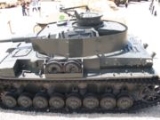
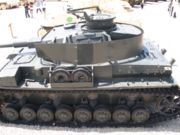
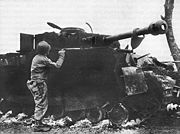
tanks. Many WWII German tanks had spaced armour in the form of armoured skirts, Schürzen, to make their thinner side armour more effective against anti-tank fire.
The principle of spaced armour protects against high explosive anti-tank (HEAT) projectiles which create a focus
Focus (geometry)
In geometry, the foci are a pair of special points with reference to which any of a variety of curves is constructed. For example, foci can be used in defining conic sections, the four types of which are the circle, ellipse, parabola, and hyperbola...
ed jet of plasticised metal, very effective at the focus point, but much less so beyond there. Relatively thin armour plates or even metal mesh, much lighter than fully protective armour, can be attached as side skirts or turret skirts on tanks and other armoured vehicles. This light armour detonates the warhead prematurely so that the jet of molten metal is focussed well before the main armour, becoming relatively ineffective. Factory-made and improvised stand-off armour was introduced in the Second World War, however its introduction was to counter Soviet anti-tank units using conventional kinetic penetrator type rounds, not the Bazooka
Bazooka
Bazooka is the common name for a man-portable recoilless rocket antitank weapon, widely fielded by the U.S. Army. Also referred to as the "Stovepipe", the innovative bazooka was amongst the first-generation of rocket propelled anti-tank weapons used in infantry combat...
, Panzerfaust
Panzerfaust
The Panzerfaust was an inexpensive, recoilless German anti-tank weapon of World War II. It consisted of a small, disposable preloaded launch tube firing a high explosive anti-tank warhead, operated by a single soldier...
, and other HEAT weapons as commonly thought.
In response to increasingly effective HEAT warheads, integral spaced armour was reintroduced in the 1960s on the German Leopard 1. There are hollow spaces inside this type of armour, increasing the length of travel from the exterior of the vehicle to the interior for a given weight of armour, to reduce the shaped charge's penetrating power. Sometimes the interior surfaces of these hollow cavities are sloped, presenting angles to the anticipated path of the shaped charge's jet in order to further dissipate its power. For example, a given weight of armour can be distributed in 2 layers 15 cm (6 in) thick instead of a single 30 cm (12 in) layer, giving much better protection against shaped charges.
Today light armoured vehicles mount panels of metal rods, known as slat armour or cage armour, and some main battle tanks carry rubber skirts to protect their relatively fragile suspension and front belly armour.
The Whipple shield
Whipple shield
The Whipple shield or Whipple bumper, invented by Fred Whipple, is a type of hypervelocity impact shield used to protect manned and unmanned spacecraft from collisions with micrometeoroids and orbital debris whose velocities generally range between ....
uses the principle of spaced armour to protect spacecraft from the impacts of very fast micrometeoroid
Micrometeoroid
A micrometeoroid is a tiny meteoroid; a small particle of rock in space, usually weighing less than a gram. A micrometeor or micrometeorite is such a particle that enters the Earth's atmosphere or falls to Earth.-Scientific interest:...
s. The impact with the first wall melts or breaks up the incoming particle, causing fragments to be spread over a wider area when striking the subsequent walls.