

Space weathering

Encyclopedia
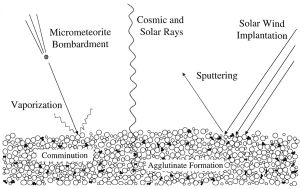
Space weathering is a blanket term used for a number of processes that act on any body exposed to the harsh space environment. Airless bodies (including the Moon
, Mercury
, the asteroids, comets, and some of the moons of other planets) incur many weathering processes:
Space weathering is important because these processes affect the physical and optical properties of the surface of many planetary bodies. Therefore, it is critical to understand the effects of space weathering in order to properly interpret remotely sensed data.
s (or regolith
). The constant flux of high energy particles and micrometeorites, along with larger meteorites, act to comminute
, melt, sputter and vaporize components of the lunar soil, as well as to garden (or overturn) it.
The first products of space weathering that were recognized in lunar soils were "agglutinates". These are created when micrometeorites melt a small amount of material, which incorporates surrounding glass and mineral fragments into a glass-welded aggregate ranging in size from a few micrometers to a few millimeters. Agglutinates are very common in lunar soil, accounting for as much as 60 to 70% of mature soils. These complex and irregularly-shaped particles appear black to the human eye, largely due to the presence of nanophase
iron
.
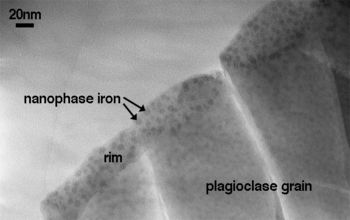
Space weathering also produces surface-correlated products on individual soil grains, such as glass splashes; implanted hydrogen
, helium
and other gases; solar flare
tracks; and accreted components, including nanophase iron. It wasn't until the 1990s that improved instruments, in particular transmission electron microscopes, and techniques allowed for the discovery of very thin (60-200 nm) patina
s, or rims, which develop on individual lunar soil grains as a result of the redepositing of vapor from nearby micrometeorite impacts and the redeposition of material sputtered from nearby grains.
These weathering processes have large effects on the spectral properties of lunar soil, particularly in the ultraviolet
, visible, and near infrared (UV/Vis/NIR) wavelengths. These spectral changes have largely been attributed to the inclusions of "nanophase iron" which is a ubiquitous component of both agglutinates and soil rims. These very small (one to a few hundred nanometers in diameter) blebs of metallic iron are created when iron-bearing minerals (e.g. olivine
and pyroxene
) are vaporized and the iron is liberated and redeposited in its native form.
is reduced), redder (reflectance increases with increasing wavelength), and the depth of its diagnostic absorption band
s are reduced These effects are largely due to the presence of nanophase
iron in both the agglutinates and in the accreted rims on individual grains. The darkening effects of space weathering are readily seen by studying lunar craters. Young, fresh craters have bright ray system
s, because they have exposed fresh, unweathered material, but over time those rays disappear as the weathering process darkens the material.
However, we do see evidence for asteroidal space weathering. For years there had been a so-called "conundrum" in the planetary science community because, in general, the spectra of asteroids do not match the spectra of our collection of meteorites. Particularly, the spectra of S-type asteroid
s, the most abundant type, did not match the spectra of the most abundant type of meteorites, ordinary chondrite
s (OCs). The asteroid spectra tended to be redder with a steep curvature in the visible wavelengths. However, Binzel et al. have identified near Earth asteroids with spectral properties covering the range from S-type to spectra similar to those of OC meteorites, suggesting an ongoing process is occurring that can alter the spectra of OC material to look like S-type asteroids. There is also evidence of regolith alteration from Galileo's flybys of Gaspra
and Ida
showing spectral differences at fresh craters. With time, the spectra of Ida and Gaspra appear to redden and lose spectral contrast. Evidence from NEAR Shoemaker
's x-ray measurements of Eros
indicate an ordinary chondrite composition despite a red-sloped, S-type spectrum, again suggesting that some process has altered the optical properties of the surface. Results from the Hayabusa
spacecraft at the asteroid Itokawa
, also ordinary chondrite in composition, shows spectral evidence of space weathering. Because Itokawa is so small (550 m diameter), the low gravity does not allow for the development of a mature regolith. However, it appears that weathering patinas can and do develop on rock surfaces on the asteroid.
also differs substantially from the Moon. For one thing, it is significantly hotter in the day (diurnal
surface temperature ~100 °C for the Moon, ~425 °C on Mercury) and colder at night, which may alter the products of space weathering. In addition, because of its location in the solar system, Mercury is also subjected to a slightly larger flux of micrometeorites that impact at much higher velocities than the Moon. These factors combine to make Mercury much more efficient than the Moon at creating both melt and vapor. Per unit area, impacts on Mercury are expected to produce 13.5x the melt and 19.5x the vapor than is produced on the Moon. Agglutinitic glass-like deposits and vapor-deposited coatings should be created significantly faster and more efficiently on Mercury than on the Moon.
The UV/Vis spectrum of Mercury, as observed telescopically from Earth, is roughly linear, with a red slope. There are no absorption bands related to Fe-bearing minerals, such as pyroxene. This means that either there is no iron on the surface of Mercury, or else the iron in the Fe-bearing minerals has been weathered to nanophase iron. A weathered surface would then explain the reddened slope.
Moon
The Moon is Earth's only known natural satellite,There are a number of near-Earth asteroids including 3753 Cruithne that are co-orbital with Earth: their orbits bring them close to Earth for periods of time but then alter in the long term . These are quasi-satellites and not true moons. For more...
, Mercury
Mercury (planet)
Mercury is the innermost and smallest planet in the Solar System, orbiting the Sun once every 87.969 Earth days. The orbit of Mercury has the highest eccentricity of all the Solar System planets, and it has the smallest axial tilt. It completes three rotations about its axis for every two orbits...
, the asteroids, comets, and some of the moons of other planets) incur many weathering processes:
- collisions of galactic cosmic rayGalactic cosmic rayGalactic cosmic rays are cosmic rays that have their origin inside our Galaxy. GCRs are high-energy charged particles, and are usually protons, electrons, and fully ionized nuclei of light elements...
s and solar cosmic rays, - irradiationIrradiationIrradiation is the process by which an object is exposed to radiation. The exposure can originate from various sources, including natural sources. Most frequently the term refers to ionizing radiation, and to a level of radiation that will serve a specific purpose, rather than radiation exposure to...
, implantation, and sputteringSputteringSputtering is a process whereby atoms are ejected from a solid target material due to bombardment of the target by energetic particles. It is commonly used for thin-film deposition, etching and analytical techniques .-Physics of sputtering:...
from solar windSolar windThe solar wind is a stream of charged particles ejected from the upper atmosphere of the Sun. It mostly consists of electrons and protons with energies usually between 1.5 and 10 keV. The stream of particles varies in temperature and speed over time...
particles, and - bombardment by different sizes of meteorites and micrometeorites.
Space weathering is important because these processes affect the physical and optical properties of the surface of many planetary bodies. Therefore, it is critical to understand the effects of space weathering in order to properly interpret remotely sensed data.
History
Much of our knowledge of the space weathering process comes from studies of the lunar samples returned by the Apollo program, particularly the lunar soilLunar soil
Lunar soil is the fine fraction of the regolith found on the surface of the Moon. Its properties can differ significantly from those of terrestrial soil...
s (or regolith
Regolith
Regolith is a layer of loose, heterogeneous material covering solid rock. It includes dust, soil, broken rock, and other related materials and is present on Earth, the Moon, some asteroids, and other terrestrial planets and moons.-Etymology:...
). The constant flux of high energy particles and micrometeorites, along with larger meteorites, act to comminute
Comminution
Comminution is the process in which solid materials are reduced in size, by crushing, grinding and other processes. It occurs naturally during faulting in the upper part of the crust and is an important operation in mineral processing, ceramics, electronics and other fields. Within industrial uses,...
, melt, sputter and vaporize components of the lunar soil, as well as to garden (or overturn) it.
The first products of space weathering that were recognized in lunar soils were "agglutinates". These are created when micrometeorites melt a small amount of material, which incorporates surrounding glass and mineral fragments into a glass-welded aggregate ranging in size from a few micrometers to a few millimeters. Agglutinates are very common in lunar soil, accounting for as much as 60 to 70% of mature soils. These complex and irregularly-shaped particles appear black to the human eye, largely due to the presence of nanophase
Nanophase material
Nanophase materials are materials that have grain sizes under 100 nanometres. They have different mechanical and optical properties compared to the large grained materials of the same chemical composition....
iron
Iron
Iron is a chemical element with the symbol Fe and atomic number 26. It is a metal in the first transition series. It is the most common element forming the planet Earth as a whole, forming much of Earth's outer and inner core. It is the fourth most common element in the Earth's crust...
.
Space weathering also produces surface-correlated products on individual soil grains, such as glass splashes; implanted hydrogen
Hydrogen
Hydrogen is the chemical element with atomic number 1. It is represented by the symbol H. With an average atomic weight of , hydrogen is the lightest and most abundant chemical element, constituting roughly 75% of the Universe's chemical elemental mass. Stars in the main sequence are mainly...
, helium
Helium
Helium is the chemical element with atomic number 2 and an atomic weight of 4.002602, which is represented by the symbol He. It is a colorless, odorless, tasteless, non-toxic, inert, monatomic gas that heads the noble gas group in the periodic table...
and other gases; solar flare
Solar flare
A solar flare is a sudden brightening observed over the Sun surface or the solar limb, which is interpreted as a large energy release of up to 6 × 1025 joules of energy . The flare ejects clouds of electrons, ions, and atoms through the corona into space. These clouds typically reach Earth a day...
tracks; and accreted components, including nanophase iron. It wasn't until the 1990s that improved instruments, in particular transmission electron microscopes, and techniques allowed for the discovery of very thin (60-200 nm) patina
Patina
Patina is a tarnish that forms on the surface of bronze and similar metals ; a sheen on wooden furniture produced by age, wear, and polishing; or any such acquired change of a surface through age and exposure...
s, or rims, which develop on individual lunar soil grains as a result of the redepositing of vapor from nearby micrometeorite impacts and the redeposition of material sputtered from nearby grains.
These weathering processes have large effects on the spectral properties of lunar soil, particularly in the ultraviolet
Ultraviolet
Ultraviolet light is electromagnetic radiation with a wavelength shorter than that of visible light, but longer than X-rays, in the range 10 nm to 400 nm, and energies from 3 eV to 124 eV...
, visible, and near infrared (UV/Vis/NIR) wavelengths. These spectral changes have largely been attributed to the inclusions of "nanophase iron" which is a ubiquitous component of both agglutinates and soil rims. These very small (one to a few hundred nanometers in diameter) blebs of metallic iron are created when iron-bearing minerals (e.g. olivine
Olivine
The mineral olivine is a magnesium iron silicate with the formula 2SiO4. It is a common mineral in the Earth's subsurface but weathers quickly on the surface....
and pyroxene
Pyroxene
The pyroxenes are a group of important rock-forming inosilicate minerals found in many igneous and metamorphic rocks. They share a common structure consisting of single chains of silica tetrahedra and they crystallize in the monoclinic and orthorhombic systems...
) are vaporized and the iron is liberated and redeposited in its native form.
Effects on spectral properties
The spectral effects of space weathering are threefold: as a surface matures it becomes darker (the albedoAlbedo
Albedo , or reflection coefficient, is the diffuse reflectivity or reflecting power of a surface. It is defined as the ratio of reflected radiation from the surface to incident radiation upon it...
is reduced), redder (reflectance increases with increasing wavelength), and the depth of its diagnostic absorption band
Absorption band
An absorption band is a range of wavelengths, frequencies or energies in the electromagnetic spectrum which are able to excite a particular transition in a substance...
s are reduced These effects are largely due to the presence of nanophase
Nanophase material
Nanophase materials are materials that have grain sizes under 100 nanometres. They have different mechanical and optical properties compared to the large grained materials of the same chemical composition....
iron in both the agglutinates and in the accreted rims on individual grains. The darkening effects of space weathering are readily seen by studying lunar craters. Young, fresh craters have bright ray system
Ray system
A ray system comprises radial streaks of fine ejecta thrown out during the formation of an impact crater, looking a bit like many thin spokes coming from the hub of a wheel. The rays can extend for lengths up to several times the diameter of their originating crater, and are often accompanied by...
s, because they have exposed fresh, unweathered material, but over time those rays disappear as the weathering process darkens the material.
Space weathering on asteroids
Space weathering is also thought to occur on asteroids, though the environment is quite different from the Moon. Impacts in the asteroid belt are slower, and therefore create less melt and vapor. Also, fewer solar wind particles reach the asteroid belt. And finally, the higher rate of impactors and lower gravity of the smaller bodies means that there is more overturn and the surface exposure ages should be younger than the lunar surface. Therefore, space weathering should occur more slowly and to a lesser degree on the surfaces of asteroids.However, we do see evidence for asteroidal space weathering. For years there had been a so-called "conundrum" in the planetary science community because, in general, the spectra of asteroids do not match the spectra of our collection of meteorites. Particularly, the spectra of S-type asteroid
S-type asteroid
S-type asteroids are of a stony composition, hence the name. Approximately 17% of asteroids are of this type, making it the second most common after the C-type.-Characteristics:...
s, the most abundant type, did not match the spectra of the most abundant type of meteorites, ordinary chondrite
Ordinary chondrite
The Ordinary chondrites are a class of stony chondritic meteorites. They are by far the most numerous group and comprise about 87% of all finds...
s (OCs). The asteroid spectra tended to be redder with a steep curvature in the visible wavelengths. However, Binzel et al. have identified near Earth asteroids with spectral properties covering the range from S-type to spectra similar to those of OC meteorites, suggesting an ongoing process is occurring that can alter the spectra of OC material to look like S-type asteroids. There is also evidence of regolith alteration from Galileo's flybys of Gaspra
951 Gaspra
951 Gaspra is an S-type asteroid that orbits very close to the inner edge of the asteroid belt. Gaspra was the first asteroid ever to be closely approached when it was visited by the Galileo spacecraft, which flew by on its way to Jupiter on 29 October 1991.-Characteristics:Apart from a multitude...
and Ida
243 Ida
243 Ida is an asteroid in the Koronis family of the asteroid belt. It was discovered on 29 September 1884 by Johann Palisa and named after a nymph from Greek mythology. Later telescopic observations categorized Ida as an S-type asteroid, the most numerous type in the inner asteroid belt. On 28...
showing spectral differences at fresh craters. With time, the spectra of Ida and Gaspra appear to redden and lose spectral contrast. Evidence from NEAR Shoemaker
NEAR Shoemaker
The Near Earth Asteroid Rendezvous - Shoemaker , renamed after its 1996 launch in honor of planetary scientist Eugene M. Shoemaker, was a robotic space probe designed by the Johns Hopkins University Applied Physics Laboratory for NASA to study the near-Earth asteroid Eros from close orbit over a...
's x-ray measurements of Eros
433 Eros
433 Eros is a near-Earth asteroid discovered in 1898, and the first asteroid to be orbited by a probe . It is an S-type asteroid approximately 34.4×11.2×11.2 km in size, the second-largest NEA after 1036 Ganymed, and belongs to the Amor group.Eros is a Mars-crosser asteroid, the first known...
indicate an ordinary chondrite composition despite a red-sloped, S-type spectrum, again suggesting that some process has altered the optical properties of the surface. Results from the Hayabusa
Hayabusa
was an unmanned spacecraft developed by the Japan Aerospace Exploration Agency to return a sample of material from a small near-Earth asteroid named 25143 Itokawa to Earth for further analysis....
spacecraft at the asteroid Itokawa
25143 Itokawa
25143 Itokawa is an Apollo and Mars-crosser asteroid. It was the first asteroid to be the target of a sample return mission, the Japanese space probe Hayabusa.-Discovery and naming:...
, also ordinary chondrite in composition, shows spectral evidence of space weathering. Because Itokawa is so small (550 m diameter), the low gravity does not allow for the development of a mature regolith. However, it appears that weathering patinas can and do develop on rock surfaces on the asteroid.
Space weathering on Mercury
The environment at MercuryMercury (planet)
Mercury is the innermost and smallest planet in the Solar System, orbiting the Sun once every 87.969 Earth days. The orbit of Mercury has the highest eccentricity of all the Solar System planets, and it has the smallest axial tilt. It completes three rotations about its axis for every two orbits...
also differs substantially from the Moon. For one thing, it is significantly hotter in the day (diurnal
Diurnal cycle
A diurnal cycle is any pattern that recurs every 24 hours as a result of one full rotation of the Earth.In climatology, the diurnal cycle is one of the most basic forms of climate patterns. The most familiar such pattern is the diurnal temperature variation...
surface temperature ~100 °C for the Moon, ~425 °C on Mercury) and colder at night, which may alter the products of space weathering. In addition, because of its location in the solar system, Mercury is also subjected to a slightly larger flux of micrometeorites that impact at much higher velocities than the Moon. These factors combine to make Mercury much more efficient than the Moon at creating both melt and vapor. Per unit area, impacts on Mercury are expected to produce 13.5x the melt and 19.5x the vapor than is produced on the Moon. Agglutinitic glass-like deposits and vapor-deposited coatings should be created significantly faster and more efficiently on Mercury than on the Moon.
The UV/Vis spectrum of Mercury, as observed telescopically from Earth, is roughly linear, with a red slope. There are no absorption bands related to Fe-bearing minerals, such as pyroxene. This means that either there is no iron on the surface of Mercury, or else the iron in the Fe-bearing minerals has been weathered to nanophase iron. A weathered surface would then explain the reddened slope.