

Soweto

Encyclopedia
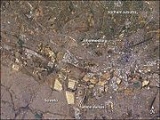
Soweto is a lower-class-populated urban area of the city of Johannesburg
in Gauteng
, South Africa
, bordering the city's mining
belt in the south. Its name is an English
syllabic abbreviation for South Western Townships. Formerly a separate municipality, it is now incorporated in the City of Johannesburg Metropolitan Municipality
, Suburbs of Johannesburg
.
drew thousands of black workers to the Reef
. They were also propelled by legislation that rendered many rural Black Africans landless. Informal settlements developed to meet the growing lack of housing. The Sofasonke squatter's movement of James Mpanza
in 1944 organised the occupation of vacant land in the area, at what became known as Masakeng (Orlando West). Partly as a result of Mpanza's actions, the city council was forced to set up emergency camps in Orlando and Moroka, and later in Central Western Jabavu.
noted during the opening ceremonies that the facility would be used for the area's black population after the war. In 1947 King George VI
visited and presented medals to the troops there. From this start grew Baragwanath Hospital (as it became known after 1948), reputedly the world's largest hospital. In 1997 another name change followed, with the sprawling facility now known as Chris Hani-Baragwanath Hospital in honour of the South African Communist Party
leader who was assassinated in 1993 by white extremists.
-dominated National Party
gained power in 1948 and began to implement apartheid, the pace of forced removals and the creation of townships outside legally-designated white areas increased. The Johannesburg council established new townships to the southwest for black Africans evicted from the city's freehold areas of Martindale, Sophiatown
, and Alexandra. Some townships were basic site and service plots (Tladi, Zondi, Dhlamini, Chiawelo, Senaoane, 1954), while at Dube middle class residents built their own houses. The first hostel to accommodate migrant workers evicted from the inner city in 1955 was built at Dube. The following year houses were built in the newly proclaimed townships of Meadowlands and Diepkloof.
In 1956 townships were laid out for particular ethnic groups as part of the state's strategy to sift black Africans into groupings that would later form the building blocks of the so-called "independent homelands." Spurred by a donation of R6-million to the state by Sir Ernest Oppenheimer
in 1956 for housing in the area, Naledi, Mapetla, Tladi, Moletsane and Phiri
were created to house Sotho and Tswana-speakers. Zulu and Xhosa speakers were accommodated in Dhlamini, Senaoane, Zola, Zondi, Jabulani, Emdeni and White City. Chiawelo was established for Tsonga and Venda-speaking residents.
In 1963, the name Soweto (SOuth WEstern TOwnships) was officially adopted for the sprawling township that now occupied what had been the farms of Doornkop, Klipriviersoog, Diepkloof
, Klipspruit and Vogelstruisfontein.
. Police opened fire in Orlando West on 10,000 students marching from Naledi High School to Orlando Stadium, The rioting continued and 23 people, including two white people, died on the first day in Soweto. The first to be killed was Hector Pieterson, who was 12 years old, when the police began to open fire on the students. Another among the killed was Dr. Melville Edelstein, who had devoted his life to social welfare among blacks. He was stoned to death by the mob and left with a sign around his neck proclaiming "Beware Afrikaaners". The impact of the Soweto protests reverberated through the country and across the world. In their aftermath, economic and cultural sanctions were introduced from abroad. Political activists left the country to train for guerrilla resistance. Soweto and other townships became the stage for violent state repression. Since 1991 this date and the schoolchildren have been commemorated by the International Day of the African Child
.
Soweto became an independent municipality with elected black councilors in 1983, in line with the Black Local Authorities Act. Previously the townships were governed by the Johannesburg council, but from the 1970s the state took control.
Soweto's black African councilors were not provided by the apartheid state with the finances to address housing and infrastructural problems. Township residents opposed the black councilors as puppet collaborators who personally benefited financially from an oppressive regime. Resistance was spurred by the exclusion of blacks from the newly formed tricameral Parliament (which did include Whites, Asians and Coloreds). Municipal elections in black, coloured, and Indian areas were subsequently widely boycotted, returning extremely low voting figures for years. Popular resistance to state structures dates back to the Advisory Boards (1950) that co-opted black residents to advise whites who managed the townships.
's 1985 Kabwe congress in Zambia
to make South Africa ungovernable. As the state forbade public gatherings, church buildings like Regina Mundi were sometimes used for political gatherings.
In 1995, Soweto became part of the Southern Metropolitan Transitional Local Council, and in 2002 was incorporated into the City of Johannesburg. A series of bomb explosions rocked Soweto in October 2002. The explosions, believed to be the work of the Boeremag
, a right wing extremist group, damaged buildings and railway lines, and killed one person.
Soweto's population is predominantly black
. All eleven of the country's official languages are spoken, and the main linguistic groups (in descending order of size) are Zulu
, Sotho, Tswana
, Venda
, and Tsonga
.
operates commuter trains between Soweto and central Johannesburg
. Soweto train stations are at Naledi, Merafe, Inhlazane, Ikwezi, Dube, Phefeni, Phomolong, Mzimhlophe, Mlamlankunzi, Orlando, Nancefield, Kliptown, Tshiawelo and Midway.
skirts the eastern boundary of Soweto. There is efficient road access for many parts of the region along busy highways to the CBD and Roodepoort
, but commuters are largely reliant on trains and taxis.
The N12 forms the southern border of Soweto.
A new section of the N17 road (South Africa) is under construction that will provide Soweto with a 4 lane highway link to Nasrec
.
The M70, also known as the Soweto Highway, links Soweto with central Johannesburg
via Nasrec
and Booysens. This road is multi lane, has dedicated taxiways and passes next to Soccer City in Nasrec.
A major thoroughfare through Soweto is the Golden Highway. It provides access to both the N1 as well as the M1
highways.
Minibus taxis are a popular form of transport. In 2000 it was estimated that around 2000 minibus taxis operated from the Baragwanath taxi rank alone.
A Bus rapid transit
system, commonly known as Rea Vaya provides transport for around 16 000 commuters daily.
PUTCO
has for many years provided bus commuter services to Soweto residents.
s and the improving of park
s and green space
s in the area.
Hostel
s are another prominent physical feature of Soweto. Originally built to house male migrant workers, many have been improved as dwellings for couples and families.
s of Gauteng
, Soweto shares much of the same media as the rest of Gauteng
. There are however some media sources dedicated to Soweto iteself:
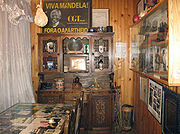
, which is a style of hip-hop specific to South Africa. This form of music, which combined many elements of house music, American hip-hop, and traditional African music, became a strong force amongst black South Africans. The spread of Soweto in popular culture worked both ways, as American hip-hop artists Hieroglyphics rap about the terrible conditions and changing social order in their song "Soweto," saying that cowardice has ruled this area, but how now the "gems," or black youth, need to express themselves. This appears to be Hieroglyphics attempt to urge a critical, political version of hip-hop in South Africa.
Estimates of how many residential areas make up Soweto itself vary widely. Some counts say that Soweto comprises 29 townships, whilst others find 34. The differences may be due to confusion arising from the merger of adjoining townships (such as Lenasia and Eldorado Park) with those of Soweto into Regions 6 and 10. The total number also depends on whether the various "extensions" and "zones" are counted separately, or as part of one main suburb. The 2003 Regional Spatial Development Framework arrived at 87 names by counting various extensions (e.g. Chiawelo's 5) and zones (e.g. Pimville's 7) separately. The City of Johannesburg's website groups the zones and extensions together to arrive at 32, but omits Noordgesig and Mmesi Park.
The list below provides the dates when some of Soweto's townships were established, along with the probable origins or meanings of their names, where available:
Other Soweto townships include Phomolong and Snake Park
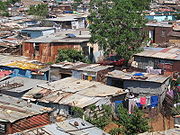
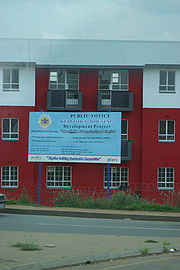 Many parts of Soweto rank among the poorest in Johannesburg, although individual townships tend to have a mix of wealthier and poorer residents. In general, households in the outlying areas to the northwest and southeast have lower incomes, while those in southwestern areas tend to have higher incomes.
The economic development of Soweto was severely curtailed by the apartheid state, which provided very limited infrastructure and prevented residents from creating their own businesses. Roads remained unpaved, and many residents had to share one tap between four houses, for example. Soweto was meant to exist only as a dormitory town for black Africans who worked in white houses, factories, and industries. The 1957 Natives (Urban Areas) Consolidation Act and its predecessors restricted residents between 1923 to 1976 to seven self-employment categories in Soweto itself. Sowetans could operate general shops, butcheries, eating houses, sell milk or vegetables, or hawk
goods. The overall number of such enterprises at any time were strictly controlled. As a result, informal trading developed outside the legally-recognized activities.
By 1976 Soweto had only two cinemas and two hotels, and only 83% of houses had electricity. Up to 93% of residents had no running water. Using fire for cooking and heating resulted in respiratory problems that contributed to high infant mortality rates (54 per 1,000 compared to 18 for whites, 1976 figures.
The restrictions on economic activities were lifted in 1977, spurring the growth of the taxi industry as an alternative to Soweto's inadequate bus and train transport systems.
In 1994 Sowetans earned on average almost six and a half times less than their counterparts in wealthier areas of Johannesburg (1994 estimates). Sowetans contribute less than 2% to Johannesburg's rates). Some Sowetans remain impoverished, and others live in shanty town
s with little or no services. About 85% of Kliptown
comprises informal housing. The Soweto Electricity Crisis Committee argues that Soweto's poor are unable to pay for electricity. The committee believes that the South African government's privatization drives will worsen the situation. Research showed that 62% of residents in Orlando East and Pimville were unemployed or pensioners.
There have been signs recently indicating economic improvement. The Johannesburg City Council began to provide more street lights and to pave roads. Private initiatives to tap Sowetans' combined spending power of R4.3 billion were also planned, including the construction of Protea Mall, Jabulani Mall, the development of Maponya Mall, an upmarket hotel in Kliptown, and the Orlando Ekhaya entertainment centre. Soweto has also become a centre for nightlife and culture.
Singer–songwriter Joe Strummer
, formerly of the Clash
, referenced Soweto in his solo album Streetcore (song: "Arms Aloft"), as well as in the Clash track, "Where You Gonna Go (Soweto)", found on the album London Calling (Legacy Edition).
The UK music duo Mattafix
has a song called "Memories Of Soweto" on their 2007 album Rhythm & Hymns
.
Soweto is mentioned in the anti-apartheid song "Gimme Hope Jo'anna
" by Eddy Grant
. The line "While every mother in a black Soweto fears the killing of another son" refers to police brutality
during apartheid.
Dr. Alban
's song "Free Up Soweto" was included in the 1994 album Look Who's Talking.
Mexican group Tijuana No!
recorded the song "Soweto" for their first album "No". In reference to the city and the movements.
It is also the name of a song by the rap group Hieroglyphics
.
American band Vampire Weekend
refers to its own musical style, a blend of indie rock and pop with African influences, as "Upper West Side Soweto", based on the same description of Paul Simon
's album Graceland
.
in 2008. Soweto is also mentioned in the novel, Waiting for the Rain
by Sheila Gordon
.
Soweto was characterized in the American film Stander
. The film presented the story of Andre Stander
, a rogue police captain who sympathized with the irrational state of apartheid and its corruption by becoming a bank thief. The Soweto uprising riots provided Stander's breaking point in the film.
In 2006, Sara Blecher and Rimi Raphoto made the popular documentary "Surfing Soweto", about young kids "surfing" in the roof of Soweto trains, and the social problem this represents.
The 2009 film District 9
was shot in Soweto, specifically Chiawelo
. The plot involves a species of aliens who arrive on Earth in a starving and helpless condition, seeking aid. The originally benign attempts to aid them turn increasingly oppressive due to the overwhelming numbers of aliens and the cost of maintaining them, and to increasing xenophobia on the part of humans who treat the intelligent and sophisticated aliens like animals while taking advantage of them for personal and corporate gain. The aliens are housed in shacks in a slum-like concentration camp called "District 9", which is in fact modern-day Soweto; an attempt to evacuate the aliens to another camp leads to violence and a wholesale slaughter by South African mercenary security forces (a reference to historical events in "District Six
", a mostly Coloured neighborhood subjected to forced segregation during the apartheid years). The parallels to apartheid South Africa are obvious but not explicitly remarked on in the film.
Soweto was the birthplace of:
Other residents
Films that include Soweto scenes:
Regions of Johannesburg
The administration of Johannesburg was decentralised into 11 regions following the creation of the post-apartheid City of Johannesburg Metropolitan Municipality in 2000...
in Gauteng
Gauteng
Gauteng is one of the nine provinces of South Africa. It was formed from part of the old Transvaal Province after South Africa's first all-race elections on 27 April 1994...
, South Africa
South Africa
The Republic of South Africa is a country in southern Africa. Located at the southern tip of Africa, it is divided into nine provinces, with of coastline on the Atlantic and Indian oceans...
, bordering the city's mining
Mining
Mining is the extraction of valuable minerals or other geological materials from the earth, from an ore body, vein or seam. The term also includes the removal of soil. Materials recovered by mining include base metals, precious metals, iron, uranium, coal, diamonds, limestone, oil shale, rock...
belt in the south. Its name is an English
English language
English is a West Germanic language that arose in the Anglo-Saxon kingdoms of England and spread into what was to become south-east Scotland under the influence of the Anglian medieval kingdom of Northumbria...
syllabic abbreviation for South Western Townships. Formerly a separate municipality, it is now incorporated in the City of Johannesburg Metropolitan Municipality
City of Johannesburg Metropolitan Municipality
The City of Johannesburg Metropolitan Municipality is a metropolitan municipality that manages the local governance of Johannesburg, South Africa...
, Suburbs of Johannesburg
Suburbs of Johannesburg
The suburbs of Johannesburg are officially demarcated areas within the city of Johannesburg, South Africa. As in other Commonwealth countries, the term suburb refers to a "neighbourhood", although the term has a somewhat stronger meaning in South Africa as most "suburbs" have legally recognised...
.
History
The history of African townships south west of Johannesburg that would later form Soweto was propelled by the increasing eviction of Africans by city and state authorities. Africans had been drawn to work on the gold mines that were established after 1886. From the start they were accommodated in separate areas on the outskirts of Johannesburg, such as Brickfields (Newtown). In 1904 British-controlled city authorities removed African and Indian residents of Brickfields to an "evacuation camp" at Klipspruit municipal sewage farm (not Kliptown, a separate township) outside the Johannesburg municipal boundary, following a reported outbreak of plague. Two further townships were laid out to the east and the west of Johannesburg in 1918. Townships to the south west of Johannesburg followed, starting with Pimville in 1934 (a renamed part of Klipspruit) and Orlando in 1935.World War I
Industrialisation during World War IWorld War I
World War I , which was predominantly called the World War or the Great War from its occurrence until 1939, and the First World War or World War I thereafter, was a major war centred in Europe that began on 28 July 1914 and lasted until 11 November 1918...
drew thousands of black workers to the Reef
Witwatersrand
The Witwatersrand is a low, sedimentary range of hills, at an elevation of 1700–1800 metres above sea-level, which runs in an east-west direction through Gauteng in South Africa. The word in Afrikaans means "the ridge of white waters". Geologically it is complex, but the principal formations...
. They were also propelled by legislation that rendered many rural Black Africans landless. Informal settlements developed to meet the growing lack of housing. The Sofasonke squatter's movement of James Mpanza
James Mpanza
James Mpanza was a squatter leader in Johannesburg, South Africa from the mid 1940s until the late 1960s. In 1944 he led the land invasion that resulted in the founding of modern Soweto. Mpanza is known as 'the father of Soweto'.-Further Reading:...
in 1944 organised the occupation of vacant land in the area, at what became known as Masakeng (Orlando West). Partly as a result of Mpanza's actions, the city council was forced to set up emergency camps in Orlando and Moroka, and later in Central Western Jabavu.
Baragwanath Hospital
The Imperial Military Hospital Baragwanath, named after Cornishman John Albert Baragwanath, was built in 1941 during the Second World War to serve as a British Military Hospital. John Albert Baragwanath initially owned the situated site as a hostel, The Wayside Inn, until the British Government paid £328,000 to make it a hospital. Field-Marshal Jan SmutsJan Smuts
Jan Christiaan Smuts, OM, CH, ED, KC, FRS, PC was a prominent South African and British Commonwealth statesman, military leader and philosopher. In addition to holding various cabinet posts, he served as Prime Minister of the Union of South Africa from 1919 until 1924 and from 1939 until 1948...
noted during the opening ceremonies that the facility would be used for the area's black population after the war. In 1947 King George VI
George VI of the United Kingdom
George VI was King of the United Kingdom and the Dominions of the British Commonwealth from 11 December 1936 until his death...
visited and presented medals to the troops there. From this start grew Baragwanath Hospital (as it became known after 1948), reputedly the world's largest hospital. In 1997 another name change followed, with the sprawling facility now known as Chris Hani-Baragwanath Hospital in honour of the South African Communist Party
South African Communist Party
South African Communist Party is a political party in South Africa. It was founded in 1921 as the Communist Party of South Africa by the joining together of the International Socialist League and others under the leadership of Willam H...
leader who was assassinated in 1993 by white extremists.
Government policy from 1948
After the AfrikanerAfrikaner
Afrikaners are an ethnic group in Southern Africa descended from almost equal numbers of Dutch, French and German settlers whose native tongue is Afrikaans: a Germanic language which derives primarily from 17th century Dutch, and a variety of other languages.-Related ethno-linguistic groups:The...
-dominated National Party
National Party (South Africa)
The National Party is a former political party in South Africa. Founded in 1914, it was the governing party of the country from 4 June 1948 until 9 May 1994. Members of the National Party were sometimes known as Nationalists or Nats. Its policies included apartheid, the establishment of a...
gained power in 1948 and began to implement apartheid, the pace of forced removals and the creation of townships outside legally-designated white areas increased. The Johannesburg council established new townships to the southwest for black Africans evicted from the city's freehold areas of Martindale, Sophiatown
Sophiatown, Gauteng
Sophiatown is a suburb of Johannesburg, South Africa.Sophiatown was a legendary black cultural hub that was destroyed under Apartheid, rebuilt under the name by Triomf, and in 2006 officially returned to its original name.Sophiatown was one of the oldest black areas in Johannesburg and its...
, and Alexandra. Some townships were basic site and service plots (Tladi, Zondi, Dhlamini, Chiawelo, Senaoane, 1954), while at Dube middle class residents built their own houses. The first hostel to accommodate migrant workers evicted from the inner city in 1955 was built at Dube. The following year houses were built in the newly proclaimed townships of Meadowlands and Diepkloof.
In 1956 townships were laid out for particular ethnic groups as part of the state's strategy to sift black Africans into groupings that would later form the building blocks of the so-called "independent homelands." Spurred by a donation of R6-million to the state by Sir Ernest Oppenheimer
Ernest Oppenheimer
Sir Ernest Oppenheimer was a diamond and gold mining entrepreneur, financier and philanthropist, who controlled De Beers and founded the Anglo American Corporation of South Africa.-Career:...
in 1956 for housing in the area, Naledi, Mapetla, Tladi, Moletsane and Phiri
Phiri, Soweto
Phiri is a township in the urban area of Soweto, in the city of Johannesburg in South Africa. The township was founded in 1956, as part of the demographic reorganization started by the state that year...
were created to house Sotho and Tswana-speakers. Zulu and Xhosa speakers were accommodated in Dhlamini, Senaoane, Zola, Zondi, Jabulani, Emdeni and White City. Chiawelo was established for Tsonga and Venda-speaking residents.
In 1963, the name Soweto (SOuth WEstern TOwnships) was officially adopted for the sprawling township that now occupied what had been the farms of Doornkop, Klipriviersoog, Diepkloof
Diepmeadow, Gauteng
Diepmeadow is a township that is part of the greater Soweto in Johannesburg, Gauteng, South Africa. It consists of two townships of Diepkloof and Meadowlands. Meadowlands was built to accommodate the residents of Sophiatownyomi ias greatved in 1957. Diepkloof was established in 1959 to accommodate...
, Klipspruit and Vogelstruisfontein.
Soweto Uprising
Soweto came to the world's attention on June 16, 1976 with the Soweto Uprising, when mass protests erupted over the government's policy to enforce education in Afrikaans rather than EnglishEnglish language
English is a West Germanic language that arose in the Anglo-Saxon kingdoms of England and spread into what was to become south-east Scotland under the influence of the Anglian medieval kingdom of Northumbria...
. Police opened fire in Orlando West on 10,000 students marching from Naledi High School to Orlando Stadium, The rioting continued and 23 people, including two white people, died on the first day in Soweto. The first to be killed was Hector Pieterson, who was 12 years old, when the police began to open fire on the students. Another among the killed was Dr. Melville Edelstein, who had devoted his life to social welfare among blacks. He was stoned to death by the mob and left with a sign around his neck proclaiming "Beware Afrikaaners". The impact of the Soweto protests reverberated through the country and across the world. In their aftermath, economic and cultural sanctions were introduced from abroad. Political activists left the country to train for guerrilla resistance. Soweto and other townships became the stage for violent state repression. Since 1991 this date and the schoolchildren have been commemorated by the International Day of the African Child
International Day of the African Child
The International Day of the African Child has been celebrated on June 16 every year since 1991, when it was first initiated by the Organisation of African Unity. It honors those who participated in the Soweto Uprising in 1976 on that day...
.
Aftermath
In response, the apartheid state started providing electricity to more Soweto homes, yet phased out financial support for building additional housing.Soweto became an independent municipality with elected black councilors in 1983, in line with the Black Local Authorities Act. Previously the townships were governed by the Johannesburg council, but from the 1970s the state took control.
Soweto's black African councilors were not provided by the apartheid state with the finances to address housing and infrastructural problems. Township residents opposed the black councilors as puppet collaborators who personally benefited financially from an oppressive regime. Resistance was spurred by the exclusion of blacks from the newly formed tricameral Parliament (which did include Whites, Asians and Coloreds). Municipal elections in black, coloured, and Indian areas were subsequently widely boycotted, returning extremely low voting figures for years. Popular resistance to state structures dates back to the Advisory Boards (1950) that co-opted black residents to advise whites who managed the townships.
Further popular resistance: incorporation into the City
In Soweto, popular resistance to apartheid emerged in various forms during the 1980s. Educational and economic boycotts were initiated, and student bodies were organized. Street committees were formed, and civic organizations were established as alternatives to state-imposed structures. One of the most well-known "civics" was Soweto's Committee of Ten, started in 1978 in the offices of The Bantu World newspaper. Such actions were strengthened by the call issued by African National CongressAfrican National Congress
The African National Congress is South Africa's governing Africanist political party, supported by its tripartite alliance with the Congress of South African Trade Unions and the South African Communist Party , since the establishment of non-racial democracy in April 1994. It defines itself as a...
's 1985 Kabwe congress in Zambia
Zambia
Zambia , officially the Republic of Zambia, is a landlocked country in Southern Africa. The neighbouring countries are the Democratic Republic of the Congo to the north, Tanzania to the north-east, Malawi to the east, Mozambique, Zimbabwe, Botswana and Namibia to the south, and Angola to the west....
to make South Africa ungovernable. As the state forbade public gatherings, church buildings like Regina Mundi were sometimes used for political gatherings.
In 1995, Soweto became part of the Southern Metropolitan Transitional Local Council, and in 2002 was incorporated into the City of Johannesburg. A series of bomb explosions rocked Soweto in October 2002. The explosions, believed to be the work of the Boeremag
Boeremag
The Boeremag is a South African right-wing activism group with white separatist aims and is accused of planning to overthrow the ruling African National Congress government and to reinstate a new Boer administered republic reminiscent of the era when Boers administered independent republics...
, a right wing extremist group, damaged buildings and railway lines, and killed one person.
Demographics
As Soweto was counted as part of Johannesburg in South Africa's 2008 census, Soweto's population is 1,3 million recent demographic statistics are not readily It has been estimated that 40% of Johannesburg's residents live in Soweto. However, the 2008 Census put its population at 1,3 million (2010) or about one-third of the city's total population.Soweto's population is predominantly black
Black people
The term black people is used in systems of racial classification for humans of a dark skinned phenotype, relative to other racial groups.Different societies apply different criteria regarding who is classified as "black", and often social variables such as class, socio-economic status also plays a...
. All eleven of the country's official languages are spoken, and the main linguistic groups (in descending order of size) are Zulu
Zulu language
Zulu is the language of the Zulu people with about 10 million speakers, the vast majority of whom live in South Africa. Zulu is the most widely spoken home language in South Africa as well as being understood by over 50% of the population...
, Sotho, Tswana
Tswana language
Tswana or Setswana is a language spoken in Southern Africa by about 4.5 million people. It is a Bantu language belonging to the Niger–Congo language family within the Sotho languages branch of Zone S , and is closely related to the Northern- and Southern Sotho languages, as well as the Kgalagadi...
, Venda
Venda language
Venda, also known as or , is a Bantu language and an official language of South Africa. The majority of Venda speakers live in the northern part of South Africa's Limpopo Province, but about 10% of speakers live in Zimbabwe. The Venda language is related to Kalanga which is spoken in Botswana...
, and Tsonga
Tsonga language
The Tsonga or Xitsonga language is spoken in southern Africa by the Tsonga people, also known as the Shangaan.- Classification :Tsonga belongs to the Bantu branch of the Niger–Congo languages...
.
Landmarks
Soweto landmarks include:- Chris Hani Baragwanath HospitalChris Hani Baragwanath HospitalChris Hani Baragwanath Hospital is the second largest hospital in the world after West China hospital of Medical Sciences, Sichuan University, occupying , with 3 200 beds and 6 760 staff members. The hospital is in the Soweto area of Johannesburg, South Africa...
, Diepkloof - Orlando Towers
- Credo Mutwa village, Central Western Jabavu
- Walter Sisulu Square, Kliptown
- Regina Mundi Catholic Church, Rockville
- Freedom Towers
- SAAF 1723, a decommissioned Avro ShackletonAvro ShackletonThe Avro Shackleton was a British long-range maritime patrol aircraft for use by the Royal Air Force. It was developed by Avro from the Avro Lincoln bomber with a new fuselage...
of the South African Air ForceSouth African Air ForceThe South African Air Force is the air force of South Africa, with headquarters in Pretoria. It is the world's second oldest independent air force, and its motto is Per Aspera Ad Astra...
is on static display on the roof of Vic's Viking Garage, a service station on the Golden Highway.
Transport
The suburb was not historically allowed to create employment centres within the area, so almost all of its residents are commuters to other parts of the city.Rail
MetrorailMetrorail Gauteng
Metrorail Gauteng is a network of commuter rail services in Gauteng province in South Africa, serving the Greater Johannesburg metropolitan area as well as Pretoria and its suburbs...
operates commuter trains between Soweto and central Johannesburg
Johannesburg
Johannesburg also known as Jozi, Jo'burg or Egoli, is the largest city in South Africa, by population. Johannesburg is the provincial capital of Gauteng, the wealthiest province in South Africa, having the largest economy of any metropolitan region in Sub-Saharan Africa...
. Soweto train stations are at Naledi, Merafe, Inhlazane, Ikwezi, Dube, Phefeni, Phomolong, Mzimhlophe, Mlamlankunzi, Orlando, Nancefield, Kliptown, Tshiawelo and Midway.
Road
The N1 Western BypassN1 Western Bypass (South Africa)
The Western Bypass is a section of the N1 and the Johannesburg Ring Road located in the city of Johannesburg, South Africa. The freeway was inially opened in 1975 as a route to avoid the city centre of Johannesburg and access for the western areas of the Witwatersrand. From the south, the Western...
skirts the eastern boundary of Soweto. There is efficient road access for many parts of the region along busy highways to the CBD and Roodepoort
Roodepoort, Gauteng
Roodepoort is an area in Johannesburg, Gauteng, South Africa. Johannesburg's most famous botanical garden, Witwatersrand National Botanical Gardens , is located in Roodepoort...
, but commuters are largely reliant on trains and taxis.
The N12 forms the southern border of Soweto.
A new section of the N17 road (South Africa) is under construction that will provide Soweto with a 4 lane highway link to Nasrec
Nasrec, Gauteng
Nasrec is a suburb of Johannesburg, South Africa. It is located in Region 9.Nasrec is the last station on its branch line of the Johannesburg metro railway line and is home to the Johannesburg Soccer City and Expo Centre Johannesburg.- External links :*...
.
The M70, also known as the Soweto Highway, links Soweto with central Johannesburg
Johannesburg
Johannesburg also known as Jozi, Jo'burg or Egoli, is the largest city in South Africa, by population. Johannesburg is the provincial capital of Gauteng, the wealthiest province in South Africa, having the largest economy of any metropolitan region in Sub-Saharan Africa...
via Nasrec
Nasrec, Gauteng
Nasrec is a suburb of Johannesburg, South Africa. It is located in Region 9.Nasrec is the last station on its branch line of the Johannesburg metro railway line and is home to the Johannesburg Soccer City and Expo Centre Johannesburg.- External links :*...
and Booysens. This road is multi lane, has dedicated taxiways and passes next to Soccer City in Nasrec.
A major thoroughfare through Soweto is the Golden Highway. It provides access to both the N1 as well as the M1
M1 (Johannesburg)
The M1 De Villiers Graaff motorway is a major freeway in Johannesburg, South Africa. The highway connects the southern areas with the city centre and extends further north through Sandton...
highways.
Minibus taxis are a popular form of transport. In 2000 it was estimated that around 2000 minibus taxis operated from the Baragwanath taxi rank alone.
A Bus rapid transit
Bus rapid transit
Bus rapid transit is a term applied to a variety of public transportation systems using buses to provide faster, more efficient service than an ordinary bus line. Often this is achieved by making improvements to existing infrastructure, vehicles and scheduling...
system, commonly known as Rea Vaya provides transport for around 16 000 commuters daily.
PUTCO
PUTCO
The Public Utility Transport Corporation provides commuter bus services in Gauteng, Limpopo and the western parts of Mpumalanga in South Africa. PUTCO was established in 1945 after the bus strike of 1944...
has for many years provided bus commuter services to Soweto residents.
Housing
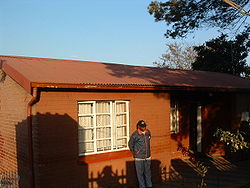
The area is mostly composed of old "matchbox" houses, or four-room houses built by the government, that were built to provide cheap accommodation for black workers during apartheid. However, there are a few smaller areas where prosperous Sowetans have built houses that are similar in stature to those in more affluent suburbs. Many people who still live in matchbox houses have improved and expanded their homes, and the City Council has enabled the planting of more treeTree
A tree is a perennial woody plant. It is most often defined as a woody plant that has many secondary branches supported clear of the ground on a single main stem or trunk with clear apical dominance. A minimum height specification at maturity is cited by some authors, varying from 3 m to...
s and the improving of park
Park
A park is a protected area, in its natural or semi-natural state, or planted, and set aside for human recreation and enjoyment, or for the protection of wildlife or natural habitats. It may consist of rocks, soil, water, flora and fauna and grass areas. Many parks are legally protected by...
s and green space
Open space reserve
Open space reserve, open space preserve, and open space reservation, are planning and conservation ethics terms used to describe areas of protected or conserved land or water on which development is indefinitely set aside...
s in the area.
Hostel
Hostel
Hostels provide budget oriented, sociable accommodation where guests can rent a bed, usually a bunk bed, in a dormitory and share a bathroom, lounge and sometimes a kitchen. Rooms can be mixed or single-sex, although private rooms may also be available...
s are another prominent physical feature of Soweto. Originally built to house male migrant workers, many have been improved as dwellings for couples and families.
Media
Being part of the urban agglomerationAgglomeration
In the study of human settlements, an urban agglomeration is an extended city or town area comprising the built-up area of a central place and any suburbs linked by continuous urban area. In France, INSEE the French Statistical Institute, translate it as "Unité urbaine" which means continuous...
s of Gauteng
Gauteng
Gauteng is one of the nine provinces of South Africa. It was formed from part of the old Transvaal Province after South Africa's first all-race elections on 27 April 1994...
, Soweto shares much of the same media as the rest of Gauteng
Gauteng
Gauteng is one of the nine provinces of South Africa. It was formed from part of the old Transvaal Province after South Africa's first all-race elections on 27 April 1994...
. There are however some media sources dedicated to Soweto iteself:
- Soweto TVSoweto TVSoweto TV is a South African community television channel broadcasting in the biggest township of South Africa, Soweto. Other than this the channel is broadcast to South African subscribers to the Dstv pay tv service. It provides a network station for South Africa's only networked program, KMT . It...
is a community television channel, available on DStvDStvDStv is MultiChoice's multi-channel digital satellite TV service in Africa, launched in 1995. It operates from two satellites over Africa, broadcasting on Ku band via Eutelsat W7 and Intelsat 7 , which only requires a small satellite dish...
channel 150. - The SowetanThe SowetanThe Sowetan is an English language, South African newspaper that started in 1981 as a liberation struggle newspaper and was freely distributed to households in the black township of Soweto, Johannesburg, Gauteng Province....
newspaper has a readership of around 1.6 million.
Museums, monuments and memorials
- Hector Pieterson MuseumHector Pieterson MuseumThe Hector Pieterson Museum is a large museum located in Orlando West, Soweto, South Africa, two blocks away from where Hector Pieterson was shot and killed. The museum is named in his honour. It became one of the first museums in Soweto when it opened in 16 June 2002...
, Orlando West - Nelson Mandela National Museum, Orlando West
- Regina MundiRegina MundiRegina Mundi is the largest Roman Catholic church in South Africa. It is located in Orlando East, Soweto, a populous black urban residential area within the city of Johannesburg...
church, Rockville
Music
Soweto is credited as one of the founding places for kwaitoKwaito
Kwaito is a music genre that emerged in Johannesburg, South Africa, during the 1990s. It is a variant of house music featuring the use of African sounds and samples. Typically at a slower tempo range than other styles of house music, Kwaito often contains catchy melodic and percussive loop samples,...
, which is a style of hip-hop specific to South Africa. This form of music, which combined many elements of house music, American hip-hop, and traditional African music, became a strong force amongst black South Africans. The spread of Soweto in popular culture worked both ways, as American hip-hop artists Hieroglyphics rap about the terrible conditions and changing social order in their song "Soweto," saying that cowardice has ruled this area, but how now the "gems," or black youth, need to express themselves. This appears to be Hieroglyphics attempt to urge a critical, political version of hip-hop in South Africa.
- Azola Gospel Group staying opposite Maponya Mall
Events
- The Soweto OpenSoweto OpenThe Soweto Open is a professional tennis tournament played on outdoor hard courts. It is currently part of the Association of Tennis Professionals Challenger Tour and the ITF Women's tour as a 100K event...
tennis tournament, part of the Challenger Tour is annually hosted in Soweto. - The annual Soweto marathon is run over a 42.2 kilometres (26.2 mi) course through Soweto.
Festivals
The Soweto Wine Festival has built up cult status since its launch in 2004. The three-night wine festival is hosted at the University of Johannesburg, Soweto Campus on Chris Hani Road from 6 pm to 10 pm in the first weekend of September. Organised by the Cape Wine Academy, the festival attracts well over 6000 wine enthusiasts, over 100 of South Africa's finest wineries and well over 900 fine wines to taste. In 2010, the expanded 3-night festival exceeded organisers' expectations, attracting well over 7,500 visitors to the wine event in Soweto.Stadiums
- FNB StadiumFNB StadiumSoccer City, known as FNB Stadium for commercial purposes, is a stadium located in Nasrec, the Soweto area of Johannesburg, South Africa. It is located next to the South African Football Association headquarters where both the FIFA offices and the Local Organising Committee for the 2010 FIFA World...
, South Africa's largest stadium - Eldoroda Park Stadium
- Dobsonville StadiumDobsonville StadiumDobsonville Stadium is a multi-purpose stadium in Soweto, a suburb of Johannesburg, South Africa. It is mostly used for football matches, but is also equipped with an athletics track. It is the home ground of Moroka Swallows, a football club which plays in the Premier Soccer League...
, home ground of Moroka Swallows - Jabavu Stadium
- Noordgesig Stadium
- Orlando StadiumOrlando StadiumOrlando Stadium is a multi-purpose stadium, in Soweto, a suburb of Johannesburg, South Africa. The stadium was originally built in 1959, at a cost of £37,500, with a capacity of 24,000....
, home ground of Orlando Pirates - Meadowlands Stadium
Suburbs
By 2003 the Greater Soweto area consisted of 87 townships grouped together into Administrative Regions 6 and 10 of Johannesburg.Estimates of how many residential areas make up Soweto itself vary widely. Some counts say that Soweto comprises 29 townships, whilst others find 34. The differences may be due to confusion arising from the merger of adjoining townships (such as Lenasia and Eldorado Park) with those of Soweto into Regions 6 and 10. The total number also depends on whether the various "extensions" and "zones" are counted separately, or as part of one main suburb. The 2003 Regional Spatial Development Framework arrived at 87 names by counting various extensions (e.g. Chiawelo's 5) and zones (e.g. Pimville's 7) separately. The City of Johannesburg's website groups the zones and extensions together to arrive at 32, but omits Noordgesig and Mmesi Park.
The list below provides the dates when some of Soweto's townships were established, along with the probable origins or meanings of their names, where available:
| Name | Established | Origin of name |
|---|---|---|
| Braamfischerville | ||
| Chiawelo | 1956 | "Place of Rest" (Venda) |
| Diepkloof | ||
| Dlamini | 1956 | Unknown, Nguni family name. Michael Mabaso also comes from here. |
| Dobsonville | including Dobsonville Gardens | |
| Doornkop | "Hill of Thorns" (Afrikaans) | |
| Dube | 1948 | Named for John Langalibalele Dube (1871–1946), educator, newspaper founder, and the first ANC president (1912–17) |
| Emdeni | 1958 | "A border, last township before Mogale City (then Krugersdorp Municipality)" (Xhosa), including extensions |
| Jabavu | 1948 | Named for Davidson Don Tengo Jabavu (1885–1959), educator and author |
| Jabulani | 1956 | "Rejoice" (Zulu) |
| Klipspruit | 1904 | "Rocky Stream" (Afrikaans), originally a farm. |
| Kliptown Kliptown Kliptown is a suburb of the formerly black township of Soweto in Gauteng, South Africa, located about 17 km south-west of Johannesburg. The population of Kliptown is between 38,000 and 45,000 . Kliptown is the oldest residential district of Soweto, and was first laid out in 1891 on land which... |
||
| Lakeside Lakeside -Australia:*Lakeside Joondalup Shopping City, Joondalup, Western Australia*Lakeside, near Reservoir, Victoria*Lakeside International Raceway, Pine Rivers, Queensland*Lakeside Mental Hospital, formerly known as Ballarat Lunatic Asylum, Ballarat, Victoria... |
||
| Mapetla | 1956 | Someone who is angry |
| Meadowlands Meadowlands, Gauteng Meadowlands is a suburb of Johannesburg, Gauteng Province, South Africa.... |
||
| Mmesi Park | Sotho name for somebody who burns things on fire | |
| Mofolo | 1954 | Named for Thomas Mofolo (1876–1948), Sotho author, translator, and educator |
| Molapo | 1956 | Name of a Basotho tribe, sotho name for fetique |
| Moletsane | 1956 | Name of a Batuang chief |
| Moroka | 1946 | Named for Dr James Sebe Moroka (1891–1985), later ANC president (1949–52) during the 1952 Defiance Campaign |
| Naledi | 1956 | "Star" (Sotho/Pedi/Tswana), originally Mkizi |
| Noordgesig | "North View" (Afrikaans) | |
| Orlando Orlando Orlando is a major city in the U.S. state of Florida.Orlando may also refer to-Places:* in Florida** Orlando, a major city** Greater Orlando, the 27th-largest metropolitan area in the United States... |
1932 | Named for Edwin Orlando Leake (1860–1935), chairman of the Non-European Affairs Department (1930–31), Johannesburg mayor (1925–26) |
| Phefeni | ||
| Phiri Phiri, Soweto Phiri is a township in the urban area of Soweto, in the city of Johannesburg in South Africa. The township was founded in 1956, as part of the demographic reorganization started by the state that year... |
1956 | "Hyena" (Sotho/Tswana) |
| Pimville | 1934 | Named for James Howard Pim, councillor (1903–07), Quaker, philanthropist, and patron of Fort Hare Native College ; originally part of Klipspruit |
| Power Park | In the vicinity of the power station | |
| Protea Glen | Unknown (The protea is South Africa's national flower) | |
| Protea North | ||
| Protea South | ||
| Senaoane | 1958 | Named for Solomon G Senaoane (−1942), first sports organiser in the Non-European Affairs Department |
| Tladi | 1956 | "Lightning" (Sotho) |
| Zola | 1956 | "Calm" (Zulu/Xhosa) |
| Zondi | 1956 | Unknown family name (Zulu) |
Other Soweto townships include Phomolong and Snake Park
Economy
The economic development of Soweto was severely curtailed by the apartheid state, which provided very limited infrastructure and prevented residents from creating their own businesses. Roads remained unpaved, and many residents had to share one tap between four houses, for example. Soweto was meant to exist only as a dormitory town for black Africans who worked in white houses, factories, and industries. The 1957 Natives (Urban Areas) Consolidation Act and its predecessors restricted residents between 1923 to 1976 to seven self-employment categories in Soweto itself. Sowetans could operate general shops, butcheries, eating houses, sell milk or vegetables, or hawk
Hawking
- People :* Stephen Hawking, an English theoretical physicist and cosmologist- Fictional characters :* James "Jim" Hawking, a character from the anime series, Outlaw Star- Other uses :...
goods. The overall number of such enterprises at any time were strictly controlled. As a result, informal trading developed outside the legally-recognized activities.
By 1976 Soweto had only two cinemas and two hotels, and only 83% of houses had electricity. Up to 93% of residents had no running water. Using fire for cooking and heating resulted in respiratory problems that contributed to high infant mortality rates (54 per 1,000 compared to 18 for whites, 1976 figures.
The restrictions on economic activities were lifted in 1977, spurring the growth of the taxi industry as an alternative to Soweto's inadequate bus and train transport systems.
In 1994 Sowetans earned on average almost six and a half times less than their counterparts in wealthier areas of Johannesburg (1994 estimates). Sowetans contribute less than 2% to Johannesburg's rates). Some Sowetans remain impoverished, and others live in shanty town
Shanty town
A shanty town is a slum settlement of impoverished people who live in improvised dwellings made from scrap materials: often plywood, corrugated metal and sheets of plastic...
s with little or no services. About 85% of Kliptown
Kliptown
Kliptown is a suburb of the formerly black township of Soweto in Gauteng, South Africa, located about 17 km south-west of Johannesburg. The population of Kliptown is between 38,000 and 45,000 . Kliptown is the oldest residential district of Soweto, and was first laid out in 1891 on land which...
comprises informal housing. The Soweto Electricity Crisis Committee argues that Soweto's poor are unable to pay for electricity. The committee believes that the South African government's privatization drives will worsen the situation. Research showed that 62% of residents in Orlando East and Pimville were unemployed or pensioners.
There have been signs recently indicating economic improvement. The Johannesburg City Council began to provide more street lights and to pave roads. Private initiatives to tap Sowetans' combined spending power of R4.3 billion were also planned, including the construction of Protea Mall, Jabulani Mall, the development of Maponya Mall, an upmarket hotel in Kliptown, and the Orlando Ekhaya entertainment centre. Soweto has also become a centre for nightlife and culture.
In popular culture
Songs alluding to SowetoSinger–songwriter Joe Strummer
Joe Strummer
John Graham Mellor , best remembered by his stage name Joe Strummer, was the co-founder, lyricist, rhythm guitarist and lead vocalist of the British punk rock band The Clash. His musical experience included his membership in The 101ers, Latino Rockabilly War, The Mescaleros and The Pogues, in...
, formerly of the Clash
The Clash
The Clash were an English punk rock band that formed in 1976 as part of the original wave of British punk. Along with punk, their music incorporated elements of reggae, ska, dub, funk, rap, dance, and rockabilly...
, referenced Soweto in his solo album Streetcore (song: "Arms Aloft"), as well as in the Clash track, "Where You Gonna Go (Soweto)", found on the album London Calling (Legacy Edition).
The UK music duo Mattafix
Mattafix
Mattafix are a UK duo, made up of Marlon Roudette and Preetesh Hirji. Their sound is a fusion of hip hop/rap, R&B, reggae, dancehall, blues, jazz, soul and world...
has a song called "Memories Of Soweto" on their 2007 album Rhythm & Hymns
Rhythm & Hymns
Rhythm & Hymns is Mattafix's second album, released in November 2007. As of yet, it's unknown if it will be released in the United States. The album includes the charity single "Living Darfur"...
.
Soweto is mentioned in the anti-apartheid song "Gimme Hope Jo'anna
Gimme Hope Jo'anna
"Gimme Hope Jo'anna" is a song originally by Eddy Grant, a well-known anti-apartheid reggae anthem from the 1980s, written during the apartheid era in South Africa. The song was banned by the South African government when it was released, but was widely played in South Africa nonetheless...
" by Eddy Grant
Eddy Grant
Edmond Montague "Eddy" Grant is a musician, born in Plaisance, Guyana.- Life and career :When he was still a young boy, his parents emigrated to London, UK, where he settled. He lived in Kentish Town and went to school at the Acland Burghley Secondary Modern at Tufnell Park...
. The line "While every mother in a black Soweto fears the killing of another son" refers to police brutality
Police brutality
Police brutality is the intentional use of excessive force, usually physical, but potentially also in the form of verbal attacks and psychological intimidation, by a police officer....
during apartheid.
Dr. Alban
Dr. Alban
Alban Uzoma Nwapa , known by his stage name Dr. Alban, is a Nigerian, Sweden-based musician and producer with his own record label dr-records. His music can best be described as a Eurodance/hip-hop reggae with a dancehall style. He is most famous for his worldwide 1992 hit "It's My...
's song "Free Up Soweto" was included in the 1994 album Look Who's Talking.
Mexican group Tijuana No!
Tijuana No!
Tijuana No! is a Mexican ska, rock and punk band, from Tijuana BC, México. In the beginning their name was Radio Chantaje , and later they became No, but upon the knowledge of another band called the same, they changed their name to No de Tijuana , to later just shorten it to Tijuana No!...
recorded the song "Soweto" for their first album "No". In reference to the city and the movements.
It is also the name of a song by the rap group Hieroglyphics
Hieroglyphics (band)
Hieroglyphics, also known as the Hieroglyphics Crew and Hiero, are an American underground hip hop collective based in Oakland, California. The collective was founded in the early-1990s by rapper Del tha Funkee Homosapien...
.
American band Vampire Weekend
Vampire Weekend
Vampire Weekend is an American indie rock band from New York City that formed in 2006 and signed to XL Recordings. The Band has four members: Ezra Koenig, Rostam Batmanglij, Chris Tomson, and Chris Baio. The band released its first album Vampire Weekend in 2008, which produced the singles "Mansard...
refers to its own musical style, a blend of indie rock and pop with African influences, as "Upper West Side Soweto", based on the same description of Paul Simon
Paul Simon
Paul Frederic Simon is an American singer-songwriter and guitarist.Simon is best known for his success, beginning in 1965, as part of the duo Simon & Garfunkel, with musical partner Art Garfunkel. Simon wrote most of the pair's songs, including three that reached number one on the US singles...
's album Graceland
Graceland (album)
Graceland was Paul Simon's highest charting album in the U.S. in over a decade, reaching #3 in the national Billboard charts, receiving a certification of 5× Platinum by the RIAA and eventually selling over 14 million copies, making it Simon's most commercially successful album...
.
Fiction and cinema
The marches by students in Soweto are briefly mentioned in a novel by Linzi Glass named Ruby Red, which had been nominated for the Carnegie MedalCarnegie Medal
The Carnegie Medal is a literary award established in 1936 in honour of Scottish philanthropist Andrew Carnegie and given annually to an outstanding book for children and young adults. It is awarded by the Chartered Institute of Library and Information Professionals...
in 2008. Soweto is also mentioned in the novel, Waiting for the Rain
Waiting for the Rain
Waiting for the Rain by Sheila Gordon tells the story of two boys growing up on Oom Koos', Frikkie's uncle, farm in South Africa during the Apartheid era...
by Sheila Gordon
Sheila Gordon
Sheila Gordon, a novelist born in Johannesburg, South Africa on January 22, 1927, is the author of Waiting for the Rain, The Middle of Somewhere, and Unfinished Business...
.
Soweto was characterized in the American film Stander
Stander (film)
Stander is a 2003 biographical film about Captain André Stander, a South African police officer who turned into a bank robber, starring Thomas Jane.-Reception:...
. The film presented the story of Andre Stander
Andre Stander
Andre Stander was a Police Captain at the CID branch of Kempton Park Police Station, South Africa who began robbing banks in the 1970s and later became known in popular media as the head of the "Stander Gang" in the early 1980s...
, a rogue police captain who sympathized with the irrational state of apartheid and its corruption by becoming a bank thief. The Soweto uprising riots provided Stander's breaking point in the film.
In 2006, Sara Blecher and Rimi Raphoto made the popular documentary "Surfing Soweto", about young kids "surfing" in the roof of Soweto trains, and the social problem this represents.
The 2009 film District 9
District 9
District 9 is a 2009 South African science fiction thriller film directed by Neill Blomkamp. It was written by Blomkamp and Terri Tatchell, and produced by Peter Jackson and Carolynne Cunningham. The film stars Sharlto Copley, Jason Cope, and David James...
was shot in Soweto, specifically Chiawelo
. The plot involves a species of aliens who arrive on Earth in a starving and helpless condition, seeking aid. The originally benign attempts to aid them turn increasingly oppressive due to the overwhelming numbers of aliens and the cost of maintaining them, and to increasing xenophobia on the part of humans who treat the intelligent and sophisticated aliens like animals while taking advantage of them for personal and corporate gain. The aliens are housed in shacks in a slum-like concentration camp called "District 9", which is in fact modern-day Soweto; an attempt to evacuate the aliens to another camp leads to violence and a wholesale slaughter by South African mercenary security forces (a reference to historical events in "District Six
District Six, Cape Town
District Six is the name of a former inner-city residential area in Cape Town, South Africa. It is best known for the forced removal of over 60,000 of its inhabitants during the 1970s by the apartheid regime....
", a mostly Coloured neighborhood subjected to forced segregation during the apartheid years). The parallels to apartheid South Africa are obvious but not explicitly remarked on in the film.
Famous Sowetans
Native SowetansSoweto was the birthplace of:
- Frank ChikaneFrank ChikaneFrank Chikane is a South African civil servant, writer and cleric. He is a member of the African National Congress.-Biography:...
(born 1951), anti-apartheid activist and life-long resident - Bonginkosi Dlamini, aka" Zola", poet, actor, and musician
- Morgan GouldMorgan GouldMorgan Leonard Gould is a South African international footballer who plays professionally for Supersport United, as a defender.-Club career:...
(born 1983), Association football player who plays for Supersport United F.C. - Doctor KhumaloDoctor KhumaloTheophilus Doctorson "Doctor" Khumalo is a retired South African soccer player. He is best known for being a star midfielder for Kaizer Chiefs as well as the South African national team, Bafana Bafana.-Career:...
(born 1967), football player - Bakithi Kumalo, bass guitar player.
- Jack LeroleJack LeroleAaron "Big Voice" Jack Lerole was a South African penny whistle player and singer, a leading performer in the kwela style of music in the 1950s, and best remembered in the UK as the leader of 'Elias and His Zig Zag Jive Flutes', who had an international hit in 1958 with "Tom...
musician, famous for penny whistle performance - Lebo M., composer
- Mandoza (born 1978), kwaito musician
- Richard MaponyaRichard MaponyaRichard John Pelwana Maponya, GCOB, is a South African entrepreneur and property developer best known for building a business empire despite the restrictions of apartheid and his determination to see the Soweto township develop economically.-Early career:At the age of 24, Maponya, then a teacher,...
businessman, anti-apartheid activist - Teko ModiseTeko ModiseTeko Tsholofelo Modise is a South African footballer, who plays for Mamelodi Sundowns in the Premier Soccer League and for the South African national team.-Early life:...
footballer - Kaizer MotaungKaizer MotaungKaizer Motaung is a former South African soccer player and founder of the Kaizer Chiefs Football Club, of which he is still chairman and managing director...
(born October 16, 1944), is founder and pastor of Kaizer Chiefs Football ClubKaizer Chiefs Football ClubKaizer Chiefs is a South African football club based in Johannesburg that plays in the Premier Soccer League.The team is nicknamed Amakhosi which means "lords" or "chiefs" in Zulu and Phefeni Glamour Boys. They currently play most of their home games at Soccer City in Nasrec, Soweto, which is...
. - Lucas RadebeLucas RadebeLucas Valeriu Radebe is a former Leeds United and South African football player. During his career, Radebe was renowned for being a world-class centre back and a great ambassador for the sport....
(born 1969), former football player and national team captain - Cyril RamaphosaCyril RamaphosaMatamela Cyril Ramaphosa is a South African lawyer, trade union leader, activist, politician and businessman. He was born in Soweto, Gauteng province...
(born 1952), lawyer, trade union leader, activist, politician and businessman - Tokyo SexwaleTokyo SexwaleMosima Gabriel Sexwale , commonly known as Tokyo Sexwale , is the current Minister of Human Settlements of South Africa. A South African businessman, politician, anti-apartheid activist, and former political prisoner. His nickname of "Tokyo" is derived from his involvement with the sport of...
(born 1953), businessman and former politician, anti-apartheid activist, and political prisoner - Jomo SonoJomo SonoEphraim Matsilela Sono is a South African soccer club owner and coach and was also a star soccer player....
(born 1955), a South African football club owner and coach and also a former star soccer player - Siphiwe TshabalalaSiphiwe TshabalalaLawrence Siphiwe Tshabalala is a South African professional footballer, who currently plays for Kaizer Chiefs.-Club career:...
(born 1984) South Africa footballer who plays for Kaizer Chiefs Football ClubKaizer Chiefs Football ClubKaizer Chiefs is a South African football club based in Johannesburg that plays in the Premier Soccer League.The team is nicknamed Amakhosi which means "lords" or "chiefs" in Zulu and Phefeni Glamour Boys. They currently play most of their home games at Soccer City in Nasrec, Soweto, which is...
.
Other residents
- Gibson KenteGibson KenteGibson Kente was a South African playwright based in Soweto. He was known as the Father of Black Theatre in South Africa, and was one of the first writers to deal with life in the South African black townships. He produced 23 plays and television dramas between 1963 and 1992. He is also...
(1932–2004), playwrightPlaywrightA playwright, also called a dramatist, is a person who writes plays.The term is not a variant spelling of "playwrite", but something quite distinct: the word wright is an archaic English term for a craftsman or builder...
. - Irvin KhozaIrvin KhozaIrvin Khoza is a South African soccer administrator. Nicknamed "Iron Duke / Squveve", he is the Chairman of Orlando Pirates Football Club, Chairman of the South African Premier Soccer League and by virtue of this, Vice-President of the South African Football Association...
(born January 27, 1948) is a South African football administrator and Chairman of Orlando Pirates. - Aggrey KlaasteAggrey KlaasteAggrey Zola Klaaste was a South African newspaperjournalist and editor. He was best known for being editor of the Soweto-based newspaper, the Sowetan, from 1988 to 2002...
(1940–2004), newspaperNewspaperA newspaper is a scheduled publication containing news of current events, informative articles, diverse features and advertising. It usually is printed on relatively inexpensive, low-grade paper such as newsprint. By 2007, there were 6580 daily newspapers in the world selling 395 million copies a...
journalistJournalistA journalist collects and distributes news and other information. A journalist's work is referred to as journalism.A reporter is a type of journalist who researchs, writes, and reports on information to be presented in mass media, including print media , electronic media , and digital media A...
and editorEditingEditing is the process of selecting and preparing written, visual, audible, and film media used to convey information through the processes of correction, condensation, organization, and other modifications performed with an intention of producing a correct, consistent, accurate, and complete...
. - Ali BaeBae Lerefolo (born 1940), Scriptwriter, actor, theater performer
- Nelson MandelaNelson MandelaNelson Rolihlahla Mandela served as President of South Africa from 1994 to 1999, and was the first South African president to be elected in a fully representative democratic election. Before his presidency, Mandela was an anti-apartheid activist, and the leader of Umkhonto we Sizwe, the armed wing...
(born 1918) spent many years living in Soweto. His Soweto home in Orlando is currently a major tourist attraction. - Lilian NgoyiLilian NgoyiLillian Masediba Ngoyi "Ma Ngoyi", , was a South African anti-apartheid activist. She was the first woman elected to the executive committee of the African National Congress, and helped launch the Federation of South African Women.Ngoyi joined the ANC Women's League in 1952; she was at that stage a...
(1911–1980), anti-apartheid activist, who spent 18 years under house arrest in Mzimhlope. - Steven PienaarSteven PienaarSteven Jerome Pienaar is a South African footballer who plays for English Premier League club Tottenham Hotspur. He can play on either the right or left wing and is also a member of the South African national team. Pienaar has previously played for Ajax Cape Town, Ajax, Borussia Dortmund and Everton...
(born 1982), Everton F.C.Everton F.C.Everton Football Club are an English professional association football club from the city of Liverpool. The club competes in the Premier League, the highest level of English football...
and national team football player - Hector PietersonHector PietersonHector Pieterson became the subject of an iconic image of the 1976 Soweto uprising in South Africa when a news photograph by Sam Nzima of the dying Hector being carried by another student while his sister ran next to them, was published around the world. He was killed at the age of 12 when the...
(1964–1976), the first student to be killed during the 1976 uprising in Soweto. A picture where the dying Hector is carried away by a man became a famous press photo. Today a memorial and museum named after him in Orlando West reminds of the 1976 Student Uprising. - Percy QobozaPercy QobozaPercy Peter Tshidiso Qoboza was an influential black South African journalist, author, and outspoken critic of the apartheid government in South Africa during the early periods of world recognition of the problems evident in the racially divided land...
(1938–1988), newspaperNewspaperA newspaper is a scheduled publication containing news of current events, informative articles, diverse features and advertising. It usually is printed on relatively inexpensive, low-grade paper such as newsprint. By 2007, there were 6580 daily newspapers in the world selling 395 million copies a...
journalistJournalistA journalist collects and distributes news and other information. A journalist's work is referred to as journalism.A reporter is a type of journalist who researchs, writes, and reports on information to be presented in mass media, including print media , electronic media , and digital media A...
and editorEditingEditing is the process of selecting and preparing written, visual, audible, and film media used to convey information through the processes of correction, condensation, organization, and other modifications performed with an intention of producing a correct, consistent, accurate, and complete...
. - Gerard SekotoGerard SekotoGerard Sekoto , was a South African artist and musician. He is recognized as the pioneer of urban black art, social realism, and more recently as the father of South African art and of his 8 daughters and 3 sons...
(1913–1993), artist who lived in Kliptown before emigrating to France in 1947. - Desmond TutuDesmond TutuDesmond Mpilo Tutu is a South African activist and retired Anglican bishop who rose to worldwide fame during the 1980s as an opponent of apartheid...
(born 1931), cleric and activist who rose to worldwide fame during the 1980s, through his opposition to apartheid.
Other interest
Well-known artists from Soweto, besides those mentioned above, include:- The Soweto Gospel ChoirSoweto Gospel Choir-History:The Soweto Gospel Choir was formed in Soweto, South Africa by David Mulovhedzi and Beverly Bryer, two choir directors. The 30+ member ensemble blends elements of African gospel, Negro spirituals, reggae, and American popular music...
. Songs and interview from NPR's All Things Considered Soweto Gospel Choir: 'Voices from Heaven', February 4, 2005. - Soweto String QuartetSoweto String QuartetThe Soweto String Quartet is a string quartet from Soweto in South Africa composed of Reuben Khemese, Makhosini Mnguni, Sandile Khemese and Thami Khemese. Their music is a fusion of the "dance rhythms of Kwela, the syncopated guitars of Mbaqanga, the saxophones and trumpets of swaying African jazz...
- Soweto Melodic Voices, the youth choir selected to sing at the 2009 Confederations Cup.
Films that include Soweto scenes:
- Tau ya Soweto (2005).
- SarafinaSarafinaSarafina! is a South African musical by Mbongeni Ngema depicting students involved in the Soweto Riots, in opposition to apartheid. It was also adapted into a 1992 film starring Whoopi Goldberg and Leleti Khumalo....
(1992). - Hijack stories (2000)
See also
- The World (South African newspaper)The World (South African newspaper)The World, originally named The Bantu World, was the Johannesburg black daily newspaper which published photographer Sam Nzima's iconic image of Hector Pieterson, taken during the Soweto uprisings of June 16, 1976.- History:...
- Region 6 (Johannesburg)Region 6 (Johannesburg)Region 6 was an administrative district in the city of Johannesburg, from 2000 to 2006, South Africa. It was situated towards the south west of the Greater Johannesburg Metropolitan Area. It abutted the city's Mining Belt in the north or the southern boundary of Region 5 and from there stretched...
- Region 1995 (Johannesburg)
- Soweto riotsSoweto riotsThe Soweto Uprising, also known as June 16, was a series of high school student-led protests in South Africa that began on the morning of June 16, 1976. Students from numerous Sowetan schools began to protest in the streets of Soweto, in response to the introduction of Afrikaans as the medium of...
- NorwetoNorwetoNorweto was a low-cost suburban development proposed in 1986 for black South Africans during the Apartheid era in South Africa. It was closer to affluent white suburbs than Soweto , and the development was canceled after complaints from the "Greenbelt Action Group", among others....
- Stompie MoeketsiStompie MoeketsiJames Seipei , also known as Stompie Moeketsi, was a teenage African National Congress activist from Parys in South Africa...
External links
- Egoli – A History of Black Johannesburg
- Soweto uprisings.com, an extensive map mashup with info on the events on June 16, 1976.
- Walter Sisulu Square
- Soul of Soweto Accommodation
- "Next Stop Soweto" microsite for Township sounds from the 70s
- Soweto Wine Festival
- Audio slideshow on Soweto
- Gotta Know It All - Soweto