

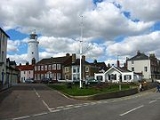
Southwold

Encyclopedia
Southwold is a town on the North Sea
coast, in the Waveney
district of the English
county
of Suffolk
. It is located on the North Sea
coast at the mouth of the River Blyth
within the Suffolk Coast and Heaths Area of Outstanding Natural Beauty. The town is around 11 miles (18 km) south of Lowestoft
and 29 miles (47 km) north-east of Ipswich
. It is within the parliamentary constituency of Suffolk Coastal
.
as an important fishing port, and it received its town charter from Henry VII
in 1489. Over the following centuries a shingle
bar built up across the harbour mouth, preventing the town from becoming a major port.
Southwold was the home of a number of Puritan
emigrants to the Massachusetts Bay Colony
in the early seventeenth century. Richard Ibrook, born in Southwold and a former bailiff of the town, emigrated to Hingham, Massachusetts
, along with Rev. Peter Hobart, son of Edmund Hobart of Hingham, Norfolk
. Rev. Hobart was formerly an assistant vicar of Southwold's St. Edmunds Church after his graduation from Magdalene College, Cambridge
. (Hobart married as his second wife in America Rebecca Ibrook, daughter of his fellow Puritan Richard Ibrook.) The immigrants to Hingham were led by Robert Peck, vicar of St. Andrews' Church in Hingham and a native of Beccles
.
In 1659 a fire devastated most of the town and damaged St Edmunds Church, whose original structure dated from the 12th century. The fire created a number of open spaces within the town which were never rebuilt. Today these green
s, and the restriction of expansion because of the surrounding marsh
es, have preserved its genteel appearance.
On the green just above the beach, descriptively named Gun Hill, the six eighteen-pounder cannon
commemorate the Battle of Sole Bay, fought in 1672 between English and French fleets on one side and the Dutch (under Michiel de Ruyter
) on the other. The battle was bloody but indecisive and many bodies were washed ashore. Southwold Museum has a collection of memento
s of the event.
It has occasionally been held that the cannons were actually captured from the Scots
at Culloden
and given to the town by the Duke of Cumberland but they are much larger than those used in that campaign.
connected to Halesworth
and ran from the 24 September 1879 to April 1929. In 2007 the Southwold Railway Society submitted plans to build a new line running between the parish of Easton Bavents and Henham Park, with the intention of creating a link from the town to the nearest mainline service at Halesworth
. However, these plans were criticised for having no relation to the original route of the railway and, amongst other reasons, environmental concerns. In July 2007 the plans were rejected by both Waveney
and Suffolk Coastal
District Councils.
In December 2008 the Railway Society introduced a new proposal for a Railway Park, including railway track and a museum, on a site at present occupied by a car-breaker's yard, adjacent to the local sewage works.
. It stands as a landmark in the centre of the town. It replaced three local lighthouses that were under serious threat from coastal erosion
. It began operation in 1890 and was electrified and de-manned in 1938. The lighthouse is unusual in that the light itself is switched on and off in sequence (four flashes every 20 seconds), rather than using lenses to create a rotating beam. Trinity House organises visits during the summer.
Sole Bay brewery
was re-built on a site occupied by a brewery since 1660. The town's pubs
and hotels are the Sole Bay Inn, Lord Nelson, Harbour Inn, Kings Head, Red Lion, The Swan, The Crown, and the Blyth (formerly Pier Avenue) Hotel. Public houses lost in the town since 1952 were The Marquis of Lorne, The Brickmakers Arms, The Queen Victoria (now a restaurant but once notable for being the only non-Adnams pub in the town), The Royal and The Southwold Arms. Among Southwold's hotels, the Marlborough was destroyed by enemy action in the Second World War, the Grand was demolished in the 1950s and housing built on the site, and the Craighurst on North Parade was converted to flats in recent years.
Southwold Pier
was built in 1900, and, at 247 metres (about 810 feet) was long enough to accommodate the Belle steamers which carried trippers along the coast. In World War 2, it was weakened by having two breaches blown in it; one by the Royal Engineers, to hinder a possible German invasion and the other by a loose sea-mine. Although the gaps were repaired in 1948, a gale in 1955 destroyed a large part of it; and further damage, caused by weather, occurred over the following decades. By 1987, the pier had been reduced in length to approximately 27 metres (about 90 feet) and what remained was generally in a poor condition. It was entirely rebuilt and restored in 2001 under the auspices of the then-owner, Chris Iredale, and is now approximately 190 metres (about 623 feet) in length. Whilst many English seaside piers are in decline, Southwold Pier is enjoying renewed popularity. It includes a collection of modern coin-operated novelty machines made by Tim Hunkin
. Once again, pleasure steamers such as the paddle steamer PS Waverley
and the MV Balmoral berth at the Pier to embark and disembark trippers.
The Old Water Tower, which stands proudly in the middle of Southwold Common, was built in 1890. The tank held 40,000 gallons of water and was powered by huge sails. On St. Valentine's Day 1899 George Neller, a respected local man, died when his coat got caught in its machinery. In 1937 a new water tower was built next door that was capable of holding 150,000 gallons. The then Southwold Borough Council bought the Old Water Tower before it went into the hands of successive water companies. It was returned to the Town Council for a nominal fee of £100 in 1987. The Old Water Tower has since been used as the Lifeboat Museum and was later used by Adnams for a number of years.
During World War I, the Cannons on Gun Hill were widely regarded as one reason that this part of the coast was bombarded by the German Fleet as a 'fortified coast'. In World War II the cannon were prudently removed, reputedly buried for safety, and returned to their former position after hostilities.
There is a model boat pond just to the North of the pier, where the Southwold Model Yacht Regattas
are held during spring and summer months. The Electric Picture Palace cinema was opened in 2002, a pastiche
of the original 1912 cinema that stood nearby. The town also contains an Amber
Museum.
. By the 15th century Southwold was an important town in its own right, and the church was rebuilt to match its power and wealth.
The church is renowned for its East Anglian flushwork
, especially that of the tower. Knapped and unknapped flints are arranged in patterns, textures and designs and create the stone work. The curving letters over the west window are most famous: SCT. EDMUND ORA P. NOBIS (St Edmund pray for us). Each letter is crowned, and set in knapped flints. The church has a copper clad roof with an easily recognisable flèche
(or spirelet), above a clerestory
of eighteen windows. The flèche was purely for display, and has never contained a bell. The tower has no parapet and is a very fine piece of architecture, with its large bell openings. The roof of the nave is so high that it makes the tower seem shorter than it really is; but it is at least 100 feet high. Southwold does not have any surviving medieval glass, thanks to its destruction by William Dowsing
in 1644. In fact, the only windows in the church that have stained glass are the East windows over the altar (1954, by Sir Ninian Comper
), and the West window below the grand tower. In World War 2 the church was narrowly missed by a German bomb that destroyed houses in the nearby Hollyhock Square. The bomb did not do much damage to the building itself but did blow out most of the windows - another reason why the church has very little stained glass. The church was tidied very quickly for the funerals, a short while later, of the people killed by the bomb.
In the interior, the Southwold rood screen is considered by many to be the finest in the county. It stretches all the way across the church, and is three separate screens; a rood screen across the chancel arch and parclose screens across the north and south chancel aisles. A 15th Century clock jack stands at the west end. He has an axe and bell which he uses to strike the time, and has a twin at Blythburgh
. The Southwold jack is special because it has a name - Southwold Jack - and he is one of the symbols of the Adnams brewery. The font has been badly mutilated but is still very impressive with its large ornate cover. The roof in the chancel is painted and its height gives the church a very open feeling. The present-day church community life is extremely diverse and makes good use of St Edmund's Hall (also destroyed during the Second World War and rebuilt) to the rear of the church. The Parish of Southwold is part of the Sole Bay Team Ministry, along with the Parishes of Blythburgh
, Sotherton
, Reydon
, South Cove, Uggeshall
, Walberswick
and Wangford
.
. The tower held five bells in 1553. Over the years these bells have been recast and others added to create the current eight. The current fourth and fifth are probable recasts of the originals, being cast in 1668 by John Darbie of Ipswich
. The third dates from 1820 and is by William Dobson of Downham Market
. In 1828 one bell was recast and a further two added. The bell that was recast constitutes the present tenor, also by William Dobson. The sixth and seventh were added and are likely to originate from All Saints, South Elmham. Both are medieval bells, the sixth being cast around 1538 by William Barker and the seventh by Brasyers of Norwich
in approximately 1513. The two trebles date from 1881 and are by Moore, Holmes & Mackenzie of Redenhall, Norfolk. However, a peal
rung on 26 July 1858 of Oxford Treble Bob Major, indicates that the tower possessed a ring of eight prior to 1881.
The tenor (the largest) weighs 10 and ¾ hundredweight
or 551 kg and the treble (the lightest) about half of that. The bells hang in a timber frame installed in 1897 by George Day & Son of Eye, Suffolk
. In 1990 the bells were rehung on new fittings and the frame strengthened by the Whitechapel Bell Foundry
. There is a large amount of space surrounding the frame allowing ease of access and maintenance. The clock uses the seventh bell to strike the hours. There are no other bells in the tower other than the ringing peal. The bells are rung from a ringing chamber some 52 steps up the tower. The chamber has many ringing mementoes remembering the achievements of previous years. The tower is affiliated to the Suffolk Guild of Ringers. The bells are rung regularly for practice, Sunday services, weddings and other special occasions.
, and vehicular access is by two roads; Carnsey Road to the west, and Ferry Road to the east. It extends from the river mouth to nearly a mile upstream and serves mainly fishing boats, yachts and small pleasure boats. The clubhouse of Southwold Sailing Club is located on the north side of the harbour. The quay and area in front of the Harbour Inn is called "Blackshore"; although this name is often, but incorrectly, used to refer to the whole of the Harbour.
Situated at the seaward end of the harbour are the RNLI Lifeboat Shed, and the Alfred Corry Museum. Housed in the former Cromer lifeboat shed, the latter is home to the former Southwold lifeboat "Alfred Corry", which was in service from 1893 to 1918. The boat is currently being restored to her original state.
The river can be crossed on foot or bicycle by a public footbridge
(partly the old railway bridge) upstream from The Harbour Inn, and giving access to the nearby village of Walberswick. This bridge, known as the Bailey Bridge
, is based upon the footings of the original railway bridge. It replaced that bridge, which contained a swinging section to allow the passage of wherries and other shipping, and which was largely demolished at the start of the Second World War as a precaution when German invasion was expected.
Towards the mouth of the River Blyth, a rowing boat ferry service runs between the Walberswick and Southwold banks. The ferry
has been operated by the same family since the 1920s, when it was a chain ferry that could take cars. The chain ferry ceased working in 1941, but some small vestiges remain at the Walberswick slipway.
and shingle
. In 2005/6 it was further protected by a coastal management scheme which includes beach nourishment
, new groyne
s on the south side of the pier and riprap
to the north.
It is overlooked by brightly painted beach hut
s.
in the ITV
British drama Upstairs, Downstairs
. The town and its vicinity has been used as the setting for numerous films and television programmes, including Iris about the life of Iris Murdoch
starring Judi Dench
; Drowning by Numbers
by Peter Greenaway
; Kavanagh QC
starring John Thaw
; 'East of Ipswich' by Michael Palin
; Little Britain
with Matt Lucas
and David Walliams
; and a 1969 version of David Copperfield
.
The BBC children's series 'Grandpa in My Pocket' is filmed in Southwold and Aldeburgh.
Julie Myerson
set her 2003 novel about a brutal murder of a young woman, Something Might Happen, in Southwold, or as she described it, "a sleepy, slightly self-satisfied seaside town". The town isn't named in her book, but Myerson stated that setting a murder in the car park did make her feel as if she "was soiling something really good". She holidayed in the town as a child and said in an interview that while everything else in her life had changed, only her mother and Southwold had remained the same. She lives in London but owns a second home in the town.
(then known as Eric Blair) spent time as a teenager and in his thirties in Southwold, living at his parents' home. A plaque
can be seen next door to what is now the fish and chip shop at the far end of the High Street.
From January to June 1922 he attended a cramming establishment
in Southwold to prepare for his Indian Police Service
exams and his career in Burma. In 1929 after eighteen months in Paris he returned to the family home at Southwold and spent most of the next five years based at Southwold. He tutored a handicapped child and a family of three boys during this time and wrote reviews and developed Burmese Days
. During this period he spent nearly eighteen months teaching in West London until he had a serious bout of pneumonia. His mother then insisted that he stay at home instead of carrying on teaching and he spent the time writing A Clergyman's Daughter
. The novel is partly set in a fictionalised East Anglian town called "Knype Hill". His final visit to Southwold was in 1939.
North Sea
In the southwest, beyond the Straits of Dover, the North Sea becomes the English Channel connecting to the Atlantic Ocean. In the east, it connects to the Baltic Sea via the Skagerrak and Kattegat, narrow straits that separate Denmark from Norway and Sweden respectively...
coast, in the Waveney
Waveney
Waveney is a local government district in Suffolk, England, named after the River Waveney that forms its north-west border. The district council is based in Lowestoft, the major settlement in Waveney, which is the only unparished area in the district...
district of the English
England
England is a country that is part of the United Kingdom. It shares land borders with Scotland to the north and Wales to the west; the Irish Sea is to the north west, the Celtic Sea to the south west, with the North Sea to the east and the English Channel to the south separating it from continental...
county
County
A county is a jurisdiction of local government in certain modern nations. Historically in mainland Europe, the original French term, comté, and its equivalents in other languages denoted a jurisdiction under the sovereignty of a count A county is a jurisdiction of local government in certain...
of Suffolk
Suffolk
Suffolk is a non-metropolitan county of historic origin in East Anglia, England. It has borders with Norfolk to the north, Cambridgeshire to the west and Essex to the south. The North Sea lies to the east...
. It is located on the North Sea
North Sea
In the southwest, beyond the Straits of Dover, the North Sea becomes the English Channel connecting to the Atlantic Ocean. In the east, it connects to the Baltic Sea via the Skagerrak and Kattegat, narrow straits that separate Denmark from Norway and Sweden respectively...
coast at the mouth of the River Blyth
River Blyth, Suffolk
The River Blyth is a river in Suffolk, England, with a tidal estuary between Southwold and Walberswick.It can be crossed by pedestrians by a public footbridge called the Bailey Bridge about a mile upstream from the sea or by the Walberswick rowing boat ferry between 9am-5pm daily.The estuary mouth...
within the Suffolk Coast and Heaths Area of Outstanding Natural Beauty. The town is around 11 miles (18 km) south of Lowestoft
Lowestoft
Lowestoft is a town in the English county of Suffolk. The town is on the North Sea coast and is the most easterly point of the United Kingdom. It is north-east of London, north-east of Ipswich and south-east of Norwich...
and 29 miles (47 km) north-east of Ipswich
Ipswich
Ipswich is a large town and a non-metropolitan district. It is the county town of Suffolk, England. Ipswich is located on the estuary of the River Orwell...
. It is within the parliamentary constituency of Suffolk Coastal
Suffolk Coastal (UK Parliament constituency)
Suffolk Coastal is a county constituency represented in the House of Commons of the Parliament of the United Kingdom. It elects one Member of Parliament by the first past the post system of election.This East Anglian constituency was created in 1983....
.
History
Southwold was mentioned in the Domesday BookDomesday Book
Domesday Book , now held at The National Archives, Kew, Richmond upon Thames in South West London, is the record of the great survey of much of England and parts of Wales completed in 1086...
as an important fishing port, and it received its town charter from Henry VII
Henry VII of England
Henry VII was King of England and Lord of Ireland from his seizing the crown on 22 August 1485 until his death on 21 April 1509, as the first monarch of the House of Tudor....
in 1489. Over the following centuries a shingle
Shingle beach
A shingle beach is a beach which is armoured with pebbles or small- to medium-sized cobbles. Typically, the stone composition may grade from characteristic sizes ranging from two to 200 mm diameter....
bar built up across the harbour mouth, preventing the town from becoming a major port.
Southwold was the home of a number of Puritan
Puritan
The Puritans were a significant grouping of English Protestants in the 16th and 17th centuries. Puritanism in this sense was founded by some Marian exiles from the clergy shortly after the accession of Elizabeth I of England in 1558, as an activist movement within the Church of England...
emigrants to the Massachusetts Bay Colony
Massachusetts Bay Colony
The Massachusetts Bay Colony was an English settlement on the east coast of North America in the 17th century, in New England, situated around the present-day cities of Salem and Boston. The territory administered by the colony included much of present-day central New England, including portions...
in the early seventeenth century. Richard Ibrook, born in Southwold and a former bailiff of the town, emigrated to Hingham, Massachusetts
Hingham, Massachusetts
Hingham is a town in northern Plymouth County on the South Shore of the U.S. state of Massachusetts and suburb in Greater Boston. The United States Census Bureau 2008 estimated population was 22,561...
, along with Rev. Peter Hobart, son of Edmund Hobart of Hingham, Norfolk
Hingham, Norfolk
Hingham is a market town and civil parish in the Forehoe district in the heart of rural Norfolk, in England. The civil parish covers an area of and had a population of 2,078 in 944 households as of the 2001 census. Grand architecture surrounds the market place and village green...
. Rev. Hobart was formerly an assistant vicar of Southwold's St. Edmunds Church after his graduation from Magdalene College, Cambridge
Magdalene College, Cambridge
Magdalene College is a constituent college of the University of Cambridge, England.The college was founded in 1428 as a Benedictine hostel, in time coming to be known as Buckingham College, before being refounded in 1542 as the College of St Mary Magdalene...
. (Hobart married as his second wife in America Rebecca Ibrook, daughter of his fellow Puritan Richard Ibrook.) The immigrants to Hingham were led by Robert Peck, vicar of St. Andrews' Church in Hingham and a native of Beccles
Beccles
Beccles is a market town and civil parish in the Waveney District of the English county of Suffolk. The town is shown on the milestone as from London via the A145 Blythburgh and A12 road, northeast of London as the crow flies, southeast of Norwich, and north northeast of the county town of...
.
In 1659 a fire devastated most of the town and damaged St Edmunds Church, whose original structure dated from the 12th century. The fire created a number of open spaces within the town which were never rebuilt. Today these green
Village green
A village green is a common open area which is a part of a settlement. Traditionally, such an area was often common grass land at the centre of a small agricultural settlement, used for grazing and sometimes for community events...
s, and the restriction of expansion because of the surrounding marsh
Marsh
In geography, a marsh, or morass, is a type of wetland that is subject to frequent or continuous flood. Typically the water is shallow and features grasses, rushes, reeds, typhas, sedges, other herbaceous plants, and moss....
es, have preserved its genteel appearance.
On the green just above the beach, descriptively named Gun Hill, the six eighteen-pounder cannon
Cannon
A cannon is any piece of artillery that uses gunpowder or other usually explosive-based propellents to launch a projectile. Cannon vary in caliber, range, mobility, rate of fire, angle of fire, and firepower; different forms of cannon combine and balance these attributes in varying degrees,...
commemorate the Battle of Sole Bay, fought in 1672 between English and French fleets on one side and the Dutch (under Michiel de Ruyter
Michiel de Ruyter
Michiel Adriaenszoon de Ruyter is the most famous and one of the most skilled admirals in Dutch history. De Ruyter is most famous for his role in the Anglo-Dutch Wars of the 17th century. He fought the English and French and scored several major victories against them, the best known probably...
) on the other. The battle was bloody but indecisive and many bodies were washed ashore. Southwold Museum has a collection of memento
Souvenir
A souvenir , memento, keepsake or token of remembrance is an object a person acquires for the memories the owner associates with it. The term souvenir brings to mind the mass-produced kitsch that is the main commodity of souvenir and gift shops in many tourist traps around the world...
s of the event.
It has occasionally been held that the cannons were actually captured from the Scots
Scotland
Scotland is a country that is part of the United Kingdom. Occupying the northern third of the island of Great Britain, it shares a border with England to the south and is bounded by the North Sea to the east, the Atlantic Ocean to the north and west, and the North Channel and Irish Sea to the...
at Culloden
Battle of Culloden
The Battle of Culloden was the final confrontation of the 1745 Jacobite Rising. Taking place on 16 April 1746, the battle pitted the Jacobite forces of Charles Edward Stuart against an army commanded by William Augustus, Duke of Cumberland, loyal to the British government...
and given to the town by the Duke of Cumberland but they are much larger than those used in that campaign.
Railway
The narrow-gauge Southwold RailwaySouthwold Railway
- External links :* * * *...
connected to Halesworth
Halesworth
Halesworth is a small market town in the northeastern corner of Suffolk, England. It is located south west of Lowestoft, and straddles the River Blyth, 9 miles upstream from Southwold. The town is served by Halesworth railway station on the Ipswich-Lowestoft East Suffolk Line...
and ran from the 24 September 1879 to April 1929. In 2007 the Southwold Railway Society submitted plans to build a new line running between the parish of Easton Bavents and Henham Park, with the intention of creating a link from the town to the nearest mainline service at Halesworth
Halesworth railway station
Halesworth is a railway station serving the town of Halesworth in Suffolk. The station is located on the Ipswich-Lowestoft East Suffolk Line.It is the nearest station to the town of Southwold, although some passengers from Southwold prefer to use Darsham station.The station is served by National...
. However, these plans were criticised for having no relation to the original route of the railway and, amongst other reasons, environmental concerns. In July 2007 the plans were rejected by both Waveney
Waveney
Waveney is a local government district in Suffolk, England, named after the River Waveney that forms its north-west border. The district council is based in Lowestoft, the major settlement in Waveney, which is the only unparished area in the district...
and Suffolk Coastal
Suffolk Coastal
Suffolk Coastal is a local government district in Suffolk, England. Its council is based in Woodbridge. Other towns include Felixstowe.The district was formed on 1 April 1974, under the Local Government Act 1972, as a merger of the municipal borough of Aldeburgh, along with Felixstowe,...
District Councils.
In December 2008 the Railway Society introduced a new proposal for a Railway Park, including railway track and a museum, on a site at present occupied by a car-breaker's yard, adjacent to the local sewage works.
Lighthouse
Southwold lighthouse was constructed in 1887 by Trinity HouseTrinity House
The Corporation of Trinity House of Deptford Strond is the official General Lighthouse Authority for England, Wales and other British territorial waters...
. It stands as a landmark in the centre of the town. It replaced three local lighthouses that were under serious threat from coastal erosion
Coastal erosion
Coastal erosion is the wearing away of land and the removal of beach or dune sediments by wave action, tidal currents, wave currents, or drainage...
. It began operation in 1890 and was electrified and de-manned in 1938. The lighthouse is unusual in that the light itself is switched on and off in sequence (four flashes every 20 seconds), rather than using lenses to create a rotating beam. Trinity House organises visits during the summer.
Other town features
In 1890, the AdnamsAdnams Brewery
Adnams PLC is a British regional brewery company founded in 1890 in Southwold, Suffolk, England, by George and Ernest Adnams. The earliest recorded brewing on the Adnams site was in 1396 by Johanna de Corby. The company produces cask ale and pasteurised bottled beers. Annual production is around...
Sole Bay brewery
Brewery
A brewery is a dedicated building for the making of beer, though beer can be made at home, and has been for much of beer's history. A company which makes beer is called either a brewery or a brewing company....
was re-built on a site occupied by a brewery since 1660. The town's pubs
Public house
A public house, informally known as a pub, is a drinking establishment fundamental to the culture of Britain, Ireland, Australia and New Zealand. There are approximately 53,500 public houses in the United Kingdom. This number has been declining every year, so that nearly half of the smaller...
and hotels are the Sole Bay Inn, Lord Nelson, Harbour Inn, Kings Head, Red Lion, The Swan, The Crown, and the Blyth (formerly Pier Avenue) Hotel. Public houses lost in the town since 1952 were The Marquis of Lorne, The Brickmakers Arms, The Queen Victoria (now a restaurant but once notable for being the only non-Adnams pub in the town), The Royal and The Southwold Arms. Among Southwold's hotels, the Marlborough was destroyed by enemy action in the Second World War, the Grand was demolished in the 1950s and housing built on the site, and the Craighurst on North Parade was converted to flats in recent years.
Southwold Pier
Southwold Pier
Southwold Pier is a pier in Southwold, Suffolk, East Anglia, England.Whilst many English seaside piers are in decline, Southwold Pier is enjoying renewed popularity...
was built in 1900, and, at 247 metres (about 810 feet) was long enough to accommodate the Belle steamers which carried trippers along the coast. In World War 2, it was weakened by having two breaches blown in it; one by the Royal Engineers, to hinder a possible German invasion and the other by a loose sea-mine. Although the gaps were repaired in 1948, a gale in 1955 destroyed a large part of it; and further damage, caused by weather, occurred over the following decades. By 1987, the pier had been reduced in length to approximately 27 metres (about 90 feet) and what remained was generally in a poor condition. It was entirely rebuilt and restored in 2001 under the auspices of the then-owner, Chris Iredale, and is now approximately 190 metres (about 623 feet) in length. Whilst many English seaside piers are in decline, Southwold Pier is enjoying renewed popularity. It includes a collection of modern coin-operated novelty machines made by Tim Hunkin
Tim Hunkin
Tim Hunkin is an English engineer, cartoonist, writer, and artist living in Suffolk, England. He is best known for creating the Channel Four television series The Secret Life of Machines, in which he explains the workings and history of various household devices...
. Once again, pleasure steamers such as the paddle steamer PS Waverley
PS Waverley
PS Waverley is the last seagoing passenger carrying paddle steamer in the world. Built in 1946, she sailed from Craigendoran on the Firth of Clyde to Arrochar on Loch Long until 1973...
and the MV Balmoral berth at the Pier to embark and disembark trippers.
The Old Water Tower, which stands proudly in the middle of Southwold Common, was built in 1890. The tank held 40,000 gallons of water and was powered by huge sails. On St. Valentine's Day 1899 George Neller, a respected local man, died when his coat got caught in its machinery. In 1937 a new water tower was built next door that was capable of holding 150,000 gallons. The then Southwold Borough Council bought the Old Water Tower before it went into the hands of successive water companies. It was returned to the Town Council for a nominal fee of £100 in 1987. The Old Water Tower has since been used as the Lifeboat Museum and was later used by Adnams for a number of years.
During World War I, the Cannons on Gun Hill were widely regarded as one reason that this part of the coast was bombarded by the German Fleet as a 'fortified coast'. In World War II the cannon were prudently removed, reputedly buried for safety, and returned to their former position after hostilities.
There is a model boat pond just to the North of the pier, where the Southwold Model Yacht Regattas
Southwold Model Yacht Regattas
Southwold Model Yacht Regattas is model yacht racing club based in the town of Southwold, Suffolk, UK.SMYR was formed in 1894 and the Southwold Regatta has been held every year since. The event is open to all, but radio-controlled boats are prohibited...
are held during spring and summer months. The Electric Picture Palace cinema was opened in 2002, a pastiche
Pastiche
A pastiche is a literary or other artistic genre or technique that is a "hodge-podge" or imitation. The word is also a linguistic term used to describe an early stage in the development of a pidgin language.-Hodge-podge:...
of the original 1912 cinema that stood nearby. The town also contains an Amber
Amber
Amber is fossilized tree resin , which has been appreciated for its color and natural beauty since Neolithic times. Amber is used as an ingredient in perfumes, as a healing agent in folk medicine, and as jewelry. There are five classes of amber, defined on the basis of their chemical constituents...
Museum.
The Church of St Edmund
The parish church of Southwold is dedicated to St Edmund. It is considered to be one of Suffolk's finest. The church lies under one continuous roof. It was built over about 60 years from the 1430s to the 1490s, and replaced a smaller 13th century church that was destroyed by fire. The earlier church dated from the time when Southwold was a small fishing hamlet adjacent to the larger ReydonReydon
Reydon is a village and civil parish, north-west from Southwold and south east of Wangford in Waveney District and the ceremonial county of Suffolk in England. It has a population of 2,567....
. By the 15th century Southwold was an important town in its own right, and the church was rebuilt to match its power and wealth.
The church is renowned for its East Anglian flushwork
Flushwork
-Description:In architecture, flushwork is the decorative combination on the same flat plane of flint and ashlar stone. It is characteristic of the external walls of medieval buildings, most of the survivors being churches, in parts of Southern England, but especially East Anglia...
, especially that of the tower. Knapped and unknapped flints are arranged in patterns, textures and designs and create the stone work. The curving letters over the west window are most famous: SCT. EDMUND ORA P. NOBIS (St Edmund pray for us). Each letter is crowned, and set in knapped flints. The church has a copper clad roof with an easily recognisable flèche
Flèche
A flèche is used in French architecture to refer to a spire and in English to refer to a lead-covered timber spire, or spirelet. These are placed on the ridges of church or cathedral roofs and are usually relatively small...
(or spirelet), above a clerestory
Clerestory
Clerestory is an architectural term that historically denoted an upper level of a Roman basilica or of the nave of a Romanesque or Gothic church, the walls of which rise above the rooflines of the lower aisles and are pierced with windows. In modern usage, clerestory refers to any high windows...
of eighteen windows. The flèche was purely for display, and has never contained a bell. The tower has no parapet and is a very fine piece of architecture, with its large bell openings. The roof of the nave is so high that it makes the tower seem shorter than it really is; but it is at least 100 feet high. Southwold does not have any surviving medieval glass, thanks to its destruction by William Dowsing
William Dowsing
William Dowsing was an English iconoclast who operated at the time of the English Civil War. Dowsing was a puritan soldier who was born in Laxfield, Suffolk...
in 1644. In fact, the only windows in the church that have stained glass are the East windows over the altar (1954, by Sir Ninian Comper
Ninian Comper
Sir John Ninian Comper was a Scottish-born architect. He was one of the last of the great Gothic Revival architects, noted for his churches and their furnishings...
), and the West window below the grand tower. In World War 2 the church was narrowly missed by a German bomb that destroyed houses in the nearby Hollyhock Square. The bomb did not do much damage to the building itself but did blow out most of the windows - another reason why the church has very little stained glass. The church was tidied very quickly for the funerals, a short while later, of the people killed by the bomb.
In the interior, the Southwold rood screen is considered by many to be the finest in the county. It stretches all the way across the church, and is three separate screens; a rood screen across the chancel arch and parclose screens across the north and south chancel aisles. A 15th Century clock jack stands at the west end. He has an axe and bell which he uses to strike the time, and has a twin at Blythburgh
Blythburgh
Blythburgh is a small English village in an area known as the Sandlings, part of the Suffolk heritage coast. Located close to an area of flooded marshland and mud-flats, in 2007 its population was estimated to be 300. Blythburgh is best known for its church, Holy Trinity, internationally known as...
. The Southwold jack is special because it has a name - Southwold Jack - and he is one of the symbols of the Adnams brewery. The font has been badly mutilated but is still very impressive with its large ornate cover. The roof in the chancel is painted and its height gives the church a very open feeling. The present-day church community life is extremely diverse and makes good use of St Edmund's Hall (also destroyed during the Second World War and rebuilt) to the rear of the church. The Parish of Southwold is part of the Sole Bay Team Ministry, along with the Parishes of Blythburgh
Blythburgh
Blythburgh is a small English village in an area known as the Sandlings, part of the Suffolk heritage coast. Located close to an area of flooded marshland and mud-flats, in 2007 its population was estimated to be 300. Blythburgh is best known for its church, Holy Trinity, internationally known as...
, Sotherton
Sotherton
Sotherton is a dispersed village in Suffolk, England, located approximately 7 miles south of Beccles and 3¾ miles north east of Halesworth close to the A145. The mid-2005 population estimate for Sotherton parish was 70...
, Reydon
Reydon
Reydon is a village and civil parish, north-west from Southwold and south east of Wangford in Waveney District and the ceremonial county of Suffolk in England. It has a population of 2,567....
, South Cove, Uggeshall
Uggeshall
Uggeshall is a village in Suffolk, England, located approximately 6 miles south of Beccles and 4 miles north east of Halesworth close to the A145. The mid-2005 population estimate for Uggeshall parish was 170. Sotherton is located just to the south-west, Wangford to the south-east and Brampton...
, Walberswick
Walberswick
Walberswick is a village on the Suffolk coast in England, across the River Blyth from Southwold. Coastal erosion and the shifting of the mouth of the River Blyth meant that the neighbouring town of Dunwich was lost as a port in the last years of the 13th century...
and Wangford
Wangford
Wangford is a village in Suffolk, England, just off the A12 trunk road on the edge of the Henham Park estate just outside Southwold. .Wangford is connected to the rest of Suffolk by two main roads...
.
The Church Bells of St Edmund's
Southwold tower contains a ring of eight bells hung for change ringingChange ringing
Change ringing is the art of ringing a set of tuned bells in a series of mathematical patterns called "changes". It differs from many other forms of campanology in that no attempt is made to produce a conventional melody....
. The tower held five bells in 1553. Over the years these bells have been recast and others added to create the current eight. The current fourth and fifth are probable recasts of the originals, being cast in 1668 by John Darbie of Ipswich
Ipswich
Ipswich is a large town and a non-metropolitan district. It is the county town of Suffolk, England. Ipswich is located on the estuary of the River Orwell...
. The third dates from 1820 and is by William Dobson of Downham Market
Downham Market
Downham Market is a town and civil parish in Norfolk, England. It lies on the edge of the Fens, on the River Great Ouse, some 20 km south of the town of King's Lynn, 60 km west of the city of Norwich and the same distance north of the city of Cambridge....
. In 1828 one bell was recast and a further two added. The bell that was recast constitutes the present tenor, also by William Dobson. The sixth and seventh were added and are likely to originate from All Saints, South Elmham. Both are medieval bells, the sixth being cast around 1538 by William Barker and the seventh by Brasyers of Norwich
Norwich
Norwich is a city in England. It is the regional administrative centre and county town of Norfolk. During the 11th century, Norwich was the largest city in England after London, and one of the most important places in the kingdom...
in approximately 1513. The two trebles date from 1881 and are by Moore, Holmes & Mackenzie of Redenhall, Norfolk. However, a peal
Peal
A peal is the name given to a specific type of performance of change ringing. The precise definition of a peal has changed considerably over the years...
rung on 26 July 1858 of Oxford Treble Bob Major, indicates that the tower possessed a ring of eight prior to 1881.
The tenor (the largest) weighs 10 and ¾ hundredweight
Hundredweight
The hundredweight or centum weight is a unit of mass defined in terms of the pound . The definition used in Britain differs from that used in North America. The two are distinguished by the terms long hundredweight and short hundredweight:* The long hundredweight is defined as 112 lb, which...
or 551 kg and the treble (the lightest) about half of that. The bells hang in a timber frame installed in 1897 by George Day & Son of Eye, Suffolk
Eye, Suffolk
Eye is a small market town in the county of Suffolk, East Anglia, England, south of Diss, and on the River Dove.Eye is twinned with the town of Pouzauges in the Vendée Departement of France.-History:An island...
. In 1990 the bells were rehung on new fittings and the frame strengthened by the Whitechapel Bell Foundry
Whitechapel Bell Foundry
The Whitechapel Bell Foundry is a bell foundry in Whitechapel in the London Borough of Tower Hamlets, in the East End of London. The foundry is listed by the Guinness Book of Records as the oldest manufacturing company in Great Britain...
. There is a large amount of space surrounding the frame allowing ease of access and maintenance. The clock uses the seventh bell to strike the hours. There are no other bells in the tower other than the ringing peal. The bells are rung from a ringing chamber some 52 steps up the tower. The chamber has many ringing mementoes remembering the achievements of previous years. The tower is affiliated to the Suffolk Guild of Ringers. The bells are rung regularly for practice, Sunday services, weddings and other special occasions.
Southwold Harbour
Southwold Harbour lies south of the town on the River BlythRiver Blyth
River Blyth is the name of several rivers in England.*River Blyth, Northumberland*River Blyth, Suffolk...
, and vehicular access is by two roads; Carnsey Road to the west, and Ferry Road to the east. It extends from the river mouth to nearly a mile upstream and serves mainly fishing boats, yachts and small pleasure boats. The clubhouse of Southwold Sailing Club is located on the north side of the harbour. The quay and area in front of the Harbour Inn is called "Blackshore"; although this name is often, but incorrectly, used to refer to the whole of the Harbour.
Situated at the seaward end of the harbour are the RNLI Lifeboat Shed, and the Alfred Corry Museum. Housed in the former Cromer lifeboat shed, the latter is home to the former Southwold lifeboat "Alfred Corry", which was in service from 1893 to 1918. The boat is currently being restored to her original state.
The river can be crossed on foot or bicycle by a public footbridge
Footbridge
A footbridge or pedestrian bridge is a bridge designed for pedestrians and in some cases cyclists, animal traffic and horse riders, rather than vehicular traffic. Footbridges complement the landscape and can be used decoratively to visually link two distinct areas or to signal a transaction...
(partly the old railway bridge) upstream from The Harbour Inn, and giving access to the nearby village of Walberswick. This bridge, known as the Bailey Bridge
Bailey bridge
The Bailey bridge is a type of portable, pre-fabricated, truss bridge. It was developed by the British during World War II for military use and saw extensive use by both British and the American military engineering units....
, is based upon the footings of the original railway bridge. It replaced that bridge, which contained a swinging section to allow the passage of wherries and other shipping, and which was largely demolished at the start of the Second World War as a precaution when German invasion was expected.
Towards the mouth of the River Blyth, a rowing boat ferry service runs between the Walberswick and Southwold banks. The ferry
Ferry
A ferry is a form of transportation, usually a boat, but sometimes a ship, used to carry primarily passengers, and sometimes vehicles and cargo as well, across a body of water. Most ferries operate on regular, frequent, return services...
has been operated by the same family since the 1920s, when it was a chain ferry that could take cars. The chain ferry ceased working in 1941, but some small vestiges remain at the Walberswick slipway.
Southwold Beach
The beach is a combination of sandSand
Sand is a naturally occurring granular material composed of finely divided rock and mineral particles.The composition of sand is highly variable, depending on the local rock sources and conditions, but the most common constituent of sand in inland continental settings and non-tropical coastal...
and shingle
Slate
Slate is a fine-grained, foliated, homogeneous metamorphic rock derived from an original shale-type sedimentary rock composed of clay or volcanic ash through low-grade regional metamorphism. The result is a foliated rock in which the foliation may not correspond to the original sedimentary layering...
. In 2005/6 it was further protected by a coastal management scheme which includes beach nourishment
Beach nourishment
Beach nourishment— also referred to as beach replenishment—describes a process by which sediment lost through longshore drift or erosion is replaced from sources outside of the eroding beach...
, new groyne
Groyne
A groyne is a rigid hydraulic structure built from an ocean shore or from a bank that interrupts water flow and limits the movement of sediment. In the ocean, groynes create beaches, or avoid having them washed away by longshore drift. In a river, groynes prevent erosion and ice-jamming, which...
s on the south side of the pier and riprap
Riprap
Riprap — also known as rip rap, rubble, shot rock or rock armour or "Rip-rap" — is rock or other material used to armor shorelines, streambeds, bridge abutments, pilings and other shoreline structures against scour, water or ice erosion.It is made from a variety of rock types, commonly granite or...
to the north.
It is overlooked by brightly painted beach hut
Beach hut
A beach hut is a small, usually wooden and often brightly coloured, box above the high tide mark on popular bathing beaches. They are generally used as a shelter from the sun or wind, changing into and out of swimming costumes and for the safe storing of some personal belongings...
s.
Southwold in popular culture
The fictional Southwold Estate, seat of the equally fictional Earls of Southwold, is the country estate of the family of Lady Marjorie BellamyLady Marjorie Bellamy
The Lady Marjorie Helen Sybil Bellamy was a fictional character in the ITV drama Upstairs, Downstairs...
in the ITV
ITV
ITV is the major commercial public service TV network in the United Kingdom. Launched in 1955 under the auspices of the Independent Television Authority to provide competition to the BBC, it is also the oldest commercial network in the UK...
British drama Upstairs, Downstairs
Upstairs, Downstairs
Upstairs, Downstairs is a British drama television series originally produced by London Weekend Television and revived by the BBC. It ran on ITV in 68 episodes divided into five series from 1971 to 1975, and a sixth series shown on the BBC on three consecutive nights, 26–28 December 2010.Set in a...
. The town and its vicinity has been used as the setting for numerous films and television programmes, including Iris about the life of Iris Murdoch
Iris Murdoch
Dame Iris Murdoch DBE was an Irish-born British author and philosopher, best known for her novels about political and social questions of good and evil, sexual relationships, morality, and the power of the unconscious...
starring Judi Dench
Judi Dench
Dame Judith Olivia "Judi" Dench, CH, DBE, FRSA is an English film, stage and television actress.Dench made her professional debut in 1957 with the Old Vic Company. Over the following few years she played in several of William Shakespeare's plays in such roles as Ophelia in Hamlet, Juliet in Romeo...
; Drowning by Numbers
Drowning by Numbers
Drowning by Numbers is a 1988 British film directed by Peter Greenaway. It was entered into the 1988 Cannes Film Festival.-Plot:The film's plot centers on three women — a grandmother, mother and daughter — each named Cissie Colpitts. As the story progresses each woman successively drowns her husband...
by Peter Greenaway
Peter Greenaway
Peter Greenaway, CBE is a British film director. His films are noted for the distinct influence of Renaissance and Baroque painting, and Flemish painting in particular...
; Kavanagh QC
Kavanagh QC
Kavanagh QC is a British television series made by Carlton Television for ITV between 1995 and 2001. It has been shown on ITV3 as recently as August 2011; series 1–6 are available on Region 2 DVDs....
starring John Thaw
John Thaw
John Edward Thaw, CBE was an English actor, who appeared in a range of television, stage and cinema roles, his most popular being police and legal dramas such as Redcap, The Sweeney, Inspector Morse and Kavanagh QC.-Early life:Thaw came from a working class background, having been born in Gorton,...
; 'East of Ipswich' by Michael Palin
Michael Palin
Michael Edward Palin, CBE FRGS is an English comedian, actor, writer and television presenter best known for being one of the members of the comedy group Monty Python and for his travel documentaries....
; Little Britain
Little Britain
Little Britain is a British character-based comedy sketch show which was first broadcast on BBC radio and then turned into a television show. It was written by comic duo David Walliams and Matt Lucas...
with Matt Lucas
Matt Lucas
Matthew Richard "Matt" Lucas is an English comedian, screenwriter and actor best known for his acclaimed work with David Walliams in the television show Little Britain; as well as for his portrayals of the scorekeeping baby George Dawes in the comedy panel game Shooting Stars, Tweedledee and...
and David Walliams
David Walliams
David Edward Walliams is an English comedian, writer and actor, known for his partnership with Matt Lucas on the TV sketch show Little Britain and its predecessor Rock Profile...
; and a 1969 version of David Copperfield
David Copperfield (1969 film)
David Copperfield is a 1969 American television film directed by Delbert Mann based on the novel of the same name by Charles Dickens adapted by Jack Pulman, who later went on to adapt the Roman saga I, Claudius for BBC Television. The film was made in the UK for 20th Century Fox Television.The film...
.
The BBC children's series 'Grandpa in My Pocket' is filmed in Southwold and Aldeburgh.
Julie Myerson
Julie Myerson
Julie Myerson is an English author and critic. As well as writing both fiction and non-fiction books, she is also known for having written a long-running column in The Guardian entitled "Living with Teenagers" based on her own family experiences...
set her 2003 novel about a brutal murder of a young woman, Something Might Happen, in Southwold, or as she described it, "a sleepy, slightly self-satisfied seaside town". The town isn't named in her book, but Myerson stated that setting a murder in the car park did make her feel as if she "was soiling something really good". She holidayed in the town as a child and said in an interview that while everything else in her life had changed, only her mother and Southwold had remained the same. She lives in London but owns a second home in the town.
George Orwell
The writer George OrwellGeorge Orwell
Eric Arthur Blair , better known by his pen name George Orwell, was an English author and journalist...
(then known as Eric Blair) spent time as a teenager and in his thirties in Southwold, living at his parents' home. A plaque
Commemorative plaque
A commemorative plaque, or simply plaque, is a plate of metal, ceramic, stone, wood, or other material, typically attached to a wall, stone, or other vertical surface, and bearing text in memory of an important figure or event...
can be seen next door to what is now the fish and chip shop at the far end of the High Street.
From January to June 1922 he attended a cramming establishment
Cram school
Cram schools are specialized schools that train their students to meet particular goals, most commonly to pass the entrance examinations of high schools or universities...
in Southwold to prepare for his Indian Police Service
Indian Police Service
The Indian Police Service , simply known as Indian Police or IPS, is one of the three All India Services of the Government of India...
exams and his career in Burma. In 1929 after eighteen months in Paris he returned to the family home at Southwold and spent most of the next five years based at Southwold. He tutored a handicapped child and a family of three boys during this time and wrote reviews and developed Burmese Days
Burmese Days
Burmese Days is a novel by British writer George Orwell. It was first published in the USA in 1934. It is a tale from the time of the waning days of British colonialism, when Burma was ruled as part of the Indian empire - " a portrait of the dark side of the British Raj." At its centre is John...
. During this period he spent nearly eighteen months teaching in West London until he had a serious bout of pneumonia. His mother then insisted that he stay at home instead of carrying on teaching and he spent the time writing A Clergyman's Daughter
A Clergyman's Daughter
A Clergyman's Daughter is a 1935 novel by English author George Orwell. It tells the story of Dorothy Hare, the clergyman's daughter of the title, whose life is turned upside-down when she suffers an attack of amnesia...
. The novel is partly set in a fictionalised East Anglian town called "Knype Hill". His final visit to Southwold was in 1939.
Cultural events
In 2005, Southwold launched Suffolk's "answer to the Turner prize", the "Flying Egg" competition. This event also ran in 2006 and 2007, but was not repeated in 2008.Southwold Museum
Southwold Museum holds a number of exhibits focussed on the local and natural history of the town. The museum is owned and managed by the Southwold Museum & Historical Society. It is part of the Maritime Heritage East programme which unites 43 maritime museums on the East Coast.See also
- Southold, New YorkSouthold, New YorkSouthold is one of ten towns in Suffolk County, New York, United States. It is located in the northeastern tip of the county, on the North Fork of Long Island. The population was 20,599 at the 2000 census...
- named after Southwold, UK - Southold (CDP), New YorkSouthold (CDP), New YorkSouthold is a census-designated place that generally corresponds to the hamlet by the same name in the town of Southold in Suffolk County, New York, USA...
- village on Long Island, NY - Southwold, OntarioSouthwold, OntarioSouthwold is a township in Elgin County, in Ontario, Canada, located on the north shore of Lake Erie. It is a rich agricultural zone producing predominantly corn and soybeans.-History:...
- Canadian link - Rev. John YoungsJohn YoungsJohn Youngs was a Puritan minister who founded Southold, New York.-Life:...
- founder of Southold, NY - Latitude festivalLatitude FestivalThe Latitude Festival is an annual music festival that takes place in Henham Park, Southwold, Suffolk, England. It was first held in July 2006....
External sources
- Munn, Geoffrey, 'Southwold: An Earthly Paradise', Antique Collectors Club, (Woodbridge, 2006) ISBN 1-85149-518-5 90000
External links
- A Short History of the Southwold Railway
- George Orwell in Southwold
- Photos of Southwold
- Brief details of Southwold history
- Very detailed history of places in Southwold
- Southwold Museum
- Online edition of free monthly newspaper Southwold Organ
- Southwold harbour, ferry, amber museum, sand art, and pier.
- Southwold Harbour
- The Southwold Longshore Fishery
- The "Alfred Corry" Museum
- Southwold Guided Tour
- Southwold Online
- Explore Southwold
- Photograph of where George Orwell lived
- Four webcams from the top of The Old Water Tower on Southwold Common