
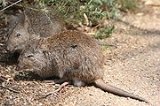
The
Southern Brown Bandicoot (
Isoodon obesulus), also known as the
Quenda from the local
NoongarThe Noongar are an indigenous Australian people who live in the south-west corner of Western Australia from Geraldton on the west coast to Esperance on the south coast...
tongue from South Western Australia, is a
short-nosed bandicootThe short-nosed bandicoots are members of the order Peramelemorphia. They can be found in Queensland, New South Wales, Victoria and in Albany, Western Australia.-Species:There are three species in this genus:...
found mostly in southern Australia.
This
bandicootBandicoots are a group of about 20 species of small to medium-sized, terrestrial marsupial omnivores in the order Peramelemorphia.- Etymology :...
shows some
sexual dimorphismSexual dimorphism is a phenotypic difference between males and females of the same species. Examples of such differences include differences in morphology, ornamentation, and behavior.-Examples:-Ornamentation / coloration:...
, with females being slightly smaller than males. The average male length is 330 mm (13 in), with a tail of 120 mm (4.7 in). Females are about 30 mm (1.2 in) shorter, with a 10 mm (0.393700787401575 in) shorter tail. Males weigh an average of 0.9 kg (2 lb), females 0.7 kg (1.5 lb). The fur of this
marsupialMarsupials are an infraclass of mammals, characterized by giving birth to relatively undeveloped young. Close to 70% of the 334 extant species occur in Australia, New Guinea, and nearby islands, with the remaining 100 found in the Americas, primarily in South America, but with thirteen in Central...
is coarse and colored a dark greyish to yellowish brown, with the undersides a creamy-white. It has short, round ears.
Reproduction is closely linked to local rainfall pattern, and many brown bandicoots breed all year around. A litter of up to 5 young is born after an 11-day gestation and is weaned at 2 months.
While some authorities list as many as five subspecies (
I. o. fusciventer,
I. o. obesulus,
I. o. peninsulae,
I. o. affinus,
I. o. nauticus), the most recent edition of Mammal Species of the World only lists
I. o. nauticus as a valid subspecies, aside from the nominate; the others are given synonym status.
In many areas of its range, the species is threatened but may be locally common where rainfall is high enough and vegetation cover is thick enough. Despite depredations from the introduced European
Red FoxThe red fox is the largest of the true foxes, as well as being the most geographically spread member of the Carnivora, being distributed across the entire northern hemisphere from the Arctic Circle to North Africa, Central America, and the steppes of Asia...
, in some regions it thrives, being reported anecdotally to be living on properties adjoining shopping and population centres such as
StirlingStirling is a city and former ancient burgh in Scotland, and is at the heart of the wider Stirling council area. The city is clustered around a large fortress and medieval old-town beside the River Forth...
in the
Adelaide HillsThe Adelaide Hills are part of the Mount Lofty Ranges, east of the city of Adelaide in the state of South Australia. It is unofficially centred on the largest town in the area, Mount Barker, which has a population of around 29,000 and is also one of Australia's fastest growing towns.- History :The...
.