

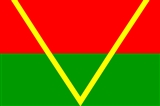
South Kasai

Encyclopedia
South Kasai was a secessionist region in the area of south central Republic of the Congo
(Léopoldville
) during the early 1960s. The region sought independence in similar circumstances to neighboring State of Katanga
during the political turmoil arising from the decolonization
of Belgian Congo
. Ethnic conflicts and political tensions between leaders of the central government and local leaders plagued the diamond
-rich region.
was named president of South Kasai and Joseph Ngalula was appointed head of government.
An assembly of notables invested Kalonji's father with the imperial title of Mulopwe on 12 April 1961. The new emperor immediately abdicated in favor of his son, who thereafter ruled South Kasai as Mulopwe (Emperor or King) Albert I Kalonji.
On 16 July, Kalonji rejected royalty status, but retained the title of Mulopwe and changed his name to Albert I Kalonji Ditunga.
Kalonji attempted to set up a new government following an escape from prison on 7 September 1962, but it was terminated less than a month later.
Under the subsequent regime of Joseph Mobutu (Mobutu Sese Seko), the former South Kasai was divided to discourage separatist sentiment or activity.
Republic of the Congo (Léopoldville)
The Republic of the Congo was an independent republic established following the independence granted to the former colony of the Belgian Congo in 1960...
(Léopoldville
Leopoldville
Leopoldville may refer to:* The capital of the Democratic Republic of the Congo, today known as Kinshasa* SS Leopoldville, a troopship sunk in 1944...
) during the early 1960s. The region sought independence in similar circumstances to neighboring State of Katanga
State of Katanga
Katanga was a breakaway state proclaimed on 11 July 1960 separating itself from the newly independent Democratic Republic of the Congo. In revolt against the new government of Patrice Lumumba in July, Katanga declared independence under Moise Tshombe, leader of the local CONAKAT party...
during the political turmoil arising from the decolonization
Decolonization
Decolonization refers to the undoing of colonialism, the unequal relation of polities whereby one people or nation establishes and maintains dependent Territory over another...
of Belgian Congo
Belgian Congo
The Belgian Congo was the formal title of present-day Democratic Republic of the Congo between King Leopold II's formal relinquishment of his personal control over the state to Belgium on 15 November 1908, and Congolese independence on 30 June 1960.-Congo Free State, 1884–1908:Until the latter...
. Ethnic conflicts and political tensions between leaders of the central government and local leaders plagued the diamond
Diamond
In mineralogy, diamond is an allotrope of carbon, where the carbon atoms are arranged in a variation of the face-centered cubic crystal structure called a diamond lattice. Diamond is less stable than graphite, but the conversion rate from diamond to graphite is negligible at ambient conditions...
-rich region.
Secession
On 14 June 1960, days before the colony was to become independent, officials declared the independence of Kasai (not of Congo) and proclaimed the Federal State of South Kasai. On 8 August 1960, the autonomous Mining State of South Kasai was proclaimed with its capital at Bakwanga (present-day Mbuji-Mayi). Albert KalonjiAlbert Kalonji
Albert Kalonji is a Congolese politician best known for leading the short-lived secessionist state of South Kasai during the Congo Crisis...
was named president of South Kasai and Joseph Ngalula was appointed head of government.
An assembly of notables invested Kalonji's father with the imperial title of Mulopwe on 12 April 1961. The new emperor immediately abdicated in favor of his son, who thereafter ruled South Kasai as Mulopwe (Emperor or King) Albert I Kalonji.
On 16 July, Kalonji rejected royalty status, but retained the title of Mulopwe and changed his name to Albert I Kalonji Ditunga.
Reintegration
After a bloody four month military campaign during which thousands of civilians were massacred, troops of the Congolese central government re-conquered the region and arrested Kalonji on 30 December 1961, thus ending the South Kasai secession.Kalonji attempted to set up a new government following an escape from prison on 7 September 1962, but it was terminated less than a month later.
Under the subsequent regime of Joseph Mobutu (Mobutu Sese Seko), the former South Kasai was divided to discourage separatist sentiment or activity.
External resources
- South Kasai (Autonomous State of)
- South Kasai (Democratic Republic of Congo)
- South Kasai Refugees Airlifted from Kamina to Luluabourg 10 May 1962
- An Epidemic of Kwashiorkor in the South Kasai, Congo
- The Congo: From Leopold to Kabila: A People's History (Paperback) by Georges Nzongola-Ntalaja p104 ff
- Electronic Journal of Africana Bibliography Vol. 9 (2004) Luba-Kasai: A Working Bibliography