

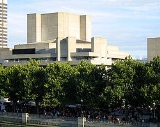
South Bank

Encyclopedia
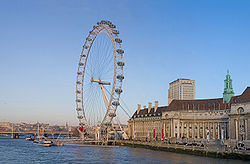
London
London is the capital city of :England and the :United Kingdom, the largest metropolitan area in the United Kingdom, and the largest urban zone in the European Union by most measures. Located on the River Thames, London has been a major settlement for two millennia, its history going back to its...
, England located immediately adjacent to the south side of the River Thames
River Thames
The River Thames flows through southern England. It is the longest river entirely in England and the second longest in the United Kingdom. While it is best known because its lower reaches flow through central London, the river flows alongside several other towns and cities, including Oxford,...
. It forms a long and narrow section of riverside development that is within the London Borough of Lambeth
London Borough of Lambeth
The London Borough of Lambeth is a London borough in south London, England and forms part of Inner London. The local authority is Lambeth London Borough Council.-Origins:...
to the border with the London Borough of Southwark
London Borough of Southwark
The London Borough of Southwark is a London borough in south east London, England. It is directly south of the River Thames and the City of London, and forms part of Inner London.-History:...
(which is properly Bankside
Bankside
Bankside is a district of London, England, and part of the London Borough of Southwark. Bankside is located on the southern bank of the River Thames, east of Charing Cross, running from a little west of Blackfriars Bridge to just a short distance before London Bridge at St Mary Overie Dock to...
) and was formerly simply known as Lambeth Marsh / Lower Marsh. It developed much more slowly than the north bank of the river due to adverse conditions, and throughout its history has twice functioned as an entertainment district, separated by a hundred years of use as a location for industry. Change to the current use of the South Bank began in 1917 with the construction of County Hall
County Hall, London
County Hall is a building in Lambeth, London, which was the headquarters of London County Council and later the Greater London Council . The building is on the bank of the River Thames, just north of Westminster Bridge, facing west toward the City of Westminster, and close to the Palace of...
at Lambeth and the Festival of Britain
Festival of Britain
The Festival of Britain was a national exhibition in Britain in the summer of 1951. It was organised by the government to give Britons a feeling of recovery in the aftermath of war and to promote good quality design in the rebuilding of British towns and cities. The Festival's centrepiece was in...
in 1951 redefined the area as a place for arts and entertainment and the name 'South Bank' was formally adopted. It now forms a significant tourist district in central London
Central London
Central London is the innermost part of London, England. There is no official or commonly accepted definition of its area, but its characteristics are understood to include a high density built environment, high land values, an elevated daytime population and a concentration of regionally,...
which stretches from the near Oxo Tower to the east to the London Eye
London Eye
The London Eye is a tall giant Ferris wheel situated on the banks of the River Thames, in London, England.It is the tallest Ferris wheel in Europe, and the most popular paid tourist attraction in the United Kingdom, visited by over 3.5 million people annually...
and County Hall at Westminster Bridge
Westminster Bridge
Westminster Bridge is a road and foot traffic bridge over the River Thames between Westminster on the north side and Lambeth on the south side, in London, England....
in the west. A series of central London bridges connect the South Bank to North London
North London
North London is the northern part of London, England. It is an imprecise description and the area it covers is defined differently for a range of purposes. Common to these definitions is that it includes districts located north of the River Thames and is used in comparison with South...
, including the more recent Golden Jubilee pedestrian bridge.
History
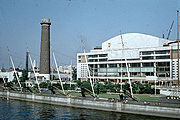
River Thames
The River Thames flows through southern England. It is the longest river entirely in England and the second longest in the United Kingdom. While it is best known because its lower reaches flow through central London, the river flows alongside several other towns and cities, including Oxford,...
was slower to develop than the north bank, alongside the City of London
City of London
The City of London is a small area within Greater London, England. It is the historic core of London around which the modern conurbation grew and has held city status since time immemorial. The City’s boundaries have remained almost unchanged since the Middle Ages, and it is now only a tiny part of...
and Westminster
Westminster
Westminster is an area of central London, within the City of Westminster, England. It lies on the north bank of the River Thames, southwest of the City of London and southwest of Charing Cross...
, because it was low-lying flood area. During the Middle Ages
Middle Ages
The Middle Ages is a periodization of European history from the 5th century to the 15th century. The Middle Ages follows the fall of the Western Roman Empire in 476 and precedes the Early Modern Era. It is the middle period of a three-period division of Western history: Classic, Medieval and Modern...
the south bank developed by embankment and drainage the 'South Bank' area developed as grazing land. With the increase in the urban population of London outside the City towards Westminster the areas opposite of the shallow bank and mud flats of the south bank were ideal locations for industry and wharfage; and the south bank went on to develop as an industrial location in a patchwork of private ownership, with the riverside cut off from the public access. From 1750 the creation of Westminster Bridge and its associated approach roads across to London Bridge, to the south-east, the south-west and the additional traffic from 1789 of Blackfriars Bridge
Blackfriars Bridge
Blackfriars Bridge is a road and foot traffic bridge over the River Thames in London, between Waterloo Bridge and Blackfriars Railway Bridge, carrying the A201 road. The north end is near the Inns of Court and Temple Church, along with Blackfriars station...
opened up access to the area. In the 1820s Waterloo Bridge
Waterloo Bridge
Waterloo Bridge is a road and foot traffic bridge crossing the River Thames in London, England between Blackfriars Bridge and Hungerford Bridge. The name of the bridge is in memory of the British victory at the Battle of Waterloo in 1815...
intensified this process.
There was a shift in use when the London County Council
London County Council
London County Council was the principal local government body for the County of London, throughout its 1889–1965 existence, and the first London-wide general municipal authority to be directly elected. It covered the area today known as Inner London and was replaced by the Greater London Council...
required a new County Hall
County Hall, London
County Hall is a building in Lambeth, London, which was the headquarters of London County Council and later the Greater London Council . The building is on the bank of the River Thames, just north of Westminster Bridge, facing west toward the City of Westminster, and close to the Palace of...
, built between 1917 and 1922 on the south bank near North Lambeth. The construction of County Hall returned the first section of river frontage to public use with the extension of the Albert Embankment. This was extended eastwards in 1951 when the Festival of Britain
Festival of Britain
The Festival of Britain was a national exhibition in Britain in the summer of 1951. It was organised by the government to give Britons a feeling of recovery in the aftermath of war and to promote good quality design in the rebuilding of British towns and cities. The Festival's centrepiece was in...
caused a considerable area to be redeveloped. The legacy of the festival was mixed, with buildings and exhibits demolished to make way for Jubilee Gardens whilst the Royal Festival Hall
Royal Festival Hall
The Royal Festival Hall is a 2,900-seat concert, dance and talks venue within Southbank Centre in London. It is situated on the South Bank of the River Thames, not far from Hungerford Bridge. It is a Grade I listed building - the first post-war building to become so protected...
and The Queen's Walk
The Queen's Walk
The Queen's Walk is a promenade located on the South Bank of the River Thames in London, England, between Lambeth Bridge and Tower Bridge.The creation of pedestrian access along the south bank of the Thames was seen as an integral part of the creation of the Jubilee Walkway to mark the Silver...
were retained as part of the Southbank Centre. During the years following the festival the arts and entertainment complex grew with additional facilities, including the Queen Elizabeth Hall
Queen Elizabeth Hall
The Queen Elizabeth Hall is a music venue on the South Bank in London, United Kingdom that hosts daily classical, jazz, and avant-garde music and dance performances. The QEH forms part of Southbank Centre arts complex and stands alongside the Royal Festival Hall, which was built for the Festival...
, and other arts venues opened along the river such as the Royal National Theatre
Royal National Theatre
The Royal National Theatre in London is one of the United Kingdom's two most prominent publicly funded theatre companies, alongside the Royal Shakespeare Company...
.
Geography
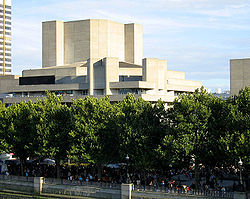
Westminster Bridge
Westminster Bridge is a road and foot traffic bridge over the River Thames between Westminster on the north side and Lambeth on the south side, in London, England....
and slightly further east of Waterloo Bridge
Waterloo Bridge
Waterloo Bridge is a road and foot traffic bridge crossing the River Thames in London, England between Blackfriars Bridge and Hungerford Bridge. The name of the bridge is in memory of the British victory at the Battle of Waterloo in 1815...
. The area is hemmed in between the river to the north and the viaducts of the approaches to Waterloo Station from the south-west and south-east.
Culture
The South Bank is a significant arts and entertainment district. The Southbank Centre comprises the Royal Festival HallRoyal Festival Hall
The Royal Festival Hall is a 2,900-seat concert, dance and talks venue within Southbank Centre in London. It is situated on the South Bank of the River Thames, not far from Hungerford Bridge. It is a Grade I listed building - the first post-war building to become so protected...
, the Queen Elizabeth Hall
Queen Elizabeth Hall
The Queen Elizabeth Hall is a music venue on the South Bank in London, United Kingdom that hosts daily classical, jazz, and avant-garde music and dance performances. The QEH forms part of Southbank Centre arts complex and stands alongside the Royal Festival Hall, which was built for the Festival...
and The Hayward art gallery. The Royal National Theatre
Royal National Theatre
The Royal National Theatre in London is one of the United Kingdom's two most prominent publicly funded theatre companies, alongside the Royal Shakespeare Company...
and BFI Southbank
BFI Southbank
BFI Southbank is the leading repertory cinema in the UK specialising in seasons of classic, independent and non-English language films and is operated by the British Film Institute.-History:...
are located adjacent to the east, but are not part of the centre. County Hall is no longer used as the seat of London government and has been converted for use as a hotel, also housing the Sea Life London Aquarium, the London Film Museum
London Film Museum
The London Film Museum, founded and created by Jonathan Sands in February 2008, is a museum dedicated to the British film industry.It is located in County Hall on the South Bank in London, and features original props, costumes and sets from feature films. There is also a section on how films are...
, and is the location of the London Eye
London Eye
The London Eye is a tall giant Ferris wheel situated on the banks of the River Thames, in London, England.It is the tallest Ferris wheel in Europe, and the most popular paid tourist attraction in the United Kingdom, visited by over 3.5 million people annually...
. Next to the National Theatre is the London Television Centre (originally the South Bank Television Centre), created as the studios of London Weekend Television
London Weekend Television
London Weekend Television was the name of the ITV network franchise holder for Greater London and the Home Counties including south Suffolk, middle and east Hampshire, Oxfordshire, south Bedfordshire, south Northamptonshire, parts of Herefordshire & Worcestershire, Warwickshire, east Dorset and...
and now home to ITV Studios
ITV Studios
ITV Studios is a television production company owned by the British television network ITV. It not only makes programmes primarily for its parent company, but also for other networks...
.
Part of the South Bank Centre known as the under-croft, has been used by the skateboard community since the early seventies. It was originally an architectural dead-spot which has become the home of British skateboarding. The size of the under-croft has been reduced in recent years and was supposed to be returned to original size. This now seems unlikely and the future of the whole space is completely unsure at present. One part of the South Bank Centre has already been turned into shops looking out over the river and rumour has it the rest is sure to follow.
The South Bank is a central location in the 1952 comedy film The Happy Family
The Happy Family (1952 film)
The Happy Family is a 1952 British comedy film directed by Muriel Box and starring Stanley Holloway, Kathleen Harrison and Naunton Wayne. The plot of the film centres on resistance by a family to the disruption caused by the construction of the Festival of Britain. It is also known by the...
which is set around the Festival of Britain
Festival of Britain
The Festival of Britain was a national exhibition in Britain in the summer of 1951. It was organised by the government to give Britons a feeling of recovery in the aftermath of war and to promote good quality design in the rebuilding of British towns and cities. The Festival's centrepiece was in...
.
Transport
Part of the success of the area as a visitor attraction is attributed to the high levels of public transport access. Several main railway terminals are within walking distance of the South Bank, on both sides of the river, including WaterlooWaterloo station
Waterloo station, also known as London Waterloo, is a central London railway terminus and London Underground complex. The station is owned and operated by Network Rail and is close to the South Bank of the River Thames, and in Travelcard Zone 1....
, Charing Cross
Charing Cross railway station
Charing Cross railway station, also known as London Charing Cross, is a central London railway terminus in the City of Westminster, England. It is one of 18 stations managed by Network Rail, and trains serving it are operated by Southeastern...
, and nearby Blackfriars
Blackfriars station
Blackfriars station, also known as London Blackfriars, is a central London railway terminus and London Underground complex in the City of London, England. Its platforms will eventually span the River Thames a short distance downstream from Blackfriars Bridge. The current entrance is located on the...
. The London Underground has stations on or near the South Bank, from west to east, at Westminster
Westminster tube station
Westminster is a London Underground station in the City of Westminster. It is served by the Circle, District and Jubilee lines. On the Circle and District lines, the station is between St. James's Park and Embankment and, on the Jubilee line it is between Green Park and Waterloo. It is in...
, Waterloo, Embankment
Embankment tube station
Embankment is a London Underground station in the City of Westminster, known by various names during its history. It is served by the Circle, District, Northern and Bakerloo lines. On the Northern and Bakerloo lines, the station is between Waterloo and Charing Cross stations; on the Circle and...
, Blackfriars and Southwark
Southwark tube station
Southwark tube station is a London Underground Jubilee line station in the London Borough of Southwark at the corner of Blackfriars Road and The Cut. It is between the and stations and is in Travelcard Zone 1. It was opened on 20 November 1999 as part of the Jubilee Line Extension...
. Accessibility to the north bank is high with connections made, from west to east, over the Westminster
Westminster Bridge
Westminster Bridge is a road and foot traffic bridge over the River Thames between Westminster on the north side and Lambeth on the south side, in London, England....
, Golden Jubilee, Waterloo
Waterloo Bridge
Waterloo Bridge is a road and foot traffic bridge crossing the River Thames in London, England between Blackfriars Bridge and Hungerford Bridge. The name of the bridge is in memory of the British victory at the Battle of Waterloo in 1815...
and Blackfriars
Blackfriars Bridge
Blackfriars Bridge is a road and foot traffic bridge over the River Thames in London, between Waterloo Bridge and Blackfriars Railway Bridge, carrying the A201 road. The north end is near the Inns of Court and Temple Church, along with Blackfriars station...
. The river is utilised as a means of transport with piers along the South Bank at the London Eye and Royal Festival Hall.