
Home      Discussion      Topics      Dictionary      Almanac
Signup       Login
South Australia Police

South Australia Police

Overview
The South Australia Police (SAPOL) is the police force of the Australia
Australia
Australia , officially the Commonwealth of Australia, is a country in the Southern Hemisphere comprising the mainland of the Australian continent, the island of Tasmania, and numerous smaller islands in the Indian and Pacific Oceans. It is the world's sixth-largest country by total area...

n state
States and territories of Australia
The Commonwealth of Australia is a union of six states and various territories. The Australian mainland is made up of five states and three territories, with the sixth state of Tasmania being made up of islands. In addition there are six island territories, known as external territories, and a...

 of South Australia
South Australia
South Australia is a state of Australia in the southern central part of the country. It covers some of the most arid parts of the continent; with a total land area of , it is the fourth largest of Australia's six states and two territories.South Australia shares borders with all of the mainland...

. It is an agency of the Government of South Australia
Government of South Australia
The form of the Government of South Australia is prescribed in its constitution, which dates from 1856, although it has been amended many times since then...

 within the South Australian Department of Justice.
Discussion
Ask a question about 'South Australia Police'
Start a new discussion about 'South Australia Police'
Answer questions from other users
Full Discussion Forum
 
Unanswered Questions
Encyclopedia
The South Australia Police (SAPOL) is the police force of the Australia
Australia
Australia , officially the Commonwealth of Australia, is a country in the Southern Hemisphere comprising the mainland of the Australian continent, the island of Tasmania, and numerous smaller islands in the Indian and Pacific Oceans. It is the world's sixth-largest country by total area...

n state
States and territories of Australia
The Commonwealth of Australia is a union of six states and various territories. The Australian mainland is made up of five states and three territories, with the sixth state of Tasmania being made up of islands. In addition there are six island territories, known as external territories, and a...

 of South Australia
South Australia
South Australia is a state of Australia in the southern central part of the country. It covers some of the most arid parts of the continent; with a total land area of , it is the fourth largest of Australia's six states and two territories.South Australia shares borders with all of the mainland...

. It is an agency of the Government of South Australia
Government of South Australia
The form of the Government of South Australia is prescribed in its constitution, which dates from 1856, although it has been amended many times since then...

 within the South Australian Department of Justice.

History


Formally established in 1838 under Henry Inman
Henry Inman (police commander)
Henry Inman , cavalry officer, Pioneer of South Australia, founder and first commander of the South Australia Police, overlander, Anglican clergyman.-Origins:...

, the force is the oldest in Australasia and it is the third oldest organised Police Service in the World. Unlike other Australian police forces, which originally employed soldiers or former convicts, the South Australia Police enlisted only volunteers. This occurred because South Australia was the only free province on the continent.

Organisation


SAPOL's structure consists of various units. Through chain of command
Chain of Command
Chain of Command may refer to:* Chain of command, in a military context, the line of authority and responsibility along which orders are passed* "Chain of Command" , the fifth episode of the first season of Beast Wars...

, all units are accountable to the Commissioner. Services are the largest units, and are headed by a sworn Assistant Commissioner, or for areas which are not policing specific, such as information technology
Information technology
Information technology is the acquisition, processing, storage and dissemination of vocal, pictorial, textual and numerical information by a microelectronics-based combination of computing and telecommunications...

, a civilian Director. Services are directly accountable to either the Commissioner or Deputy Commissioner.

Services are based on Local Service Areas (LSA) which provide operational policing services, and Branches, which provide other specialised services or assistance. These areas are further broken down into Sections. Larger sections may be divided into a number of Teams.

Local Service Areas


Local Service Areas are the main organisational unit to provide policing services to the public. A local service area contains a number of police stations, and specialist services to support frontline police such as Detectives
Detective
A detective is an investigator, either a member of a police agency or a private person. The latter may be known as private investigators or "private eyes"...

, Crime Scene Investigators and Traffic
Highway patrol
A highway patrol is either a police unit created primarily for the purpose of overseeing and enforcing traffic safety compliance on roads and highways, or a detail within an existing local or regional police agency that is primarily concerned with such duties.Duties of highway patrols or traffic...

 police.
Northern Operations Service Southern Operations Service
Barossa LSA Eastern Adelaide LSA
Elizabeth LSA Hills Fleurieu LSA
Eyre and Western LSA Limestone Coast LSA
Far North LSA Murray Mallee LSA
Holden Hill LSA South Coast LSA
Yorke Mid-North LSA Sturt LSA
Western Adelaide LSA

Ranks


Probationary
Constable
Constable First Class
Constable
Constable
A constable is a person holding a particular office, most commonly in law enforcement. The office of constable can vary significantly in different jurisdictions.-Etymology:...

Senior
Constable
Senior Constable
First Class
Brevet
Sergeant
Sergeant
Sergeant
Sergeant is a rank used in some form by most militaries, police forces, and other uniformed organizations around the world. Its origins are the Latin serviens, "one who serves", through the French term Sergent....

Senior
Sergeant
Senior Sergeant
First Class


All grades of Constable perform the same basic range of duties, with the rank only reflecting experience. The rank of Probationary Constable is held for the first fifteen months of service. A First Class Constable is qualified for promotion to Senior Constable. A Senior Constable First Class is either an officer qualified for promotion to Sergeant/Senior Sergeant or has won a Senior Constable First Class position on merit. A Brevet Sergeant is a temporary designation for an officer in a particular position which would require specialised skills, such as a Crime Scene Investigator or STAR Group member.

A Sergeant normally manages a team during a shift. A Sergeant may also manage a small country station. A Detective Sergeant is normally in charge of a team in an investigations section. As with a Sergeant, a Detective Sergeant may be the officer in charge of a country CIB unit. A Senior Sergeant is the officer in charge of a section, including traffic, criminal investigation, and operations (uniform). A Senior Sergeant traditionally does more administrative work than active patrol duties.
Inspector
Inspector
Inspector is both a police rank and an administrative position, both used in a number of contexts. However, it is not an equivalent rank in each police force.- Australia :...

Chief
Inspector
Superintendent
Superintendent (police)
Superintendent , often shortened to "super", is a rank in British police services and in most English-speaking Commonwealth nations. In many Commonwealth countries the full version is superintendent of police...

Chief
Superintendent
Commander Assistant
Commissioner
Deputy
Commissioner
Commissioner


Officers of Police were formerly known as Commissioned Officers. This name was changed as SAPOL Officers no longer receive a Queen's Commission. Officers of Police act primarily as managers and generally do not partake in operational policing. An Inspector is in charge of a section. A Detective Inspector is normally in charge of the whole station CIB. A uniform Inspector is normally in charge of the station's operations.

A Chief Inspector commands a department at station level. A uniform Chief Inspector is in charge of all uniformed officers, regardless of their attachments to assigned areas (e.g. general duties, traffic duties etc). Some country LSA's have Chief Inspectors as the Regional Commander. A Detective Chief Inspector is in charge of all CIB related matters.

Superintendents, Chief Superintendents and Commanders may be the manager of a Local Service Area or Branch, such as the Major Crime Branch. An LSA Commander is generally a Superintendent. A Chief Superintendent may be the manager of a specialised area, such as a Service Coordination Branch. Few Commanders are appointed. The Industrial Relations Branch has a Commander as its officer in charge.

An Assistant Commissioner is the manager of a Service, such as Northern Operations Service or Crime Service.

The Deputy Commissioner is the assistant to the Commissioner, who commands the force.

Uniform


SAPOL issues uniforms to sworn police officers. Police officers working in non-specialised areas generally wear standard uniform, which consists of a light blue collared shirt with attached police badges and navy blue slacks. Short and long sleeve shirts are worn as preferred. Police officers wear white peaked cap and tie in winter. During summer officers wear an Akubra
Akubra
Akubra is an Australian brand of bush hat, whose wide-brimmed styles are a distinctive part of Australian culture, especially in rural areas. The name is believed to be derived from an Aboriginal word for head covering....

 wide brimmed hat and are not required to wear a tie. Baseball caps are worn in specialist areas, including STAR Group, Crime Scene, State Traffic Enforcement Section, and by Operational Safety Trainers.

Officers in northern country areas wear khaki uniforms instead blue.

Operational equipment


The standard issue SA Police firearms are the .40 Smith & Wesson M&P
Smith & Wesson M&P
The Smith & Wesson Model 10, previously known as the Smith & Wesson Military & Police or the Smith & Wesson Victory Model, is a .38-caliber revolver developed from the Smith & Wesson .38 Hand Ejector Model of 1889. In production since 1899, it is a fixed-sight, six-shot handgun with a fluted...

. CIB officers are issued with the Smith & Wesson M&P
Smith & Wesson M&P
The Smith & Wesson Model 10, previously known as the Smith & Wesson Military & Police or the Smith & Wesson Victory Model, is a .38-caliber revolver developed from the Smith & Wesson .38 Hand Ejector Model of 1889. In production since 1899, it is a fixed-sight, six-shot handgun with a fluted...

 .40 compact pistol. Other equipment issued to officers are oleoresin capsicum spray
Pepper spray
Pepper spray, also known as OC spray , OC gas, and capsicum spray, is a lachrymatory agent that is used in riot control, crowd control and personal self-defense, including defense against dogs and bears...

, ASP Extendable Baton and Hiatts handcuffs
Handcuffs
Handcuffs are restraint devices designed to secure an individual's wrists close together. They comprise two parts, linked together by a chain, a hinge, or rigid bar. Each half has a rotating arm which engages with a ratchet that prevents it from being opened once closed around a person's wrist...

. Special Tasks and Rescue
Special Tasks and Rescue
Special Tasks and Rescue is the Police Tactical Group of the South Australia Police.-History:Formed on 30 November 1978 the South Australian Police STAR Group was a rationalisation of specialist resources into one command/unit. Specialist units had existed prior to 1978 within SAPOL to deal with...

 (STAR Group) officers have also been issued with the Smith & Wesson M&P.

Specialised units such as STAR Group use other equipment suited to the nature of their duties.

Vehicles


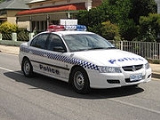
SAPOL officers use a number of vehicles in day to day duties. The primary vehicle used by patrol members are modified Holden
Holden
GM Holden Ltd is an automaker that operates in Australia, based in Port Melbourne, Victoria. The company was founded in 1856 as a saddlery manufacturer. In 1908 it moved into the automotive field, before becoming a subsidiary of the U.S.-based General Motors in 1931...

 Commodore
Holden Commodore
The Holden Commodore is an automobile manufactured since 1978 by the Holden subsidiary of General Motors in Australia, and, formerly, in New Zealand. In the mid-1970s, Holden established proposals to replace the long-serving Kingswood nameplate with a smaller, Opel-based model...

. Also used are Ford, Toyota Hilux, and Holden Colorado caged vehicles for prisoner transport. In remote country areas, Toyota Land Cruiser
Toyota Land Cruiser
The is a series of four-wheel drive vehicles produced by the Japanese car maker Toyota Motor Corporation. It is not related to the Studebaker Land Cruiser car produced in the US from 1934-1954....

 Troop Carriers are used as primary patrol vehicles. Patrol cars are used in both marked and unmarked variants.

Members of the State Traffic Enforcement Section ride marked and unmarked Honda
Honda
is a Japanese public multinational corporation primarily known as a manufacturer of automobiles and motorcycles.Honda has been the world's largest motorcycle manufacturer since 1959, as well as the world's largest manufacturer of internal combustion engines measured by volume, producing more than...

 and BMW
BMW
Bayerische Motoren Werke AG is a German automobile, motorcycle and engine manufacturing company founded in 1916. It also owns and produces the Mini marque, and is the parent company of Rolls-Royce Motor Cars. BMW produces motorcycles under BMW Motorrad and Husqvarna brands...

 motorcycles for traffic, escort, and other duties.

SAPOL have the use of several Police Operations Vehicles which are used in a wide variety of ways, for example, as a mobile police station/unit at a large public function, or as forward command posts at search and rescue
Search and rescue
Search and rescue is the search for and provision of aid to people who are in distress or imminent danger.The general field of search and rescue includes many specialty sub-fields, mostly based upon terrain considerations...

s, or other incidents such as siege or hostage situations. The Special Tasks and Rescue
Special Tasks and Rescue
Special Tasks and Rescue is the Police Tactical Group of the South Australia Police.-History:Formed on 30 November 1978 the South Australian Police STAR Group was a rationalisation of specialist resources into one command/unit. Specialist units had existed prior to 1978 within SAPOL to deal with...

 Group (STAR Group) also possess a Lenco BearCat
Lenco BearCat
The Lenco BearCat is a wheeled armored personnel carrier in use with numerous military and law enforcement agencies.-History:Since 1981 the Massachusetts based Lenco Industries, known as Lenco Armoured Vehicles has designed and manufactured armored vehicles for Law Enforcement, Military, Government...

 armoured vehicle available for use in siege or terrorist situations.

The SAPOL Water Operations Unit uses a number of watercraft
Watercraft
A watercraft is a vessel or craft designed to move across or through water. The name is derived from the term "craft" which was used to describe all types of water going vessels...

 to police coastal and inland waterways. Members of STAR Group and Transit Services Branch act as crew members on a Eurocopter EC-130 helicopter operated by the Motor Accident Commission Rescue Helicopter Service. Officers also crew other helicopters operated by the MAC Rescue Helicopter Service dependent on the mission. Helicopters are multi-role and are used for search and rescue operations, crime prevention and police pursuits.

For ceremonial activities, crowd control and patrol duties, the SAPOL Mounted Operations Unit use grey horses. They are bred and trained at the Thebarton Police Barracks, just outside the central business district of Adelaide. These Police 'Greys' as they are known, are ideal for Police work as the light grey tones make the horse highly visible at night. They are also highly recognisable in the community and are often involved in community events such as leading the annual Christmas pageant and ANZAC day parade.

Training


Recruit training is conducted at Fort Largs Police Academy
Fort Largs Police Academy
Fort Largs is historic defence facility in the seaside suburb of Taperoo near Port Adelaide, approximately north west of Adelaide's centre. Today Fort Largs survives in greatly modified condition from its original state...

 located in the western Adelaide suburb of Taperoo. Cadets undergo a 29 week course, called the 'Constable Development Program' (CDP). The CDP is broken down into 5 phases, which includes training at the Police Academy and field experience at metropolitan LSAs. Police cadets learn law, about investigations and police procedures. Cadets also undertake operational safety training, including self-defence and the use of firearms. Practical role-playing and assessments are part of the course.

Cadets graduate with the rank of Probationary Constable and are subject to a 15 month period of on the job training. Probationary Constables are required to work with a Field Tutor for the first 6 months of the probationary period whilst they complete a Personal Learning Portfolio. Probationary Constables also undertake a range of duties to enhance their learning, including traffic, prisoner management, and general duties. For the following 6 months, probationary constables continue to collect evidence of their workplace competency before attended the Probationary Constable Assessment Workshop to determine whether they are suitable to progress to the rank of Constable
Constable
A constable is a person holding a particular office, most commonly in law enforcement. The office of constable can vary significantly in different jurisdictions.-Etymology:...

. Upon completion of the probationary period, officers receive a Diploma of Public Safety (Policing) and are appointed to the rank of Constable.

Training is ongoing and further courses are available for officers to attend.

External links