
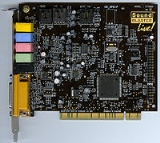
A
sound card is an internal
computerA computer is a programmable machine designed to sequentially and automatically carry out a sequence of arithmetic or logical operations. The particular sequence of operations can be changed readily, allowing the computer to solve more than one kind of problem...
expansion cardThe expansion card in computing is a printed circuit board that can be inserted into an expansion slot of a computer motherboard or backplane to add functionality to a computer system via the expansion bus.One edge of the expansion card holds the contacts that fit exactly into the slot...
that facilitates the input and output of
audio signalsSound is a mechanical wave that is an oscillation of pressure transmitted through a solid, liquid, or gas, composed of frequencies within the range of hearing and of a level sufficiently strong to be heard, or the sensation stimulated in organs of hearing by such vibrations.-Propagation of...
to and from a computer under control of computer programs. The term
sound card is also applied to external audio interfaces that use software to generate sound, as opposed to using hardware inside the PC. Typical uses of sound cards include providing the audio component for multimedia applications such as music composition, editing video or audio, presentation, education and entertainment (games) and video projection. Many computers have sound capabilities built in, while others require additional expansion cards to provide for audio capability.
General characteristics
Sound cards usually feature a
digital-to-analog converterIn electronics, a digital-to-analog converter is a device that converts a digital code to an analog signal . An analog-to-digital converter performs the reverse operation...
(DAC), which converts recorded or generated digital data into an analog format. The output signal is connected to an amplifier, headphones, or external device using standard interconnects, such as a
TRS connectorA TRS connector is a common family of connector typically used for analog signals including audio. It is cylindrical in shape, typically with three contacts, although sometimes with two or four . It is also called an audio jack, phone jack, phone plug, and jack plug...
or an
RCA connectorAn RCA connector, sometimes called a phono connector or cinch connector, is a type of electrical connector commonly used to carry audio and video signals...
. If the number and size of connectors is too large for the space on the backplate the connectors will be off-board, typically using a breakout box, or an auxiliary backplate. More advanced cards usually include more than one sound chip to provide for higher data rates and multiple simultaneous functionality, for example digital production of
synthesizedA synthesizer is an electronic instrument capable of producing sounds by generating electrical signals of different frequencies. These electrical signals are played through a loudspeaker or set of headphones...
sounds (usually for real-time generation of music and sound effects using minimal data and CPU time).
Digital sound reproduction is usually done with multichannel DACs, which are capable of simultaneous digital samples at different pitches and volumes and application of real-time effects, like filtering or distortion. Multichannel digital sound playback can also be used for music synthesis, when used with a compliance, and even multiple-channel emulation. This approach has become common as manufacturers seek simpler and lower-cost sound cards.
Most sound cards have a
line in connector for an input signal
from a cassette tape or other sound source that has higher voltage levels than a microphone. The sound card digitizes this signal and stores it (under control of appropriate matching computer software) on the computer's
hard diskA hard disk drive is a non-volatile, random access digital magnetic data storage device. It features rotating rigid platters on a motor-driven spindle within a protective enclosure. Data is magnetically read from and written to the platter by read/write heads that float on a film of air above the...
for storage, editing, or further processing. Another common external connector is the
microphone connector, for signals from a
microphoneA microphone is an acoustic-to-electric transducer or sensor that converts sound into an electrical signal. In 1877, Emile Berliner invented the first microphone used as a telephone voice transmitter...
or other low-level input device. Input through a microphone jack can be used, for example, by
speech recognitionSpeech recognition converts spoken words to text. The term "voice recognition" is sometimes used to refer to recognition systems that must be trained to a particular speaker—as is the case for most desktop recognition software...
or
voice over IPVoice over Internet Protocol is a family of technologies, methodologies, communication protocols, and transmission techniques for the delivery of voice communications and multimedia sessions over Internet Protocol networks, such as the Internet...
applications.
Sound channels and polyphony
An important sound card characteristic is
polyphonyIn music, polyphony is a texture consisting of two or more independent melodic voices, as opposed to music with just one voice or music with one dominant melodic voice accompanied by chords ....
, which refers to its ability to process and output multiple
independent voices or sounds
simultaneously. These distinct
channels are seen as the number of audio outputs, which may correspond to a speaker configuration such as 2.0 (stereo), 2.1 (stereo and sub woofer), 5.1 (surround), or other configuration. Sometimes, the terms
voice and
channel are used interchangeably to indicate the degree of polyphony, not the output speaker configuration.
For example, many older
sound chipA sound chip is an integrated circuit designed to produce sound . It might be doing this through digital, analog or mixed-mode electronics...
s could accommodate three voices, but only one audio channel (i.e., a single mono output) for output, requiring all voices to be mixed together. Later cards, such as the
AdLibAd Lib, Inc. was a manufacturer of sound cards and other computer equipment founded by Martin Prevel, a former professor of music and vice-dean of the music department at the Université Laval...
sound card, had a 9-voice polyphony combined in 1 mono output channel.
For some years, most PC sound cards have had multiple FM synthesis voices (typically 9 or 16) which were usually used for MIDI music. The full capabilities of advanced cards aren't often completely used; only one (mono) or two (
stereoSTEREO is a solar observation mission. Two nearly identical spacecraft were launched into orbits that cause them to respectively pull farther ahead of and fall gradually behind the Earth...
) voice(s) and channel(s) are usually dedicated to playback of digital sound samples, and playing back more than one digital sound sample usually requires a software
downmixDownmixing is a general term used for manipulating audio where a number of distinct audio channels are mixed together to produce a lower number of channels...
at a fixed sampling rate. Modern low-cost integrated soundcards (i.e., those built into motherboards) such as
audio codecAll codecs are devices or computer programs capable of coding or decoding a digital data stream or signal.The term audio codec has two meanings depending on the context:...
s like those meeting the AC'97 standard and even some lower-cost expansion sound cards still work this way. These devices may provide more than two sound output channels (typically 5.1 or 7.1
surround soundSurround sound encompasses a range of techniques such as for enriching the sound reproduction quality of an audio source with audio channels reproduced via additional, discrete speakers. Surround sound is characterized by a listener location or sweet spot where the audio effects work best, and...
), but they usually have no actual hardware polyphony for either sound effects or MIDI reproduction – these tasks are performed entirely in software. This is similar to the way inexpensive
softmodemA Softmodem, or software modem, is a modem with minimal hardware capacities, designed to use a host computer's resources to perform most of the tasks performed by dedicated hardware in a traditional modem.A Softmodem is also referred to as a Winmodem because the first commercially available...
s perform modem tasks in software rather than in hardware.
Also, in the early days of
wavetable synthesisWavetable synthesis is used in certain digital music synthesizers to implement a restricted form of real-time additive synthesis. The technique was first developed by Wolfgang Palm of PPG in the late 1970s and published in 1979, and has since been used as the primary synthesis method in...
, some sound card manufacturers advertised polyphony solely on the MIDI capabilities alone. In this case, the card's output channel is irrelevant (and typically, the card is only capable of two channels of digital sound). Instead, the polyphony measurement solely applies to the amount of MIDI instruments the sound card is capable of producing at one given time.
Today, a sound card providing actual hardware polyphony, regardless of the number of output channels, is typically referred to as a "hardware audio accelerator", although actual voice polyphony is not the sole (or even a necessary) prerequisite, with other aspects such as hardware acceleration of 3D sound, positional audio and real-time DSP effects being more important.
Since digital sound playback has become available and provided better performance than synthesis, modern soundcards with hardware polyphony don't actually use DACs with as many channels as voices. Instead, they perform voice mixing and effects processing in hardware (eventually performing digital filtering and conversions to and from the frequency domain for applying certain effects) inside a dedicated DSP. The final playback stage is performed by an external (in reference to the DSP chip(s)) DAC with significantly fewer channels than voices (e.g., 8 channels for 7.1 audio, which can be divided among 32, 64 or even 128 voices).
Color codes
Connectors on the sound cards are colour coded as per the
PC System Design GuideThe PC System Design Guide is a series of hardware design requirements and recommendations for IBM PC compatible personal computers, compiled by Microsoft and Intel Corporation during 1997–2001...
. They will also have symbols with arrows, holes and soundwaves that are associated with each jack position, the meaning of each is given below:
| Colour | Function | Connector | symbol |
| |
PinkPink is a mixture of red and white. Commonly used for Valentine's Day and Easter, pink is sometimes referred to as "the color of love." The use of the word for the color known today as pink was first recorded in the late 17th century....
|
Analog microphoneA microphone is an acoustic-to-electric transducer or sensor that converts sound into an electrical signal. In 1877, Emile Berliner invented the first microphone used as a telephone voice transmitter... audio input. |
3.5 mm TRS A TRS connector is a common family of connector typically used for analog signals including audio. It is cylindrical in shape, typically with three contacts, although sometimes with two or four . It is also called an audio jack, phone jack, phone plug, and jack plug...
|
A microphone |
| |
Light blue Blue is a colour, the perception of which is evoked by light having a spectrum dominated by energy with a wavelength of roughly 440–490 nm. It is considered one of the additive primary colours. On the HSV Colour Wheel, the complement of blue is yellow; that is, a colour corresponding to an equal...
|
Analog line level Line level is a term used to denote the strength of an audio signal used to transmit analog sound between audio components such as CD and DVD players, TVs, audio amplifiers, and mixing consoles, and sometimes MP3 players.... audio input. |
3.5 mm TRS A TRS connector is a common family of connector typically used for analog signals including audio. It is cylindrical in shape, typically with three contacts, although sometimes with two or four . It is also called an audio jack, phone jack, phone plug, and jack plug...
|
An arrow going into a circle |
| |
Lime green |
Analog line level audio output for the main stereo signal (front speakers or headphones). |
3.5 mm TRS A TRS connector is a common family of connector typically used for analog signals including audio. It is cylindrical in shape, typically with three contacts, although sometimes with two or four . It is also called an audio jack, phone jack, phone plug, and jack plug...
|
Arrow going out one side of a circle into a wave |
| |
BrownBrown is a color term, denoting a range of composite colors produced by a mixture of orange, red, rose, or yellow with black or gray. The term is from Old English brún, in origin for any dusky or dark shade of color.... /Dark |
Analog line level audio output for a special panning,'Right-to-left speaker'. |
3.5 mm TRS A TRS connector is a common family of connector typically used for analog signals including audio. It is cylindrical in shape, typically with three contacts, although sometimes with two or four . It is also called an audio jack, phone jack, phone plug, and jack plug...
|
| |
Black Black is the color of objects that do not emit or reflect light in any part of the visible spectrum; they absorb all such frequencies of light...
|
Analog line level audio output for surround speakers, typically rear stereo. |
3.5 mm TRS A TRS connector is a common family of connector typically used for analog signals including audio. It is cylindrical in shape, typically with three contacts, although sometimes with two or four . It is also called an audio jack, phone jack, phone plug, and jack plug...
|
| |
Orange |
Analog line level audio output for center channel speaker and subwoofer A subwoofer is a woofer, or a complete loudspeaker, which is dedicated to the reproduction of low-pitched audio frequencies known as the "bass". The typical frequency range for a subwoofer is about 20–200 Hz for consumer products, below 100 Hz for professional live sound, and below...
|
3.5 mm TRS A TRS connector is a common family of connector typically used for analog signals including audio. It is cylindrical in shape, typically with three contacts, although sometimes with two or four . It is also called an audio jack, phone jack, phone plug, and jack plug...
|
| |
Gold/Grey |
Game portThe game port is a device port found on IBM PC compatible systems throughout the 1980s and 1990s. It was the traditional connector for joystick input devices until superseded by USB in the 21st century.... / MIDIMIDI is an industry-standard protocol, first defined in 1982 by Gordon Hall, that enables electronic musical instruments , computers and other electronic equipment to communicate and synchronize with each other...
|
15 pin D |
Arrow going out both sides into waves |
History of sound cards for the IBM PC architecture
Sound cards for computers compatible with the
IBM PCThe IBM Personal Computer, commonly known as the IBM PC, is the original version and progenitor of the IBM PC compatible hardware platform. It is IBM model number 5150, and was introduced on August 12, 1981...
were very uncommon until 1988, which left the single internal
PC speakerA PC speaker is a loudspeaker, built into some IBM PC compatible computers. The first IBM Personal Computer, model 5150, employed a standard 2.25 inch magnetic driven speaker. More recent computers use a piezoelectric speaker instead. The speaker allows software and firmware to provide...
as the only way early PC software could produce sound and music. The speaker hardware was typically limited to
square waveA square wave is a kind of non-sinusoidal waveform, most typically encountered in electronics and signal processing. An ideal square wave alternates regularly and instantaneously between two levels...
s, which fit the common nickname of "beeper". The resulting sound was generally described as "beeps and boops". Several companies, most notably Access Software, developed techniques for digital sound reproduction over the PC speaker; the resulting audio, while baldly functional, suffered from distorted output and low volume, and usually required all other processing to be stopped while sounds were played. Other home computer models of the 1980s included hardware support for digital sound playback, or music synthesis (or both), leaving the IBM PC at a disadvantage to them when it came to multimedia applications such as music composition or gaming.
It is important to note that the initial design and marketing focuses of sound cards for the IBM PC platform were not based on gaming, but rather on specific audio applications such as music composition (
AdLib Personal Music SystemAd Lib, Inc. was a manufacturer of sound cards and other computer equipment founded by Martin Prevel, a former professor of music and vice-dean of the music department at the Université Laval...
, Creative Music System, IBM Music Feature Card) or on speech synthesis (Digispeech
DS201,
Covox Speech ThingThe Covox Speech Thing was an external audio device attached to the computer to output digital sound. It was composed of the most primitive 8-bit DAC using a resistor ladder and an analogue signal output, and plugged in to the printer port of the PC.The circuit was marketed around 1986 by Covox,...
, Street Electronics
Echo). Not until Sierra and other game companies became involved in 1988 was there a switch toward gaming.
Hardware manufacturers
One of the first manufacturers of sound cards for the
IBM PCThe IBM Personal Computer, commonly known as the IBM PC, is the original version and progenitor of the IBM PC compatible hardware platform. It is IBM model number 5150, and was introduced on August 12, 1981...
was
AdLibAd Lib, Inc. was a manufacturer of sound cards and other computer equipment founded by Martin Prevel, a former professor of music and vice-dean of the music department at the Université Laval...
, who produced a card based on the
Yamaha YM3812The Yamaha YM3812 also known as the OPL2 is a sound chip created by Yamaha Corporation in 1985 and famous for its wide use in IBM PC-based sound cards such as the AdLib and Sound Blaster.It is backwards compatible with the OPL aka YM3526, to which it is very similar – in fact, it only adds 3 new...
sound chip, also known as the OPL2. The AdLib had two modes: A 9-voice mode where each voice could be fully programmed, and a less frequently used "percussion" mode with 3 regular voices producing 5 independent percussion-only voices for a total of 11. (The percussion mode was considered inflexible by most developers; it was used mostly by AdLib's own composition software.)
Creative Labs also marketed a sound card about the same time called the Creative Music System. Although the
C/MS had twelve voices to AdLib's nine, and was a stereo card while the AdLib was mono, the basic technology behind it was based on the
Philips SAA 1099The Philips SAA1099 sound generator was a 6-voice sound chip used by some 1980's devices, notably:* The SAM Coupé British-made computer* The Creative Music System by Creative Labs, which was also marketed at RadioShack as the Game Blaster. They had 2 chips, for 12 voices.* Their Sound Blaster 1.0...
chip which was essentially a square-wave generator. It sounded much like twelve simultaneous PC speakers would have, and failed to sell well, even after Creative renamed it the Game Blaster a year later, and marketed it through Radio Shack in the US. The Game Blaster retailed for under $100 and included the hit game
Silpheedis a video game series developed by Game Arts and designed by the late Takeshi Miyaji. It made its debut on the Japanese PC-8801 in 1986, and was ported to the Fujitsu FM-7 and MS-DOS formats soon after. It was later remade for the Mega-CD and has a sequel called Silpheed: The Lost Planet for the...
.
A large change in the IBM PC compatible sound card market happened with Creative Labs' introduced the
Sound BlasterThe Sound Blaster family of sound cards was the de facto standard for consumer audio on the IBM PC compatible system platform, until the widespread transition to Microsoft Windows 95, which standardized the programming interface at application level , and the evolution in PC design led to onboard...
card. The Sound Blaster cloned the AdLib, and added a sound coprocessor for recording and play back of digital audio (likely to have been an Intel microcontroller relabeled by Creative). It was incorrectly called a "DSP" (to suggest it was a
digital signal processorA digital signal processor is a specialized microprocessor with an architecture optimized for the fast operational needs of digital signal processing.-Typical characteristics:...
), a
game portThe game port is a device port found on IBM PC compatible systems throughout the 1980s and 1990s. It was the traditional connector for joystick input devices until superseded by USB in the 21st century....
for adding a
joystickA joystick is an input device consisting of a stick that pivots on a base and reports its angle or direction to the device it is controlling. Joysticks, also known as 'control columns', are the principal control in the cockpit of many civilian and military aircraft, either as a center stick or...
, and capability to interface to MIDI equipment (using the game port and a special cable). With more features at nearly the same price, and compatibility as well, most buyers chose the Sound Blaster. It eventually outsold the AdLib and dominated the market.
The Sound Blaster line of cards, together with the first inexpensive
CD-ROMA CD-ROM is a pre-pressed compact disc that contains data accessible to, but not writable by, a computer for data storage and music playback. The 1985 “Yellow Book” standard developed by Sony and Philips adapted the format to hold any form of binary data....
drives and evolving video technology, ushered in a new era of
multimediaMultimedia is media and content that uses a combination of different content forms. The term can be used as a noun or as an adjective describing a medium as having multiple content forms. The term is used in contrast to media which use only rudimentary computer display such as text-only, or...
computer applications that could play back CD audio, add recorded dialogue to computer games, or even reproduce motion video (albeit at much lower resolutions and quality in early days). The widespread decision to support the Sound Blaster design in multimedia and entertainment titles meant that future sound cards such as Media Vision's Pro Audio Spectrum and the
Gravis UltrasoundGravis UltraSound or GUS is a sound card for the IBM PC compatible system platform, made by Canada-based Advanced Gravis Computer Technology Ltd...
had to be Sound Blaster
compatibleA family of computer models is said to be compatible if certain software that runs on one of the models can also be run on all other models of the family. The computer models may differ in performance, reliability or some other characteristic...
if they were to sell well. Until the early 2000s (by which the AC'97 audio standard became more widespread and eventually usurped the SoundBlaster as a standard due to its low cost and integration into many motherboards), Sound Blaster compatibility is a standard that many other sound cards still support to maintain compatibility with many games and applications released.
Industry adoption
When game company
Sierra On-LineSierra Entertainment Inc. was an American video-game developer and publisher founded in 1979 as On-Line Systems by Ken and Roberta Williams...
opted to support add-on music hardware (instead of built-in hardware such as the
PC speakerA PC speaker is a loudspeaker, built into some IBM PC compatible computers. The first IBM Personal Computer, model 5150, employed a standard 2.25 inch magnetic driven speaker. More recent computers use a piezoelectric speaker instead. The speaker allows software and firmware to provide...
and built-in sound capabilities of the
IBM PCjrThe IBM PCjr was IBM's first attempt to enter the home computer market. The PCjr, IBM model number 4860, retained the IBM PC's 8088 CPU and BIOS interface for compatibility, but various design and implementation decisions led the PCjr to be a commercial failure.- Features :Announced November 1,...
and
Tandy 1000The Tandy 1000 was the first in a line of more-or-less IBM PC compatible home computer systems produced by the Tandy Corporation for sale in its Radio Shack chain of stores.-Overview:...
), what could be done with sound and music on the IBM PC changed dramatically. Two of the companies Sierra partnered with were
Rolandis a Japanese manufacturer of electronic musical instruments, electronic equipment and software. It was founded by Ikutaro Kakehashi in Osaka on April 18, 1972, with ¥33 million in capital. In 2005 Roland's headquarters relocated to Hamamatsu in Shizuoka Prefecture. Today it has factories in Japan,...
and
AdlibAd Lib, Inc. was a manufacturer of sound cards and other computer equipment founded by Martin Prevel, a former professor of music and vice-dean of the music department at the Université Laval...
, opting to produce in-game music for
King's Quest 4King's Quest is an adventure game series created by the American software company Sierra Entertainment. It is widely considered a classic series from the golden era of adventure games. Following the success of its first installment, the series was primarily responsible for building the reputation...
that supported the
Roland MT-32The Roland MT-32 Multi-Timbre Sound Module is a MIDI synthesizer module first released in 1987 by Roland Corporation. Along with its compatible modules, it established an early de-facto standard in computer music and was the first product in Roland's ミュージくん line of Desktop Music System packages...
and
Adlib Music SynthesizerAd Lib, Inc. was a manufacturer of sound cards and other computer equipment founded by Martin Prevel, a former professor of music and vice-dean of the music department at the Université Laval...
. The MT-32 had superior output quality, due in part to its method of sound synthesis as well as built-in reverb. Since it was the most sophisticated synthesizer they supported, Sierra chose to use most of the MT-32's custom features and unconventional instrument patches, producing background sound effects (e.g., chirping birds, clopping horse hooves, etc.) before the Sound Blaster brought playing real audio clips to the PC entertainment world. Many game companies also supported the MT-32, but supported the Adlib card as an alternative because of the latter's higher market base. The adoption of the MT-32 led the way for the creation of the
MPU-401The MPU-401, where MPU stands for MIDI Processing Unit, was an important but now obsolete interface for connecting MIDI-equipped electronic music hardware to Personal Computers...
/
Roland Sound CanvasRoland/Edirol Sound Canvas lineup is a series of PCM-based MIDI sound modules and PC sound cards primarily intended for computer music usage, created by Roland Corporation. All Sound Canvas modules are General MIDI compatible...
and
General MIDIGeneral MIDI or GM is a standardized specification for music synthesizers that respond to MIDI messages. GM was developed by the MIDI Manufacturers Association and the Japan MIDI Standards Committee and first published in 1991...
standards as the most common means of playing in-game music until the mid-1990s.
Feature evolution
Early
ISAIndustry Standard Architecture is a computer bus standard for IBM PC compatible computers introduced with the IBM Personal Computer to support its Intel 8088 microprocessor's 8-bit external data bus and extended to 16 bits for the IBM Personal Computer/AT's Intel 80286 processor...
bus soundcards were half-duplex, meaning they couldn't record and play digitized sound simultaneously, mostly due to inferior card hardware (e.g.,
DSPsA digital signal processor is a specialized microprocessor with an architecture optimized for the fast operational needs of digital signal processing.-Typical characteristics:...
). Later, ISA cards like the SoundBlaster AWE series and Plug-and-play Soundblaster clones eventually became full-duplex and supported simultaneous recording and playback, but at the expense of using up two IRQ and DMA channels instead of one, making them no different from having two half-duplex sound cards in terms of configuration. Towards the end of the ISA bus' life, ISA soundcards started taking advantage of IRQ sharing, thus reducing the IRQs needed to one, but still needed two DMA channels. Many
PCIConventional PCI is a computer bus for attaching hardware devices in a computer...
bus cards do not have these limitations and are mostly full-duplex. It should also be noted that many modern PCI bus cards also do not require free DMA channels to operate.
Also, throughout the years, soundcards have evolved in terms of digital audio sampling rate (starting from 8-bit 11.025 kHz, to 32-bit, 192 kHz that the latest solutions support). Along the way, some cards started offering wavetable synthesis, which provides superior MIDI synthesis quality relative to the earlier OPL-based solutions, which uses FM-synthesis. Also, some higher end cards started having their own RAM and processor for user-definable sound samples and MIDI instruments as well as to offload audio processing from the CPU.
For years, soundcards had only one or two channels of digital sound (most notably the
Sound BlasterThe Sound Blaster family of sound cards was the de facto standard for consumer audio on the IBM PC compatible system platform, until the widespread transition to Microsoft Windows 95, which standardized the programming interface at application level , and the evolution in PC design led to onboard...
series and their compatibles) with the exception of the E-MU card family, which had hardware support for up to 32 independent channels of digital audio. Early games and
MODMOD is a computer file format used primarily to represent music, and was the first module file format. MOD files use the “.MOD” file extension, except on the Amiga where the original trackers instead use a “mod.” prefix scheme, e.g. “mod.echoing”...
-players needing more channels than a card could support had to resort to mixing multiple channels in software. Even today, the tendency is still to mix multiple sound streams in software, except in products specifically intended for gamers or professional musicians, with a sensible difference in price from "software based" products. Also, in the early era of wavetable synthesis, soundcard companies would also sometimes boast about the card's polyphony capabilities in terms of MIDI synthesis. In this case polyphony solely refers to the amount of MIDI notes the card is capable of synthesizing simultaneously at one given time and not the amount of digital audio streams the card is capable of handling.
In regards to physical sound output, the number of physical sound channels has also increased. The first soundcard solutions were mono. Stereo sound was introduced in the early 90s, and quadraphonic sound came in 1989. This was shortly followed by 5.1 channel audio. The latest soundcards support up to 8 physical audio channels in the 7.1 speaker setup.
Crippling of features
Most new soundcards no longer have the audio loopback device commonly called "Stereo Mix"/"Wave out mix"/"Mono Mix"/"What U Hear" that was once very prevalent and that allows users to digitally record speaker output to the microphone input. Many users suspect the RIAA is responsible for colluding with or pressuring computer and soundcard manufacturers to disable this and other features because of their ability to be used for
copyright infringementCopyright infringement is the unauthorized or prohibited use of works under copyright, infringing the copyright holder's exclusive rights, such as the right to reproduce or perform the copyrighted work, or to make derivative works.- "Piracy" :...
(although many legitimate uses exist for this feature), but no proof of this currently exists. However, virtually no other answers exist as to why computer and soundcard manufacturers have been discontinuing this feature. No notice or information is usually given to consumers of the exclusion or inclusion of the feature when purchasing or in specifications. Manufacturers like Lenovo fail to implement the chipset feature in hardware, while other manufacturers disable the
driver-Surnames of people:* Alexander Gooch and Alice Driver , English Protestant martyrs* Andrew Driver , English professional footballer* Betty Driver , English singer, actress and author...
from supporting it which can be fixed with driver updates (as in the case of
DellDell, Inc. is an American multinational information technology corporation based in 1 Dell Way, Round Rock, Texas, United States, that develops, sells and supports computers and related products and services. Bearing the name of its founder, Michael Dell, the company is one of the largest...
).
Professional soundcards (audio interfaces)
Professional soundcards are special soundcards optimized for low-latency multichannel sound recording and playback, including studio-grade fidelity. Their drivers usually follow the
Audio Stream Input OutputAudio Stream Input/Output is a computer sound card driver protocol for digital audio specified by Steinberg, providing a low-latency and high fidelity interface between a software application and a computer's sound card...
protocol for use with professional sound engineering and music software, although ASIO drivers are also available for a range of consumer-grade soundcards.
Professional soundcards are usually described as "audio interfaces", and sometimes have the form of external rack-mountable units using
USBUSB is an industry standard developed in the mid-1990s that defines the cables, connectors and protocols used in a bus for connection, communication and power supply between computers and electronic devices....
,
FireWireThe IEEE 1394 interface is a serial bus interface standard for high-speed communications and isochronous real-time data transfer, frequently used by personal computers, as well as in digital audio, digital video, automotive, and aeronautics applications. The interface is also known by the brand...
, or an optical interface, to offer sufficient data rates. The emphasis in these products is, in general, on multiple input and output connectors, direct hardware support for multiple input and output sound channels, as well as higher sampling rates and fidelity as compared to the usual consumer soundcard. In that respect, their role and intended purpose is more similar to a specialized multi-channel data recorder and real-time audio mixer and processor, roles which are possible only to a limited degree with typical consumer soundcards.
On the other hand, certain features of consumer soundcards such as support for
environmental audio extensionsThe environmental audio extensions are a number of digital signal processing presets for audio, present in Creative Technology's later Sound Blaster sound cards and the Creative NOMAD/Creative ZEN product lines...
(EAX), optimization for hardware acceleration in video games, or real-time ambience effects are secondary, nonexistent or even undesirable in professional soundcards, and as such audio interfaces are not recommended for the typical home user.
The typical "consumer-grade" soundcard is intended for generic home, office, and entertainment purposes with an emphasis on playback and casual use, rather than catering to the needs of audio professionals. In response to this,
SteinbergSteinberg GmbH is a German musical software and equipment company based in Hamburg. It mainly produces music recording, arranging and editing software as used in digital audio workstations and VSTi software synthesizers.- History :...
(the creators of audio recording and sequencing software, Cubase and
NuendoNuendo is a music software product developed by Steinberg for music recording, arranging, editing and post-production as part of a Digital Audio Workstation. The package is aimed at audio and video post-production market segments, but it also contains optional modules that can be used for...
) developed a protocol that specified the handling of multiple audio inputs and outputs.
In general, consumer grade soundcards impose several restrictions and inconveniences that would be unacceptable to an audio professional. One of a modern soundcard's purposes is to provide an AD/DA converter (
analog to digitalAn analog-to-digital converter is a device that converts a continuous quantity to a discrete time digital representation. An ADC may also provide an isolated measurement...
/digital to analog). However, in professional applications, there is usually a need for enhanced recording (analog to digital) conversion capabilities.
One of the limitations of consumer soundcards is their comparatively large sampling latency; this is the time it takes for the AD Converter to complete conversion of a sound sample and transfer it to the computer's main memory.
Consumer soundcards are also limited in the
effective sampling rates and bit depths they can actually manage (compare
analog versus digital soundThis article compares the two ways in which sound is recorded and stored. Actual sound waves consist of continuous variations in air pressure. Representations of these signals can be recorded using either digital or analog techniques....
) and have lower numbers of less flexible input channels: professional studio recording use typically requires more than the two channels that consumer soundcards provide, and more accessible connectors, unlike the variable mixture of internal—and sometimes virtual—and external connectors found in consumer-grade soundcards.
Integrated sound hardware on PC motherboards
In 1984, the first
IBM PCjrThe IBM PCjr was IBM's first attempt to enter the home computer market. The PCjr, IBM model number 4860, retained the IBM PC's 8088 CPU and BIOS interface for compatibility, but various design and implementation decisions led the PCjr to be a commercial failure.- Features :Announced November 1,...
had only a rudimentary 3-voice sound synthesis chip (the SN76489) which was capable of generating three square-wave tones with variable
amplitudeAmplitude is the magnitude of change in the oscillating variable with each oscillation within an oscillating system. For example, sound waves in air are oscillations in atmospheric pressure and their amplitudes are proportional to the change in pressure during one oscillation...
, and a pseudo
white noiseWhite noise is a random signal with a flat power spectral density. In other words, the signal contains equal power within a fixed bandwidth at any center frequency...
channel that could generate primitive percussion sounds. The
Tandy 1000The Tandy 1000 was the first in a line of more-or-less IBM PC compatible home computer systems produced by the Tandy Corporation for sale in its Radio Shack chain of stores.-Overview:...
, initially a clone of the PCjr, duplicated this functionality, with the Tandy TL/SL/RL models adding digital sound recording/playback capabilities.
In the late 1990s, many computer manufacturers began to replace plug-in soundcards with a "
codecA codec is a device or computer program capable of encoding or decoding a digital data stream or signal. The word codec is a portmanteau of "compressor-decompressor" or, more commonly, "coder-decoder"...
" chip (actually a combined audio
ADAn analog-to-digital converter is a device that converts a continuous quantity to a discrete time digital representation. An ADC may also provide an isolated measurement...
/
DAIn electronics, a digital-to-analog converter is a device that converts a digital code to an analog signal . An analog-to-digital converter performs the reverse operation...
-converter) integrated into the
motherboardIn personal computers, a motherboard is the central printed circuit board in many modern computers and holds many of the crucial components of the system, providing connectors for other peripherals. The motherboard is sometimes alternatively known as the mainboard, system board, or, on Apple...
. Many of these used Intel's AC'97 specification. Others used inexpensive
ACRThe Advanced Communications Riser, or ACR, is a form factor and technical specification for PC motherboard expansion slots. It is meant as a supplement to PCI slots, a replacement for Audio/modem riser slots, and a competitor and alternative to Communications and Networking Riser ...
slot accessory cards.
From the mid 2000s most motherboards were manufactured with integrated "real" (non-codec) soundcards, usually in the form of a custom chipset providing something akin to full
Sound BlasterThe Sound Blaster family of sound cards was the de facto standard for consumer audio on the IBM PC compatible system platform, until the widespread transition to Microsoft Windows 95, which standardized the programming interface at application level , and the evolution in PC design led to onboard...
compatibility. This saves an expansion slot while providing the user with (relatively) high-quality sound.
Integrated sound on other platforms
Various non-IBM PC compatible computers, such as early
home computerHome computers were a class of microcomputers entering the market in 1977, and becoming increasingly common during the 1980s. They were marketed to consumers as affordable and accessible computers that, for the first time, were intended for the use of a single nontechnical user...
s like the
CommodoreCommodore is the commonly used name for Commodore Business Machines , the U.S.-based home computer manufacturer and electronics manufacturer headquartered in West Chester, Pennsylvania, which also housed Commodore's corporate parent company, Commodore International Limited...
C64The Commodore 64 is an 8-bit home computer introduced by Commodore International in January 1982.Volume production started in the spring of 1982, with machines being released on to the market in August at a price of US$595...
and
AmigaThe Amiga is a family of personal computers that was sold by Commodore in the 1980s and 1990s. The first model was launched in 1985 as a high-end home computer and became popular for its graphical, audio and multi-tasking abilities...
,
NEC, a Japanese multinational IT company, has its headquarters in Minato, Tokyo, Japan. NEC, part of the Sumitomo Group, provides information technology and network solutions to business enterprises, communications services providers and government....
's PC-88 and
PC-98PC-98 may refer to:*PC-98, a 1998 computer guideline by Microsoft and Intel, see PC System Design Guide*NEC PC-9801, a line of Japanese computers by NEC from the 1980s to early 1990s...
,
Fujitsuis a Japanese multinational information technology equipment and services company headquartered in Tokyo, Japan. It is the world's third-largest IT services provider measured by revenues....
's
FM-7FM-7 is a home computer released in 1982 in Japan.The Fujitsu FM-7 was Fujitsu's first entry into the Japanese home computer market, and for their debut computer, they chose to come out with a 6809-based personal computer very similar to Radio Shack's Color Computer.-Hardware:*Two MC 68B09 CPUs @...
and
FM TownsThe FM Towns system is a Japanese PC variant, built by Fujitsu from February 1989 to the summer of 1997. It started as a proprietary PC variant intended for multimedia applications and PC games, but later became more compatible with regular PCs...
, the
MSXMSX was the name of a standardized home computer architecture in the 1980s conceived by Kazuhiko Nishi, then Vice-president at Microsoft Japan and Director at ASCII Corporation...
,
AppleApple Inc. is an American multinational corporation that designs and markets consumer electronics, computer software, and personal computers. The company's best-known hardware products include the Macintosh line of computers, the iPod, the iPhone and the iPad...
's Macintosh, and workstations from manufacturers like
SunSun Microsystems, Inc. was a company that sold :computers, computer components, :computer software, and :information technology services. Sun was founded on February 24, 1982...
, have had their own motherboard integrated sound devices. In some cases, most notably in those of the Amiga, C64, PC-88, PC-98, MSX, FM-7, and FM towns, they provide very advanced capabilities (as of the time of manufacture), in others they are only minimal capabilities. Some of these platforms have also had sound cards designed for their
busIn computer architecture, a bus is a subsystem that transfers data between components inside a computer, or between computers.Early computer buses were literally parallel electrical wires with multiple connections, but the term is now used for any physical arrangement that provides the same...
architectures that cannot be used in a standard PC.
Several Japanese computer platforms, including the PC-88, PC-98, MSX, and FM-7, featured built-in FM synthesis sound from
YamahaYamaha may refer to:* Yamaha Corporation, a Japanese company with a wide range of products and services** Yamaha Motor Company, a Japanese motorized vehicle-producing company...
by the mid-1980s. By 1989, the FM Towns computer platform featured built-in PCM
sample-basedSample-based synthesis is a form of audio synthesis that can be contrasted to either subtractive synthesis or additive synthesis. The principal difference with sample-based synthesis is that the seed waveforms are sampled sounds or instruments instead of fundamental waveforms such as the saw waves...
sound and supported the
CD-ROMA CD-ROM is a pre-pressed compact disc that contains data accessible to, but not writable by, a computer for data storage and music playback. The 1985 “Yellow Book” standard developed by Sony and Philips adapted the format to hold any form of binary data....
format.
The custom sound chip on
AmigaThe Amiga is a family of personal computers that was sold by Commodore in the 1980s and 1990s. The first model was launched in 1985 as a high-end home computer and became popular for its graphical, audio and multi-tasking abilities...
, named Paula, had four digital sound channels (2 for the left speaker and 2 for the right) with 8 bit resolution (although with patches, 14/15bit was accomplishable at the cost of high CPU usage) for each channel and a 6 bit volume control per channel. Sound Play back on Amiga was done by reading directly from the chip-RAM without using the main CPU.
Sound cards on other platforms
The earliest known soundcard used by computers was the Gooch Synthetic Woodwind, A music device for PLATO terminals, and is widely hailed as the precursor to sound cards and MIDI. It was invented in 1972.
The earliest FM synthesis sound boards were manufactured by
YamahaYamaha may refer to:* Yamaha Corporation, a Japanese company with a wide range of products and services** Yamaha Motor Company, a Japanese motorized vehicle-producing company...
for several Japanese computer platforms in the early 1980s, including the NEC PC-88,
PC-98PC-98 may refer to:*PC-98, a 1998 computer guideline by Microsoft and Intel, see PC System Design Guide*NEC PC-9801, a line of Japanese computers by NEC from the 1980s to early 1990s...
, and
FM-7FM-7 is a home computer released in 1982 in Japan.The Fujitsu FM-7 was Fujitsu's first entry into the Japanese home computer market, and for their debut computer, they chose to come out with a 6809-based personal computer very similar to Radio Shack's Color Computer.-Hardware:*Two MC 68B09 CPUs @...
. In 1989, PCM
sample-based synthesisSample-based synthesis is a form of audio synthesis that can be contrasted to either subtractive synthesis or additive synthesis. The principal difference with sample-based synthesis is that the seed waveforms are sampled sounds or instruments instead of fundamental waveforms such as the saw waves...
was featured with the
FM TownsThe FM Towns system is a Japanese PC variant, built by Fujitsu from February 1989 to the summer of 1997. It started as a proprietary PC variant intended for multimedia applications and PC games, but later became more compatible with regular PCs...
computer platform.
MSXMSX was the name of a standardized home computer architecture in the 1980s conceived by Kazuhiko Nishi, then Vice-president at Microsoft Japan and Director at ASCII Corporation...
computers also relied on sound cards to produce better quality audio. The card, known as
MoonsoundMoonsound was the name of a sound card released for the MSX home-computer system at the Tilburg computer fair in 1995. The name Moonsound originated from the software Moonblaster that was written for people to use this hardware plug-in synthesizer.- History :...
, uses a
Yamaha OPL4The Yamaha YMF278B, also known as the OPL4 , is a sound chip that incorporates both sample-based synthesis and FM synthesis.-Sample-based synthesis component:...
sound chip. Prior to the Moonsound, there were also soundcards called
MSX Music and
MSX Audio, which uses OPL2 and OPL3 chipsets, for the system.
While many of Apple's machines come with on-board sound capabilities, their bestselling
Apple IIThe Apple II is an 8-bit home computer, one of the first highly successful mass-produced microcomputer products, designed primarily by Steve Wozniak, manufactured by Apple Computer and introduced in 1977...
series suffered from a lack of more than minimal sound devices, all but the last model containing only a beeper that was even more limited than the one in the PC. To get around the problem, the Sweet Micro Systems company developed the
MockingboardThe Mockingboard is a sound card for the Apple II family of microcomputers built by Sweet Micro Systems. The standard Apple II machines never had particularly good sound, especially when compared to competitors like the SID chip-enabled Commodore 64...
(a name-play on
mockingbirdMockingbirds are a group of New World passerine birds from the Mimidae family. They are best known for the habit of some species mimicking the songs of other birds and the sounds of insects and amphibians, often loudly and in rapid succession. There are about 17 species in three genera...
), which was essentially a sound card for the Apple II. Early Mockingboard models ranged from 3 voices in mono, while some later designs were 6 voices in stereo. Some software supported use of two
MockingboardThe Mockingboard is a sound card for the Apple II family of microcomputers built by Sweet Micro Systems. The standard Apple II machines never had particularly good sound, especially when compared to competitors like the SID chip-enabled Commodore 64...
cards which allowed 12 voice music and sound. A 12 voice, single card clone of the
MockingboardThe Mockingboard is a sound card for the Apple II family of microcomputers built by Sweet Micro Systems. The standard Apple II machines never had particularly good sound, especially when compared to competitors like the SID chip-enabled Commodore 64...
called the
PhasorPhasor is a stereo music, sound and speech synthesizer created by Applied Engineering for the Apple II family of computers. Consisting of a sound card and a set of related software, the Phasor system was designed to be compatible with most software written for other contemporary Apple II cards,...
was also made by Applied Engineering. In late 2005 a company called ReactiveMicro.com produced a 6 voice clone called the Mockingboard v1 and also has plans to clone the Phasor and produce a hybrid card which will be user selectable between
MockingboardThe Mockingboard is a sound card for the Apple II family of microcomputers built by Sweet Micro Systems. The standard Apple II machines never had particularly good sound, especially when compared to competitors like the SID chip-enabled Commodore 64...
and
PhasorPhasor is a phase vector representing a sine wave.Phasor may also be:* Phasor , a stereo music, sound and speech synthesizer for the Apple II computer* Phasor measurement unit, a device that measures phasors on an electricity grid...
modes plus support both the SC-01 or SC-02 speech synthesizers.
USB sound cards
USB sound "cards" are mostly external boxes that plug into the computer via
USBUSB is an industry standard developed in the mid-1990s that defines the cables, connectors and protocols used in a bus for connection, communication and power supply between computers and electronic devices....
.
They are sometimes called audio "interfaces" rather than sound-cards, however, this is misleading, since an "audio interface" is a term also used to describe the interface between a computer's sound-card and an external device, e.g., a standard audio socket. And thus, a USB audio interface may describe a device allowing a computer which has a sound-card, yet lacks a standard audio socket, to be connected to an external device which requires such a socket, via its USB socket.
The USB specification defines a standard interface, the USB audio device class, allowing a single driver to work with the various USB sound devices and interfaces on the market.
Cards meeting the USB 1.1 specification have sufficient data transfer capacity to support high quality sound operation if their circuit design permits. However, USB 1.1 data throughput allows for concurrent use of a limited number of channels and/or limited sampling frequency and/or limited bit depth. For example 2 channels in and 2 channels out at 48 kHz/16 bit, or 2 channels out and no input at 96 kHz/24-bit. For a higher number of channels and/or digital signal parameters, USB 2.0 or higher is needed. While it is possible to pass compressed audio with more channels at higher bitrate (for example, a
Sound BlasterThe Sound Blaster family of sound cards was the de facto standard for consumer audio on the IBM PC compatible system platform, until the widespread transition to Microsoft Windows 95, which standardized the programming interface at application level , and the evolution in PC design led to onboard...
Extigy is capable of 5.1 audio at 48kHz/16 bit output with no input by means of an AC3 stream on USB 1.1), such systems are usually proprietary and not fully supported outside of their intended operating systems.
Other outboard sound devices
USB sound cards are far from the first external devices allowing a computer to record or synthesize sound. For example, devices such as the
Covox Speech ThingThe Covox Speech Thing was an external audio device attached to the computer to output digital sound. It was composed of the most primitive 8-bit DAC using a resistor ladder and an analogue signal output, and plugged in to the printer port of the PC.The circuit was marketed around 1986 by Covox,...
were attached to the parallel port of an IBM PC and fed 6- or 8-bit PCM sample data to produce audio. Also, many types of professional soundcards (audio interfaces) have the form of an external FireWire or USB unit, usually for convenience and improved fidelity.
Sound cards using the
PCMCIA cardbusIn computing, PC Card is the form factor of a peripheral interface designed for laptop computers. The PC Card standard was defined and developed by the Personal Computer Memory Card International Association which itself was created by a number of computer industry companies in the United States...
interface were popular in the early days of portable computing when laptops and notebooks did not have onboard sound. Even today, while rare, these cardbus audio solutions are still used in some setups in which the onboard sound solution of the notebook or laptop is not up to par with the owners' expectations or requirements, and are particularly targeted at mobile
DJA disc jockey, also known as DJ, is a person who selects and plays recorded music for an audience. Originally, "disc" referred to phonograph records, not the later Compact Discs. Today, the term includes all forms of music playback, no matter the medium.There are several types of disc jockeys...
s, with units providing separated outputs usually allow both playback and monitoring from one system.
Driver architecture
To use a sound card, the
operating systemAn operating system is a set of programs that manage computer hardware resources and provide common services for application software. The operating system is the most important type of system software in a computer system...
(OS) typically requires a specific
device driverIn computing, a device driver or software driver is a computer program allowing higher-level computer programs to interact with a hardware device....
. This is a low-level program that handles the data connections between the physical hardware and the operating system. Some operating systems include the drivers for some or all cards available, in other cases the drivers are supplied with the card itself, or are available for download.
- DOS
DOS, short for "Disk Operating System", is an acronym for several closely related operating systems that dominated the IBM PC compatible market between 1981 and 1995, or until about 2000 if one includes the partially DOS-based Microsoft Windows versions 95, 98, and Millennium Edition.Related...
programs for the IBM PC often had to use universal middlewareMiddleware is computer software that connects software components or people and their applications. The software consists of a set of services that allows multiple processes running on one or more machines to interact...
driver libraries (such as the HMI Sound Operating System, the Miles Audio Interface Libraries (AIL), the Miles Sound SystemMiles Sound System , formerly known as Audio Interface Library , is a sound software system primarily for video games and used mostly as an alternative for low-end audio chipsets. It uses little CPU time while providing adequate audio output. It was originally a middleware driver library for...
etc.) which had drivers for most common sound cards, since DOS itself had no real concept of a sound card. Some card manufacturers provided (sometimes inefficient) middleware TSRTerminate and Stay Resident is a computer system call in DOS computer operating systems that returns control to the system as if the program has quit, but keeps the program in memory...
-based drivers for their products. Often the driver is a Sound Blaster and AdLib emulator designed to allow their products to emulate a Sound Blaster and AdLib, and to allow games that could only use SoundBlaster or AdLib sound to work with the card. Finally, some programs simply had driver/middleware source code incorporated into the program itself for the sound cards that were supported.
- Microsoft Windows
Microsoft Windows is a series of operating systems produced by Microsoft.Microsoft introduced an operating environment named Windows on November 20, 1985 as an add-on to MS-DOS in response to the growing interest in graphical user interfaces . Microsoft Windows came to dominate the world's personal...
uses drivers generally written by the sound card manufacturers. Many device manufacturers supply the drivers on their own discs or to Microsoft for inclusion on Windows installation disc. Sometimes drivers are also supplied by the individual vendors for download and installation. Bug fixes and other improvements are likely to be available faster via downloading, since CDs cannot be updated as frequently as a web or FTP site. USB audio device class support is present from Windows 98 SE onwards. Since Microsoft's Universal Audio ArchitectureUniversal Audio Architecture is an initiative unveiled in 2002 by Microsoft to standardize the hardware and class driver architecture for audio devices in modern Microsoft Windows operating systems...
(UAA) initiative which supports the HD Audio, FireWire and USB audio device class standards, a universal class driver by Microsoft can be used. The driver is included with Windows VistaWindows Vista is an operating system released in several variations developed by Microsoft for use on personal computers, including home and business desktops, laptops, tablet PCs, and media center PCs...
. For Windows XPWindows XP is an operating system produced by Microsoft for use on personal computers, including home and business desktops, laptops and media centers. First released to computer manufacturers on August 24, 2001, it is the second most popular version of Windows, based on installed user base...
, Windows 2000Windows 2000 is a line of operating systems produced by Microsoft for use on personal computers, business desktops, laptops, and servers. Windows 2000 was released to manufacturing on 15 December 1999 and launched to retail on 17 February 2000. It is the successor to Windows NT 4.0, and is the...
or Windows Server 2003Windows Server 2003 is a server operating system produced by Microsoft, introduced on 24 April 2003. An updated version, Windows Server 2003 R2, was released to manufacturing on 6 December 2005...
, the driver can be obtained by contacting Microsoft support. Almost all manufacturer-supplied drivers for such devices also include this class driver.
- A number of versions of UNIX
Unix is a multitasking, multi-user computer operating system originally developed in 1969 by a group of AT&T employees at Bell Labs, including Ken Thompson, Dennis Ritchie, Brian Kernighan, Douglas McIlroy, and Joe Ossanna...
make use of the portable Open Sound SystemThe Open Sound System is an interface for making and capturing sound in Unix or Unix-like operating systems. It is based on standard Unix devices...
(OSS). Drivers are seldom produced by the card manufacturer.
- Most present day Linux distribution
A Linux distribution is a member of the family of Unix-like operating systems built on top of the Linux kernel. Such distributions are operating systems including a large collection of software applications such as word processors, spreadsheets, media players, and database applications...
s make use of the Advanced Linux Sound Architecture (ALSA). Up until Linux kernelThe Linux kernel is an operating system kernel used by the Linux family of Unix-like operating systems. It is one of the most prominent examples of free and open source software....
2.4, OSS was the standard sound architecture for Linux, although ALSA can be downloaded, compiled and installed separately for kernels 2.2 or higher. But from kernel 2.5 onwards, ALSA was integrated into the kernel and the OSS native drivers were deprecated. Backwards compatibility with OSS-based software is maintained, however, by the use of the ALSA-OSS compatibility API and the OSS-emulation kernel modules.
- Mockingboard support on the Apple II is usually incorporated into the programs itself as many programs for the Apple II boot directly from disk. However a TSR is shipped on a disk that adds instructions to Apple Basic so users can create programs that use the card, provided that the TSR is loaded first.
See also
- EAX
The environmental audio extensions are a number of digital signal processing presets for audio, present in Creative Technology's later Sound Blaster sound cards and the Creative NOMAD/Creative ZEN product lines...
- ASIO
- Sound chip
A sound chip is an integrated circuit designed to produce sound . It might be doing this through digital, analog or mixed-mode electronics...
- Audio signal processing
Audio signal processing, sometimes referred to as audio processing, is the intentional alteration of auditory signals, or sound. As audio signals may be electronically represented in either digital or analog format, signal processing may occur in either domain...
- Guitar effects unit
Effects units are electronic devices that alter how a musical instrument or other audio source sounds. Some effects subtly "color" a sound, while others transform it dramatically. Effects are used during live performances or in the studio, typically with electric guitar, keyboard and bass...
- Sound effect
For the album by The Jam, see Sound Affects.Sound effects or audio effects are artificially created or enhanced sounds, or sound processes used to emphasize artistic or other content of films, television shows, live performance, animation, video games, music, or other media...
Audio Libraries (Categories)
- Codec
A codec is a device or computer program capable of encoding or decoding a digital data stream or signal. The word codec is a portmanteau of "compressor-decompressor" or, more commonly, "coder-decoder"...
- Virtual Studio Technology
Steinberg's Virtual Studio Technology is an interface for integrating software audio synthesizer and effect plugins with audio editors and hard-disk recording systems. VST and similar technologies use digital signal processing to simulate traditional recording studio hardware with software...
(VST)
- Cross-platform Audio Creation Tool (XACT)
- DirectSound
DirectSound is a software component of the Microsoft DirectX library for the Windows operating system. DirectSound provides a low-latency interface to the sound card driver and can handle the mixing and recording of multiple audio streams....
- DirectMusic
DirectMusic is a deprecated component of the Microsoft DirectX API that allows music and sound effects to be composed and played and provides flexible interactive control over the way they are played. Architecturally, DirectMusic is a high-level set of objects, built on top of DirectSound, that...
- OpenAL
OpenAL is a cross-platform audio API. It is designed for efficient rendering of multichannel three dimensional positional audio. Its API style and conventions deliberately resemble those of OpenGL.- History :...
- Stereo
The term Stereophonic, commonly called stereo, sound refers to any method of sound reproduction in which an attempt is made to create an illusion of directionality and audible perspective...
- Dolby Digital
Dolby Digital is the name for audio compression technologies developed by Dolby Laboratories. It was originally called Dolby Stereo Digital until 1994. Except for Dolby TrueHD, the audio compression is lossy. The first use of Dolby Digital was to provide digital sound in cinemas from 35mm film prints...
(EX, Surround EX)
- S Logic
- SNR
Signal-to-noise ratio is a measure used in science and engineering that compares the level of a desired signal to the level of background noise. It is defined as the ratio of signal power to the noise power. A ratio higher than 1:1 indicates more signal than noise...
- Texture (music)
In music, texture is the way the melodic, rhythmic, and harmonic materials are combined in a composition , thus determining the overall quality of sound of a piece...
- Audio Compression
External links