
Home      Discussion      Topics      Dictionary      Almanac
Signup       Login
Sopwith Aviation Company

Sopwith Aviation Company

Overview
The Sopwith Aviation Company was a British aircraft company that designed and manufactured aeroplanes mainly for the British Royal Naval Air Service
Royal Naval Air Service
The Royal Naval Air Service or RNAS was the air arm of the Royal Navy until near the end of the First World War, when it merged with the British Army's Royal Flying Corps to form a new service , the Royal Air Force...

, Royal Flying Corps
Royal Flying Corps
The Royal Flying Corps was the over-land air arm of the British military during most of the First World War. During the early part of the war, the RFC's responsibilities were centred on support of the British Army, via artillery co-operation and photographic reconnaissance...

 and later Royal Air Force
Royal Air Force
The Royal Air Force is the aerial warfare service branch of the British Armed Forces. Formed on 1 April 1918, it is the oldest independent air force in the world...

 in the First World War, most famously the Sopwith Camel
Sopwith Camel
The Sopwith Camel was a British First World War single-seat biplane fighter introduced on the Western Front in 1917. Manufactured by Sopwith Aviation Company, it had a short-coupled fuselage, heavy, powerful rotary engine, and concentrated fire from twin synchronized machine guns. Though difficult...

. Sopwith aircraft were also used in varying numbers by the French, Belgian, and American air services during the War.
Discussion
Ask a question about 'Sopwith Aviation Company'
Start a new discussion about 'Sopwith Aviation Company'
Answer questions from other users
Full Discussion Forum
 
Recent Discussions
Encyclopedia
The Sopwith Aviation Company was a British aircraft company that designed and manufactured aeroplanes mainly for the British Royal Naval Air Service
Royal Naval Air Service
The Royal Naval Air Service or RNAS was the air arm of the Royal Navy until near the end of the First World War, when it merged with the British Army's Royal Flying Corps to form a new service , the Royal Air Force...

, Royal Flying Corps
Royal Flying Corps
The Royal Flying Corps was the over-land air arm of the British military during most of the First World War. During the early part of the war, the RFC's responsibilities were centred on support of the British Army, via artillery co-operation and photographic reconnaissance...

 and later Royal Air Force
Royal Air Force
The Royal Air Force is the aerial warfare service branch of the British Armed Forces. Formed on 1 April 1918, it is the oldest independent air force in the world...

 in the First World War, most famously the Sopwith Camel
Sopwith Camel
The Sopwith Camel was a British First World War single-seat biplane fighter introduced on the Western Front in 1917. Manufactured by Sopwith Aviation Company, it had a short-coupled fuselage, heavy, powerful rotary engine, and concentrated fire from twin synchronized machine guns. Though difficult...

. Sopwith aircraft were also used in varying numbers by the French, Belgian, and American air services during the War.

History


The company was founded in Kingston upon Thames
Kingston upon Thames
Kingston upon Thames is the principal settlement of the Royal Borough of Kingston upon Thames in southwest London. It was the ancient market town where Saxon kings were crowned and is now a suburb situated south west of Charing Cross. It is one of the major metropolitan centres identified in the...

 by Thomas Octave Murdoch (Tommy, later Sir Thomas) Sopwith
Thomas Sopwith
Sir Thomas Octave Murdoch Sopwith, CBE, Hon FRAeS was an English aviation pioneer and yachtsman.-Early life:...

, a well-to-do gentleman sportsman interested in aviation, yachting and motor-racing, in June 1912, when Sopwith was only 24 years old. The company's first factory premises opened that December in a recently closed roller skating rink in Canbury Park Road near Kingston Railway Station in South West London. An early collaboration with the S. E. Saunders boatyard of East Cowes on the Isle of Wight, in 1913, produced the Sopwith "Bat Boat", an early Flying boat
Flying boat
A flying boat is a fixed-winged seaplane with a hull, allowing it to land on water. It differs from a float plane as it uses a purpose-designed fuselage which can float, granting the aircraft buoyancy. Flying boats may be stabilized by under-wing floats or by wing-like projections from the fuselage...

 with a Consuta
Consuta
Consuta was a revolutionary form of construction of watertight hulls for boats and marine aircraft, comprising four veneers of mahogany planking interleaved with waterproofed calico and stitched together with copper wire....

 laminated hull which could operate on sea or land. A small factory subsequently opened in Woolston, Hampshire in 1914.

During the First World War, the company made more than 16,000 aircraft and employed 5,000 people. Many more of the company's aircraft were made by subcontractors rather than by Sopwiths themselves. These included Fairey
Fairey
-People:*Charles Richard Fairey, British aircraft manufacturer*Francis Fairey, , Canadian politician,*Jim Fairey, outfielder*Shepard Fairey, American artist-Companies:*Fairey Aviation Company, British aircraft company...

, Clayton and Shuttleworth
Clayton & Shuttleworth
Clayton & Shuttleworth was an engineering company located at Stamp End Works, Lincoln, Lincolnshire. The company was established in 1842 when Nathaniel Clayton formed a partnership with his brother-in-law, Joseph Shuttleworth .-History:...

, William Beardmore and Company
William Beardmore and Company
William Beardmore and Company was a Scottish engineering and shipbuilding conglomerate based in Glasgow and the surrounding Clydeside area. It was active between about 1890 and 1930 and at its peak employed about 40,000 people...

 and Ruston Proctor
Ruston (engine builder)
Ruston & Hornsby, later known as Ruston, was an industrial equipment manufacturer in Lincoln, England, the company's history going back to 1840. The company is best known as a manufacturer of narrow and standard gauge diesel locomotives and also of steam shovels. Other products included cars, steam...

.

After the war, the company attempted to produce aircraft for the civil market based on their wartime types, such as the Dove derivative of the Pup and the Swallow, a single-winged Camel, but the wide availability of war-surplus aircraft at knock-down prices meant this was never economic. In 1919 the company worked with ABC motorcycles
ABC motorcycles
ABC motorcycles was a British motorcycle manufacturer established in 1914 by Ronald Charteris in London. Several British motorcycle firms started up with the name "ABC", including Sopwith. The All British Engine Company Ltd...

 and produced 400cc flat twin motorcycles under licence. They also purchased ABC Motors
ABC Motors
ABC Motors Limited of Hersham, Surrey, England was a manufacturer of cars, aircraft, motor scooters, and engines for road and air. Established by Ronald Charteris in Hersham, Surrey in 1912, its chief designer was the young and talented Granville Bradshaw...

 in an attempt to diversify, but this venture also failed. The Sopwith company was wound up in 1920 after the business collapsed, and in the face of a potential large demand from the government for Excess War Profits Duty.

Upon the liquidation of the Sopwith company, Tom Sopwith himself, together with Harry Hawker
Harry Hawker
Harry George Hawker MBE, AFC, was an Australian aviation pioneer and co-founder of Hawker Aircraft, the firm that would later be responsible for a long series of successful military aircraft.-Early life:...

, Fred Sigrist and Bill Eyre, immediately formed H.G. Hawker Engineering, forerunner of the Hawker Aircraft
Hawker Aircraft
Hawker Aircraft Limited was a British aircraft manufacturer responsible for some of the most famous products in British aviation history.-History:...

 and Hawker Siddeley lineage. Sopwith was Chairman of Hawker Siddeley until his retirement. Hawker and its successors produced many more famous military aircraft, including the inter-war Hart
Hawker Hart
The Hawker Hart was a British two-seater biplane light bomber of the Royal Air Force , which had a prominent role during the RAF's inter-war period. The Hart was designed during the 1920s by Sydney Camm and built by Hawker Aircraft...

, and Demon; World War II's Hurricane
Hawker Hurricane
The Hawker Hurricane is a British single-seat fighter aircraft that was designed and predominantly built by Hawker Aircraft Ltd for the Royal Air Force...

, Typhoon
Hawker Typhoon
The Hawker Typhoon was a British single-seat fighter-bomber, produced by Hawker Aircraft. While the Typhoon was designed to be a medium-high altitude interceptor, and a direct replacement for the Hawker Hurricane, several design problems were encountered, and the Typhoon never completely satisfied...

, and Tempest
Hawker Tempest
The Hawker Tempest was a British fighter aircraft primarily used by the Royal Air Force in the Second World War. The Tempest was an improved derivative of the Hawker Typhoon, and one of the most powerful fighter aircraft used during the war....

; and the post-war Sea Fury
Hawker Sea Fury
The Hawker Sea Fury was a British fighter aircraft developed for the Royal Navy by Hawker during the Second World War. The last propeller-driven fighter to serve with the Royal Navy, it was also one of the fastest production single piston-engined aircraft ever built.-Origins:The Hawker Fury was an...

, Hunter
Hawker Hunter
The Hawker Hunter is a subsonic British jet aircraft developed in the 1950s. The single-seat Hunter entered service as a manoeuvrable fighter aircraft, and later operated in fighter-bomber and reconnaissance roles in numerous conflicts. Two-seat variants remained in use for training and secondary...

 and Harrier. These later jet types were manufactured in the same factory buildings used to produce Sopwith Snipes in 1918.

Famous Sopwith aircraft


Initially, Tom Sopwith himself, assisted by his former personal mechanic Fred Sigrist, led the design of the company's types. Following a number of unremarkable pre-war designs for the Royal Naval Air Service, such as the Three-Seater and Bat-Boat, Sopwith's first major success was the fast and compact (hence the name) Tabloid
Sopwith Tabloid
|-See also:-References:* Bruce, J.M. "". Flight. 8 November 1957. pp. 733–736.* Bruce, J.M. "". Flight. 15 November 1957. pp. 765–766.* Bruce, J.M. "". Flight. 29 November 1957. pp. 845–848....

, a design which first showed the influence of the company's test pilot, the Australian Harry Hawker
Harry Hawker
Harry George Hawker MBE, AFC, was an Australian aviation pioneer and co-founder of Hawker Aircraft, the firm that would later be responsible for a long series of successful military aircraft.-Early life:...

. A float-equipped version of this aircraft won the Schneider Trophy
Schneider Trophy
The Coupe d'Aviation Maritime Jacques Schneider was a prize competition for seaplanes. Announced by Jacques Schneider, a financier, balloonist and aircraft enthusiast, in 1911, it offered a prize of roughly £1,000. The race was held eleven times between 1913 and 1931...

 in 1914. The landplane version was used by both the RNAS and RFC at the start of the war. With higher power and floats, the type evolved into the Sopwith Baby
Sopwith Baby
-See also:...

, which was a workhorse of the RNAS for much of the First World War.

In 1916, Herbert Smith
Herbert Smith (engineer)
Herbert Smith was a British aircraft designer.Smith started his career with the Yorkshire engineering company of Dean, Smith & Grace. He joined the Sopwith Aviation Company as a draughtsman in March 1914 and became Sopwith's chief engineer later that year. Smith designed the Pup, Triplane, Camel,...

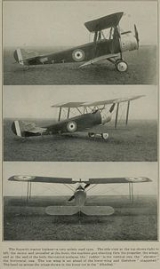
 became Chief Engineer of the Sopwith company, and under his design leadership its other successful World War I types included the larger Type 9901. This aircraft, better known as the 1½ Strutter
Sopwith 1½ Strutter
The Sopwith 1½ Strutter was a British one or two-seat biplane multi-role aircraft of the First World War. It is significant as the first British-designed two seater tractor fighter, and the first British aircraft to enter service with a synchronised machine gun...

 due to its unconventional cabane strut
Cabane strut
The cabane struts of a biplane aircraft support the upper wing over the fuselage and work in conjunction with other wing components such as spars and flying wires to transmit flight loads....

 arrangement, was used from 1916 by the RNAS, RFC and the French Aviation Militaire as a single-seat bomber, two seat fighter and artillery spotter and trainer. Soon after came the small and agile single-seat Scout, which quickly became better known as the Pup
Sopwith Pup
The Sopwith Pup was a British single seater biplane fighter aircraft built by the Sopwith Aviation Company. It entered service with the Royal Flying Corps and the Royal Naval Air Service in the autumn of 1916. With pleasant flying characteristics and good maneuverability, the aircraft proved very...

 because of its obvious descent from the 1½ Strutter. The Pup and 1½ Strutter were the first successful British tractor
Tractor configuration
thumb|right|[[Evektor-Aerotechnik|Aerotechnik EV97A Eurostar]], a tractor configuration aircraft, being pulled into position by its pilot for refuelling....

 fighters equipped with a synchronising gear
Interrupter gear
An interrupter gear is a device used on military aircraft and warships in order to allow them to target opponents without damaging themselves....

 to allow a machine gun to fire through the rotating propeller. This gear was known as the Sopwith-Kauper gear from its designers, although several other designs were used later. The Pup was widely used on the Western Front
Western Front (World War I)
Following the outbreak of World War I in 1914, the German Army opened the Western Front by first invading Luxembourg and Belgium, then gaining military control of important industrial regions in France. The tide of the advance was dramatically turned with the Battle of the Marne...

 by the RFC and from ships by the RNAS from the autumn of 1916 to the early summer of 1917, and was considered a delight to fly by its pilots. It continued in use as an advanced trainer for the remainder of the War. The Pup began the famous series of animal-named Sopwith aircraft during the war, which, as a whole, would become renowned in aviation history as "The Flying Zoo".

Experimentally equipped with three narrow-chord wings and a more powerful engine, the Pup led to the Triplane
Sopwith Triplane
The Sopwith Triplane was a British single seat fighter aircraft designed and manufactured by the Sopwith Aviation Company during the First World War. Pilots nicknamed it the Tripehound or simply the Tripe. The Triplane became operational with the Royal Naval Air Service in early 1917 and was...

, which was used by just four squadrons of the RNAS during 1917, but became well-known for its startling fighting qualities, put to best use by Raymond Collishaw
Raymond Collishaw
Air Vice Marshal Raymond Collishaw CB, DSO & Bar, OBE, DSC, DFC, RAF was a distinguished Canadian fighter pilot, squadron leader, and commanding officer who served in the Royal Naval Air Service and later the Royal Air Force. He was the highest scoring RNAS flying ace and the second highest...

's famous 'Black Flight' of 'Naval 10' (No. 10 Squadron RNAS
No. 210 Squadron RAF
No. 210 Squadron was a Royal Air Force unit established in World War I. Disbanded and reformed a number of times in the ensuing years, it operated as a fighter squadron during World War I and as a maritime patrol squadron during the Spanish Civil War, World War II and the Cold War before it was...

). This flight was so called due to the black identification colour of the flight's aircraft, which in turn led to their naming as Black Maria, Black Prince, Black Death, Black Roger and Black Sheep. Such was the impact of this type that it spawned a large number of experimental triplane designs from manufacturers on all sides, although only the Fokker Triplane achieved any subsequent success.
In the early summer of 1917 the twin-gun Camel
Sopwith Camel
The Sopwith Camel was a British First World War single-seat biplane fighter introduced on the Western Front in 1917. Manufactured by Sopwith Aviation Company, it had a short-coupled fuselage, heavy, powerful rotary engine, and concentrated fire from twin synchronized machine guns. Though difficult...

 fighter was introduced. This aircraft was highly manoeuvrable and well-armed, and over 5,000 were produced up until the end of the War. It destroyed more enemy aircraft than any other British type, but its difficult flying qualities also killed very many novice pilots in accidents. It was used, modified, as both a night-fighter and shipboard aircraft, and was flown in combat by the Belgian and American Air Services as well as the British.

Later still in front-line service came the stationary-engined four-gun Dolphin and the ultimate rotary-engined fighter, the Snipe
Sopwith Snipe
The Sopwith 7F.1 Snipe was a British single-seat biplane fighter of the Royal Air Force . It was designed and built by the Sopwith Aviation Company during the First World War, and came into squadron service a few weeks before the end of that conflict, in late 1918.The Snipe was not a fast aircraft...

. The Snipe saw little wartime service, being issued only in small numbers to the Front, but William George Barker
William George Barker
William George Barker VC, DSO & Bar, MC & Two Bars was a Canadian First World War fighter ace and Victoria Cross recipient...

, the Canadian ace, won a Victoria Cross
Victoria Cross
The Victoria Cross is the highest military decoration awarded for valour "in the face of the enemy" to members of the armed forces of various Commonwealth countries, and previous British Empire territories....

 flying one in an epic single-handed dogfight against enormous odds.

Towards the end of the war the company produced the Cuckoo
Sopwith Cuckoo
-See also:-References:*Davis, Mick. Sopwith Aircraft. Ramsbury, Marlborough, Wiltshire: Crowood Press, 1999. ISBN 1-86126-217-5.*Layman, R.D. Naval Aviation In The First World War: Its Impact And Influence. London: Caxton, 2002. ISBN 1-84067-314-1....

 torpedo-bomber and the Salamander
Sopwith Salamander
-See also:-References:NotesBibliography...

 armoured ground-attack development of the Snipe, but these types were too late to see action. Many other experimental prototypes were produced throughout the war, mostly named after animals (Hippo, Gnu etc.), leading to some referring to the 'Sopwith Zoo'.

Following World War I, the Sopwith Snipe was chosen as the standard fighter of the much-reduced Royal Air Force, and soldiered on until finally replaced in the late 1920s.

Aircraft


Pre World War I
  • 1912 – Sopwith Tractor Biplane
    Sopwith Tractor Biplane
    |-See also:-References:*Bruce, J.M. British Aeroplanes 1914-18. London:Putnam, 1957.*Bruce, J.M. The Aeroplanes of the Royal Flying Corps . London:Putnam, 1982. ISBN 0 370 30084 x....

  • 1913 – Sopwith Bat Boat
    Sopwith Bat Boat
    -See also:-References:NotesBibliography*"". Flight, 12 July 1913, p.762.*"". Flight, 30 August 1913. p.967.*"". Flight, 21 March 1914. pp. 294—312.*"". Flight, 31 July 1914. p.800.*"". Flight 21 August 1914, pp.873—875....

  • 1914 – Sopwith Admiralty Type C
    Sopwith Admiralty Type C
    |-References:NotesSources...

  • 1914 – Sopwith Special torpedo seaplane Type C
    Sopwith Special torpedo seaplane Type C
    |-See also:...

  • 1914 – Sopwith 1914 Schneider Racer
  • 1914 – Sopwith Type SPGN or "Gunbus"


World War I
  • Sopwith Admiralty Type 137
  • Sopwith Type 806
  • Sopwith Type 807
  • Sopwith Type 860
    Sopwith Type 860
    |-See also:-References:*...

  • Sopwith Two-Seat Scout
    Sopwith Two-Seat Scout
    |-See also:...

  • Sopwith Tabloid
    Sopwith Tabloid
    |-See also:-References:* Bruce, J.M. "". Flight. 8 November 1957. pp. 733–736.* Bruce, J.M. "". Flight. 15 November 1957. pp. 765–766.* Bruce, J.M. "". Flight. 29 November 1957. pp. 845–848....

  • Sopwith Baby
    Sopwith Baby
    -See also:...

  • Sopwith Sparrow 
  • Sopwith 1½ Strutter
    Sopwith 1½ Strutter
    The Sopwith 1½ Strutter was a British one or two-seat biplane multi-role aircraft of the First World War. It is significant as the first British-designed two seater tractor fighter, and the first British aircraft to enter service with a synchronised machine gun...

  • Sopwith Pup
    Sopwith Pup
    The Sopwith Pup was a British single seater biplane fighter aircraft built by the Sopwith Aviation Company. It entered service with the Royal Flying Corps and the Royal Naval Air Service in the autumn of 1916. With pleasant flying characteristics and good maneuverability, the aircraft proved very...

  • Sopwith Triplane
    Sopwith Triplane
    The Sopwith Triplane was a British single seat fighter aircraft designed and manufactured by the Sopwith Aviation Company during the First World War. Pilots nicknamed it the Tripehound or simply the Tripe. The Triplane became operational with the Royal Naval Air Service in early 1917 and was...

  • Sopwith L.R.T.Tr.
    Sopwith L.R.T.Tr.
    |-See also:-References:*Bruce, J.M. British Aeroplanes 1914-18. London:Putnam, 1957.*Bruce, J.M. War Planes of the First World War: Volume Two Fighters. London:Macdonald, 1968. ISBN 0 356 01473 8....

  • Sopwith Camel
    Sopwith Camel
    The Sopwith Camel was a British First World War single-seat biplane fighter introduced on the Western Front in 1917. Manufactured by Sopwith Aviation Company, it had a short-coupled fuselage, heavy, powerful rotary engine, and concentrated fire from twin synchronized machine guns. Though difficult...

  • Sopwith B.1
    Sopwith B.1
    |-See also:-References:*Bruce, J.M. British Aeroplanes 1914-18. London:Putnam, 1957.*Bruce, J.M. Sopwith B.1 & T.1 Cuckoo: Windsock Datafile 90. Berkhamsted, Hertfordshire, UK: Albatros Publications, 2001. ISBN 1-902207-41-6....

  • Sopwith Hippo
    Sopwith Hippo
    |-See also:-Notes: Some sources suggest that, rather than a rebuilt first prototype, that the Hippo with reduced stagger was a new aircraft.-References:*Bruce, J.M. British Aeroplanes 1914-18. London:Putnam, 1957....

  • Sopwith Cobham
    Sopwith Cobham
    |-See also:-References:*Bruce, J.M. British Aeroplanes 1914-18. London:Putnam, 1957.*Lewis, Peter. The British Bomber Since 1914. London:Putnam, Third edition, 1980. ISBN 0 370 30265 6....

     Twin Engine Bomber
  • Sopwith AT "Aerial Target" – radio controlled guided missile
  • Sopwith Dragon
    Sopwith Dragon
    |-See also:-References:* Davis, Mick. Sopwith Aircraft. Ramsbury, Marlborough, Wiltshire: Crowood Press, 1999. ISBN 1-86126-217-5.* Mason, Francis K. The British Fighter Since 1912. Annapolis, Maryland: Naval Institute Press, 1992. ISBN 1-55750-082-7....

  • Sopwith Snipe
    Sopwith Snipe
    The Sopwith 7F.1 Snipe was a British single-seat biplane fighter of the Royal Air Force . It was designed and built by the Sopwith Aviation Company during the First World War, and came into squadron service a few weeks before the end of that conflict, in late 1918.The Snipe was not a fast aircraft...

  • Sopwith Dolphin
  • Sopwith Salamander
    Sopwith Salamander
    -See also:-References:NotesBibliography...

  • Sopwith Cuckoo
    Sopwith Cuckoo
    -See also:-References:*Davis, Mick. Sopwith Aircraft. Ramsbury, Marlborough, Wiltshire: Crowood Press, 1999. ISBN 1-86126-217-5.*Layman, R.D. Naval Aviation In The First World War: Its Impact And Influence. London: Caxton, 2002. ISBN 1-84067-314-1....

  • Sopwith Bulldog
    Sopwith Bulldog
    |-See also:-References:*Bruce, J.M. War Planes of the First World War: Volume Three Fighters. London:Macdonald, 1969. ISBN 0356 01490 8.*Green, William and Swanborough, Gordon. The Complete Book of Fighters. New York:Smithmark, 1994. ISBN 0-8317-3939-8....

  • Sopwith Buffalo
    Sopwith Buffalo
    |-See also:-References:*Bruce, J.M. British Aeroplanes 1914-18. London:Putnam, 1957.*Bruce, J.M. "The First British Armoured Brigade",Part 3. Air International, April 1979, Vol 16 No. 4. Bromley, UK:Fine Scroll Publishing. pp. 182-190, 199-200....

  • Sopwith Rhino
    Sopwith Rhino
    -Notes: Mason considers these dimensions suspect and suggests a length of 30 ft 3 in and span of 41 ft , although it states that these numbers are also suspect....

  • Sopwith Scooter
  • Sopwith Swallow
    Sopwith Swallow
    |-See also:-References:* Bruce J.M. British Aeroplanes 1914-18. London:Putnam, 1957.* Bruce, J,M. War Planes of the First World War: Volume Three: Fighters. London: Macdonald, 1969, ISBN 0356 01490 8....

  • Sopwith Snail
    Sopwith Snail
    -References:*Bruce, J.M. British Aeroplanes 1914-18. London:Putnam, 1957.*Bruce, J.M. War Planes of the First World War: Fighters Volume One. London:Macdonald, 1969. ISBN 356 01490 8....

  • Sopwith Snapper
    Sopwith Snapper
    -References:*"". Flight, 26 June 1919, pp. 837–847.*Bruce, J.M. British Aeroplanes 1914-18. London:Putnam, 1957.*Bruce, J.M. War Planes of the First World War: Fighters Volume Three. London:Macdonald, 1969. ISBN 0 356 01490 8....

  • Sopwith Snark
    Sopwith Snark
    |-See also:-Notes: A similar installation of two Lewis guns on the lower wings of Sopwith Dolphin fighters was tested by No. 87 Squadron RAF.-Bibliography:*Bruce, J.M. British Aeroplanes 1914-18. London:Putnam, 1957....


Post World War I
  • Sopwith Gnu
    Sopwith Gnu
    -References:* A.J. Jackson, British Civil Aircraft since 1919 - Volume 3, Putnam, London 1988, ISBN 0 85177 818 6* The Illustrated Encyclopedia of Aircraft , Orbis Publishing....

  • Sopwith 1919 Schneider Cup Seaplane
  • Sopwith Atlantic
    Sopwith Atlantic
    |-See also:-References:*"". Flight, 5 April 1913. p. 393.*"". Flight, 21 November 1918. p. 1316.*"". Flight, 10 April 1919. pp. 476–480.*"". Flight, 17 April 1919, pp. 503–505....

  • Sopwith Antelope
    Sopwith Antelope
    -Bibliography:*". Flight, 8 July 1920, pp. 712—727.*"". Flight, 22 July 1920, pp. 793—806.*"". Flight, 5 August 1920, pp. 855—861.*Jackson, A.J. British Civil Aircraft 1919-1972:Volume III. London:Putnam, 1988. ISBN 0 85177 818 6....

  • Sopwith Wallaby
  • Sopwith Rainbow racer
  • Sopwith Grasshopper
    Sopwith Grasshopper
    -Bibliography:...