

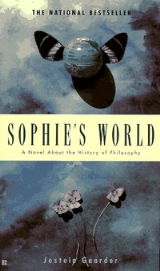
Sophie's World

Encyclopedia
Sophie's World is a novel
by Jostein Gaarder
, published in 1991. It was originally written in Norwegian, but has since been translated into English
(1995) and many other languages. It sold more than 30 million copies and is one of the most successful Norwegian novels outside of Norway. The book has been adapted into a film and a PC-game.
in the year 1990. She lives with her cat Sherekan, her goldfish, a tortoise, two budgerigar
s and her mother. Her father is a captain of an oil tanker
, and is away for most of the year. He does not appear in the book.
The book begins with Sophie receiving two anonymous messages in her mailbox (Who are you? Where does the world come from?), as well as a post card addressed to 'Hilde Møller Knag, c/o Sophie Amundsen'. Shortly afterwards she receives a packet of papers, part of a correspondence course in philosophy.
With these mysterious communications, Sophie becomes the student of a fifty-year-old philosopher, Alberto Knox. Initially, he is completely anonymous to Sophie, but as the story unfolds he reveals more and more about himself. The papers and the packet both turn out to be from him, although the post card is not; it is addressed from someone called Albert Knag, who is a major in a United Nations peacekeeping unit
stationed in Lebanon
.
Alberto teaches her about the history of philosophy
. She gets a substantive and understandable review from the Pre-Socratic Greeks
through Jean-Paul Sartre
. Along with the philosophy lessons, Sophie and Alberto try to outwit the mysterious Albert Knag, who appears to have God-like powers, which Alberto finds quite troubling.
Sophie learns about medieval philosophy while being lectured by Alberto, dressed as a monk
, in an ancient church, and she learns about Jean-Paul Sartre and Simone de Beauvoir
in a French café. Various philosophical questions and methods of reasoning are put before Sophie, as she attempts to work them out on her own. Many of Knox's philosophic packets to her are preluded by more short questions, such as "Why is Lego
the most ingenious toy in the world?".
Alberto takes Sophie from Hellenism
to the rise of Christianity
and its interaction with Greek
thought and on into the Middle Ages
. Over the course of the book, he covers the Renaissance
, Baroque
, Enlightenment
and Romantic
periods, and the philosophies that stemmed from them.
Mixed in with the philosophy lessons is a plot rather more akin to normal teenage novels, in which Sophie interacts with her mother and her friend Joanna. This is not the focus of the story, however; it simply serves to move the plot along. After the introduction to Berkeley
, the perspective of the novel shifts to the mysterious Hilde. Sophie and Alberto's entire world is revealed to be a literary construction by Albert Knag as a present for his daughter, Hilde, on her fifteenth birthday on June 15. The novel continues with Hilde's story as a framing device for Sophie's story, but the stories intertwine as Hilde's understanding of philosophy grows alongside Sophie's. As Albert Knag continues to meddle with Sophie's life, Alberto helps her fight back by teaching her everything he knows about philosophy. This, he explains, is the only way to understand her world. Meanwhile, Alberto's lessons allow Hilde to develop her own understanding of Sophie's world and use her knowledge against her father for exercising too much power over Sophie's world.
This is laced with events which appear scientifically impossible, such as Sophie seeing her reflection in a mirror wink
with both eyes, or actually seeing Socrates
and Plato
. Being a book based on philosophy, however, it promises—and delivers—an explanation for everything in the end, when Sophie and Alberto Knox escape from Albert Knag.
won an Amanda Award
for her role in the movie.
and Iceland
, again scripted by Petter Skavlan.
It was also adapted for television in 1995 by Paul Greengrass
and shown on the BBC as part of The Late Show. This version starred Jessica Marshall-Gardiner as Sophie, Jim Carter as Albert Knox, and Twiggy
as Sophie's Mother.
and Mac
CD-ROM
game by The MultiMedia Corporation.
in 1994. A best seller in Norway, the novel was translated into fifty-three languages, with over thirty million copies in print.
Novel
A novel is a book of long narrative in literary prose. The genre has historical roots both in the fields of the medieval and early modern romance and in the tradition of the novella. The latter supplied the present generic term in the late 18th century....
by Jostein Gaarder
Jostein Gaarder
Jostein Gaarder /ˈju:staɪn ˈgɔːrdər/ is a Norwegian intellectual and author of several novels, short stories and children's books. Gaarder often writes from the perspective of children, exploring their sense of wonder about the world. He often uses metafiction in his works, writing stories within...
, published in 1991. It was originally written in Norwegian, but has since been translated into English
English language
English is a West Germanic language that arose in the Anglo-Saxon kingdoms of England and spread into what was to become south-east Scotland under the influence of the Anglian medieval kingdom of Northumbria...
(1995) and many other languages. It sold more than 30 million copies and is one of the most successful Norwegian novels outside of Norway. The book has been adapted into a film and a PC-game.
Plot summary
Sophie Amundsen (Sofie Amundsen in the Norwegian version) is a fourteen year old girl who lives in NorwayNorway
Norway , officially the Kingdom of Norway, is a Nordic unitary constitutional monarchy whose territory comprises the western portion of the Scandinavian Peninsula, Jan Mayen, and the Arctic archipelago of Svalbard and Bouvet Island. Norway has a total area of and a population of about 4.9 million...
in the year 1990. She lives with her cat Sherekan, her goldfish, a tortoise, two budgerigar
Budgerigar
The Budgerigar , also known as Common Pet Parakeet or Shell Parakeet informally nicknamed the budgie, is a small, long-tailed, seed-eating parrot, and the only species in the Australian genus Melopsittacus...
s and her mother. Her father is a captain of an oil tanker
Oil tanker
An oil tanker, also known as a petroleum tanker, is a merchant ship designed for the bulk transport of oil. There are two basic types of oil tankers: the crude tanker and the product tanker. Crude tankers move large quantities of unrefined crude oil from its point of extraction to refineries...
, and is away for most of the year. He does not appear in the book.
The book begins with Sophie receiving two anonymous messages in her mailbox (Who are you? Where does the world come from?), as well as a post card addressed to 'Hilde Møller Knag, c/o Sophie Amundsen'. Shortly afterwards she receives a packet of papers, part of a correspondence course in philosophy.
With these mysterious communications, Sophie becomes the student of a fifty-year-old philosopher, Alberto Knox. Initially, he is completely anonymous to Sophie, but as the story unfolds he reveals more and more about himself. The papers and the packet both turn out to be from him, although the post card is not; it is addressed from someone called Albert Knag, who is a major in a United Nations peacekeeping unit
Department of Peacekeeping Operations
The Department of Peacekeeping Operations is a department of the United Nations which is charged with the planning, preparation, management and direction of UN peacekeeping operations.-History of the DPKO:...
stationed in Lebanon
Lebanon
Lebanon , officially the Republic of LebanonRepublic of Lebanon is the most common term used by Lebanese government agencies. The term Lebanese Republic, a literal translation of the official Arabic and French names that is not used in today's world. Arabic is the most common language spoken among...
.
Alberto teaches her about the history of philosophy
History of philosophy
The history of philosophy is the study of philosophical ideas and concepts through time. Issues specifically related to history of philosophy might include : How can changes in philosophy be accounted for historically? What drives the development of thought in its historical context? To what...
. She gets a substantive and understandable review from the Pre-Socratic Greeks
Pre-Socratic philosophy
Pre-Socratic philosophy is Greek philosophy before Socrates . In Classical antiquity, the Presocratic philosophers were called physiologoi...
through Jean-Paul Sartre
Jean-Paul Sartre
Jean-Paul Charles Aymard Sartre was a French existentialist philosopher, playwright, novelist, screenwriter, political activist, biographer, and literary critic. He was one of the leading figures in 20th century French philosophy, particularly Marxism, and was one of the key figures in literary...
. Along with the philosophy lessons, Sophie and Alberto try to outwit the mysterious Albert Knag, who appears to have God-like powers, which Alberto finds quite troubling.
Sophie learns about medieval philosophy while being lectured by Alberto, dressed as a monk
Monk
A monk is a person who practices religious asceticism, living either alone or with any number of monks, while always maintaining some degree of physical separation from those not sharing the same purpose...
, in an ancient church, and she learns about Jean-Paul Sartre and Simone de Beauvoir
Simone de Beauvoir
Simone-Ernestine-Lucie-Marie Bertrand de Beauvoir, often shortened to Simone de Beauvoir , was a French existentialist philosopher, public intellectual, and social theorist. She wrote novels, essays, biographies, an autobiography in several volumes, and monographs on philosophy, politics, and...
in a French café. Various philosophical questions and methods of reasoning are put before Sophie, as she attempts to work them out on her own. Many of Knox's philosophic packets to her are preluded by more short questions, such as "Why is Lego
Lego
Lego is a line of construction toys manufactured by the Lego Group, a privately held company based in Billund, Denmark. The company's flagship product, Lego, consists of colorful interlocking plastic bricks and an accompanying array of gears, minifigures and various other parts...
the most ingenious toy in the world?".
Alberto takes Sophie from Hellenism
Hellenistic civilization
Hellenistic civilization represents the zenith of Greek influence in the ancient world from 323 BCE to about 146 BCE...
to the rise of Christianity
Christianity
Christianity is a monotheistic religion based on the life and teachings of Jesus as presented in canonical gospels and other New Testament writings...
and its interaction with Greek
Ancient Greece
Ancient Greece is a civilization belonging to a period of Greek history that lasted from the Archaic period of the 8th to 6th centuries BC to the end of antiquity. Immediately following this period was the beginning of the Early Middle Ages and the Byzantine era. Included in Ancient Greece is the...
thought and on into the Middle Ages
Middle Ages
The Middle Ages is a periodization of European history from the 5th century to the 15th century. The Middle Ages follows the fall of the Western Roman Empire in 476 and precedes the Early Modern Era. It is the middle period of a three-period division of Western history: Classic, Medieval and Modern...
. Over the course of the book, he covers the Renaissance
Renaissance
The Renaissance was a cultural movement that spanned roughly the 14th to the 17th century, beginning in Italy in the Late Middle Ages and later spreading to the rest of Europe. The term is also used more loosely to refer to the historical era, but since the changes of the Renaissance were not...
, Baroque
Baroque
The Baroque is a period and the style that used exaggerated motion and clear, easily interpreted detail to produce drama, tension, exuberance, and grandeur in sculpture, painting, literature, dance, and music...
, Enlightenment
Age of Enlightenment
The Age of Enlightenment was an elite cultural movement of intellectuals in 18th century Europe that sought to mobilize the power of reason in order to reform society and advance knowledge. It promoted intellectual interchange and opposed intolerance and abuses in church and state...
and Romantic
Romanticism
Romanticism was an artistic, literary and intellectual movement that originated in the second half of the 18th century in Europe, and gained strength in reaction to the Industrial Revolution...
periods, and the philosophies that stemmed from them.
Mixed in with the philosophy lessons is a plot rather more akin to normal teenage novels, in which Sophie interacts with her mother and her friend Joanna. This is not the focus of the story, however; it simply serves to move the plot along. After the introduction to Berkeley
George Berkeley
George Berkeley , also known as Bishop Berkeley , was an Irish philosopher whose primary achievement was the advancement of a theory he called "immaterialism"...
, the perspective of the novel shifts to the mysterious Hilde. Sophie and Alberto's entire world is revealed to be a literary construction by Albert Knag as a present for his daughter, Hilde, on her fifteenth birthday on June 15. The novel continues with Hilde's story as a framing device for Sophie's story, but the stories intertwine as Hilde's understanding of philosophy grows alongside Sophie's. As Albert Knag continues to meddle with Sophie's life, Alberto helps her fight back by teaching her everything he knows about philosophy. This, he explains, is the only way to understand her world. Meanwhile, Alberto's lessons allow Hilde to develop her own understanding of Sophie's world and use her knowledge against her father for exercising too much power over Sophie's world.
This is laced with events which appear scientifically impossible, such as Sophie seeing her reflection in a mirror wink
Wink
A wink is a facial expression made by briefly closing one eye. A wink is an informal mode of non-verbal communication usually signalling shared hidden knowledge or intent, which may also include, in some contexts, sexual attraction....
with both eyes, or actually seeing Socrates
Socrates
Socrates was a classical Greek Athenian philosopher. Credited as one of the founders of Western philosophy, he is an enigmatic figure known chiefly through the accounts of later classical writers, especially the writings of his students Plato and Xenophon, and the plays of his contemporary ...
and Plato
Plato
Plato , was a Classical Greek philosopher, mathematician, student of Socrates, writer of philosophical dialogues, and founder of the Academy in Athens, the first institution of higher learning in the Western world. Along with his mentor, Socrates, and his student, Aristotle, Plato helped to lay the...
. Being a book based on philosophy, however, it promises—and delivers—an explanation for everything in the end, when Sophie and Alberto Knox escape from Albert Knag.
Movie
In 1999 Sophie's World was adapted into a Norwegian movie by screenwriter Petter Skavlan. It was not widely released outside of Norway. Kjersti HolmenKjersti Holmen
Kjersti Holmen is a Norwegian actress.She was born on Nøtterøy, and later moved to Alnabru, where she grew up with her parents and two sisters. She graduated from the Norwegian National Academy of Theatre in 1980, and has been employed at the National Theatre since 1981 – permanently since...
won an Amanda Award
Amanda (award)
The Amanda Award is an award given annually at the Norwegian International Film Festival in Haugesund, Norway, to promote and improve Norwegian film. The award originated in 1985, and has since 2005 been exclusively a film award...
for her role in the movie.
Television
The 1999 movie was also presented as an eight-part TV series in AustraliaAustralia
Australia , officially the Commonwealth of Australia, is a country in the Southern Hemisphere comprising the mainland of the Australian continent, the island of Tasmania, and numerous smaller islands in the Indian and Pacific Oceans. It is the world's sixth-largest country by total area...
and Iceland
Iceland
Iceland , described as the Republic of Iceland, is a Nordic and European island country in the North Atlantic Ocean, on the Mid-Atlantic Ridge. Iceland also refers to the main island of the country, which contains almost all the population and almost all the land area. The country has a population...
, again scripted by Petter Skavlan.
It was also adapted for television in 1995 by Paul Greengrass
Paul Greengrass
Paul Greengrass is an English film director, screenwriter and former journalist. He specialises in dramatisations of real-life events and is known for his signature use of hand-held cameras.-Life and career:...
and shown on the BBC as part of The Late Show. This version starred Jessica Marshall-Gardiner as Sophie, Jim Carter as Albert Knox, and Twiggy
Twiggy
Lesley Lawson née Hornby known as Twiggy is an English model, actress, and singer. In the early-1960s she became a prominent British teenage model of swinging sixties London with others such as Penelope Tree....
as Sophie's Mother.
Computer game
In 1998 it was adapted into a PCPersonal computer
A personal computer is any general-purpose computer whose size, capabilities, and original sales price make it useful for individuals, and which is intended to be operated directly by an end-user with no intervening computer operator...
and Mac
Mac OS
Mac OS is a series of graphical user interface-based operating systems developed by Apple Inc. for their Macintosh line of computer systems. The Macintosh user experience is credited with popularizing the graphical user interface...
CD-ROM
CD-ROM
A CD-ROM is a pre-pressed compact disc that contains data accessible to, but not writable by, a computer for data storage and music playback. The 1985 “Yellow Book” standard developed by Sony and Philips adapted the format to hold any form of binary data....
game by The MultiMedia Corporation.
Awards
Sophie's World won the Deutscher JugendliteraturpreisDeutscher Jugendliteraturpreis
The Deutscher Jugendliteraturpreis is an annual award established in 1956 by the Federal Ministry of Family Affairs, Senior Citizens, Women and Youth to recognise outstanding works of children's literature. It is Germany's only state-funded literary award. In the past, authors from many countries...
in 1994. A best seller in Norway, the novel was translated into fifty-three languages, with over thirty million copies in print.