

.gif)
Solidus (coin)

Encyclopedia
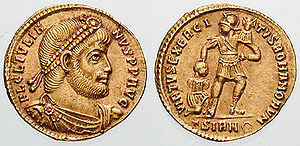
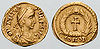
Gold coin
A gold coin is a coin made mostly or entirely of gold. Gold has been used for coins practically since the invention of coinage, originally because of gold's intrinsic value...
issued by the Romans
Ancient Rome
Ancient Rome was a thriving civilization that grew on the Italian Peninsula as early as the 8th century BC. Located along the Mediterranean Sea and centered on the city of Rome, it expanded to one of the largest empires in the ancient world....
, and a weight measure for gold
Gold
Gold is a chemical element with the symbol Au and an atomic number of 79. Gold is a dense, soft, shiny, malleable and ductile metal. Pure gold has a bright yellow color and luster traditionally considered attractive, which it maintains without oxidizing in air or water. Chemically, gold is a...
more generally, corresponding to 4.5 grams.
Roman and Byzantine coinage
The solidus was first introduced by DiocletianDiocletian
Diocletian |latinized]] upon his accession to Diocletian . c. 22 December 244 – 3 December 311), was a Roman Emperor from 284 to 305....
around 301 AD, struck at 60 to the Roman pound of pure gold (and thus weighing about 5.5 g each) and with an initial value equal to 1,000 denarii
Denarius
In the Roman currency system, the denarius was a small silver coin first minted in 211 BC. It was the most common coin produced for circulation but was slowly debased until its replacement by the antoninianus...
. However, Diocletian's solidus was struck only in small quantities, and thus had only minimal economic effect.
The solidus was reintroduced by Constantine I in 312 AD, permanently replacing the aureus
Aureus
The aureus was a gold coin of ancient Rome valued at 25 silver denarii. The aureus was regularly issued from the 1st century BC to the beginning of the 4th century, when it was replaced by the solidus...
as the gold coin of the Roman Empire. The solidus was struck at a rate of 72 to a Roman pound of pure gold, each coin weighing twenty-four Greco-Roman carats, or about 4.5 grams of gold per coin. By this time, the solidus was worth 275,000 increasingly debased denarii.
The solidus was maintained essentially unaltered in weight and purity until the 10th century, though in the Greek-speaking world during the Roman period and then in the Byzantine economy
Byzantine economy
The Byzantine economy was among the most advanced in Europe and the Mediterranean for many centuries. Constantinople was a prime hub in a trading network that at various times extended across nearly all of Eurasia and North Africa. Some scholars argue that, up until the arrival of the Arabs in the...
it was known as the nomisma (plural nomismata). Whenever the coin was taken in by the treasury, it was melted down and reissued. This maintained the evenness of the weight of the circulating solidi, since the coin did not tend to be in circulation long enough to become worn.
Minting of the gold coin—unlike the base-metal coins of the time—had no permanently established minting facility. Due to the requirement that taxes be paid in gold, solidus minting operations tended to follow the emperor and his court. For example, solidi were minted in Milan
Milan
Milan is the second-largest city in Italy and the capital city of the region of Lombardy and of the province of Milan. The city proper has a population of about 1.3 million, while its urban area, roughly coinciding with its administrative province and the bordering Province of Monza and Brianza ,...
in 353, and in Ravenna
Ravenna
Ravenna is the capital city of the Province of Ravenna in the Emilia-Romagna region of Italy and the second largest comune in Italy by land area, although, at , it is little more than half the size of the largest comune, Rome...
after 402. These locations were imperial residences at the respective times.
Although merchants were forbidden to use solidi outside the Byzantine Empire, there was sufficient trade in these coins outside the empire that they became a desirable circulating currency in Arabian countries. Since the solidi circulating outside the empire were not used to pay taxes to the emperor they did not get reminted, and the soft pure-gold coins quickly became worn.
Through the end of the 7th century, Arabic copies of solidi—dinars minted by the caliph Abd al-Malik ibn Marwan, who had access to supplies of gold from the upper Nile
Upper Nile
Upper Nile is one of the 10 states of South Sudan. The current governor of Upper Nile, and its first governor in the independence era of South Sudan, is Simon Kun Puoch. The White Nile flows through the state, giving it its name. The state also shares a similar name with the region of Greater Upper...
—began to circulate in areas outside the Byzantine Empire. These corresponded in weight to only 20 carats (4 g), but matched the weight of the worn solidi that were circulating in those areas. The two coins circulated together in these areas for a time.
Except in special cases, the solidus was not marked with any face value throughout its seven-century manufacture and circulation.
Solidi were wider and thinner than the Aureus
Aureus
The aureus was a gold coin of ancient Rome valued at 25 silver denarii. The aureus was regularly issued from the 1st century BC to the beginning of the 4th century, when it was replaced by the solidus...
, with the exception of some lower-quality issues from the Byzantine Empire. Fractions of the solidus known as semissis (half-solidi) and tremissis (one-third solidi) were also produced.
The word soldier is ultimately derived from solidus, referring to the solidi with which soldiers were paid.
Impact on world currencies
In medieval Europe, when the only coin in circulation was the silver penny (denarius), the solidus was used as a unit of account equal to 12 denarii. Variations on the word solidus in the local language gave rise to a number of currency units:France
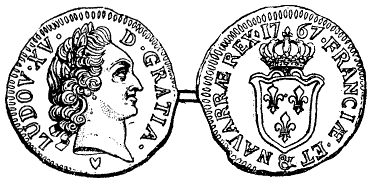
In the French language, which evolved directly from common or "vulgar" Latin over the centuries, solidus mutated to soldus, then solt, then sol and finally sou. No gold solidi were minted after the Carolingians adopted the silver standard; thenceforward the solidus or sol was a paper accounting unit equivalent to one-twentieth of a pound (librum or livre) of silver and divided into 12 denarii or deniers . The monetary unit disappeared with decimalisation and introduction of the Franc during the French revolution (1st republic) in 1795, but 5 centimes, the twentieth part of the Franc, inherited the name as a nickname.To this day, in French around the world, solde means the balance
Balance
- Equipment :* Balance beam, a piece of gymnastics apparatus.* Balance board, a piece of training equipment.* Balancing machine, a machine that balances mechanical rotating parts to lessen vibration.* Balance wheel, a watch component....
of an account or invoice. Sou is also used as slang for a small coin of little value, as in sans le sou. "I'm broke", "without money".
In Quebec French
Quebec French
Quebec French , or Québécois French, is the predominant variety of the French language in Canada, in its formal and informal registers. Quebec French is used in everyday communication, as well as in education, the media, and government....
sou is also by far the most commonly employed term for the Canadian cent
Canadian dollar
The Canadian dollar is the currency of Canada. As of 2007, the Canadian dollar is the 7th most traded currency in the world. It is abbreviated with the dollar sign $, or C$ to distinguish it from other dollar-denominated currencies...
(standard French, centime, rarely used in Quebec French). Interestingly, quarter dollars
Quarter (Canadian coin)
The quarter is a Canadian coin, valued at 25 cents or one-fourth of a Canadian dollar. It is a small, circular coin of silver colour. According to the Royal Canadian Mint, the official name for the coin is the 25-cent piece, but in practice it is simply called a quarter.-History of...
in Quebec French are often called trente sous (thirty cents) because of a series of changes in terminology, currencies, and exchange rates. After the British conquest of Canada in 1759, French coins gradually went out of use, and sou became a nickname for the halfpenny, which was similar in value to the French sou. Spanish dollars and U.S. dollars were also in use, and from 1841 to 1858 the exchange rate was fixed at $4 = £1 (or 400¢ = 240d). This made 25¢ equal to 15d, or 30 halfpence (trente sous). In 1858, pounds, shillings, and pence were abolished in favour of dollars and cents, and the nickname sou began to be used for the 1¢ coin
Penny (Canadian coin)
In Canada, a penny is a coin worth one cent or of a dollar. According to the Royal Canadian Mint, the official national term of the coin is the "one-cent piece", but in practice the term penny or cent is universal. Originally, "penny" referred to a two-cent coin. When the two-cent coin was...
, but the idiom trente sous for 25¢ endured.
Romania
In the Romanian languageRomanian language
Romanian Romanian Romanian (or Daco-Romanian; obsolete spellings Rumanian, Roumanian; self-designation: română, limba română ("the Romanian language") or românește (lit. "in Romanian") is a Romance language spoken by around 24 to 28 million people, primarily in Romania and Moldova...
, which evolved directly from "vulgar" Latin, solidus mutated to soldus, then sold.
In Romanian, sold means the balance of an account or invoice, while soldă means the payment for military services.
Italy
The name of the medieval Italian silver soldo (plural soldi), coined since the 11th century, was derived from solidus.This word is still in common use today in Italy in its plural soldi with the same meaning as the English equivalent "money".
Spain and Peru, Portugal and Brazil
As with soldier in English, the Spanish and Portuguese equivalent is soldado (almost the same pronunciationPronunciation
Pronunciation refers to the way a word or a language is spoken, or the manner in which someone utters a word. If one is said to have "correct pronunciation", then it refers to both within a particular dialect....
). The name of the medieval Spanish
Spain in the Middle Ages
After the disorders of the passage of the Vandals and Alans down the Mediterranean coast of Hispania from 408, the history of Medieval Spain begins with the Iberian kingdom of the Arianist Visigoths , who were converted to Catholicism with their king Reccared in 587...
sueldo and Portuguese soldo (which also means salary) was derived from solidus, which is also used in the Philippines as Suweldo.
The Portuguese word saldo, as the forementioned French solde, also means the balance of an account or invoice. And, for that matter in Afrikaans the word "saldo" means the balance of an account.
Some have suggested that the Peruvian unit of currency, the sol is derived from solidus, but the standard unit of Peruvian currency was the real up until 1863. Throughout the Spanish world the dollar equivalent was 8 reales ("pieces of eight"), which circulated legally in the United States until 1857. We hear echoes of that time in the expression "two bits" for a quarter dollar, and the real was last used for accounting in the US stock market, which traded in 1/8 dollars until 2001.
The Peruvian sol was introduced at a rate of 5.25 per British Pound, or just under four shillings (the legacy soldus). The term soles de oro was introduced in 1933, three years after Peru had actually abandoned the gold standard. In 1985 the Peruvian sol was replaced at one thousand to one by the inti, representing the sun god of the Incas. By 1991 it had to be replaced with a new sol at a million to one, after which it remained reasonably stable.
United Kingdom
King Offa of MerciaOffa of Mercia
Offa was the King of Mercia from 757 until his death in July 796. The son of Thingfrith and a descendant of Eowa, Offa came to the throne after a period of civil war following the assassination of Æthelbald after defeating the other claimant Beornred. In the early years of Offa's reign it is likely...
adopted the Frankish silver standard of libra, solidi and denarii; although for centuries English coinage was restricted to the silver penny the scilling, understood to be the value of a cow in Kent or a sheep elsewhere , was a 12d money of account like its French equivalent, until the Tudors minted the first shilling coins. Prior to decimalisation
Decimal Day
Decimal Day was the day the United Kingdom and Ireland decimalised their currencies.-Old system:Under the old currency of pounds, shillings and pence, the pound was made up of 240 pence , with 12 pence in a shilling and 20 shillings in a...
in the United Kingdom in 1971, the abbreviation s., from solidus, was used to represent shilling
Shilling
The shilling is a unit of currency used in some current and former British Commonwealth countries. The word shilling comes from scilling, an accounting term that dates back to Anglo-Saxon times where it was deemed to be the value of a cow in Kent or a sheep elsewhere. The word is thought to derive...
s, just as d. and £
Pound sign
The pound sign is the symbol for the pound sterling—the currency of the United Kingdom . The same symbol is used for similarly named currencies in some other countries and territories, such as the Irish pound, Gibraltar pound, Australian pound and the Italian lira...
, from denarius
Denarius
In the Roman currency system, the denarius was a small silver coin first minted in 211 BC. It was the most common coin produced for circulation but was slowly debased until its replacement by the antoninianus...
and Librum
Ancient Roman units of measurement
The ancient Roman units of measurement were built on the Hellenic system with Egyptian, Hebrew, and Mesopotamian influences. The Roman units were comparatively consistent and well documented.-Length:Notes...
, were respectively used to represent pence and pounds
Pound sterling
The pound sterling , commonly called the pound, is the official currency of the United Kingdom, its Crown Dependencies and the British Overseas Territories of South Georgia and the South Sandwich Islands, British Antarctic Territory and Tristan da Cunha. It is subdivided into 100 pence...
, leading to the abbreviation "£sd
£sd
£sd was the popular name for the pre-decimal currencies used in the Kingdom of England, later the United Kingdom, and ultimately in much of the British Empire...
." The common use of a slash, e.g. 2/6 for two shillings and sixpence, was a holdover of the old orthographic long S
Long s
The long, medial or descending s is a form of the minuscule letter s formerly used where s occurred in the middle or at the beginning of a word, for example "ſinfulneſs" . The modern letterform was called the terminal, round, or short s.-History:The long s is derived from the old Roman cursive...
.
See also
- Roman currencyRoman currencyThe Roman currency during most of the Roman Republic and the western half of the Roman Empire consisted of coins including the aureus , the denarius , the sestertius , the dupondius , and the as...
- Byzantine coinageByzantine coinageByzantine currency, money used in the Eastern Roman Empire after the fall of the West, consisted of mainly two types of coins: the gold solidus and a variety of clearly valued bronze coins...
- Hoxne HoardHoxne HoardThe Hoxne Hoard is the largest hoard of late Roman silver and gold discovered in Britain, and the largest collection of gold and silver coins of the fourth and fifth century found anywhere within the Roman Empire...
- Solidus (punctuation)Solidus (punctuation)The solidus is a punctuation mark used to indicate fractions including fractional currency. It may also be called a shilling mark, an in-line fraction bar, or a fraction slash....
- Slash (punctuation)Slash (punctuation)The slash is a sign used as a punctuation mark and for various other purposes. It is now often called a forward slash , and many other alternative names.-History:...
(also called a solidus)