


Soldering

Encyclopedia
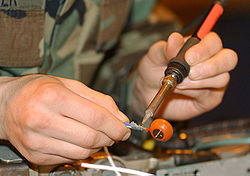
Metal
A metal , is an element, compound, or alloy that is a good conductor of both electricity and heat. Metals are usually malleable and shiny, that is they reflect most of incident light...
items are joined together by melting and flowing a filler metal (solder
Solder
Solder is a fusible metal alloy used to join together metal workpieces and having a melting point below that of the workpiece.Soft solder is what is most often thought of when solder or soldering are mentioned and it typically has a melting range of . It is commonly used in electronics and...
) into the joint, the filler metal having a lower melting point
Melting point
The melting point of a solid is the temperature at which it changes state from solid to liquid. At the melting point the solid and liquid phase exist in equilibrium. The melting point of a substance depends on pressure and is usually specified at standard atmospheric pressure...
than the workpiece. Soldering differs from welding
Welding
Welding is a fabrication or sculptural process that joins materials, usually metals or thermoplastics, by causing coalescence. This is often done by melting the workpieces and adding a filler material to form a pool of molten material that cools to become a strong joint, with pressure sometimes...
in that soldering does not involve melting the work pieces.
There are three forms of soldering, each requiring higher temperatures and each producing an increasingly stronger joint strength:
- soft soldering, which originally used a tin-lead alloyAlloyAn alloy is a mixture or metallic solid solution composed of two or more elements. Complete solid solution alloys give single solid phase microstructure, while partial solutions give two or more phases that may or may not be homogeneous in distribution, depending on thermal history...
as the filler metal, - silver soldering, which uses an alloy containing silverSilverSilver is a metallic chemical element with the chemical symbol Ag and atomic number 47. A soft, white, lustrous transition metal, it has the highest electrical conductivity of any element and the highest thermal conductivity of any metal...
, - brazingBrazingBrazing is a metal-joining process whereby a filler metal is heated above and distributed between two or more close-fitting parts by capillary action. The filler metal is brought slightly above its melting temperature while protected by a suitable atmosphere, usually a flux...
which uses a brassBrassBrass is an alloy of copper and zinc; the proportions of zinc and copper can be varied to create a range of brasses with varying properties.In comparison, bronze is principally an alloy of copper and tin...
alloy for the filler.
The alloy of the filler metal for each type of soldering can be adjusted to modify the melting temperature of the filler. Soldering appears to be a hot glue
Hot glue
Hot melt adhesive , also known as hot glue, is a form of thermoplastic adhesive that is commonly supplied in solid cylindrical sticks of various diameters, designed to be melted in an electric hot glue gun...
process, but it differs from gluing significantly in that the filler metals alloy with the workpiece at the junction to form a gas- and liquid-tight bond.
Soft soldering is characterized by having a melting point of the filler metal below approximately 400 °C (752 °F), whereas silver soldering and brazing use higher temperatures, typically requiring a flame or carbon arc torch to achieve the melting of the filler. Soft solder filler metals are typically alloys (often containing lead
Lead
Lead is a main-group element in the carbon group with the symbol Pb and atomic number 82. Lead is a soft, malleable poor metal. It is also counted as one of the heavy metals. Metallic lead has a bluish-white color after being freshly cut, but it soon tarnishes to a dull grayish color when exposed...
) that have liquidus temperatures below 350°C.
In the soldering process, heat is applied to the parts to be joined, causing the solder to melt and to bond to the workpieces in an alloying process called wetting
Wetting
Wetting is the ability of a liquid to maintain contact with a solid surface, resulting from intermolecular interactions when the two are brought together. The degree of wetting is determined by a force balance between adhesive and cohesive forces.Wetting is important in the bonding or adherence of...
. In stranded wire, the solder is drawn up into the wire by capillary action
Capillary action
Capillary action, or capilarity, is the ability of a liquid to flow against gravity where liquid spontanously rise in a narrow space such as between the hair of a paint-brush, in a thin tube, or in porous material such as paper or in some non-porous material such as liquified carbon fiber, or in a...
in a process called 'wicking'. Capillary action also takes place when the workpieces are very close together or touching. The joint strength is dependent on the filler metal used, where soft solder is the weakest and the brass alloy used for brazing is the strongest. Soldering, which uses metal to join metal in a molecular bond has electrical conductivity and is water- and gas-tight. There is evidence that soldering was employed up to 5000 years ago in Mesopotamia.
Origins
Soldering and brazingBrazing
Brazing is a metal-joining process whereby a filler metal is heated above and distributed between two or more close-fitting parts by capillary action. The filler metal is brought slightly above its melting temperature while protected by a suitable atmosphere, usually a flux...
are thought to have arisen very early in the history of metal-working, probably before 4000 BCE http://www.weldinghistory.org/whistoryfolder/brazing/bh_pre1900s.html. Sumerian swords from ~3000 BCE were assembled using hard soldering.
Soldering was historically used to make jewelry items, cooking ware and tools, as well as other uses
such as in assembling stained glass
Stained glass
The term stained glass can refer to coloured glass as a material or to works produced from it. Throughout its thousand-year history, the term has been applied almost exclusively to the windows of churches and other significant buildings...
.
Applications
Currently, the two most common uses of soldering are in plumbing and in electronics where it is used to connect electrical wiringElectrical wiring
Electrical wiring in general refers to insulated conductors used to carry electricity, and associated devices. This article describes general aspects of electrical wiring as used to provide power in buildings and structures, commonly referred to as building wiring. This article is intended to...
and to connect electronic component
Electronic component
An electronic component is a basic electronic element and may be available in a discrete form having two or more electrical terminals . These are intended to be connected together, usually by soldering to a printed circuit board, in order to create an electronic circuit with a particular function...
s to printed circuit board
Printed circuit board
A printed circuit board, or PCB, is used to mechanically support and electrically connect electronic components using conductive pathways, tracks or signal traces etched from copper sheets laminated onto a non-conductive substrate. It is also referred to as printed wiring board or etched wiring...
s (PCBs). It provides reasonably permanent but reversible connections between copper pipes in plumbing
Plumbing
Plumbing is the system of pipes and drains installed in a building for the distribution of potable drinking water and the removal of waterborne wastes, and the skilled trade of working with pipes, tubing and plumbing fixtures in such systems. A plumber is someone who installs or repairs piping...
systems as well as joints in sheet metal objects such as food cans, roof flashing
Flashing (weatherproofing)
Flashing refers to thin continuous pieces of sheet metal or other impervious material installed to prevent the passage of water into a structure from an angle or joint...
, rain gutter
Rain gutter
A rain gutter is a narrow channel, or trough, forming the component of a roof system which collects and diverts rainwater shed by the roof....
s and automobile radiator
Radiator
Radiators are heat exchangers used to transfer thermal energy from one medium to another for the purpose of cooling and heating. The majority of radiators are constructed to function in automobiles, buildings, and electronics...
s. Jewelry components, machine tools and some refrigeration and plumbing components are often assembled and repaired by the higher temperature silver soldering process. Small mechanical parts are often soldered or brazed as well. Soldering is also used to join lead came
Came
A came is a divider bar used between small pieces of glass to make a larger glazing panel, sometimes referred to as leaded glass. This process is then referred to as "leading". Cames are mostly made of soft metals such as lead, zinc, copper or brass. They generally have an H-shaped cross section,...
and copper foil in stained glass
Lead came and copper foil glasswork
Lead came and copper foil glasswork are the arts and crafts of cutting colored glass and joining the pieces into picturesque designs.The traditional method uses lead came...
work. It can also be used as a semi-permanent patch for a leak in a container or cooking vessel.
Each form of solder offers advantages and disadvantages. Soft soldering uses the lowest temperatures but it is not a strong join and should not be used for load-bearing applications. It also cannot withstand elevated temperatures and as such is typically restricted to normal ambient temperatures and below. Silver soldering, as used by jewelers, machinists and in some plumbing applications, requires the use of a torch or other high temperature source and is much stronger than soft soldering. Brazing provides the strongest joint but also requires the hottest temperatures to melt the filler metal, requiring a torch or other high temperature source and darkened goggles to protect the eyes from the bright light produced by the heat of the work. It is often used to repair cast iron objects, wrought iron furniture, etc.
Some examples of soft-solder types and their applications include tin-lead (general purpose), tin-zinc for joining aluminium
Aluminium
Aluminium or aluminum is a silvery white member of the boron group of chemical elements. It has the symbol Al, and its atomic number is 13. It is not soluble in water under normal circumstances....
, lead-silver for strength at higher than room temperature, cadmium-silver for strength at high temperatures, zinc-aluminium for aluminium and corrosion resistance, and tin-silver and tin-bismuth for electronics.
Solders
Soldering filler materials are available in many different alloyAlloy
An alloy is a mixture or metallic solid solution composed of two or more elements. Complete solid solution alloys give single solid phase microstructure, while partial solutions give two or more phases that may or may not be homogeneous in distribution, depending on thermal history...
s for differing applications. In electronics assembly, the eutectic alloy of 63% tin and 37% lead (or 60/40, which is almost identical in performance to the eutectic) has been the alloy of choice. Other alloys are used for plumbing, mechanical assembly, and other applications.
A eutectic formulation has several advantages for soldering; chief among these is the coincidence of the liquidus and solidus
Solidus (chemistry)
In chemistry, materials science, and physics, the solidus is the locus of temperatures below which a given substance is completely solid...
temperatures, i.e. the absence of a plastic phase. This allows for quicker wetting as the solder heats up, and quicker setup as the solder cools. A non-eutectic formulation must remain still as the temperature drops through the liquidus and solidus temperatures. Any differential movement during the plastic phase may result in cracks, giving an unreliable joint. Additionally, a eutectic formulation has the lowest possible melting point, which minimizes heat stress on electronic components during soldering.
Common solder alloys are mixtures of tin and lead, respectively:
- 63/37: melts at 183 °C (361.4 °F) (eutectic: the only mixture that melts at a point, instead of over a range)
- 60/40: melts between 183 –
- 50/50: melts between 185 –
For environmental reasons (and the introduction of regulations such as the European RoHS (Restriction of Hazardous Substances Directive
Restriction of Hazardous Substances Directive
The Directive on the restriction of the use of certain hazardous substances in electrical and electronic equipment 2002/95/EC was adopted in February 2003 by the European Union. The RoHS directive took effect on 1 July 2006, and is required to be enforced and become law in each member state...
)) lead-free solders are becoming more widely used. They are also suggested anywhere young children may come into contact with (since young children are likely to place things into their mouths), or for outdoor use where rain and other precipitation may wash the lead into the groundwater. Unfortunately, most lead-free solders are not eutectic formulations, melting at around 250 °C (482 °F), making it more difficult to create reliable joints with them.
Other common solders include low-temperature formulations (often containing bismuth
Bismuth
Bismuth is a chemical element with symbol Bi and atomic number 83. Bismuth, a trivalent poor metal, chemically resembles arsenic and antimony. Elemental bismuth may occur naturally uncombined, although its sulfide and oxide form important commercial ores. The free element is 86% as dense as lead...
), which are often used to join previously-soldered assemblies without un-soldering earlier connections, and high-temperature formulations (usually containing silver
Silver
Silver is a metallic chemical element with the chemical symbol Ag and atomic number 47. A soft, white, lustrous transition metal, it has the highest electrical conductivity of any element and the highest thermal conductivity of any metal...
) which are used for high-temperature operation or for first assembly of items which must not become unsoldered during subsequent operations. Alloying silver with other metals changes the melting point, adhesion and wetting characteristics, and tensile strength. Of all the brazing alloys, brazing has the greatest strength, with silver solders not being substantially stronger than soft solder and having the broadest applications. Specialty alloys are available with properties such as higher strength, better electrical conductivity and higher corrosion resistance.
Flux
The purpose of fluxFlux (metallurgy)
In metallurgy, a flux , is a chemical cleaning agent, flowing agent, or purifying agent. Fluxes may have more than one function at a time...
is to facilitate the soldering process. The obstacle to a successful solder joint is an impurity at the site of the union, e.g. dirt, oils or oxidation. The impurities can be removed by mechanical cleaning or by chemical means, but the elevated temperatures required to melt the filler metal (the solder) encourages the work piece (and the solder) to re-oxidize. This effect is accelerated as the soldering temperatures increase and can completely prevent the solder from joining to the workpiece. One of the earliest forms of flux was charcoal
Charcoal
Charcoal is the dark grey residue consisting of carbon, and any remaining ash, obtained by removing water and other volatile constituents from animal and vegetation substances. Charcoal is usually produced by slow pyrolysis, the heating of wood or other substances in the absence of oxygen...
, which acts as a reducing agent
Reducing agent
A reducing agent is the element or compound in a reduction-oxidation reaction that donates an electron to another species; however, since the reducer loses an electron we say it is "oxidized"...
and helps prevent oxidation during the soldering process. Some fluxes go beyond the simple prevention of oxidation and also provide some form of chemical cleaning (corrosion).
For many years, the most common type of flux used in electronics (soft soldering) was rosin
Rosin
.Rosin, also called colophony or Greek pitch , is a solid form of resin obtained from pines and some other plants, mostly conifers, produced by heating fresh liquid resin to vaporize the volatile liquid terpene components. It is semi-transparent and varies in color from yellow to black...
-based, using the rosin from selected pine trees. It was ideal in that it was non-corrosive and non-conductive at normal temperatures but became mildly reactive (corrosive) at the elevated soldering temperatures. Plumbing and automotive applications, among others, typically use an acid-based (muriatic acid) flux which provides cleaning of the joint. These fluxes cannot be used in electronics because they are conductive and because they will eventually dissolve the small diameter wires. Many fluxes also act as a wetting agent in the soldering process, reducing the surface tension
Surface tension
Surface tension is a property of the surface of a liquid that allows it to resist an external force. It is revealed, for example, in floating of some objects on the surface of water, even though they are denser than water, and in the ability of some insects to run on the water surface...
of the molten solder and causing it to flow and wet the workpieces more easily.
Fluxes for soft solder are currently available in three basic formulations:
- Water-soluble fluxes (no VOCVolatile organic compoundVolatile organic compounds are organic chemicals that have a high vapor pressure at ordinary, room-temperature conditions. Their high vapor pressure results from a low boiling point, which causes large numbers of molecules to evaporate or sublimate from the liquid or solid form of the compound and...
's required for removal) are higher activity fluxes designed to be removed with water after soldering. - No-clean fluxes which are mild enough to not "require" removal due to the non-conductive and non-corrosive residue. Performance of the flux needs to be carefully evaluated; a very mild 'no-clean' flux might be perfectly acceptable for production equipment, but not give adequate performance for a poorly controlled hand-soldering operation. They are so-called "no-clean" because the residue left after the solder operation is non-conductive and won't cause electrical shorts; nevertheless these fluxes leave a white-color residue like dilute bird-droppings. which is plainly visible. Since the presence of foreign matter, detritus, even lint, on circuit boards is a defect for all three classes of electronic circuit boards (ranging from cheap consumer electronics to high-reliability, mission critical applications), these sorts of fluxes must still be cleaned as with all hand solder work, typically brushing with 99% isopropyl alcohol as the solvent and lint-free non-synthetic (eg cotton) wipes.
- Traditional rosinRosin.Rosin, also called colophony or Greek pitch , is a solid form of resin obtained from pines and some other plants, mostly conifers, produced by heating fresh liquid resin to vaporize the volatile liquid terpene components. It is semi-transparent and varies in color from yellow to black...
fluxes are available in non-activated (R), mildly activated (RMA) and activated (RA) formulations. RA and RMA fluxes contain rosin combined with an activating agent, typically an acid, which increases the wettability of metals to which it is applied by removing existing oxides. The residue resulting from the use of RA flux is corrosiveCorrosiveA corrosive substance is one that will destroy or irreversibly damage another surface or substance with which it comes into contact. The main hazards to people include damage to the eyes, the skin, and the tissue under the skin; inhalation or ingestion of a corrosive substance can damage the...
and must be cleaned off the piece being soldered. RMA flux is formulated to result in a residue which is not significantly corrosive, with cleaning being preferred but optional.
Processes
Soldering operations can be performed with hand tools, one joint at a time, or en masse on a production line. Hand soldering is typically performed with a soldering iron, soldering gun, or a torch, or occasionally a hot-air pencil. Sheetmetal work was traditionally done with "soldering coppers" directly heated by a flame, with sufficient stored heat in the mass of the soldering copper to complete a joint; torches or electrically-heated soldering irons are more convenient. All soldered joints require the same elements of cleaning of the metal parts to be joined, fitting up the joint, heating the parts, applying flux, applying the filler, removing heat and holding the assembly still until the filler metal has completely solidified. Depending on the nature of flux material used, cleaning of the joints may be required after they have cooled.The distinction between soldering and brazing is arbitrary and often misunderstood, with some choosing to make each type a separate category, though the only distinction is the alloy of the filler metal (the solder) and the temperature at which it melts. Soft soldering can be done with a heated iron whereas the other methods require a higher temperature to melt the solder than can be achieved with a heated iron. Soldering, by definition, is the use of a filler metal to join workpieces and, as such, encompasses soft soldering, "hard" soldering (silver soldering) and brazing. The word brazing comes from the type of solder that is used for that soldering process—a brass alloy. The term silver solder likewise denotes the type of solder that is used. Soft solder comes from the fact that lead was a primary ingredient and is a soft metal. Each alloy has characteristics that work best for certain applications, notably strength and conductivity, and each type of solder and alloy has different melting temperatures. (There are some soft solders sold as "silver" solder because they contain a small fraction of silver.) Lead based solders should not be used on precious metals because the lead dissolves the metal into itself and disfigures it. A temperature of 450 °C is usually used as a practical delineating point between soft solder and hard solder and brazing alloys require even higher temperatures. Different equipment and/or fixturing is usually required since (for instance) a soldering iron
Soldering iron
A soldering iron is a hand tool most commonly used in soldering. It supplies heat to melt the solder so that it can flow into the joint between two workpieces.A soldering iron is composed of a heated metal tip and an insulated handle...
cannot achieve high enough temperatures for hard soldering or brazing. Practically speaking there is a significant difference between the processes — brazing solders have more structural strength than silver solder, which has more strength than soft solder. Brazing solders are formulated primarily for strength, silver solder is used by jewelers to protect the precious metal and by machinists and refrigeration technicians for its strength but lower melting temperature than brazing, and the primary benefit of soft solder is the low temperature used (to prevent heat damage to electronic components and insulation). Since the joint is produced using a metal with a lower melting temperature than the workpiece, the joint will weaken as the ambient temperature approaches the melting point of the filler metal. For that reason, the higher temperature processes produce joints which are effective at higher temperatures. Brazed connections can be as strong or nearly as strong as the parts they connect, even at elevated temperatures.
"Hard soldering" or "silver soldering" (performed with high-temperature solder containing up to 40% silver) is also often considered a form of brazing, since it involves filler materials with melting points in the vicinity of, or in excess of, 450 °C. Although the term "silver soldering" is used much more often than "silver brazing", it may be technically incorrect depending on the exact melting point of the filler in use. In silver soldering ("hard soldering"), the goal is generally to give a beautiful, structurally sound joint, especially in the field of jewelry. Thus, the temperatures involved, and the usual use of a torch rather than an iron, would seem to indicate that the process should be referred to as "brazing" rather than "soldering", but the endurance of the "soldering" appellation serves to indicate the arbitrary nature of the distinction (and the level of confusion) between the two processes.
Induction soldering is a process which is similar to brazing. The source of heat in induction soldering is induction heating
Induction heating
Induction heating is the process of heating an electrically conducting object by electromagnetic induction, where eddy currents are generated within the metal and resistance leads to Joule heating of the metal...
by high-frequency AC current in a surrounding copper coil. This induces currents in the part being soldered, heat then being generated by resistive heating. The copper rings can be made to fit the part needed to be soldered for precision in the work piece. Induction soldering is a process in which a filler metal (solder) is placed between the facing surfaces of (to be joined) metals. The filler metal in this process is melted at a fairly low temperature. Fluxes are commonly used in induction soldering. This is a process which is particularly suitable for soldering continuously. The process is usually done with coils that wrap around a cylinder/pipe that needs to be soldered.
Some metals are easier to solder than others. Copper, silver, and gold are easy. Iron, mild steel and nickel
Nickel
Nickel is a chemical element with the chemical symbol Ni and atomic number 28. It is a silvery-white lustrous metal with a slight golden tinge. Nickel belongs to the transition metals and is hard and ductile...
are found to be more difficult. Because of their thin, strong oxide films, stainless steel
Stainless steel
In metallurgy, stainless steel, also known as inox steel or inox from French "inoxydable", is defined as a steel alloy with a minimum of 10.5 or 11% chromium content by mass....
and aluminium are even more difficult. Titanium
Titanium
Titanium is a chemical element with the symbol Ti and atomic number 22. It has a low density and is a strong, lustrous, corrosion-resistant transition metal with a silver color....
, magnesium
Magnesium
Magnesium is a chemical element with the symbol Mg, atomic number 12, and common oxidation number +2. It is an alkaline earth metal and the eighth most abundant element in the Earth's crust and ninth in the known universe as a whole...
, cast iron
Cast iron
Cast iron is derived from pig iron, and while it usually refers to gray iron, it also identifies a large group of ferrous alloys which solidify with a eutectic. The color of a fractured surface can be used to identify an alloy. White cast iron is named after its white surface when fractured, due...
s, some high-carbon steel
Steel
Steel is an alloy that consists mostly of iron and has a carbon content between 0.2% and 2.1% by weight, depending on the grade. Carbon is the most common alloying material for iron, but various other alloying elements are used, such as manganese, chromium, vanadium, and tungsten...
s, ceramic
Ceramic
A ceramic is an inorganic, nonmetallic solid prepared by the action of heat and subsequent cooling. Ceramic materials may have a crystalline or partly crystalline structure, or may be amorphous...
s, and graphite
Graphite
The mineral graphite is one of the allotropes of carbon. It was named by Abraham Gottlob Werner in 1789 from the Ancient Greek γράφω , "to draw/write", for its use in pencils, where it is commonly called lead . Unlike diamond , graphite is an electrical conductor, a semimetal...
can be soldered but it involves a process similar to joining carbides. They are first plated with a suitable metallic element that induces interfacial bonding.
Electronic components (PCBs)
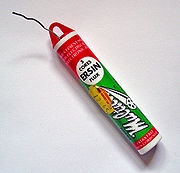
Currently, mass-production printed circuit boards (PCBs) are mostly wave soldered
Wave soldering
Wave soldering is a large-scale soldering process by which electronic components are soldered to a printed circuit board to form an electronic assembly. The name is derived from the use of waves of molten solder to attach metal components to the PCB...
or reflow soldered
Reflow soldering
Reflow soldering is a process in which a solder paste is used to temporarily attach one or several electrical components to their contact pads, after which the entire assembly is subjected to controlled heat, which melts the solder, permanently connecting the joint...
, though hand soldering of production electronics is also still standard practice for many tasks. In wave soldering, parts are temporarily adhered to the PCB with small dabs of adhesive, then the assembly is passed over flowing solder in a bulk container. Reflow soldering is a process in which a solder paste
Solder paste
Solder paste sometimes refers to soldering flux that does not contain solder.Solder paste is used to connect the leads of integrated chip packages to attachment points in the circuit patterns on a printed circuit board...
(a mixture of prealloyed solder powder and a flux-vehicle that has a peanut butter-like consistency) is used to stick the components to their attachment pads, after which the assembly is heated by an infrared lamp; a hot air pencil; or, more commonly, by passing it through a carefully controlled oven. Since different components can be best assembled by different techniques, it is common to use two or more processes for a given PCB. For example, surface mounted
Surface-mount technology
Surface mount technology is a method for constructing electronic circuits in which the components are mounted directly onto the surface of printed circuit boards . An electronic device so made is called a surface mount device...
parts may be reflow soldered first, with a wave soldering process for the through-hole
Through-hole technology
Through-hole technology, also spelled "thru-hole", refers to the mounting scheme used for electronic components that involves the use of leads on the components that are inserted into holes drilled in printed circuit boards and soldered to pads on the opposite side either by manual assembly by...
mounted components coming next, and bulkier parts hand-soldered last.
For hand soldering of electronic components, the heat source tool should be selected to provide adequate heat for the size of joint to be completed. A 100 watt soldering iron may provide too much heat for printed circuit boards, while a 25 watt iron will not provide enough heat for large electrical connectors, joining copper roof flashing, or large stained-glass lead came. Using a tool with too high a temperature can damage sensitive components, but protracted heating by a tool that is too cool or under powered can also cause extensive heat damage.
Hand-soldering techniques require a great deal of skill to use on the finest pitch chip
Integrated circuit
An integrated circuit or monolithic integrated circuit is an electronic circuit manufactured by the patterned diffusion of trace elements into the surface of a thin substrate of semiconductor material...
packages. In particular ball grid array (BGA)
Ball grid array
A ball grid array is a type of surface-mount packaging used for integrated circuits.- Description :The BGA is descended from the pin grid array , which is a package with one face covered with pins in a grid pattern. These pins conduct electrical signals from the integrated circuit to the printed...
devices are notoriously difficult if not impossible to rework by hand.
For attachment of electronic components to a PCB, proper selection and use of flux helps prevent oxidation during soldering, which is essential for good wetting and heat transfer. The soldering iron tip must be clean and pre-tinned with solder to ensure rapid heat transfer. Components which dissipate large amounts of heat during operation are sometimes elevated above the PCB to avoid PCB overheating. After inserting a through-hole mounted component, the excess lead is cut off, leaving a length of about the radius of the pad. Plastic or metal mounting clips or holders may be used with large devices to aid heat dissipation and reduce joint stresses.
A heat sink may be used on the leads of heat sensitive components to reduce heat transfer to the component. This is especially applicable to germanium parts. (Note the heat sink will mean the use of more heat to complete the joint.) If all metal surfaces are not properly fluxed and brought above the melting temperature of the solder in use, the result will be an unreliable "cold solder joint".
To simplify soldering, beginners are usually advised to apply the soldering iron and the solder separately to the joint, rather than the solder being applied direct to the iron. When sufficient solder is applied, the solder wire is removed. When the surfaces are adequately heated, the solder will flow around the joint. The iron is then removed from the joint.
Since non-eutectic solder alloys have a small plastic range, the joint must not be moved until the solder has cooled down through both the liquidus and solidus temperatures. Visually, a good solder joint will appear smooth and shiny, with the outline of the soldered wire clearly visible. A matte gray surface is a good indicator of a joint that was moved during soldering. Too little solder will result in a dry and unreliable joint; too much solder (the 'solder blob' very familiar to beginners) is not necessarily unsound, but tends to mean poor wetting. With some fluxes, flux residue remaining on the joint may need to be removed, using water, alcohol or other solvents compatible with the process. Excess solder and unconsumed flux and residue is sometimes wiped from the soldering iron tip between joints. The tip of the iron is kept wetted with solder ("tinned") when hot to minimize oxidation and corrosion of the tip itself.
Environmental legislation in many countries, and the whole of the European Community area (see RoHS
Restriction of Hazardous Substances Directive
The Directive on the restriction of the use of certain hazardous substances in electrical and electronic equipment 2002/95/EC was adopted in February 2003 by the European Union. The RoHS directive took effect on 1 July 2006, and is required to be enforced and become law in each member state...
), has led to a change in formulation of both solders and fluxes. Water soluble non-rosin based fluxes have been increasingly used since the 1980s so that soldered boards can be cleaned with water or water based cleaners. This eliminates hazardous solvents from the production environment, and effluent.
Hot-bar reflow
Hot-bar reflow is a selective soldering process where two pre-fluxed, solder coated parts are heated with heating element (called a thermode) to a sufficient temperature to melt the solder.Pressure is applied through the whole process (usually 15 s) to ensure that components stay in place during cooling. The heating element is heated and cooled for each connection. Up to 4000 W
Watt
The watt is a derived unit of power in the International System of Units , named after the Scottish engineer James Watt . The unit, defined as one joule per second, measures the rate of energy conversion.-Definition:...
can be used in the heating element allowing fast soldering, good results with connections requiring high energy.
Laser
Laser soldering is a technique where a ~30-50 WWatt
The watt is a derived unit of power in the International System of Units , named after the Scottish engineer James Watt . The unit, defined as one joule per second, measures the rate of energy conversion.-Definition:...
laser
Laser
A laser is a device that emits light through a process of optical amplification based on the stimulated emission of photons. The term "laser" originated as an acronym for Light Amplification by Stimulated Emission of Radiation...
is used to melt and solder an electrical connection joint. Diode
Diode
In electronics, a diode is a type of two-terminal electronic component with a nonlinear current–voltage characteristic. A semiconductor diode, the most common type today, is a crystalline piece of semiconductor material connected to two electrical terminals...
laser systems based on semiconductor junctions are used for this purpose.
Wavelength
Wavelength
In physics, the wavelength of a sinusoidal wave is the spatial period of the wave—the distance over which the wave's shape repeats.It is usually determined by considering the distance between consecutive corresponding points of the same phase, such as crests, troughs, or zero crossings, and is a...
s are typically 808 nm through 980 nm. The beam is delivered via an optical fiber to the workpiece, with fiber diameters 800 um and smaller. Since the beam out of the end of the fiber diverges rapidly, lens
Lens (optics)
A lens is an optical device with perfect or approximate axial symmetry which transmits and refracts light, converging or diverging the beam. A simple lens consists of a single optical element...
es are used to create a suitable spot size on the workpiece at a suitable working distance. A wire feeder is used to supply solder.
Both lead-tin and silver-tin material can be soldered. Process recipes will differ depending on the alloy
Alloy
An alloy is a mixture or metallic solid solution composed of two or more elements. Complete solid solution alloys give single solid phase microstructure, while partial solutions give two or more phases that may or may not be homogeneous in distribution, depending on thermal history...
composition. For soldering 44-pin chip carriers to a board using soldering preforms, power levels were on the order of 10 Watts and solder times approximately 1 second. Low power levels can lead to incomplete wetting and the formation of voids, both of which can weaken the joint.
Fiber focus infrared soldering
Fiber focus infrared soldering is technique where many infraredInfrared
Infrared light is electromagnetic radiation with a wavelength longer than that of visible light, measured from the nominal edge of visible red light at 0.74 micrometres , and extending conventionally to 300 µm...
sources are led through fibers
Optical fiber
An optical fiber is a flexible, transparent fiber made of a pure glass not much wider than a human hair. It functions as a waveguide, or "light pipe", to transmit light between the two ends of the fiber. The field of applied science and engineering concerned with the design and application of...
, then focused onto a single spot at which the connection is soldered.
Pipe soldering
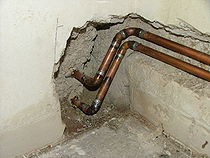
Copper conducts heat away much faster than a soldering iron or gun can provide, so a propane torch
Propane torch
A propane torch is a tool for burning the flammable gas propane . The maximum adiabatic flame temperature a propane torch can achieve with air is 2,268 kelvins...
is most commonly used to deliver the necessary BTUs per minute; for large tubing sizes and fittings a MAPP†
MAPP gas
MAPP gas is a trademarked name belonging to Linde Group, previously to Dow, for a fuel gas based on a stabilized mixture of methylacetylene and propadiene. The name comes from the original chemical composition: methylacetylene-propadiene propane...
-fueled, acetylene
Acetylene
Acetylene is the chemical compound with the formula C2H2. It is a hydrocarbon and the simplest alkyne. This colorless gas is widely used as a fuel and a chemical building block. It is unstable in pure form and thus is usually handled as a solution.As an alkyne, acetylene is unsaturated because...
-fueled, or propylene
Propylene
Propene, also known as propylene or methylethylene, is an unsaturated organic compound having the chemical formula C3H6. It has one double bond, and is the second simplest member of the alkene class of hydrocarbons, and it is also second in natural abundance.-Properties:At room temperature and...
-fueled torch is used with atmospheric air as the oxidizer; MAPP†/oxygen or acetylene/oxygen are rarely used because the flame temperature is much higher than the melting point of copper. Too much heat destroys the temper of hard-tempered copper tubing, and can burn the flux out of a joint before the solder is added, resulting in a faulty joint. For larger tubing sizes, a torch fitted with various sizes of interchangeable swirl tips is employed to deliver the needed BTUs/minute.
Most experienced plumbers seldom use propane fuel. In the hands of a skilled tradesman, the hotter flame of acetylene, MAPP, or propylene allows more joints to be completed per hour.
†True MAPP gas has not been produced or sold in North American since 2008 when the last plant producing the fuel closed. The yellow canisters available in hardware stores, while labeled MAPP, are MAPP substitutes that burns at a somewhat cooler temperature.
Solder fittings, which are short sections of smooth pipe designed to slide over the outside of the mating tube, are usually used for copper joints. There are two types of fittings: end feed fittings which contain no solder, and solder ring fittings, in which there is a ring of solder in a small circular recess inside the fitting.
As with all solder joints, all parts to be joined must be clean and oxide free. Internal and external wire brushes are available for the common pipe and fitting sizes; emery cloth
Emery cloth
Emery cloth is a type of abrasive that has emery glued to a cloth backing. It is commonly used in metalworking by hand. A finer, less commonly seen grade has a paper backing instead.-Grades:...
and wire-wool are frequently used as well, although metal wool products are discouraged, as they can contain oil, which would contaminate the joint.
Because of the size of the parts involved, and the high activity and contaminating tendency of the flame, plumbing fluxes are typically much more chemically active, and more acidic, than electronic fluxes. Because plumbing joints may be done at any angle, even upside down, plumbing fluxes are generally formulated as pastes which stay in place better than liquids. Flux should be applied to all surfaces of the joint, inside and out. Flux residues should be removed after the joint is complete or they can, eventually, erode through the copper substrates and cause failure of the joint.
Many plumbing solder formulations are available, with different characteristics such as higher or lower melting temperature, depending on the specific requirements of the job. Building codes currently almost universally require the use of lead-free solder for potable water piping, though traditional tin-lead solder is still available. Studies have shown that lead-soldered plumbing pipes can result in elevated levels of lead in drinking water.
Since copper pipe quickly conducts heat away from a joint, great care must be taken to ensure that the joint is properly heated through to obtain a good bond. After the joint is properly cleaned, fluxed and fitted, the torch flame is applied to the thickest part of the joint, typically the fitting with the pipe inside it, with the solder applied at the gap between the tube and the fitting. When all the parts are heated through, the solder will melt and flow into the joint by capillary action. The torch may need to be moved around the joint to ensure all areas are wetted out. However, the installer must take care to not overheat the areas being soldered. If the tube begins to discolor it means that the tube has been over-heated and is beginning to oxidize, stopping the flow of the solder and causing the soldered joint not to seal properly. Before oxidation the molten solder will follow the heat of the torch around the joint. When the joint is properly wetted out, the solder and then the heat are removed, and while the joint is still very hot, it is usually wiped with a dry rag. This removes excess solder as well as flux residue before it cools down and hardens. With a solder ring joint, the joint is heated until a ring of molten solder is visible around the edge of the fitting and allowed to cool.
Solder connections are usually considered the most difficult of the three methods of connecting copper tubing, but soldering copper is a very simple process, provided some basic conditions are provided:
- The tubing and fittings must be cleaned to bare metal with no tarnish
- Any pressure which is formed by heating of the tubing must have an outlet
Copper is only one material that is joined in this manner. Brass fittings are often used for valves or as a connection fitting between copper and other metals. Brass piping is soldered in this manner in the making of brass and some woodwind (saxophone and flute) musical instruments
Mechanical and aluminium soldering
A number of solder materials, primarily zincZinc
Zinc , or spelter , is a metallic chemical element; it has the symbol Zn and atomic number 30. It is the first element in group 12 of the periodic table. Zinc is, in some respects, chemically similar to magnesium, because its ion is of similar size and its only common oxidation state is +2...
alloys, are used for soldering aluminium metal and alloys and to some lesser extent steel and zinc. This mechanical soldering is similar to a low temperature brazing operation, in that the mechanical characteristics of the joint are reasonably good and it can be used for structural repairs of those materials.
The American welding society
American Welding Society
The American Welding Society is a nonprofit organization dedicated to advancing the science, technology, and application of welding and allied joining and cutting processes, including brazing, soldering, and thermal spraying...
defines brazing as using filler metals with melting points over 450 °C (842 °F) — or, by the traditional definition in the United States, above 800 °F (426.7 °C). Aluminium soldering alloys generally have melting temperatures around 730 °F (387.8 °C). This soldering / brazing operation can use a propane torch heat source.
These materials are often advertised as "aluminium welding", but the process does not involve melting the base metal, and therefore is not properly a weld.
United States Military Standard or MIL-SPEC specification MIL-R-4208 defines one standard for these zinc-based brazing/soldering alloys. A number of products meet this specification. or very similar performance standards.
Resistance soldering is soldering in which the heat required to flow the solder is created by passing an electric current through the solder. When current is conducted through a resistive material a certain level of heat is generated. By regulating the amount of current conducted and the level of resistance encountered, the amount of heat produced can be predetermined and controlled.
Electrical resistance (usually described as a material's opposition to the flow of an electric current) is used to convert electric energy into thermal energy as an electric current (I) conducted through a material with resistance (R) releases power (P) equal to: P = I² R, where P is the power measured in watts, I is the current measured in amperes and R is the resistance measured in ohms.
Resistance soldering
Resistance soldering is unlike using a conduction iron, where heat is produced within an element and then passed through a thermally conductive tip into the joint area. A cold soldering iron requires time to reach working temperature and must be kept hot between solder joints. Thermal transfer may be inhibited if the tip is not kept properly wetted during use. With resistance soldering an intense heat can be rapidly developed directly within the joint area and in a tightly controlled manner. This allows a faster ramp up to the required solder melt temperature and minimizes thermal travel away from the solder joint, which helps to minimize the potential for thermal damage to materials or components in the surrounding area. Heat is only produced while each joint is being made, making resistance soldering more energy efficient. Resistance soldering equipment, unlike conduction irons, can be used for difficult soldering and brazing applications where significantly higher temperatures may be required. This makes resistance comparable to flame soldering in some situations. When the required temperature can be achieved by either flame or resistance methods the resistance heat is more localized because of direct contact, whereas the flame will spread thus heating a potentially larger area.Stained glass soldering
Historically, stained glassStained glass
The term stained glass can refer to coloured glass as a material or to works produced from it. Throughout its thousand-year history, the term has been applied almost exclusively to the windows of churches and other significant buildings...
soldering tips were copper, heated by being placed in a charcoal
Charcoal
Charcoal is the dark grey residue consisting of carbon, and any remaining ash, obtained by removing water and other volatile constituents from animal and vegetation substances. Charcoal is usually produced by slow pyrolysis, the heating of wood or other substances in the absence of oxygen...
-burning brazier
Brazier
A brazier is a container for fire, generally taking the form of an upright standing or hanging metal bowl or box. Used for holding burning coal as well as fires, a brazier allows for a source of light, heat, or cooking...
. Multiple tips were used; when one tip cooled down from use, it was placed back in the brazier of charcoal and the next tip was used.
More recently, electrically heated soldering irons are used. These are heated by a coil or ceramic heating element inside the tip of the iron. Different power ratings are available, and temperature can be controlled electronically. These characteristics allow longer beads to be run without interrupting the work to change tips. Soldering irons designed for electronic use are often effective though they are sometimes underpowered for the heavy copper and lead came used in stained glass work.
Oleic acid is the classic flux material that has been used to improve solderability.
Tiffany type stainglass is made by gluing copper foil around the edges of the pieces of glass and then soldering them together. This method makes it possible to create three dimensional stained glass pieces.
Solderability
The Solderability of a substrate is a measure of the ease with which a soldered joint can be made to that material.Desoldering and resoldering
Used solder contains some of the dissolved base metals and is unsuitable for reuse in making new joints. Once the solder's capacity for the base metal has been achieved it will no longer properly bond with the base metal, usually resulting in a brittle cold solder joint with a crystalline appearance.It is good practice to remove solder from a joint prior to resoldering—desoldering braids or vacuum desoldering equipment (solder suckers) can be used. Desoldering wicks contain plenty of flux that will lift the contamination from the copper trace and any device leads that are present. This will leave a bright, shiny, clean junction to be resoldered.
The lower melting point of solder means it can be melted away from the base metal, leaving it mostly intact, though the outer layer will be "tinned" with solder. Flux will remain which can easily be removed by abrasive or chemical processes. This tinned layer will allow solder to flow into a new joint, resulting in a new joint, as well as making the new solder flow very quickly and easily.
Lead-free electronic soldering
More recently environmental legislation has specifically targeted the wide use of lead in the electronics industry. The RoHS directives in Europe require many new electronic circuit boards to be lead free by 1 July 2006, mostly in the consumer goods industry, but in some others as well. In Japan lead was phased out prior to legislation by manufacturers due to the additional expense in recycling products containing lead.It is a common misconception that lead free soldering requires higher soldering temperatures than lead/tin solder; the wetting temperature in lead/tin solder is higher than the melting point and is the controlling factor - Wave soldering can proceed at the same temperature as previous lead/tin soldering. Nevertheless many new technical challenges have arisen with this endeavor; to reduce the melting point of tin based solder alloys various new alloys have had to be researched, with additives of copper, silver, bismuth as typical minor additives to reduce melting point and control other properties, additionally tin is a more corrosive metal, and can eventually lead to the failure of solder baths etc.
Lead-free construction has also extended to components, pins, and connectors. Most of these pins used copper frames, and either lead, tin, gold or other finishes. Tin finishes are the most popular of lead-free finishes. Nevertheless, this brings up the issue of how to deal with tin whiskers
Whisker (metallurgy)
Metal whiskering is a crystalline metallurgical phenomenon involving the spontaneous growth of tiny, filiform hairs from a metallic surface. The effect is primarily seen on elemental metals but also occurs with alloys....
. The current movement brings the electronics industry back to the problems solved in the 1960s by adding lead. JEDEC
JEDEC
The JEDEC Solid State Technology Association, formerly known as the Joint Electron Devices Engineering Council , is an independent semiconductor engineering trade organization and standardization body...
has created a classification system to help lead-free electronic manufacturers decide what provisions to take against whiskers, depending upon their application.
Soldering defects
Various problems may arise in the soldering process which lead to joints which are non functional either immediately or after a period of use.The most common defect when hand-soldering results from the parts being joined not exceeding the solder's liquidus temperature, resulting in a "cold solder" joint. This is usually the result of the soldering iron being used to heat the solder directly, rather than the parts themselves. Properly done, the iron heats the parts to be connected, which in turn melt the solder, guaranteeing adequate heat in the joined parts for thorough wetting. In 'electronic' hand soldering solder the flux is embedded in the solder. Therefore heating the solder first may cause the flux to evaporate before it cleans the surfaces (pcb pad and component connection) being soldered.
An improperly selected or applied flux can cause joint failure, or if not properly cleaned off the joint, may corrode the metals in the joint over time and cause eventual joint failure. Without flux the joint may not be clean, or may be oxidized, resulting in an unsound joint.
In electronics non-corrosive fluxes are often used. Therefore cleaning flux off may merely be a matter of aesthetics or to make visual inspection of joints easier in specialised 'mission critical' applications such as medical devices, military and aerospace i.e. satellites. For satellites also to reduce weight slightly but usefully. In some conditions i.e. high humidity, even non-corrosive flux might remain slightly active, therefore the flux may be removed to absolutely negate the possibility of corrosion over time. In some applications, the PCB might also be coated in some form of protective material such as a lacquer
Lacquer
In a general sense, lacquer is a somewhat imprecise term for a clear or coloured varnish that dries by solvent evaporation and often a curing process as well that produces a hard, durable finish, in any sheen level from ultra matte to high gloss and that can be further polished as required...
to protect it and/or exposed solder joints from the environment.
Movement of metals being soldered before the solder has cooled will cause a highly unreliable cracked joint. In electronics' soldering terminology this is known as a 'dry' joint. It has a characteristically dull or grainy appearance immediately after the joint is made, rather than being smooth, bright and shiny. This appearance is caused by crystallization of the liquid solder. A dry joint is weak mechanically and a poor conductor electrically.
In general a good looking soldered joint is a good joint. As mentioned it should be smooth, bright and shiny. If not smooth i.e. lumps or balls of otherwise shiny solder the metal has not 'wetted' properly. Not being bright and shiny suggests a weak 'dry' joint. However, technicians trying to apply this guideline when using lead-free solder formulations may experience frustration, because these types of solders readily cool to a dull surface even if the joint is good. The solder looks shiny while molten, and suddenly hazes over as it solidifies even though it has not been disturbed during cooling.
In electronics a 'concave' fillet is ideal. This indicates good wetting and minimal use of solder (therefore minimal heating of heat sensitive components). A joint may be good, but if a large amount of unnecessary solder is used then more heating is obviously required. Excessive heating of a PCB may result in 'delamination', the copper track may actually lift off the board, particularly on single sided PCBs without 'through hole' plating.
In the joining of copper tube, failure to properly heat and fill a joint may lead to a 'void' being formed. This is usually a result of improper placement of the flame. If the heat of the flame is not directed at the back of the fitting cup, and the solder wire applied 180 degrees opposite the flame, then solder will quickly fill the opening of the fitting, trapping some flux inside the joint. This bubble of trapped flux is the void; an area inside a soldered joint where solder is unable to completely fill the fittings' cup, because flux has become sealed inside the joint, preventing solder from occupying that space.
Tools
Hand-soldering tools include the electric soldering iron, which has a variety of tips available ranging from blunt to very fine to chisel heads for hot-cutting plastics, and the soldering gunSoldering gun
A soldering gun is a tool for soldering metals using tin-based solder to achieve a highly conductive contact. The tool uses a pistol shape, and has a trigger style switch so it can be easily operated with one hand. The body of the tool contains a transformer with a single-turn secondary element...
, which typically provides more power, giving faster heat-up and allowing larger parts to be soldered. Hot-air guns and pencils allow rework
Rework
Rework is the term for the refinishing operation or repair of an electronic printed circuit board assembly. Mass processing techniques are not applicable to single device repair and/or replacement, so specialized techniques are required to replace defective components – most notably area array...
of component packages which cannot easily be performed with electric irons and guns.
Soldering torches are a type of soldering device that uses a flame rather than a soldering iron tip to heat solder. Soldering torches are often powered by butane and are available in sizes ranging from very small butane/oxygen units suitable for very fine but high-temperature jewelry work, to full-size oxy-fuel torches suitable for much larger work such as copper piping. Common multipurpose propane torches, the same kind used for heat-stripping paint and thawing pipes, can be used for soldering pipes and other fairly large objects either with or without a soldering tip attachment; pipes are generally soldered with a torch by directly applying the open flame.
A soldering copper is a tool with a large copper head and a long handle which is heated in a blacksmith
Blacksmith
A blacksmith is a person who creates objects from wrought iron or steel by forging the metal; that is, by using tools to hammer, bend, and cut...
's forge fire and used to apply heat to sheet metal
Sheet metal
Sheet metal is simply metal formed into thin and flat pieces. It is one of the fundamental forms used in metalworking, and can be cut and bent into a variety of different shapes. Countless everyday objects are constructed of the material...
for soldering. Typical soldering coppers have heads weighing between one and four pounds. The head provides a thermal mass
Thermal mass
Thermal mass is a concept in building design which describes how the mass of the building provides "inertia" against temperature fluctuations, sometimes known as the thermal flywheel effect...
, which can store enough heat for soldering large areas between re-heating the copper in the fire. The larger the head, the longer the working time it affords. Historically, soldering coppers were a standard tool used in auto bodywork, although body solder
Body solder
Body solder is a type of solder used to smooth the surface of automobile bodies before painting. It has been largely supplanted by Bondo, but many purists and auto customizers continue to use body solder, asserting that it bonds better to sheet metal, feels better, wears better, resists higher...
has been mostly superseded by spot welding
Spot welding
Spot welding is a process in which contacting metal surfaces are joined by the heat obtained from resistance to electric current flow. Work-pieces are held together under pressure exerted by electrodes. Typically the sheets are in the thickness range...
for mechanical connection and non-metallic fillers for contouring.
Toaster ovens and hand held infrared lights have been used to reproduce production soldering processes on a much smaller scale.
Bristle brushes are usually used to apply plumbing paste flux. For electronic work, flux-core solder is generally used, but additional flux may be used from a flux pen or dispensed from a small bottle with a syringe-like needle.
Wire brush
Wire brush
A wire brush is a tool, consisting of a handle, usually wood or plastic, occasionally bone, and a brush. The brush is usually made from a large number of steel wire bristles. The steel used is generally a high carbon variety and very hard. Other wire brushes feature bristles made from brass or...
, wire wool and emery cloth are commonly used to prepare plumbing joints for connection. Electronic joints rarely require mechanical cleaning, though copper traces with a dark layer of oxide passivation (due to aging), as on a new prototyping board that has been on the shelf for about a year or more, may need to be polished to a shine with steel wool before being soldered.
For PCB assembly and rework, alcohol and acetone (one or the other) are commonly used with cotton swabs or bristle brushes to remove flux residue. A heavy rag is usually used to remove flux from a plumbing joint before it cools and hardens. A fiberglass brush can also be used. Some fluxes for electronics are designed to be stable and inactive when cool and do not need to be cleaned off, though they still can be if desired, while other fluxes are acidic and must be removed after soldering to prevent corrosion of the circuits.
A heat sink
Heat sink
A heat sink is a term for a component or assembly that transfers heat generated within a solid material to a fluid medium, such as air or a liquid. Examples of heat sinks are the heat exchangers used in refrigeration and air conditioning systems and the radiator in a car...
, such as a crocodile clip, can be used to prevent damaging heat-sensitive components while soldering. The heat sink limits the temperature of the component body by absorbing and dissipating heat (reducing the thermal resistance between the component and the air), while the thermal resistance of the leads maintains the temperature difference between the part of the leads being soldered and the component body so that the leads become hot enough to melt the solder while the component body remains cooler.
External links
- Basic soldering guide
- Desoldering guide
- Soldering videos
- A short video explanation of how solder works
- RoHS directive 2002/95/EC - the restriction of the use of certain hazardous substances in electrical and electronic equipment