


Solar core

Encyclopedia
Sun
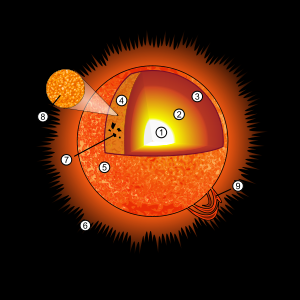
The Sun is the star at the center of the Solar System. It is almost perfectly spherical and consists of hot plasma interwoven with magnetic fields...
is considered to extend from the center to about 0.2 to 0.25 solar radius. It is the hottest part of the Sun and of the Solar System
Solar System
The Solar System consists of the Sun and the astronomical objects gravitationally bound in orbit around it, all of which formed from the collapse of a giant molecular cloud approximately 4.6 billion years ago. The vast majority of the system's mass is in the Sun...
. It has a density of up to 150 g/cm³ (150 times the density of liquid water
Water
Water is a chemical substance with the chemical formula H2O. A water molecule contains one oxygen and two hydrogen atoms connected by covalent bonds. Water is a liquid at ambient conditions, but it often co-exists on Earth with its solid state, ice, and gaseous state . Water also exists in a...
) and a temperature of close to 15,000,000 kelvin
Kelvin
The kelvin is a unit of measurement for temperature. It is one of the seven base units in the International System of Units and is assigned the unit symbol K. The Kelvin scale is an absolute, thermodynamic temperature scale using as its null point absolute zero, the temperature at which all...
(by contrast, the surface of the Sun is close to 6,000 kelvin). The core is made of hot, dense gas in the plasmic state. The core, inside 0.24 solar radius, generates 99% of the fusion power of the Sun.
Energy production
About 3.6 protonProton
The proton is a subatomic particle with the symbol or and a positive electric charge of 1 elementary charge. One or more protons are present in the nucleus of each atom, along with neutrons. The number of protons in each atom is its atomic number....
s (hydrogen nuclei) are converted into helium nuclei every second, releasing mass and energy at the mass-energy equivalence
Mass-energy equivalence
In physics, mass–energy equivalence is the concept that the mass of a body is a measure of its energy content. In this concept, mass is a property of all energy, and energy is a property of all mass, and the two properties are connected by a constant...
rate of 4.3 million tonnes per second, 380 yottawatts (3.8 watt
Watt
The watt is a derived unit of power in the International System of Units , named after the Scottish engineer James Watt . The unit, defined as one joule per second, measures the rate of energy conversion.-Definition:...
s), equivalent to 9.1 megatons of TNT
TNT equivalent
TNT equivalent is a method of quantifying the energy released in explosions. The ton of TNT is a unit of energy equal to 4.184 gigajoules, which is approximately the amount of energy released in the detonation of one ton of TNT...
per second.
The core produces almost all of the Sun's heat
Heat
In physics and thermodynamics, heat is energy transferred from one body, region, or thermodynamic system to another due to thermal contact or thermal radiation when the systems are at different temperatures. It is often described as one of the fundamental processes of energy transfer between...
via fusion
Nuclear fusion
Nuclear fusion is the process by which two or more atomic nuclei join together, or "fuse", to form a single heavier nucleus. This is usually accompanied by the release or absorption of large quantities of energy...
: the rest of the star is heated by energy that is transferred outward from the core. The energy produced by fusion in the core, except a small part carried out by neutrinos
Solar neutrino
Electron neutrinos are produced in the Sun as a product of nuclear fusion. By far the largest fraction of neutrinos passing through the Earth are Solar neutrinos....
, must travel through many successive layers to the solar photosphere before it escapes into space as sunlight
Sunlight
Sunlight, in the broad sense, is the total frequency spectrum of electromagnetic radiation given off by the Sun. On Earth, sunlight is filtered through the Earth's atmosphere, and solar radiation is obvious as daylight when the Sun is above the horizon.When the direct solar radiation is not blocked...
or kinetic energy
Kinetic energy
The kinetic energy of an object is the energy which it possesses due to its motion.It is defined as the work needed to accelerate a body of a given mass from rest to its stated velocity. Having gained this energy during its acceleration, the body maintains this kinetic energy unless its speed changes...
of particles.
The energy production per unit time (power) produced by fusion in the core varies with distance from the solar center. At the center of the sun, fusion power is estimated by model to be about 276.5 watts/m3, a power production density which more nearly approximates reptile metabolic heat generation than it does a thermonuclear bomb. Peak power production in the Sun's center, per volume, has been compared to the volumetric heats generated in an active compost heap. The tremendous power output of the Sun is not due to its high power per volume, but instead due to its gigantic size.
The low power outputs encountered inside the fusion core of the Sun may also be surprising in terms of the large powers which might be predicted by a simple application of the Stefan–Boltzmann law for temperatures of 10 to 15 million kelvins. However, layers of the Sun are radiating to outer layers only slightly lower in temperature, and it is this difference in radiation powers between layers which determines net power production and transfer in the solar core.
By the time 19% of the solar radius is reached (near the edge of the conventional core), temperatures have dropped to about 10 million kelvins and fusion power densities to 6.9 watts/m3 (about 2.5% of maximum). 91% of solar energy is produced within this zone. At 24% of the radius (the outer "core" by some definitions), 99% of the Sun's power has been produced. By the time 30% of the radius is reached, fusion has stopped almost entirely.
Equilibrium
The rate of nuclear fusion depends strongly on density, so the fusion rate in the core is in a self-correcting equilibrium: a slightly higher rate of fusion would cause the core to heat up more and expandThermal expansion
Thermal expansion is the tendency of matter to change in volume in response to a change in temperature.When a substance is heated, its particles begin moving more and thus usually maintain a greater average separation. Materials which contract with increasing temperature are rare; this effect is...
slightly against the weight
Weight
In science and engineering, the weight of an object is the force on the object due to gravity. Its magnitude , often denoted by an italic letter W, is the product of the mass m of the object and the magnitude of the local gravitational acceleration g; thus:...
of the outer layers, reducing the fusion rate and correcting the perturbation; and a slightly lower rate would cause the core to cool and shrink slightly, increasing the fusion rate and again reverting it to its present level.
Energy transfer
The high-energy photonPhoton
In physics, a photon is an elementary particle, the quantum of the electromagnetic interaction and the basic unit of light and all other forms of electromagnetic radiation. It is also the force carrier for the electromagnetic force...
s (gamma ray
Gamma ray
Gamma radiation, also known as gamma rays or hyphenated as gamma-rays and denoted as γ, is electromagnetic radiation of high frequency . Gamma rays are usually naturally produced on Earth by decay of high energy states in atomic nuclei...
s and x-ray
X-ray
X-radiation is a form of electromagnetic radiation. X-rays have a wavelength in the range of 0.01 to 10 nanometers, corresponding to frequencies in the range 30 petahertz to 30 exahertz and energies in the range 120 eV to 120 keV. They are shorter in wavelength than UV rays and longer than gamma...
s) released in fusion reactions take a long time to reach the Sun's surface, slowed down by the indirect path taken, as well as by constant absorption and reemission at lower energies in the solar mantle
Mantle (geology)
The mantle is a part of a terrestrial planet or other rocky body large enough to have differentiation by density. The interior of the Earth, similar to the other terrestrial planets, is chemically divided into layers. The mantle is a highly viscous layer between the crust and the outer core....
. Estimates of the "photon travel time" range from as much as 50 million years to as little as 17,000 years. However, the concept of photon travel is not a well-defined one, since photons are not conserved, and one photon at a high temperature normally turns into many photons at a lower temperature, during passage of heat out of the solar core to the Sun's photosphere. The long periods of time (tens of millions of years) refer to the characteristic time for the entire solar tempererature distribution to change, as a result of changing heat generation rate in the core. This is far longer than the average time for transport of heat through the Sun because most of the Sun's heat capacity is in the kinetic energy of the particles in its plasma, not in the electromagnetic radiation present within it. The shorter estimates of "photon travel time" (tens of thousands of years) refer to the (relatively rapid) mean time needed for radiation to travel from the center of the Sun to the photosphere, even though the Sun's heat cannot pass from core to surface at this rate, due to the large heat capacity needed to be heated or cooled in the process, as mentioned above.
After a final trip through the convective outer layer to the transparent "surface" of the photosphere
Photosphere
The photosphere of an astronomical object is the region from which externally received light originates. The term itself is derived from Ancient Greek roots, φῶς, φωτός/phos, photos meaning "light" and σφαῖρα/sphaira meaning "sphere", in reference to the fact that it is a spheric surface perceived...
, the photons escape as visible light. Each gamma ray in the Sun's core is converted into several million visible light photons before escaping into space. Neutrino
Neutrino
A neutrino is an electrically neutral, weakly interacting elementary subatomic particle with a half-integer spin, chirality and a disputed but small non-zero mass. It is able to pass through ordinary matter almost unaffected...
s are also released by the fusion reactions in the core, but unlike photons they very rarely interact with matter, so almost all are able to escape the Sun immediately. For many years measurements of the number of neutrinos produced in the Sun were much lower than theories predicted
Solar neutrino problem
The solar neutrino problem was a major discrepancy between measurements of the numbers of neutrinos flowing through the Earth and theoretical models of the solar interior, lasting from the mid-1960s to about 2002...
, a problem which was recently resolved through a better understanding of the effects of neutrino oscillation
Neutrino oscillation
Neutrino oscillation is a quantum mechanical phenomenon predicted by Bruno Pontecorvowhereby a neutrino created with a specific lepton flavor can later be measured to have a different flavor. The probability of measuring a particular flavor for a neutrino varies periodically as it propagates...
.
External links
- Animated explanation of the core of the Sun (University of Glamorgan).
- Animated explanation of the temperature and density of the core of the Sun (University of Glamorgan).