

Sokol

Encyclopedia
Gymnastics
Gymnastics is a sport involving performance of exercises requiring physical strength, flexibility, agility, coordination, and balance. Internationally, all of the gymnastic sports are governed by the Fédération Internationale de Gymnastique with each country having its own national governing body...
organization first founded in Czech region of Austria-Hungary, Prague
Prague
Prague is the capital and largest city of the Czech Republic. Situated in the north-west of the country on the Vltava river, the city is home to about 1.3 million people, while its metropolitan area is estimated to have a population of over 2.3 million...
, in 1862 by Miroslav Tyrš and Jindřich Fügner. Primarily a fitness training center, the Sokol, also through lectures, discussions, and group outings provided what Tyrš viewed as physical, moral, and intellectual training for the nation. This training extended to members of all classes, and eventually to women. The movement also spread across all the regions populated by the Slavic culture in German Empire
German Empire
The German Empire refers to Germany during the "Second Reich" period from the unification of Germany and proclamation of Wilhelm I as German Emperor on 18 January 1871, to 1918, when it became a federal republic after defeat in World War I and the abdication of the Emperor, Wilhelm II.The German...
(Poland
Poland
Poland , officially the Republic of Poland , is a country in Central Europe bordered by Germany to the west; the Czech Republic and Slovakia to the south; Ukraine, Belarus and Lithuania to the east; and the Baltic Sea and Kaliningrad Oblast, a Russian exclave, to the north...
(Sokół)), Serbia
Serbia
Serbia , officially the Republic of Serbia , is a landlocked country located at the crossroads of Central and Southeast Europe, covering the southern part of the Carpathian basin and the central part of the Balkans...
, Bulgaria
Bulgaria
Bulgaria , officially the Republic of Bulgaria , is a parliamentary democracy within a unitary constitutional republic in Southeast Europe. The country borders Romania to the north, Serbia and Macedonia to the west, Greece and Turkey to the south, as well as the Black Sea to the east...
(Macedonia
Republic of Macedonia
Macedonia , officially the Republic of Macedonia , is a country located in the central Balkan peninsula in Southeast Europe. It is one of the successor states of the former Yugoslavia, from which it declared independence in 1991...
), Russian Empire
Russian Empire
The Russian Empire was a state that existed from 1721 until the Russian Revolution of 1917. It was the successor to the Tsardom of Russia and the predecessor of the Soviet Union...
(Poland, Ukraine
Ukraine
Ukraine is a country in Eastern Europe. It has an area of 603,628 km², making it the second largest contiguous country on the European continent, after Russia...
, Belarus
Belarus
Belarus , officially the Republic of Belarus, is a landlocked country in Eastern Europe, bordered clockwise by Russia to the northeast, Ukraine to the south, Poland to the west, and Lithuania and Latvia to the northwest. Its capital is Minsk; other major cities include Brest, Grodno , Gomel ,...
), and the rest of Austria-Hungary such as Slovenia
Slovenia
Slovenia , officially the Republic of Slovenia , is a country in Central and Southeastern Europe touching the Alps and bordering the Mediterranean. Slovenia borders Italy to the west, Croatia to the south and east, Hungary to the northeast, and Austria to the north, and also has a small portion of...
and Croatia
Croatia
Croatia , officially the Republic of Croatia , is a unitary democratic parliamentary republic in Europe at the crossroads of the Mitteleuropa, the Balkans, and the Mediterranean. Its capital and largest city is Zagreb. The country is divided into 20 counties and the city of Zagreb. Croatia covers ...
. In many of these nations, the organization also served as an early precursor to the Scouting
Scouting
Scouting, also known as the Scout Movement, is a worldwide youth movement with the stated aim of supporting young people in their physical, mental and spiritual development, that they may play constructive roles in society....
movements. Though officially an institution "above politics", the Sokol played an important part in the development of Czech nationalism
Czech National Revival
Czech National Revival was a cultural movement, which took part in the Czech lands during the 18th and 19th century. The purpose of this movement was to revive Czech language, culture and national identity...
, providing a forum for the spread of mass-based nationalist ideologies. The articles published in the Sokol journal, lectures held in the Sokol libraries, and theatrical performances at the massive gymnastic festivals called Slets
Slet (sporting event)
Slet is an athletic exposition, competition, and nationalist identity building event organized by the Sokol organization for Czech and other Eastern European youth. The word slet means 'a gathering of falcons'. The first Sokol slet was held in 1882 in Prague to celebrate the 20th anniversary of...
(Czech plural: slety- meaning "meetings of birds" from the verb "slétnout se" - come together by flying) helped to craft and disseminate the Czech nationalist mythology and version of history.
Early history
The idea for physical training centers was not a new one. The Sokol movement consciously traced its roots in physical education to the athletes and warriors of Ancient GreeceAncient Greece
Ancient Greece is a civilization belonging to a period of Greek history that lasted from the Archaic period of the 8th to 6th centuries BC to the end of antiquity. Immediately following this period was the beginning of the Early Middle Ages and the Byzantine era. Included in Ancient Greece is the...
. More directly, the nature of the Sokol was influenced by the German Turnverein, mass-based, nation-minded gymnastics societies founded by Friedrich Ludwig Jahn
Friedrich Ludwig Jahn
Friedrich Ludwig Jahn was a German gymnastics educator and nationalist. He is commonly known as Turnvater Jahn, roughly meaning "father of gymnastics" Jahn.- Life :...
in 1811.
Miroslav Tyrš, the founder of the first Sokol in Prague in 1862, continued as the most influential figure in the movement until his death in 1884. Born Friedrich Emanuel Tirsch into a German speaking family in 1834, Tyrš grew up under the influence of the Romantic nationalism
Romantic nationalism
Romantic nationalism is the form of nationalism in which the state derives its political legitimacy as an organic consequence of the unity of those it governs...
that gave rise to the uprisings that swept across Europe in 1848. He received a thorough education at the University of Prague
Charles University in Prague
Charles University in Prague is the oldest and largest university in the Czech Republic. Founded in 1348, it was the first university in Central Europe and is also considered the earliest German university...
, where he majored in philosophy. It was not until the early 1860s that he became involved in the Czech nationalist cause, and changed his name to the Slavic form. After he failed to find a position in academia, Tyrš combined his experience working as a therapeutic gymnastics trainer with the nationalist ideologies he had been exposed to in Prague: the first Sokol club was formed.
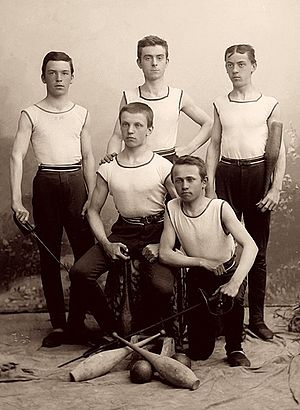
The first Sokol worked to develop new Czech terminology for the training exercises, which centered on marching
Marching
See also: Loaded marchMarching refers to the organized, uniformed, steady and rhythmic walking forward, usually associated with military troops.Marching is often performed to march music, and often associated with military parades....
drills, fencing
Fencing
Fencing, which is also known as modern fencing to distinguish it from historical fencing, is a family of combat sports using bladed weapons.Fencing is one of four sports which have been featured at every one of the modern Olympic Games...
, and weightlifting
Weight training
Weight training is a common type of strength training for developing the strength and size of skeletal muscles. It uses the weight force of gravity to oppose the force generated by muscle through concentric or eccentric contraction...
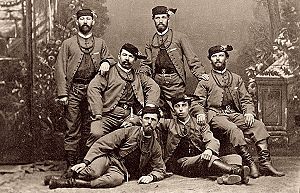
. They designed a uniform that was a mélange of Slavic and revolutionary influences: brown Russian pants, a Polish revolutionary jacket, a Montenegrin
Montenegro
Montenegro Montenegrin: Crna Gora Црна Гора , meaning "Black Mountain") is a country located in Southeastern Europe. It has a coast on the Adriatic Sea to the south-west and is bordered by Croatia to the west, Bosnia and Herzegovina to the northwest, Serbia to the northeast and Albania to the...
cap, and a red Garibaldi shirt. A Sokol flag, red with a white falcon, was designed by the writer Karolína Světlá
Karolína Svetlá
Karolina Světlá was a Czech female author of the 19th century. She was a representative to the literary May School. She married Professor Petr Mužák in 1852, who had taught her music. She also had an affair with Jan Neruda. She introduced Eliška Krásnohorská to literature and feminism...
(and painted by known Czech artist Josef Mánes
Josef Mánes
Josef Mánes was a Czech painter.He was taught by his father, Antonín Mánes , who was a landscape painter and the professor of arts; in addition, he was the nephew of Václav Mánes, and brother of Quido Mánes and Amalie Mánesová, all of whom were also painters...
).
The Prague Sokol initially drew its leaders from the ranks of politicians and its members from the petite bourgeoisie
Petite bourgeoisie
Petit-bourgeois or petty bourgeois is a term that originally referred to the members of the lower middle social classes in the 18th and early 19th centuries...
and the working classes. The first president was Jindřich Fügner, an ethnic German who was a member of the Czech cause. Most founders were also members of the Young Czechs party, the most influential including Prince Rudolf von Thurn-Taxis, Josef Barák, and Julius and Eduard Grégr. The authorities of Austria-Hungary
Austria-Hungary
Austria-Hungary , more formally known as the Kingdoms and Lands Represented in the Imperial Council and the Lands of the Holy Hungarian Crown of Saint Stephen, was a constitutional monarchic union between the crowns of the Austrian Empire and the Kingdom of Hungary in...
kept a continually close eye on the movement, but the reputation and prestige of the Sokol continued to grow; soon the Sokol members were known by most as the "Czech national army".
1860s and 1870s: Initial growth, militarization, and internal problems
Within the first year the Sokols expanded beyond Prague, first into the MoraviaMoravia
Moravia is a historical region in Central Europe in the east of the Czech Republic, and one of the former Czech lands, together with Bohemia and Silesia. It takes its name from the Morava River which rises in the northwest of the region...
and the Slovenian regions of the Habsburg empire. Initially the majority of members were students and professionals, but over time there was a trend towards increasingly working class members.
The Sokol training went through periods of greater militarized training, during the Austro-Prussian War
Austro-Prussian War
The Austro-Prussian War was a war fought in 1866 between the German Confederation under the leadership of the Austrian Empire and its German allies on one side and the Kingdom of Prussia with its German allies and Italy on the...
in 1866, when Sokol members were hired as guards for public events. This militaristic side of the Sokol movement continued to resurface throughout its history.
The internal issues that were to plague the Sokol movement over the years emerged almost immediately. These internal arguments reached fruition during the 1870s with the power struggle in leadership between the members of Old Czechs and the Young Czechs parties. Theoretically, the Sokol was a society “above politics.” Always flamboyantly nationalistic, the more conservative members of the Sokol argued that the organization should maintain its distance from politics while the Young Czech members advocated more direct political participation. Theoretically, the Sokol was also open equally to members of all classes. The informal “thou” (ty) was used by all members, but there were constant arguments over whether this was necessary or not. Different leaders believed that the Sokol was a mass-based institution defined by its working class members, while others viewed it more as a middle class apparatus by which to educate and raise the national consciousness of the working classes.
1880s: Slets, Union, and the French
In 1882, the first slet was held. Slet came from the Czech word for "a flocking of birds" (Czech plural: slety). The same word is, of course, available in other Slavic populated regions. It meant a mass gymnasticsMass games
Mass games or mass gymnastics are a form of performing arts or gymnastics in which large numbers of performers take part in a highly regimented performance that emphasizes group dynamics rather than individual prowess.-Methods:...
(1572 Sokols) festival that became a grand tradition within the Sokol movement that spread across the Central Europe together with other Slavic movements such as the political Pan-Slavism
Pan-Slavism
Pan-Slavism was a movement in the mid-19th century aimed at unity of all the Slavic peoples. The main focus was in the Balkans where the South Slavs had been ruled for centuries by other empires, Byzantine Empire, Austria-Hungary, the Ottoman Empire, and Venice...
. This first one and the following Slets included an elaborate welcoming ceremony at the train station, mass demonstrations, gymnastics competitions, speeches, and theatrical events, open to members of all Sokols.
In 1887 the Habsburg authorities finally allowed, after over twenty years worth of proposals, the formation of a union of Sokol clubs – Czech Sokol Community (Česká obec sokolská, ČOS). The union centralized all the Sokols in the Czech lands
Czech lands
Czech lands is an auxiliary term used mainly to describe the combination of Bohemia, Moravia and Czech Silesia. Today, those three historic provinces compose the Czech Republic. The Czech lands had been settled by the Celts , then later by various Germanic tribes until the beginning of 7th...
and sent missionary Sokol trainers to the rest of the Slavic world to found Sokol institutions in Kraków
Kraków
Kraków also Krakow, or Cracow , is the second largest and one of the oldest cities in Poland. Situated on the Vistula River in the Lesser Poland region, the city dates back to the 7th century. Kraków has traditionally been one of the leading centres of Polish academic, cultural, and artistic life...
, Ljubljana
Ljubljana
Ljubljana is the capital of Slovenia and its largest city. It is the centre of the City Municipality of Ljubljana. It is located in the centre of the country in the Ljubljana Basin, and is a mid-sized city of some 270,000 inhabitants...
, Zagreb
Zagreb
Zagreb is the capital and the largest city of the Republic of Croatia. It is in the northwest of the country, along the Sava river, at the southern slopes of the Medvednica mountain. Zagreb lies at an elevation of approximately above sea level. According to the last official census, Zagreb's city...
, and even Russian Empire
Russian Empire
The Russian Empire was a state that existed from 1721 until the Russian Revolution of 1917. It was the successor to the Tsardom of Russia and the predecessor of the Soviet Union...
(mostly the Ukrainian lands).
In 1889, though officially forbidden by the authorities, members of the Prague Sokol went to the World's Fair
Exposition Universelle (1889)
The Exposition Universelle of 1889 was a World's Fair held in Paris, France from 6 May to 31 October 1889.It was held during the year of the 100th anniversary of the storming of the Bastille, an event traditionally considered as the symbol for the beginning of the French Revolution...
in Paris
Paris
Paris is the capital and largest city in France, situated on the river Seine, in northern France, at the heart of the Île-de-France region...
. There they won several medals and established strong connections with the French gymnasts and French public. The Sokols have been credited with establishing the beginning of the strong French sympathy for the Czechs and their subsequent political alliances on this trip.
1890s: The progressive era
The 1890s were a progressive era for the Sokols. In order to encourage a wider range of participation, the Sokols reformed their programs, offering training sessions of varying intensities, extending their libraries, emphasizing the educational aspect of training, and starting programs for adolescents, youth, and women. There was an increasing focus on mass-based ideology and working class egalitarianism under the leadership of the Young Czechs, namely Jan Podlipný, who was also the mayor of Prague 1897–1900.The second Slet was held in 1891 (over 5,000 Sokols) and the third one soon afterwards in 1895. At this third Slet the congress of the Sokol union laid out its progressive new trajectory in the St. Wenceslas Day (September 28) Resolutions. The leaders chose to continue to provide more accessible forms of training, with less focus on competition and more on an egalitarian idea of people’s gymnastics, balancing mental as well as physical education.
1900–1914: Competitors and neo-Slavism
The rise of the Social Democrats and Agrarian Parties in the political arena played out in Sokol politics as well as national ones. The Social Democrats formed a rival gymnastics society, the Workers' Gymnastics Club, (Dělnická tělovýchovná jednota, DTJ). Most Sokol leaders aligned with the Czech National SocialistsCzech National Social Party
Czech National Social Party was a civic nationalist political party established in 1898 within the Young Czech Party as a nominally socialist group with a stress on achieving Czech independence from Austria–Hungary Czech National Social Party (Czech: Česká strana národně sociální) was a civic...
after the decline of the Young Czech party, and attacked the Social Democrats as “Germans” and “Jews” opposed to the true Czech cause. Václav Kukař, a powerful ČOS figure, developed the policy of "cleansing" (očištění) and sought to limit membership to those who he believed demonstrated commitment to purely Czech causes. Most of the progressive members of the Sokols were purged or left voluntarily to join the DTJ. Another rival gymnast society was founded by the Christian-Socialist party under the name Orel
Orel (movement)
The Orel movement is a Moravia-based Czech youth movement and gymnastics organization which emerged between 1902-1909 as Catholic Church-supported competitor of the nationalistic and therefore, in the local policical context, rather anti-Catholic organization Sokol.A similar organization with the...
("Eagle"). In the face of such competition, the Sokols set about reaffirming their traditional mission under the leadership of Josef Scheiner.
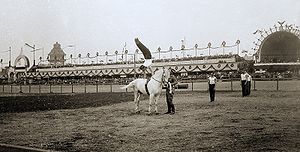
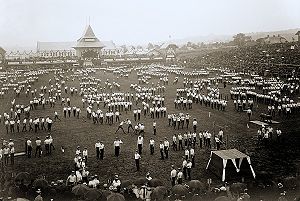
Poles
thumb|right|180px|The state flag of [[Poland]] as used by Polish government and diplomatic authoritiesThe Polish people, or Poles , are a nation indigenous to Poland. They are united by the Polish language, which belongs to the historical Lechitic subgroup of West Slavic languages of Central Europe...
, Slovenes, Croats
Croats
Croats are a South Slavic ethnic group mostly living in Croatia, Bosnia and Herzegovina and nearby countries. There are around 4 million Croats living inside Croatia and up to 4.5 million throughout the rest of the world. Responding to political, social and economic pressure, many Croats have...
, Russians
Russians
The Russian people are an East Slavic ethnic group native to Russia, speaking the Russian language and primarily living in Russia and neighboring countries....
, Bulgarians
Bulgarians
The Bulgarians are a South Slavic nation and ethnic group native to Bulgaria and neighbouring regions. Emigration has resulted in immigrant communities in a number of other countries.-History and ethnogenesis:...
, Serbs
Serbs
The Serbs are a South Slavic ethnic group of the Balkans and southern Central Europe. Serbs are located mainly in Serbia, Montenegro and Bosnia and Herzegovina, and form a sizable minority in Croatia, the Republic of Macedonia and Slovenia. Likewise, Serbs are an officially recognized minority in...
, as well as Frenchmen and Americans
United States
The United States of America is a federal constitutional republic comprising fifty states and a federal district...
. This Slet also marked the first appearance of women who grew to be a major part of Sokol members in the following decades.
The fifth Slet, held in 1907 (over 12,000 Sokols), had an increasingly Slavic focus and moved away from the more egalitarian idea of people's gymnastics with increased competition aspects. It marked the creation of the Federation of Slavic Sokols under the neo-Slavic idea of the Czechs as the strongest Slavic nation, second only to Russia.
At the 1910 meeting of the ČOS congress the sokols reaffirmed their intentions to remain "above politics” and loosened their strict membership rules to allow Social Democrats, though still not clericals, into the sokols.
In 1912, the first "All-Slavic Slet" (Všeslovanský slet, over 30,000 Sokols) was held with a largely military atmosphere, causing Augustin Očenášek (a member of Sokol) to remark, "When the thunder comes and the nations rise up to defend their existence, let it be the Sokol clubs from which the cry to battle will sound..." (Nolte, p78). The cry to battle did sound two years later, when the first rumors of Franz Ferdinand
Archduke Franz Ferdinand of Austria
Franz Ferdinand was an Archduke of Austria-Este, Austro-Hungarian and Royal Prince of Hungary and of Bohemia, and from 1889 until his death, heir presumptive to the Austro-Hungarian throne. His assassination in Sarajevo precipitated Austria-Hungary's declaration of war against Serbia...
's assassination reached the Sokol members, most of whom were attending a regional Slet in Brno
Brno
Brno by population and area is the second largest city in the Czech Republic, the largest Moravian city, and the historical capital city of the Margraviate of Moravia. Brno is the administrative centre of the South Moravian Region where it forms a separate district Brno-City District...
.
World War I to Communism: Continued struggle of Czech nationalism
With the onset of World War IWorld War I
World War I , which was predominantly called the World War or the Great War from its occurrence until 1939, and the First World War or World War I thereafter, was a major war centred in Europe that began on 28 July 1914 and lasted until 11 November 1918...
, in 1915 the Sokols were officially disbanded. Many members were active in persuading the Czechs to defect from the Austro-Hungarian army to the Russian side. Sokol members also helped create the Czechoslovak Legions and local patrols that kept order after the disintegration of Habsburg authority, and during the creation of Czechoslovakia in October 1918. They also fulfilled their title as the "Czech national army", helping to defend Slovakia
Slovakia
The Slovak Republic is a landlocked state in Central Europe. It has a population of over five million and an area of about . Slovakia is bordered by the Czech Republic and Austria to the west, Poland to the north, Ukraine to the east and Hungary to the south...
against the invasion of Béla Kun
Béla Kun
Béla Kun , born Béla Kohn, was a Hungarian Communist politician and a Bolshevik Revolutionary who led the Hungarian Soviet Republic in 1919.- Early life :...
and the Hungarians.
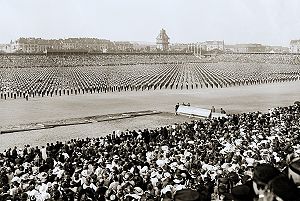
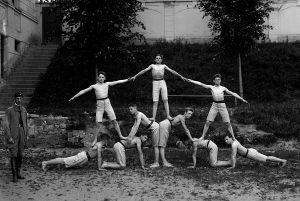
Munich Agreement
The Munich Pact was an agreement permitting the Nazi German annexation of Czechoslovakia's Sudetenland. The Sudetenland were areas along Czech borders, mainly inhabited by ethnic Germans. The agreement was negotiated at a conference held in Munich, Germany, among the major powers of Europe without...
of 1938 and were later brutally suppressed and banned during the Nazi occupation of Bohemia and Moravia.
After World War II
World War II
World War II, or the Second World War , was a global conflict lasting from 1939 to 1945, involving most of the world's nations—including all of the great powers—eventually forming two opposing military alliances: the Allies and the Axis...
they held one more Slet in 1948 before they were once again suppressed, this time by the Communists. The Communist Party tried to replace tradition of Slets with mass exercises employed for propaganda purposes: Spartakiad
Spartakiad (Czechoslovakia)
thumb|Spartakiad in 1960The Spartakiads in Czechoslovakia were mass physical exercise events. They were arranged by the Communist government as a replacement of the Sokol gatherings disapproved by the regime...
(spartakiády).
The Sokols reappeared briefly during the Prague Spring
Prague Spring
The Prague Spring was a period of political liberalization in Czechoslovakia during the era of its domination by the Soviet Union after World War II...
of 1968. After years of hibernation, Sokol was revived for the fourth time in 1990; a Slet was in 1994 (23,000 Sokols participating), after the fall of Communism
Velvet Revolution
The Velvet Revolution or Gentle Revolution was a non-violent revolution in Czechoslovakia that took place from November 17 – December 29, 1989...
. Presently, the organization focuses on physical training in gymnastics and other athletics. Its popularity is, however, well below pre-war levels and a large percentage of members are older people with memories of the pre-1948 Sokol movement. A further Slet was held in 2000 (25,000 Sokols); another was held in July 2006.
Sokol Abroad
Members of Sokol who emigrated from Czechoslovakia set up small Sokol groups abroad. This Sokol migration, for a variety of reasons, began even before Czechoslovakia became a nation in 1918, intensified as a result of the World Wars and the Communist suppression, and continues to this day. Bohemian, Moravian, and Slovak immigrants and Czech-American citizens started the American Sokol Organization in St. Louis Missouri in 1865, only three years after the first Prague Sokol. Units quickly formed and by 1878, the United States had 13 Sokol chapters. By 1937, American Sokol membership rolls counted nearly 20,000 adults in areas as far-flung as New York City, New Jersey, Pennsylvania, Chicago, Cleveland, Iowa, Minnesota, Nebraska, Oklahoma, St. Louis, Texas and parts of Canada.Expansion
PionýrPionýr
Pionýr is a Czech-based voluntary, independent and political movement of children, youth and adult people. It focuses on non-formal, educational activities and is organised during leisure time...
, which had under communism been a part of the Socialist Union of Youth is nowadays a non-political organization organizing leisure time for children, part of the International Falcon Movement - Socialist Education International.
At the beginning of the twentieth century the Sokol movement was introduced in Catalonia
Catalonia
Catalonia is an autonomous community in northeastern Spain, with the official status of a "nationality" of Spain. Catalonia comprises four provinces: Barcelona, Girona, Lleida, and Tarragona. Its capital and largest city is Barcelona. Catalonia covers an area of 32,114 km² and has an...
and soon was considered as a new tradition. It bore the name of falcó
Falco
- People :* Albert Falco, diving companions of Jacques Cousteau, Chief Diver and later Captain of the RV Calypso* Falco , Austrian pop/rock star* Quintus Pompeius Falco, Roman governor of Britannia* Domenico Falco, Italian footballer...
(hawk
Hawk
The term hawk can be used in several ways:* In strict usage in Australia and Africa, to mean any of the species in the subfamily Accipitrinae, which comprises the genera Accipiter, Micronisus, Melierax, Urotriorchis and Megatriorchis. The large and widespread Accipiter genus includes goshawks,...
in Catalan
Catalan language
Catalan is a Romance language, the national and only official language of Andorra and a co-official language in the Spanish autonomous communities of Catalonia, the Balearic Islands and Valencian Community, where it is known as Valencian , as well as in the city of Alghero, on the Italian island...
) and was influenced by the older tradition of the castellers.
See also
- Sokol in Poland
- Sokol AuditoriumSokol AuditoriumThe Sokol Auditorium is located at 2234 South 13th Street in the Little Bohemia neighborhood of south Omaha, Nebraska. It is a local icon for its historical context, as well as modern musical performances and gymnastics....
- Sokol PavilionSokol PavilionThe Sokol Pavilion, also known as Sokol Auditorium, is an historic building in Wilber, Nebraska, that was built in 1930. It was listed on the National Register of Historic Places on September 14, 1995. The building historically served as a host for Sokol gymnastic events and as a meeting hall for...
- Pan-SlavismPan-SlavismPan-Slavism was a movement in the mid-19th century aimed at unity of all the Slavic peoples. The main focus was in the Balkans where the South Slavs had been ruled for centuries by other empires, Byzantine Empire, Austria-Hungary, the Ottoman Empire, and Venice...
- Mass gamesMass gamesMass games or mass gymnastics are a form of performing arts or gymnastics in which large numbers of performers take part in a highly regimented performance that emphasizes group dynamics rather than individual prowess.-Methods:...
External links
- Česká obec sokolská – official webpage of the Czech Sokol Community
- Slovak Catholic Sokol – official webpage of the largest active Slovak Sokols in USA
- Pittsburgh's Slovak Catholic Sokol
- American Sokol Educational and Physical Culture Organization – official webpage of the US Sokols
- Sokolska knjižnica – Sokol Library (Serbian/Yugoslav) at Project Rastko page
- The Sokol Movement – an article on American-Czech Educational Center webpage
- Sokol – Our Czech Heritage – an article on SVU (Czechoslovak Society of Arts and Sciences) webpages
- Sokol Cleveland – in Encyclopedia of Cleveland History
- Historical photographs of Sokol by Šechtl and Voseček studios
- Sokol postcards